Technology (IJRASET)
A Simulation Approach to Improve Performance in
Foundry Industry
Digvijay B. Sutar1, B. R. Jadhav2
1
Student, Department of Mechanical Engineering, Rajarambapu Institute of technology, Rajaramnagar, Islampur, (India)
2
Asso.Professor, Department of Mechanical Engineering, Rajarambapu Institute of technology, Rajaramnagar, Islampur, (India)
Abstract: It is possible to evaluate production system performance measurement and organizational alternative structures with dynamic simulation methods for efficiency of cost and productivity. The parameters which are vary for different organizational structures and scope of production systems are examined in a mutual simulation-based performance measurement system. In general, the simulation-based performance measurement criteria are lead time, lead time deviation, utilization rate, and work-in-process as goal achievements of logistics and delivery rate in performance evaluation module. Lean manufacturing is often seen as a set of tools that reduce the total cost and improve the quality of manufactured products.The foundry industry, as well as manufacturing in general, has significant challenges in the current regulatory and political climate with developing an economically and environmentally sustainable business model.
Keywords:Manufacturing Performances, Simulation, WITNESS, Lean manufacturing.
I. INTRODUCTION
The placement of the facilities in the plant area, often referred to as ‘‘facility layout problem’’, is known to have a significant impact upon manufacturing costs, work in process, lead times and productivity. A good placement of facilities contributes to the overall efficiency of operations and can reduce until 50% the total operating expenses. Machining lines are widely used in automotive and other industries. They are expensive with heavy investments in their installation and implementation. This investment influences to a great extent the cost of the finished products. Therefore, machining line manufacturers are increasingly interested in the optimization of the line design process. The objective is to minimize some criteria such as the total investment cost, total number of workstations, cost of operations (tool, men power, energy, etc.), or the cycle time. Lean manufacturing is “systematic approach for identifying and eliminating waste through continuous improvement by flowing the product at the pull of customer in pursuit of perfection”. Lean manufacturing concepts are mostly applied in industries where more repetitive human resources are used. In these industries productivity is highly influenced by the efficiency of working people with tools or operating equipments. To eliminate waste, it is important to understand exactly what it is and where it exists. The main tools of a lean manufacturing are Value Stream
Mapping, 5S, Total Productive Maintenance (TPM), Single Minute Exchange of Dies (SMED), Kaizen, Kanban, and 6σ. Each of
these tools focuses on certain aspects and areas of the manufacturing process in order to increase productivity through a proper utilization of man and machine. Foundry industry faces many problems such as poor quality and poor productivity due to the large number of process parameters. Foundries finding many difficulty in producing high quality casting and schedule given by the buyers company. Casting defects result in increased unit cost and machining of shop floor personnel.
II. LITERATURE REVIEW
Stefan Bock et al. (2007) have studied detail layout planning for irregularly-shaped machines with transportation path design. Research addresses layout planning problems. Research introduces an integrated approach which allows a more detailed layout planning by simultaneously determining machine arrangement and transportation paths.
Pierre E.C. Johansson (2013)discussed Current State of Standardized Work in Automotive Industry in Sweden. His Work more focuses on how to implement standardized work in global organizations focusing on local demands and cultural differences and similarities. Standardized work contains a different way of thinking which motivates the entire organization to work more efficient and deliver a higher quality at lower cost.
Technology (IJRASET)
From the literature review it is found that various lean manufacturing tools are used to focuses on certain aspects and areas of the manufacturing process in order to increase productivity by proper utilization of man and machine. lean manufacturing tools are widely used such as just in time manufacturing, kanban cards, kaizen, 5S + safety, value stream mapping (VSM), waste elimination for better performance of manufacturing processes.
III. PROPOSED METHODOLOGY
A. Study and collection of the data regarding existing layouts, parts and machines.
B. Conducted Time Study
C. Drawn Current layout in AutoCAD for analyzing material movement and to identify problems.
D. Performance simulation of the current layouts using WITNESS software to find machine utilization.
E. Comparison between current and proposed simulation results.
F. Planning for machines combination.
G. Planning for material handling.
H. Different alternative options were created in stimulation and suggested to the company.
I. Company management will select the most suitable option.
J. Implimentation.after which is results will be studied and recommendation will be made for further improvements.
IV. STUDY AND DATA COLLECTION OF EXISTING LAYOUT
Basic input data for layout
planning;-P-product or material, including variation and characteristics Q-quantity or volume of each variety or item
R-routing or process; the operations, their sequence, and the process machinery S-services or supporting activities
T-time.
This work is carried out in foundry which manufactures various types of automotive parts. Mainly ventilated brake discs are manufactured in large quantity. So that product is selected.
P-product or material:-
Part name: Pressure plate 7300
Material used: Specimen grade cast iron ss : 4404
Weight : 8.25 kg.
[image:3.612.198.415.560.723.2]V. CURRENT LAYOUT SIMULATION
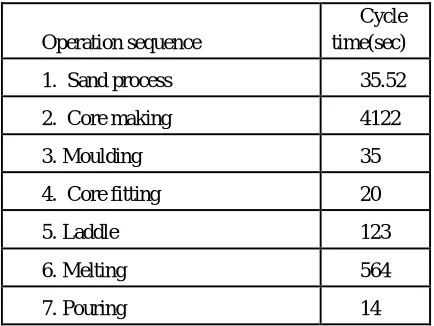
Table 1. Operation Sequence and cycle time for Pressure plate 7300
Operation sequence
Cycle time(sec)
1. Sand process 35.52
2. Core making 4122
3. Moulding 35
4. Core fitting 20
5. Laddle 123
6. Melting 564
Technology (IJRASET)
8. Auto mold handling 55
9. Shake out 3410
10.Removal of runner and riser 40
11.Shot blasting 60
12.Fettling 180
13.Painting 800
14.Inspection and testing 3360
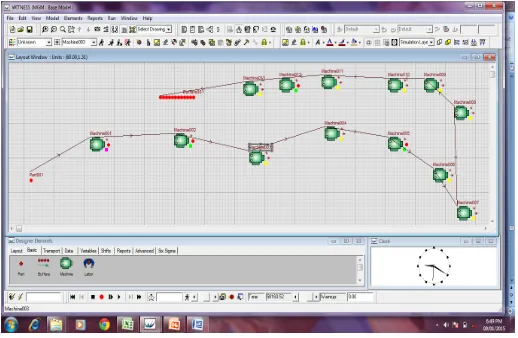
In this WITNESS simulation software, many small models were generated for the study purpose which becomes helpful to generate this model. The model created using the WITNESS simulation software.
[image:4.612.161.528.57.210.2]The elements used in this model are Part, Machine and buffer are as below:
Fig.1 Current model created for the simulation
Part: The red colored small dot indicates the ‘Part’. It can be created by right click of your mouse on Designer (Default) option in ‘Element’ Window, which is at right side of the Witness window. We can use more than one part in one model. We can give the different color to different parts. We can check the Statistical data after the run. The Part is indicated as P1.
Machines: This is another important element in the model. With the similar way of part, we can create the machine. In this machine, we can adjust the Setup time, machine downtime, the cycle time etc. here in this model, only the Setup time is used as input parameter. Other options are not considered. The machines are indicated as M1, M2, M3, M4, M5, M6 to Machine013.
In this Created model, the different notations are used. These are as follows.
1] Machines: M1, M2, M3, M4, M5, M6 and Machine013
2] Part: P1.
Table 2. Simultion result
Report by on shift time
Machine
% Idle
% Busy
% Blocked
[image:4.612.177.436.275.444.2]Technology (IJRASET)
VI. PROBLEMS IN CURRENT LAYOUT
In-effective utilization of recourses (machines idle time is high i.e 70.21 %)
Excessive stock in process at the factory as well as in traveling. At the core making process machine is busy for long time i.e 99.01%
VII. DEVELOPMENT OF SIMULATION MODEL
Firstly considering there is single machine for each operation and modeling is done in WITNESS software. It is based on following assumptions
A. Assumptions
1) Machines need to be setup before each operation.
2) Machines do not breakdown during processing.
3) For parts, First-In-First-Out (FIFO) rule is applied.
4) Parts movement from one machine to other is done by using conveyor
5) The model is flexible and new element can be easily add or remove.
The screenshot of the model created for first run using WITNESS Simulation software is shown below figure
Fig.2. Developed model created for the simulation Moulding and core
fitting
98.68 1.32 0.00
Laddle 97.04 2.96 0.00
Melting 86.98 13.02 0.00
Pouring 99.69 0.31 0.00
Auto mold handling 98.77 1.23 0.00
Shake out 23.78 76.22 0.00
Removal of runner and riser
99.11 0.89 0.00
Shot blasting 98.66 1.34 0.00
Fettling 95.98 4.02 0.00
Painting 83.43 16.57 0.00
Inspection and testing 30.67 69.33 0.00
Technology (IJRASET)
Table 3. Simulation result by adding bufferReport by on shift time
Machine % Idle % Busy % Blocked
Sand process 1.33 98.67 0.00
Core making 0.11 99.89 0.00
Moulding and core fitting 98.83 1.17 0.00
Laddle 97.38 2.62 0.00
Melting 88.00 12.00 0.00
Pouring 99.70 0.30 0.00
Auto mold handling 98.83 1.17 0.00
Shake out and removal runner ,riser.
28.08 71.92 0.00
Shot blasting 98.18 1.82 0.00
Fettling 96.72 3.28 0.00
Painting 85.41 14.59 0.00
Inspection and testing 40.33 59.67 0.00
Total 65.39 28.23 0
VIII. CONCLUSION
With the help of WITNESS Simulation software, the model is created and runs are taken. From the WITNESS Simulation software, the output data collected. By adding buffer in previous model, it is found that machine idle time is reduced by 4.82% and core making machine busy time is also reduced.
REFERENCES
[1] Stefan Bock, Kai Hoberg, “Detailed layout planning for irregularly-shaped machines with transportation path design” European Journal of Operational Research 177 (2007) 693–718.
[2] Rahani AR, Muhammad al-Ashraf, “Production Flow Analysis through Value Stream Mapping: A Lean Manufacturing Process Case Study” Procedia Engineering 41 (2012) 1727 – 1734.
[3] Pierre E. C. Johansson et al. “Current State of Standardized Work in Automotive Industry in Sweden” Procedia CIRP 7 (2013) 151 – 156N.
[4] R. M. Belokar, Yashveer Dhull, Surender Nain, Sudhir Nain, “Optimization of Time by Elimination of Unproductive Activities through ‘MOST’” International Journal of Innovative Technology and Exploring Engineering (IJITEE), June 2012.
[5] Ivica Veža et al. “Lean Manufacturing Implementation Problems in Beverage Production Systems” International Journal of Industrial Engineering and Management (IJIEM), Vol. 2 No 1, 2011, pp. 21-26.