Technology (IJRASET)
©IJRASET 2015: All Rights are Reserved
260
Application of Fuzzy Logic for Evaluation of
Academic Performance of Students of Computer
Application Course
Meenakshi1, Pankaj Nagar2 1
Jagannath International Management School,Guru Gobind Singh Indraprastha University,New Delhi, INDIA
2
Statistics Department,University of Rajasthan, Jaipur, INDIA
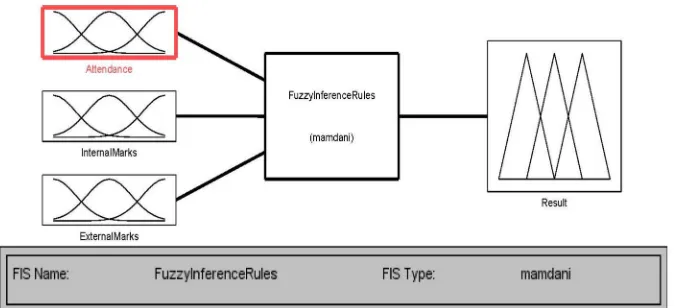
Abstract— Institutes evaluate students’ academic performance through a conventional evaluation system which is framed by the institutes under educational policies and/or the institutional rules and regulations. This research study proposes a new fuzzy logic based performance evaluation method. In this method, we consider three parameters attendance, internal marks and external marks which are considered to evaluate students in an IT related undergraduate course. Then an expert system using fuzzy logic based on Mamdani technique has been designed and tested on a real sample and the two results have been compared.
Keywords— Academic Performance evaluation, fuzzy logic technique, Students Performance, expert system, IT course
I. INTRODUCTION
Students’ academic success is evaluated by their performance in exams conducted by the institutes or Universities. Considering the high demand of IT professionals and the gap between academia and IT Industry it is important that we must explore the possibilities of automated system which can effectively evaluate the performance of students in computer science and IT related courses. The authors had proposed an expert system using fuzzy logic in another paper[1].In this paper the system has been tested for real data of third year students of a computer application course(BCA) for the subject Linux. The result generated by the expert system is then compared with the result of the convention method to test the difference in the result of two systems.
II. LITERATURE REVIEW
For last few years, fuzzy logic theory is being used in the education system. Implementation of the fuzzy logic for various activities of assessment of students’ performance such as evaluation of answer scripts of students in an examination [2][3][4], evaluation of lab examination [5][6], projects evaluation [7] and many more. Fuzzy rules have been developed to check how fuzzy rules can be used to model and evaluate the achievement of the learning outcomes in information systems courses[8]. It was proposed to use of the fuzzy set technique to be applied in the evaluation process of the industrial automation systems learning area, which aimed to lessen the evaluation complexity and ambiguity[9].Neural fuzzy sets containing fuzzy linguistic constructors in rule and query expressions and logical statements were developed, to model the structure of fuzzy linguistic expressions [10]. It has also been investigated whether use of fuzzy logic is suitable for the resolutions of achieving fair assessment. To apply fuzzy logic along with standard numerical grading, a case study was carried out for a poster competition for postgraduates. It was observed that that this fuzzy logic based grading method has many advantages over the traditional method [11]. The outperformance of a Fuzzy Probabilistic Neural Network model to predict personalized student performance was observed in comparison to traditional statistical models as well as traditional back-propagation neural networks [12]. An approach based on fuzzy set was presented to evaluate the results of student-centered learning where there was participation of students to determine the criteria for assessment with their weightage [13]. It was also found in another study that the evaluation with Fuzzy Logic renders great flexibility and robustness in the evaluation process [14]. A dynamic automated converter of crisp set into fuzzy set based on C-Means clustering algorithm was developed and tested. This system has the capabilities to handle imprecise and missing data [15].The fuzzy inference system has also been used to obtain Performance of Students for different input values of Teaching Effectiveness, Student Attendance, and other Facilities [16].
Technology (IJRASET)
©IJRASET 2015: All Rights are Reserved
261
of India and test the results for the students of undergraduate IT related courses.
III. METHODOLOGY
The fuzzy expert system designed by the authors is explained as below The fuzzy logic model comprises of following stages:
A. Crisp Value (Data)
The values for input variables may be collected from the records of the students’ end term result with
[image:3.612.189.424.233.318.2]internal assessment (f1), external Assessment (f2) and overall attendance of the Semester (f3) shown in Table I
TABLE I.INPUT VARIABLES (ELEMENTS) OF THE PROPOSED EVALUATION MODEL
Input Variables
Criteria
f1 Student’s Attendance
f2 Internal Marks
f3 External Marks
(Term Examination)
B. Fuzzification (Fuzzy Input Value)
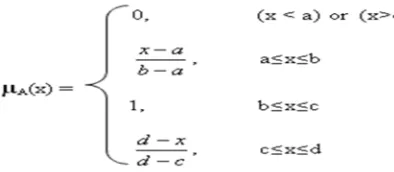
Fuzzification of three input variables (elements) is done by using variable which are similar to verbal human language such as average, good, very good, excellent etc.. Then each input variable is assigned a trapezoidal Membership function, defined by a lower limit ‘a’, an upper limit ‘d’, a lower support limit ‘b’, and an upper support limit ‘c’, where a < b < c < d, for the degree of association for respective linguistic variables is represented in eqn.(1).
The process of fuzzification of the three input variable is as follows
1) Fuzzification of Input Variable Students 'Attendance: The Students’ attendance in the subject Linux was taken every day in each lecture. The percentage of attendance is calculated from the number of classes attended by the students in the subject throughout one term of four months.
TABLE. II.CALCULATION OF CRISP VALUES OF STUDENTS’ ATTENDANCE
S.No. Month Subject
Students Monthly attendance
(%)
Overall Students Attendance%
(1) (2) (3) (4) (5)
1 M1 S1 A1 Avg.of
Col.4
2 M2 A2
3 M3 A3
[image:3.612.184.381.412.498.2]Technology (IJRASET)
©IJRASET 2015: All Rights are Reserved
262
TABLE III.STUDENTS’ ATTENDANCE IN TERMS OF LINGUISTIC VARIABLES
Student Attendance
Poor Average Good Very Good
Excellent
f1 <50 50-54.9 55-64.9 65-75 >75
[image:4.612.141.441.176.295.2]Membership Function of the input variable Students Attendance (f1) is shown in Fig.1.
Fig.1 Membership function of input variable Attendance (f1)
2) Fuzzification of Input Variable Internal Marks
TABLE IV.CALCULATIONS OF CRISP VALUES OF INTERNAL MARKS
Sr. No.
Subject Assignment Marks
TestMarks Internal Marks
(1) (2) (3) (4) (5)
1 S1 A1 f21 Avg.of
Col.3 & 4
2 A2 f22
TABLE V INTERNAL MARKS IN TERMS OF LINGUISTIC VARIABLES
Internal Marks Poor Average Good Very Excellent
f2 <50 50-59.9 60-69.9 70-79.9 >80
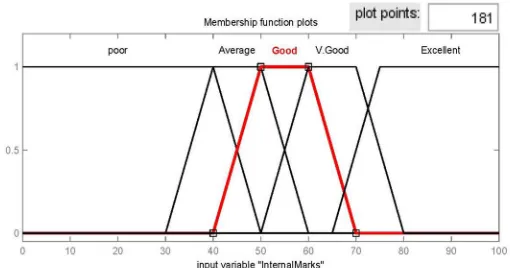
[image:4.612.166.421.567.701.2]Membership Function of the input variable Internal Marks (f2) is shown in Fig.2
Technology (IJRASET)
©IJRASET 2015: All Rights are Reserved
263
3) Fuzzification of Input Variable External Marks
[image:5.612.209.403.148.202.2]After the end of the term, final exam is conducted for all subjects. The crisp value of external marks in Linux
TABLE VI CALCULATION OF CRISP VALUE OF EXTERNAL MARKS
Sr. No. Subject External Marks (1) (2) (3)
1 S1 f31
TABLEVII.RANGE FOR LINGUISTIC VARIABLES OF THE EXTERNAL MARKS FOR FUZZY INPUT F3
External Marks
Poor Average Good Very Good
Excellent
f3 <50 50-59.9 60-69.9 70-79.9 >80
[image:5.612.144.437.322.451.2]Membership Function of the input variable Internal Marks (f3) is shown in Fig.3
Fig.3.Membership function of input variable External Marks (f3)
C. Development of Fuzzy Rule and Inference Mechanism
[image:5.612.129.467.541.695.2]To relate the inputs and output membership functions, fuzzy inference rules are used in inference process. These linguistics rules use “IF-THEN” statements. These rule are flexible and can be formulated depending upon the importance to be given to a particular input with the discussion with the academic experts.
Technology (IJRASET)
©IJRASET 2015: All Rights are Reserved
264
Table VIII represents the rules for the three inputs and corresponding output
TABLEVIII CONSTRUCTION OF FUZZY INFERENCE RULES S.No. Attendance
f1
Internal Marks f2
External Marks
f3
Final Result (Output) F
1 Poor Poor Poor Poor 2 Poor Poor Average Poor 3 Poor Poor Good Average 4 Poor Poor V.Good Average 5 Poor V.Good Good Good 6 Poor Average Poor Poor 7 Poor Average Average Average 8 Poor Average Good Average 9 Poor Good Good Good 10 Poor Good Excellent V.Good 11 Average Good Average Average 12 Average Good Good Good 13 Average Good V.Good Good 14 Average V.Good V.Good V.Good 15 Average Excellent Average Good 16 Average Average Average Average 17 Average Poor Poor Poor 18 Average Good Poor Average 19 Good Average Average Average 20 Good Excellent Excellent V.Good 21 Good Average Good Good 22 Good Poor Poor Poor 23 V.Good V.Good Excellent V.Good 24 V.Good V.Good V.Good V.Good 25 V.Good Poor Poor Poor 26 V.Good V.Good Good V.Good 27 V.Good Excellent Excellent Excellent 28 Excellent V.Good Excellent V.Good 29 Excellent Average Average V.Good 30 Excellent V.Good Average Good 31 Excellent Good Average Good 32 Excellent Poor Poor Poor 33 Excellent Poor Average Average 34 Excellent Average Poor Poor 35 Excellent Poor Good Good 36 Excellent Good Poor Average 37 Excellent Poor V.Good V.Good 38 Excellent V.Good Poor Average 39 Excellent Excellent Poor Good 40 Excellent Excellent Average V.Good 41 Excellent Excellent Good V.Good 42 Excellent Excellent V.Good V.Good 43 Excellent Excellent Excellent Excellent
D. Defuzzification Of Fuzzy Output (To Find Out The Final Result With The Help Of Suitable Defuzzification Method)
Technology (IJRASET)
©IJRASET 2015: All Rights are Reserved
265
µF(x)=Maxk [min[µ(f1),µ(f2),µ(f3)]], k=1,2,3,4,...r(2)
This expression expresses the value of membership function for output variable overall performance for active rules for each input. The logical operator AND is used among the three inputs. Similar to the fuzzy linguistic variables of input we have used the linguistic variables for output which have been shown in Table IX
TABLE IX. STUDENTS’ OVERALL PERFORMANCE IN TERMS OF LINGUISTIC VARIABLE
Overall performance
Poor Average Good Very Good Excellent
P < 50 50 ≤ P
<65
65 ≤ P
<75
75 ≤ P <85 ≥85
[image:7.612.124.448.266.396.2]Membership Function of the output variable Overall Performance of a student (P) is shown in Fig. 5
Fig.5.Membership function of students’ overall performance
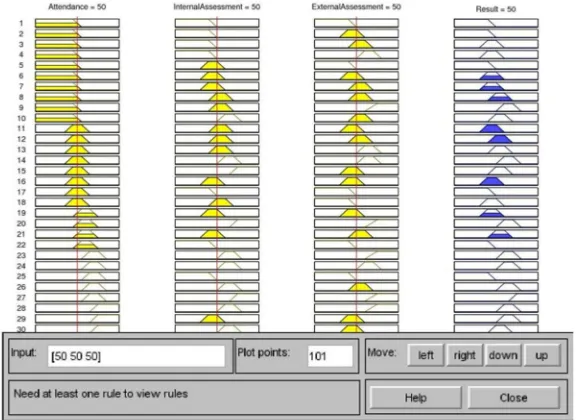
[image:7.612.154.443.450.660.2]Rule viewer of the proposed fuzzy expert system for the evaluation of overall students’ performance is shown in Fig.6
Fig.6. RuleViewerof fuzzyexpertsystem
Technology (IJRASET)
©IJRASET 2015: All Rights are Reserved
266
Fig.7. Surface Viewer of fuzzy expert system with input variables internal marks and external marks.
IV. EXPERIMENT RESULTS
[image:8.612.167.424.88.277.2]In this paper, we have used MATLAB (version R2013a) for implementing proposed fuzzy system for student s’ academic performance evaluation. The proposed Fuzzy Expert system was tested with 54 Student’s term attendance, internal marks and external marks in the subject Linux for one term. The result from the fuzzy expert system along with the final result from conventional method of assessment is shown in Table X. Two sample t-test was also performed on the two results obtained from conventional method and from fuzzy expert system which is shown in Table XI. The null hypothesis considered as that there is no difference in the mean value of two samples.(two results are similar)
Table X COMPARISON OF STUDENT’S PERFORMANCE Marks
Range from
Marks Range to
Frequency Conventional
Method
Fuzzy System
45 50 2 4
51 55 5 2
56 60 4 6
61 65 11 6
66 70 11 16
71 75 15 10
76 80 3 9
81 85 1 0
86 90 1 0
91 95 1 0
96 100 0 1
Table XI t-Test: TWO-SAMPLE ASSUMING EQUAL VARIANCES Statistical
Tools
Conventional Method
Fuzzy Approach Mean 67.46 67.63
Technology (IJRASET)
©IJRASET 2015: All Rights are Reserved
267
Hypothesized Mean Difference
0
df 106
t Stat -0.092140896 P(T<=t) two-tail 0.92676001 t Critical two-tail 1.982597262
V. CONCLUSION
The t-test is conducted using MS Excel. As per value of t test we cannot reject the null hypothesis that two results are similar as p-value of test statistics is 0.927( < 0.975) and the t-statistic is -0.09, which does not fall into the rejection region. In other words, we accept the null hypotheses that means conventional result is equal to the mean fuzzy system result with 95% confidence level. This shows that that the expert system can provide the same results as conventional method. Therefore one can apply computer based Fuzzy System Approach in plane of time consuming conventional method. However, in some cases, the variations in results from fuzzy system have been observed for some students who have same result through conventional method. It was due the difference in their attendance which shows that expert system incorporates input attendance effectively. On the contrary in the conventional system, for a regular course, a student must have mandatory attendance failing to which the student may not be allowed to appear in exams. This shows that the expert system provides flexibility to the inflexible conventional system which is greatly required in present age of technology.
REFERENCES
[1] Narula, M.; Nagar, P., Fuzzy logic based expert system for students' performance evaluation, International Conference on Computing for Sustainable Global Development (INDIACom), 2015 , vol., no., pp.803-808,
URL: http://ieeexplore.ieee.org/stamp/stamp.jsp?tp=&arnumber=7100360&isnumber=7100186
[2] Biswas, R. 1995, Application of fuzzy sets in student’s evaluation, Fuzzy Set and systems, pp. 187-194.
[3] Ibrahim Saleh, Seong-in Kim , A fuzzy system for evaluating students’ learning achievement. s.l. : Expert Systems with Ap plications, 2009. [4] Bakal, Shilpa Ingoley & J.W. 2012, Use of Fuzzy Logic in Evaluating Students’ Learning Achievement, International Journal on Advanced
Computer Engineering and Communication Technology (IJACECT), pp. 47-54.
[5] Rajiv Bhatt, Darshana Bhatt., Fuzzy Logic based Student Performance Evaluation Model for Practical Component of Engineering Institution Subjects, International Journal of Technology and Engineering Education , 2011, Vol. 8.
[6] Maria Samarakou, Andreas Papadakis, PantelisPrentakis, Dimitrios Karolidis, Spyros Athineos, A Fuzzy Model for Enhanced Student Evaluation, s.l. : The International Journal of Learning, Vol. 16.
[7] G.Meenakshi. 2013, An Assessment of Final Year project Using Fuzzy Logic, International Journal of Advanced Research in Computer and Communication Engineering Vol. 2, Issue 9, September 2013, pp. 3392-3394.
[8] Faouzi Bouslama, Azzedine Lansari, Akram Al-Rawi. 2006, Fuzzy Rules In Assessing Student Learning Outcomes, American Society for Engineering Education.
[9] Eduardo André Mossin, Rodrigo Palucci Pantoni and Dennis Brandão (2010), Students’ Evaluation based on Fuzzy Sets Theory, Fuzzy Systems, Ahmad Taher Azar (Ed.), ISBN: 978-953-7619-92-3, InTech, DOI: 10.5772/7225. Available from:
http://www.intechopen.com/books/fuzzy-systems/students-evaluation-based-on-fuzzy-sets-theory
[10] Nykänen, O. 2, Inducing Fuzzy Models for Student Classification., s.l. : Educational Technology & Society, 2006, Vol. 9. 223-234. [11] McLoone, Séamus C. s.l. : ISSC 2012,On Using Fuzzy Logic for Grading Highly Subjective Assessment Material – a Case Study, NUI
Maynooth, June 28-29, 2012.
[12] Nidhi Arora, Jatinder Kumar R. Saini, A Fuzzy Probabilistic Neural Network for Student’s Academic Performance Prediction , s.l. : International Journal of Innovative Research in Science, Engineering and Technology, 2013, Vol. 2. 4425-4432.
[13] Zhou, Jian Ma and Duanning. 2000, Fuzzy Set Approach to the Assessment of Student-Centered Learning, IEEE Transactions on Education, VOL . 43, NO. 2, pp. 237-241.
[14] Shruti S Jamsandekar, R.R Mudholkar. 2013, Performance Evaluation by Fuzzy Inference Technique, International Journal of Soft Computing and Engineering (IJSCE), pp. 158-164.
[15] Ramjeet Singh Yadav, P. Ahmed, Academic Performance Evaluation Using Fuzzy C-Means, s.l.: International Journal of Computer Science Engineering and Information Technology Research (IJCSEITR), Vol. 2. 55-84.