5
II
February 2017
Technology (IJRASET)
Total Productive Maintenace: A Detailed Study
Virang N. Patel1, Dr. Hemant Thakkar2 1Research scholar, 2Associate professor
Mechanical Engineering Department, G.H.Patel College of Engineering and Technology,Anand,Gujarat,India
Abstract: tpm (total productive maintenance) is a holistic approach to equipment maintenance that strives to achieve perfect production. In addition, it values a safe working environment. Total productive maintenance (tpm) is an approach to improve and enhance productivity. Tpm improves the overall effectiveness of equipment with the active involvement of operators. The objectives of this paper is to review the literature on tpm and based on this summarize the findings in the form definitions of tpm as given by various researchers, the benefits achieved as a result of tpm implementation, targets of tpm, and implementation aspects of tpm. In the end, some concluding observations and directions for future research.
Key words: total productive maintenance, literature review,benefits.
I. INTRODUCTION
Seiichi Nakajima (1988) has defined TPM as an innovative approach to maintenance that optimizes equipment effectiveness, eliminates breakdowns, and promotes autonomous maintenance by operators through day-to-day activities involving the total work force. Thus, TPM is not a specific maintenance policy, it is a culture, a philosophy and a new attitude towards maintenance.
TPM is considered as medical science of machines.TPM emphasizes proactive and preventative maintenance to maximize the operational efficiency of the equipment. It blurs the distinction between the roles of production and maintenance by placing a strong emphasis on empowering operators to help maintain their equipment.
The implementation of a TPM program creates a shared responsibility for equipment that encourages greater involvement of plant floor workers. In the right environment this can be very effective in improving productivity (increasing uptime, reducing cycle times, and eliminating defects).
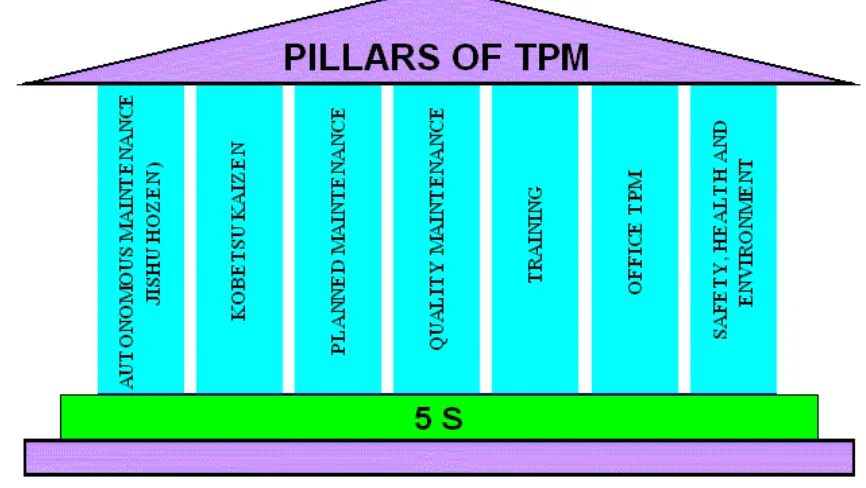
TPM paves the way for excellent planning, organising, monitoring and controlling practices through its unique Eight-pillar
[image:2.612.85.518.460.704.2]Technology (IJRASET)
II. SUMMARIZED FINDINGS FROM LITERATURE SURVEY
A. TPM definitions
Table 1:-The definitions of TPM as given by various researchers are tabulated in table 1.
Name of Author Definitions G. Chand,
B. Shirvani (2000)
The goal of TPM is to enhance equipment effectiveness and maximize equipment output. It strives to attain and maintain optimal equipment conditions in order to prevent unexpected breakdowns, speed losses, and quality defects in the process Ranteshwar Singh,
Ashish M Gohil, Dhaval B Shah, Sanjay Desai (2013)
TPM is an innovative approach to maintenance that optimizes equipment effectiveness, eliminates breakdowns, and promotes autonomous operator maintenance through day-to-day activities involving the total workforce.
Kathleen E. McKone, Roger G. Schroeder, Kristy O. Cua
(2001)
TPM provides a comprehensive company-wide approach to maintenance management, which can be divided into long-term and short-term elements. In the long-term, efforts focus on the new equipment design and elimination of sources of lost equipment time and typically require the involvement of many areas of the organization. In the short-term, TPM activities include an autonomous maintenance program for the production department and a planned maintenance program for the maintenance department.
Chowdury M. L. Rahman (2015)
Total Productive Maintenance (TPM) is a maintenance philosophy designed to integrate Equipment maintenance into the manufacturing process.
Amit Kumar Gupta, Dr. R. K. Garg (2012)
Total Productive Maintenance (TPM) is a methodology that aims to increase the availability of existing equipment, hence reducing the need for further capital investment.
Abdul Talib Bon, Mandy Lim (2015)
[image:3.612.77.527.127.455.2]Total Productive Maintenance (TPM) as the enabling tool to maximize the effectiveness of equipment by setting and maintaining the optimum relationship between people and their machines.
Table 1. Definitions of TPM by different authors.
[image:3.612.65.547.501.700.2]B. Benefits of tpm
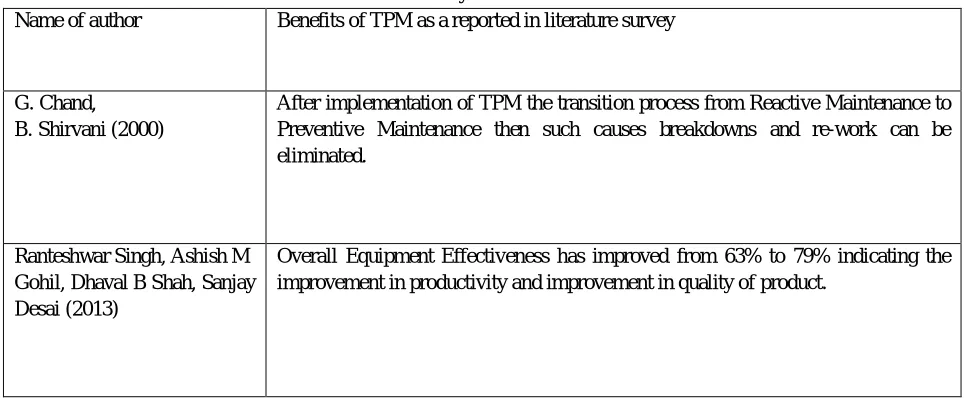
Table 1:-Various benefits as stated by various researchers are shown in table 2. Name of author Benefits of TPM as a reported in literature survey
G. Chand, B. Shirvani (2000)
After implementation of TPM the transition process from Reactive Maintenance to Preventive Maintenance then such causes breakdowns and re-work can be eliminated.
Ranteshwar Singh, Ashish M Gohil, Dhaval B Shah, Sanjay Desai (2013)
Technology (IJRASET)
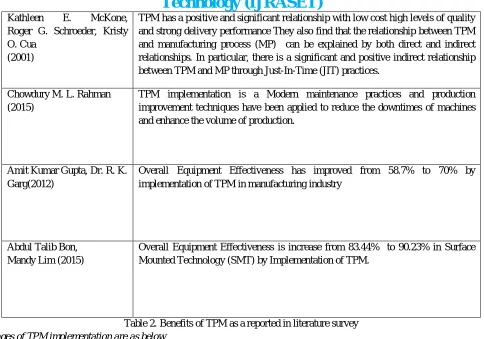
Kathleen E. McKone, Roger G. Schroeder, Kristy O. Cua
(2001)
TPM has a positive and significant relationship with low cost high levels of quality and strong delivery performance They also find that the relationship between TPM and manufacturing process (MP) can be explained by both direct and indirect relationships. In particular, there is a significant and positive indirect relationship between TPM and MP through Just-In-Time (JIT) practices.
Chowdury M. L. Rahman (2015)
TPM implementation is a Modern maintenance practices and production improvement techniques have been applied to reduce the downtimes of machines and enhance the volume of production.
Amit Kumar Gupta, Dr. R. K. Garg(2012)
Overall Equipment Effectiveness has improved from 58.7% to 70% by implementation of TPM in manufacturing industry
Abdul Talib Bon, Mandy Lim (2015)
[image:4.612.65.549.65.404.2]Overall Equipment Effectiveness is increase from 83.44% to 90.23% in Surface Mounted Technology (SMT) by Implementation of TPM.
Table 2. Benefits of TPM as a reported in literature survey
C. Stages of TPM implementation are as below
1) Preparatory Stage : Announcement by Management to all about TPM introduction in the organization:
Proper understanding, commitment and active involvement of the top management in needed for this step. Senior management should have awareness programs, after which announcement is made. Decision the implement TPM is published in the in house magazine, displayed on the notice boards and a letter informing the same is send to suppliers and customers. Initial education and propaganda for TPM:
Training is to be done based on the need. Some need intensive training and some just awareness training based on the knowledge of employees in maintenance. Setting up TPM and departmental committees:
TPM includes improvement, autonomous maintenance, quality maintenance etc., as part of it. When committees are set up it should take care of all those needs. Establishing the TPM working system and target:
Each area/work station is benchmarked and target is fixed up for achievement. A master plan for institutionalizing:
Next step is implementation leading to institutionalizing wherein TPM becomes an organizational culture. Achieving PM award is the proof of reaching a satisfactory levels.
2) Introduction Stage: A small get-together, which includes our suppliers and customer’s participation, is conducted. Suppliers as they should know that we want quality supply from them. People from related companies and affiliated companies who can be our customers, sisters concerns etc. are also invited. Some may learn from us and some can help us and customers will get the message from us that we care for quality output, cost and keeping to delivery schedules.
Technology (IJRASET)
III. CONCLUSION
Today TPM may be the only thing that stands between success and total failure for some companies; it has been proven to be a program that works. After successful implementation of TPM, it is found that Overall Equipment Effectiveness is increased.
REFERENCES
[1] G. Chand,B. Shirvani,“Implementation of TPM in cellular manufacture”, Journal of Materials Processing Technology 103 (2000) 149-154.
[2] Ranteshwar Singh, Ashish M Gohil, Dhaval B Shah, Sanjay Desai, “Total Productive Maintenance (TPM) Implementation in a Machine Shop: A Case Study”, Chemical, Civil and Mechanical Engineering Tracks of 3rd Nirma University International Conference on Engineering(NUiCONE 2012).
[3] Kathleen E. McKone, Roger G. Schroeder , Kristy O. Cua, “The impact of total productive maintenance practices on manufacturing performance”, Journal of Operations Management 19 (2001) 39–58.
[4] Chowdury M. L. Rahman, “Assessment of Total Productive Maintenance implementation in a semiautomated manufacturing company through downtime and mean downtime analysis”, International Conference on Industrial Engineering and Operations Management Dubai, UAE, March 3 – 5, 2015.
[5] Amit Kumar Gupta, Dr. R. K. Garg, “ OEE Improvement by TPM Implementation: A Case Study”, International Journal of IT, Engineering and Applied Sciences Research, Volume 1, No. 1, October 2012.
[6] Abdul Talib Bon, Mandy Lim, “Total Productive Maintenance In Automotive Industry: Issues And Effectiveness”, International Conference on Industrial Engineering and Operations Management Dubai, United Arab Emirates (UAE), March 3 – 5, 2015.