Technology (IJRASET)
©IJRASET 2013: All Rights are Reserved
681
SMART Evacuation System
Muthupandian Mohan1, Pramod Sridhar2, Srijith Srinath31,2,3
Department of Computer Science, BMS College of Engineering
Abstract— The proper evacuation of people inside a building during an emergency, the detection of a fire inside a building, and the detection of those people who are caught in the building are vital contingencies in the safety of human life when faced with the risk of a fire. By detecting where the occupants of a building are and where the fire is currently present, we can save hundreds of lives. Hence the automatic evacuation of occupants in a building during an emergency is a major goal that many safety organizations and emergency response branches are working towards. This paper discusses the various different techniques and protocols that are used in human detection, fire detection, and in evacuation. This paper also discusses various different ways humans behave in situations of panic and how to predict their behaviour. Another important aspect that is discussed are the various protocols that must be followed in the event of a fire emergency. The primary purpose of this survey is to study the numerous methods and techniques available in human and fire detection as well as in emergency evacuation. By doing so we will be able to ascertain where exactly progress can be made in this domain of fire safety and evacuation.
Keywords— Fire Evacuation, Fire Safety, Fire Detection, Evacuation Protocols, Inside Positioning Systems.
I. INTRODUCTION
In case of a fire emergency, the first-most priority is the accelerated evacuation of the occupants present in the building. We, human beings, in accordance with basic human behavior tend to panic and ignore evacuation protocols which are present when our survival instincts kick in. Behavioral scientists believe that people take a lot of time to assess a potentially dangerous situation and then arrive at a decision. Most often the time spent on assessing a situation ends up in the loss of life. Even with well established evacuation protocols and exit strategies, people tend to forget and rush to the same exit or taking drastic measures, ultimately leading to congestion and possible loss of lives.
Fire detection is the first thing that takes place during a fire emergency. Using different techniques, a fire is detected and then the information is relayed to the residents. Manual detection is one of the oldest methods, and it involves a person shouting about the fire or first hand experience of the components of a fire. There are several automatic methods of fire detection such as:
Thermal detectors - This device responds when the thermal energy of a fire increases the temperature of a heat sensitive element. These sensors identify abnormal fast temperature fluctuations in a room. and come in two types; one with a predetermined temperature at which it goes off and the other is the “rate of rise” detector.
Smoke detectors - This battery powered device are used for detecting smoke through ionization or photoelectric sensors thereby
mimicking the characteristic of the human nose. Most often the fire is detected in the incipient stage (starting stage). They consist of two parts; one to detect the smoke and the other a horn to make sound to let people know about the fire.
Flame detectors - They imitate the human sense of sight, and operate on infrared, ultraviolet or a combination of both. Their sensing equipment recognizes the heat signature and then sounds the alarm if needed. Most often they are used in locomotives and aircrafts.
Video analysis - This modern method to detect a fire uses cameras and fire detection algorithms to study the color, geometry and
motion of a fire. This method is most often used in open spaces and large covered areas. Using video analysis you can cover a larger area simultaneously, thereby increasing safety over a large area.
Indoor positioning systems have started gaining a lot of popularity these days with applications such as in-store navigation, warehouses, shopping malls, museums and parking lots. With GPS (Global Positioning System) being useless indoors due to lack of accuracy, IPS is a more efficient alternative. The Indoor Positioning System utilizes magnetic fields, light, bluetooth and Wi-Fi signals to help in identifying the position of occupants in huge buildings with complex floor plans.
II. FIRE GROWTH AND STAGES
Technology (IJRASET)
©IJRASET 2013: All Rights are Reserved
682
that is hot.
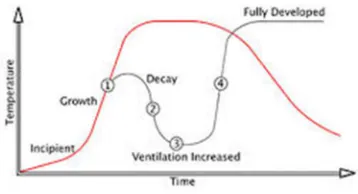
The initial stage of fire creation is called the incipient stage, which is also called as the ignition period [1]. At this stage the ignition source comes in contact with the fuel, and a slow growth of the fire begins. The incipient stage can prevail for a few minutes to even a couple of hours. A lot of factors decide how long this period is going to exist. These factors can include the number of combustible materials like paper, books, wood, furniture, fabric, plastic, and any combustible liquids that are present. Other factors that also affect this period’s duration would be the position of these materials, the structure of the building and availability of oxygen in proximity to the fire. It is during this stage that smoke starts to develop. By quick response, at this stage the fire can either be stopped or at times controlled most efficiently.
[image:3.612.216.395.351.448.2]At the end of the incipient stage, the fire slowly begins to grow faster and more aggressively. It is at this stage more fuel and oxygen is consumed and the fire begins to spread across the area. The temperatures can easily increase to more than 1000ºC (1800 ºF) at which point it becomes an inferno and almost impossible to control [2]. Josh states that within a few minutes the combustible materials increase the temperatures enough for a “Flash” which instantaneously ignites all of the combustible materials that are present in the room [2]. It is during these few minutes that the lives of people and firefighters that are close to fires are greatly endangered. In the event of a fire, the most dangerous aspect isn’t actually the heat or the chances of getting burnt. One of the reasons of most deaths in the event of a fire is due to the smoke [1]. During this stage of the fire, a huge amount of smoke is produced which causes the person to faint. The smoke deprives us from inhaling oxygen and ultimately chokes us to death. When caught in this stage it’s best to keep low to the ground, because the heat from the fire will cause the smoke to rise due to convection currents.
Figure 1: Stages of Fire Growth
When the fire reaches the “Fully Developed” stage where all the combustible items have been ignited and the growth of the fire has reached its maximum, the structural integrity of the building is put to the test [2]. If the building holds, then the fire will eventually decay. The decay occurs due to two main reasons - firstly the lack of any more combustible materials to consume and secondly lack of oxygen. If the fire is not extinguished or controlled it will lead to a “burn out”, in which everything including the building and all of its contents are lost [2].
III.EVACUATION PROTOCOLS
Everyone knows the golden rule when it comes to a fire; when a fire alarm is activated or a smoke detector is activated, everyone present in the building must evacuate immediately. This must be done in an orderly fashion. The most important thing is to look after your safety before you try saving someone else. To avoid death and injuries these set of rules are usually followed- [4][5]
A. Common Protocols
The first thing in the event of a fire emergency is to activate the Fire alarm. Or call the Fire Department or any other Emergency Services. Most of the times by activating the Fire alarm the Fire Department is notified automatically.
If the Fire is small and in the initial stages. Use the Fire Extinguisher to control and extinguish the fire if you’re capable of using it properly. If you feel that the fire cannot be extinguished and is spreading rapidly you must evacuate the building immediately. Once a fire alarm is heard, collect your valuables like wallets and identification if possible and leave the room, otherwise leave them behind.
Technology (IJRASET)
©IJRASET 2013: All Rights are Reserved
683
ensure that you don't lock it behind you.
Once out of the rooms and offices move to the nearest exit (emergency). Please make sure you use emergency staircase only. Remember an elevator must never be used in emergency evacuation. In case you come across fire or smoke, use an alternative exit instead.
Assist those with disabilities. Ask help from a few others and carry the person with disabilities who can’t navigate the emergency staircase. Make sure you do not use the elevators in helping people with disabilities.
Once you’ve exited the building proceed to a designated gathering point away from the radius of the burning building. This often helps in having a head count to determine the people who are still stuck inside. The gathering point must be an open field, or a park. It should be well away from the building on fire.
One must also ensure to keep streets, fire lanes, hydrant areas and walkways empty. This is done to make space for emergency vehicles and emergency personnel. Also inform the emergency personnel about the injured and any people that are still stuck in the building.
One shouldn't re-enter the building until verbally told by the Fire Department or emergency personnel. This is to ensure your safety from falling debris due to compromised structural integrity and other such fire related concerns.
According to all Fire Departments, if a fire alarm is falsely activated. One will have to pay a heavy fine. This kind of false alarm is frowned upon as it wastes a large amount of resources and time that could’ve been used to save others from an actual emergency [3].
IV. HUMAN BEHAVIOUR
Human behavior has been playing a big role in the loss of life during fires for many years. Extensive studies of human behavior during emergencies have helped code developers and public educators to identify the major factors that affect the occupants during a fire emergency situation [16].
Human behavior research has shown that any action or decision-making performed during a fire emergency occurs in four phases [6]. First, is the perception phase wherein the person can perceive external, physical and social cues from their environment, including physical cues such as flames, smoke, heat, and social cues such as general panic, seeing others in action. Additionally, a lot of other factors influence people such as information overload, time pressure, sometimes even their own thoughts or memory from a past event. Second, is the interpretation phase where the person attempts to interpret the information provided by the cues from the perception phase. The third phase is the decision making phase, which involves persons making decisions on what to do next based on the interpretations of the current situation and risks. Finally, phase 4 of the behavioral process is when the person performs the action based upon the decision-making phase [17]. This paper has led us to believe that human decision making can become incapacitated in times of emergency and ultimately lead to the biggest loss in lives. This can be easily remedied if clear instructions are given before the emergency begins to actually formulate.
V. FIRE DETECTION
There are many ways to detect a fire, the human nose being one of the best, uses millions of neurons (sensors) to process and help the brain make the best response about whether a fire has occurred or not [7]. The brain searches its database to find out what is the origin of the smell. If the odor isn’t familiar then it is marked as a strange odor, which should be learnt as a new pattern [9].
Thermal detectors are the oldest type of automatic fire detection device and are separated into electric heat detectors and automatic sprinkler heads [12]. Electric heat detectors only sound an alarm and have extinguishing features. A sprinkler is a combination of an extinguishing device and a heat activated fire detector. Heat detectors are best used in small confined spaces where heat can be detected easily [12].
Smoke detectors have gained wide usage during the 1970s and 1980s in residential buildings [1]. They mimic the human nose by detecting airborne smoke by usage of ionization sensors or photoelectric sensors [8]. They are usually placed on ceilings or high on walls because smoke having lower density rises up.
Photoelectric sensors use the smoke present in the environment caused by a fire which affects a beam of light passing through. LED’s, aerosol detectors transmit light at a particular intensity to determine if there’s a fire by applying the photoelectric concepts. [21].
Technology (IJRASET)
©IJRASET 2013: All Rights are Reserved
684
[image:5.612.250.374.182.304.2]coefficients [10]. Huan Li designed a novel algorithm for fire detection in video for industrial application. He and his team named their project as Color Context Analysis based Efficient Real-time Flame Detection Algorithm (CCAFDA). The algorithm uses flame detection context based dynamic feature row vector and optical flame feature area vector to select the flame region in a frame [11]. Thermoelectric detectors work by applying various thermoelectric properties of metals, using these there has been a high rate of success in detecting fire. This concept works based on generation of voltage between bimetallic junctions, which is figuring out the various heating points of metals at which the resistivity changes. During events of rapid increase in temperature this method has proven to be very effective [21].
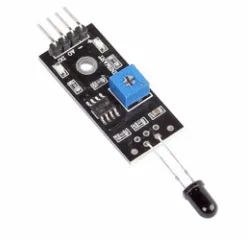
Figure 2: Flame Sensor
Evacuaid is an emergency app for anyone who needs a safer, faster and easier evacuation. This was developed in Norway, it’s not only the worlds first intelligent emergency flashlight. The combination of light and sound has proven to be a secure lifesaver for firemen through the years. Based on this principle the Evacuaid emergency bracelet is useful and lifesaving in high-risk situations [13].
FireReady app is the official Victorian government app for access to timely, relevant and tailored bushfire warnings. The app collects and pushes out data from emergency services. It uses this information to provide incident summaries and warnings via the app to help you make informed decisions about your safety. It notifies the app users the location of bushfires or forest fires [14].
VI.INDOOR POSITIONING SYSTEMS
Indoor location sensing systems have become very popular in recent years. These systems provide a new layer of automation called automatic object location detection. Real world applications depending on such automation such as; the location detection of products stored in a warehouse, location detection of medical personnel or equipment in a hospital, or even the location detection of firemen in a building on fire [18].
AT&T Cambridge has developed an ultrasonic tracking technology which provided a better and more accurate indoor positioning. Users and objects are tagged with ultrasonic tags identified as “bats” [20].
Optical Indoor positioning systems make use of only the cameras available in the premises, they are the main sensors to pick up a person’s location. Static cameras locate moving objects in the form of images and distance is measured with the help of laser scanners, range imaging cameras etc in order to roughly determine the position of a person [22].
Localization of objects using UWB (Ultra-WideBand): This uses the principle of a RADAR to detect dynamic and static objects. This type of a method requires multiple emitters that are omnidirectional and multiple receivers[22].
The IPS system is a new and developing technology that can be used to locate the position of occupants in the building. A pioneer of this technology is open source software called Redpin, which utilizes IPS to provide room level accuracy of the location of people in the building. Moreover, it avoids the time-consuming training and setup phase that is known from other similar systems and instead relies on it and will not provide geographic coordinates but rather symbolic identifiers as for example the number or name of a room [16].
The architecture of Redpin consists of two basic components: a Sniffer component that gathers and collects information about different wireless devices in range in order to create a fingerprint, and a Locator component, which stores measured fingerprints in a repository and contains the algorithm to locate a mobile device. The fingerprint can then be calculated using RSS in every nook and cranny of the floor to assign a unique measurement, which is called the fingerprint [17].
Technology (IJRASET)
©IJRASET 2013: All Rights are Reserved
685
as the ID of all non-portable Bluetooth devices that is called process sniffing [16]. This measurement is then sent to a central server, which will subsequently try to locate the mobile device given all known fingerprints and locate it within an error [17].
There are various available technology options for the design of an IPS such as infrared (IR), ultrasound, radio-frequency identification (RFID), wireless local area network (WLAN), Bluetooth, sensor networks, ultra-wideband (UWB), magnetic signals, vision analysis and audible sound. Based on these fundamental technologies, numerous IPSs have been developed by different companies, research centers and universities. Each system takes advantage of a particular positioning technology or combining some of these technologies, which also inherits the limitations of these technologies [19].
VII. CONCLUSION
Although many protocols do exist in the event of a fire, statistically it is known that very few of us ever bother to memorize all the exits when we enter a building or familiarize ourselves with the floorplans. A lot of time is wasted in making a decision during an emergency trying to find the floor plans and formulating a possible route of escape, without any knowledge about the current status of the building. Automatic fire detection and route prediction using IPS will bypass the time consuming process of manual decision-making by monitoring the building’s status and reporting the safest evacuation route to the occupants of the building. By using various different sensors to detect and identify the location of the fire, we can improve the accuracy and speed of the detection and response process considerably. The usage of IPS will allow for the best accuracy in detection of people in a building as well as provide life saving information to the emergency response personnel so the survivors who are unable to escape the building can be located and saved as quickly as possible.
VIII. ACKNOWLEDGMENT
We are grateful to B.M.S College of Engineering for having provided us with the facilities needed for the successful completion of this Project. We express our sincere thanks to our Principal Dr. K Mallikarjuna Babu, Head of the department of Computer Science Dr. H S Guruprasad, Project Guide Dr. G R Prasad and the teachers of the Computer Science and Engineering Department, BMSCE, whose support and guidance were invaluable.
Finally, we would like to thank my parents and friends for their constant support and encouragement.
REFERENCES
[1] Nick Artim, “An Introduction to Fire Detection, Alarm, and Automatic Fire Sprinkler”, Emergency Management, NDCC [Northeast Documentation Conservation Center]
[2] Josh, Sep 27, 2010 “The four stages of Fire”, Journey to Firefighter [3] Fire Regulations - Delhi government website.
[4] “Emergency Response Guidelines” Siena Heights University, Department of Public Safety [5] “Fire Evacuation Procedures” Oklahoma State University
[6] R L Paulsen, Dec 1981, “Human Behavior and Fire Emergencies: An Annotated Bibliography”
[7] Bryan, J. L. (1988). 'Behavioral Response to Fire and Smoke,' SFPE Handbook of Fire Protection Engineering, National Fite Protection Association, Quincy. [8] Brain, M. (2000). "How Smoke Detectors Work ", from http://home.howstuffworks.com/smoke1.htm.
[9] Shurmer, H. V. and J. W. Gardner 1992. "Odour Discrimination with an Electronic Nose." Sensors andActuators B: 1-11. [10] Che-Bin-Liu and Narendra Ahuja, Mar 2013 “Vision Based Fire Detection” University of Illinois
[11] Huan. Li1,2 , Shan. Chang2 , Zhe. Li3 , Lipng.Shao, Dongguan, Guangdong, June 2008, “ Color Context Analysis based Efficient Real-time Flame Detection Algorithm
[12] Richard W. Bukowski, “Techniques for Fire Detection” Center for Fire Research National Bureau of Standards [13] Evacuaid.web.29th Oct .2015. (www.evacuaid.no)
[14] FireReady App - Country Fire Authority." Country Fire Authority. Web. 29 Oct. 2015. [15] "Voice Evacuation." Reliable Fire & Security. Web. 29 Oct. 2015.
[16] Philipp Bolliger (2008) “Redpin - Adaptive, Zero-Configuration Indoor Localization through User Collaboration”
[17] H. Lim, L. Kung, J. Hou, and H. Luo. Zero-configuration, robust indoor localization: Theory and experimentation. Proceedings of IEEE INFOCOM, 2006. [18] H Liu - 2007 - Survey of Wireless Indoor Positioning Techniques and Systems.
[19] Yanying Gu, Anthony Lo, Senior Member, IEEE, and Ignas Niemegeers - 2008 - A Survey of Indoor Positioning Systems for Wireless Personal Networks [20] H Koyuncu - 2010 -A Survey of Indoor Positioning and Object Locating Systems