Technology (IJRASET)
A Study and Analysis of Bot Project Performance
Using Time Impact Analysis
S. Binil Sundar1, J. Renuga2
1
Asst Professor (SG), 2Asst Professor, Civil Engineering Department Saveetha School of Engineering, Saveetha University, Chennai, India.
Abstract--Inadequate or weak preparatory work before starting construction of any structure may cause serious problems during the construction period. For example, projects without sufficient detailed drawings or construction schedules and a disorganized building site can create many problems in the management and completion of the construction works. Consequently, the cost of construction increases digressively, the construction duration of the project extends and the quality of construction is affected adversely. This study dwells on the importance of construction schedules in achieving the aim of producing good quality construction work within the specified duration.
Monitoring continuously the interactive relation concerning delays in construction schedules and contractor demands is a complicated process. Here the simplest and basic approach is that, both for owner and contractor, time is money and for this reason construction schedule delays should be analyzed and corrective measures should be taken in a timely manner. The main purpose of this study is to investigate the causes of construction schedule delays and the methods of schedule delay analyses. The “Time Impact Analysis Method” (TIA) was applied to the case study project using MSP software in order to determine the construction schedule delays; to measure the impacts of these delays on the project completion duration; and to allocate responsibility amongst the project participants for preventing delay claims.
I. INTRODUCTION
A. General
Planning and control of resources within the framework of a project is the main target of construction management. Construction management procedures guide managers about how the resources can be best used during construction process and aims for the timely and efficient application of the resources in construction projects. Many issues shall be carefully thought in order to conduct a project successful. Construction site activities are only the second part of the whole construction process. The first part is comprised of all kinds of office work. The planning, designing, estimating, negotiating, purchasing, scheduling, controlling, accounting, etc. shall be done carefully in the office before the work starts on the site to accomplish the objective of a quality project within budget and on schedule. Construction delays are widespread in most projects around the world. Some delays may happen in the preconstruction phase which is defined as the period beginning from the initial conception of the project to the signing of the contract between the owner and the contractor; however some of them may happen in the construction phase that is the period when actual construction is under way. Project schedules are consistently dynamic and uncertain. Several controllable and uncontrollable factors can adversely affect the project schedule and cause delays.
B. Objective
The objectives of the work done with Study Analysis of Road Project Performance Using Tia (Time Impact Analysis) were. To study and understand project scheduling.
To determine the major types & causes of construction delays. To study the types of schedule delay analysis techniques. C. Scope
The scope of the work done with Study Analysis of Road Project Performance Using Tia (Time Impact Analysis) was.
The focus of the work is to do a detailed study about the performance of project and analyzing it by using the management software tool MSP.
Technology (IJRASET)
II. LITERATURE REVIEW
A. General
The main purpose of literature review is to give an idea about the work conducted world over in the field of study. In this brief review of literature about the delay and model is repotted and discussed. Literature regarding other delay measure is also reported.
B. Literature
Aibinu A.A et al (2002) describes the construction delay hasbecome endemic in Nigeria. It is imperative to create awareness of the extent to which delays can adversely affect project delivery. Delay had significant effect on completion cost and time of 61 building projects studied. Client-related delay is significant in Nigeria. Acceleration of site activities coupled with improved clients’ project management procedure and inclusion appropriate contingency allowance in pre contract estimate should assuage the adverse effect of construction delays.
Technology (IJRASET)
III. METHODOLOGY
A.Flow Chart of Methodology
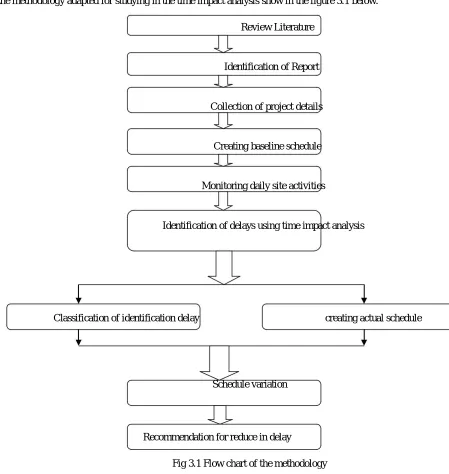
The flowchart of the methodology adapted for studying in the time impact analysis show in the figure 3.1 below.
Review Literature
Identification of Report
Collection of project details
Creating baseline schedule
Monitoring daily site activities
Identification of delays using time impact analysis
Classification of identification delay creating actual schedule
Schedule variation
[image:4.612.113.562.108.582.2]Recommendation for reduce in delay
Fig 3.1 Flow chart of the methodology B. Steps Involved
The above said methodology is for developing a delay analysis model in Construction companies. The detailed methodology can be explained as follows:
1) Identification Project: Identification project is any process of preparing and collecting data, for example, as part of a process improvement or similar project. The purpose of material collection is to obtain information to keep on record, to make decisions about important issues, or to pass information on to others.
2) Collection Of Project Details: The project details are collected from the company. The date for the execution of each process is also collected from the company. The data may be collected using a questionnaire or with the brainstorming.
Technology (IJRASET)
The scheduling work takes place in four phases.Planning Scheduling Monitoring Controlling
The schedules can be done in weekly basis. A good scheduling requires ongoing preparation as activities draw closer to execution.
IV. TYPES OF CONSTRUCTION DELAYS & DELAY ANALYSIS TECHNIQUES
A. Types of Construction Delays
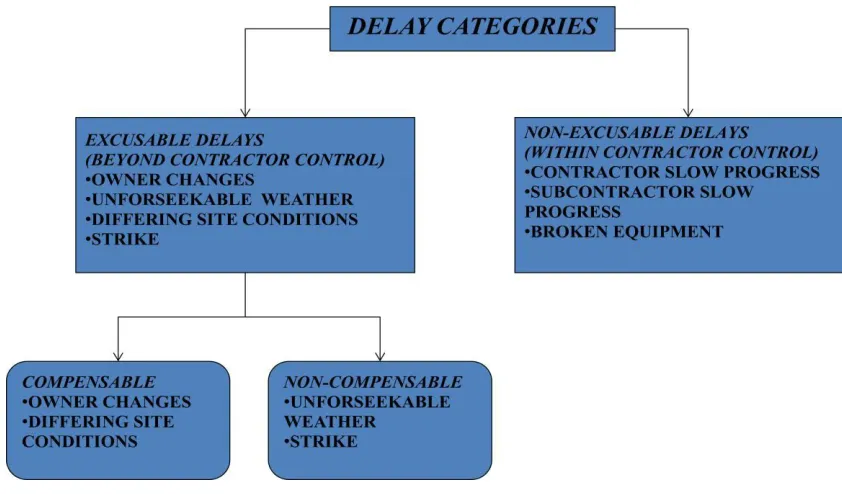
[image:5.612.121.542.219.466.2]There are three types of construction delays.
Fig 4.1: Delay categories
1) Excusable Delays: Excusable delays are those not attributable to the contractor’s actions or inactions, and typically include unforeseen events. These events are beyond the contractor’s control and are without fault or negligence on his/her part.Excusable delays, when founded, entitle the contractor to a time extension if the completion date is affected. This type of delay can also have an impact on non-critical activities which need a more detailed analysis to determine whether additional time extension is warranted, or if the reduction of float time can be justified. Excusable delays can be further classified into excusable with compensation and excusable without compensation.
2) Non-Excusable Delays: Non-excusable delays are delays which result from the contractors’ or subcontractors’ actions or inactions. These delays might be the results of underestimates of productivity, improper project planning and scheduling, poor site management and supervision, wrong construction methods, equipment breakdowns, unreliable subcontractors or suppliers. Consequently, this type of delay presents no entitlement to a time extension or delay damages for the contractor if the delay can be proved to have affected the whole project. The client, however, could be entitled to liquidate damages. An example of a non Excusable delay would be when a contractor fails to provide sufficient manpower to complete the job on time.
Technology (IJRASET)
B. Schedule Delay FactorsThe factors that affect the scheduling process are being listed below. Consultant Related Delay Factors (CRF1)
Contractor Related Delay Factors (CRF2) Design Related Delay Factors(DRF) Equipment Related Delay Factors(EF1) External Related Delay Factors(EF2) Labor Related Delay Factors(LRF) Material Related Delay Factors(MRF) Owner Related Delay Factors(ORF) Project Related Delay Factors(PRF)
V. PROJECT DETAILS
A.Site Details
The site detail of the roadway project is listed below.
• Name of The Project : NAM Expressway Ltd ( Narketpally –
Addanki Medarametla)
• Client : Andhra Pradesh Road Development
Corporation
• EPC Contractor : Ramky Infrastructures Ltd
• Construction Period : 30 Months
• Concession Period : 24 Years
• Total Length of Project Road : 212 Kms
• Type of Project : BOT(Build Operate Transfer)
• Type of Up gradation : Strengthening & Widening To 4
Lanes
In Service Lanes In Urban & Semi Urban
Sections.
• Estimated Project Cost : Rs. 1196.84 Crores
B. Technical Data
Technology (IJRASET)
• Start Chain age : Km 0+000
• End Chain age : Km 212+500
• Total Length of Project Road : 212.500 Km
Type of up gradation : Strengthening & Widening of 2 lanes
to 4 Lanes • Pavement overlay Composition (over Existing Road)
(a) Dense Bituminous Macadam (DBM) = 50 - 75 mm
(b) Bituminous Concrete (BC) = 40 mm
• Pavement Composition (New Construction)
(a) Sub grade (with 10% CBR) = 500 mm
(b) Granular Sub Base (GSB) = 200 mm
(c) Wet Mix Macadam (WMM) = 250 mm
VI. DATA COLLECTION
A. Daily Progress Report
The Summary of hourly- and daily-conditions and events at a worksite on
every workday, prepared for the offsite project administrators. An
essential document in construction projects, it records the number of
workers/employees and work equipment at the construction site, exact time the
work began and ended, job progress, weather, accidents (if any), etc. On
no-work days it reports "No Work Today," and serves as an evidence in case
of disputes.
B. MS Project Schedule
In the world of project management, project schedules can be characterized by their level of sophistication, by their intended usage, or by the nature of their content:
In terms of sophistication, project schedules range from the simplest (activity listing, timetable), to the more comprehensive (bar charts which converge action with time), to the most complex (network-based schedules, such as CPM, where activities are causally linked).
Technology (IJRASET)
project schedules (including precursor plans) are tools of the project manager, intended to optimize their efforts to effectively manage the project.
The third categorization of project schedules relates to content of the presentation of the schedule. This content is conveyed using adjectives placed before the word “schedule”. Examples are “bar chart schedule”, “milestone schedule”, “submittal schedules”, “design schedules”, “outage schedules”
C. Anticipated Financial Progress As Per Boq In Percentage
Anticipated financial progress is the expected financial run of a project/entity in a period of time. It is a predicted value which may vary depending on certain uncalculated risks. A project is feasible and profitable only if it's anticipated financial progress percentage is in positive numbers. It is not advisable to continue the project if its anticipated financial progress is very low or in negative numbers.
D. Daily Activity Report
The Summary submitted by each responsible persons in site to provide certain details to the management about project activities and performance over a given period .It records the number of workers/employees and work equipment at the construction site, exact time the work began and ended, job progress, accidents (if any), etc.
VII. ANALYSIS AND RESULTS
Impacts of construction schedule delays on the duration of the case study project were analyzed by the help of Time Impact Analysis method. The results of application of the selected method and the discussions are given in this section under respective headings, presented with tables.
A. Determination of Delays
In application of the TIA method, the accuracy of records which were used in the delay analysis was very important. To provide reliability of schedule delay analysis, inaccurate and unreliable records should not be used during the analysis process. Project changes, changing site conditions, official correspondences between project participants, time extension requests of the contractor were approved under the control of parties. Therefore, these records did not require any reliability control. In this study, only approved records were collected and analyzed, such as the Daily Project Report, MSP Schedule, etc., After these steps, it was noticed that there had been many problems during the whole construction process inevitably resulting in delays in the as-planned schedule. The results of this delay analysis are presented in the following sections
1) Delay In Lcc In Bituminous Works: In this project, the LCC in bituminous works which is affected due to paver fault resulting in the delay in the activity. According to the schedule the activity should have been finished on 25.11.12 and this activity was finished in 02.01.13 resulting in delay of 37 days.
2) Delay In Laying Of Pipes: The laying of NP 4 pipes is due to rain. The dewatering process tooksome time so the pipe laying process difficult and it has been delayed from10.12.12 to 08.01.13 Resulting in delay of 28 days.
B. Summary Of Allocation of Liability To Parties And Delay Types S.
DELAYED
CAUSES TYPE OF
LIABLE
DELAY
TYPE OF ACTION TO
N OF DELAY ID
ACTIVITY PARTY DELAY BE TAKEN
O DELAY FACTORS CODE
Non
Periodic
LCC in Delay due excusable
Equipment maintenance
1 bituminous to contractor EF2 Non
Technology (IJRASET)
bled
unfor
Excusable
Cannot be
Pipes of bled avoided, shall
Unanticipat External Non
2 pipes in weather EF1 be adjusted
ed events factor Compensa
culverts conditions( in the
ble rain) Schedule unforeseea Excusable Cannot be
ble avoided, shall
Unanticipat External Non
3 Back filling weather EF1 be adjusted
ed events factor Compensa
conditions( in the
ble
rain) schedule
Reinforced/
Design shall pre
be finalized &
stressed Delay in Delay due Excusable
checked
4 cement approval of to Consultant CF2 Compensa
before
concrete in drawings consultant ble
starting the super project. structure Non Well trained labors shall
Constructin Poor Delay due excusable
be recruited
Technology (IJRASET)
barrier hip contractor compensa
ble
6 Making procureme Delay due Consultant CF2 Excusable Materials
reinforcem nt of to Compensa shall be
ent materials consultant ble procured on
time
7 Stone unforeseea Unanticipat External EF1 Excusable Cannot be
pitching ble ed events factor Non avoided, shall
weather Compensa be adjusted
conditions( ble in the
rain) schedule
8 Constructin Poor Delay due Contractor CF1 Non Well trained
g bed Workman to excusable labors shall
flooring ship contractor Non- be recruited
compensa
ble
9 Laying Poor Delay due Contractor CF1 Non Well trained
RCC for Workmans to excusable labors shall
box / slab hip contractor Non- be recruited
culverts in compensa
superstruct ble
ure M25
Grade
10 Providing procureme Delay due CF2 Excusable Materials
and fixing nt of to
Consultant
Compensa shall be
bearings materials consultant ble procured on
Technology (IJRASET)
VIII. CONCLUSION
The major problems for contractors and owners, can be caused by Construction schedule delays, which results in costly disputes, controversial issues and adverse relationships between all the project participants. It point out, the most important causes of delays are shortage of resources, financial difficulties and organizational deficiencies of the company, delays in design work, large quantities, of extra work and frequent change orders. Here in this project the baseline schedule is taken into account and from that delays are rectified. The scheduling is updated by using the Daily Progress report & Daily Activity reports and the baseline schedule is compared with the ongoing schedule and the results are found.
In the case of the project the following delay events can be listed as follows Delay in laying of LCC in bituminous works
Delay in laying of pipes of pipes in culverts Delay in back filling
Delay in Reinforced/pre stressed cement concrete in super structure Delay in constructing crash barrier
Delay in Providing and fixing bearings Delay in painting in sub structures.
The reason for selecting the Time Impact Analysis (TIA) method was that it can display the progress of construction works step by step with the help of MSP® software.
REFERENCES
[1] Aibinu A.A, Jagboro G.O “ The effects construction delays on project ddelivery in nigerian construction industry”(2002)
[2] Takim, R, Akintoye, A And Kelly, J Performance measurement systems in construction. in: greenwood, d j , 19th annual arcomconference, 3-5 september 2003, university of brighton.association of researchers in construction management, vol. 1, 423-32 (2003).
[3] Divakarand.K K. Subramanian “Critical success factors in real-time monitoring of construction projects”(2009)
[4] Gyadu-Asiedu William, Fritz J.Scheublin And Emilia L.C.Wang Edmond- De Wilde De Ligny ”Project performance measurements for productivity improvements”(2006).
[5] Jyh-Bin Yang1, Kuei-Mei Huang, Chang-Hung Lee, And Sheue-Meei Chen “Delay impact analysis method for lost productivity in construction projects” (2005)
[6] Marais D, Martin L Delay analysis and its potential to reducesituations resulting in claims and losses”(2006). [7] Sheikh.A.W, Muree.M.R, And Soomro.A.R “Identification of critical delay factors in construction”(2010) [8] Wail Menesi “Construction delay analysis under multiple baseline updates”(2007)
[9] Mustafa Özdemir “A probabilistic schedule delay analysis in construction projects by using fuzzy logic incorporated with relative importance index (rii) method” (2010)