Technology (IJRASET)
An Implementation of Cluster Head Algorithm
with ACO and Leach Protocol in WSN for
Transferring the Data
Manjeet Kaur1, Er. Mandeep Kaur2
Guru Kshi University, Talwandi Sabo
Abstract: A wireless network is any type of computer network that uses wireless data connections for connecting network nodes. Wireless networking is a method by which homes, telecommunications networks and enterprise (business) installations avoid the costly process of introducing cables into a building, or as a connection between various equipment locations. Wireless sensor network and its applications are interesting research that have been focused recently. Battery consumption of sensor nodes is the main problem in the family of wireless sensor that should be solved. So, to increase the scalability of the network, and to reduce the energy usage fo roverall sensor operations, clustering techniques and data aggregation are the main focus. The multi tier techniques has been designed precisely and the selection of the cluster head using Fuzzy Logic based on the three selected parameters are well used along with its limited resources of wireless sensor network. The main problem in wireless sensor network is the battery consumption. The sensor node battery cannot be recharged once it is depleted and there is no power supply. To enhance the new cluster head algorithm with ACO and Leach Protocol a new algorithm is implemented for data transmission and we are getting the 85% accuracy of the work.
Keywords: ACO, WSN, Data, scalability etc.
I.INTRODUCTION
Wireless LANs are often used for connecting to local resources and to the Internet A wireless local area network (WLAN) links two or more devices over a short distance using a wireless distribution method, usually providing a connection through an access point for Internet access. The use of spread-spectrum or OFDM technologies may allow users to move around within a local coverage area, and still remain connected to the network.
Products using the IEEE 802.11 WLAN standards are marketed under the Wi-Fi brand name. Fixed wireless technology implements point-to-point links between computers or networks at two distant locations, often using dedicated microwave or modulated laser light beams over line of sight paths. It is often used in cities to connect networks in two or more buildings without installing a wired link.
Fig.1.Wireless LAN
A. Wireless mesh network
Technology (IJRASET)
B. Wireless MANWireless metropolitan area networks are a type of wireless network that connects several wireless LANs.
1) WiMAX is a type of Wireless MAN and is described by the IEEE 802.16 standard.[6]
C. Wireless WAN
Wireless wide area networks are wireless networks that typically cover large areas, such as between neighboring towns and cities, or city and suburb. These networks can be used to connect branch offices of business or as a public internet access system. The wireless connections between access points are usually point to point microwave linksusing parabolic dishes on the 2.4 GHz band, rather than omnidirectional antennas used with smaller networks. A typical system contains base station gateways, access points and wireless bridging relays. Other configurations are mesh systems where each access point acts as a relay also. When combined with renewable energy systems such as photo-voltaic solar panels or wind systems they can be stand alone systems.[5]
II. ANT COLONY OPTIMIZATION
A fresh general-purpose heuristic algorithm[16] which is often used to resolve different scombinatorial optimization problems. The brand new heuristic has the next desirable characteristics: 1. It is versatile, because it could be placed on similar versions of the exact same problem; for instance, there's a straightforward extension from the traveling salesman problem (TSP) to the asymmetric traveling salesman problem (ATSP). 2. It is robust. It can be applied with only minimal changes to other combinatorial optimization problems including the quadratic assignment problem (QAP) and the job-shop scheduling problem (JSP). 3. Its population based approach. In ACO [17, 18] it allows the exploitation of positive feedback as a search mechanism, . In addition, it makes the machine amenable to parallel implementations. These desirable properties are counterbalanced by the fact that, for many applications, the Ant System could be outperformed by more specialized algorithms. Consider for example the experimental setting.’
III. CLUSTERING
Clustering techniques in wireless sensor networks aim at gathering data among groups of nodes, which elect leaders among themselves. The leader or cluster-heads has the role of aggregating the data and reporting the data to the BS. The advantages of this scheme are that it reduces the energy usage of each node and communication cost. The clustering algorithms that are made is based on homogeneity and heterogeneity of nodes. One of the earliest work proposing this approach in WSNs is LEACH (Low-Energy Adaptive Clustering Hierarchy). Recently, there have been lots of other clustering techniques which are mostly variants of LEACH protocol with the slight improvement and different application scenarios. DEEC (Design of a distributed energy-efficient clustering), EDACH (Energy-Driven Adaptive Clustering Hierarchy) and EEUC (An EnergyEfficient Unequal Clustering Mechanism) are all clustering techniques proposed with the objective of minimizing energy usage, while extending network lifetime. Clustered sensor network can be classified into two main types: homogeneous and heterogeneous sensor network. While energy efficiency in WSNs remains a function of the uniform distribution of energy among sensor nodes, classifying clustering techniques depends on the objectives in mind. The Optimal clustering technique is the technique for the heterogeneity nodes [1].
IV. PROBLEM DEFINITION
The following problems are found:
A. The main problem in wireless sensor network is the battery consumption. The sensor node battery cannot be recharged once it is depleted and there is no power supply.
B. The existing protocols are not applicable to those WSNs that are deployed in large regions because it uses single hop routing where each sensor node can communicate directly to the cluster head and the base station. So, it causes problems of energy imbalanced.
C. The problem of unbalanced energy dissipation in cluster based WSNs is investigated. Another problem is cluster-based and homogeneous WSNs in which cluster heads transmit data to base station by one -hop communication.
D. There is problem to selection of next cluster head after the first cluster head is dead. The selection of the next cluster head will probably change all the nodes members in the cluster and the energy of the data transmission will be captured at this stage.
V. METHODOLOGY
Technology (IJRASET)
routing. In ACO algorithm Ant agents are placed on the source node which iteratively produces the solution by using probabilistic approach and the pheromone value (which defines the goodness of path) of optimum path from source to sink. This process continues until the final termination condition is achieved, i.e. all the nodes are dead in the system.
The proposed approach is processed in two phase the setup phase and the steady state phase as in LEACH [8]. In WSN routing algorithm the packets has been send from source node to the base station i.e. source to sink. In the proposed Ant based approach the nodes are placed as Ant agents . The cluster head is chosen randomly as in the setup phase of LEACH [1] . Basic layout of the sensor system is built and initialization of parameters is performed. Following steps are repeated until all the nodes are dead in the sensor system. 1. Randomly cluster heads are selected among the alive sensor nodes and clusters are built around these cluster heads which comprises of their associated nodes. 2. A radius for the cluster is chosen in such a way so that nodes having redundant information will stay within the range of the chosen radius. Experimental setup shows that taking 5 as radius gives the optimum result. Of all the nodes lying within the radius only one node is allowed to send the data packet to the cluster head as all the nodes lying within that area would send similar data or redundant data. Cluster head then sends this data to base station. 3. For all the nodes which lie outside the radius, we apply ACO in sending the packet data from these sensor nodes to the cluster head. This routing algorithm follows the probabilistic approach for constructing the solution, i.e. selecting the suitable path for transmission. This probabilistic selection uses pheromone information and the heuristic information, which is updated continuously.
[image:4.612.47.563.297.708.2]VI. PROPOSED STEPS OF THE WORK
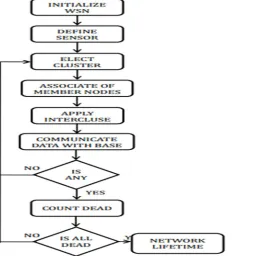
Figure 3 shows the flowchart of the proposed methodology.
Step 1:- Initialize the wireless sensor network with the various characteristics.
Step 2:- Define sensor field with the respective placement of the sensor nodes and also the base station.
Step 3:- Now cluster head selection technique come in action to elect some of the sensor nodes as cluster heads.
Step 4:- Now association of the member nodes with the cluster heads will be done by using the minimum distance formula between the member nodes and the respective cluster heads.
Step 5:- Apply inter cluster data aggregation technique to fuse data from the cluster heads and compress it before sending to the base station.
Step 6:- Now evaluate the route using the Ant colony optimization and communicate the data from the cluster head(s) to the base station.
Step 7:- Count if any dead node and check whether all dead. If all dead the show network lifetime and return else move to step 3
[image:4.612.201.458.450.706.2]Technology (IJRASET)
VII. RESULT
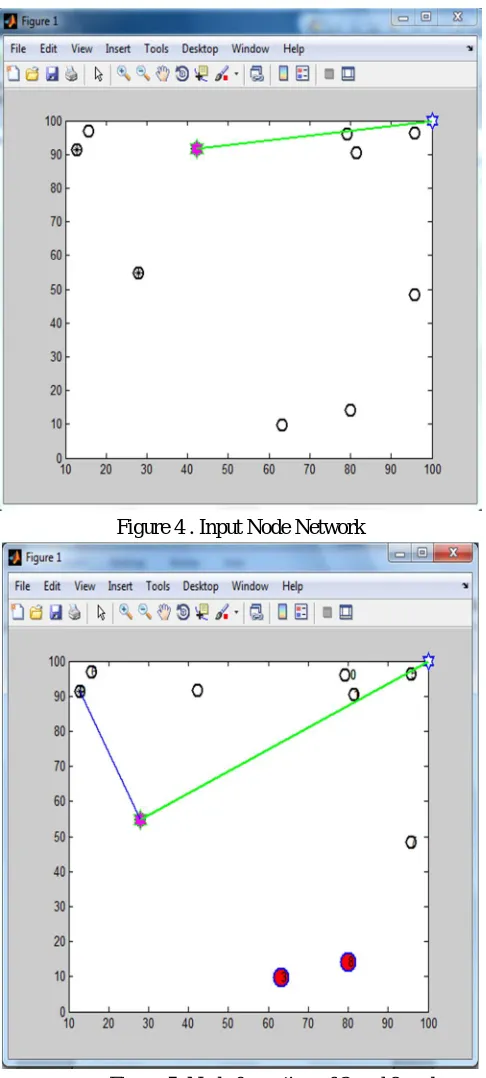
Number of nodes is deployed in filed and there is a Base Station to which they send the sensed data .In the direct transmission method the nodes directly send sensed data to BS. The Scenario of Direct transmission is as shown in figure. The sensing nodes are at different location from BS so this scenario will cause different amount of energy dissipation. Every time when nodes have data to send to BS, BS have to communicate with each and every node which leads large amount of energy consumption of BS as compared to others So this method is not efficient when life time of BS is critical. This Method is useful BS lies in the Sensor network and when BS is at distant location then this method will leads to shorter life time of the network.
[image:5.612.186.429.165.704.2]Figure 4 . Input Node Network
Technology (IJRASET)
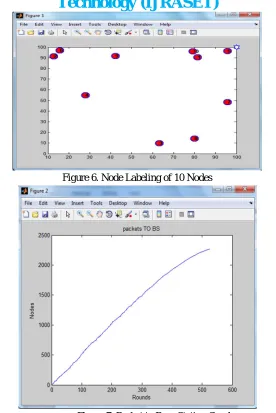
[image:6.612.169.445.65.478.2]Figure 6. Node Labeling of 10 Nodes
Figure 7. Packet to Base Station Graph
No of Nodes Network Life Time Packet to BS First Dead All dead Energy Used
10 525 2268 292 525 -0.0023
10 515 2200 250 510 -0.0021
10 520 2301 229 512 -0.0026
20 570 2506 252 555 -0.1585
20 565 2543 292 542 -0.2656
20 555 2458 280 524 -0.0143
20 532 2400 285 542 -0.005
20 540 2587 289 556 -0.008
VIII.CONCLUSION
Technology (IJRASET)
causes problems of energy imbalanced. The problem of unbalanced energy dissipation in cluster based WSNs is investigated. Another problem is cluster-based and homogeneous WSNs in which cluster heads transmit data to base station by one -hop communication. Proposed framework is cluster based technique in which respective cluster heads are chosen randomly. Instead of an extra overhead of selecting intermediate nodes, proposed algorithm is able to give best results as proved in simulation results given above. In this paper, Cluster heads are selected randomly. In future works, we would try to apply an algorithm for selection of cluster heads so that we could optimize the procedure.
IX. FUTURE SCOPE
In the future work it is improved with the help of other routing protocols to get the better results on dead nodes and the live nodes to find the energy loss and packet loss during the transmission of data.
REFERENCES
[1] Anno, J., Barolli, L., Xhafa, F., &Durresi, A. (2007). A cluster head selection method for wireless sensor networks based on fuzzy logic. In IEEE region 10 annual international conference, TENCON 2007 1–3 (pp. 833– 836).
[2] Annoa, J., Barollib, L., Durresic, A., Xhafad, F., &Koyamae, A. (2008). Performance evaluation of two fuzzy-based cluster head selection systems for wireless sensor networks. Mobile Information Systems, 4, 297– 312.
[3] Bonabeau, E.; Dorigo, M.; Theraulaz, G. Inspiration for Optimization from Social Insect Behavior.Nature 2000, 406, 39-42.
[4] Camilo, T.; Carreto, C.; Silva, J.S.; Boavida, F. An Energy-efficient Ant-Based Routing Algorithm for Wireless Sensor Networks. In Proceedings of ANTS 2006-the 5th International Workshop on Ant Colony Optimization and Swarm Intelligence, Brussels, Belgium, 2006;
[5] Caro, G.D.; Dorigo, M. AntNet: Distributed Stigmergetic Control for Communications Networks.J. Artif. Intell. Res. 1998, 9, 317-365.
[6] Dawood.M.Sheik., et.al (2012) “Study of Energy Efficient Clustering Algorithm for Wireless Sensor Networks” International Journal of Emerging Research in Management &Technology .
[7] De, S.; Qiao, C.; Wu, H. Meshed Multipath Routing with Selective Forwarding: An Efficient Strategy in Wireless Sensor Networks. Wirel. Sensor Netw. 2003, 43, 481-497.
[8] Dehni.L., et.al (2006) "Power Control and Clustering in Wireless Sensor Networks," in Challenges in Ad Hoc Networking. vol. 197, K. Agha, et al., Eds., ed: Springer US.
[9] Dorigo, M.; Gambardella, L.M. Ant Colony System: A Cooperative Learning Approach to theTraveling Salesman Problem. IEEE Trans. Evol. Comput. 1997, 1, 53-66.
[10] Dorigo, M.; Stützle, T. Ant Colony Optimization, 1st ed.; MIT Press: Cambridge, MA, USA, 2004;pp. 1-319.
[11] Ganesan, D.; Govindan, R.; Shenker, S.; Estrin, D. Highly-resilient, Energy-Efficient Multipath Routing in Wireless Sensor Networks. ACM Mob. Comput. Commun. Rev. (MC2R) 2001, 5,11-25.
[12] Grover.A., et.al (2014) “AOMDV with Multi-Tier Multi-Hop Clustering in Wireless Sensor Networks” Advanced Engineering Technology and Application,Adv. Eng. Tec. Appl. 3, No. 3, 29-33 .
[13] Günes, M.; Sorges, U.; Bouazizi, I. ARA-the Ant-Colony Based Routing Algorithm for MANETs.In Proceedings of International Workshop on AD Hoc Networking (WAHN 2002), Vancouver,BC, Canada, 2002; pp. 79-85.
[14] Hashmi S and T. Moufth, (2003) “A New Transport Layer Sensor network protocol”, IEEE Transactions, vol. 5,pp.118-156, Mar.2003
[15] Heinzelman, W.R.; Chandrakasan, A.; Balakrishnan, H. Energy-efficient CommunicationProtocol for Wireless Microsensor Networks. In Proceedings of the 33rd Hawaii International Conference on System Sciences, Maui, HI, USA, 2000; pp. 1-10.
[16] Heinzelman.W.R., et.al (2000) "Energy-efficient communication protocol for wireless micro sensor networks," in System Sciences, 2000. Proceedings of the 33rd Annual Hawaii International Conference on
[17] Khalid Hussain, Abdul Hanan Abdullah, ― Cluster Head Election Schemes for WSN and MANETǁ: A Survey ISSN 1818-4952 © IDOSI Publications, 2013 [18] Lindsey, S.; Raghavendre, C. PEGASIS: Power-efficient Gathering in Sensor Information Systems. In Proceedings of IEEE Aerospace Conference, Big Sky,
MT, USA, 2002;pp. 1125-1130.
[19] Liu, C.; Li, L.; Xiang, Y. Research of Multi-Path Routing Protocol Based on Parallel Ant Colony Algorithm Optimization in Mobile Ad Hoc Networks. In Proceedings of International Conference on Information Technology: New Generations (ITNG 2008), Las Vegas, NV, USA, 2008;pp. 1006-1010
[20] Meng., et.al (2013) "An Energy Efficient Clustering Scheme for Data Aggregation in Wireless Sensor Networks." Journal of Computer Science and Technology 28, no. 3.
[21] Okdem, S.; Karaboga, D. Routing in Wireless Sensor Networks Using Ant Colony Optimization.In Proceedings of the 1st NASE/ESA Conference on Adaptive Hardware and System-AHS,Istanbul, Turkey, 2006; pp. 401-404.
[22] OssamaYounis And Sonia Fahmy, Heed: ―A Hybrid, Energy-Efficient, Distributed Clustering Approach For Ad-Hoc Sensor Networksǁ(vol-3,issue- 4I 2009n 47907– 2066, Usa).