International Journal of Emerging Technology and Advanced Engineering
Website: www.ijetae.com (ISSN 2250-2459, ISO 9001:2008 Certified Journal, Volume 9, Issue No. 7, July 2019)
48
The Use of A Priori Information in Error-Control Coding
Dobri Atanassov Batovski
Vincent Mary School of Science and Technology, Assumption University of Thailand, Bangkok, Thailand [email protected]
Abstract— The controlled addition to the
information-bearing data sequence of a pattern of a priori known symbols, referred to as a priori information, makes it possible to improve the error-correcting capabilities of the main coding scheme in use. The introduced redundancy makes it easier to eliminate burst errors and establish error-free data transmission. The use of a priori information is validated in the presence of severe channel noise and interference when the channel decoder operates beyond the limits of its performance. Further elimination of errors could be achieved if the pattern of a priori symbols depends on the information-bearing content. This approach is especially beneficial for short-length packets processed by simple channel decoders of limited error-correcting capabilities.
Keywords— A priori information, convolutional codes, burst errors, error-control coding, Internet of Things, suboptimal performance.
I. INTRODUCTION
The transmission reliability of wireless networks is essential for the operation of the ever increasing number of devices joining the Internet of Things (IoT) [1, 2]. Simple devices of limited processing capability contribute to the traffic of short-length packets transmitted wirelessly to the nearest gateway. The presence of significant noise and signal interference in a wireless channel results in burst errors. Such errors could be detected with cyclic redundancy check (CRC) codes [3] and resolved with automatic-repeat-request (ARQ) packet retransmissions or corrected with a combination of interleavers and forward error-correction (FEC) codes such as linear block codes [4], convolutional codes [5], turbo codes [6], low density parity check (LDPC) codes [7-9], and other coding techniques [10]. Polar codes were recently introduced for symmetric binary-input discrete memoryless channels (B-DMC) [11]. The capability of polar codes to achieve Shannon’s channel capacity [12] was quickly recognized by the industry and said codes were adopted for the Enhanced Mobile Broadband (eMBB) control channels for the fifth generation (5G) new radio (NR) interface [13, 14] while there is an ongoing effort to improve their performance with successive cancellation decoders for data channels.
There is a certain signal-to-noise (SNR) threshold for any channel coding scheme below which the number of bit errors exceeds the corresponding error-correction limit. Then the data packet where the unrecoverable errors occur could be retransmitted, which would increase the latency, or dropped, which would decrease the throughput, thus affecting the quality of service (QoS). This contribution provides an alternative coding option in order to enhance the performance of the existing codes with minor modifications to the channel coding design.
II. CHANNEL CODING WITH APRIORI INFORMATION
The insertion of additional bits, often playing the role of control bits, in binary streams has been practiced since the very first practical implementations of digital communication systems. The meaning of the term a priori information thus depends on the intended purpose of the redundancy.
Most efforts in the past have been concentrated on the combined source-channel decoding of voice, image, and video signals, an example is a joint source-channel decoding algorithm for a block code [15]. Since such signals are highly correlated, after source coding there is some remaining redundancy in each coded frame as well as between consecutive frames due to time correlation [16, 17]. It has been shown that the a priori information that models the source parameters can be used twice involving both the channel decoder and the source decoder for a better signal reconstruction [18, 19].
International Journal of Emerging Technology and Advanced Engineering
Website: www.ijetae.com (ISSN 2250-2459, ISO 9001:2008 Certified Journal, Volume 9, Issue No. 7, July 2019)
49
III. METHODOLOGYThe apparent function of a bit that is known a priori is to serve as a buffer for spikes of noise. This can be conveniently illustrated with a rate-1/2 non-systematic convolutional code (CC) of constraint length K = 3 which is traditionally provided in books on coding theory. The set of binary generator polynomials CC(111, 101),
g1(x) = 1 + x + x2, (1)
g2(x) = 1 + x2, (2)
or CC(7, 5) in octal form represents a code of minimal Hamming distance between encoded sequences (free distance) dmin = 5 that can correct up to two errors [10]:
t = ⌊(dmin - 1)/2⌋ = 2. (3)
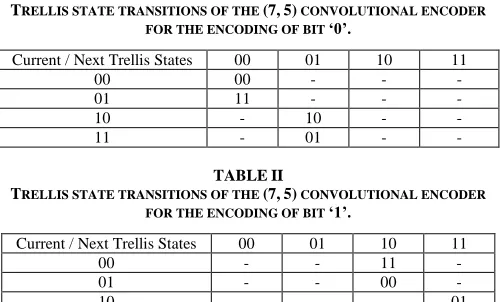
For simplicity, hard-decision decoding is assumed and a four-state trellis is sufficient to trace surviving paths in a four-state Viterbi decoder [21]. Tables 1 and 2 show the trellis state transitions for the encoding of bits ‘0’ and ‘1’, correspondingly.
TABLEI
TRELLIS STATE TRANSITIONS OF THE (7,5) CONVOLUTIONAL ENCODER FOR THE ENCODING OF BIT ‘0’.
Current / Next Trellis States 00 01 10 11
00 00 - - -
01 11 - - -
10 - 10 - -
11 - 01 - -
TABLEII
TRELLIS STATE TRANSITIONS OF THE (7,5) CONVOLUTIONAL ENCODER FOR THE ENCODING OF BIT ‘1’.
Current / Next Trellis States 00 01 10 11
00 - - 11 -
01 - - 00 -
10 - - - 01
11 - - - 10
This particular code can correct up to two errors even if they form a burst error. The code is linear and an all-zero input sequence is sufficient to demonstrate its error-correcting properties. Given a two-bit burst error 00-11-00 in the encoded bits, five subsequent pairs of error-free encoded bits, 00-11-00-00-00-00-00, are needed for successful error correction, and for a two-bit burst error of the form 01-10, there should be four subsequent error-free encoded pairs 01-10-00-00-00-00. Also, a three-bit burst error 01-11 can be corrected while 11-10 cannot as there is an alternative 11-10-11 surviving path with Hamming distance d = 2 bits for the input sequence 100.
Assuming that the first bit of the input bit stream is known a priori as 0, the 11-10 error pattern becomes correctable. The selection of all surviving paths on the code three with Hamming distance d ≤ 3 is limited to four such encoded paths:
00-00-00-00-00-00-00-00-00, d = 3, 11-10-11-00-00-00-00-00-00, d = 2, 11-10-00-10-11-00-00-00-00, d = 3, and 11-10-00-10-00-10-00-10-00, d = 3,
which correspond to input bit streams
000000000, 100000000, 101000000, and 101010101.
Knowing that the first input bit is set to zero is sufficient to select bit stream 000000000 and discard the remaining three streams. Without a priori information, bit stream 100000000 would be incorrectly selected instead.
Therefore, the prior knowledge of some input bits allows one to select surviving paths with Hamming distances greater than the paths provided by the Viterbi algorithm. A minor modification is required for the algorithm to work with bit patterns that are known a priori. When decoding the received noisy stream at input bit positions with a priori information, only one of Tables 1 and 2 should be used: Table 1 if the bit is set to 0, or Table 2 if the bit is set to 1. As a result, the trellis state transitions are reduced in half at such bit positions which explains the improved error-correcting capabilities of the modified coding scheme.
The input bit patterns with known bits should preferably be equidistant with consecutive bits spaced t bits apart from each other. If t = 2 bit errors, every second input bit should be known a priori for maximum decoding efficiency.
An equidistant pattern of known bits makes it possible to correct a 4-bit burst error 11-11 with the (7, 5) code. The set of all surviving paths with d ≤ 4 is listed below:
00-00-00-00-00-00-00-00-00, d = 4, 11-10-11-00-00-00-00-00-00, d = 3, 11-10-00-10-11-00-00-00-00, d = 4, 11-10-00-10-00-10-00-10-00, d = 4, and 11-01-01-11-00-00-00-00-00, d = 4.
The corresponding input bit streams are
[image:2.612.44.296.395.546.2]International Journal of Emerging Technology and Advanced Engineering
Website: www.ijetae.com (ISSN 2250-2459, ISO 9001:2008 Certified Journal, Volume 9, Issue No. 7, July 2019)
50
The input bit stream 000000000 is finally selected because the remaining streams do not match the equidistant pattern 0_0_0_0_0 of known input bits.The pattern could also be 0_1_0_1_0, 1_0_1_0_1, 1_1_1_1_1 or any other combination of zeros and ones. The decoding performance would remain unaffected. It should be noted that the interval between the equidistant pattern bits could vary dynamically depending on the SNR.
IV. PERFORMANCE EVALUATION OF ERROR CORRECTION WITH APRIORI INFORMATION
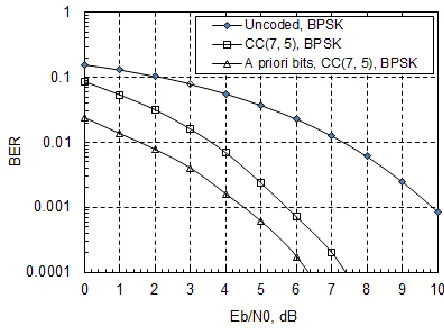
The error patterns and the patterns with a priori information seldom match. The performance of the proposed modified channel decoder should be evaluated from statistical point of view. Results from simulated data transmissions involving binary phase shift keying (BPSK) modulation and additive white Gaussian noise (AWGN) channel are presented in Figure 1. The obtained bit error rate (BER) is shown as a function of the signal energy per bit to noise power spectral density ratio (Eb/N0).
The Eb/N0 ratio at the output of the channel encoder is given in decibels as
Eb/N0, dB, Encoder Output = Eb/N0, dB, Encoder Input + 10log10r, (4)
where r = 1/2 is the code rate of the convolutional code. Converting the decibels to a linear scale
Eb/N0 = 10Eb/N0/10, (5)
and assuming that Eb = 1,
N0 = 1/(Eb/N0), (6)
gives for BPSK modulation
σ = (N0/2)1/2, (7)
where σ is the standard deviation of the zero-mean Gaussian distribution of the AWGN channel.
Figure 1 compares the convolutional decoding with the proposed use of a priori information, the CC(7, 5) decoding and the uncoded transmission. The 1-dB improvement of the ‘waterfall’ curve shows that the operation of the convolutional code is aided by the pattern of known bits.
Figure 2 shows simulated results for CC(17, 13). This convolutional code has a free distance dmin = 6 and can correct up to 3 errors. It is also included in the core specification of Bluetooth 5 for coded data transmission at 500 kbps and 125 kbps [22]. The 2-dB improvementof the ‘waterfall’ curve is due to the longer burst errors that can be corrected.
This pilot study demonstrates the simplicity and the effectiveness of the use of a priory information for channel coding. The provided examples are based on well-known standard convolutional codes to show that even the most basic codes can be enhanced and perform much better with a pattern of known bits. Obviously, such an enhancement is to be avoided for high SNR and is to be activated only as a last resort whenever the normal operation of the channel decoder fails. Such transmission failures are common among autonomous IoT devices and also pose a security risk.
Bluetooth is one of the short-distance communication technologies that could benefit from the utilization of a priori information. For instance, it is expected to have a beneficial effect even on the CRC error detection.
It is better to have a low throughput than no throughput at all when nearing a point of wireless separation between connected devices. The trade-off between the reduced number of retransmissions and the increased number of packets to compensate for the redundancy deserves a further investigation.
An alternative to a priori information enhancement is lowering the transmission rate. A repetition code instead of distinct known bits would also operate with relative success. A portion of the bit pattern may include specific information about the payload. There are numerous options for the design of bit patterns that complement each other. In addition, the application of pseudorandom non-equidistant patterns might prove effective in specific scenarios to better match the noise pattern.
FIGURE I BER VS.EB/N0 FOR THE CC(7,5) CODING CONFIGURATION
[image:3.612.335.557.492.657.2]International Journal of Emerging Technology and Advanced Engineering
Website: www.ijetae.com (ISSN 2250-2459, ISO 9001:2008 Certified Journal, Volume 9, Issue No. 7, July 2019)
51
FIGURE II BER VS.EB/N0 FOR THE CC(17,13) CODING
CONFIGURATION WITH A PRIORI INFORMATION.
The improved BER performance for low SNR is achieved with a significant amount of redundancy which eventually could be compensated with more efficient compression of the packed payload. The compression of short-length packets is another topic which deserves attention for the development of novel techniques for packet management of IoT traffic. Also, prospective implementation of hybrid ARQ-FEC techniques could allow compressed data to be transmitted with a minimum number of retransmissions when approaching the channel capacity limit.
V. CONCLUSION
The controlled addition of a priori information to data sequences allows the existing coding schemes to improve their performance at the expense of increased redundancy. This could prove beneficial when the codecs operate at the limits of their error-correcting capability when approaching the channel capacity limit in the presence of severe noise and interference. The advancement of coding schemes for simple wireless IoT devices requires the use of smart techniques that efficiently utilize a variety of existing coding approaches depending on the channel conditions. The addition of a priori information to the information-bearing binary stream is suitable for short-length data packets if multiple retransmission attempts occur due to error detection. Then the transmitter and the receiver could activate an enhanced a-priori-information mode of operation for the error-control codec that would reduce the number of errors to be corrected.
The error-correcting capability of the codec could only be better with the use of a priori information as further retransmissions could be avoided whenever all errors in a given data packet can be corrected. This study is an initial step towards a prospective standardization that would allow standard codecs to be built with an option to activate a-priori-information mode depending on the worsening channel conditions.
REFERENCES
[1] Ashton, L. 2009. That ‘Internet of Things’ thing. RFID Journal 22(7), 97-114.
[2] Evans, D. 2011. The Internet of Things: How the next evolution of the Internet is changing everything. Cisco Internet Business Solutions Group (IBSG), White Paper.
[3] Peterson, W. W., and Brown, D. T. 1961. Cyclic codes for error detection. Proceedings of the IRE 49(1), 228-235.
[4] Hamming, R. W. 1950. Error detecting and error correcting codes. Bell System Technical Journal 29(2), 147-160.
[5] Elias, P. 1955. Coding for noisy channels. IRE International Convention Record 3(4), 37-46.
[6] Berrou, C., Glavieux, A., and Thitimajshima, P. 1993. Near Shannon limit error-correcting coding and decoding: Turbo-codes. 1. Proceedings of ICC’93, Geneva, Switzerland, 23-26 May 1993, Vol. 2, 1064-1070.
[7] Gallager, R. G. 1963. Low Density Parity Check Codes. M.I.T. Press, Cambridge, MA, USA.
[8] MacKay, D. J. C., and Neal, R. M. 1997. Near Shannon limit performance of low density parity check codes. Electronics Letters 33(6), 457-458.
[9] MacKay, D. J. C. 1999. Good error-correcting codes based on very sparse matrices. IEEE Transactions on Information Theory 45(2), 399-431.
[10]Moon, T. K. 2005. Error Correction Coding. John Wiley & Sons, Hoboken, NJ, USA.
[11]Arikan, E. 2009. Channel polarization: A method for constructing capacity-achieving codes for symmetric binary-input memoryless channels. IEEE Transactions on Information Theory 55(7), 3051-3073.
[12]Shannon, C. E. 1948. A mathematical theory of communication. The Bell System Technical Journal 27, 379-423, 623-656.
[13]3GPP TS 38.212. 2017. NR; Multiplexing and channel coding (Release 15). 3rd Generation Partnership Project; Technical Specification Group Radio Access Network.
[14]R1-1711729. 2017. WF on circular buffer of Polar Code, 3GPP TSG RAN WG1 meeting NR Ad-Hoc#2, Ericsson, Qualcomm, MediaTek, LG Electronics.
[15]El Baz, A., Aitsab, O., Pyndiah, R., and Solaiman, B. 1998. Channel decoding of block codes with a priori information. In Proceedings of IEEE GLOBECOM’98, Sydney, New South Wales, Australia, 8-12 November 1998, Vol. 6, 3536-3541.
International Journal of Emerging Technology and Advanced Engineering
Website: www.ijetae.com (ISSN 2250-2459, ISO 9001:2008 Certified Journal, Volume 9, Issue No. 7, July 2019)
52
[17]Kaindl, M., and Hindelang, T. 1999. Estimation of bit error probabilities using a priori information. In Proceedings of GLOBECOM’99, Rio de Janeiro, Brazil, 5-9 December 1999, Vol. 5, 2422-2426.
[18]Hindelang, T., Fingscheidt, T., Seshadri, N., and Cox, R. V. 2000. Combined source/channel (de)coding: Can a priori information be used twice? In Proceedings of ICC’2000, New Orleans, LA, USA, 18-22 June 2000, Vol. 3, 1208-1212.
[19]Hindelang, T., Adrat, M., Fingscheidt, T., and Heinen, S. 2007. Joint source and channel coding: From the beginning until the “EXIT”. European Transactions on Telecommunications 18(8), 851-858.
[20]Matsuzawa, K. 2003. On the Improvement of the Existing Error-Control Coding Techniques for Deep Space Communications. Master Thesis. Department of Telecommunications Science, Faculty of Science and Technology, Assumption University of Thailand, Bangkok, Thailand.
[21]Viterbi, A. J. 1967. Error bounds for convolutional codes and an asymptotically optimum decoding algorithm. IEEE Transactions on Information Theory 13(2), 260-269.
[22]Bluetooth®. 2016. Bluetooth core specification version 5.0.