h i g h w a y s c o n s t r u c ti o n p r oj e c t s in
E n gl a n d
Tez el, BA, Aziz, Z U H , Ko sk el a , LJ a n d Tz o r t z o p o ul o s F a z e n d a , P
T i t l e Vis u al m a n a g e m e n t c o n di tio n in h i g h w a y s c o n s t r u c tio n p r oj e c t s i n E n g l a n d
A u t h o r s Tez el, BA, Aziz, Z U H , Ko s k el a , LJ a n d Tzo r t z o p o u lo s F a z e n d a , P
Typ e C o nf e r e n c e o r Wo r k s h o p I t e m
U RL T hi s v e r si o n is a v ail a bl e a t :
h t t p :// u sir. s alfo r d . a c . u k /i d/ e p ri n t/ 3 9 4 2 8 /
P u b l i s h e d D a t e 2 0 1 6
U S IR is a d i gi t al c oll e c ti o n of t h e r e s e a r c h o u t p u t of t h e U n iv e r si ty of S alfo r d . W h e r e c o p y ri g h t p e r m i t s , f ull t e x t m a t e r i al h el d i n t h e r e p o si t o r y is m a d e f r e ely a v ail a bl e o nli n e a n d c a n b e r e a d , d o w nl o a d e d a n d c o pi e d fo r n o
n-c o m m e r n-ci al p r iv a t e s t u d y o r r e s e a r n-c h p u r p o s e s . Pl e a s e n-c h e n-c k t h e m a n u s n-c ri p t fo r a n y f u r t h e r c o p y ri g h t r e s t r i c ti o n s .
Tezel, A. Aziz, Z., Koskela,.L., Tzortzopoulos, P. (2016). “Visual Management Condition in Highways Construction Projects in England” In: Proc. 24th Ann. Conf. of the Int’l. Group for Lean Construction, Boston, MA, USA, sect.6 pp. 133–142. Available at: <www.iglc.net>.
133 Section 6:Production Planning and Control
.
VISUAL MANAGEMENT CONDITION IN
HIGHWAYS CONSTRUCTION PROJECTS IN
ENGLAND
Algan Tezel1, Zeeshan Aziz2, Lauri Koskela3 and Patricia Tzortzopoulos4
ABSTRACT
Lean construction has recently gained momentum in England’s highways construction supply chain. The literature indicates that the current view to Visual Management (VM) within those lean implementations is limited to some VM tools. This paper explores the condition of VM, which is a fundamental sensory information management strategy in the lean production system, in the highways sector in England.
VM in construction is a scarcely researched topic, particularly outside the building construction context. The existing VM research focuses generally on the application of a specific VM tool rather than the VM strategy itself. The paper identifies the current VM condition with its realization means (VM tools), drivers, barriers and future implementation opportunities in England’s highways construction supply chain through five case studies and a focus group research effort.
The main findings are; (a) the current implementation of VM, particularly on English highways construction fields, is limited, and (b) along with many drivers and implementation opportunities for VM, (c) there are also some significant barriers before VM. The main limitations of the research are that the paper discusses the issue mainly for the construction phase and limited amount of data were collected from operational site staff.
KEYWORDS
Visual Management, big room/obeya, lean construction, transportation sector, highways
INTRODUCTION
Partly due to the concrete lean construction vision from the main public client (Highways England) for significant efficiency gains, lean construction has been increasingly finding a place on the agendas of contractors operating in the highways supply chain in England (Drysdale 2013; Fullalove 2013). One of the fundamental elements of lean construction is
1 Research Fellow, School of the Built Environment, University of Salford, UK, [email protected]
2 Senior Lecturer, School of the Built Environment, University of Salford, UK, [email protected] 3 Professor, University of Huddersfield, UK, [email protected]
134 Proceedings IGLC-24, July 2016 | Boston, USA
Visual Management (VM), which is a visual (sensory) information management strategy. There are some specific characteristics of VM (Greif 1991); (a) the information in VM is presented to create information fields, from which people can freely pull information in a self-service fashion, (b) the information need is determined ahead of time to prevent information deficiencies (pre-emptive approach), (c) the information display is integrated into process elements (space, machinery, equipment, components, materials, tools, gadgets etc.) and (d) the communication is simple and relies little or not at all on verbal or textual information.
Galsworth (1997) proposed a general classification of VM tools, i.e.: (a) information giving (e.g. signboards); (b) signalling (e.g. andon boards); (c) response limiting /controlling (e.g. kanban cards); and (d) response guaranteeing (poka-yoke systems) visual tools. In practice, those VM classification types commonly manifest themselves in the forms of some conventional VM tools (Galsworth 1997); the 5S workplace structuring methodology, visual performance boards and obeya (big rooms), in which many Key Performance Indicators (KPIs) are located to facilitate meetings and continuous improvement, visual standard operating sheets, the A3 methodology, production, maintenance and safety control cards (kanbans), and warning and control type poka-yokes for increased operational safety, quality and reduced set-up times.
The literature on VM in construction has been accumulating (Tezel et al. 2015). However, it still mainly revolves around VM’s conceptual benefits and the applicability of some conventional and IT based VM tools (i.e. the KanBIM and VisiLean prototypes by Sacks et al. (2013) and Dave (2013) respectively) in construction, particularly in building construction projects. Currently, there is lack of empirical research on VM in the highways context.
Also, without giving in-depth analyses of the realization of the VM strategy itself, the narratives on VM in the highways supply chain in England are limited to the use visual performance boards (Drysdale 2013; Fullalove 2013). This further highlights the current narrow view to the subject. The general condition of the VM strategy in highways construction and maintenance projects is unknown. Therefore, this paper aims at exploring the VM condition in highways construction and maintenance projects in England by (a) identifying its current use, (b) barriers, (c) drivers and (d) future implementation opportunities as the research objectives.
RESEARCH METHODOLOGY
Visual Management Condition in Highways Construction Projects in England
135
Section 6: Production Planning and Control
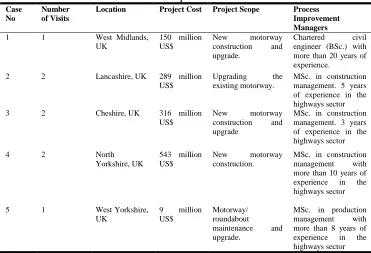
[image:4.612.120.491.224.477.2]studies include site observations on the field, in the site office and compound, photographic documentation, open-ended, semi-structured interviews with process improvement managers, informal discussions with the construction managers and investigation of the site archives. To triangulate some of the findings from the interviews and field observations, a structured questionnaire was distributed to the site operational staff (i.e. civil engineers, foremen, traffic safety controller, health and safety controller etc.) at Case 2 and Case 3 and 20 responses were collected. See Table 1 for the detailed description of the case sites and corresponding process improvement managers.
Table 1: Description of the Cases
Case No
Number of Visits
Location Project Cost Project Scope Process Improvement Managers
1 1 West Midlands, UK
150 million US$
New motorway construction and upgrade.
Chartered civil engineer (BSc.) with more than 20 years of experience.
2 2 Lancashire, UK 289 million US$
Upgrading the existing motorway.
MSc. in construction management. 5 years of experience in the highways sector 3 2 Cheshire, UK 316 million
US$
New motorway construction and upgrade
MSc. in construction management. 3 years of experience in the highways sector 4 2 North
Yorkshire, UK
543 million US$
New motorway construction.
MSc. in construction management with more than 10 years of experience in the highways sector 5 1 West Yorkshire,
UK
9 million US$
Motorway/ roundabout maintenance and upgrade.
MSc. in production management with more than 8 years of experience in the highways sector
After completing the case studies, a workshop event on VM in highway construction and maintenance projects was organized to set the scene for the focus group research. The event was promoted in the Lean Construction Institute-UK’s and Chartered Institute of Building’s networks. Focus group research involves systematic discussions with a selected group of individuals to gain information about their views and experiences of a topic (Stewart and Shamdasani 2014). The composition of the focus group participants was as follows; 12 academics/researchers, 6 lean construction consultants working in the highways sector and 22 professionals/practitioners from the highways sector.
RESEARCH FINDINGS
C
URRENTU
SE OFV
ISUALM
ANAGEMENT136 Proceedings IGLC-24, July 2016 | Boston, USA
from site offices or compound areas in the highways context. Also, it was found that the shared visual information with the site personnel is mostly limited to generic health and safety information on mobile boards/trailers/vans. There are also many similarities among the projects as to the use of VM; the most commonly used VM tools are visual performance boards displaying various project KPIs in the offices/compounds. It should be also noted that some projects had shown efforts to support their VM use with IT systems (BIM and mobile computing). See Figure 1 and Figure 2 for some of the captured VM tools at the case projects.
Table 2: Current VM Use at Case Projects
Case No VM tools in offices/compounds VM tools on-sites
1 (a) Visual performance boards, (b) an obeya room, (c) static near miss recording/display stations using iPads, (d) decent level of housekeeping but no 5S, (e) heavy plant/equipment tracking boards, (f) color-coded construction site ingress/egress documents, (g) the Last Planner meeting boards
(a) Different housekeeping levels among subcontractors; no 5S, (b) improvisational VM practices by the workforce (i.e. marking underground utilities with colored sticks), (c) generic health and safety information on mobile boards/vans, (d) color-coded tags for equipment safety checks, (e) limited amount of information on the schedule, (e) safety helmets integrated with sensors to warn the workforce of a dangerously close proximity with a heavy plant through vibration (warning poka-yoke), (f) goal posts to direct/guide heavy plant, (g) color-coded cones for traffic management
2 (a) Visual performance boards, (b) team meeting/ continuous improvement boards, (c) traffic management 2 week look-ahead board, (d) decent level of housekeeping but no 5S, (e) heavy plant/equipment tracking boards, (f) visual control boards for critical documentation, (g) color-coded construction site ingress/egress visual boards, (h) boards on which people can record their continuous improvement ideas, (i) the Last Planner meeting boards
(a) Different housekeeping levels among subcontractors; no 5S, (b) improvisational VM practices by the workforce, (c) health and safety information on mobile boards/trailers, (d) limited amount of information on the schedule, (e) goal posts to direct/guide heavy plant, (f) 72 iPads distributed to the site personnel to support the flow of information between the site and office, (g) color-coded cones for traffic management
3 (a) Visual performance boards, (b) an obeya room, (c) a BIM based work coordination document for the subcontractors (d) decent level of housekeeping but no 5S, (e) heavy plant/equipment tracking boards, (f) color-coded construction site ingress/egress displays, (g) the Last Planner meeting boards
(a) Different housekeeping levels among subcontractors; no 5S, (b) improvisational VM practices by the workforce, (c) health and safety information on mobile boards/trailers, (d) limited amount of information on the schedule, (e) goal posts to direct/guide heavy plant, (f) color-coded cones for traffic management, (g) color-coded tags for equipment safety checks
4 (a) Visual performance boards, (b) an extensive use of BIM in the Last Planner meetings, client engagement, 4D BIM (schedule integrated), design reviews and safety auditing, (c) decent level of housekeeping but no 5S, (d) heavy plant/equipment tracking boards, (e) color-coded construction site ingress/egress displays, (f) the Last Planner meeting boards
(a) Different housekeeping levels among subcontractors; no 5S, (b) improvisational VM practices by the workforce, (c) generic health and safety information on mobile boards/vans, (d) limited amount of information on the schedule, (e) goal posts to direct/guide heavy plant, (f) color-coded tags for equipment safety checks
5 (a) Visual performance boards, (b) decent level of housekeeping but no 5S, (c) heavy plant/equipment tracking boards, (d) color-coded construction site ingress/egress displays, (e) the Last Planner meeting boards
Visual Management Condition in Highways Construction Projects in England
137
Section 6: Production Planning and Control
(a) (b)
Figure 1: (a) Obeya room at Case 1, (b) Traffic management 2-week look ahead board for the coordination of night and day shift traffic management teams at Case 2
(a) (b)
Figure 2: (a) Creating a BIM based visual document to coordinate different work locations of the subcontractors at Case 3, (b) Use of BIM to support the Last Planner
meetings at Case 4
To triangulate the initial findings, the researchers distributed a questionnaire to the operational personnel at Case 2 and Case 3 regarding the types of information they want to see more on-site, close to the operational areas. The findings support the comments given by the process improvement managers and the researchers’ observations as to the need to share more varied information beyond health and safety with the site personnel. According to the questionnaire, the site personnel want to see more schedule, quality and process related information on-site (Figure 3).
17 15
13 9
5 4 4
0 5 10 15 20
[image:6.612.182.447.518.649.2]138 Proceedings IGLC-24, July 2016 | Boston, USA
Figure 3: Types of information the site personnel want to see more on-site at Case 2 and Case 3
B
ARRIERS AND DRIVERS FORV
ISUALM
ANAGEMENTThere are some barriers that hinder the further dissemination and development of VM and drivers that push the VM strategy in the highways supply chain. The comprehensive data in hand enabled the identification of some of those points for England’s highways construction and maintenance context (see Table 3). Some commonalities emerge among many of the identified barriers and drivers from different data sources.
Table 3: Barriers and Drivers for VM
Data Source Barriers for VM Drivers for VM
Pr o ce ss i mpr o v eme n t m a n a g er s Case 1
(a) Lack of awareness of VM, (b) limited view to VM (visual performance boards), (c) lack of the business case for VM (problems in quantifying its benefits for senior management)
(a) Increasing attention given to lean construction and its techniques in the UK, (b) Increasing number of private organizations (consultants) and institutes that are actively working on lean construction (c) Highways England’s commitment affect contractors’ decisions, (d) cooperation with universities to drive lean construction and VM, (e) VM can help contractors work more efficiently
Case 2’
(a) Lack of awareness of VM, (b) limited view to VM (visual performance boards), (c) lack of personnel driving VM and lean construction in highway projects, (d) lack of senior management’s support and ownership, (e) lack of the business case for VM (problems in quantifying its benefits for senior management), (f) limited communication with operational staff to drive VM further
(a) Increasing attention given to lean construction and its techniques in the UK, (b) Highways England’s commitment affect contractors’ decisions, (c) VM can help contractors work more efficiently, (d) construction managers can delegate work to their personnel through VM (for increased self management).
Case 3
a) Lack of awareness of VM, (b) limited view to VM (visual performance boards), (c) lack of personnel driving VM and lean construction in highway projects, (d) lack of senior management’s support and ownership, (e) lack of the business case for VM (problems in quantifying its benefits for senior management), (f) limited communication with operational staff to drive VM further
(a) Increasing attention given to lean construction and its techniques in the UK, (b) Highways England’s commitment affect contractors’ decisions
Case 4
(a) Lack of awareness of VM, (b) limited view to VM (visual performance boards), (c) lack of the business case for VM (problems in quantifying its benefits for senior management)
(a) Increasing attention given to lean construction and its techniques in the UK, (b) Highways England’s commitment affect contractors’ decisions, (c) VM can help decrease operational waste and increase work coordination
Case 5
a) Lack of awareness of VM, (b) limited view to VM (visual performance boards), (c) lack of personnel driving VM and lean construction in highway projects, (d) lack of senior management’s support and ownership, (e) lack of the business case for VM (problems in quantifying its benefits for senior management), (f) limited communication with operational staff to drive VM further
Visual Management Condition in Highways Construction Projects in England
139
Section 6: Production Planning and Control
Focus groups
(a) Lack of awareness of VM, (b) limited view to VM (visual performance boards), (c) lack of the business case for VM (problems in quantifying its benefits for senior management), (d) the temporary, project based structure of the industry limits the knowledge transfer for VM among different projects, (e) more pilot implementation projects for VM in the highways sector on more advanced concepts are needed, (f) lack of training documentation, (g) lack of an audit for best practices for VM, (h) limited cooperation/information share among contractors
(a) Obtaining higher lean construction implementation scores from Highways England helps contractors win future contracts; it is an important driver for contractors, (b) pilot VM/ lean construction implementation projects with universities, (c) VM will improve employee morale, work efficiency, collaboration between the main client and supply chain partners and help construction move to the production mind-set.
F
UTUREI
MPLEMENTATIONO
PPORTUNITIES FORV
ISUALM
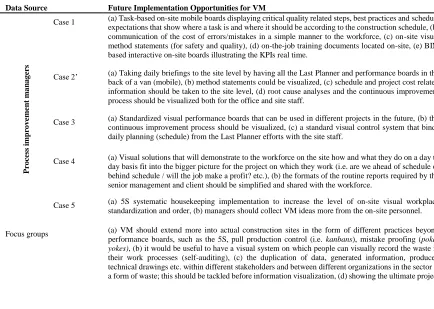
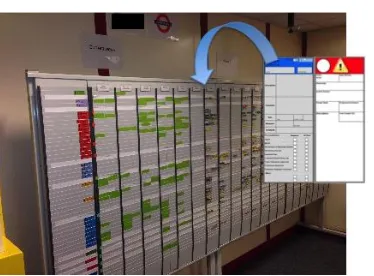
ANAGEMENT [image:8.612.90.524.421.730.2]The captured future implementation opportunities were divided into three main groups; the ideas given by the process improvement managers, opportunities captured from the focus group discussions and observations by the researchers. Whether the proposed VM ideas in this section will yield any benefits in the highways context is yet to be tested in the field, possibly through case study, action and design science research efforts in the future. It will also be useful to collect more data from operational site staff regarding their views on those future VM opportunities. A detailed summary of the captured data on the future implementation opportunities for VM in the highways context can be seen in Table 4. See Figure 4 for an example of the proposed visual control board linking the Last Planner’s 3-week look ahead plans with site teams through the use of activity and problem cards.
Table 4: Future VM Implementation Opportunities for Highways Construction
Data Source Future Implementation Opportunities for VM
Pr
o
ce
ss
i
mpr
o
v
eme
n
t
m
a
n
a
g
er
s
Case 1 (a) Task-based on-site mobile boards displaying critical quality related steps, best practices and schedule expectations that show where a task is and where it should be according to the construction schedule, (b) communication of the cost of errors/mistakes in a simple manner to the workforce, (c) on-site visual method statements (for safety and quality), (d) on-the-job training documents located on-site, (e) BIM based interactive on-site boards illustrating the KPIs real time.
Case 2’ (a) Taking daily briefings to the site level by having all the Last Planner and performance boards in the back of a van (mobile), (b) method statements could be visualized, (c) schedule and project cost related information should be taken to the site level, (d) root cause analyses and the continuous improvement process should be visualized both for the office and site staff.
Case 3 (a) Standardized visual performance boards that can be used in different projects in the future, (b) the continuous improvement process should be visualized, (c) a standard visual control system that binds daily planning (schedule) from the Last Planner efforts with the site staff.
Case 4 (a) Visual solutions that will demonstrate to the workforce on the site how and what they do on a day to day basis fit into the bigger picture for the project on which they work (i.e. are we ahead of schedule or behind schedule / will the job make a profit? etc.), (b) the formats of the routine reports required by the senior management and client should be simplified and shared with the workforce.
Case 5 (a) 5S systematic housekeeping implementation to increase the level of on-site visual workplace standardization and order, (b) managers should collect VM ideas more from the on-site personnel.
140 Proceedings IGLC-24, July 2016 | Boston, USA
goals and company vision is important in your VM efforts, (e) it will be also useful to visualize the connections between different work groups and processes, (f) involve the workforce into VM implementations more
[image:9.612.224.411.263.401.2]Researchers’ observations (a) 5S can be tried in warehouses, material/equipment lay-down areas, offices, depots, construction compounds, material test laboratories, canteens, toilets and changing rooms, on actual construction fields, workshops, traffic control rooms, maintenance and supply vans, wellbeing facilities and material trailers, (b) the A3 methodology can be used to succinctly communicate different processes on-site (i.e. the continuous improvement, concrete or asphalt laying process etc.), (c) visual standard operating sheets on mobile boards or vans, (d) a visual control board linking the Last Planner System with site teams, (e) pull production control (kanbans) in materials like prefabricated elements, light poles, cables, aggregates etc. to reduce on-site stocks, (f) heijunka leveling for critical plant/heavy equipment (i.e. excavator, roller, asphalter), (g) extended use of cloud BIM (i.e. AutoCAD 360) for better information visualization/ flow among mobile work teams, (h) extended use of BIM based prototypes linking the Last Planner with site personnel (i.e. KanBIM or VisiLean), (i) extended use of systems integrating BIM, Geographic Information Systems (GIS) and mobile computing for advanced visual control of assets/teams on large highway construction sites.
Figure 4: A proposed visual control board example from a metro station upgrade project in London (see Brady (2014) for the details of implementation)
DISCUSSION
The main finding regarding the current use of VM is that the current VM implementation scope in highway construction and maintenance projects in England could be broadened beyond visual performance boards and extended more into the production area (construction field). Also, as identified from the cases and the questionnaire, along with the existing health and safety information, the content of the shared information on-site should be augmented to cover more schedule/programme related, quality related and process related information.
Visual Management Condition in Highways Construction Projects in England
141
Section 6: Production Planning and Control
construction sector to establish a VM implementation database may also contribute to the dissemination and standardisation of effective VM practices through the supply chain.
Along with Highways England’s lean construction vision as the main client, the increasing general attention given to lean construction in the UK and various practical benefits of VM were cited as the main drivers for the VM strategy. Contractors are closely following Highways England’s priorities. Therefore, Highways England’s lead and impetus for VM underlining the existence of various VM concepts and opportunities will positively affect the degree of VM deployments in the supply chain.
The identified VM opportunities are worth investigating further and likely to be relevant as they reflect an observed, actual implementation need coming from the sector’s professionals and researchers. There are three important points to ponder while implementing the identified opportunities for VM; obtaining the ownership of senior management, the current lack of which was found to be a barrier for VM; clearly illustrating VM’s expected benefits or demonstrating the business case (the need for the VM tool/system) and involving workforce in the implementation (i.e. design and use of the VM system) process.
The nature of the current VM practices is mostly office or compound-based, manual and more static, which calls for more actual site-based and dynamic VM tools supported by emerging technologies. The highways context (very large construction areas with many different subcontractors working in different locations) is particularly suitable for those types of dynamic implementations. In connection with BIM, the maturing concepts of the Internet of Things (IoT), advanced photogrammetry, rapid laser scanning (e.g. LiDAR and LADAR), mobile/wearable computing and GIS will find a greater place in lean construction and VM deployments in the highways construction and maintenance sector in the near future.
CONCLUSIONS
This paper aims at exploring the current condition of VM in highways construction and maintenance projects in England by discussing its current use, main barriers, drivers and future implementation opportunities. Although the current VM implementations are limited in the highways supply chain, the interviewed process improvement managers and participants in the focus group were generally approving the benefits of VM discussed in the literature, which were also found among the main drivers for VM. However, apart from some evidence from Case 2 and Case 3, the general view of both managers and workforce to VM is still unknown and should be investigated in future research efforts.
142 Proceedings IGLC-24, July 2016 | Boston, USA
The VM opportunities were proposed for testing in the field as future research and implementation opportunities for VM in the highways context. This is to say the authors do not present the opportunities asserting that they will certainly yield benefits. Whether they will contribute to highways construction and maintenance operations are yet to be seen in future research and implementations.
The main limitations of the research are that the paper discusses the issue mainly in relation to the construction phase from the large contractors’ (Tier 1’s) perspective and limited amount of data were collected from operational site staff. Conducting similar research efforts for the design and maintenance phase of highway projects presents a future research opportunity for VM in construction. Additionally, the approach of small and medium size organizations (SMEs)- which constitute around 80% of the sector - to VM in the supply chain provides another research opportunity.
REFERENCES
Brady, D. A. (2014). “Using Visual Management to Improve Transparency in Planning and Control in Construction.” PhD Diss., Univ. of Salford, Salford, UK.
Dave, B. A. (2013). “Developing A Construction Management System Based On Lean Construction And Building Information Modelling.” PhD Diss., Univ. of Salford, Salford, UK.
Drysdale, D. (2013). “Introducing lean improvement into the UK Highways Agency supply chain.” In Proceedings of the 21th Annual Conference of the International Group for Lean Construction (IGLC), Fortaleza, Brazil.
Fullalove, L.H. (2013). “Examples of lean techniques and methodology applied to UK road schemes.” In Proceedings of the 21th Annual Conference of the International Group for Lean Construction (IGLC), Fortaleza, Brazil.
Galsworth, G. (1997). Visual Systems: Harnessing The Power of A Visual Workplace. AMACOM, New York, USA.
Greif, M. (1991). The Visual Factory: Building Participation through Shared Information. Productivity Press, Portland, USA.
Sacks, R., Barak, R., Belaciano, B., Gurevich, U. and Pikas, E. (2013). “KanBIM workflow management system: Prototype implementation and field testing.” Lean Construction Journal, 19-35.
Stewart D.W. and Shamdasani P.N. (2014). Focus Groups: Theory and Practice. 3rd Edn. Sage, London, UK.
Tezel, A., Koskela, L., Tzortzopoulos, P., Formoso, C. T., and Alves, T. (2015). “Visual management in Brazilian construction companies: taxonomy and guidelines for implementation.” ASCE, J. Mang. Eng, 31(6), 05015001.