International Journal of Emerging Technology and Advanced Engineering
Website: www.ijetae.com (ISSN 2250-2459,ISO 9001:2008 Certified Journal, Volume 5, Issue 3, March 2015)
198
An Energy Efficient Cluster Based Routing and Localization in
MANET for Emergency Scenario
Santhi G
1, Soundararajan N
2, Yasar Arafath T
3, Manibalan T
4 1Assistant Professor, 2,3,4Student, Department of Information Technology, Pondicherry Engineering College, Puducherry, India
Abstract -- The main constraint of sensor nodes is their limited energy resources since their batteries are non-renewable. In wireless sensor networks most of the energy in a node is spent for transmission and reception of the acquired data. In order to increase the lifetime of the network it is necessary to reduce the energy consumption of the sensors. Thus optimal consumption of energy is mandatory by reducing traffic overhead in the network. In this work an Energy Efficient Cluster based Routing Protocol (EECBRP) is proposed, which divides the sensor nodes in the network into clusters, thus it efficiently minimizes the flooding traffic during route discovery and speeds up the process of transmitting the information as well. The location of the collected data can be obtained using localization technique in Wireless Sensor Networks (WSNs). A localization method with few anchor nodes in the sensor network that knows its position and assists the unknown nodes in identifying their positions is discussed in this paper. Clustering the sensor nodes helps in localization of the sensor nodes and it is proven to be one of the best methods to reduce the energy consumption in the wireless sensor network since it reduces the time delay, the transmission distance and time. The proposed work is compared with AODV routing algorithm and found efficient than it.
Keywords-- Clustering, Energy Efficiency, Location Tracking, Routing, Wireless Sensor Networks.
I.
INTRODUCTION
The advancements in wireless communication technologies enabled large scale wireless sensor networks (WSNs) deployment. Due to the feature of ease of deployment of sensor nodes, wireless sensor networks have a vast range of applications such as surveillance in remote regions, military applications and rescue missions. Wireless sensor network is composed of large number of sensor nodes. The event is sensed by the low power sensor node deployed in neighborhood and the sensed information is transmitted to a remote processing unit or base station [2]. But absence of energy efficiency is one of the major challenges in Wireless Sensor Network (WSN) that is yet to be sorted out, which reduces the lifetime of the network.
To deliver crucial information from the environment in real time it is impossible with wired sensor networks whereas wireless sensor networks are used for data collection and processing in real time from environment.
There are two main applications of wireless sensor networks which can be categorized as: monitoring and tracking. Battery powered nodes are a common feature of many WSN applications, where recharging or replacement would not normally be feasible, and so are considered to be disposable. Many methods of powering these devices have been explored, including solar power, but they remain to be seen typically as “one-use” devices [3]. Wireless sensor networks are composed of independent sensor nodes deployed in an area working collectively in order to monitor different environmental and physical conditions such as motion, temperature, pressure, vibration sound or pollutants. The main reason in the advancement of wireless sensor network was military applications in battlefields in the beginning but now the application area is extended to other fields including industrial monitoring, controlling of traffic and health monitoring. Limited constraints such as size and cost results in constraints of energy, bandwidth, memory and computational speed of sensor nodes.
International Journal of Emerging Technology and Advanced Engineering
Website: www.ijetae.com (ISSN 2250-2459,ISO 9001:2008 Certified Journal, Volume 5, Issue 3, March 2015)
199
To address the issues of existing techniques, energy is wasted by flooding in route discovery and duplicated transmission of data by multiple routes from the source to the destination. Since the clusters are adaptive, so there is poor clustering set-up during a round will affect overall performance.In large emergency area or with a deep indoor scenario, to minimize the system energy consumption, a clustering based routing and localization algorithm is here presented. It is supposed that, in the operating area; a WSN has already been deployed and that it can be activated in case of emergency. Some of the nodes (anchors) are able to localize themselves by means of an absolute positioning system. During the network start-up, the network infrastructure is created. To reduce the network overhead, multi-step routing and localization protocols are adopted. In the first phase, nodes are collected into clusters. Afterwards, a course-to fine approach is exploited: the output of the routing protocol provides an initial guess about the node positions that will be refined by the localization procedure [1].
The rest of the paper is organized as follows: In section 2, the related work which briefly describes the various routing protocols in WSN is discussed. In section 3, the main features of the WSN for emergency scenario are provided and the problem setting is defined. Section 4 briefly explains the proposed work. Section 5 is dedicated to the description of the selected clustering technique and localization method. Simulation results verifying the effectiveness of the proposed approach are presented in Section 6. Finally, concluding remarks and future works are drawn in Section 7.
II. RELATED WORK
The fundamental functionality of routing in an ad hoc network is to relay data using data using multi-hop communication model. Routing protocols in wireless multi-hop networks can be classified into reactive, proactive and position based methodologies. In proactive protocol, all nodes maintain a steady map of the network topology by working out the routing tables. Hence the node can start communicating immediately after a data request. The Wireless Routing Protocol [4] is a proactive unicast routing protocol for mobile ad hoc networks using Bellman-Ford Distance Vector routing algorithm. Moreover, proactive routing protocol has a limited scalability and not suitable for large ad hoc networks. The Destination Sequence Distance Vector (DSDV) [6] is a unicast proactive ad hoc network routing protocol based on Bellman Ford algorithm.
The Optimized Link State Routing Protocol (OLSR) [5] is a non-uniform proactive Link State Routing algorithm. It is a core-node based algorithm- special nodes are dynamically selected to serve as a backbone for the network. Reactive network protocols are based on demand of data transfer. Each node makes its routing table when the communication of nodes is requisite for sending packets. Routing overhead can be greatly reduced in low traffic condition or if the topology since there is no need of routing data time to time or maintain routes in no traffic. Both Dynamic Source Routing [7] and Ad hoc On demand Distance Vector Routing are grouped into Reactive Routing protocol. Since routing is done after a route request, these protocols are ordered by an initial communication delay.
Hybrid routing protocols are proposed to combine the protocols of reactive and proactive type and overcome their inadequacies. The hybrid protocols reduce the control overhead of proactive protocol and decrease latency of route search operations in reactive protocol. Zone routing protocol [8] is a hybrid protocol for mobile ad hoc networks. In CBRP, every node retains a neighbor table to store link states unidirectional or bi-directional and the states of its neighbor. Besides the information related to the cluster nodes, a cluster head keeps information of neighboring nodes together with cluster heads of neighboring clusters and gateway nodes connecting to neighboring nodes.
A taxonomy of localization algorithms for sensor networks can be sketched according to the computational organization, i.e., centralized and distributed, to the mechanism adopted for estimating location, i.e., range-based or range free, and to the availability of anchors nodes, i.e. anchor-based or anchor-free [1].
International Journal of Emerging Technology and Advanced Engineering
Website: www.ijetae.com (ISSN 2250-2459,ISO 9001:2008 Certified Journal, Volume 5, Issue 3, March 2015)
200
The key idea is to model geometric constraints between nodes as linear matrix inequalities (LMIs), and then use the semi-definite programming theory to solve it. The result is a bounding region for each node, representing feasible locations where nodes are supposed to be. In, the authors exploit the connectivity information, i.e., the communication range of each node, to derive the locations of the nodes in the network. This algorithm is based on multidimensional scaling (MDS).Range-based algorithms exploit point-to-point distances or angle estimates in order to perform the localization task. Range-free algorithms are not based on the availability or reliability of range information. Although range-free approaches are appealing as a cost effective alternative to more expensive range-based approaches, their performance may lack in accuracy. Anchor-based algorithms rely on the availability of location information of a sub set of nodes in order to estimate the localization for the whole network. Anchor free methods determine the geometry of the network by exploiting local interaction among nodes. Anchor based algorithms offer the advantage of directly localizing nodes within a global reference frame though the number of anchor nodes and their distribution in the sensor field affect their estimation accuracy. Anchor-free algorithms may represent a different solution if a priori knowledge about location is not available and the estimation regarding a global reference frame is not required [1].
III. PROBLEM DEFINITION
In emergency scenario, location awareness is an important aspect. The success of rescue operations depends on first responders tracking, in-field injured persons triaging, and physical environment monitoring. During emergency situations, the rescuers experience unknown and complex environments. One solution to achieve this augmented-reality goal is to consider a WSN able to monitor the emergency area and gather information about the environment.
As stated in the introduction, the work mainly focuses on a WSN previously deployed in the environment and activated only when an emergency occurs, in order to reduce the power consumption. For example, in an indoor environment, sensor nodes could be embedded into emergency signs and fire extinguishers. Nodes equipped with temperature sensors can enable their activation when fire occurs in the area. In outdoor, motion sensors spread over the ground can switch on the nodes in a landslide. When the WSN is activated, network parameters as size, sensor positions, topology, or density are unknown and may be changed due to the accident.
A set of N sensor nodes on a planar environment has been considered. According to the analyzed framework, the network can be assumed to have the following properties:
1. In the network, the nodes are quasi-stationary. 2. The network comprises of many mobile/stationary
nodes. This implies that energy consumption is not uniform on all nodes.
3. All the sensor nodes both static as well as mobile are deployed randomly over the surveillance volume and nodes are left unattended after initial deployment of the network.
4. Absolute positioning devices i.e. GPS antenna, are equipped on some nodes which play the role of anchor of networks.
5. Some of the nodes in the network are unaware of their locations. They are called as ordinary nodes.
6. All nodes in the network have some similar capabilities such as processing, computation and communication. They can be able to measure inter nodal distances.
7. Communication is Omni-directional and broadcast in nature. We also assume that, the initial battery powers of the nodes are identical at deployment.
The first assumption is compulsory for attaining a stable configuration for clusters: the nodes rapidly moving in the network may degrade the quality of the network, since they change the distribution of nodes in their cluster. The second theory stimulates the need for re-clustering to select newer cluster heads and re-distribute the consumption of energy. The third and fourth supports the need of a network localization procedure. The fifth and last property deals with the need of a network lifetime extension and a balance on cluster head loads.
Some requirements have to be met:
1. Distributed clustering-each node makes decisions independently based on local information.
2. Clustering ends within a fixed number of iterations regardless of the network diameter.
3. After each clustering procedure, each node is either a cluster head or an ordinary node belonging to one cluster.
4. Clustering should be efficient in terms of computational complexity and message exchanging. 5. Cluster heads are well-distributed over the emergency
area.
International Journal of Emerging Technology and Advanced Engineering
Website: www.ijetae.com (ISSN 2250-2459,ISO 9001:2008 Certified Journal, Volume 5, Issue 3, March 2015)
201
IV. PROPOSED WORK
The proposed algorithm is based on cluster based routing protocol for ad hoc network. Clustering is introduced to WSNs because it has been recognized as an effective approach to provide better data aggregation and scalability for large WSNs. Clustering also preserves the limited energy resources of the sensor nodes. Sensor network reliability is currently addressed in various algorithms by utilizing re-clustering that occurs at various time intervals; however the result is often energy inefficient and limits the time available within a network for data transmission and sensing tasks.
In this paper, a hybrid routing algorithm called Energy Efficient Cluster Based Routing Protocol (EECBRP) for MANET based on Cluster Based Routing Protocol is proposed. It uses clustering structure to decrease routing control overhead and improve the networks scalability.
The proposed work uses Cluster Based Routing Protocol for routing in the pre-deployed sensor networks and predicts the position of the nodes and that approximated positions are used to guess the location of the sensor nodes. Using clusters reduces the energy consumption of the sensor nodes and eventually increase the life time of the sensor nodes. The main advantage of the proposed system are reduction in the time delay, the transmission distance and time. The proposed system also maintains the link stability of its routing path over the wireless sensor network.
V. CLUSTERING AND ROUTING
Routing protocols based on clustering exploit both proactive and reactive behavior. On the one hand, each node maintains an updated list of linked nodes and their routes by periodically distributing routing tables throughout the network. On the other hand, each node discovers the network path by flooding the network with Route Request packets. Nodes act as proactive or reactive ones according to their hierarchical level. The proposed work achieves a good performance in terms of lifetime by balancing the energy load among all the nodes.
Compared to other protocols, the proposed protocol has the following features [11]:
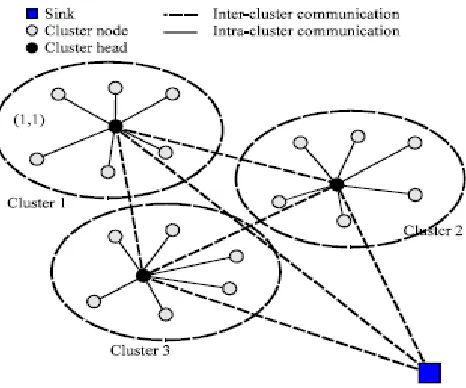
[image:4.612.332.565.245.439.2]Fully distributed operation; minimizes on-demand route discovery traffic and routing overhead; uses “local repair” mechanism to reduce route acquisition delay and new route re-discovery traffic; explicit exploitation of uni-directional links that would otherwise be unused; less flooding traffic during the dynamic route discovery process; broken routes could be repaired locally without rediscovery; increases the packet delivery ratio to a great extent; sub-optimal routes could be shortened as they are used.
Fig. 1: Wireless Sensor Network after Clustering
A. Cluster Formation
International Journal of Emerging Technology and Advanced Engineering
Website: www.ijetae.com (ISSN 2250-2459,ISO 9001:2008 Certified Journal, Volume 5, Issue 3, March 2015)
202
B. Neighbor Estimation
Algorithm can rapidly find neighbors while sending and receiving RREQ and RREP. HELLO message is only sent to a destination that is not in the neighbor list. This difference can deliver less routing packets and therefore, better normalized routing load. This implementation permits the protocol to discover neighbor nodes quickly and utilize neighbor node information in the route discovery process.
C.Adjacent Cluster Discovery
Adjacent Cluster Discovery identifies cluster gateways. Gateways are nodes that lie within the transmission range of two or more CHs and are used for routing between clusters. Each node belonging to a cluster holds the Cluster Adjacency Table in which the information about the other neighbor nodes is stored. It is used for creating a map of the cluster heads in the network.
D.Routing and Localization
When a source node S wants to deliver data to an unknown (no match in routing table) node D, S first check its neighbor table, if there is a match, it just adds this route into routing table and directly send data to D, otherwise S initiate a path discovery process to locate the destination. When a source node S seeks to set up a connection to a destination D, S send route request message to its cluster head.
Localization in sensor networks can be defined as “identification of sensor node's position'' i.e. spatial coordinates of wireless sensor nodes. Localization of sensor node is important because it helps in identifying the position of sensor node which first sends the message to base station during emergency. Static sensor nodes are equipped with GPS enabled devices and are expected to be aware of their position at any instance. These static nodes periodically broadcast beacon messages about their location in the network space. As soon as any mobile sensor node comes within the communication range of static sensor node, it will receive the broadcast message. On receiving such messages the mobile nodes calculate their position based on the equation of sphere and clustering information is also used for localization.
VI. SIMULATION AND RESULTS
After the detail discussion of Cluster based routing protocol for WSN and necessary implementations, the preparation of model for routing protocol and analyzing its effect for critical condition monitoring application with the help of different parameters is done.
A.Simulation Environment
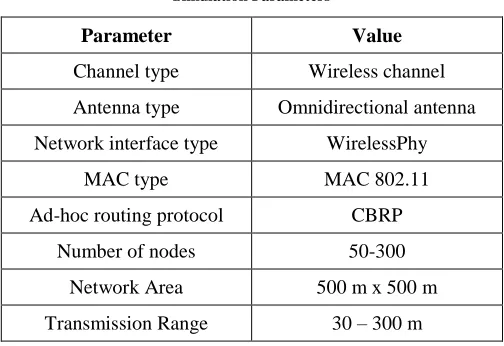
To verify the effectiveness of the proposed approach, it has been tested under different operating conditions by simulating the real Wireless Sensor Network using NS-2 [12] tool. In order to understand the performance of the proposed approach with respect to the existing clustering procedures, we have carried out several tests.
NS-2 software is used in this study. It is mainly consists of two languages. They are OTCL and C++. The use of OTCL can be broken down into four major steps. Creation of nodes (modeling) is the first step, agent creation, application for the respective agents and finish procedure. The use of C++ is the back end process which supports for packet transmission.
[image:5.612.318.570.425.598.2]Three different scenarios have been selected. In all the cases a planar environment of 500 m x 500 m is considered. In this environment, the sensor nodes are randomly deployed which are equipped with antenna. The different scenarios are characterized by changing the number of deployed nodes in the network such as 50, 100, 150, 200, 250 and 300 nodes. The number of anchor nodes, which are the 30% of the total number of nodes 15, 30, 45, 60, 75 and 90 respectively are also deployed.
Table I: Simulation Parameters
Parameter Value
Channel type Wireless channel
Antenna type Omnidirectional antenna
Network interface type WirelessPhy
MAC type MAC 802.11
Ad-hoc routing protocol CBRP
Number of nodes 50-300
Network Area 500 m x 500 m
Transmission Range 30 – 300 m
B. Performance Metrics
1) End-to-End Delay: The End-to-End delay is defined as the average time taken by a data packet to reach the destination. It also includes the delay caused by route discovery process and the queue in data packet transmission. Only the data packets that are successfully delivered to the destinations is counted.
International Journal of Emerging Technology and Advanced Engineering
Website: www.ijetae.com (ISSN 2250-2459,ISO 9001:2008 Certified Journal, Volume 5, Issue 3, March 2015)
203
2) Packet Loss: The packet loss is defined as the number of packets dropped during the transmission of the data i.e. failure of one or more transmitted packets to arrive at their destination.
Packet loss = Number of packets sent – Number of packets received
3) Packet Delivery Ratio: Packet Delivery Ratio (PDR) is defined as the ratio of average number of data packets delivered to the destination. This elucidates the level of delivered data to the destination.
PDR = ∑ Number of packet received / ∑ Number of packet sent
C. Simulation Results
In this section, the proposed routing protocol is evaluated and compared with AODV routing protocol via simulation. For this purpose, the proposed algorithm is implemented on NS-2 simulator.
The results obtained for the selected routing protocols with the help of different parameters and scenarios from simulation are analyzed here. The reported results have been averaged over several trials for each scenario. The parameters used to evaluate the performance of proposed work which is compared with that of the existing system are Average End-to-End delay, Packet Loss Ratio, Average Packet Delivery Ratio. In the following, simulation results about the proposed work are shown separately.
[image:6.612.323.570.237.417.2]Fig. 2 compares the packet delivery ratio (PDR) for AODV and CBRP. As the number of nodes increases the packet delivery ratio decreases. The packet delivery ratio of CBRP is clearly higher than the AODV protocol and the proposed algorithm can scale up to larger network.
Fig. 2: Packet Delivery Ratio Vs No. of nodes
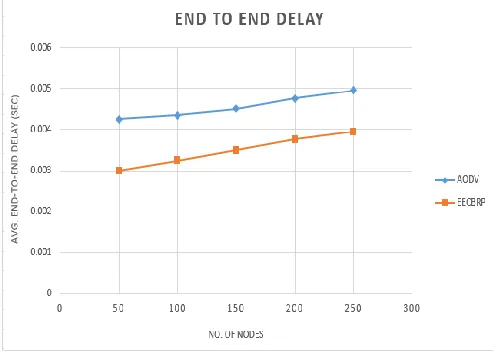
The comparison of the end-to-end delay is show in Fig. 3. As the total number of nodes increases, the average end-to-end delay also increases, because more connections and congestions appear in higher density network. It can also be concluded from this study (Fig. 3) that the average end-to-end delay for proposed approach is better than the AODV protocol. This is because CBRP routing protocol has local path repair and need smaller route discovery time.
Fig. 3: End-to-End Delay Vs No. of nodes
[image:6.612.324.568.501.684.2]The comparison of the packet loss ratio is show in Fig. 4. As the total number of nodes increases, the packet loss ratio decreases. It can also be concluded from this study (Fig. 4) that the packet loss ratio for proposed approach is better than the AODV protocol.
[image:6.612.47.291.518.692.2]International Journal of Emerging Technology and Advanced Engineering
Website: www.ijetae.com (ISSN 2250-2459,ISO 9001:2008 Certified Journal, Volume 5, Issue 3, March 2015)
204
The results of simulation shows that the packet delivery ratio increases greatly and packet delay decreases significantly, when compared with other routing algorithms such as Ad hoc on-demand Distance Vector (AODV).VII. CONCLUSION AND FUTURE WORK
An Energy Efficient Cluster Based Routing Protocol for routing and localizing unknown nodes in a wireless sensor network is discussed. In the proposed work the routing is done quickly, because routing is depended on the address of cluster heads. In failure of any node in the route, its CH may use another node to forward packets in the network. This causes the error tolerance to be enhanced. The performance of proposed system has been evaluated through extensive simulation with network topologies of various sizes. The simulation results show that the network is able to quickly configure the communication infrastructure providing a rough localization of the sensor nodes deployed. Moreover, the simulation results demonstrate that CBRP fit the requirements for clustering and routing, also demonstrates a significant improvements in packet delivery ratio over traditional routing protocol and better performance than other routing algorithms. Thus, clustering conserves the limited energy resources of the sensor nodes. The proposed system is very scalable in that it has linear complexity in the number of neighbors and constant complexity in the total number of nodes.
To get the better result with several protocols, analysis can be done with the protocols like DSR and DSDV. Further, the system can implement security based wireless sensor network by routing the packets in a more secured way.
REFERENCES
[1] M. Carli, S. Panzieri, F. Pascucci, “A joint routing and localization algorithm for emergency scenario”, Elsevier, Ad Hoc Networks 13 (2014) 19–33.
[2] Gurpreet Kaur, Er. Sandeep Kaur Dhanda, “Analysing the effect of Wormhole Attack on Routing Protocol in Wireless Sensor Network”, International Journal of Advanced Research in Computer and Communication Engineering Vol. 2, Issue 8, August 2013. [3] C. Haigaug, W. Huafeng, H. Jinchu and G. Chuanshan,
“Event-based Trust Framework Model in Wireless Sensor Networks”, In the proceedings of the IEEE International Conference on Networking, Architecture and storage, June. 2008.
[4] S. Murthy, J.J. Garcia-Luna-Aceves, “An efficient routing protocol for wireless networks”, ACM Mobile Networks and Applied Journals (1996). Special Issue on Routing in Mobile Communication Networks.
[5] H. Mineno, K. Soga, T. Takenaka, Y. Terashima, T. Mizuno, “Integrated protocol for optimized link state routing and localization: OLSR-L”, Simulation Modelling Practice and Theory 19 (2011) 1711–1722.
[6] C.E. Perkins, P. Bhagwat, “Highly dynamic Destination-Sequenced Distance-Vector Routing (DSDV) for mobile computers”, ACM Computer Communication Review 24 (4) (1994) 234–244. [7] D. Johnson, D. Maltz, “Dynamic source routing in ad hoc wireless
networks”, in: T. Imielinski, H. Korth (Eds.), Mobile Computing, Kluwer Acad. Publ., 1996.
[8] Z.J. Haas, M.R. Pearlman, “The Zone Routing Protocol (ZRP) for ad hoc networks”, Internet Draft (1988).
[9] H. Chan, M. Luk, A. Perrig, “Using clustering information for sensor network localization”, in: The International Conference on Distributed Computing in Sensor Systems (DCOSS), 2005. [10] Youssef, A. Ashok, M. Younis, “Accurate anchor-free node
localization in wireless sensor networks”, in: 24th IEEE International Performance Computing, and Communications Conference, 2005, pp. 465–470.