International Journal of Emerging Technology and Advanced Engineering
Website: www.ijetae.com (ISSN 2250-2459, ISO 9001:2008 Certified Journal, Volume 6, Issue 10, October 2016)
Research on Rheo-Casting and Application of Rheo-Diecasting
Process for Thick-Wall Components
Nguyen Hong Hai
1, Nguyen Tien Tai
2, Nguyen Ngoc Tien
31Hanoi University of Science and Technology, N1 Dai Co Viet Street, Hanoi, Vietnam 2Research Institute of Technology for Machinery, N25, Vu Ngoc Phan Street, Hanoi, Vietnam
3The College of Mechanics and Metallurgy, LuongSon, Thainguyen Province, Vietnam
Abstract - Rheo-casting process on cooling slope and by electromagnetic stirring of Al-Si alloy is studied. The microstructure obtained is fine, spheroidal form with grain size less than 40 m, roundness factor less than 1.5. The Fe-containing intermetallic compound has the Chinese script form. Combined with high-pressure die-casting a new process, known as rheo-diecasting is developed for thick-wall components, such as pump body, which is in general difficult to produce by die-casting method because of the pore formation. The result is good: the component structure is sound, almost no pore was found.
Keywords - rheo-, rheo-diecasting, electromagnetic stirring, cooling slope, thick-wall, simulation.
I. INTRODUCTION
As known, in the case of conventional casting method the crystal microstructure is always dendritic with many defects interdendritic or intergranular. The most desired crystal morphology for constructional materials is spherical, which enhances much the mechanical properties of alloys. This spherical form of grains can be obtained by semi-solid processing (SSP). There are many different
semi-solid routes for obtaining non-dendritic
microstructures [1], such as liquidus/near-liquidus casting, „New MIT Process‟, Semi-solid thermal transformation, Rheo- and thixocasting and so on.
The interesting properties of semisolid alloys with globular structure made possible the invention of a new technology that offers several advantages over the conventional casting, such as porosity reduction, lower forming temperatures, improved flow properties, reduced process force, near net shape forming, better mechanical properties, etc. The most known SSP technologies used for aluminum and other alloys is rheocasting.
The “rheo” routes (rheocasting, rheoforging, rheo-rolling, rheoextrusion) do not require semi-finished products with globular structure, because in this type of process the melted material is subjected to different techniques (electromagnetic stirring, mechanical vibration, cooling slope technique etc. [2, 3, 4, 5, 6]) in order to obtain in the semisolid interval a globular solid fraction in a liquid matrix.
[image:1.612.322.569.408.488.2]Liquid metal high-pressure die-casting (HPDC) is the most popular process used to make aluminium alloys casting, due to the unique characteristics of high efficiency and low production cost. However, Al-alloy components produced by the HPDC contain a large number of porosity due to gas entrapment during die filling. Such porosity can severely deteriorate mechanical properties, exclude the application of HPDC components in the high-safety and airtight systems, and deny the opportunity for further property enhancement by heat treatment and application in welding. Thus, the most detrimental feature of HPDC is turbulent filling of the mould, involving formation of the pore weakening the alloy matrix and affecting on its soundness (Fig. 1).
Fig. 1. Formation of porosity due to turbulent flow in HPDC
The turbulent flow can be transformed into near-laminar if it exists some solid fraction in the melt filling the mold. The near-laminar melt flow allows to reduce the gas involved in the melt thus reduces the porosity formation. Combination of rheocasting and high pressure diecasting creates new casting process known as Rheo-Die Casting (RDC), an innovative one-step.
International Journal of Emerging Technology and Advanced Engineering
Website: www.ijetae.com (ISSN 2250-2459, ISO 9001:2008 Certified Journal, Volume 6, Issue 10, October 2016)
II. EXPERIMETAL
Objective: Aluminium alloy A356.0 (7.0 Si, 0.3 Mg, rem Al), the most widely used aluminium diecasting alloy. Typical used: parts for automotive and electrical industries such as motor frames and housing.
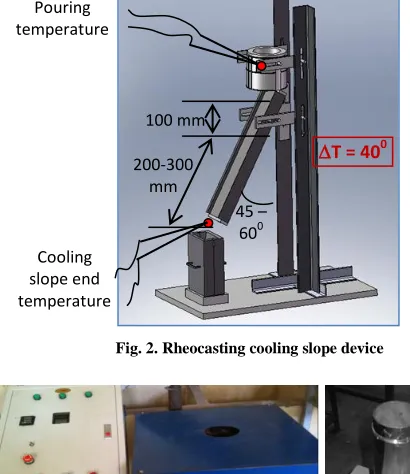
Rheocasting: for investigation of alloy microstructure formed after pouring into the mold through cooling slope a device shown in the fig. 2 was used. Two thermocouples are installed for measuring of the pouring temperature and the temperature at the end of cooling slope (before entering into the mold). The difference is about 400, depending on the cooling length and cooling slope angle (both are adjustable). Also, a device for studying the effect of electromagnetic stirring, shown in the figure 3, was used.
a) b) Figure 3. a) Electro-magnetic stirrer; b) cup for stirring
[image:2.612.321.556.133.263.2]Rheo-diecasting: combination of 3 methods: near-liquidus casting + cooling slop + diecasting (fig. 4).
Fig. 4. Technological scheme for rheo-diecasting
III. RESULTS AND DISCUSSIONS
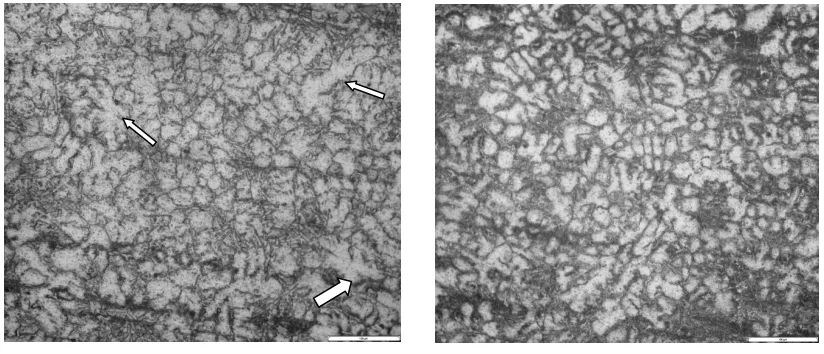
[image:2.612.59.264.317.554.2]Effect of pouring temperature. The alloy microstructure depends remarkably on the pouring temperature, as shown in fig.5, 6, 7.
Fig. 5. Microstructure obtained with pouring temperature at 6750 C;
cooling length 200 mm, cooling slope angle 450
As seen, at pouring temperature 6750C, the alloy microstructure is typical dendritic (fig.5); it‟s obviously due to the too high pouring temperature, hence after running through cooling slope the alloy temperature is still much higher than liquidus (about 635 versus 6150 C); no heterogeneous nuclei can be formed at a such temperature. In this case, the cooling length and slope angle play no role. An another picture can be observed when the pouring temperature decreases to 6500 C (figure 6): the crystals became nodular, equiaxed and rather fine (30–40 m), indicating the effectiveness of the cooling slope: many nuclei were being formed when the metal runs along it.
100 mm
200-300 mm Pouring
temperature
Cooling slope end temperature
[image:2.612.328.563.347.517.2]T = 400
Fig. 2. Rheocasting cooling slope device
45 – 600
Cooling slope
International Journal of Emerging Technology and Advanced Engineering
[image:3.612.100.503.138.313.2]Website: www.ijetae.com (ISSN 2250-2459, ISO 9001:2008 Certified Journal, Volume 6, Issue 10, October 2016)
Fig. 6. Microstructure obtained with pouring temperature at 6500 C;
Left: cooling length 200 mm, right: cooling length 300 mm, both with cooling slope angle 450
One can note that in this case the cooling length of 300 mm is the most appreciate: the sharp factor of grains, determined as F = /4 .S, where p is the sharp perimeter and S is its area, is about 1.4, which is very close to the sharp factor of the circle (F = 1); in the case of 200mm-length, some dendrites can remain (arrow in the figure 6,
left).
If the pouring temperature decreases more (until 6250C) one can observe some grain conglomeration (arrows in the figure 7, left). If the cooling length is increased to 300 mm the crystal morphology becomes transient from nodular to dendritic. This occurs because at low enough temperature the dendritic network can be coherent, becomes steady and can‟t be broken down after.
Fig. 7. Microstructure obtained with pouring temperature at 6250 C;
Left: cooling length 200 mm, right: cooling length 300 mm, both with cooling slope angle 450
So, for A356 alloy the pouring temperature should be 6500C through the cooling slope of 300 mm length, so the temperature of the melt entering into the mold is about 6100 C; slope angle between 45 and 600 depending on the die machine. These parameters are applied for rheo-diecasting process.
[image:3.612.92.504.427.604.2]International Journal of Emerging Technology and Advanced Engineering
Website: www.ijetae.com (ISSN 2250-2459, ISO 9001:2008 Certified Journal, Volume 6, Issue 10, October 2016)
In addition, Cu and Mg is often added as alloying elements to improve the durability and hardness. Impurities and alloying elements partly goes into solid solution, the unsolved part creates intermetallic phases in the process of
solidification. Research results show that the
electromagnetic stirring has a large influence on the form of intermetallic phases: the coarse platelet form (figure 8a) of -Al5FeSi intermetallic phase was transformed into
more compact Chinese script form (-Al8Fe2Si), with less
harmful influence to the mechanical properties of alloys (figure 8b).
This may be a new finding. The cause of the morphological changes may due to the cavitation created in the process of electromagnetic stirring [6]: a very high pressure appeared when caves collapsed and can reach thousands of atmospheres, resulted in the extremely strong shock waves.
The forces created due to wave propagation will cause the dendrites broken and will distribute the dendrite fragments into the area around and the new crystals can form from these ideal nuclei. Also nucleation process can occur due to changes in equilibrium crystallization temperature, caused by a change in pressure [7] or is due to the surface cooling by gas bubbles. The wave propagation also cause a major disturbance in the liquid metal and the result is the newly formed nuclei will distributed throughout the entire tank of liquid, so the crystallization process will proceed in the whole volume Similarly by this way intermetallic phases were influenced by the creation and collapse of cavitation causing a strong breaking force, and a local high cooling rate allow them to have more compact shape and smaller size. However this is a fairly new problem and needs more research to light the mechanism of influence of electromagnetic stirring.
[image:4.612.125.490.340.472.2]
Figure 8. Morphology of -Al5FeSi intermetallic phases (a) without and (b) with (b) electromagnetic stirring
Simulation and rheo-diecasting
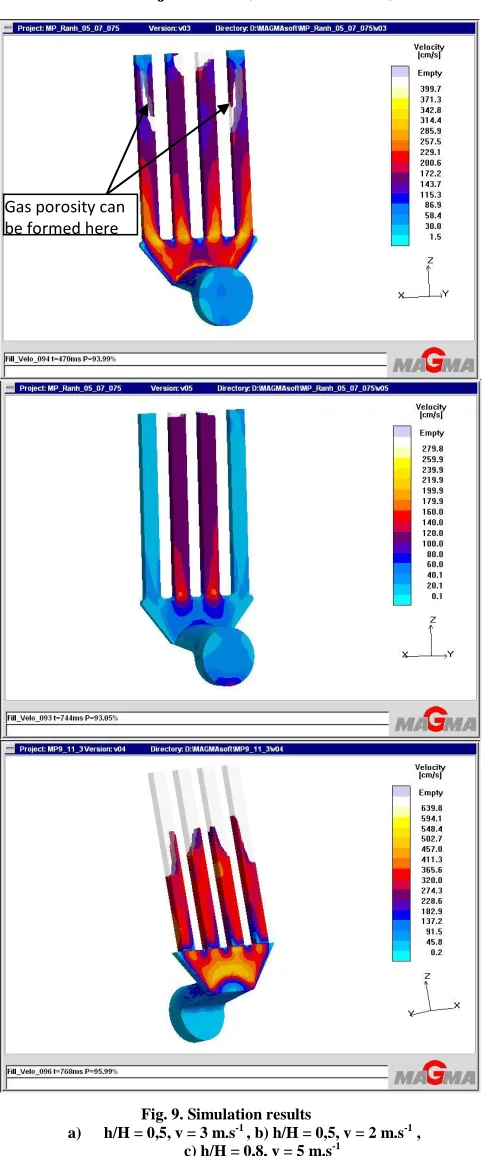
Simulation with software “MAGMAsoft” shows, that at the gate/casting wall thickness ratio, h/H, as 0.5, the turbulent flow can occur at gate velocity at about 3 m.s-1 (fig. 9a); air can be injected into the mold, and as the result, gas porosity can be formed. The laminar flow can be obtained at much lower gate velocity (2.2 m.s-1 – fig. 9b).
If the gate/casting wall thickness ratio is increased (for example to 0.8) then the laminar flow can be obtained at much higher gate velocity; it can reach the value of 5 m/s without gas injection (fig. 9c). That allows, on one hand, to produce the defect free thick-wall components, on another hand, to fill thin-wall parts if available.
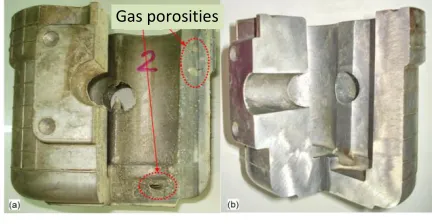
The simulation results are applied for producing a thick-wall component such as the pump block BRA50 (fig. 10). As seen, it‟s very thick-wall component. In the case of conventional die casting, the gas porosities can be observed (fig. 10a). This type of defect can be eliminated only in the case of rheo-diecasting (fig. 10b).
The specific weight is also examined for two cases: conventional and rheo-die casting (fig. 11). As seen, the specific weight increases as the pressure increases in both cases, but the specific weight of rheo-die casting sample is remarkable higher: its mean value is in the range of 2.67 g.cm-3, which is approaching the ASTM standard, meanwhile it‟s only 2.62 for conventional case. These results indicates one more time the advantage of rheo-die casting in comparison with conventional.
Al
5FeSi
a)
b)
Al
8Fe
4Si
[image:4.612.332.548.604.716.2]International Journal of Emerging Technology and Advanced Engineering
Website: www.ijetae.com (ISSN 2250-2459, ISO 9001:2008 Certified Journal, Volume 6, Issue 10, October 2016)
Fig. 9. Simulation results
a) h/H = 0,5, v = 3 m.s-1 , b) h/H = 0,5, v = 2 m.s-1 ,
[image:5.612.55.297.128.706.2]c) h/H = 0,8, v = 5 m.s-1
Fig. 11. Specific weight of samples in two cases
IV. CONCLUSIONS
1. Cooling slope is simple and effective rheo-casting method; its aim is to create the heterogeneous nuclei and to wash them after that into the mold.
2. Nodular or equi-axed crystal morphology can be
formed if the most important technological
parameters, such as pouring temperature, Tpour, and
cooling time (cooling length, l, and cooling slope angle,
, are well combined. For A356 alloy these
parameters are found as Tpour = 6500C, l = 300 mmand = 450
.
3. The morphology of Fe-containing intermetallic compounds can be change from course and harmful platelet into more compact and less harmful Chinese script one.
4. Simulation results shows that laminar flow can be obtained at very high gate velocity if the melt is poured into the mold at semi-solid state: the melt temperature while entering into the mold is 6100 C, that is lower than its liquidus temperature; that help to produce thick-wall component and at the same time allow to fill the thin-wall parts.
5. The experiment results shows the thick-wall gas porosity free component, such as pump block BRA50, can be produced successfully by rheo-diecasting process. The specific weight examination shows also the advantage of this method: its value in the rheo-diecasting case is much higher and approaches ASTM
standard (2,67g.cm-3), meanwhile in the case of conventional die-casting this value is only 2,62 g.cm-3. So the rheo-die casting can be considered
as very promising producing method for light weight metals.
Gas porosity can
be formed here 2,6
2,61 2,62 2,63 2,64 2,65 2,66 2,67 2,68 2,69
180 185 190 195 200 205 210
Áp lực (kg/cm2)
T
ỷ
t
rọ
n
g
(
g
/c
m
3
)
Áp lực-Bán lỏng Áp lực
Rheo-die casting Conventional die casting
Pressure, kg.cm-2
S
pe
ci
fi
c
we
ig
ht
, g.
cm
International Journal of Emerging Technology and Advanced Engineering
Website: www.ijetae.com (ISSN 2250-2459, ISO 9001:2008 Certified Journal, Volume 6, Issue 10, October 2016)
REFERENCES
[1] H.V. Atkinson. 2005. Modelling the semisolid processing of metallic
alloys. Progress in Materials Science 50, pp. 341-412.
[2] Toshio Haga , P. Kapranos. 2002. Simple Rheocasting processes.
Journal of Materials Processing Technology, Elsevier.
[3] J. Wannasin, S. Thanabumrungkul.2008. Development of a
semi-solid metal processing technique for aluminium casting applications. Songklanakarin J. Sci. Technol. 30 (2), 215-220.
[4] N.K.Tolochko, V.I. Timoshpolski, A.S. Kalinichenko and
Yu.A.Shienok. 2006. Formation of Bulk Metal Ingots with Homogeneous Fine-Grained Structure using Novel Semisolid Casting Technique. Solid State Phenomena Vols. 116-117 (2006) pp
406-409. Online at http://www.scientific.net. Trans Tech
Publications, Switzerland.
[5] J. Wannasin1, R.A. Martinez and M.C. Flemings. 2006.A Novel
Technique to Produce Metal Slurries for Semi-Solid Metal Processing. Solid State Phenomena Vols. 116-117, pp 366-369, online at http://www.scientific.net. Trans Tech Publications, Switzerland.
[6] Charles Vives. 1996. Effects of forced electromagnetic vibrations
during the solidification of aluminum alloys: Part I. solidification in the presence of crossed alternating electric fields and stationary magnetic fields. Metallurgical and Materials Transactions B. Volume 27, Issue 3, pp 445-455.
[7] А.И.Батышев. 1990. Кристаллизация металлов и сплавов под