
Kaveh Shahbaz1
1Author affiliation:
University of Malaya
Chemical engineering department, university of Malaya, Kuala Lumpur, Malaysia [email protected]
Farouq Sabri Mjalli2
2Author affiliation:
Sultan Qaboos University
Petroleum and Chemical Engineering Department, Sultan Qaboos University, Oman ♫
Mohd Ali Hashim3
3Author affiliation:
University of Malaya
Chemical engineering department, university of Malaya, Kuala Lumpur, Malaysia
Inas Moen AlNashef4
4Author affiliation:
King Saud University
Chemical Engineering Department, King Saud University, Riyadh, Saudi Arabia ♫ [email protected]
ABSTRACT
The Produced biodiesel through the alkali-catalyzed transesterification must be treated before utilization as an alternative fuel. Low content of catalyst is one of the important pointers needed for passing the EN 14214 and ASTM D6751 international biodiesel standards. In this work, potassium hydroxide (KOH) was selected as catalyst for the transesterification reaction. Two different salts namely; methyl triphenyl phosphunium bromide (MTPB) and choline chloride (ChCl) in combination with four different hydrogen bond donors namely; glycerol, ethylene glycol, 2,2,2-trifluoroacetamide and triethylen glycol were selected to synthesis eighteen deep eutectic solvents (DESs). These DESs were employed as solvents for the removal of residual KOH from palm oil based biodiesel. The results revealed that all tested DESs were able to reduce the content of KOH. The [ChCl:glycerol] DESs and [MTPB:glycerol] DESs proved to be capable of high KOH removal from palm oil-based biodiesel with an average removal efficiency of 98.59% and 97.57% respectively.
INTRODUCTION
and reduces the global warming problems; low sulfur and aromatic content; its cetane number and flash point are as high as fossil-based diesel; its agricultural; environmental benefits; being of domestic origin reduces the dependency on imported petroleum; good engine performance and facility to be blended with normal petroleum-based diesel (Ma and Hanna 1999; Munack 2006; Alptekin and Canakci 2008; Lapuerta et al. 2008). Currently, there are four main methods to produce biodiesel namely; direct use and blending of raw oils (Adams et al. 1983; Engler et al. 1983; Strayer et al. 1983), micro-emulsions (Schwab et al. 1987), thermal cracking (Chang and Wan 1947; Crossley et al. 1962; Pioch et al. 1993), and transesterification (Leung et al. 2010). Amongst these methods, transesterification is the most common method for synthesizing the biodiesel. Generally, the transesterification reaction can be catalyzed by alkalis, acids, and enzymes (Ma and Hanna 1999). Recently, enzyme catalysts have attracted more scientists' attention because these catalysts prevent the soap formation and the purification process is effortless to complete. Nevertheless, they haven’t been utilized commercially due to their long reaction times and high cost (Fukuda et al. 2001; Leung et al. 2010). The alkali and acid catalysts are more used in the production of biodiesel compared to enzyme catalysts because of their inexpensive raw material chemicals. The acid-catalyzed transesterification reaction requires a high molar ratio of methanol to oil; moreover, its reaction time is very long as compared with alkali catalysts and the acidic catalysts are corrosive and non-environmentally friendly (Marchetti and Errazu 2008; Rashtizadeh et al. 2010). The most common catalysts for the transesterification reaction are the alkali catalysts (homogeneous base catalysts) such as sodium hydroxide (NaOH) and potassium hydroxide (KOH) which are being used commercially in biodiesel production (Demirbas 2008; Dias et al. 2008; Rashid et al. 2008).
Hideki et al.(Fukuda et al. 2001) initiated that the best production of biodiesel is by
using homogeneous alkaline catalysts; however, biodiesel includes unreacted
components and unwanted products such as residual catalyst, water, un-reacted alcohol, free glycerol, and soaps that were generated during the transesterification reaction. Hence, several stages such as neutralization, evaporation of residual methanol and water washing are necessary to remove these impurities from biodiesel before using it as an alternative fuel.
to remove the impurities. Both the ion exchange and the magnesium silicate process have the advantage of being waterless. However, using these methods will increase the production cost because of the added materials expenses and in some cases overrun the limits specified in the EN Standard. Another method for the purification of biodiesel is by membrane extraction. Using this method, the final production cost is increased and the processing throughput decreases due to exiting contaminants (Leung et al. 2010). Due to ionic liquids (ILs) unusual favorable properties, they have attracted more attention and became a focus point for many applications. However, there is still a challenge for the large-scale applications of ionic liquids in industry, because of complicated synthesis processes and the expensive raw material chemicals (Robin 2003). Hence, deep eutectic solvents (DESs) can be utilized as a low cost alternatives of ILs (Hou et al. 2008). DESs are formed from mixtures of organic halide salts with an organic compound which is a hydrogen bond donor (HBD) and able to form a hydrogen bond with the halide ion (Shahbaz et al. 2011). Deep eutectic solvents have properties similar to ionic liquids, especially, their potential as tuneable solvents that can be customized to a particular type of chemistry (Nkuku and LeSuer 2007). Currently, DESs are being used in research as well as industry because of their potential as an alternative environment friendly solvents and advantages over traditional ionic liquids such as ease of preparation in high purity at low cost, non-toxicity, non-reactivity with water and being biodegradable (Abbott et al. 2004). In addition, DESs are being studied comprehensively in many research areas as media for organic and inorganic reactions and separations. In addition, the advantages of the DESs have the best answer for the industrial requirements for large-scale applications.
EXPERIMENTAL SECTION
Synthesis of biodiesel and DESs
In this work, the transesterification of palm oil with methanol to fatty acid methyl ester (FAME) using KOH as homogenous catalyst is considered. Palm oil (FFM Sdn Bhd) was supplied at local food store and Methanol (99.8%), potassium hydroxide (98.9%) were purchased from Sigma–Aldrich, Malaysia. 500 g palm oil was poured in the batch reactor to carry out the transesterification reaction. Homogeneous potassium methoxide was prepared by dissolving potassium hydroxide (1wt% of palm oil) in methanol and then added to the reactor at the reaction temperature of 60 ºC. The molar ratio of palm oil to methanol was 1:10 and agitation was set at a constant speed (400 rpm) during the experiment. After 2 hours, the mixture was poured to a separation funnel. After allowing overnight settling, the upper layer (biodiesel phase) was separated from the lower layer (glycerol-rich phase).
In this work, nine ammonium salt-based DESs and nine phosphunium-based DESs were synthesized and utilized as solvents in liquid-liquid extraction for the removal of
residual catalyst (KOH). Choline chloride (C5H14ClNO) and methyl triphenyl
phosphunium bromide (C19H18PBr) as salts and 2,2,2-trifluoroacetamide (C2H2F3NO),
glycerol (C3H8O3), ethylene glycol (C2H6O2) and triethylen glycol (C6H14O4) as
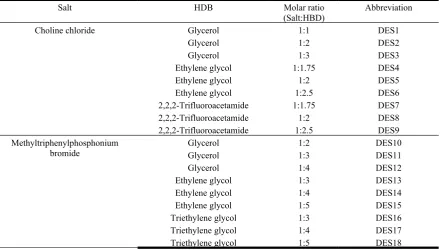
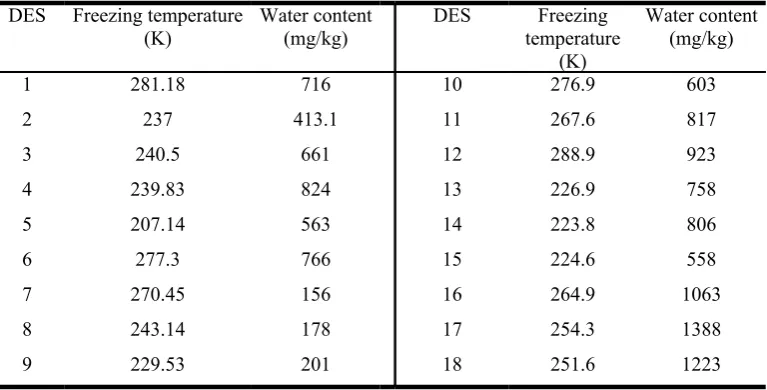
hydrogen bond donors were supplied from Merck Chemicals with high purity )> 99(% and utilized for the synthesis of DESs without further purification. The deep eutectic solvents were formed by stirring the salt with different HBD in different molar ratios under an argon atmosphere and at 353.15 K until a homogenous and colorless liquid appeared. Table 1 presents the compositions of the different DESs synthesized in this study (termed in this study as DES1 to DES18). The freezing point measurements of all DESs were made using Mettler Toledo Differential Scanning Calorimeter )DSC). Furthermore, the water content of all DESs was determined by Karl Fisher titration method. Table 2 shows the freezing temperature and water content of the studied DESs in this work.
Salt HDB Molar ratio
(Salt:HBD)
Abbreviation
Choline chloride Glycerol 1:1 DES1
Glycerol 1:2 DES2
Glycerol 1:3 DES3
Ethylene glycol 1:1.75 DES4
Ethylene glycol 1:2 DES5
Ethylene glycol 1:2.5 DES6 2,2,2-Trifluoroacetamide 1:1.75 DES7 2,2,2-Trifluoroacetamide 1:2 DES8 2,2,2-Trifluoroacetamide 1:2.5 DES9 Methyltriphenylphosphonium
bromide
Glycerol 1:2 DES10
Glycerol 1:3 DES11
Glycerol 1:4 DES12
[image:4.595.93.534.505.755.2]Ethylene glycol 1:3 DES13 Ethylene glycol 1:4 DES14 Ethylene glycol 1:5 DES15 Triethylene glycol 1:3 DES16 Triethylene glycol 1:4 DES17 Triethylene glycol 1:5 DES18
Table 2. Freezing Temperatures and water content for Studied DESs.
DES Freezing temperature (K)
Water content (mg/kg)
DES Freezing temperature
(K)
Water content (mg/kg)
1 281.18 716 10 276.9 603
2 237 413.1 11 267.6 817
3 240.5 661 12 288.9 923
4 239.83 824 13 226.9 758
5 207.14 563 14 223.8 806
6 277.3 766 15 224.6 558
7 270.45 156 16 264.9 1063
8 243.14 178 17 254.3 1388
9 229.53 201 18 251.6 1223
Extraction Process
To perform the extraction of KOH from palm oil-based biodiesel, each DES was added to the biodiesel phase individually in different molar ratios (ranging 0.75-3 molar units DES per 1 molar unit biodiesel). The samples were then agitated for 1 hour at 200 rpm using an orbital shaker and at ambient temperature. Finally after two hours settling, the upper layer was separated and directly analyzed for its KOH content by measuring the potassium element using inductively coupled plasma-optical emission (ICP-OES).
ICP-OES analysis
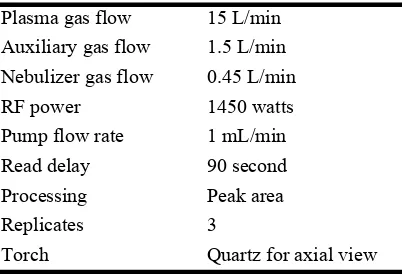
The measurement of potassium was conducted using the PerkinElmer Optima 7000 DV ICP-OES instrument (PerkinElmer, Inc., Shelton, CT, USA) equipped with WinLab32 and Aragon (99.99%) was used as the carrier gas. The ICP-OES analytical conditions are given in Table 3. The wavelength for the analysis of potassium was set at 766.486 nm. The oil standard for potassium (500 mg/kg) and oil based were supplied from Conostan Company and diluted in xylene solution (Merck, > 99%) at six different concentrations (0.5 ppm, 1ppm, 2 ppm, 5ppm, 7 ppm and 15ppm). The resulting solutions were directly injected into the ICP-OES to perform the calibration. The linear
correlation coefficient (R2) was found to be 0.998 which indicated reasonable linearity.
Table 3. ICP analytical conditions.
Plasma gas flow 15 L/min Auxiliary gas flow 1.5 L/min Nebulizer gas flow 0.45 L/min RF power 1450 watts Pump flow rate 1 mL/min Read delay 90 second Processing Peak area Replicates 3
Torch Quartz for axial view
RESULT AND DISCUSSION
The biodiesel was synthesized by the alkali-catalysed transesterification of palm oil and without any purification or washing step was directly analysed by the ICP-OES. A KOH content of 79.588 mg/kg was determined which is exceeds the ASTM D6751 and EN 14214 international standards (5mg/kg) acceptable limits.
Choline chloride (ChCl) was mixed separately with three different Hydrogen bond donors namely; glycerol, ethylene glycol and 2,2,2-trifluoroacetamide at three different molar ratios to form the nine DESs based on ChCl (DES1 to DES9). Moreover, methyl triphenyl phosphunium bromide (MTPB) was mixed with three different HBD (glycerol, ethylene glycol and triethylen glycol) at three different molar ratios to synthesis the nine DESs based on MTPB (DES10 to DES18). In this work, all molar ratios of salt: HBD were selected based on the minimum freezing temperature. As indicated by Table 2, all the synthesized DESs gave low freezing points as compared to their constituting components and below ambient temperature. This is consistent with the general behaviour of deep eutectic solvents. In addition, water content of all ChCl-based DESs was less than 0.1 wt%. Also for the all MTPB-ChCl-based DESs, the water content was less than 0.1 wt% except DES16, DES17 and DES18 which were 0.106 wt%, 0.138 wt% and 0.122 wt% respectively (Table 2). Nonetheless, all DESs water content were consistent with physical properties of deep eutectic solvents.
For the removal of residual KOH from palm oil-based biodiesel, the synthesized DESs were mixed with the produced biodiesel for one hour at six different molar ratios of DES to biodiesel (0.75:1, 1:1, 1.5:1, 2:1, 2.5:1 and 3:1) to determine maximum removal efficiency. The extraction process was carried out at ambient temperature. After two hours settling, The DES layer was separated wholly and no emulsion was formed. The biodiesel layer was analysed for its KOH content by measuring potassium element using ICP-OES. Intermolecular attractions of solvent (DES) with solute (KOH) exist in ion pairing, hydrogen bonding, dipole and Van der Waals interactions. However, Due to the polarity of DESs, existence of the hydroxyl group in both DES and KOH and the solvation forces for KOH in biodiesel, DESs have high affinity for the attraction of KOH through the hydrogen bonding and dipole-dipole attraction.
not detected by ICP-OES due to the method detection limit (MDL) of 0.1 mg/kg. This indicates that the KOH content was below the MDL. The removal efficiency of KOH content by using these DESs was above 99.87%. It can be concluded that all ChCl to glycerol DESs at all ratios of DES:biodiesel excluding DES1 at 0.75:1 (DES1: biodiesel) ratio were successful to decrease the KOH content lower than the value required by ASTM D6751 and EN 14214 international standards. Moreover, the content of KOH was reduced with the increase in mole fraction of glycerol in eutectic mixture of ChCl: glycerol.
DES : Biodiesel molar ratio
0.5 1.0 1.5 2.0 2.5 3.0 3.5
C
on
ce
n
tr
at
io
n o
f K
O
H
(m
g/k
g)
0.0 2.0 4.0 6.0 8.0
DES1 DES2 ASTM D6752
Fig. 1. KOH removed after extraction by the [ChCl:glycerol] DES with different compositions.
DES : Biodiesel molar ratio
0.5 1.0 1.5 2.0 2.5 3.0 3.5
C
on
ce
n
tr
at
io
n o
f K
O
H
(m
g/k
g)
0.0 4.0 8.0 12.0 16.0 20.0 24.0 28.0
DES4 DES5 DES6 ASTM D6752
Fig. 2. KOH removed after extraction by the [ChCl:ethylene glycol] DES with different compositions.
DES : Biodiesel molar ratio
0.5 1.0 1.5 2.0 2.5 3.0 3.5
C
on
ce
n
tr
at
io
n o
f K
O
H
(m
g/k
g)
2.0 3.0 4.0 5.0 6.0 7.0
DES7 DES8 DES9 ASTM D6752
Fig. 3. KOH removed after extraction by the [ChCl:2,2,2-Trifluoroacetamide] DES with different compositions.
[image:8.595.86.430.80.566.2]DES : Biodiesel molar ratio
0.5 1.0 1.5 2.0 2.5 3.0 3.5
C on ce n tr at io n o f K O H (m g/k g) 0.0 1.0 2.0 3.0 4.0 5.0 6.0 7.0 DES10 DES11 DES12 ASTM D6752
Fig. 4. KOH removed after extraction by the [MTPB:glycerol] DES with different compositions.
DES : Biodiesel molar ratio
0.5 1.0 1.5 2.0 2.5 3.0 3.5
C on ce n tr at io n o f K O H (m g/k g) 0 1 2 3 4 5 6 7 8 DES13 DES14 DES15 ASTM D6752
Fig.5. KOH removed after extraction by the [MTPB:ethylene glycol] DES with different compositions.
DES : Biodiesel molar ratio
0.5 1.0 1.5 2.0 2.5 3.0 3.5
C on ce n tr at io n o f K O H (m g/k 0.0 2.0 4.0 6.0 8.0 10.0 12.0 14.0 DES16 DES17 DES18 ASTM D6752
DESs and [MTPB:glycerol] DESs proved that glycerol-based DESs are efficient to remove the KOH content from palm oil-base biodiesel. Consequently, glycerol as a HBD in the eutectic mixture of salt:HBD is more suitable than the others for the current application. One reason can be the high solubility of KOH in glycerol.
CONCLUSION
In the present work, we examined a new purification technique for removal residual KOH from palm oil-based biodiesel using ammonium-based DESs and phosphonium-based DESs. For this purpose, nine ChCl-phosphonium-based DESs and nine MTPB-phosphonium-based DESs at different compositions were tested as solvent in for the removal of KOH content. All tested DESs (DES1 to DES18) were able to remove the residual KOH. The removal efficiency of KOH by all used DESs increased with increase in DES:biodiesel molar ratio. Moreover, KOH removal efficiency using all tested DESs increased by increasing the mole fraction of HBD in the mixture of salt:HBD apart from 2,2,2-trifluoroacetamide as HBD. The KOH average removal efficiency of 98.59% and 97.57% by ChCl: glycerol DESs (DES1 to DES3) and MTPB to glycerol DESs (DES10 to DES12) proves that these DESs were more efficient than other DESs to remove the KOH from palm oil-base biodiesel. These DESs at all DES:biodiesel molar ratios excluding DES1 at 0.75:1 (DES1: biodiesel) ratio were successful to reduce the KOH content below the value required by ASTM D6751 and EN 14214 international standards.
ACKNOWLEDGEMENT
The authors would like to thank the Institute of Research Management and Monitoring of the University of Malaya (research grant No. PS133/2009C), Sultan Qaboos University and King Saud University for their support to this research.
REFERENCES
Abbott, A. P., D. Boothby, et al. (2004). "Deep Eutectic Solvents Formed between Choline Chloride and Carboxylic Acids:  Versatile Alternatives to Ionic
Liquids." Journal of the American Chemical Society126(29): 9142-9147.
Abbott, A. P., P. M. Cullis, et al. (2007). "Extraction of glycerol from biodiesel into a
eutectic based ionic liquid." Green Chemistry9(8): 868-872.
Adams, C., J. Peters, et al. (1983). "Investigation of soybean oil as a diesel fuel
extender: Endurance tests." Journal of the American Oil Chemists' Society 60(8):
1574-1579.
Alptekin, E. and M. Canakci (2008). "Determination of the density and the viscosities of
biodiesel-diesel fuel blends." Renewable Energy33(12): 2623-2630.
ASTM D-6751-02, Standard Specification for Biodiesel Fuel (B100) Blend Stock for Distillate Fuels, Designation D-6751-02, American Society for Testing and Materials: West Conshohocken, PA, 2002.
Atadashi, I. M., M. K. Aroua, et al. (2010). "Biodiesel separation and purification: A
review." Renewable Energy36(2): 437-443.
Berrios, M. and R. L. Skelton (2008). "Comparison of purification methods for
biodiesel." Chemical Engineering Journal144(3): 459-465.
Canakci, M, et al. (2001). Biodiesel production from oils and fats with high free fatty acids. St. Joseph, MI, ETATS-UNIS, American Society of Agricultural Engineers. Chang, C.-C. and S.-W. Wan (1947). "China's Motor Fuels from Tung Oil." Industrial &
Cooke, B. S. S. D., Clarksville, IN 47129, US), Abrams, Christopher (3904 Forest Trace, Louisville, KY 40245, US), Bertram, Bryan (4105 Doe Ridge Drive, Floyds Knobs, IN 47119, US) (2009). PURIFICATION OF BIODIESEL WITH ADSORBENT MATERIALS, The Dallas Group of America, Inc. (374 Route 22, P.O. Box 489, EP1670882).
Crossley, A., T. Heyes, et al. (1962). "The effect of heat on pure triglycerides." Journal
of the American Oil Chemists' Society39(1): 9-14.
Demirbas, A. (2008). Current Technologies in Biodiesel Production. Biodiesel, Springer
London:161-173.
Dias, J. M., M. C. M. Alvim-Ferraz, et al. (2008). "Comparison of the performance of different homogeneous alkali catalysts during transesterification of waste and virgin
oils and evaluation of biodiesel quality." Fuel87(17-18): 3572-3578.
Dubé, M. A., A. Y. Tremblay, et al. (2007). "Biodiesel production using a membrane
reactor." Bioresource Technology98(3): 639-647.
Engler, C., L. Johnson, et al. (1983). "Effects of processing and chemical characteristics of plant oils on performance of an indirect-injection diesel engine." Journal of the
American Oil Chemists' Society60(8): 1592-1596.
Fukuda, H., A. Kondo, et al. (2001). "Biodiesel fuel production by transesterification of
oils." Journal of Bioscience and Bioengineering92(5): 405-416.
Gerpen, J. V. (2005). "Biodiesel processing and production." Fuel Processing
Technology86(10): 1097-1107.
Hayyan, M., F. S. Mjalli, et al. (2009). "A novel technique for separating glycerine from
palm oil-based biodiesel using ionic liquids." Fuel Processing Technology 91(1):
116-120.
Hou, Y., Y. Gu, et al. (2008). "Novel binary eutectic mixtures based on imidazole."
Journal of Molecular Liquids143(2-3): 154-159.
Kareem, M. A., F. S. Mjalli, et al. (2010). "Phosphonium-Based Ionic Liquids Analogues and Their Physical Properties." Journal of Chemical & Engineering Data
55(11): 4632-4637.
Lapuerta, M., O. Armas, et al. (2008). "Effect of biodiesel fuels on diesel engine
emissions." Progress in Energy and Combustion Science34(2): 198-223.
Leung, D. Y. C., X. Wu, et al. (2010). "A review on biodiesel production using
catalyzed transesterification." Applied Energy87(4): 1083-1095.
Ma, F. and M. A. Hanna (1999). "Biodiesel production: a review." Bioresource
Technology70(1): 1-15.
Marchetti, J. M. and A. F. Errazu (2008). "Esterification of free fatty acids using sulfuric acid as catalyst in the presence of triglycerides." Biomass and Bioenergy
32(9): 892-895.
Meher, L. C., D. Vidya Sagar, et al. (2006). "Technical aspects of biodiesel production
by transesterification--a review." Renewable and Sustainable Energy Reviews10(3):
248-268.
Munack, A. (2006). "Books: Biodiesel – A comprehensive handbook. Martin
Mittelbach, Claudia Remschmidt (Ed.)." Biotechnology Journal1(1): 102-102.
Nkuku, C. A. and R. J. LeSuer (2007). "Electrochemistry in Deep Eutectic Solvents."
The Journal of Physical Chemistry B111(46): 13271-13277.
Pioch, D, et al. (1993). Biofuels from catalytic cracking of tropical vegetable oils. Paris, FRANCE, Société d'éditions techniques continentales.
Rashid, U., F. Anwar, et al. (2008). "Production of sunflower oil methyl esters by
1202-double aluminosilicate layers, microporous and mesoporous materials as catalyst for
biodiesel production via transesterification of soybean oil." Fuel89(11): 3393-3398.
Robin, D. R. K., R. S. I. (2003). "Ionic Liquids: Industrial Applications to Green
Chemistry." Journal of the American Chemical Society125(24): 7480-7480.
Schwab, A. W., M. O. Bagby, et al. (1987). "Preparation and properties of diesel fuels
from vegetable oils." Fuel66(10): 1372-1378.
Shahbaz, K., F.S. Mjalli, M.A. Hashim and I.M. Al-Nashef (2010). " Using deep eutectic solvents for the removal of glycerol from palm oil-based biodiesel." J.
Applied Sci10(24): 3349-3354.
Shahbaz, K., F. S. Mjalli, et al. (2011). "Prediction of deep eutectic solvents densities at
different temperatures." Thermochimica Acta515(1-2): 67-72.
Strayer, R., J. Blake, et al. (1983). "Canola and high erucic rapeseed oil as substitutes for diesel fuel: Preliminary tests." Journal of the American Oil Chemists' Society
60(8): 1587-1592.
BRIEF BIOGRAPHY OF PRESENTER
First Authoris PhD candidate at the Department of chemical Engineering, Faculty of
engineering, university of Malaya, Malaysia. He can be reached at
![Figure 4 shows that all the [MTPB:glycerol] DESs at all DES:biodiesel ratios removed](https://thumb-us.123doks.com/thumbv2/123dok_us/8654580.868667/8.595.86.430.80.566/figure-shows-mtpb-glycerol-dess-biodiesel-ratios-removed.webp)
