http://www.scirp.org/journal/jbm ISSN Online: 2327-509X
ISSN Print: 2327-5081
Disability: A Case Screening Program Approach
Sudarshan Paudel
1, Lilanath Bhandari
2, Dil Bahadur Bhandari
11Department of Community Health Sciences, Patan Academy of Health Sciences, Lalitpur, Nepal 2Department of Public Health, HOPE International College, Lalitpur, Nepal
Abstract
Disability is an accident waiting to happen in population. Large numbers of population in world are disabled and its prevalence is on the rise. Disabled people have to face two additional challenges namely, limitation in body and social stigmatization on top of other social happening to general public. The stipulation of disability will be subjective because social and physical condi-tion is directly related to it. The study was also envisioned to develop a disa-bility screening approach. The objective was to focus on how disabled has been included in the government’s health plans in Nepal. The study has pre-sented data of 894 disabled people from randomly selected seven VDCs of Makwanpur district. The total population in studied VDCs was 87,502. The study was conducted in coordination with local governing bodies and health development partners during August-October in 2012. The study revealed 1.02 percent prevalence of disability among study population. The majority were suffering physical disability (60.6 percent) followed by deaf (19.7 per-cent). Based on age group, young adults (15 - 19 years) group was more (31 percent) vulnerable. Out of total, the number of male was higher due to their high exposure in external environment and risk taking behaviour.
Keywords
Disability, Case Screening, Nepal
1. Introduction
The latest census of Nepal (2011) has accepted that people with disabilities are economically and socially vulnerable, underprivileged and marginalized popula-tion in the country [1] [2]. The same phenomenon is found across the world. People with disabilities have poorer health outcomes, lower attainment of edu-cation, lesser opportunities to participate in economic activities and withdrawal from basic social services in their everyday lives due to the lack of accessibility, availability and affordability as compared to people without disabilities [3]. The
How to cite this paper: Paudel, S., Bhan-dari, L. and BhanBhan-dari, D.B. (2017) Disabili-ty: A Case Screening Program Approach. Journal of Biosciences and Medicines, 5, 10-21.
https://doi.org/10.4236/jbm.2017.52002
Received: December 19, 2016 Accepted: February 6, 2017 Published: February 9, 2017
Copyright © 2017 by authors and Scientific Research Publishing Inc. This work is licensed under the Creative Commons Attribution International License (CC BY 4.0).
report furthermore emphasizes that condition of socio-economically underpri-vileged people is further worse.
An estimated 15% of the world’s population—approximately one billion people, of whom 200 million are children—experience some form of disability which was around 10% during 1970s [4]. The disability prevalence will increase in coming days due to increasing number of ageing population and high preva-lence of lifestyle related diseases conditions worldwide. Besides that trends of environmental dilapidation, poor developmental infrastructure, fragile health care system, social unrest, risky socio-cultural practices in some ethnic groups will continue augmenting disability [3] [4].
Disability can be measured in different ways, affecting both the number of in-cidences and distributions on various variables. Thus, the disability rates from diverse national data collection sources are not yet comparable across the world because of differences in definition, concepts and methods [5] [6].
The study focused on how disabled has been included in the government’s health plans in Nepal. The second part of the article presents data from a small study of disabled people. The study was conducted in Makawanpur, a hilly dis-trict of Nepal in coordination with local governing bodies, health development partners and disable people self-help groups.
2. Disability and Disabled People
Disability and poverty are inextricably linked and lead to a vicious cycle with one being both a cause and a consequence of the other [3] [5]. Persons with disabili-ties are estimated to make up to 15% to 20% of poor people in developing coun-tries [3] [7]. Worldwide, as much as 50% of disabilities are directly linked to po-verty [8]. The relationships between poverty and disability are complex, includ-ing social exclusion and stigma, and barriers to employment. Disability and po-verty is examined by two methods. If the popo-verty is analyzed in terms of availa-bility of money, good or services earning and consuming, it is called monetary method. This method is used to measure household level poverty. This method, however, lacks the explanatory variables that breed poverty [9]. The other me-thod of measuring poverty is quality of life and focuses on opportunity for dig-nity, freedom, self-respect and respect to others, and decent living [10].
It is a distressing fact that the number of people with disabilities is growing due to population growth, ageing, emergence of chronic diseases, and medical advances that preserve and prolong life. The most common causes of impair-ment and disability are: chronic diseases such as diabetes, cardiovascular disease and cancer; injuries due to road traffic accidents, violence, falls and landmines; birth defects; malnutrition; and communicable diseases such as HIV/AIDS and leprosy [3] [7] [8]. Furthermore, many people were disabled during the ten year long civil war [11].
[13]. The organizations have proposed interventions for a more equitable society that dismantles disabling barriers and respects human rights for everyone. This awareness has developed the medical model of disability [12]. The medical mod-el looks at disability at the individual levmod-el, proposing interventions that can im-prove individuals’ functioning ability and decrease the impact of the disabilities (to those who can afford). The social model of disability has had a profound im-pact on the way disability issues are understood and analyzed. It has also led to the development of the “International Classification of Functioning, Disability and Health” (ICF, 2001) by the World Health Organization (WHO) [14]. In the context of health, under ICF, disability is seen as a complex relationship between the health condition and the contextual factors (i.e. environmental) and personal factors [15] [16].
3. Disability in Nepal
Nepal, with a population of about 26 million, is one of the underdeveloped countries in the world with a per capita income of US $762 per year in fiscal year 2015 [17]. The poverty incidence or poverty headcount rate for Nepal is 25.2 percent [18]. More than 60% (31% according to the government data) of the population live in abject poverty, which affects different human development indices [19]. Over the past decade, life in Nepal has been marked by internal strife and civil war with suspension of civil liberties, which have been reinstated only recently. This has worsened the general situation in the country.
The ten year long insurgency has affected the lives of many people all over the country and many have become disabled, caught in ambush or in crossfire be-tween national security forces and Maoists [20]. Nepal is prone to environmental and natural disasters such as landslides, floods, and earthquake, which have di-rect implications for the prevalence of disability.
Disability is complex and multifaceted, with its effect on various span of life. Culture of the land has great role over the factors contributing to disability. Merging all factors into one indicator that can measure longevity is difficult. A better approach would be to rethink what measures are needed for different ob-jectives and how to best calculate them [23]. This type of measures would enable citizens to demand health and rehabilitation services. Today, such services are not available, particularly among the poor and other disadvantaged groups. Un-til now, Nepali disabled people are far behind to make their voice heard because they are rescind within family [2] [6].
In 2006, the government of Nepal made a National Policy and Plan of Action on Disability [25]. It identified 17 areas for the development of PWDs’ condi-tions. This document was based on the Declaration of Asian and Pacific Decade of Disabled Persons, (1993-2002); the World Action Plan on Disability (1982); the UN’s Standard Rules on the Equalization of Opportunities for PWD; and the seven priority areas determined by Biwako Millennium Framework of Action,
[15] as well as national policies and plans. However, these plans are hardly re-flected in actual practice. The document had specified the responsibilities of dif-ferent stakeholders, stating that all agencies, sectors and parties have to collabo-rate while implementing the plan, for instance, decide how to approach families in communities in order to unveil cases of disability, and how to ensure the sur-vival of disabled newborn. The implementation is faced with several challenges: lack of financial resources and means, lack of coordination, lack of mass aware-ness, flaws in government institutional structures that leads to delay in necessary amendments of acts and regulation and formulation of new laws, policies and regulations, etc. Issues related to transparency, accountability, organisation co-ordination, exchange of experiences both at the national and international levels, appropriate mobilisation of non government organisations and civil society, all are essential steps for the government to effectively implement its plan.
The constitution of Nepal promulgated in 2015 has guaranteed “right to health care” as a fundamental right and provides each citizen the “right to seek health care services from the state and no citizen shall be deprived of emergency health care.” The constitution has envisioned dignified life and equal access to social services and facilities to people with physical impairment along with their diversity identity [13].
4. Disability Study in Makawanpur
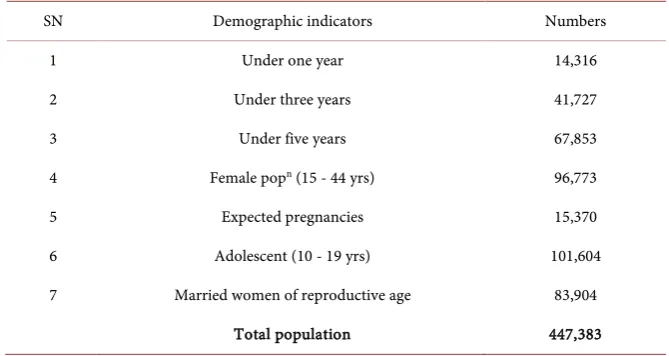
Makawanpur is a hilly district of Nepal with a population of approximately 447,383 (Table 1) which includes various ethnic groups (more than 15 tribes), each with its own language and culture. The Tamang people represent a majority with 47 percent of the district’s population, whereas the Bankariya and the Chepang are ethnic minorities who feel their life conditions somewhat imper-illed [26].
Table 1. Demographic information of the Makawanpur district.
SN Demographic indicators Numbers
1 Under one year 14,316
2 Under three years 41,727
3 Under five years 67,853
4 Female popn (15 - 44 yrs) 96,773
5 Expected pregnancies 15,370
6 Adolescent (10 - 19 yrs) 101,604
7 Married women of reproductive age 83,904
Total population 447,383
and the population growth is 2.2%. The average household size among the 71,112 families is 5, with a total population of 447,383 [12]. The proportion of rural population is 82.6%, and the density per square km is 160.5 people. The literacy rate in the district is 63.4% (female 53.9%). 53.6% among the economi-cally active population work in agriculture. Only 25.15% of the land can be cul-tivated [14].
5. Sample Size
To find the sample size, the district was divided into two parts demarking by Tribhuvan Highway ensuring equal number of VDCs. The population size and ethnic composition in both parts was almost alike. We reviewed government statistics to ensure disability awareness, care and support programs coverage from government sectors and other development agencies, and found consistent in both parts thus decided to select only one part. Through random method western part [from Tribhvan Highway] of district was selected for data collec-tion. Out of total twenty-one VDCs of western part of Makwanpur, seven VDCs were selected randomly for data collection. The VDCs are almost homogenous in number and geography.
The data for this study were collected in a survey during August to October in 2012 in collaboration with district development committee, and the district dis-ability steering committee. The study had covered all households from study VDCs. Almost all the households belong to marginalised rural groups, usually specific caste groups [14].
6. Selection of Volunteers
3) good raport skills and 4) prior experince woriking in disability awareness and services. The Health Post In-charges published notice to express their interest by those who meet criteria. The District Disability Screening Committee in coordi-nation with Healthpost In-charge interviewed all eligible incumbets and pub-lished name list of 8 volunteers (4 female and 4 male) at least one volunteers from all study VDCs. (Due to difficulty topography andn large number of household size, there were two volunteers in Hadikhola VDC). The selected vo-lunteers were apppointed in Health Post who were subjected to get transporta-tion, fooding and acomodation cost at actual basis.
Research volunteers were privided with intensive residential training for 13 days by District Disability Screenig Committee in coordination with National Disability Federation of Nepal. The content of the training were as follow:
• Concept, definition and development of Community Based Rehabilitation
(CBR).
• Basic functions and structure of Human anatomy.
• Social and Community Approach on Disability.
• Definition and classification of disability, Social Model of Disability
(Disabil-ity and Development, Disabil(Disabil-ity and Poverty, Disabil(Disabil-ity and Human rights, Disability related national and international policies, laws and rules).
• Visual disability and rehabilitation. • Intellectual Disability and Rehabilitation. • Hearing Disability and Rehabilitation. • Mental Illness and psycho-social counseling. • Physical Disability and Rehabilitation.
• Sound and Speaking Disability and Rehabilitation. • Disability Identification and Comprehensive Assessment. • Advocacy and Awareness for Disability Rights.
• Rights of Women/Girls with Disability. • Deaf-Blindness and Rehabilitation.
• Disability Management in rural area: Program planning, managing,
report-ing, recording keeping etc.
After successfully complition of training, volunteers were mobilized under the aegis of district disability screening committee so that they felt responsible to-ward the community rather than surver organization. Three survey volunteers were parents of disabled children and the rest were from ethnic groups.
The preliminary tasks for the volunteers were to identify the PWDs, provide preventive services to PWDs, and to encourage the VDC in their own commu-nity to make disability a developmental issue. The volunteers periodically de-veloped a community disability plan for VDC. This was done in collaboration with district disability streering committee. After six month of basic training, they were given 6 days refresher training and orientation about disability screen- ing, using a disability assessment form (DAF).
disabili-ty. They were also equiped with basic tool-kits for screening and creating awar-ness in their community and filled up all the assessed cases asking with house-hold head of every househouse-hold from study VDCs. The identification of disabled persons in a family was based on acceptance by the head of each household. If someone had not perceived or intentionally hidden information from the CDVs, relevant respondents could not be included in the study. Such cases are probably few, thus not affecting the study’s results.
Disability can be conceptualized on a continuum from minor difficulties in functioning to major impacts on a person’s life but for this survey, the national definition and classification of disability, developed by the Nepali Government in September 2006 on the basis of the International Classification of Function-ing, Disability and Health (ICF) was followed. The classification has defined seven types of disabilities i.e. Physical disability, Visual Disability, Hearing Disa-bility, Speech DisaDisa-bility, Deaf-blind, Intellectual DisaDisa-bility, and Multiple Dis-abilities. The new definition comprises persons with Muscular Dystrophy, Short people (Dwarfs), Autistic, Deaf and blind, Stutter, etc. Disaggregating these data further by sex, age, income, or occupation is important for uncovering patterns, trends, and other information about “subgroups” of people experiencing disabil-ity. The study differentiated people according to literate/illiterate, and to five educational levels: primary schooling (grade 1 - 5), lower secondary schooling (grade 6 - 8), secondary schooling (grade 9 - 10), higher secondary schooling (grade 11 - 12), and university degree. The economic classification of a family was based on the amount of food production: 1) Very poor: family production of grain is hardly enough for three months or less; 2) Poor: family production is hardly enough for nine months per year.
7. Results and Discussion
Table 2 presents number of disabled people pooled in 2012 in study community. There are total 894 disabled people out of 87,502 which is 1.02 percentages. The table shows generally low percentages of disabled people, but four VDCs have above 1.2%.
The figure (Table 2) shows that out of 7 VDC, three VDCs namely Bajrabara-hi, Manahari and Basamadi have ≤1% of disabled people and remaining four VDCs namely Agra, Gogane, Hadikhola and Namtar have >1.2% of disabled people. These four VDCs are geographically very difficult and hard to reach. The main source of income is agriculture but these are food deficit communities.
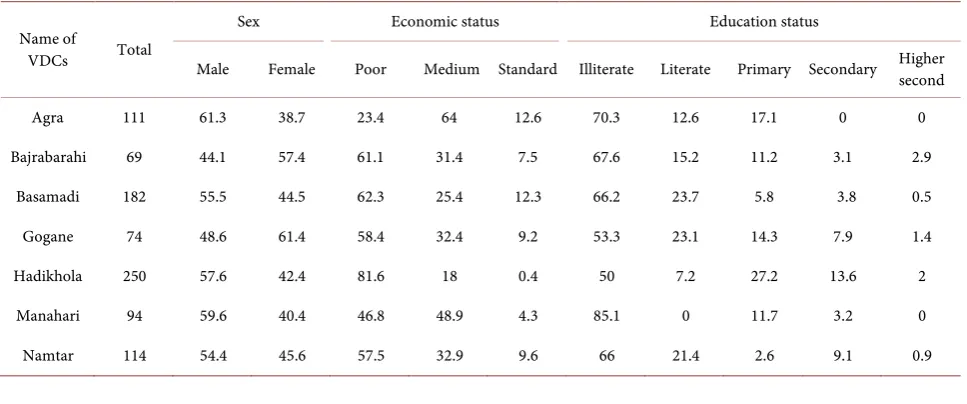
The data (Table 3) shows that there are more disabled among male than fe-male, more among poor than people from other economic status and more among illiterate than literate people, and more among people with low than higher education. There were higher number of male disabled people in Agra, Manahari, Hadikhola, Basamadi and Namtar whereas Bajrabarahi and Gogane had the higher number of female disabled people.
regular source of income and standard were those who had satisfactory food se-curity throughout the year.
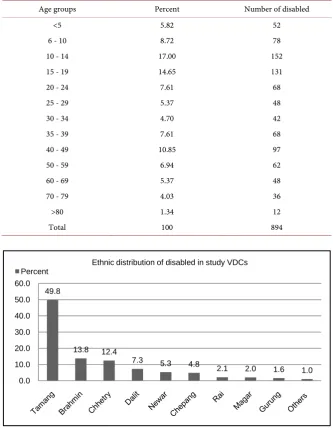
More number of disabled people were found to be in the age group between 10 - 19 years comprising about 31% of the total disabled people (Table 4).
Based on ethinic distribution of population, Tamangs were found to have the highest percentage of disability followed by Brahmins and Chhetri (Figure 1).
[image:8.595.208.540.328.514.2]The study has revealed that 60.6% people have physical disability (Figure 2). For the study purpose, physical disability means being limitation to perform the activities of daily life due to physical deficiency, defect or deformity by birth, or by accident after birth, or due to disease, followed by deaf (19.7%). For the study purpose deaf means person who have limitation to hear, speak clearly or cannot speak at all. Least among other but very large number of people have mental (3.6%) disability. This category is defined as people who have limitation to per-form the activities of daily life due to mental deficiency, defect or deper-formity by birth, by accident after birth, or by disease.
Table 2. VDC-wise disabled people in Makawanpur district.
Name of VDCs Number disabled Total population in the VDCs % disabled people out of total population
Agra 111 8926 1.24
Bajrabarahi 69 7854 0.88
Basamadi 182 17,797 1.02
Gogane 74 5648 1.31
Hadikhola 250 20,839 1.20
Manahari 94 17,349 0.54
Namtar 114 9089 1.25
Total 894 87,502 1.02
Table 3. Disabled people, by sex, economic and educational status in percentage.
Name of
VDCs Total
Sex Economic status Education status
Male Female Poor Medium Standard Illiterate Literate Primary Secondary Higher second
Agra 111 61.3 38.7 23.4 64 12.6 70.3 12.6 17.1 0 0
Bajrabarahi 69 44.1 57.4 61.1 31.4 7.5 67.6 15.2 11.2 3.1 2.9
Basamadi 182 55.5 44.5 62.3 25.4 12.3 66.2 23.7 5.8 3.8 0.5
Gogane 74 48.6 61.4 58.4 32.4 9.2 53.3 23.1 14.3 7.9 1.4
Hadikhola 250 57.6 42.4 81.6 18 0.4 50 7.2 27.2 13.6 2
Manahari 94 59.6 40.4 46.8 48.9 4.3 85.1 0 11.7 3.2 0
[image:8.595.57.541.546.748.2]Table 4. Disabled people by age. Percent.
Age groups Percent Number of disabled
<5 5.82 52
6 - 10 8.72 78
10 - 14 17.00 152
15 - 19 14.65 131
20 - 24 7.61 68
25 - 29 5.37 48
30 - 34 4.70 42
35 - 39 7.61 68
40 - 49 10.85 97
50 - 59 6.94 62
60 - 69 5.37 48
70 - 79 4.03 36
>80 1.34 12
Total 100 894
[image:9.595.209.538.92.497.2]Figure 1. Disabled people by ethnic group. Percent.
Figure 2. Types of disability in the VDCs and Percent of total number of disabled.
49.8
13.8 12.4
7.3 5.3 4.8
2.1 2.0 1.6 1.0
0.0 10.0 20.0 30.0 40.0 50.0 60.0
Ethnic distribution of disabled in study VDCs Percent
60.6
19.7
9.5
6.6
3.6 0.0
10.0 20.0 30.0 40.0 50.0 60.0 70.0
[image:9.595.208.538.546.716.2]8. Conclusion
People with disabilities are large in number in rural communities. The hetero-geneity of the conceptual framework and insufficient recognition of the impor-tance of indicator accuracy, the age factor, and the socio-economic characteris-tics of the populations under study, all affected the prevalence disability rate in Makwanpur. Disabled are considered as burden by the families, society and state. The disability condition is related to economic strata of population. Mainly people from lower socio-economic condition are in risk of serious problems in-cluding disability. The study has revealed that majority of the disabled person had physical disability following deaf and blind. Based on age group, young adults (15 - 19 years) group was more vulnerable. Out of total, the number of male was higher due to their high exposure in external environment and risk taking behaviour. The poverty and unavailability of health care services and illi-teracy are other underpinning grounds to elevate the number. To revert the sce-nario, individual, family, society and nation have to give attention in nutrition, preventable diseases, environmental factors and workplace. Nepal has initiated prevention of health conditions of people associated with disability but there are lots of efforts needed to be laid to educate people about disability and its man-agement which helps to reduce socio-cultural, environmental detergents in harmony with the needs of disabled persons. Disability management should be multisectoral interventions and it should be reflected policies and priority pro-grams.
Acknowledgements
Prof. Marit Bakke from Norway ([email protected]) has supported to elevate the issues of disabled people of Nepal, and gave valuable inputs on its first draft.
Prof. Madhusudan Subedi, Department of Sociology and Anthropology, Tribhuvan University, Nepal encouraged us for the study and helped to review the manuscript and feedback.
Shudarshan Subedi, President of Federation of Nepal Disabled Association for their wise contribution in reviewing the article.
References
[1] National Population and Housing Census (National Report) (2011) Central Bureau of Statistics, National Planning Commission Secretariat, Government of Nepal, Kathmandu, Nepal.
http://cbs.gov.np/image/data/Population/National%20Report/National%20Report.p df
[2] Ministry of Health, Government of Nepal (2016) Vulnerable Community Develop-ment Plan. Nepal Health Sector ManageDevelop-ment Project, Kathmandu Nepal.
http://www.docr.gov.np/sites/default/files/docr_notice.pdf [3] World Health Organization (2011) World Report on Disability.
http://www.who.int/disabilities/world_report/2011/report.pdf
WP/2009/DHP/10 Report Series No.: RS/2009/GE/37(PHL).
http://www.wpro.who.int/NR/rdonlyres/2707CE22-97F4-4046-9ADD-5C6C8A49E 7B7/0/FinalCBRReportJune2009_010210.pdf
[5] World Health Oraganization (2006) Disability and Poverty—WHO Fact Sheet, Disability and Rehabilitation Team, World Health Organisation (WHO/DAR), Ge-neva.
[6] Subedi, M. (2012) Challenges to Measure and Compare Disability: A Methodologi-cal Concern. Dhaulagiri Journal of Sociology and Anthropology, 6, 1-24.
[7] Elwan, A. (1999) Poverty & Disability: A Survey of the Literature. World Bank. [8] DFID (2000) Disability, Poverty and Development, UK Department for
Interna-tional Development (DFID).
[9] Laderchi, C.R. (2000) The Moneraty Approach to Poverty. A Survey of Concepts and Methods. QEH Working Paper Series, QEHWPS58, University of Oxford. [10] Sen, A. (2012) Development as Freedom. Oxford University Press, New Delhi. [11] UNDP (2009) Nepal Human Development Index (NDHI) Report.
http://www.undp.org.np/publication/html/nhdr2009/NHDR2009.pdf
[12] National Policy and Plan of Action on Disability (2006) Government of Nepal, Ministry of Women, Children and Social Welfare, Kathmandu.
[13] The Constitution of Nepal (2015).
http://www.lawcommission.gov.np/en/documents/2016/01/constitution-of-nepal-2. pdf
[14] World Health Organization (2007) International Classification of Functioning, Disability and Health: Children & Youth Version.
http://apps.who.int/iris/bitstream/10665/43737/1/9789241547321_eng.pdf?ua=1 [15] ESCAP (2002) High-Level Intergovernmental Meeting to Conclude the Asian and
Pacific Decade of Disabled Persons, 1993-2002. ESCAP, Otsu City, Shiga. http://www.unescap.org/esid/psis/disability/bmf/bmf.html on 28/12/2010
[16] Mitra, S. (2003) The Capability Approach to Disability. Journal of Disability Policy Studies, 16, 236-247. https://doi.org/10.2139/ssrn.2330438
http://cfs.unipv.it/sen/papers/Mitra.pdf
[17] Economic Survey (2015) Ministry of Finance, Government of Nepal.
http://www.mof.gov.np/uploads/document/file/Final%20Economic%20Survey%202 071-72%20English%20(Final)_20150716082638.pdf
[18] Government of Nepal (2014) Nepal Human Development Report, beyond Geogra-phy. National Planning Commission. www.npc.gov.np
[19] Shrestha, S. (2003) Accessibility of Health Services in Nepal. In: Deepak S., Ed., Po-verty, Health and Development, Health Cooperation Papers Volume 17, AIFO, Ita-ly.
[20] DSI (2007) Country Strategy of the Danish Council of Organization of Disabled People (October 2007-September 2012). The Study Made by Organization Devel-opment Centre (ODC), Nepal.
[21] Nepal Population Report (2011) Government of Nepal Ministry of Health and Pop-ulation, Population Division Ramshahpath, Kathmandu.
www.mohp.gov.np
[22] Health Management Information System (2007) Projected Population (Based on 2001 Census) for Health Management Information System. Ministry of Health and Population, Nepal.
https://doi.org/10.1016/S0140-6736(07)60752-1
[24] NPC & UNICEF (2001) A Situation Analysis of Disability in Nepal. National Plan-ning Commission of Nepal, Kathmandu.
[25] National Policy and Plan of Action on Disability (2006) Ministry for Women, Children and Social Welfare, Government of Nepal.
https://rcrdnepa.files.wordpress.com/2008/05/national-policy-and-plan-of-action20 06-eng.pdf
[26] DDC/MK (2007) Annual Report of District Development Committee Makwanpur, Nepal.
Submit or recommend next manuscript to SCIRP and we will provide best service for you:
Accepting pre-submission inquiries through Email, Facebook, LinkedIn, Twitter, etc. A wide selection of journals (inclusive of 9 subjects, more than 200 journals)
Providing 24-hour high-quality service User-friendly online submission system Fair and swift peer-review system
Efficient typesetting and proofreading procedure
Display of the result of downloads and visits, as well as the number of cited articles Maximum dissemination of your research work
Submit your manuscript at: http://papersubmission.scirp.org/