Munich Personal RePEc Archive
Improved tests for spatial correlation
Robinson, Peter M. and Rossi, Francesca
London School of Economics, University of Southampton
22 June 2012
Online at
https://mpra.ub.uni-muenchen.de/41835/
Improved Tests for Spatial Correlation
Peter M. Robinson and Francesca Rossi
London School of Economics and University of Southampton
June 22, 2012
Abstract
We consider testing the null hypothesis of no spatial autocorrelation against the alternative of first order spatial autoregression. A Wald test statistic has good first-order asymptotic properties, but these may not be relevant in small or moderate-sized samples, especially as (depending on properties of the spatial weight matrix) the usual parametric rate of convergence may not be attained. We thus develop tests with more accurate size properties, by means of Edgeworth expansions and the bootstrap. The finite-sample performance of the tests is examined in Monte Carlo simulations.
JEL classifications: C12; C21
1
Introduction
The modelling and analysis of spatially correlated data can pose significant complica-tions and difficulties. Correlation across spatial data is typically a possibility, due to competition, spillovers, aggregation and other circumstances. Such correlation might be anticipated in observable variables or in the unobserved disturbances in an econo-metric model, or both. In, for example, a linear regression model with exogenous regressors, if only the regressors are spatially correlated the usual rules for large sam-ple inference (based on least squares) are unaffected. However, if also the disturbances are spatially correlated then though least squares estimates of the regression coeffi-cients are likely to retain their consistency property, their asymptotic variance matrix reflects the correlation. This matrix needs to be consistently estimated in order to carry out statistical inference, and its estimation (whether parametric or nonparamet-ric) offers greater challenges than when time series data are involved, due to the lack of ordering in spatial data, as well as possible irregular spacing or lack of reliable infor-mation on locations. In addition least squares estimates are rendered asymptotically inefficient by spatial correlation, and developing generalized least squares estimates is similarly beset by ambiguities.
A sensible first step in data analysis is therefore to investigate whether or not there is evidence of spatial correlation, by carrying out a statistical test of the null hypothesis of no spatial correlation. Many such asymptotically valid tests are poten-tially available, so one might focus on ones that are likely to have reasonable power against anticipated alternatives. This requires specifying a parametric model for the spatial correlation. A widely applicable and popular model is the (first-order) spatial autoregression (SAR). For simplicity we stress the case of zero mean observable data; we shall also allow in some of the paper for an unknown intercept but our work can also be extended to test for lack of spatial correlation in unobservable disturbances in more general models, such as regressions. Given then×1 vector of observations
y= (y1, ..., yn) ′
, the prime denoting transposition, the SAR model is
y=λW y+ǫ, (1.1)
where ǫ = (ǫ1, ..., ǫn) ′
consists of unobservable, uncorrelated random variables with zero mean and unknown varianceσ2, λ is an unknown scalar, and W is an n×n
user-specified “weight” matrix, having (i, j)-th element wij, where wii = 0 for all
iand (in order to identify λ) normalization restrictions satisfied. Such restrictions imply that in general each elementwij changes with nas nincreases, implying that
W,and thusy,form triangular arrays (i.e. W =Wn= (wijn), y=yn= (yin)) but we
suppress reference to thensubscript. The elementwijcan be regarded as a (scaled)
the applicability of the model beyond situations when they are known, and entailing simpler modelling than is typically possible when one attempts to incorporate locations of irregularly spaced geographical observations.
The null hypothesis of interest is
H0:λ= 0, (1.2)
whence theyi are uncorrelated (and homoscedastic). An obvious statistic for testing
(1.2) is the Wald statistic based on the least squares estimate ˆλofλ, which is given by
ˆ
λ= y
′
W y
y′W′W y. (1.3)
Due to the dependence between right-hand side observables and disturbances in (1.1), ˆ
λ is inconsistent for λ, as discussed by Lee (2002). However, ˆλ does converge in probability to zero when λ = 0, so a test statistic for (1.2) based on ˆλ might be expected to be asymptotically valid. In particular, under (1.1), (1.2) and regularity conditions a central limit theorem for independent non-identically distributed random variables gives
h
tr W W′
/
tr W2+W W′ 1/2iˆλ→dN(0,1). (1.4)
Since the square-bracketed norming factor can be directly computed, asymptotically valid Wald tests against one-sided (λ >0 orλ <0) or two-sided (λ6= 0) hypotheses are readily carried out.
The accuracy of such tests is dependent on the magnitude ofn, and the normal approximation might not be expected to be good for smallishn. Moreover, under conditions described later and as shown by Lee (2004) for the Gaussian maximum likelihood estimate of λ, the rate of convergence in (1.4) can be less than the usual parametric rate n1/2, depending on the assumptions imposed on W as n increases.
In particular ifwij =O(1/h) is imposed, where the positive sequence h= hn can
increase no faster thann, the rate is (n/h)1/2, which increases more slowly thann1/2
unlesshremains bounded. This outcome renders the usefulness of the Wald test based on (1.4) more dubious than in standard parametric situations.
our tests in Monte Carlo simulations, comparing also with the simple uncorrected test and tests based on the bootstrap, which (see e.g. Singh (1981) or Hall (1992a)) might be expected to achieve our Edgeworth correction. Proofs are left to an appendix.
Our results are fairly straightforwardly extendable to situations in whichy rep-resents unobservable disturbances in regression models, and in which the intercept model we consider is extended to include explanatory variables, but as the topic of higher-order approximations in spatial econometrics is relatively new, we focus here on the most basic, classical settings.
2
Edgeworth expansions for the least squares
es-timate
The present section develops a (third-order) formal Edgeworth expansion for ˆλ in (1.3) under the null hypothesis of no spatial correlation (1.2). We introduce first some further definitions and assumptions.
Assumption 1The ǫi are independent normal random variables with mean zero
and unknown variance σ2.
Normality is an unnecessarily strong condition for the first-order result (1.4), but it provides some motivation for stressing a quadratic form objective function and is familiar in higher order asymptotic theory. Edgeworth expansions and resulting test statistics are otherwise complicated by the presence of cumulants ofǫi. Assumption 1
implies that under (1.2) theyi are spatially independent.
For a real matrixA, let||A||be the spectral norm ofA(i.e. the square root of the largest eigenvalue ofA′
A) and let||A||∞be the maximum absolute row sums norm of
A(i.e. ||A||∞= max i
P
j
|aij|, in whichaijis the (i, j)th element ofAandiandjvary
respectively across all rows and columns ofA). LetKbe a finite generic constant.
Assumption 2
(i) For all n, wii= 0,i= 1, ..., n.
(ii) For all sufficiently largen,W is uniformly bounded in row and column sums in absolute value, i.e. ||W||∞+||W
′
||∞≤K
(iii) For all sufficiently large n, uniformly in i, j = 1, ..., n, wij = O(1/h), where
h=hnis a positive sequence bounded away from zero for allnsuch that h/n→0
as n→ ∞.
to keep spatial correlation manageable. Commonly in practical applications W is symmetric with non-negative elements and row normalized, such that Σnj=1wij = 1
for alli, in which case Assumption 2(ii) is automatically satisfied. Part (iii) covers two cases which have rather different implications for our results: eitherhis bounded (when in (1.4) ˆλenjoys a parametricn1/2rate of convergence), orhis divergent (when
ˆ
λhas a slower than parametric, (n/h)1/2, rate). By way of illustration consider (see Case (1991)),
Wn=Ir⊗Bm, Bm= 1
m−1(lml
′
m−Im), (2.1)
where Is is the s×s identity matrix, lm is the m×1 vector of 1’s, and⊗ denotes
Kronecher product. HereW is symmetric with non-negative elements and row nor-malized,n=mr. Parts (i) and (ii) of Assumption 2 are satisfied, andh∼m, where “∼” throughout indicates that the ratio of left and right sides converges to a finite, nonzero constant. Thus in the boundedhcase onlyr→ ∞asn→ ∞, whereas in the divergenthcasem→ ∞andr→ ∞.
Now define
tij= h
ntr(W
i
W′j), i≥0, j≥0, i+j≥1, (2.2)
t= h
ntr((W W
′
)2). (2.3)
Under Assumption 2 all tij in (2.2) and t are O(1) (because, for any real A such
that||A||∞ ≤K, we havetr(AW) = O(n/h) ). To ensure the leading terms of the
expansion in the theorem below are well defined, we introduce
Assumption 3
lim
n→∞
h
n(t20+t11)>0. (2.4)
By the Cauchy inequality, Assumption 3 implies limn→∞ht11/n > 0, and the two conditions are equivalent when W is symmetric or when its elements are all non-negative. Assumption 3 is automatically satisfied under (2.1). It follows from Assumptions 2 and 3 that in (1.4) the norming factor
tr(W W′) (tr(W2) +W W′)1/2 =
t11
(t20+t11)1/2
n
h
1/2
∼n
h
1/2
. (2.5)
Now define
a= t11
(t20+t11)1/2, b=
t21
(t20+t11)1/2t11, c=
2t30+ 6t21
(t20+t11)3/2, (2.6)
d= t
t2 11
, e= 12(t31+t22) (t20+t11)t11, f=
6t40+ 24t31+ 6t22+ 12t
(t20+t11)2 , g=
1
and
U(ζ) = 2bζ2−c
6H2(ζ), (2.8)
V(ζ) =1
6(e−6bc)ζH2(ζ)−(d−6b
2)ζ3− 1
24f H3(ζ) + 1 3bcζ
2H3(ζ)−2b2ζ5, (2.9)
whereHj(ζ) is thejth Hermite polynomial, such that
H2(ζ) =ζ2−1 H3(ζ) =ζ3−3ζ. (2.10)
ThusU(ζ) is an even, generally non-homogeneous, quadratic function ofζ, whileV(ζ) is an odd, generally non-homogeneous, polynomial inζ of degree 5.
Write Φ(ζ) =P r(Z ≤ζ) for a standard normal random variableZ, and φ(ζ) for the probability density function (pdf) ofZ. LetF(ζ) =P(n/h)1/2aλˆ≤ζ.
Theorem 1Let (1.1) and Assumptions 1-3 hold. UnderH0 in (1.2), for any realζ, F(ζ)admits the third order formal Edgeworth expansion
F(ζ) = Φ(ζ) +U(ζ)φ(ζ)
h n
1/2
+V(ζ)φ(ζ)h
n+O
h n
3/2!
, (2.11)
where
U(ζ) =O(1), V(ζ) =O(1), (2.12)
asn→ ∞.
Generally,U(ζ) andV(ζ) are non-zero, whence there are leading correction terms of exact orders (h/n)1/2 andh/n, and both terms are known functions ofζ.
A corresponding result to Theorem 1 is available for the pure SAR model with unknown intercept, i.e.
y=µl+λW y+ǫ, (2.13)
whereµis an unknown scalar andl=ln. The least squares estimate ofλin (2.13) is
˜
λ= y
′
W′
P y
y′W′P W y, (2.14)
whereP =In−l(l′l)−1l′. Under (1.2), the same kind of regularity conditions and the
additional
Assumption 4For all n,Σn
j=1wij= 1,i= 1, ..., n,
˜
that of ˆλand, in particular, ˜λ converges to the true value at the standardn1/2 rate
whetherhis bounded or divergent asn→ ∞. Since the main goal of this paper is to provide refined tests when the rate of convergence might be slower than the parametric raten1/2, the case of model (2.13) whenW is not row-normalized is not considered here.
Define
˜
U(ζ) =U(ζ) +g1/2 (2.15)
and
˜
V(ζ) =V(ζ) +
g
2(1 +p) + 2bg
1/2−g4
2
ζ−2bg2ζ3+cg
1/2
6 H3(ζ), (2.16)
where
p=l′W W′l/n. (2.17)
(WhenW is symmetric Assumption 4 impliesp= 1). Let ˜F(ζ) =P((n/h)1/2aλ˜≤ζ).
Theorem 2Let (2.13) and Assumptions 1-4 hold. UnderH0 in (1.2), for any realζ,
˜
F(ζ)admits the third order formal Edgeworth expansion
˜
F(ζ) = Φ(ζ) + ˜U(ζ)φ(ζ)
h n
1/2
+ ˜V(ζ)φ(ζ)h
n+O
h n
3/2!
, (2.18)
where
˜
U(ζ) =O(1), V˜(ζ) =O(1), (2.19)
asn→ ∞.
The second- and third-order correction terms are again generally non-zero, and of orders (h/n)1/2 and h/nrespectively. Notice that ˜U(ζ) > U(ζ), so the second-order
approximate distribution function (df) of ˜λis greater than that of ˆλ. The Edgeworth approximation in (2.18) is unaffected byµ(and the approximations in both (2.11) and (2.18) are unaffected by σ2). Consequently results can be similarly obtained when
there is a more general linear regression component than in (2.13), at least when regressors are non-stochastic or strictly exogenous. Indeed, similar techniques will yield approximations with respect to the model y−µl = λW(y−µl) +ǫ, or more general linear regression models with SAR disturbances.
Finally, it is worth stressing that Theorems 1 and 2 hold not only under Assump-tion 1, but also for the class of spherically symmetric distributed disturbances (e.g. Hillier (2001) or Forchini (2002)). Specifically, let w =ǫ(ǫ′
ǫ)−1/2, where ǫ satisfies
Assumption 1. Thus, w is uniformly distributed on the unit sphere in ℜn. It can
be shown that the distributions of both ǫ′
W ǫ/ǫ′
W′
W ǫ and ǫ′
W′
P ǫ/ǫ′
W′
P W ǫ are the same as those ofw′
W w/w′
W′
W wandw′
W′
P w/w′
W′
spherically symmetric distribution for ǫ, since any random vector within such class would implywbeing uniformly distributed on the unit sphere inℜn.
3
Improved tests for no spatial correlation
We consider first tests of the null hypothesis (1.2) against the alternative
H1: λ >0 (3.1)
in the no-intercept model (1.1).
Forα∈(0,1) (for exampleα= 0.05 orα= 0.01) define the normal critical value
zα such that 1−α= Φ(zα). Writeq= (n/h)1/2aˆλ. On the basis of (1.4) a test that
rejects (1.2) against (3.1) when
q > zα (3.2)
has approximate sizeα. Theorem 1 readily yields more accurate tests that are simple to calculate because the coefficients ofU(ζ) andV(ζ) are known,W being chosen by the practitioner.
Define the exact critical valuewα such that 1−α=F(wα), so a test that rejects
whenq > wαhas exact sizeα. Also introduce the Edgeworth corrected critical value
uα=zα−
h
n
1/2
U(zα). (3.3)
Corollary 1Let (1.1) and Assumptions 1-3 hold. UnderH0 in (1.2), asn→ ∞
wα=zα+O
h n
1/2!
(3.4)
=uα+O
h n
. (3.5)
Corollary 1 follows follows immediately from Theorem 1. From Corollary 1, the test that rejects (1.2) against (3.1) when
q > uα (3.6)
is more accurate than (3.2). Of course when the alternative of interest isλ <0, the same conclusion can be drawn for the tests which reject whenq < −zα, q < −uα,
respectively.
statistic that can be compared withzα. Introduce the polynomial
G(ζ) =ζ+
h n
1/2
U(ζ) +h
n
1 3
2b−c 6
2
ζ3. (3.7)
which has known coefficients (see Yanagihara et al. (2005)). SinceG(ζ) has derivative (1 +ζ(2b−c/6)(h/n)1/2)2>0, it is monotonically increasing. ThusF(ζ) =P(G(q)≤ G(ζ)) and we invert the expansion in Theorem 1 to obtain
Corollary 2Let (1.1) and Assumptions 1-3 hold. UnderH0, asn→ ∞
P(G(q)> zα) =α+O
h n
. (3.8)
Thus the test that rejects when
G(q)> zα (3.9)
has size that differs fromαby smaller order than the size of (3.2).
Still more accurate tests can be deduced from Theorem 1 by employing also the third-order correction factorV(ζ), but the above tests have the advantage of simplicity. TheV term, however, is especially relevant in deriving improved tests against the two-sided alternative hypothesis
H0: λ6= 0. (3.10)
BecauseU(ζ) is an even function it follows from Theorem 1 that
P(|q| ≤ζ) = 2Φ(ζ)−1 + 2h
nV(ζ) +O
h n
3/2!
. (3.11)
Thence define the Edgeworth-corrected critical value for a two-sided test,
vα/2=zα/2− n
hV(zα/2), (3.12)
noting that the approximate size-α two-sided test based on (1.4) rejectsH0 against (3.10) when
|q|> zα/2. (3.13)
Corollary 3Let (1.1) and Assumptions 1-3 hold. UnderH0, asn→ ∞
sα/2=zα/2+O
h n
(3.14)
=vα/2+O
h n
3/2!
. (3.15)
Thus rejecting (1.2) against (3.10) when
|q|> vα/2 (3.16)
rather than (3.13) reduces the error toO((h/n)3/2). In fact, Theorem 1 can be
estab-lished to fourth-order, with fourth-order term that is even inζ, and errorO((h/n)2),
so the error in (3.15) can be improved toO((h/n)2).
As with the one-sided alternative (3.1), a corrected test statistic that can be com-pared withzα/2 can be derived from Theorem 1. Define (Yanagihara et al. (2005))
L(ζ) =ζ+h
nV(ζ)
+
h
n
2 1
4
L21ζ+ L2
2ζ5
5 +
L2 3ζ9
9 +
2 3L1L2ζ
3+2
5L1L3ζ
5+2
7L2L3ζ
7, (3.17)
whereL1=−1
6(e−6bc)+ 1 8f,L2=
1
2(e−6bc)−3(d−6b 2)−1
8f−3bcandL3= 5 3bc−10b
2,
so L(ζ) is a degree-7 polynomial in ζ with known coefficients. It is readily checked thatV(ζ) has derivativeL1+L2ζ2+L3ζ4, whereL(ζ) has derivative (1 + (h/n)(L1+
L2ζ2+L3ζ4)/2)2 >0 and is thus monotonically increasing. Therefore, from (3.11),
we obtain
Corollary 4Let (1.1) and Assumptions 1-3 hold. UnderH0, asn→ ∞
P(L(|q|)> zα/2) =α+O
h n
3/2!
. (3.18)
The transformation in (3.17) and Corollary 4 follow from (3.11) using a minor modification of Theorem 2 of Yanagihara et al. (2005). From the latter result, we conclude that the test that rejectsH0 against (3.10) when
L(|q|)> zα/2 (3.19)
has size which is closer toαthan (3.13).
Improved tests can be similarly derived from Theorem 2 for the intercept model in (2.13). We first consider tests ofH0 in (1.2) against (3.1). Let ˜q = (n/h)1/2aλ˜.
approximate levelαwhen
˜
q > zα. (3.20)
Define the exact and Edgeworth-corrected critical values ˜wα, such that 1−α= ˜F( ˜wα),
and ˜uα=zα−U˜(zα)(h/n)1/2=uα−g1/2(h/n)1/2, respectively.
Similarly to Corollaries 1 and 2, from Theorem 2 we deduce
Corollary 5Let (2.13) and Assumptions 1-4 hold. UnderH0 in (1.2), asn→ ∞
˜
wα=zα+O
h n
1/2!
(3.21)
= ˜uα+O
h
n
. (3.22)
Notice that ˜uα< uα for anyα, so that the second-order corrected critical value is
lower for the intercept model. Let
˜
G(ζ) =ζ+
h
n
1/2
˜
U(ζ) +h
n
1 3
2b−c 6
2
ζ3=G(ζ) +
h
n
1/2
g1/2. (3.23)
Corollary 6Let (2.13) and Assumptions 1-4 hold. UnderH0 in (1.2), asn→ ∞
P( ˜G(˜q)> zα) =α+O
h n
. (3.24)
Thus, tests that reject (1.2) against (3.1) when either
˜
q >u˜α (3.25)
or
˜
G(˜q)> zα, (3.26)
are more accurate than (3.20).
Also, from Theorem 2 improved tests of (1.2) against (3.10) can be deduced. From (2.18), since ˜U(ζ) is an even function we obtain,
P(|q˜| ≤ζ) = 2Φ(ζ)−1 + 2h
nV˜(ζ) +O
h n
3/2!
. (3.27)
Define ˜sα/2 such that P(|q˜| ≤ s˜α/2) = 1−α and ˜vα/2 = zα/2−(n/h) ˜V(zα/2). A
standard, approximate sizeα, two-sided test rejects (1.2) against (3.10) when
From (3.27) we deduce
Corollary 7Let (2.13) and Assumptions 1-4 hold. UnderH0, asn→ ∞
˜
sα/2=zα/2+O
h n
(3.29)
= ˜vα/2+O
h n
3/2!
. (3.30)
Finally, define
˜
L(ζ) =ζ+h
nV˜(ζ)
+
h n
2
1 4
˜
L21ζ+
˜
L22ζ5
5 +
L23ζ9
9 +
2 3L1˜ L2ζ˜
3+2
5L1L3ζ˜
5+2
7L2L3ζ˜
7, (3.31)
where ˜L1=L1+g2(1 +p) + 2bg1/2−g4
2 −
cg1/2
2 ,L2˜ =L2−6bg
1/2+cg1/2
2 .
Corollary 8Let (2.13) and Assumptions 1-4 hold. UnderH0, asn→ ∞
P( ˜L(|q˜|)> zα/2) =α+O
h n
3/2!
. (3.32)
From Corollaries 7 and 8, we conclude that the tests that rejectH0against (3.10) when either
|q˜|>˜vα/2 (3.33)
or
˜
L(|q˜|)> zα/2 (3.34)
have sizes closer toαthan that obtained from (3.28).
Before concluding this section we should acknowledge that the distribution func-tions under (1.2) and Assumption 1 of bothqand ˜qcan also be evaluated numerically using the procedure introduced by Imhof (1961) (for implementation details see e.g. Lu and King (2002)). Exact critical values can then be numerically calculated. However, Imhof-type of implementations heavily rely on numerical solutions of highly non-linear equations and therefore might not be not fully reliable.
4
Bootstrap correction and simulation results
e.g. Singh (1981)). For the no-intercept model (1.1) the bootstrap test is as follows (e.g Paparoditis and Politis (2005)). We construct 199n×1 vectorsǫ∗
j, whose elements
are independently generated asN(0,σˆ2),j = 1, ....,199.The bootstrap test statistic
isq∗
j= (n/h)1/2aǫ ∗′
j W ′
ǫ∗ j/ǫ
∗′
j W ′
W ǫ∗
j,j= 1, ...,199, its (1−α)th percentile beingu ∗ α
which solvesP199
j=11(q
∗ j≤u
∗
α)/199≤1−α,where 1(.) indicates the indicator function.
We reject (1.2) against the one-sided alternative (3.1) when
q > u∗α. (4.1)
Defining the (1−α)th percentile of|q∗
j|as the valuev ∗
αsolvingP199j=11(|q
∗ j| ≤v
∗ α)/199≤
1−α,we reject (1.2) against the two-sided alternative (3.10) if
|q|> vα∗. (4.2)
For the intercept model (2.13) we define ˜q∗
j = (n/h)1/2a˜ǫ ∗′
j W ′
Pǫ˜∗ j/ǫ˜
∗′
j W ′
P W˜ǫ∗ j,
j = 1, ...,199, where the components of each ˜ǫ∗
j are independently generated from
N(0,˜σ2) with ˜σ2 =y′
P y/n. The (1−α)th quantiles of ˜q∗ j and|q˜
∗ j|, ˜u
∗ α and ˜v
∗ α, solve
P199
j=11(˜q
∗ j ≤u˜
∗
α)/199≤1−α,andP199j=11(|q˜
∗ j| ≤˜v
∗
α)/199≤1−α, respectively. We
reject (1.2) against (3.1) or (3.10) when
˜
q >u˜∗α (4.3)
or
|q˜|>˜vα∗, (4.4)
respectively.
In the simulations we setσ2 = 1 in Assumption 1,µ= 2 in (2.13) and chooseW
as in (2.1), for variousmandr. Recalling that orders of magnitudes in Theorems 1 and 2 are affected by whetherhdiverges or remains bounded asn→ ∞, we represent both cases by different choices ofm∼h. We choose (m, r) = (8,5), (12,8), (18,11), (28,14), i.e. n = 40, 96, 198, 392, to represent “divergent” h, and (m, r) = (5,8), (5,20), (5,40), (5,80), i.e. n= 40, 100, 200, 400 to represent “bounded”h. For each of these combinations we compute ˆλand ˜λfrom the same realization ofǫacross 1000 replications. In all testsα= 0.05.
Empirical sizes are displayed in Tables 1-8, in which “normal”, “Edgeworth”, “transformation” and “bootstrap” refer respectively to tests using the standard normal approximation, Edgeworth-corrected critical values, Edgeworth-corrected test statis-tic and bootstrap cristatis-tical values, and the respective abbreviations N, E, T, B will be extensively used in the text.
(Tables 1 and 2 about here)
model (1.1), whenhis respectively “divergent” and “bounded”. Test N is drastically under-sized for eachnin both tables. The sizes for E are somewhat better, and improve asnincreases, in particular for “divergent”hthe discrepancy between empirical and nominal sizes is 18.2% lower relative to N, on average across sample size, while as n
increases this discrepancy decreases by about 0.7% for N, but by 9.5% for E. Both T and B perform well for alln. Indeed, on average, whenhis “divergent” empirical sizes for T and B are 80.4% and 85.4%, respectively, closer to 0.05 than those for N, with a similar pattern in Table 2. Tables 1 and 2 are consistent with Theorem 1 in whichF converges to Φ at raten1/2 when his bounded, but only at rate (n/h)1/2
whenhis divergent. Indeed, whenhis “bounded”, on average the difference between empirical and nominal size decreases by 6.8% asnincreases for N, while this difference only decreases by 0.7% in case h is “divergent”. Also, from Table 2, the average improvements offered by E, T and B over N are about 41%, 88% and 84%, respectively. Overall, T and B perform best.
(Tables 3 and 4 about here)
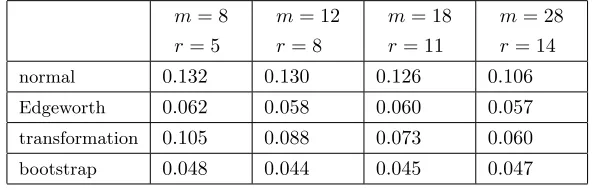
Tables 3 and 4 cover two-sided tests for the no-intercept model (1.1), namely (3.13), (3.16), (3.19) and (4.2). Again, N is very poor, though contrary to the one-sided test case the problem is now over-sizing, and E, T and B all offer notable improvements. Indeed, whenh is “divergent” the difference between empirical and nominal sizes is reduced respectively on average across sample sizes by 87.4%, 59% and 94% for E, T and B relative to N, and by 86%, 59% and 95% whenhis “bounded”. In the tables B seems overall most accurate, followed by E.
(Tables 5 and 6 about here)
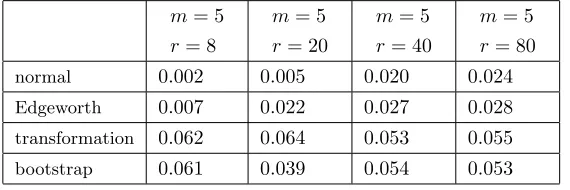
Tables 5 and 6 contain results for one-sided tests for the intercept model (2.13), the N, E, T and B tests being given in (3.20), (3.25), (3.26) and (4.3). The pattern is similar to that displayed in Tables 1 and 2. For “divergent”h, on average across sample sizes, empirical sizes for E, T and B are 12%, 65% and 89% closer to 5% than ones for N, with figures of 21.7%, 78.7% and 81% for “bounded”h. Overall, B performs best for “divergent”h, but it is difficult to choose between B and T whenh
is “bounded”.
(Tables 7 and 8 about here)
(Figures 1 and 2 about here)
To illustrate the effect of the transformationsG(.) and ˜G(.) used in Section 3, in Figures 1 and 2 we plot the histograms with 100 bins ofq and G(q) (Figure 1) and of ˜q and ˜G(˜q) (Figure 2) obtained from 1000 replications when m= 28 andr = 14. Both figures suggest that the densities ofqand ˜q are very skewed to the left and that most of the skewness is removed by the transformations, as in Hall (1992b).
(Tables 9-12 about here)
In Tables 9-12 we assess power against a fixed alternative, i.e.
H1:λ= ¯λ >0. (4.5)
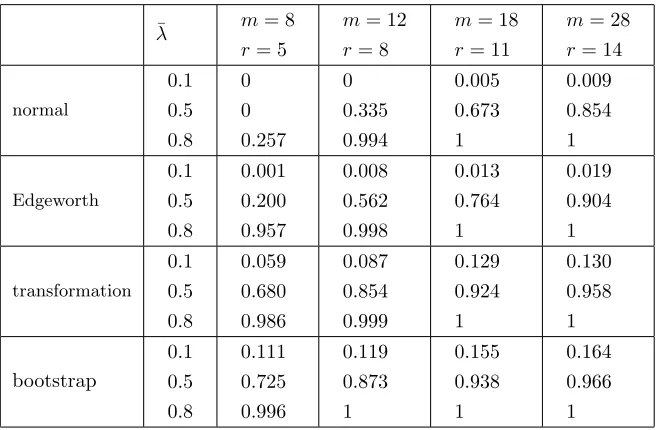
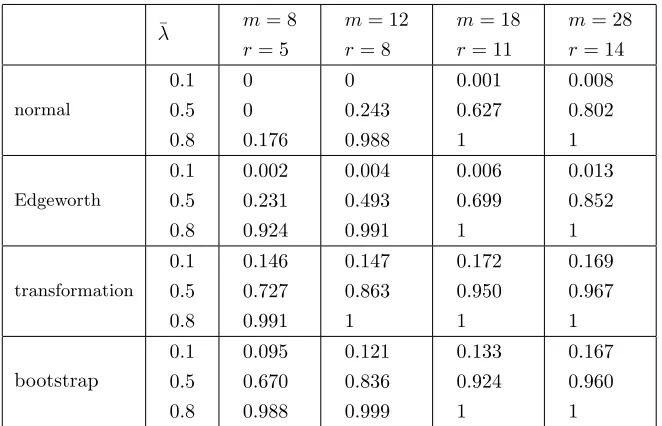
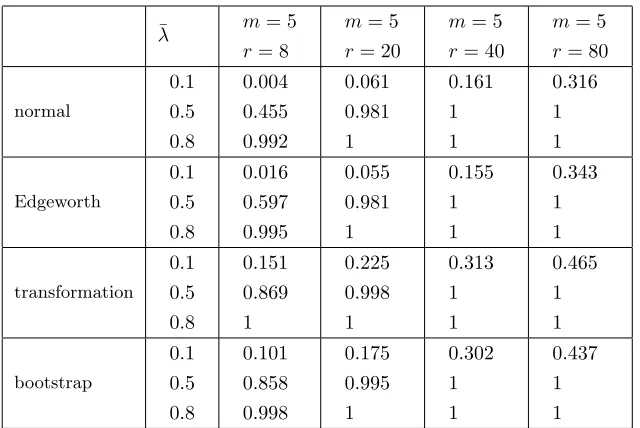
Tables 9 and 10 display the empirical power of one-sided tests in the no-intercept model (1.1) whenhis “divergent” and “bounded” respectively, while Tables 11 and 12 correspondingly contain results for the intercept model (2.13). These are non-size-corrected tests. Exept for the smallest sample size when h is “divergent”, even N performs well for the largest ¯λ= 0.8, as do all other tests in all settings. N also does comparably well to E, T and B whenh is bounded and ¯λ = 0.5. But overall N is outperformed by the other tests, with T and B offering the greatest power.
A remark on consistency of standard and corrected tests is desirable. As previously mentioned, ˆλand ˜λ are inconsistent whenλis non-zero. Therefore, in caseplimλ <ˆ λ (> λ) as n → ∞for λ >0 (λ < 0), it might be that under H1, plimˆλ= 0 as
n → ∞, with the same possibilities for ˜λ. Then the standard and corrected tests would be inconsistent. For the special case ofW in (2.1), the following theorem shows that the direction of inconsistency follows the sign ofλ.
Theorem 3
(i) Let model (1.1) hold. Under Assumption 1 and (2.1),plim
n→∞
(ˆλ−λ)is finite and has the same sign asλ.
(ii) Let model (2.13) hold. Under Assumption 1 and (2.1), plim
n→∞
(˜λ−λ) is finite and has the same sign asλ.
The proof is in the Appendix. Assumption 1 could be relaxed here, but is retained for algebraic simplicity. Under (1.1), asn→ ∞ plimλ > λˆ (< λ) as n→ ∞ when
λ >0 (λ <0) and hence, P(q > zα|H1) →1, P(q > uα|H1) → 1 and P(G(q) >
zα|H1) → 1. Similarly under (2.13), P(˜q > zα|H1) → 1, P(˜q > u˜α|H1) → 1 and
P( ˜G(˜q)> zα|H1)→1 as n→ ∞. The direction of inconsistency could be computed
Appendix
Proof of Theorem 1
Under H0, ˆλ = ǫ′
W′
ǫ/ǫ′
W′
W ǫ and thus P(ˆλ ≤ x) = P(ς ≤ 0), where ς =
ǫ′(C+C′)ǫ/2,C =W′−xW′W andxis any real number. We proceed much as in, e.g., Phillips (1977). Under Assumption 1, the characteristic function (cf) ofςis
E(eit2ǫ′(C+C′)ǫ) = 1
(2π)n/2σn
Z
ℜn
eit2ξ′(C+C′)ξe−
ξ′ξ
2σ2dξ
= 1
(2π)n/2σn
Z
ℜn
e−2σ12ξ′(I−itσ 2
(C+C′))ξ
dξ
=det(I−itσ2(C+C′))−1/2=
n
Y
j=1
(1−itσ2ηj)
−1/2, (A.1)
where theηjare eigenvalues ofC+C′anddet(A) denotes the determinant of a generic
square matrixA. From (A.1) the cumulant generating function (cgf) ofς is
ψ(t) =−1 2
n
X
j=1
ln(1−itσ2ηj) =
1 2
n
X
j=1
∞
X
s=1
(itσ2η
j)s
s
=1 2
∞
X
s=1
(itσ2)s
s
n
X
j=1 ηsj=
1 2
∞
X
s=1
(itσ2)s
s tr((C+C
′
)s). (A.2)
Denoting byκsthes−th cumulant ofς, from (A.2)
κ1=σ2tr(C), (A.3)
κ2= σ
4
2 tr((C+C
′
)2), (A.4)
κs=
σ2ss!
2
tr((C+C′
)s)
s , s >2. (A.5)
Letςc= (ς−κ1)/κ12/2. The cgf ofςcis
ψc(t) =−1 2t
2
+
∞
X
s=3 κcs(it)s
s! , (A.6)
where
κcs=
κs
so the cf ofςc is
E(eitςc) =e−12t 2 exp{ ∞ X s=3 κc
s(it)s
s! }
=e−12t 2
{1 +
∞
X
s=3 κc
s(it)s
s! + 1 2!( ∞ X s=3 κc
s(it)s
s! )
2+ 1
3!(
∞
X
s=3 κc
s(it)s
s! )
3+...}
=e−12t2
{1 +κ
c
3(it)3
3! +
κc4(it)4
4! +
κc5(it)5
5! +{
κc6
6! + (κc3)2
(3!)2}(it)
6+...}.
(A.8)
Thus by Fourier inversion, formally
P(ςc≤z) =
z
Z
−∞
φ(z)dz+κ
c 3 3! z Z −∞
H3(z)φ(z)dz+κ
c 4 4! z Z −∞
H4(z)φ(z)dz+.... . (A.9)
Collecting the above results,
P(ˆλ≤x) =P(ς≤0) =P(ςcκ21/2+κ1≤0) =P(ςc≤ −κc1)
= Φ(−κc1)− κc
3
3!Φ
(3)(−κc
1) + κc
4
4!Φ
(4)(−κ′
1) +... . (A.10)
From (A.3), (A.4) and (A.7),
κc1=
tr(C) (1
2tr((C+C
′)2))1/2. (A.11)
The numerator ofκc
1 is
tr(W)−xtr(W W′) =−xtr(W W′) =−n
hxt11, (A.12)
while its denominator is
(1
2tr(C+C
′
)2)1/2= (tr(W2) +tr(W W′)−4xtr(W2W′) + 2x2tr((W W′)2))1/2.
=n
h
1/2
t20+t11−4xt21+ 2x2t1/2
. (A.13)
Thus
κc1=
−xt11(n/h)1/2
(t20+t11−4xt21+ 2x2t)1/2 =
−xt11(n/h)1/2
(t20+t11)1/2(1−4xt21−2x2t
(t20+t11) )
1/2. (A.14)
Choose
x=
h n
1/2
(t20+t11)1/2 t11 ζ= (
h n)
1/2
whereawas defined in (2.6). By Taylor expansion
κc1=−ζ
1−4xt21−2x
2t
(t20+t11)
−1/2
=−ζ−2
h
n
1/2 t21
t11(t20+t11)1/2ζ 2 +h n t t2 11
ζ3−6h
n
t21
(t20+t11)1/2t11
2
ζ3+O
h n
3/2!
=−ζ−2
h n
1/2
bζ2+h
ndζ 3−6h
nb 2ζ3+O
h n
3/2!
, (A.16)
wherebanddwere defined in (2.6) and (2.7). Then by Taylor expansion and using
(−d/dx)jΦ(x) =−Hj−1(x)φ(x), (A.17)
we have
Φ(−κc1) = Φ ζ+ 2
h n
1/2
bζ2−h
ndζ 3+ 6h
nb 2ζ3+O
h n
3/2!!
= Φ(ζ) + 2
h
n
1/2
bζ2−h
ndζ 3+ 6h
nb 2ζ3
!
φ(ζ) + 2h
nb
2ζ4Φ(2)(ζ) +O h n
3/2!
= Φ(ζ) + 2
h n
1/2
bζ2φ(ζ) + h
n −dζ
3+b2(6ζ3−2ζ4H1(ζ))
φ(ζ) +O
h n
3/2!
= Φ(ζ) + 2
h n
1/2
bζ2φ(ζ) + h
n −dζ
3+b2(6ζ3−2ζ5)
φ(ζ) +O
h n
3/2!
.
(A.18)
Similarly,
Φ(3)(−κc1) = Φ(3)(ζ) + 2
h h
1/2
bζ2Φ(4)(ζ) +O
h n
= H2(ζ)−2
h
h
1/2
bζ2H3(ζ)
!
φ(ζ) +O
h
n
. (A.19)
From (A.5), (A.7),
κc3=
tr((C+C′
)3) (1
2tr((C+C
′)2))3/2.
By standard algebra, forxdefined in (A.15),
1
2tr((C+C
′
)2) = n
h t20+t11−4
h
n
1/2 (t20+t11)1/2t21 t11 ζ+O
h
n
!
=n
h(t20+t11)−4
n
h
1/2(t20+t11)1/2t21
tr((C+C′)3) = n
h 2t30+ 6t21−12
h n
1/2
(t20+t11)1/2(t31+t22) t11 ζ+O
h n
!
= n
h(2t30+ 6t21)−12
n
h
1/2 (t20+t11)1/2(t31+t22)
t11 ζ+O(1)
(A.21)
and thus
κc3=
n
h(2t30+ 6t21)−12 n h
1/2
(t20+t11)1/2(t31+t22)t−1
11ζ+O(1)
n h
3/2
(t20+t11)3/21−4 h n
1/2
t21t−1
11(t20+t11)−1/2ζ+O hn
3/2
=
h n
1/2
2t30+ 6t21
(t20+t11)3/2 −12 h n
t31+t22
t11(t20+t11)ζ+O
h n
3/2!!
× 1 + 6
h n
1/2
t21
t11(t20+t11)1/2ζ+O
h n ! = h n
1/2
2t30+ 6t21
(t20+t11)3/2 −12 h n
t31+t22 t11(t20+t11)ζ+
h n
6(2t30+ 6t21)t21
(t20+t11)2t11 ζ+O
h n
3/2!
=
h n
1/2
c−h
n(e−6bc)ζ+O
h n
3/2!
, (A.22)
whereb,cande were defined in (2.6) and (2.7). Similarly,
3tr((C+C′)4) =n
h(6t40+ 24t31+ 12t+ 6t22) +O
n
h
1/2
(A.23)
and thus
κc4= h n
6t40+ 24t31+ 12t+ 6t22
(t20+t11)2 +O
h n
3/2!
= h
nf+O
h n
3/2!
, (A.24)
wherefwas defined in (2.7).
Substituting (A.15), (A.18), (A.19), (A.22) and (A.24) in (A.10) and rearranging using (2.8) and (2.9) completes the proof.
Proof of Theorem 2
UnderH0 and by Assumption 2(i), ˆλ=ǫ′
W′
P ǫ/ǫ′
W′
P W ǫ. Proceeding as before,
P(˜λ ≤ x) = P(ς ≤0), which can be written as the right side of (A.10), with ς =
ǫ′
(C+C′
)ǫ/2 and
C=W′P(I−xW). (A.25)
1, and so is not described in detail. From (A.25), (2.2) and (2.17),
κ1=σ2tr(C) =−σ21 +xtr(W′
W)−x
n(l
′
W W′
l)=−σ21 +xn ht11−xp
.
(A.26) Similarly, since
l′WiW′jl=O(n) for all i≥0, j≥0, (A.27)
κ2=σ
4
2tr((C+C
′
)2)
=σ4
tr(W2) +tr(W′W)−1−1
nl
′
W′W l−4x(tr(W W′W) +O(1)) + 2x2(tr((W′W)2) +O(1))
=σ4n
h(t20+t11)−1−p−4x
n
ht21+O(1)
+ 2x2n
ht+O(1)
. (A.28)
Proceeding as in the proof of Theorem 1, the first centred cumulant ofς is
κc1=
−xn
ht11−1 +xp n
h(t20+t11)
1/2 1−
1 +p+ 4x n
ht21+O(1)
−2x2 n
ht+O(1)
n
h(t20+t11)
!−1/2
.
(A.29)
Settingxas in (A.15) and by Taylor expansion,
κc1=−
ζ+ (h/n)
1/2
(t20+t11)1/2 − h n
p t11ζ
× 1 +
h
n
1/2 2t21
t11(t20+t11)1/2ζ+ h n
1
2(t20+t11)+ 1 2
p t20+t11−
t t2 11
ζ2+ 6t
2 21 t2
11(t20+t11) ζ2 ! +O h n
3/2!
=− ζ+
h n
1/2
g1/2−h
n p t11ζ ! 1 + h n
1/2
2bζ+h
n
g
2+
g
2p−dζ
2+ 6b2ζ2
!
+O
h
n
3/2!
=−ζ−
h n
1/2
(2bζ2+g1/2)−h
n
g
2ζ+
g
2pζ−dζ
3+ 6b2ζ3+ 2bg1/2ζ
+O
h n
3/2!
,
(A.30)
withb, d,g and pdefined in (2.6), (2.7) and (2.17). Similarly, by standard algebra and using (A.27),
tr((C+C′)3) = n
h(2t30+ 6t21)−12
n
h
1/2(t20+t11)1/2(t31+t22)
agreeing with the corresponding formula in the proof of Theorem 1, so that the third centred cumulant ofς,κc3, is (A.22), whereas the fourth centred cumulant ofς,κc4, is
again (A.24). Next,
Φ(−κc1) = Φ(ζ) +
h n
1/2
(2bζ2+g1/2)φ(ζ) + h
n
g
2ζ+
g
2pζ−dζ
3+ 6b2ζ3+ 2bg1/2ζ
φ(ζ)
+1 2(2bζ
2
+g1/2)2Φ(2)(ζ) +O
h n
3/2!
= Φ(ζ) +
h n
1/2
(2bζ+g1/2)φ(ζ)
+h
n
g
2ζ+
g
2pζ−dζ
3+ 6b2ζ3+ 2bg1/2ζ−1
2(2bζ
2+g1/2)2H1(ζ)φ(ζ)
+O
h n
3/2!
(A.32)
and
Φ(3)(−κc1) = Φ(3)(ζ) +
h h
1/2
(2bζ2+g1/2)Φ(4)(ζ) +O
h n
= H2(ζ)−
h
h
1/2
(2bζ2+g1/2)H3(ζ)
!
φ(ζ) +O
h
n
. (A.33)
Substituting (A.15), (A.22), (A.24), (A.32) and (A.33) in the right side of (A.10) complete the proof.
Proof of Theorem 3
(i)From (1.1),y=S−1(λ)ǫ, whereS(x) =In−xW. Under (2.1),S−1(λ) exists for
anyλ∈(−1,1) and
S−1(λ) =
∞
X
i=0
(λW)i. (A.34)
From (A.34)S−1(λ) is symmetric,S−1(λ)W =W S−1(λ) and||S−1(λ)||
∞≤K.
For anyλ∈(−1,1),
ˆ
λ−λ= y
′
W ǫ y′W2y =
hǫ′
S−1(λ)W ǫ/n
hǫ′S−1(λ)W2S−1(λ)ǫ/n. (A.35)
Asn→ ∞, the numerator of the RHS of (A.35) converges in probability to
lim(h/n)σ2tr(S−1(λ)W) since (h/n)(ǫ′
S−1(λ)W ǫ−σ2tr(S−1(λ)W))→ 0 in second
probability tolim(h/n)σ2tr((S−1(λ)W)2). Thus
ˆ
λ−λ→p
lim
n→∞ h ntr(S
−1(λ)W)
lim
n→∞ h ntr((S
−1(λ)W)2). (A.36)
First we show that the RHS of (A.36) is finite. Since||S−1(λ)||
∞≤K,
(h/n)tr(S−1(λ)W) = O(1).The denominator in the RHS of (A.36) is non-negative
and, by (A.34), (h/n)tr((S−1(λ)W)2)∼(h/n)tr(W2),which is non-zero under (2.1).
Hence, the RHS of (A.36) is finite and its sign depends on its numerator. From (2.1) and (A.34),
tr(S−1(λ)W) =tr(
∞
X
i=0
λitr(Wi+1)) =r
∞
X
i=0
λitr(Bim+1). (A.37)
SinceBmhas one eigenvalue equal to 1 and the other (m−1) equal to−1/(m−1),
tr(Bmi+1) = 1 + (m−1)
−1
m−1
i+1
(A.38)
and hence, since|λ|<1,
tr(S−1(λ)W) =r
∞
X
i=0 λi 1−
−1
m−1
i!
= r
1−λ− r
1 + λ m−1
= λ
1−λ rm m−1 +λ.
(A.39) By substitutingh=m−1 andn=mrinto (A.39),
h ntr(S
−1(λ)W) =m−1 mr
λ
1−λ rm m−1 +λ =
λ
1−λ
m−1
m−1 +λ, (A.40)
which, for allλ∈(−1,1), has the same sign ofλ, whethermis divergent or bounded, for allm >1.
(ii)Under (2.13),
˜
λ−λ= y
′
W P ǫ y′W P W y =
hǫ′
S−1(λ)W P ǫ/n
hǫ′S−1(λ)W P W S−1(λ)ǫ/n, (A.41)
wherey=S−1(λ)(µl+ǫ) and since from (A.34) l′
S−1(λ)W P =l′
S−1(λ)′
W′
P = 0. Thus, similarly to (A.36),
˜
λ−λ→p
lim
n→∞ h ntr(S
−1(λ)W P)
lim
n→∞ h ntr((S
−1(λ)W)2P). (A.42)
The result in (ii) follows from the proof of part (i), after observing that, asn→ ∞,
=lim(h/n)tr((S−1(λ)W)2) +o(1).
References
Case, A.C. (1991). Spatial Patterns in Household Demand. Econometrica,59, 953-65.
Forchini, G. (2002). The Exact Cumulative Distribution Function of a Ratio of Quadratic Forms in Normal Variables, with Applications to the AR(1) Model.
Econometric Theory18, 823-52.
Hall, P. (1992a). The Bootstrap and Edgeworth Expansion. Springer-Verlag. Hall, P. (1992b). On the Removal of Skewness by Transformation. Journal of the Royal Statistical Society. Series B 54, 221-28.
Hillier, G. (2001). The Density of a Quadratic Form in a Vector Uniformly Distributed on then−Sphere.Econometric Theory 17, 1-28.
Imhof, J.P. (1961). Computing the Distribution of Quadratic Forms in Normal Variables. Biometrika,48, 266-83.
Kelejian, H.H. and I.R. Prucha (1998). A Generalized Spatial Two-Stages Least Squares Procedure for Estimating a Spatial Autoregressive Model with Autore-gressive Disturbances. Journal of Real Estate Finance and Economics 17, 99-121.
Lee, L.F. (2002). Consistency and Efficiency of Least Squares Estimation for Mixed Regressive, Spatial Autoregressive Models. Econometric theory 18, 252-77.
Lee, L.F. (2004). Asymptotic Distribution of Quasi-Maximum Likelihood Esti-mates for Spatial Autoregressive Models. Econometrica72, 1899-1925. Lu, Z.H. and M.L.King (2002). Improving the Numerical Techniques for Com-puting the Accumulated Distribution of a Quadratic Form in Normal Variables.
Econometric Reviews 21, 149-65.
Paparoditis, E. and D.N. Politis (2005). Bootstrap Hypothesis Testing in Re-gression Models. Statistics & Probability Letters 74, 356-65.
Phillips, P.C.B. (1977). Approximations to Some Finite Sample Distributions Associated with a First-Order Stochastic Difference Equation. Econometrica,
45, 463-85.
m= 8
r= 5
m= 12
r= 8
m= 18
r= 11
m= 28
r= 14
normal 0 0 0.001 0.001
Edgeworth 0.004 0.008 0.010 0.016
transformation 0.036 0.038 0.040 0.047
[image:26.612.158.455.124.218.2]bootstrap 0.039 0.061 0.053 0.054
Table 1: Empirical sizes (nominalα= 0.05) of tests ofH0 (1.2) againstH1 (3.1) in
no-intercept model (1.1) whenhis “divergent”.
m= 5
r= 8
m= 5
r= 20
m= 5
r= 40
m= 5
r= 80
normal 0.001 0.001 0.001 0.011
Edgeworth 0.001 0.025 0.028 0.034
transformation 0.042 0.045 0.043 0.052
[image:26.612.164.448.273.368.2]bootstrap 0.043 0.040 0.057 0.055
Table 2: Empirical sizes (nominalα= 0.05) of tests ofH0 (1.2) againstH1 (3.1) in
no-intercept model (1.1) whenhis “bounded”.
m= 8
r= 5
m= 12
r= 8
m= 18
r= 11
m= 28
r= 14
normal 0.132 0.130 0.126 0.106
Edgeworth 0.062 0.058 0.060 0.057
transformation 0.105 0.088 0.073 0.060
bootstrap 0.048 0.044 0.045 0.047
Table 3: Empirical sizes (nominal α = 0.05) of tests of H0 (1.2) against H1 (3.10) in
[image:26.612.157.454.422.517.2]m= 5
r= 8
m= 5
r= 20
m= 5
r= 40
m= 5
r= 80
normal 0.096 0.078 0.068 0.061
Edgeworth 0.062 0.051 0.049 0.052
transformation 0.055 0.025 0.042 0.052
[image:27.612.166.447.123.219.2]bootstrap 0.049 0.047 0.051 0.050
Table 4: Empirical sizes (nominal α = 0.05) of tests of H0 (1.2) against H1 (3.10) in
no-intercept model (1.1) whenhis “bounded”.
m= 8
r= 5
m= 12
r= 8
m= 18
r= 11
m= 28
r= 14
normal 0 0 0.001 0.001
Edgeworth 0.003 0.005 0.007 0.010
transformation 0.076 0.068 0.064 0.061
[image:27.612.157.455.273.368.2]bootstrap 0.040 0.048 0.047 0.046
Table 5: Empirical sizes (nominalα= 0.05) of tests ofH0(1.2) againstH1(3.1) in intercept
model (2.13) whenhis “divergent”.
m= 5
r= 8
m= 5
r= 20
m= 5
r= 40
m= 5
r= 80
normal 0.002 0.005 0.020 0.024
Edgeworth 0.007 0.022 0.027 0.028
transformation 0.062 0.064 0.053 0.055
bootstrap 0.061 0.039 0.054 0.053
Table 6: Empirical sizes (nominalα= 0.05) of tests ofH0(1.2) againstH1(3.1) in intercept
[image:27.612.165.450.422.517.2]m= 8
r= 5
m= 12
r= 8
m= 18
r= 11
m= 28
r= 14
normal 0.281 0.187 0.170 0.148
Edgeworth 0.127 0.123 0.104 0.084
transformation 0.220 0.168 0.140 0.107
[image:28.612.158.455.124.218.2]bootstrap 0.080 0.070 0.062 0.062
Table 7: Empirical sizes (nominalα= 0.05) of tests ofH0(1.2) againstH1(3.10) in intercept
model (2.13) whenhis “divergent”.
m= 5
r= 8
m= 5
r= 20
m= 5
r= 40
m= 5
r= 80
normal 0.156 0.082 0.063 0.062
Edgeworth 0.103 0.068 0.047 0.048
transformation 0.112 0.065 0.052 0.053
[image:28.612.165.450.274.368.2]bootstrap 0.042 0.058 0.061 0.040
Table 8: Empirical sizes (nominalα= 0.05) of tests ofH0(1.2) againstH1(3.10) in intercept
model (2.13) whenhis “bounded”.
¯
λ m= 8
r= 5
m= 12
r= 8
m= 18
r= 11
m= 28
r= 14
normal
0.1
0.5
0.8 0
0
0.257 0
0.335
0.994
0.005
0.673
1
0.009
0.854
1
Edgeworth
0.1
0.5
0.8
0.001
0.200
0.957
0.008
0.562
0.998
0.013
0.764
1
0.019
0.904
1
transformation
0.1
0.5
0.8
0.059
0.680
0.986
0.087
0.854
0.999
0.129
0.924
1
0.130
0.958
1
bootstrap
0.1
0.5
0.8
0.111
0.725
0.996
0.119
0.873
1
0.155
0.938
1
0.164
0.966
1
Table 9: Empirical powers of tests ofH0 (1.2) againstH1(4.5), with nominal sizeα= 0.05
[image:28.612.142.471.420.635.2]¯
λ m= 5
r= 8
m= 5
r= 20
m= 5
r= 40
m= 5
r= 80
normal
0.1
0.5
0.8
0.010
0.551
0.999
0.083
0.988
1
0.187
1
1
0.363
1
1
Edgeworth
0.1
0.5
0.8
0.016
0.676
1
0.095
0.992
1
0.200
1
1
0.375
1
1
transformation
0.1
0.5
0.8
0.122
0.858
1
0.172
0.993
1
0.280
1
1
0.420
1
1
bootstrap
0.1
0.5
0.8
0.139
0.888
1
0.203
0.992
1
0.296
1
1
0.451
1
[image:29.612.147.467.122.336.2]1
Table 10: Empirical powers of tests ofH0(1.2) againstH1(4.5), with nominal sizeα= 0.05
in no-intercept model (1.1) whenhis “bounded”.
¯
λ m= 8
r= 5
m= 12
r= 8
m= 18
r= 11
m= 28
r= 14
normal
0.1
0.5
0.8 0
0
0.176 0
0.243
0.988
0.001
0.627
1
0.008
0.802
1
Edgeworth
0.1
0.5
0.8
0.002
0.231
0.924
0.004
0.493
0.991
0.006
0.699
1
0.013
0.852
1
transformation
0.1
0.5
0.8
0.146
0.727
0.991
0.147
0.863
1
0.172
0.950
1
0.169
0.967
1
bootstrap
0.1
0.5
0.8
0.095
0.670
0.988
0.121
0.836
0.999
0.133
0.924
1
0.167
0.960
1
Table 11: Empirical powers of tests ofH0(1.2) againstH1(4.5), with nominal sizeα= 0.05
[image:29.612.141.472.391.604.2]¯
λ m= 5
r= 8
m= 5
r= 20
m= 5
r= 40
m= 5
r= 80
normal
0.1
0.5
0.8
0.004
0.455
0.992
0.061
0.981
1
0.161
1
1
0.316
1
1
Edgeworth
0.1
0.5
0.8
0.016
0.597
0.995
0.055
0.981
1
0.155
1
1
0.343
1
1
transformation
0.1
0.5
0.8
0.151
0.869
1
0.225
0.998
1
0.313
1
1
0.465
1
1
bootstrap
0.1
0.5
0.8
0.101
0.858
0.998
0.175
0.995
1
0.302
1
1
0.437
1
[image:30.612.147.467.122.336.2]1
Table 12: Empirical powers of tests ofH0(1.2) againstH1(4.5), with nominal sizeα= 0.05
Figure 1: Histograms of q (left picture) andG(q) (right picture) for 1000 replications,
m= 28,r= 14
−12 −10 −8 −6 −4 −2 0 2
0 10 20 30 40 50 60
−20 −15 −10 −5 0 5
0 10 20 30 40 50 60 70 80 90
Figure 2: Histograms of ˜q (left picture) and ˜G(˜q) (right picture) for 1000 replications,
[image:31.612.132.529.408.564.2]