Munich Personal RePEc Archive
Mobile payment systems in Turkey
Nurdilek, Dalziel and Can Ali, Avunduk
University of Leicester, Garanti Bankasi
October 2012
1
MOBILE PAYMENT SYSTEMS IN TURKEY
Nurdilek Dalziel, Associate Staff, University of Leiecster, UK
Can Ali Avunduk, Mobile Financial Services Supervisor, Garanti Bankasi, Turkey
Introduction
This chapter presents a brief introduction to electronic payments in Turkey followed by a detailed look into d
irect carrier billing
(DCB).According to MasterCard, only about half of the world’s households have a bank account although around 70 percent of consumers have a mobile phone. Today, there are more than 2.5 billion financially under-served consumers worldwide. About a billion of them own a mobile phone but have no bank account. This suggests a good potential for gaining access to formal financial services through a mobile phone for financially under-served consumers. This could also explain why emerging
nations with their relatively lower banked population have been early to embrace the cashless society. For example, according to World Bank sources Kenya’s M-Pesa has become the world’s market leader in mobile money. Half of all mobile money transactions take place in Kenya where annual transfers are now around 10 billon USD (Fengler 2012).
Through partnership among Visa / MasterCard, financial services and mobile network operators, consumers are able to purchase goods and services via their mobile phones across both physical and virtual merchants as well as to pay bills and transfer funds. The Mobile Money Partnership Program, which is an initiative by MasterCard, offers consumers the following services: (1) prepaid cards that account holders can use at merchants that accept MasterCard cards; (2) virtual card accounts that can be used for online shopping with a user’s mobile money account; (3) person-to-person payments between subscribers of two different mobile money services; and (4) face-to-face or remote payments using mobile phones for goods and services at
merchants that do not have traditional point-of-sale acceptance facilities (Finaccord 2012).
On the other hand, skeptics of cashless society argue that mobile payments are more likely to play a supplementary role rather than replacing the traditional forms of payment due to issues such as privacy and security concerns, and a desire for anonymity when making sensitive purchases. Moreover, the financial services industry is seen as another obstacle in a full transfer to mobile payments since debit and credit card transactions generate a good source of profit (Smith et al. 2012).
An Overview of Electronic Payments in Turkey
2
However, cash payments still play a significant role. According to the Central Bank of Turkey, banknotes and coins in circulation account for approximately 40 percent of the total money supply, suggesting high reliance on cash transactions.
According to
a study by Garanti Bank
in early 2012, unbanked population is estimated at 27million, which could be another factor for high dependence to cash payments.
Nevertheless, with the development of ICT and technological infrastructure,
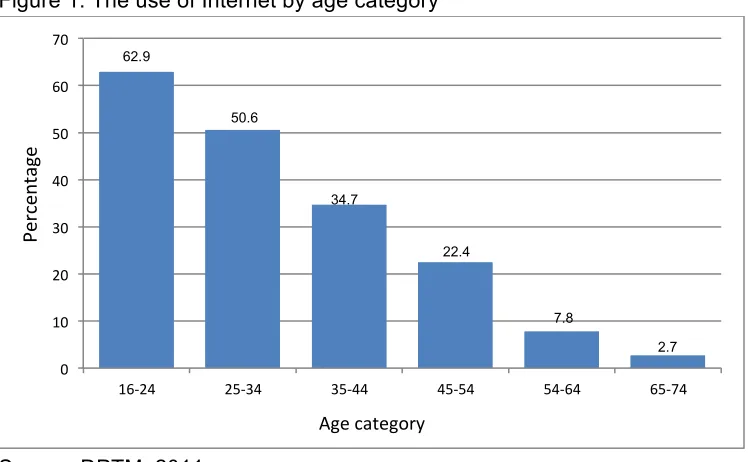
[image:3.595.91.466.285.516.2]electronic payments started to gain momentum. The number of credit and debit cards are 51 and 81 million respectively (Bankalararasi Kart Merkezi 2012). The first ATM was installed in 1987. 25 banks are reported to offer online banking. Of 30 million internet users (Anon 2012), 7.8 million are reported to be online bank customers who logged onto their account at least once in the last quarter of 2011 (Turkiye Bankalar Birligi 2012).
Figure 1: The use of Internet by age category
Source: DPTM, 2011
In comparison, currently 11 retail banks have been offering mobile banking (Turkiye Bankalar Birligi 2012). Turkish mobile market is dominated by three GSM operators: Turkcell (with a market share of 55 percent), Vodafone (with a market share of 26 percent) and Avea (with a market share of 19 percent) (Gungor and Cayci 2010). Initiated by Turkcell in April 2009, they all offer mobile payments to their subscribers. Mobile phones were introduced to Turkish users in 1994. Their popularity has been on steady increase. As of June 2010, 61.5 million people have a mobile phone reaching a penetration level of 85 percent (Gungor and Cayci 2010). In 2011, over one million people used their phone for banking transactions. Bank services offered via mobile banking are:
0 10 20 30 40 50 60 70
16-‐24 25-‐34 35-‐44 45-‐54 54-‐64 65-‐74
P
e
rc
e
n
tag
e
Age category
50.6
34.7
22.4
7.8
3
• checking balances
• transferring money between accounts • making payments
• viewing statements
• information search such as branch or ATM locator • ordering foreign currency
• buying stocks and shares
Mobile Payment Concept
The mobile payment concept has many meanings such as contactless payments by debit and credit cards, in-app purchases through online accounts like Google Wallet, iTunes and so on. The main understanding in Turkey is “direct carrier billing”. In other words, GSM carriers’ billing infrastructure is connected to merchants who sell virtual / physical goods through online platforms.
According to industry sources, in Turkey a total of just over 10 million consumers initiated a payment via their mobile phone, while around 50 percent has successfully completed a payment. For consumers who wish to perform a mobile payment transaction through their GSM operator, the only requirement is to own a mobile phone which allows the user to send and receive SMS messages. They do not need to have a bank account, which is one of the main strengths of the Turkish DCB. That is, 27 million unbanked population has now access to an electronic payment method as long as they own a mobile phone. Mobile payments are not allowed to corporate GSC subscribers. If the customer is on a pay monthly plan, the purchase price is charged to the customer’s mobile phone bill. Alternatively, if the customer is on a pay-as-you-go line, the purchase price is deducted from the pre-paid account. In this system the mobile device merely acts as a tool to confirm the order. Other than the price of the purchased product, the customer needs to pay the standard fee for the text message (SMS) they send in order to confirm their purchase.
How does Mobile Payment Work through GSM Operators?
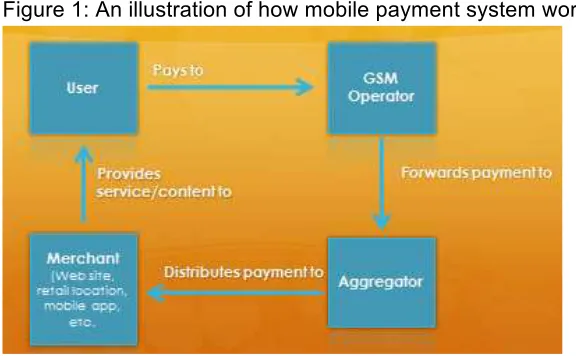
There are currently over 500 merchants offering mobile payments ranging from small scale firms to large ones, trading locally or internationally (such as Facebook, Nokia, bilyoner.com, peakgames.com, binnazabla.com, mybilet.com). 99 percent of them are virtual merchants while some offer both virtual and physical transactions. In order to partake in the DCB, first of all the given merchant needs to contact a GSM
4
Figure 1: An illustration of how mobile payment system works
When a consumer wishes to make a payment by their mobile phone, there are several ways for authenticating their mobile payment transaction although the essential principal remains the same: confirming that the order is placed and confirmed by the MSISDN (i.e. GSM number) that is inserted to the mobile device used, and that the user is fully notified & informed about the transaction before they approve it. Currently used authenticated methods are as follows:
• SMS-Keyword Scenario: The user texts a pre-defined keyword to a short code (for example by texting MC to 7979 in order to subscribe to Marie Claire magazine). Following this, DCB sends a text to the consumer informing the transaction to be made. The payment process is completed after the transaction is confirmed by the consumer. The transaction is itemised on consumer’s mobile phone bill (unless they are pay-as-you-go customer). The total balance for the phone bill needs to be paid in full by due date. The mobile device and GSM operators simply provide an alternative payment method and hence do not deal with any product, order or delivery related queries.
• Web Scenario: User enters their mobile number on the payment screen of the web site where they want to make the purchase. Then the shopper receives an SMS requesting for confirmation for the order. When the user replies this incoming SMS with “EVET” (e.i. YES), the payment is approved. No PIN is required.
• MSISDN forwarding: This is a relatively new technique mainly used for purchases made for mobile apps. In this system the mobile device needs to be connected to the Internet through GSM Carrier’s connection (EDGE, 3G, etc). The Carrier automatically detects the mobile phone number and bills the customer with no need for an SMS confirmation, which basically enables “one-click-purchase” flow from the end-user perspective.
post-5
paid subscriber does not pay their monthly bill, the GSM operator does not pay the amount to the payment aggregator. In that case, the risk is on the aggregator and the merchant. Since the transaction limits are rather low this is not considered to make a significant impact on the take up of mobile payments. As stated by industry sources, consumers or merchants are not largely affected by fraudulent use of phones since there is a strict limit on individual and monthly transactions.
Mobile Payment Aggregators (i.e. Technology Platforms)
Connecting GSM carriers’ billing gateways with online companies, enabling payment infrastructure, and managing the money flow are done by 3rd party companies which are referred to as “payment aggregators”, or “3rd party payment processors”. To be able to perform as a payment aggregator, a company needs to be certified as an “official solution partner” of the GSM Carrier, meaning that the payment processor is capable of successfully integrating its platform to the Carrrier, and providing this service to merchants on behalf of the Carrier.
All acquisition and retention activities, legal, technical and financial connections with merchants are at payment aggregators’ responsibility. P
ayment aggregator is also
expected to provide high quality service to their merchants and GSM
subscribers.
In Turkey, there are 7 active mobile payment aggregators. Among those, Mikro Odeme (Micro Payment) is the first and the largest company (holding 65% market share as of 2011), operating as a technology platform for all GSM operators in Turkey. Mikro Odeme (MO) is also the local partner of US-based social gaming company Zynga and the payment provider of Nokia for in-app purchases.
In a way, DCB is an alternative payment system to a virtual card. Virtual card is designed to be used as a credit card specifically for online transactions. It is not a physical card, so cannot be used to pay for store transactions. Similar to a traditional credit or debit card, virtual card has a card number and expiry date. The customer sets the limit on the card for each transaction depending on the value of transaction they wish to undertake. After each transaction the card limit can be reduced to zero, which is the most popular feature of a virtual card for consumers.
However, there is a significant difference between a virtual card and mobile payment. A virtual card is accepted by any online merchant who accepts a credit card whereas only merchants with a contractual partnership with one of the GSM operators can accept mobile payments. On the other hand, significantly more Turkish customers own a mobile phone than a bank, credit or virtual card. 27 million people have no access to a bank account. There are 51 million credit cards in circulation
(Bankalararasi Kart Merkezi 2012) in comparison with 61.5 million mobile phone users (Gungor and Cayci 2010). Hence the target customer base for mobile payments is potentially much larger.
6
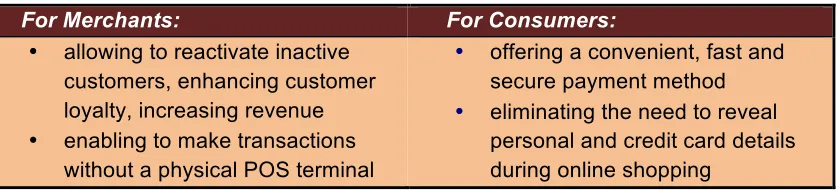
[image:7.595.94.514.157.252.2]terminal. While marketing their technology, DCB highlights the advantages of their mobile payment platform from the merchant and consumer perspectives as listed on Table 1:
Table 1: Advantages of mobile payment system as campaigned by DCB technology platforms
For Merchants: For Consumers:
• allowing to reactivate inactive customers, enhancing customer loyalty, increasing revenue • enabling to make transactions
without a physical POS terminal
• offering a convenient, fast and secure payment method • eliminating the need to reveal
personal and credit card details during online shopping
Characteristics of the Turkish Mobile Payment Systems
DCB started in Turkey by Turkcell in April 2009. Interestingly, the driving forces for this technology are GSM operators and their technology partners (such as MO) with no collaboration with financial institutions. Mobile payments do not aim to substitute credit or debit card payments. Their purpose is to provide a supplementary payment system particularly for online transactions which are under-utilised. DCB wishes to increase their market penetration by taking the advantage of low value high volume online entertainment transactions such as gaming and dating.
The merchant gets their payment for the product/service they sold from DCB. DCB charges the merchant a commission for their service, which is determined by GSM operators changing from 8 percent (for store purchases) to 40 percent (online
games). Albeit these commission rates are currently higher than physical POS rates, it is anticipated that with the development of mobile payments the rates are likely to go down.
It is likely that all three GSM operators offer mobile payments due to competitive pressures in the market (‘me too’ approach). There is limited evidence that operators have made substantial investments to promote their DCB in particular to their
customers, which will be elaborated in the next section.
Starting with the strengths of Turkish mobile payment systems, customers do not need to use a smart phone. While most contactless payments require an NFC-enabled smartphone, any mobile phone that allows sending and receiving an SMS is compatible with DCB. Secondly, purchase value is debited to consumer’s mobile account (or deducted from pre-paid credit balance) mostly after a confirmation SMS is sent by the consumer. Some mobile phones are initially locked to make a mobile payment (which requires a call to customer services to unlock the phone) while other providers offer their telephone unlocked. Although DCB can be used for store as well as online purchases, store purchases are rather limited, which takes us to the
shortcomings of the Turkish DCB.
7
consumers can use their mobiles in merchants that display their GSM operators’ payment system logo. Due to a lack of umbrella payment system (such as Visa or MasterCard) the market share for each GSM operator is likely to be highly limited and fragmented. It feels as it is more important for operators to be seen as a player in this financial innovation rather than considering it as a long term strategic initiative.
Another limitation of the DCB is that only low value (i.e. micro) payments are allowed in the system (hence the name Mikro Odeme – micro payment), which differ across GSM Operators (Table 2). Once the limit is reached no further payment is allowed. Lower limits are set for store transactions as well as for contractual subscribers. This can also be considered a strength since it limits consumers’ financial loss when their card lost or stolen and used fraudulently.
Table 2: Mobile Payment System transaction limits (as of July 2012)
Turkcell:
Single transaction limit range: 35TL (12GBP / 19USD) - 100TL (35GBP / 55USD) Monthly transaction limit range: 50TL (17GBP / 27USD) - 200TL (70GBP / 110USD) (200TL limit is increased to 360TL for pre-paid mobile users.)
Vodafone:
Single transaction limit: 70 TL (25 GBP / 38USD) Monthly transaction limit: 150 TL (55GBP / 83USD)
Avea:
Single transaction limit range: 50TL (17GBP / 27USD) -100TL (35GBP / 55USD) Monthly transaction limit range: 175TL (63GBP / 90USD) - 300TL (110GBP / 166USD)
Note: Conversions from Turkish Lira to British Sterling and United States Dollar are approximate. The Table refers to general usage - special conditions may apply.
Customers need to build up a history with their mobile operator before they can participate in DCB. Normally the requirement is to be a customer of the given mobile operator for at least 3 months and no payment defaults. Promotion credit balances cannot be used to make mobile payments.
Other Mobile Payment Methods in Turkey
Table 3 illustrates a brief summary of mobile payments systems in Turkey. In this sub-section we will present alternative mobile payment methods offered by financial institutions.
AVEA with a Bonus (Bonuslu AVEA)
With a partnership between Garanti Bankasi, GSM operator AVEA, MasterCard and digital security company Gemalto, AVEA subscribers can use their mobile phones like a credit card for contactless payments. Transactions only up to 35TL (12GBP / 19USD) are allowed to proceed. Having started as a pilot in May 2010, the
8
contactless mobile payments by replacing existing SIM card with an AVEA NFC SIM card. AVEA NFC SIM cards are sold at AVEA shops for 20TL (7GBP / 11USD). According to the CEO of Garanti Bankasi, mobile phones payments will upsurge with the popularity of NFC-enabled smart phones. It is claimed that in the near future 3 out of 5 mobiles in Turkey will have the infrastructure to enable contactless mobile payments. The target market for AVEA with a Bonus system is unbanked young population who owns a mobile phone. They will be able to use their mobile phone for virtual and physical goods purchases by using a pre-paid card (instead of a bank account) offered by Garanti Bankasi. From a merchant perspective, this system eliminates the need for a POS terminal, and hence potentially more merchants can be included in the system. Another advantage of AVEA with a Bonus system is reported to eliminate the need for cash and enabling to track all transactions, hence reducing tax evasion and black market.
Turkcell Mobile Wallet (Turkcell Cep-T Cüzdan)
Recently Turkish banks have started to offer mobile payments as part of mobile wallet. Turkcell in partnership with four leading financial institutions (Akbank, Denizbank, Garanti Bankasi and Yapi Kredi Bankasi) offers their customers to use their mobile phones for a range of services from shopping to bus pass and corporate ID card. Owing to NFC technology, mobile phone can also be used for contactless transactions. In this system, Turkcell subscribers first need to transfer information about their Akbank, Garanti Bankasi and Yapi Kredi Bankasi credit cards to their mobile phones. Then when they do shopping they can choose any of the credit cards transferred to their mobiles to make the payment. Customers need to be using an NFC-enabled smart phone and also to buy a special SIM card.
PayMobile:
Launched in 2011 PayMobile is a contactless technology offered by a collaboration between Yapi Kredi Bankasi and Turkcell, which aims to enable a smart phone to act as a credit card. Customers download their credit card details onto their mobile. No more than three credit card details can be downloaded. This technology enables customers to use their smart phone like a contactless credit card. PayMobile uses two systems: iCarte (for Visa transactions) and Sim Kart (for MasterCard
transactions), which allows for transactions up to 35TL (12GBP / 19USD). In addition to making a payment, customers can use PayMobile for a range of services such as viewing payment details, card limit, statement balance and access to previous statements. There is a one-off start-up fee which is 79TL (28GBP / 43USD). In terms of refunds and exchanges, the policy that applies to credit card payments are valid in PayMobile. The transaction is charged to the chosen credit card statement.
Table 3: A Brief Overview of Mobile Payment Systems in Turkey
o Mobile Payment through Direct Carrier Billing
§ Offered by GSM Operators, through payment aggregators § Operator infrastructure is used, banks are not involved. § Mostly used for micro-transactions and virtual goods
§ Details: http://www.mikro-odeme.com/en-us/about/mobilepayment
o CepBank
9 § Offered by Garanti Bank as CepBank (Mobile Bank in Turkish)
§ Bank infrastructure is used
§ Authentication is typically via SMS
§ Mainly used for peer-2-peer mobile money transfers § Details:
http://www.garanti.com.tr/en/personal_banking/delivery_channels/m obile_sms_banking/cepbank.page
o BonusPay
§ E-commerce solution § Offered by Garanti Bank
§ Authentication is typically via SMS § Mostly used for e-commerce § Example is hepsiburada.com § Details:
http://www.garanti.com.tr/en/personal_banking/delivery_channels/m obile_sms_banking/cepbank_shopping.page
o Türkcell Cüzdan (Turkcell Wallet)
§ Mobile Wallet
§ Offered by Garanti Bank and Turkcell together
§ Currently present for Android devices, will be launched for iOS as well. § Targets both e-commerce and physical channels.
§ Details: http://www.turkcell.com.tr/site/en/turkcellhakkinda/Sayfalar/cep-t-cuzdan/What-is-Turkcell-Cep-T-Cuzdan.aspx
o BonusluAvea (Avea with Bonus)
§ NFC payment solution
§ Offered by Garanti Bank and Avea
§ Used for micro payments in physical channels § Details:
http://www.garanti.com.tr/en/personal_banking/credit_cards/bonus_c ard_family/bonus_trink/bonus_trink_on_mobile_phone.page
o PayMobile
§ NFC payment solution
§ Offered by Yapı Kredi Bank and Turkcell § Used for micro payments in physical channels
§ http://www.worldcard.com.tr/worldu-taniyin/paymobile/default.aspx
o 3pay Credit Card
§ Offered by 3pay - Mikro Ödeme § Bank infrastructure is used
§ User triggers the transaction via SMS
§ Used for both virtual and physical goods, in online channels. § http://www.mikro-odeme.com/en-us/about/creditcard
Consumers’ View on Mobile Payment Systems
Turkish consumers do not seem to be aware of this new service offered by their mobile operators. Despite receiving monthly phone bills, customers did not recall of receiving any direct mail regarding to DCB. Similarly, it looks that there is no
10
Another factor behind the lack of consumer awareness of mobile payments is related to the target market. The system targets relatively young population who are frequent users of online gaming sites, social networks and e-commerce. Especially, online gaming industry in Turkey has been popular in recent years reaching 200 million USD transaction value in Turkey. According to MO, this market offers a good potential for cashless payments.
When we have explained the features of DCB, customers did not seem too enthusiastic about mobile payments method. Firstly, transaction limits were
commented as highly restricting. Secondly, in Turkey the volume and value of virtual purchases are still behind most European countries. It is reported that in 2009 only 12 percent of internet users placed an order or purchased an item through Internet (Algur and Cengiz 2011). Those who use virtual purchases tend to use a virtual card which is relatively more secure than a credit card. Therefore, customers were not sure what benefits they would receive when making a virtual payment by their mobile phones in comparison with a virtual card. Lastly, this was a time in Turkey that most banks were promoting new products and services such as mobile banking, mobile wallet, mobile signature, contactless cards and so on. Customers felt they were bombarded with too much information which are not very well targeted to their personal circumstances, suggesting issues with customer segmentation and
employed direct marketing techniques. Out of such frustration, as pointed out by one of our interviewees ‘perhaps mobile payment is another technological fad’. If mobile payments are to be expanded to a wider consumer segment, these are some of the issues that would need to be addressed by GSM operators and their business partners.
To conclude, the power of the Turkish DCB is related to their potential to contribute to cashless society by tapping into a market which is under-served. Turkish DCB
supplement, rather than substitute, other payment methods since the system targets a consumer segment which is not exploited by other electronic payment methods:
unbanked population. It has been only three years since the launch of the DCB. Therefore it is early to be able to comment to what extent the system has been successful in achieving its objectives. Nevertheless, our interviews with industry sources and the coverage in Turkish media suggest that mobile payments are likely to increase their popularity and market share and hence to promote a further step into cashless society in Turkey.
References:
Anon (2012) “İşte Türkiye'nin İnternet Kullanım İstatistikleri”
http://www.kaliteguncel.com/bilim-teknoloji/iste-turkiyenin-internet-kullanim-istatistikleri-h697.html [accessed on 20 September 2012]
Bankalararasi Kart Merkezi (Interbank Card Centre) (2012) “BKM Raporlar: Yillara Gore Istatistiki Bilgiler” available at ‘http://www.bkm.com.tr/yillara-gore-istatistiki-bilgiler.aspx’
Devlet Planlama Teşkilatı Müsteşarlığı (DPTM) (2011) “Bilgi Toplumu Istatistikleri 2011”,
11 Fengler, W. (2012) “How Kenya Became a World Leader for Mobile Money” available at ‘http://blogs.worldbank.org/africacan/how-kenya-became-a-world-leader-for-mobile-money’
Finaccord (2012) “Global Affinity Finance Club” Winter 2012, available at
‘http://www.finaccord.com/documents/Global%20Affinity%20Finance%20Club/global-affinity-finance-club_winter-2012.pdf’
Gungor, M. and Cayci, A. D. (2010) “Elektronik Haberlesme Sektorunde Tuketici Egilimleri” Bilgi Teknolojileri ve Iletisim Kurumu Report, November 2010.
Smith, A., Anderson, J. Q., Rainie, L. (2012) “The Future of Money: Smartphone Swiping in the Mobile Age” Pew Research Center’s Internet & American Life Project, April 17, 2012, Washington, D.C.
Turkiye Bankalar Birligi (Turkish Bankers’ Association) (2012) “Internet ve Mobil Bankacilik Istatistikleri, Aralik 2011” Report no: DT22, January 2012, Turkey
Useful Online Sources:
www.mikro-odeme.com www.mobilodeme.com
http://www.vodafone.com.tr/Servisler/mobil-odeme-servisi.php
http://www.turkcell.com.tr/bireysel/servisler/Sayfalar/turkcellmobilodeme.aspx http://www.avea.com.tr/tr/sta/bireysel/servisler/ozel/mobilodeme.shtml http://bonus.com.tr/pages/bonusluavea.aspx
http://www.turkcell.com.tr/bireysel/servisler/Sayfalar/Turkcell-Cep-T-Cuzdan.aspx http://www.worldcard.com.tr/worldu-taniyin/paymobile/default.aspx
http://evds.tcmb.gov.tr/cbt.html