ISSN Online: 1945-3124 ISSN Print: 1945-3116
Process-Oriented Requirements Engineering:
User-Centric LORS Framework
Hamdan Al-Sabri, Majed Al-Mashari
College of Computer and Information Sciences, Information Systems Department, King Saud University, Riyadh, Saudi Arabia
Abstract
In recent years, the process orientation requirements engineering field has re-ceived significant interest. However, dealing with ordinary users within an enterprise for developing as-is business process is very complex because this requires skills, responsibility, knowledge, and expertise of business processes. This research answers the following questions: 1) how to systematically gather information regarding as-is business process requirements in an informal en-vironment and by non-expert users? and 2) how can an enterprise refine the identified business process with a semantic process model? The primary pur-pose of this research is to develop a supporting framework that is suitable for the definition of an as-is business process to be deployed within the enterprise environment. Hence, the focus is on gathering requirements to define the as-is business process. This framework concentrates on three significant aspects of this process: development, refinement, and serialization the semantics of the process model. To accomplish this objective, the LORS framework has been proposed, which consists of four phases (List, Order, Refinement, and Seriali-zation). The framework presents a new unique technique to identify the busi-ness process, refine the process, and generate the model semantics. This study assumes that a simple and complete framework will help non-expert users de-fine a high-quality as-is process, such that enhance and facilitate the matching process with existing reference models. We present a case study, evaluate the case study relative to specified criteria, and research the limitations and im-plications discovered from our research. This research concludes that the LORS framework is simple, flexible, visible, interactive, dynamic, and effec-tive.
Keywords
Business Process Identification/Discovering, Business Process Requirements Engineering, BPMN MIWG, As-Is Business Process Creation, Model Semantics, Model Refinement, LORS Framework
How to cite this paper: Al-Sabri, H. and Al-Mashari, M. (2017) Process-Oriented Re- quirements Engineering: User-Centric LORS Framework. Journal of Software Engineer-ing and Applications, 10, 95-127.
https://doi.org/10.4236/jsea.2017.102006
Received: December 23, 2016 Accepted: February 4, 2017 Published: February 7, 2017 Copyright © 2017 by authors and Scientific Research Publishing Inc. This work is licensed under the Creative Commons Attribution International License (CC BY 4.0).
http://creativecommons.org/licenses/by/4.0/
1. Introduction
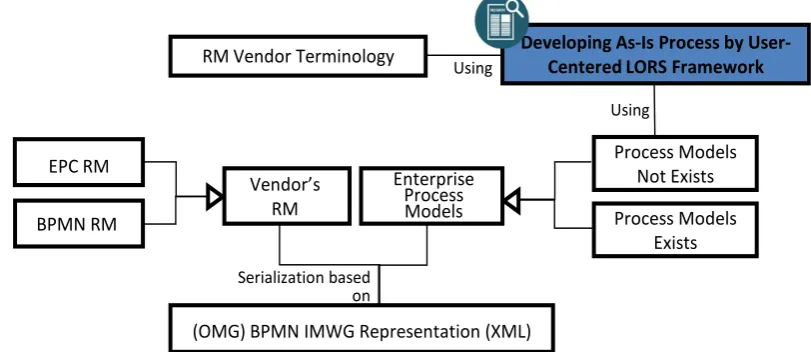
of the business process, the motivation of this research is the need to develop a coherent, structured, and complete framework for the definition of the as-is business process. Additionally, the lack of business process modeling expertise has been cited in several of the above-mentioned works. A primary reason to develop a new framework is the requirement to identify a maximal set of more efficient techniques that provide better solutions for the definition of the as-is BP to be utilized by a population of non-expert users. Specifically with regard to this research, the problem that we attempt to solve is the development of a LORS framework (List, Order, Refinement, and Serialization) that enables the non-expert user in an informal environment to develop the current state of the business process without requiring either modeling experience or development skills. In most cases, the employees of the enterprise are not familiar with the business process modeling techniques and tools [13]. As a result, we introduce the LORS framework to provide important assistance with the acceptance of this new way of depicting enterprise processes. This research work is a subset of a larger research effort and is a continuation of previous work [14], as shown in Figure 1 (the shadow represents this research work). In this research, we assume that the simple and complete framework helps non-expert users define high-quality as-is business processes such that the quality of the as-is BP models effect on matching process to the relevant ERP reference models. Furthermore, the use of vendor terminology (ontology) helps to syntactically define the busi-ness process elements correctly and generate a model for semantic aids that will assist in matching the reference models. Given these assumptions and the above problem statement, this research identified a set of requirements to define the phases of the LORS framework. The requirements of this research are grouped within categories that correspond to the business process identification phases. These are as follows: R1: The solution shall enable the non-expert users to define the as-is business process, R2: The solution shall enable the refinement of the business process according to specified refinement guidelines, styles, methods, and rules, and R3: The solution shall generate the model according to the BPMN
Figure 1. The interest of this research (RM: reference models).
(OMG) BPMN IMWG Representation (XML)
Process Models Exists Process Models
Not Exists
Using Using
Vendor’s RM EPC RM
BPMN RM
Serialization based on
RM Vendor Terminology Developing As-Is Process by User-Centered LORS Framework
MIWG formats. The purpose of this research is to answer the following ques-tions: i) how will non-expert users systematically gather information regarding the as-is BP in an informal environment? and ii) how can the identified business process be refined in order to derive a semantic process model in compliance with BPMN MIWG? This aspect of the business process requirements engineer-ing has not yet been sufficiently addressed in the literature. Therefore, the pri-mary emphasis of this research is to develop a framework based on results that are relevant to the requirements engineering field and, in particular, the area of business process definition and modeling. This research concentrates on us-er-centric business process identification and provides the following contribu-tions: a) development of a supporting framework that aids with the creation of an as-is BP under conditions of uncertainty that are characteristic of most en-terprise organizational environments, b) definition of a mechanism for the ac-quisition of the business process elements, and c) extension of the previous me-chanisms by allowing the refinement of the identified business process that is based on pre-defined guides, styles, methods, and rules. In addition, we will generate the model semantics from the identified business process defined by the BPMN MIWG formats. The structure of this paper is as follows: Section 2 in-troduces background and prerequisite data required to develop an as-is business process, and provide the basic concepts such as BP requirements engineering, BP refinement and quality dimensions, BPMN, BPMN MIWG, and model se-mantics and serialization. In Section 3, we present a review of the related work. The research model is outlined in Section 4. The LORS framework and asso-ciated framework meta-model are presented in Sections 5 and 6, respectively. A case study and application using the LORS framework is described in Section 7. The discussion and limitations of the research are discussed in Sections 8 and 9, respectively. Finally, the conclusions to this research and a discussion of future research are presented in Section 10.
2. Background and Preliminaries
This section presents the necessary background to support the theoretical and practical concepts; a short review includes the following aspects: business process, Business process identification/discovering, documentation of the as-is business process, business process requirements engineering, business process modeling, business process model and notation (BPMN), BPMN Model Interchange Work-ing Group (MIWG), model semantics specified by BPMN MIWG serialization, business process modeling techniques and methods/approaches/tools, and busi-ness process refinement.
2.1. Business Process
role, actor, flow, and goal [9]. The three uses of the business process are to in-itially create the business process, provide business process education, and manage the business process decisions [17]. The architecture of the business process consists of four components: the network of activities, the flow units, the resources, and the information structure [18]. The research in [19] documented that a business process passes through three stages of change: 1) the business process is presented via classical flowcharts, 2) the business process concentrates on information requirements to support the identified business model, and 3) business process management as the business process reaches “steady state”. Consequently, in order to define the business process, knowledge regarding the canonical concepts and architecture is required.
2.2. Business Process Identification/Discovering
The definition of the business process consists of discovering the components of the business enterprise and their interactions, both component-to-component as well as human-to-component. There are six stages that constitute the business process definition process; these are based on a bottom-up approach: identifica-tion of the business activities, identificaidentifica-tion of the human/data flows between activities, specification of the relationships between business activities, evalua-tion of the relaevalua-tionships, and identificaevalua-tion of the coupled activities [20]. Ac-cording to [21], the author distinguishes three separate techniques to approach business process discovery: 1) centralized versus distributed approach, 2) top-down versus bottom-up approach, and 3) structured versus free form ap-proach. In the first case, the centralized approach, decisions are made by an analyst meeting, as a team, with multiple Subject Matter Experts (SME). The distributed approach is characterized by the decisions formulated by an analyst after interviewing all Subject Matter Experts (SME) individually, and then com-bining and merging the input from all interviewees. In case (2), the top-down approach, the analyst begins at the highest level (root node) of abstraction and descends downward toward the terminal node, adding detail at each deeper level within the tree; in contrast, the bottom-up approach begins with no details at a terminal node and appends details as the design ascends upward toward the root. In the structured approach, the SMEs answer predefined questions and ag-gregate the answers to form the specifications of the business process. Each ap-proach described above has advantages and disadvantages, and the selection of a suitable technique is affected by a number of factors such as types of modelers (experts, non-experts) and environments.
2.3. As-Is Business Process Preparation, Collection, or Documentation
views: the organizational view and the process view. In [13] the author refer-ences exhibits of five points that are required to develop the as-is business process: 1) specification of the level of detail, 2) choice of the associated views (organizational view, data view, process view, or function view), 3) assignment of the modeling conventions (general modeling guidelines have to be defined), 4) selection of the source of information (such as organizational manuals, or documentation of the application systems), and 5) development of an identifica-tion plan. As a result, all primary requirements identified above must be speci-fied before creating the as-is business process. The as-is BP model can be applied in various circumstances according to [13]: i) specification of the shortcomings and potential improvements of the enterprise, ii) business analysis as a prerequi-site to the development of new processes, iii) generation of an overview of the current situation to aid external processes within external entity, iv) use of a checklist to help development of the to-be model, and v) the as-is model can be reused as the main input to the to-be models. In addition, the as-is BP can be used to match software reference models. The primary objectives of developing the as-is BP include: a) improving or redesigning the enterprise [24] [25] [26], b) enhancing the enterprise integration [27] [28] [29], c) providing the starting point for development of the architecture of necessary information systems [30], d) use in the requirements enumeration phase in the development of the infor-mation systems [31], and e) deployment as a knowledge repository of the enter-prise [22].
2.4. Business Process Requirements Engineering
The requirements engineering attraction to develop the business process has gained interest in recent years [32] [33]. This requirement defines the behavior of the required features and functionalities of a system, i.e., they represent the system capabilities, features, and constraints [10]. Likewise, the requirement to create an as-is BP defines the behavior of the process to include the behavior of its features and activities that represent the process functional areas, actors, fea-tures, flows, and the business rules. The difference between classical require-ments engineering approaches and process-based requirerequire-ments engineering is documented in [34]. Also, the difference between traditional and business process requirements engineering is presented in [35]. Furthermore, the re-searchers illustrated that the previous techniques do not provide sufficient in-formation to develop the business process; hence, new techniques must be de-veloped. Furthermore, in order to define the business process, the information from current business procedures and applications must be identified [22]. This research concluded that requirements engineering is considered as an appropri-ate technique to develop a coherent, complete, and valid business process by us-ing the web-based application, which depends on the LORS framework.
2.5. Development of Business Process
model the business process correctly, it must include all issues that are identified above by the researchers.
2.6. Business Process Model and Notation (BPMN)
The international standard for process modeling is called the Business Process Model and Notation (BPMN), and was developed by the Object Management Group (OMG) [48]. The BPMN is the de-facto standard for the graphical repre-sentation of the enterprise [4]. The core elements of BPMN related to the design of the business process specification involve events, tasks, gateways and se-quence flows [49]. In addition, the BPMN is emerging from the Business Process Management Initiative (BPMI). The BPMN process model consists of four basic element: Flow Objects (events, activities, and gateways), that connect the Objects (Sequence Flow), Swim lanes, and Artifacts [50]. The primary goal of BPMN is to afford a notation that is easily recognizable by business and IT users, includ-ing the business analysts who design the processes and the IT developers who are responsible for implementing BPMN [51]. BPMN version 2.0 provides a di-agram definition model and a meta-model that is capable of interchanging XMI and XSD formats. Therefore, due to the widespread usability of BPMN, this re-search focused on the process model elements and the model semantics of BPMN MIWG.
2.7. BPMN Model Interchange Working Group (MIWG)
Schema Definition (XSD) and 2) XML Metadata Interchange (XMI). However, XSD-based is the more popular format [53]. Additionally, there are three rele-vant aspects specific to the interchange formats: i) meta-model, ii) serialization (serial representation), and iii) mappings between a meta-model and tion [54]. Consequently, this research concentrated on the BPMN XSD serializa-tion format which means that the fourth phase within the LORS framework ge-nerates a model semantics based on BPMN MIWG serialization.
2.8. Business Process Refinement (Quality Dimensions)
This section provides a background of business process refinement and quality dimensions. The task of validating the model as to whether it correctly reflects reality is very difficult and sophisticated, primarily because it depends on discus-sions with stakeholders which means that it is dependent on other validation mechanisms [55]. Different frameworks and guidelines have been developed that define quality aspects in the context of process models. Moreover, the validation of the business process elements is based on the XML of the process model created using XPDL or XML in BPMN [4]. Therefore, the validation of the mod-el’s robustness must be conducted during the refinement phase of the creation of the as-is BP. In research documented in [56], the authors present seven process modeling guidelines (7PMG) that focus on modeling practice and present a set of instructions on how to build a process model as well as providing guidelines to enhance existing process models. Moreover, the six principles that are pre-sented in the guidelines address correctness, clarity, relevance, comparability, economic efficiency, and systematic design. There are several frameworks and guidelines developed to define the quality aspects of the business process such as the semiotic framework for model quality (SEQUAL) [57], Guidelines of Mod-eling (GoM) [58], Seven Process ModMod-eling Guidelines (7PMG) [56], and other studies that focus on metrics to assess the business process quality. The SIQ Framework is a process quality model based on three dimensions of quality [59]: 1) syntactic quality: this guarantees successful compiles of a business process constrained by modeling technique rules; therefore, the modeling language syn-tax and vocabulary play an important role, 2) semantic quality: this ensures that the process models will reflect true statements regarding the real world, and 3) pragmatic quality: this assures that the business process models are compre-hensible.
3. Related Work
The definition of the as-is BP has generated substantial research efforts and this research has produced a variety of different frameworks and approaches. In the following, the related works discussed fall into the context of this research. The studies include defining, identifying, and discovering the as-is BP within the en-terprise. Many researchers studied the business process model from a variety of directions; the compendium of this work provides a complete picture of the en-terprise’s procedures [32] [33] [63]. Other prominent approaches to business process modeling procedures are presented in [64] [65], which address the pro-cedures to gather the requirements to build a model. Several ideas regarding the acquisition of requirements to develop a business process are mentioned in the articles [66] [67]. In addition, several articles have stated that requirements en-gineering is appropriate to build the business process models; refer to [64] [65].
The research in [20] presents a brief review of the definition of the business process based on a bottom-up approach, conducted over five stages: 1) defining the activities of business, 2) determining the information flows between business activities, 3) applying the appropriate technique to quantify the relationships between business activities, 4) evaluating the relationships between coupled ac-tivities, and 5) identifying the coupled activities to develop the mode of the business process. However, the primary focus of the researchers is the relation-ship between the coupled activities within the enterprise and their interactions. In other research [68], the author has proposed a pragmatic framework called (CAP) that consists of three iterative phases: Capture, Analysis and Presentation, all of which are mostly concerned with capturing and understanding processes without prescribing particular notations. However, the different notations may be used within each CAP phase.
An approach to develop a process model deployed a user-centric approach to identify modeling requirements is documented in [69]. This approach concen-trates on the acquisition of the formal components of the model taken from a natural language document provided by experts or users. The authors argue that the conventional methods of object oriented analysis and conceptual modeling are insufficient to support requirements acquisition and validation by the end-user. In article [9], a formal framework to support enterprise and business process modeling has been presented, based on the situation calculus (a know-ledge representation formalism used in artificial intelligence). This process ap-plies the logic programming language, ConGolog [70]. The framework relies on concepts such as objectives and goals, roles and actors, actions and processes, and responsibilities and constraints. In addition, the work is dependent on re-sults from the i* framework that confirm the need for intentional concepts in enterprise modeling. However, the use of complex mathematical notation presents difficulties for the end users and special skills are required in the case of the situation calculus and ConGolog.
of business process design. The approach of requirements engineering that con-centrates on the visualization of requirements has been presented by [74]. Moreover, the end-to-end business process approach proposed by [75] is de-pendent on this scenario approach. Furthermore, in article [35], the authors presented an approach referred to as business process-driven requirements en-gineering that supports the acquisition of software requirements to assist the operations of an enterprise and ensure business/IT alignment. The approach re-lies on the mapping of business process goals into system goals that support the high-level goals (goal modeling, goal tree). In paper [8], the author discusses the problems of business process modeling and the techniques that were used for modeling and investigates the use of various techniques to find a better solution. The author also divided the business process modeling techniques into dia-grammatic and tabular techniques.
The [76] study proposed an approach for business process based requirements engineering called [vem:xi:]. They used the Business Process Modeling Notation (BPMN) that provides the description of end-to-end flow activities that cross business units. However, they focus more on the generation of Service Oriented Architecture (SOA) artifacts based on the requirements engineering phase. Fur-ther, the integration of the requirements engineering approach within the mod-eling of the business process and workflows is presented in [77]. However, this work does not extend to include the modeling of customers within the formal definition; it also does not adequately address the explicit management of know-ledge within an enterprise. The [78] study developed a collaborative business process modeling approach that supports the end-users that is based on a huma-nistic approach, a more user-centric approach. However, the developed ap-proach places primary emphasis on knowledge representation and visual com-position rather than defining the business process model.
In the [79] research, the authors presented a method for business process modeling referred to as the Task-Based Modeling method (TBM). They focused on management tasks and depend on selecting predefined tasks that are reusa-ble. A methodology to implement enterprise process modeling that applies the concepts of enterprise process evolution has been presented in [80]. The authors discussed a zero-time enterprise modeling technique by using a components as-sembly technique, a set of concepts, and schema used in dynamic enterprise process modeling. However, this work relies mainly on an agent-based enter-prise that requires support from the existing IT organization.
gathering requirements of a business process based on business scenarios. Their approach is divided into five phases: elicitation, formalization, validation, inte-gration, and verification. Also, in the paper [83], the authors offered an ap-proach to develop an as-is process model based on worker descriptions by using a control flow perspective. There are three stages of this approach: data collec-tion, data extraccollec-tion, and modeling and analysis with assistance from a ques-tionnaire. However, no evaluation of the proposed work is presented. In fact, the three previous works are considered as closer to this research. There is different research that is interested in defining the business process models through expe-riments and combinations. The [42] study conducted expeexpe-riments with 89 stu-dents (novices designers) and found that the hybrid design that combines text labels with abstract graphics is suitable for the design of the business process. In the article [84], the researchers merged techniques from the fields of 1) business process engineering and 2) requirements engineering, and defined BORE: a Business-Oriented approach to Requirements Elicitation.
Although many studies have been conducted on the topic of building an as-is BP model, only a small amount of research that is focused on the early phases of building the as-is BP can be located. Moreover, most of this research is still in-sufficient due to problems and drawbacks. These problems include: 1) does not provide detailed descriptions of the techniques, approaches, and frameworks, 2) does not provide a clear illustration of the hierarchy of different layers in the frameworks, 3) rarely provides systematic approaches to identify acquisition of the information necessary to develop a process model, 4) absence of comprehen-sive methods in the literature dealing with the early stages of creating a valid business process model, 5) the frameworks are unclear and unnecessarily com-plex, 6) most of the methods are manual and error-prone, and 7) there is no study reported in the literature that clearly discusses the model serialization. In general, the difference of all other frameworks and approaches are summarized by the assertion that only the LORS framework concentrates on the definition of the as-is BP model by gathering all relevant information in an informal envi-ronment and from non-expert users through the web-based LORS application. Further, the proposed framework in this research is created from the perspective that the enterprise has a number of business processes. These business processes are executed by functional areas or actors within the enterprise. Each business process is included within a set of activities. A set of activities has a business rule and workflow to define its status. In addition, a set of activities is activated and de-activated by specific events. This research attempts to provide a flexible, visi-ble, coherent, complete, and dynamic framework that assists non-expert users within the enterprise to build an as-is business process.
4. Research Model
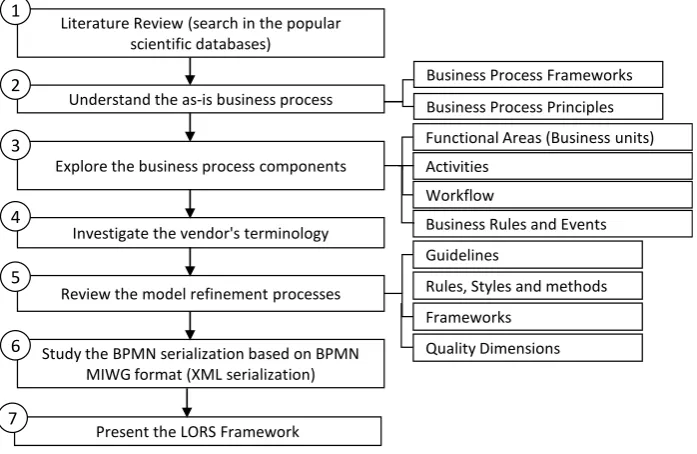
scientific databases, i.e., Web knowledge, Scopus, to gain a general understand-ing of the definition of the as-is business process, business processes principals, BPMN, BPMN MIWG, model refinement, and model semantics or serialization. The keywords used during this research were “identified/discover/define/create as-is business process, business processes identification, business process mod-eling”, and “as-is BP frameworks, business process refinement, business process serialization”, 2) understanding the as-is BP techniques, methodologies, frame-works, and business process modeling principles, 3) exploring the business process components such as functional areas, activities, events, business rules, and work flow, 4) investigating the vendors’ terminology (i.e. SAP ERP ven-dors), 5) reviewing the model refinement guidelines, rules, styles, methods, and frameworks related to refining the business process quality dimensions, 6) stud-ying the BPMN serialization based on BPMN MIWG (XML serialization), and 7) developing the framework that assists non-expert users to identify and build an as-is business process. Further, in this research, the definition of related litera-ture is based on the three criteria proposed by [85] and [86]. These criteria in-clude: i) Defining the domain area, as mentioned above, ii) defining the as-is BP within the domain under investigation, iii) Defining the sources of the relevant literature. The sources used in this paper were the scientific databases provided by Springer, Elsevier, IEEE, ACM, and most of the related journals that exist in the web of knowledge and Scopus, and iv) Defining the search strategy and the search terms. The process of refinement is conducted by using specialized terms. The research model is shown in Figure 2.
5. A LORS (List, Order, Refinement, Serialization)
Framework
[image:13.595.190.539.494.721.2]According to the American Heritage Dictionary of the English Language, the
Figure 2. Research model.
Present the LORS Framework 7
Functional Areas (Business units) Activities
Workflow
Business Rules and Events Business Process Frameworks Business Process Principles Understand the as-is business process
Explore the business process components
Investigate the vendor's terminology
Review the model refinement processes
Study the BPMN serialization based on BPMN MIWG format (XML serialization) Literature Review (search in the popular
scientific databases) 1
2
3
4
5
6
Frameworks Guidelines
Rules, Styles and methods
Quality Dimensions
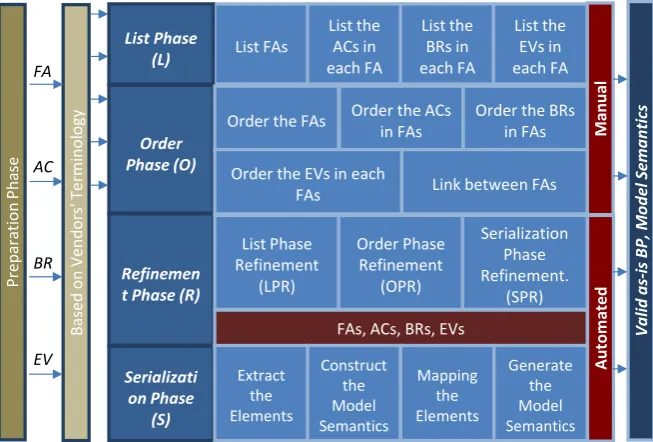
framework itself can be defined as “A structure for supporting or enclosing something else, especially a skeletal support used as the basis for something be-ing constructed; An external work platform; a scaffold; A fundamental structure, as for a written work; A set of assumptions, concepts, values, and practices that constitutes a way of viewing reality”. The objective of providing a structured framework for the definition of the as-is BP is that the detailed stages involved in the development process can be identified. This research concentrates on defin-ing, formalizdefin-ing, refindefin-ing, and generating the semantics of the as-is BP for en-terprises that do not have a business process model and cannot create one auto-matically from instance information systems, e.g. a Relational database. Fur-thermore, this research assumes that the LORS framework can be supported by non-expert users to develop a complete, coherent, and correct as-is business process. Before providing details regarding the LORS framework, it is necessary to provide a formal definition of a business process. In this research, the business process is defined as a set that consists of functional areas (FA), activities (AC), workflow (WF), business rules (BR), business rule states (BRS), and events (EV). The business process is a set that has the following elements (FAs, WF, BRs, BRS, EVs). The LORS framework phases are illustrated in Figure 3; more details about each phase and its steps are described below.
The task to build an as-is BP requires the formality of a model and a domain specification. Through the formalization, the users create the model with respect to a syntax that reflects a given domain specification [87], such as ERP domain (SAP terminology). Using a LORS framework enables the non-expert user to de-fine the current status of the enterprise in an interactive and user-friendly fa-shion. Furthermore, LORS refines the defined process and automatically gene-rates the model semantics (XML) based on BPMN MIWG; this is more compact and more powerful and closer to the BPMN specifications. The proposed LORS
Figure 3. A LORS framework.
Pre parat io n P has e Ba se d on V en do rs ' T er m in ol ogy
List FAs List the ACs in each FA List the BRs in each FA List the EVs in each FA List Phase (L) Order Phase (O) Refinemen t Phase (R)
Serializati on Phase
(S)
Order the FAs Order the ACs in FAs Order the BRs in FAs
Order the EVs in each
FAs Link between FAs
List Phase Refinement (LPR) Order Phase Refinement (OPR) Serialization Phase Refinement. (SPR) FAs, ACs, BRs, EVs
[image:14.595.210.537.494.715.2]framework consists of four phases: List, Order, Refinement, and Serialization (LORS); with an Add optional phase to instruct the user regarding the interface to the LORS framework, called “Preparation Phase”. The prototype forms of the web based application that implements the LORS framework layers includes in-terface elements which enable the user to list all process elements such as func-tional areas, activities, business rules, states, and events; this includes the possi-bility of building the relationships between elements through pre-defined lists. Therefore, to prepare the complete, correct, clear requirements for the definition of the as-is BP model, the LORS framework classification of the information is collected through the LORS phases and stored in the tables of the database. The following section describes the phases (steps) of the LORS framework in more detail. Notice that the user can save partial state information, and return to any phase or step in the LORS framework to add, delete, or update any elements; this capability is common for “ease of use” web interfaces.
1) Preparation Phase (Optional): In this phase, the users learn the interface to the LORS framework phases through a video. Probably the most efficient technique for understanding the details of business processes and their connec-tions is apprenticing [84]. The first phase assists the user to acquire the know-ledge to interface with each phase, e.g., how to list the functional areas (business units), actors, activities, events, and business rules states; also how to order the workflow. The first phase is considered optional.
Deliverable of the Preparation Phase: After the preparation phase, the user will be familiar with the LORS phase and have sufficient knowledge that will al-low him/her to create the as-is BP model.
2) List Phase (Manual): The second phase deals with listing all business process elements such as functional areas, actors in functional areas, activities, business rules with state, and events. To achieve this, the phase is partitioned in-to four steps in-to list the different elements of the business process. The primary concentration in the List phase is on gathering information regarding the as-is business process. The main challenge is to combine the information collected from users in an informal environment into a valid database that is refined with the collected data. The following subtitles illustrate the steps in the List phase. In addition, the vendors’ terminology (ontology) is used to provide a label of the business process elements in all steps.
i) List the Functional Areas: The user interacts with the web application in-terface and is able to list all functional areas within the enterprise. The term ‘‘functional area” involves the business unit and the actors within the enterprise. The actors represent the entity in the enterprise and can be a human actor such as an employee or an automated actor such as a machine [9]. The functional area description includes the name of the FA, and the type of the FA (business unit, or actor).
de-fine a business process, all activities must be identified at the level of each func-tional area within the enterprise [8]. The characteristics of the activity are type, functional area, time, rule, input/output, and cost [81]. An activity is automated when it is executed within the system without human intervention, while an ac-tivity is non-automated if there is a requirement that a user interact with the system to perform the process. In this step, the user lists all activities of each functional area; this produces the activity characteristics such as activity name, and activity type (manual, semi-automated, automated).
iii) List the Business Rules with States in each FA: The business rules are a collection of one or more conditions and a set of one or more actions (states). Each business rule is an expression, which results in a value of true, false or null (unknown) [38]. Furthermore, business rules represent specific policies, practic-es, standards, regulations, and guidelines that define how business units or ac-tors in the enterprise carry out business and are therefore considered to be us-er-perspective requirements [77]. According to [88], business rules are classified into two categories: structural and operative rules. The structural rules define how a business activity is organized while the operative rules define how the ac-tivity is carried out. Additionally, different types of conditions and constraints occur in business processes [83]. There are three types of the conditions: pre-conditions, post-conditions, and other conditions that occur during execu-tion. The Pre-condition must be evaluated as TRUE before the functional code is executed while the post-condition is evaluated at the conclusion of the function-al code. Other conditions include logicfunction-al, event occurrence, timer expiration, and stochastic events. In the notation tools, gateways are constructs for the ex-ecution flow of the process and can be one of the following: 1) AND gateway (for creating concurrent execution flows), 2) XOR gateway (to select one of a number of mutually exclusive flows), and 3) OR gateway (to select any number of flows from the set of all outgoing flows) [49]. In this step, the state must be entered af-ter each business rule through enaf-tered the outgoing flow of business rule. For the sake of simplicity, consider this simple example of a business rule that im-plements the “IS CAPACITY AVAILABLE?” rule via an “OR gateway”. The business rule states supports three outputs: i) capacity available, ii) capacity not available, and iii) capacity partially available Thus there are three outgoing flows from the “OR gateway”. In this step, the user lists all business rules (conditions) for each functional area with the following information: business rules label, business rules type (And, Or, XOR), business rules states (outputs of condi-tions), business rules position (pre-conditions, post-conditions, and other con-ditions). The “IS CAPACITY AVAILABLE?” rule will be included in the list.
iv) List the events in each FA: Events can be used to signal the start (start event), intermediate event, or end (end event) of a process. The role of the user in this step is listing the events in each functional area. The list event step in-cludes the event label (if one exists) and type (start, intermediate, and end event).
on user inputs (dynamic typing) that are based on vendor terminology such as SAP terms in reference models. The field of ontology describes the existence of objects in the world and how they are related [89]. Ontology can play a role in improving the quality of the creation of the as-is BP models. Indeed, gathering information often leads to the following specific problems: the information con-tains redundancies and repetitions, homonyms and synonyms, exceptional cases to be handled, and implicit information or confusion or inconsistencies between the schema and instance levels [82]. Often when we define the as-is business process, there are several types of documents to be considered, such as working instructions, already existing process models, intra-net information or even theses regarding parts of the process. Consequently, use of these conventions and standard terms can help in consolidating and reinforcing the enterprise as-is models [13]. Further, ontology is a formal conceptual model of a real world do-main, which represents the semantics underlying that domain. This level of se-mantic accuracy is recognized as useful (or even essential) to provide the basis for the production of generalized and reusable models of organizational beha-vior [89]. Also, the benefits of ontology-based terminology used within the business process model include improved model distribution, integration and interoperability, and model matching [90]. Therefore, in this research, the ven-dor terminology (such as: SAP terms) is used and the link between the LORS forms and the vendor dictionary is established to define consistent labels for functional areas, activities, business rules, events, and other objects used to build the as-is business process.
Deliverable of the List Phase: A list of functional areas (business units, and actors), a list of activities in each FA, a list of business rules with states in each FA, a list of events in each FA, with respect to the vendor’s terms.
3) Order/Workflow Phase (manual): The Order phase is used to represent the relationship between any two or more elements within a process that were entered previously by users during the List phase. A workflow can be defined as a set of activities organized to achieve some business process [41]. There are three types of workflow that are used: sequence, message, and association. The structured information gathered in the List phase can be translated to an appro-priate formal representation. Moreover, in order to develop the workflow of the as-is business process, the sequence flow of those elements must be established through interactive dialog defined in the LORS framework (before, after lists). In this phase, there are five steps that address the workflow of business process elements required to build the basic structures; these are: 1) order the functional areas, 2) order the activities, 3) order the business rules, 4) order the events, and 5) link the different functional areas. The type of workflow can be specified by the user but must be defined as one of the five basic structures. Furthermore, according to the LORS framework, a unique identifier for each element is auto-matically generated according to its sequence within the functional areas; thus the workflow is dependent on element identifiers (incoming, or outgoing).
and the numbers that reflect the order of the functional areas are enumerated (i.e. list contains 1, 2, 3, 4, 5; means five functional areas). The user selects the number that corresponds to the functional area arrangement.
ii) Order the Activities in each FA: In this step, the arrangement of each ac-tivity in a functional area is established. The output is similar to that of 3.1 such that each activity appears in an enumeration list, and the user selects the suitable value that corresponds to the flow of activity in the functional area.
iii) Order the Business Rules with States in each FA: The LORS Framework presents the frame of each functional area with a list of the business rules (con-tains: business rule label, BR type, BR position, and BR states) that were pre-viously specified. The user selects the appropriate arrangement of all business rules from the BRs enumeration list of each functional area. This creates an or-dered list of the Business Rules. According to the type (AND, OR, XOR) and po-sition (pre-condition, post-condition, another condition) of the business rules, the corresponding lists (before, or after list) appear in the frame. Associated with each business rule are two lists (before list, and after list) which contain the ac-tivities and events that were previously specified for each functional area. The user simply selects a suitable element from the list (before, or after list) that cor-responds to the workflow of the business rules in the functional area. This process iterates until all business rules within all functional areas are ordered. Notice that the activation of the order list (before, or after list) depends on the business rule position (post-c, pre-c, or other-c). When the business rule posi-tion is a post-condiposi-tion, the “before list” is activated, while the “after list” is ac-tivated when the position is a pre-condition. Naturally, the two lists (before, and after list) are activated when the business rule position type is other-condition. Furthermore, the outgoing flow of each business rule state flows to either activi-ty, business rule, or event. To illustrate this processing, assume a business rule called “Is capacity available?” with three states (capacity available, capacity not available, and capacity partially available), so each state flows out to either the activity, business rule, or event. Therefore, the user selects the outgoing flow for each state and the flow is linked to the corresponding activity, business rule, or event in the functional area.
iv) Order the Events in each FA: In this step, the tuple of events that was previously specified appears to users with event information (event label, event type), and the order list (before, or after list) that contains the other elements appears also. Notice that the activation of the lists (before, or after list) depends on the event type, e.g., when the event type is a start event, the “after list” is acti-vated, while the “before list” is activated when the event type is end event. Again, the two lists (before, and after list) are activated when the event type is interme-diate event. Simply, the user selects the suitable element from the order lists (before, after list) according to the workflow of the event in the functional area. Usually, the order list identifies (and contains) the other elements in the func-tional area.
functional areas that have been entered and ordered in the previous phases. The task performed by the user in this step is to create the link between the function-al areas through the elements. The interactive list that appears to the users con-sists of: outgoing from FA (automated same functional area), type of outgoing element in FA (AC, BR, or EV), select specific outgoing element, incoming FA list, type of incoming element (AC, BR, or EV), select incoming element, and type of workflow. Notice that the activation element lists depends on the type of outgoing/incoming element. When the user selects the activity as a type of out-going element, the activity list is activated while the other lists are disabled. This process iterates until the different functional areas are linked together (if there is a link). The link between different functional areas can support multiple links, i.e., there are multiple outgoing/ingoing flows between the functional areas.
Deliverable of the Order Phase: Arrangement of the functional areas (busi-ness units, and actors), an arrangement of activities in each FA, arrangement of business rules in each FA, arrangement of events in each FA, with respect to re-finement rules that are imposed on each element.
4) Refinement Phase (Automated): This section describes a method that the LORS Framework relies upon to improve and verify the consistency, correctness, and completeness of the as-is business process. Regarding the business process refinement, this phase refers to the ability to precisely depict all essential ele-ments of a business process in the context of functional areas, activities, business rules with states, and events that compose a business process in the correct way [6]. Moreover, the primary goal of this phase is to eliminate mistakes that origi-nate from invalid inputs during the List or Order phases when creating the as-is model. The refinement process is automated and enforces rules on the elements of the business process. There are four rules (business rules requirements) that are imposed in the refinement process: FA rules, AC rules, BR rules, and EV rules. These rules depend on the known frameworks, guidelines, styles, and me-thods that are presented in the literature review.
Order Phases: examining the user inputs and any refinements of the elements, check of the model serialization, and application of the refinement rules to the user inputs. There is a matrix in the LORS framework that supports the refine-ment process; it consists of the following: 1) List Phase Refinerefine-ment (LPR): (FAs List Refinement (FALR), Activities List Refinement (ACLR), Business Rules List Refinement (BRLR), and Event List Refinement (EVLR), 2) Order Phase Re-finement (OPR): (FAs Ord. ReRe-finement (FAOR), FA Ord. ReRe-finement (FAOR), Activities Order Refinement (ACOR), Business Rules Order Refinement (BROR), Event Ord. Refinement (EVOR), and Workflow Order Refinement (WFOR)), and 3) Serialization Phase Refinement (SPR): (FAs Serialization Re-finement (FASR), Activities Serial. ReRe-finement (ACSR), Business Rules Serializa-tion Refinement (BRSR), Event SerializaSerializa-tion Refinement (EVSR), and Workflow Serialization Refinement (WFSR).
Deliverable of the Refinement Phase: a valid as-is BP that refines the as-is BP elements (refine the functional areas, refine the activities, refine the business rules, and refine the events).
5) Serialization Phase (Automated): The business process creates serialized business process elements and property values that are inserted into an XML stream to generate the model semantics. There are two XML-based formats: the XML Metadata Interchange (XMI) and the XML Schema Definitions (XSDs), but the serialization is based on XML Schema Definitions (XSDs) [53]. There are also two types of definitions: model definitions and graphical definitions. The model definition describes the elements of the business process and their rela-tions; while the graphical definitions describe the visualization aspects [53]. There are two dimensions that need to be considered during a business process serialization: the semantics of the meta-model elements when different repre-sentations are used, and the terms that describe the model elements [92]. Fur-ther, the benefits of the business process semantic are enhancing the validation, use in model matching, and reuse of the model. There are four automated steps in this phase: 1) extracting the element information such as id, name, and other attributes that were previously specified by the user, 2) constructing the model semantics serialization based on the elements workflow entered by the user in compliance with the BPMN MIWG semantics of the meta-model elements, 3) mapping the elements entered by the user to the BPMN IMWG meta-model elements, and 4) generating the model semantics.
Deliverable of the Refinement Phase: Generate the model semantics using the XML file based on the BPMN MIWG format.
6. A LORS Framework Meta-Model
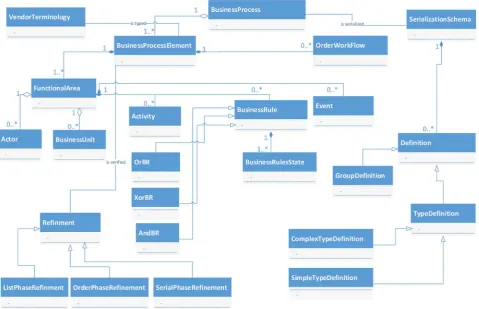
Moreover, the meta-models of the business process allow capturing three im-portant aspects of the business process such as informational, functional, and behavioral aspects [94]. For instance, the BPMN meta-model contains 151 meta- classes and 200 meta-associations. Moreover, there are several modeling ap-proaches that are described by meta-models such as the Quality-Oriented Busi-ness Process Meta-Model (QOBPM), the BusiBusi-ness Process Model and Notation (BPMN) Meta-model, and the Transactional Meta-Model for Business Process (TMBP). A comparative study of business process meta-models is presented in [94], and the researchers concluded that most of the meta-models do not support practice modeling. In [95], the researchers created a meta-model that is used to illustrate the modeling frameworks, approaches and tools for a specific domain. Several techniques are sufficiently developed to create meta-models such as UML Class diagrams, ER-diagrams, graphs, and XML schema. The design crite-ria that are necessary to develop a meta-model with an interchange format are completeness, simplicity, unambiguity, generality, and extensibility [96]. The LORS framework is illustrated in Figure 4 with consideration of the previous meta-models and the design criteria that is defined to develop a meta-model.
7. Case Study and Application
[image:21.595.60.540.406.715.2]In this research study, a simple process was used as a case study to explain the LORS framework phases discussed above. The case study is an enterprise
application that executes a purchasing process for materials that are defined by three functional areas: warehouse, purchasing, and the accounting functional area. Major process activities include: “create purchase requisition”, “create purchase order”, and “verify and payment”. To illustrate the scenario, the ware-house department sends the purchase requisition to a purchasing department to create the purchase order containing the details (quantity, sizes, and other speci-fications). Subsequently, the purchasing department sends the order to an ac-counting department to create the invoice to allow the buyer to make the pay-ment. After receiving the payment, the purchase order is closed. At this point, the warehouse receives the order. In the warehouse functional area, the source of supply is determined, including all specifications of the order and a suitable vendor is identified. Based on the purchase order from the purchasing functional area, the accounting functional area verifies the invoice and sends payment to the supplier. Materials are received by the warehouse functional area and in this way the business processes are completed.
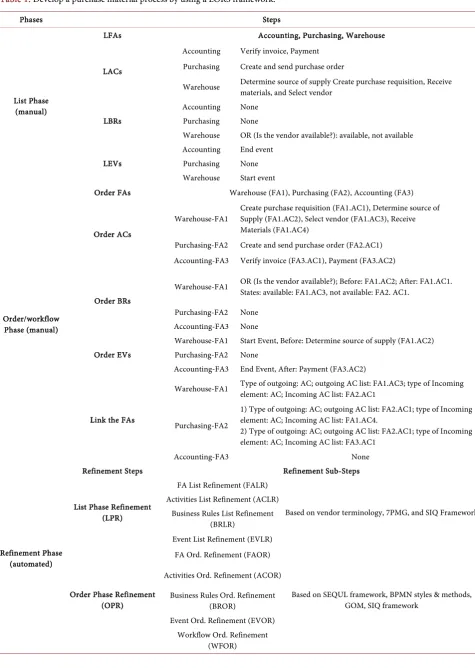
In this case study, the as-is BP is called “purchase material” and was easily de-veloped by the employee. The employee who participated in this activity inte-racts with a prototype of the web-based LORS application to complete the text boxes (required information) as shown in Table 1. All phases and steps of the LORS framework, including specific details have been applied and the final deli-verables (process model and model semantics) are shown. Due to the limitations of space, it is not possible to present all details of the case study here (see Table 1). In comparison with the conventional process approaches for building an as-is model, the benefits of applying the LORS framework include: 1) development of a valid as-is BP model performed by non-expert users with no modeling skills, and 2) the ease of use in the development and refinement of the process and the generation of the model semantics. This research is part of a larger research ef-fort that specifies the areas of change within the enterprise when implemented with the Commercial Off-The-Shelf (COTS) IT. Consequently, generating the valid as-is model semantics can help in the model matching process when com-paring the reference model with an as-is model. The specification of the enter-prise areas of change is more efficient and cost effective.
8. Discussion and Evaluation
Table 1. Develop a purchase material process by using a LORS framework.
Phases Steps
List Phase (manual)
LFAs Accounting, Purchasing, Warehouse
LACs
Accounting Verify invoice, Payment Purchasing Create and send purchase order
Warehouse Determine source of supply Create purchase requisition, Receive materials, and Select vendor
LBRs
Accounting None Purchasing None
Warehouse OR (Is the vendor available?): available, not available LEVs
Accounting End event Purchasing None Warehouse Start event
Order/workflow Phase (manual)
Order FAs Warehouse (FA1), Purchasing (FA2), Accounting (FA3)
Order ACs
Warehouse-FA1 Create purchase requisition (FA1.AC1), Determine source of Supply (FA1.AC2), Select vendor (FA1.AC3), Receive Materials (FA1.AC4)
Purchasing-FA2 Create and send purchase order (FA2.AC1) Accounting-FA3 Verify invoice (FA3.AC1), Payment (FA3.AC2)
Order BRs
Warehouse-FA1 OR (Is the vendor available?); Before: FA1.AC2; After: FA1.AC1. States: available: FA1.AC3, not available: FA2. AC1. Purchasing-FA2 None
Accounting-FA3 None Order EVs
Warehouse-FA1 Start Event, Before: Determine source of supply (FA1.AC2) Purchasing-FA2 None
Accounting-FA3 End Event, After: Payment (FA3.AC2)
Link the FAs
Warehouse-FA1 Type of outgoing: AC; outgoing AC list: FA1.AC3; type of Incoming element: AC; Incoming AC list: FA2.AC1
Purchasing-FA2
1) Type of outgoing: AC; outgoing AC list: FA2.AC1; type of Incoming element: AC; Incoming AC list: FA1.AC4.
2) Type of outgoing: AC; outgoing AC list: FA2.AC1; type of Incoming element: AC; Incoming AC list: FA3.AC1
Accounting-FA3 None
Refinement Phase (automated)
Refinement Steps Refinement Sub-Steps
List Phase Refinement (LPR)
FA List Refinement (FALR)
Based on vendor terminology, 7PMG, and SIQ Framework Activities List Refinement (ACLR)
Business Rules List Refinement (BRLR)
Event List Refinement (EVLR)
Order Phase Refinement (OPR)
FA Ord. Refinement (FAOR)
Based on SEQUL framework, BPMN styles & methods, GOM, SIQ framework
Activities Ord. Refinement (ACOR) Business Rules Ord. Refinement
(BROR)
Event Ord. Refinement (EVOR) Workflow Ord. Refinement
Continued
Serialization Phase Refinement (SPR)
FA Serial. Refinement (FASR)
Based on the semantics of meta-model elements for BPMN MIWG
Activities Serial. Refinement (ACSR)
Busi. Rules Serial. Refinement (BRSR)
Event Serial. Refinement (EVSR) Workflow Serial. Refinement
(WFSR)
Serialization Phase (automated)
Serialization Steps Description
Extraction Step Extracting the elements information such as (id, name, and other attribute) that entered pre-viously by the user. Construction Step Constructing the model semantics serialization based on the elements workflow entered by user
and according to BPMN MIWG semantics of the meta-model elements
Mapping Step Mapping between the elements entered by user and BPMN IMWG meta-model elements which means insert operation. Generating Step Generating the model semantics.
Final outcomes
Legend:
Abbreviation Stand for Abbreviation Stand for
FA. Functional area LFAs List functional areas
AC. Activity LACs List activities
BR. Business Rule LBRs List business rules
EV. Event LEVs List events
FA1.AC4 The first Functional area, the fourth activity
functional areas through the simple lists (before, after lists) using the interactive screens. Further, refinement of the developed business process was conducted automatically in parallel with the first two phases (List, and Order phase) using the predefined guides, styles, and methods. Generating the model semantics represented by the BPMN MIWG formats was illustrated in the case study. We conclude that the LORS framework is characterized by simplicity, flexibility, vi-sibility, and dynamics.
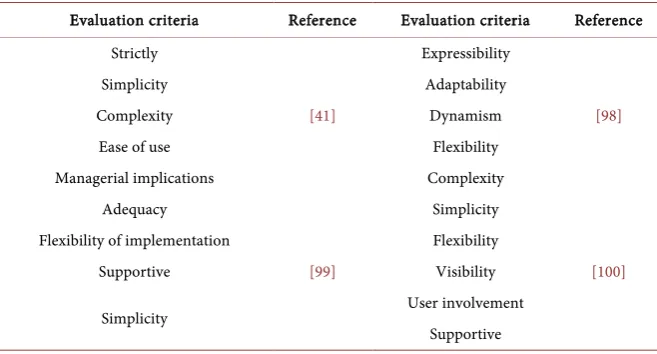
the complexity in the application of the framework, ease of use, and managerial implications [41]. Moreover, in [97], the authors present a framework called Quality-based Modeling Evaluation (Q-ME) that assesses the business process modeling quality through a set of quality attributes. Analysis of the business process modeling frameworks/approaches includes an evaluation of the strengths and weaknesses, relative to adaptability, expression support, dynamism, flexibil-ity, and complexity considerations [98]. Indeed, there is a large amount of re-search to investigate the evaluation criteria applied to the framework/approach of the as-is BP identification as mentioned in references [99] [100]. The criteria used in the evaluation of the business process discovery framework are pre-sented in Table 2.
In evaluating this results of this research, we apply the evaluation criteria spe-cified previously and conclude that the LORS framework offers a complete solu-tion to the problem of creating an as-is BP by non-expert users within an infor-mal environment. The basis for this conclusion is:
1) Simplicity: The LORS framework is simple to use by any employee within the enterprise. It enables the non-expert user to define the functional areas, ac-tivities, business rules, workflow, and also create links between the different functional areas within the process. In addition, the user develops the as-is process without the expertise and background required to perform formal busi-ness process modeling and associated extraction tasks. In addition, interaction with the LORS framework excludes ambiguous steps and does not require the users to possess modeling skills. Moreover, the LORS framework preparation phase provides a user-friendly interface that allows users to easily build the cur-rent status process models via the LORS framework.
[image:25.595.209.538.558.735.2]2) Flexibility: The framework is flexible as it allows the non-expert user to define a business process through interaction with the LORS application in two easy phases (List, and Order phase). Additionally, the framework supports au-tomated phases to refine the as-is BP and generate the model semantics. This is accomplished by using the set of guidelines, methods, and styles that were
Table 2. Criteria for evaluating the frameworks of business process discovering.
Evaluation criteria Reference Evaluation criteria Reference Strictly
[41]
Expressibility
[98]
Simplicity Adaptability
Complexity Dynamism
Ease of use Flexibility
Managerial implications Complexity Adequacy
[99]
Simplicity
[100] Flexibility of implementation Flexibility
Supportive Visibility
Simplicity User involvement
mentioned previously in the Refinement and Serialization phase.
3) Visibility: The visibility of the LORS framework is enhanced via support for many functional areas, activities, and business rules. Support to view workflows is excellent, because the framework presents the workflows in the form of well-arranged tables; this is an example of the first guideline in the 7PMG, “use as few elements in the model as possible”. Moreover, the LORS framework phases and steps are easily comprehended and easily managed. Therefore, the visibility of the LORS framework that contains many process elements exceeds that of other frameworks. This is because the entire extracted business process is presented in well-arranged tables within the application in-terface, and workflow of the process elements is clear and it is easy to track the paths between process elements.
4) User involvement (Interactive): Developing the as-is BP requires interac-tion between enterprise employees and the LORS applicainterac-tion and this will in-volve the users. They will be actively inin-volved in the first two manual phases within the LORS framework (List, Order phase) as these are considered to be the core tasks. The user involvement requires interaction with the actors, business units, activities, business rules, and workflow within the enterprise to properly create the as-is business process.
5) Dynamism: The LORS framework is a dynamic system that can automati-cally refine all elements when a business process is defined. Dynamic typing of objects is supported that is based on vendor terminology. Additionally, the framework provides support to build and generate the model semantics.
9. Limitations and Implications of the Research
10. Conclusion
Various frameworks and approaches have been proposed to assist in the defini-tion of an as-is business process. Each of these addresses some of the problems; some focus on the precision while others focus on completeness, consistency, and refinement. This research has studied a method to improve the traditional practice of development of an as-is BP in an informal environment for use by non-expert users. The contributions of this research are 1) the LORS framework, designed to discover and develop an as-is business process, 2) providing a me-chanism to refine the business process model based on refinement guidelines, styles, methods, rules, and frameworks, and 3) generating the model semantics and representation using the BPMN MIWG formats. In this research, we intro-duced the LORS framework to focus on a business process requirements engi-neering solution. The framework presented helps to overcome a set of limita-tions characteristic of traditional frameworks, and simplifies the discovery and development of an as-is BP so that it is easily adopted by non-expert employees within the enterprise. We provided an overview of the LORS framework and identified the four phases (List, Order, Refinement, and Serialization) supported by LORS. We also presented a high-level overview of BPMN elements, BPMN MIWG, and the business process with attention to the serialization based on the MIWG format used to generate the model semantics. The case study, framework evaluation criteria, and research limitations and implications were discussed. The framework evaluation process indicates that the LORS framework is simple, flexible, visible, interactive, and dynamic. The follow-on research and develop-ment work will address the limitations that were previously develop-mentioned. We plan to investigate the following areas: i) improvement of the proposed framework with more attention on the refinement phase, ii) identification of the relation-ship between elements, and iii) extending the framework to include other pers-pectives such as semantic model matching.
References
[1] Van Nuffel, D., Mulder, H. and Van Kervel, S. (2009) Enhancing the Formal Foun-dations of Bpmn by Enterprise Ontology. In: Advances in Enterprise Engineering III, Springer, Berlin, Heidelberg, 115-129.
https://doi.org/10.1007/978-3-642-01915-9_9
[2] Monk, E. and Wagner, B. (2012) Concepts in Enterprise Resource Planning. Cen-gage Learning, Boston.
[3] Rosemann, M. (2008) Understanding and Impacting the Practice of Business Process Management. International Conference on Business Process Management, Volume 5240, 2. https://doi.org/10.1007/978-3-540-85758-7_2
[4] Chinosi, M. and Trombetta, A. (2012) BPMN: An Introduction to the Standard. Computer Standards & Interfaces, 34, 124-134.
https://doi.org/10.1016/j.csi.2011.06.002
[6] Curtis, B., Kellner, M.I. and Over, J. (1992) Process Modeling. Communications of the ACM, 35, 75-90. https://doi.org/10.1145/130994.130998
[7] Weilkiens, T., Weiss, C. and Grass, A. (2011) Chapter 3-Basic Principles of Business Processes OCEB Certification Guide. Morgan Kaufmann, Boston, 33-45.
[8] Damij, N. (2007) Business Process Modelling Using Diagrammatic and Tabular Techniques. Business Process Management Journal, 13, 70-90.
https://doi.org/10.1108/14637150710721131
[9] Koubarakis, M. and Plexousakis, D. (2002) A Formal Framework for Business Process Modelling and Design. Information Systems, 27, 299-319.
https://doi.org/10.1016/S0306-4379(01)00055-2
[10] Ma, Q. and Jiang, Y. (2014) Process-Oriented Information System Requirements Engineering—A Case Study. Journal of Business Cases and Applications, 10, 1. [11] Bider, I. (2002) Tutorial on: Business Process Modeling as a Method of
Require-ments Engineering. ICEIS, Espanha.
[12] Fleischmann, A. and Stary, C. (2012) Whom to Talk to? A Stakeholder Perspective on Business Process Development. Universal Access in the Information Society, 11, 125-150. https://doi.org/10.1007/s10209-011-0236-x
[13] Schwegmann, A. and Laske, M. (2003) As-Is Modeling and Process Analysis. In: Process Management, Springer, Berlin Heidelberg, 107-133.
https://doi.org/10.1007/978-3-540-24798-2_5
[14] Al-Sabri, H.M., Al-Mashari, M. and Chikh, A. (2016) A Comparative Study and Evaluation of ERP Reference Models in the Context of ERP IT-Driven Implementa-tion: SAP ERP as a Case Study. Business Process Management Journal, in Press. [15] SAP Community Network (SCN) is the official user community of SAP SE. SAP
software users, developers, consultants, mentors and students use the SAP Commu-nity Network to get help, share ideas, learn, innovate and connect with others.
http://www.sap.com/community.html
[16] W. c. t. g. WfMC. (April 2011) WFMC-TC-1011 Ver 3, WfMC.
http://www.wfmc.org/standards/
[17] Aguilar-Saven, R.S. (2004) Business Process Modelling: Review and Framework. International Journal of Production Economics, 90, 129-149.
https://doi.org/10.1016/S0925-5273(03)00102-6
[18] Anupindi, R., Chopra, S., Deshmukh, S., Mieghem, J. and Zemel, E. (1999) Manag-ing Business Process Flows. Prentice Hall, New Jersey.
[19] Ould, M.A. (2005) Business Process Management: A Rigorous Approach. BCS, The Chartered Institute.
[20] Bititci, U.S. and Muir, D. (1997) Business Process Definition: A Bottom-Up Ap-proach. International Journal of Operations & Production Management, 17, 365- 374.
[21] Verner, L. (2004) The Challenge of Process Discovery. BPM Trends, May.
[22] Castela, N., Zacarias, M. and Tribolet, J. (2011) Proasis: As-Is Business Process Model Maintenance. Working Conference on Practice-Driven Research on Enter-prise Transformation, 89, 53-82. https://doi.org/10.1007/978-3-642-23388-3_3 [23] Fossland, S. and Krogstie, J. (2015) Modeling As-Is, Ought-to-Be and to-Be-
Experiences from a Case Study in the Health Sector. PoEM, Valencia.
[24] Bernus, P. (2003) Enterprise Models for Enterprise Architecture and ISO9000: 2000. Annual Reviews in Control, 27, 211-220.
[25] Davenport, T.H. (2013) Process Innovation: Reengineering Work through Informa-tion Technology. Harvard Business Press, Brighton.
[26] Hammer, M. and Champy, J. (2009) Reengineering the Corporation: Manifesto for Business Revolution, A. Zondervan, New York.
[27] Goul, M. and Corral, K. (2007) Enterprise Model Management and Next Genera-tion Decision Support. Decision Support Systems, 43, 915-932.
https://doi.org/10.1016/j.dss.2005.05.023
[28] Kim, H.M. and Fox, M.S. (2002) Using Enterprise Reference Models for Automated ISO 9000 Compliance Evaluation. Proceedings of the 35th Annual Hawaii Interna-tional Conference on System Sciences, Big Island, HI, 7-10 January 2002, 1278- 1287. https://doi.org/10.1109/hicss.2002.993991
[29] Chapurlat, V., Kamsu-Foguem, B. and Prunet, F. (2003) Enterprise Model Verifica-tion and ValidaVerifica-tion: An Approach. Annual Reviews in Control, 27, 185-197. https://doi.org/10.1016/j.arcontrol.2003.08.001
[30] Sousa, P., Caetano, A., Vasconcelos, A., Pereira, C. and Tribolet, J. (2006) Enterprise Architecture Modeling with the Unified Modeling Language. Enterprise Modeling and Computing with UML. IGI Global, 6, 69-97.
https://doi.org/10.4018/978-1-59904-174-2.ch004
[31] Loucopoulos, P. and Kavakli, E. (1995) Enterprise Modelling and the Teleological Approach to Requirements Engineering. International Journal of Cooperative In-formation Systems, 4, 45-79. https://doi.org/10.1142/S0218843095000032
[32] Van Der Aalst, W. and Van Hee, K.M. (2004) Workflow Management: Models, Methods, and Systems. MIT Press,Cambridge, MA.
[33] Weske, M. (2010) Business Process Management: Concepts, Languages, Architec-tures. Springer Publishing Company, Incorporated.
[34] Arao, T., Goto, E. and Nagata, T. (2005) “Business Process” Oriented Requirements Engineering Process. Proceedings of the 13th IEEE International Conference on Requirements Engineering, Paris, 29 August-2 September 2005, 395-399.
[35] De la Vara González, J.L. and Diaz, J.S. (2007) Business Process-Driven Require-ments Engineering: A Goal-Based Approach. Proceedings of the 8th Workshop on Business Process Modeling,.
[36] Mendling, J. (2008) Metrics for Process Models: Empirical Foundations of Verifica-tion. Lecture Notes in Business Information Processing, Vol. 6, 97-163.
https://doi.org/10.1007/978-3-540-89224-3
[37] Mendling, J. (2008) Metrics for Business Process Models. In: Metrics for Process Models, Springer, 103-133. https://doi.org/10.1007/978-3-540-89224-3_4
[38] da Cunha Mattos, T., Santoro, F.M., Revoredo, K. and Nunes, V.T. (2014) A Formal Representation for Context-Aware Business Processes. Computers in Industry, 65, 1193-1214. https://doi.org/10.1016/j.compind.2014.07.005
[39] Gordijn, J., Akkermans, H. and Van Vliet, H. (2000) Business Modelling Is Not Process Modeling. International Conference on Conceptual Modeling, 1921, 40-51. https://doi.org/10.1007/3-540-45394-6_5
[40] de la Vara González, J.L. (2011) Business Process-Based Requirements Specification and Object-Oriented Conceptual Modelling of Information Systems. PhD thesis, 2011, Universitat Politècnica de València.
https://riunet.upv.es/
https://riunet.upv.es/bitstream/handle/10251/11445/tesisUPV3622.pdf?sequence=1