Munich Personal RePEc Archive
Strategic Judgment Proofing
Che, Yeon-Koo and Spier, Kathryn
12 June 2006
Strategic Judgment Proofing
∗
Yeon-Koo Che
†Kathryn E. Spier
‡June 12, 2006
Abstract: A liquidity-constrained entrepreneur needs to raise capital to finance a business activity that may cause injuries to third parties — the tort victims. Taking the level of borrowing as fixed, the entrepreneur finances the activity with senior (secured) debt in order to shield assets from the tort victims in bankruptcy. Interestingly, senior debt serves the interests of society more broadly: it creates better incentives for the entrepreneur to take precautions than either junior debt or outside equity. Unfortunately, the entrepreneur will raise a socially excessive amount of senior debt, reducing his incentives for care and generating waste-ful spending. Giving tort victims priority over senior debtholders in bankruptcy prevents over-leveraging but leads to suboptimal incentives. Lender liability ex-acerbates the incentive problem even further. A Limited Seniority Rule, where the firm may issue senior debt up to an exogenous limit after which any further borrowing is treated as junior to the tort claim, dominates these alternatives. Shareholder liability, mandatory liability insurance and punitive damages are also discussed.
Keywords: the judgment proof problem, strategic judgment proofing, capital
structure, subordination, lender liability, limited seniority, shareholder liability
∗The authors thank Barry Adler, Ian Ayres, Lucian Bebchuk, Patrick Bolton, Albert Choi, Jim Dana,
Allen Ferrell, Fernando Gomez, Oliver Hart, Kazumi Hori, Daniel Klerman, Reinier Kraakman, Yair Listokin, Paul Mahoney, Mark Ramseyer, Chris Sanchirico, Alan Schwartz, James Spindler, Eric Talley, Abe Wickel-gren, Justin Wolfers, and many seminar participants, for helpful comments. They acknowledge Shoemaker Fellowship and Searle Fund for their respective financial support.
†Department of Economics, Columbia University;[email protected]
1
Introduction
There was a striking 41% rise in the number of taxi and livery accidents in New York City in the 1990’s. As described in the New York Times, many of the victims — often bystanders on the sidewalk — found themselves unable to collect their awards after receiving favorable judgments at trial.1 There were several reasons for this. First, most of New York City’s
12,000 taxi cabs were minimally insured. Second, the taxi industry is organized in such a way as to make taxi medallions — worth about $275,000 each — unreachable by the victims. The owners of the medallions often use them as collateral for loans, so that “even when the rare victim tries to seize a medallion in court, it is common to find that the owner has attached so much debt to it that there is little money left to recover.”2 Furthermore, owners
of large fleets often organize their operations into collections of much smaller taxi companies owning just two or three medallions, thereby protecting their assets from liability. In the words of Pam Liapakis, former president of the New York State Trial Lawyers Association, “When one owner can own 100 cars in different corporations, and then mortgage them to protect his assets from accident victims, that’s wrong ... The purpose of the corporate law is being subverted.”
These concerns are hardly unique to the taxi industry. In light of increasing malpractice premiums, many physicians are protecting their assets with limited liability partnerships, irrevocable trusts and offshore trusts, sometimes forgoing malpractice insurance altogether. Similar strategies are used by accountants, corporate board members, and even lawyers. In a 2003 survey of individuals with personal assets exceeding $1 million, 35% had adopted an asset protection plan, up from 17% in 2000.3 Asset protection strategies are not restricted
to small businesses.4 Following an oil spill in the Gulf of Mexico, French oil company Elf
Aquitaine decided to relinquish ownership of its oil prior to shipping it to refineries in the United States (Sullivan, 1990). More generally, large corporations have an incentive to spin
1
Drew and Newman (1998). One high-profile case involved Edward Shalala, a cousin of Donna Shalala, the former Secretary of Health and Human Services. Left permanently disabled from a 1992 accident, Mr. Shalala collected only $132,000 of his $3.2 million jury award. Another case involved Thomas Armstrong, a blind pencil seller. He and his dog “Smokey” were injured right outside of Tiffany & Company, the luxury retailer. Mr. Armstrong collected only $10,000 of his million dollar award.
2
Drew and Newman (1998). Much of this debt existed before the accidents took place. On some occasions, however, taxi owners engaged in additional borrowing following the court’s findings of liability. This practice, while illegal, further frustrates the victim’s attempts to collect.
3
Silverman (2003). The survey was conducted by Prince & Associates, a Connecticut market research and consulting firm. See also Mandell (1999).
4
off their most hazardous activities into separate units with limited financial assets.5 Indeed,
Ringleb and Wiggins (1990) attributed a 20% increase in the number of small corporations between 1967 and 1980 to the outsourcing of risky activities by large corporations to small firms.6 Large companies can also issue secured debt based on their physical assets, and then
use the cash received to buy back equity or pay dividends to existing shareholders (LoPucki, 1996).7 Furthermore, companies can issue so-called “Bowie Bonds” to securitize future cash
flows, thus making them unavailable to tort victims.8
This paper is concerned with the implications of “strategic judgment proofing,” the de-liberate strategies used by firms to shield their assets from future accident victims. While this issue has been discussed in the legal literature and to some extent in the empirical economics literature, very little theoretical work has been done. Specifically, we consider a liquidity-constrained entrepreneur (the injurer) who raises capital to finance a risky ac-tivity that may harm others. The entrepreneur can judgment proof himself through both the method of financing (namely through secured senior debt) and the level of financing. These two decisions potentially impose costs on third parties (the tort victims) and affect the entrepreneur’s incentives to improve the safety of his operations. We consider the social desirability of the entrepreneur’s judgment proofing strategies and the effectiveness of several proposed remedies.
Taking the level of borrowing as fixed, we first show that the entrepreneur would choose to finance the project with secured senior debt. Secured senior debt enjoys the highest priority in bankruptcy, and can therefore be used to shield assets from tort victims. Interestingly, this form of strategic judgment-proofing enhances social welfare. Taking the level of outside financing as fixed, senior debt creates the best incentives for the entrepreneur to take pre-cautions to reduce the harm to the victims. The reasoning is as follows. The secured senior
5
Walkovsky v. Carlton, 276 2d 585 (2d Cir. 1966) is a famous veil-piercing case. A cab company had shielded themselves from liability by incorporating each cab as its own corporation. The Court refused to pierce the veil on account of undercapitalization alone.
6
Other empirical work has revealed mixed results. Notably, Brooks (2002) finds evidence that the oil industry has, overall, become more vertically integrated in response to increased liability.
7
Warren and Westbrook (2005) analyze a sample of business bankruptcies and find that 8.8% of these firms have outstanding lawsuits and an additional 7.5% have judgment liens against them. In their sample, 61.2% of the debt is secured. Ulph and Valentini’s (2004) empirical study shows that an increase in environmental liability leads to an increase in bank debt, an effect that is mitigated when banks are also held liable.
8
debtholders face a lower risk of non-repayment than the holders of junior claims and, as a consequence, require a lower interest rate. This lower interest rate makes bankruptcy less likely, leading the entrepreneur to better internalize the social harm from the risky activity.9
Unfortunately, the level of outside financing by entrepreneurs is not fixed. We show that the entrepreneur will secure an excessive amount of senior debt in order to further dilute the value of the tort claim. In the extreme, the entrepreneur could essentially reduce its liability to zero by issuing securities whose face value exceeds the upper bound on the future firm value. In contrast to the result that secured senior debt is desirable for fixed levels of financing, the over-leveraging motive leads social welfare to fall for two reasons. First, the firm will take too little care to avoid accidents and, second, may misallocate capital and engage in wasteful spending in order to shield the cash acquired through the leveraged transaction from the tort victims.
Within this general framework we can consider several different public policies that ad-dress the judgment-proofing problem. First, suppose the victims were given priority over the secured senior debtholders in bankruptcy. This would, in effect, force the senior debt into a subordinated junior position. While this policy will prevent the over-borrowing problem iden-tified above, the firm will still take too little care to avoid harm. (As described above, junior claimants require a higher interest rate to compensate them for the risk of non-repayment and so the entrepreneur’s incentives to take precautions are diluted.) Second, the senior debtholders could be held liable for the residual harms unpaid by the injurer. This policy also prevents excessive leveraging, but exacerbates the moral hazard problem even further. A rule that we call the Limited Seniority Rule dominates these other policies. Under this rule, the firm is constrained to offer senior debt up until a limit, after which any further borrowing is treated as junior to the tort claim. Limited seniority essentially gives the “best of both worlds.” The junior treatment of borrowing beyond the pre-set limit eliminates the incentives for over borrowing (since overborrowing does not help shield the firm from liability). At the same time, the senior status of the borrowing up to the pre-set limit implies that the firm can borrow at a low interest rate, giving better incentives for precaution taking.
The current paper is related to several strands of existing research. First, it is closely related to literature on (exogenous) judgment proofness. Shavell (1986) is the first to recognize that injurers with limited assets will engage in risky activities too often and will take too little care while doing so.10 A number of possible solutions have been proposed. Shavell
9
This intuition is similar to Pitchford’s (1995) observation that lender liability increases the interest rate and consequently reduces the borrower’s precautions. This is discussed below in more detail.
10
(1986, 2004) shows that requiring judgment-proof firms to purchase liability insurance can force them to internalize the costs of their risky activities, getting them to scale back on the levels of these activities. Mandatory insurance can also lead to better incentives for care when the insurer can observe the firm’s effort level. The literature on vicarious liability makes a similar point: extending liability to a third party can be socially desirable when that third party is in a contractual relationship with the injurer and can effectively control the injurer’s actions.11 Absent the ability to monitor or otherwise control the injurer, however, extending
liability can harm rather than help the incentive problem.12
Several other papers have considered bankruptcy reform and lender liability as possible solutions to the judgment-proof problem. Bebchuk and Fried (1996, 1997) suggested that raising the priority of tort victims in bankruptcy and subordinating debt claims will give the debtholders a strong incentive to monitor of the borrower ex post, improving the firm’s precautions.13 Bebchuk and Fried did not anticipate the negative effect of subordination on
incentives identified here, however. In work that is the most closely related to ours, Pitchford (1995) considers the effects of imposing liability on lenders who offer junior debt. Lenders, anticipating future liability, require a higher interest rate in compensation. This leaves less remaining wealth for the borrower to lose in the event of an accident, diluting his incentives for care.14 None of these papers deal with the strategic judgment proofing problem. Specifically,
in all these models, firms are not allowed to employ any strategies regarding the types of financial instruments and the amount of borrowing to reduce their liability exposure.
In contrast, our paper focuses on strategic judgment proofing by endogenizing the firm’s
and showed that firms may in fact take too much care. Intuitively, corporate investments made out of cash reserves are subsequently not claimable by tort victims, so the tort victims effectively subsidize the firm’s pecuniary investments. See also Dari Mattiacci and De Geest (forthcoming).
11
See, for example, Sykes (1984), Hiriart and Martimort (2003), and Boyer and Laffont (1997), Dari Mattiacci and Parisi (2003). Hay and Spier (2005) consider extending liability to manufacturers of risky products when a judgment-proof consumer, while using the product, harms someone else.
12
If insurers cannot observe the firm’s care level, then mandatory insurance dulls incentives for care. First, insured agents don’t bear the downside and therefore underinvest; second, the increase in the insurance premium leaves less money for the firm to lose. See Shavell (2004). Boyd and Ingberman (1997) argue that extended liability can distort capital investments.
13
See Note (2003). Similarly, Hansmann and Kraakman (1991) argue in favor of shareholder liability.
14
method andlevel of external financing. This gives new insights into the desirability of alterna-tive public policies, including lender liability and debt subordination. Specifically, lender lia-bility and debt subordination can be desirable in the presence of strategic judgment proofing, even when the investors cannot monitor the entrepreneur. Further, our proposed alternative – the Limited Seniority Rule – dominates both and attains a second-best welfare target.
Our paper also contributes to the literature the role of agency costs in the design of financial securities (Jensen and Meckling, 1976).15 Innes (1990), assuming a fixed capital
requirement, showed that debt contracts dominate all monotonic alternatives in terms of the incentives they provide to the borrower to maximize the value of the venture.16 In Innes’
model, however, the firm’s effort choice affects the future cash flows of the organization, not harms to tort victims (who were absent from his analysis). Consequently, Innes’ model and most of the existing models do not distinguish different types of debt contracts, and thus cannot explain why senior debt would be chosen over junior debt. The presence of tort victims in our model allows us to distinguish between senior and junior claims, and allows us to consider the relevant public policies.17
The paper is arranged as follows. Section 2 illustrates some of the key contributions of our paper in a simple example. Section 3 lays out the basic assumptions of the model and establishes a social welfare benchmark. Section 4 characterizes the financial decisions and effort choice of the firm. Section 5 considers public policy responses, including the elevation of tort victims in bankruptcy and lender liability. Section 6 discusses robustness of our findings and other remedies of judgment proofness including shareholder liability, mandatory liability insurance, and punitive damages.
15
Modigliani and Miller’s (1958) famous result about the irrelevance of capital structure fails to hold in the presence of taxes, bankruptcy costs, and (as here) agency costs and strategic effects.
16
Innes assumed, as we do, that the lender’s payoff must be non-decreasing in firm profit. This is sensible when lenders can sabotage the firm’s results and borrowers can misrepresent their cash flows.
17
2
Example
Consider an entrepreneur who needs to raise at least $300 to purchase capital — a “taxi medallion.” The capital market is competitive and the risk-free interest rate is normalized to zero. The taxi medallion, which does not depreciate in value, will generate an additional
cash flow of $200 under the control of the entrepreneur. Although the cash flow is riskless, the business activity is risky in the sense that it may cause harm to other people. For the moment, let’s assume that there is an exogenous one-in-ten probability that the activity will cause $1,000 in damages to a tort victim. Notice that this business activity is inherently judgment proof: in the event of an accident, the total assets (the $300 medallion plus the $200 cash flow) are insufficient to compensate the tort victim for his loss.
For any fixed level of borrowing below the total value of the assets — say $300 — it is clear that the entrepreneur would choose to finance the business with secured debt. With senior status, the lender is guaranteed repayment of his loan in the event of an accident and is therefore willing to issue the loan at the risk-free rate of 0%. In the event of an accident, the lender receives the $300 taxi medallion and the tort victims claim the $200 cash flow. Note that the entrepreneur’s equity has an expected value of $180 — the entrepreneur keeps the residual $200 cash flow 90% of the time and keeps nothing in the event of an accident. If the debt were junior to the tort claim, on the other hand, then the lender would not be repaid following an accident. A face value of (approximately) $333 would allow the lender to break even in expectation, corresponding to an interest rate of 11%.18 What happens if
the entrepreneur borrows $300 with junior debt? In such a case, if no accident occurs the entrepreneur’s payoff is $300 + $200 − $333 = $167; if an accident occurs the entrepreneur receives $0, assuming that the debt has a junior status relative to the tort claim.19 His
expected payoff is therefore 90% of $167, or $150. Therefore the entrepreneur’s expected payoff is $30 higher when the debt is senior to the tort claim.
Senior debt is an effective mechanism for transferring value from the tort victims to the entrepreneur: the entrepreneur is madebetter off by $30 and the tort victims are madeworse off by $30. To see this, consider the expected payments to the tort victims. When the debt is senior, the taxi medallion is essentially taken “off the table” and the tort victims’ recovery is limited to $200. That is, the tort victims collect $20 in expectation. When the debt is junior, on the other hand, the tort victims can seize the taxi medallion worth $300 in addition
18
90% of $333 is approximately $300.
19
to the $200 cash flow. So the tort victims’ recovery following an accident is $500, or $50 in expectation.
The method of financing does more than simply reallocate value among the different players, however. It can also affect the entrepreneur’s effort choice and hence the expected accident losses. To see this, suppose that there are two levels of precaution: low and high. The low level of effort is costless for the entrepreneur and leads to a 20% accident probability. The high level of effort requires the entrepreneur to make non-pecuniary investment of $18 and reduces the accident probability to 10%. Notice that the high level of effort is socially optimal here: the entrepreneur’s cost of effort, $18, is outweighed by the $100 reduction in the expected accident losses. It is easy to see that, with senior debt, the entrepreneur will take the high level of precaution. The 10% reduction in probability multiplied by the entrepreneur’s $200 out-of-pocket cost in the event of an accident outweighs his $18 additional cost of effort. With junior debt, on the other hand, the entrepreneur will not take the high level of precautions. Suppose he did. Recall that an 11% rate of interest would reduce the entrepreneur’s personal stake from $200 to $167. The additional cost of effort, $18, is higher than the benefit of this effort, (.1) ($167) = $16.7.20 This simple example illustrates that
entrepreneur’s preferredmethod of financing — senior secured debt — is aligned with that of society more broadly. If the entrepreneur controlled the level of financing as well, he would issue securities that are backed by the $200 cash flow in addition to the $300 taxi medallion and can subsequently consume (or hide) the immediate cash infusion of $200. Since the lender expects to be repaid in full, the required rate of interest is 0%. Now the company is totally judgment proof: there are no assets for the victims to claim in the event of an accident. The entrepreneur takes the low level of effort here and, in a richer framework, his precautions would be even lower than that.
What can society do to control this behavior? First, suppose that a law were passed that elevated the status of the tort victims in bankruptcy above that of the debtholders. This effectively forces debt into a junior position. On the positive side, this law would prevent the over-leveraging identified above. The entrepreneur will limit his borrowing to the $300 taxi medallion only. On the negative side, however, the higher interest rate demanded by the lender implies that the entrepreneur will take only the low level of effort. Suppose instead that the lender is held liable for 100% of the accident victim’s losses. Assuming a high level of effort, the interest rate would necessarily rise to 30% — the first $300 of the $389 face value reflects the principal of the loan while the remaining $89 reflects the lender’s expected future
20
liability. From the entrepreneur’s perspective, the 10% reduction in probability multiplied by his $111 loss following an accident is outweighed by the $18 cost of effort.21 Indeed, this
example suggests that the entrepreneur’s incentives would be even worse with lender liability. Our proposed Limited Seniority Rule, which allows the entrepreneur to issue senior debt up to a limit of $300 and forces further borrowing into a junior subordinated position, does better than either of these other remedies. The entrepreneur would borrow exactly $300 and no more, and would subsequently take the high level of precautions. The junior treatment of the additional cash flow eliminates the incentives for overborrowing since overborrowing cannot help to shield the entrepreneur from liability. At the same time, the scheme allows for the senior status of debt up to the level required for productive use. This means that the firm can borrow on the terms that will leave it with best incentives to take precautions.
3
Model
• Primitives
Consider a privately owner-managed firm. The firm has a project that would generate a fixed cash flow of v > 0. The manager is capital constrained, so he requires an outside investment ofk < v.22 The project causes harm ofxto the society. The size and likelihood of
the harm depends on the effort (or precaution) made by the firm. Suppose that, given effort
e∈R+,xis distributed overX := [0, x], according to a cdf F(· |e) which has positive density
f(· | e) in its support. We assume that e reduces x, in the sense of f satisfying monotone likelihood ratio property in (−x, e):
(M LRP) f(x
′ |e′
)
f(x|e′) <
f(x′ |e)
f(x|e) for any x
′
> x, e′ > e, x′, x∈ X.
Assuming differentiability of F(· |e) with respect to e, (M LRP) implies that Fe(· | e) >0. We further assume that Fee ≤ 0. An effort of e by the firm incurs the cost of c(e), where
c(0) = 0, c′
(e) ≥ 0, c′′
(e) > 0, c′
(0) = 0 and c′
(∞) = ∞. The effort is unobservable to all parties other than the firm, so it cannot be directly contracted upon.
Initially, the firm can borrow any amountK ≥k from an outside investor. In particular, any borrowing in excess of its productive use k can be spent in a way not reachable by the
21
If there is no accident, the lender receives the $400 face value and the firm keeps $500−$389 = $111.
22
The firm may have internal funds ofwat its disposal for the investment, in which case the project requires
total investments of k+w, so that it requires outside investment of k. In this sense, kis interpreted to be
tort victims or the investor. For instance, the amount can be immediately spent through executive compensation, salaries to the workers, dividends to the existing shareholders, or in a long term investment that does not generate cash flow in the short term. Further, the additional financing may be subject to extra scrutiny from the investor, and thus may require additional transactions costs for the firm. For these reasons, excess borrowing may earn less than the market rate (which is normalized to be zero). Hence, we assume that the firm realizes benefit of φ(K −k;θ), where θ ∈ [0,1] is a constant parameterizing the degree of efficiency in the use of the excess borrowing such that φ12>0, φ′
(z; 0) = 0 and φ′
(z; 1) = 1. That is, a firm with θ = 1 faces no loss in its use and a firm withθ= 0 is unable to generate any return on the additional money. We assume that φ(0;θ) ≡ 0, φ′
(·;θ) > 0, φ′′
(·;θ) ≤ 0, and finally thatφ′
(0;θ) = 1 for allθ ∈(0,1]. This last assumption implies that any firm with
θ >0 incurs almost no cost in using a small amount beyond the project requirement.
Once the cash flow is generated and the damages are realized, the victim of the harm can sue for damages. For the most part, we assume that the firm pays compensatory damages, which equals realized harm, x, whenever the firm has sufficient cash flows after repaying the senior claims.
• Financial Instruments
The firm can finance its required capital, say K ≥ k, by issuing claims that may have different status at the time of bankruptcy. What will be seen crucial is a claim’s bankruptcy status relative to tort claims. Hence, we consider claims that are either “senior” or “junior” relative to the latter. “Senior debt” specifies a fixed repayment raterS ≤v, which has priority over the tort claims, so it is paid out first. Next, tort claims are paid out of cash flow left after paying rS. Finally, any “junior claims” are paid out last.23 As described below, these junior claims may be a function of the amount left.
As mentioned above, this specification is in keeping with the treatment of secured debt under U.S. bankruptcy law. A repayment contract, rS ≤k, could represent senior debt that is secured by the physical capital of the firm, for example. Our simple analytical framework is consistent with asset securitization strategies as well. A promise to repay the lender above and beyond the required capital, rS > k, could represent “Bowie Bonds” that are secured by the future cash flows of the company (rather than by physical assets). Similarly, we can interpret the senior debt in our model as actually being equity that is owned by a “parent,” while the firm (a “subsidiary”) rents the assets from the parent and controls the
23
risky activity. As described in the introduction, these asset securitization strategies have the feature that the assets owned by the parent are not part of a bankruptcy proceeding when the subsidiary becomes insolvent. In short, our framework captures many different types of judgment-proofing strategies.
The junior claims mentioned above could be either junior debt or outside equity. In general, an arbitrary junior claim specifies any payout to the investor,ρJ(v−rS−x), given a cash flowv, senior claimsrS,and tort claim ofx, whereρJ(v−rS−x)∈[0,max{v−rS−x,0}]. Like Innes (1990), we may restrict the set of junior claims by requiring both the payment to the claimant,ρJ(z), and the payment to the firmz−ρ(z) to be nondecreasing in the remaining cash flowz, forz ≥0. We call the set,R, of junior claims satisfying these propertiesstandard junior claims. All well known junior claims belong to this set. For instance, a typical junior debt contract with repayment raterJ is described byρJ(z) := min{rJ,max{z,0}}. An outside equity claim is described by ρJ(z) = µmax{z,0}, for some µ ∈ (0,1], so again ρJ(z) ∈ R. It is easy to see that any mixture of junior debt and equity generates another ρJ ∈ R. The firm’s repayment terms can be summarized by a pair, r := (rS, ρJ), such that rs < v and
[image:12.595.165.437.447.526.2]ρJ ∈ R. In case the firm carries only debt in its junior claim, then we will simply replace the second component by the repayment rate rJ (with slight abuse of notation). In sum, then a contact r yields the ex post payoffs to the three parties as follows:
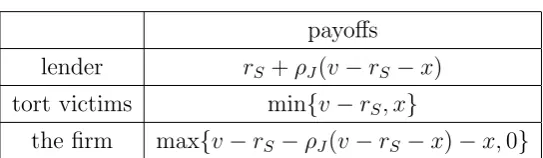
Table 1: Payoffs under Contract r
payoffs lender rS+ρJ(v−rS−x) tort victims min{v−rS, x}
the firm max{v−rS−ρJ(v−rS−x)−x,0}
The time line is as follows. At date T = 0, the firm chooses its financing contract (K,r). At date T = 1, the firm chooses effort e. At date T = 1.5, the harm x is realized. At date
T = 2, the investor is repaid and the tort victim is compensated.
• Welfare Benchmark
Before proceeding, we will establish a useful social welfare benchmark. Suppose the social planner can simply choose the firm’s borrowing as well as its precaution level directly, and assume that the firm’s project is socially desirable given the optimal choice. Then, the planner will choose (KF B, eF B) to maximize the social welfare,
W(K, e) :=v−K+φ(K−k;θ)−
Z
X
subject to the constraint that KF B ≥k. First, the optimal amount of borrowing should be
KF B =k, since the firm has no productive use of funds beyond what is needed for the project. Next, to determine the first-best precaution level, we integrate the social welfare function by parts to obtain
v−K+φ(K−k;θ)−
Z x
0
[1−F(x|e)]qdx−c(e),
so the optimal precaution, eF B, is characterized by
Z x
0
Fe(x|e)dx−c
′
(e) = 0. (1)
Throughout, we assume that W(k,0)≥ 0, so the project is socially valuable even with zero effort as long as the firm does not overleverage. This assumption will ensure the the project will be carried out in the relevant cases studied below, thus simplifying our analysis.
4
The Firm’s Problem
We first study the firm’s behavior. While our focus in this section is to analyze its behavior without any regulation, it is convenient for a later analysis to begin with a slightly general framework in which the lender may be subject to some liability. Specifically, suppose the firm picks (K,r,e) ∈ [k, v]×[0, v]× R ×R+ =:F to initiate the project. We assume that,
after the lender is repaid according to r, he is liable to pay ℓ(x) when the harmx is realized, where ℓ(·) is assumed to be nondecreasing. Then, the lender’s ex post payoff is
π(x,r, ℓ) :=rS+ρJ(v−rS−x)−ℓ(x), (2)
when harm x is realized. If the lender expects the firm to choose e, then his ex ante payoff becomes
Π(r, e;ℓ) :=
Z
X
π(x;r, ℓ)f(x|e)dx.
Meanwhile, the firm receives ex post
u(x;r) := max{v−rS−ρJ(v−rS−x)−x,0}, (3)
so its ex ante payoff given effort e is
U(K,r, e) :=φ(K −k;θ) +
Z
X
u(x;r)f(x|e)dx−c(e).
The firm then faces the problem:
[P(ℓ)] max
(K,r,e)∈F
subject to
(IR) Π(r, e;ℓ)≥K.
and
(IC) e∈arg max
e′∈R+
U(K,r, e′).
Condition (IR) ensures that the lender breaks even from the financial contract (K,r), when the firm is expected to choose effort e. Condition (IC) means that the firm must have the incentive to choose e, facing the financial contract (K,r). This is a constraint because the firm cannot commit to a level of precaution ex ante, even though it may wish to do so.24
We say that (K,r, e) ∈ F is feasible if it satisfies both (IR) and (IC) and optimal for the firm if it solves the program [P(ℓ)].
4.1
The unregulated behavior of the firm
We now analyze the unregulated behavior of the firm. Formally, we consider [P(0)]: That is, no restriction is placed on the firm’s financial decision making (i.e., the amount of borrowing and its choice of financing instruments), and the lender bears no liability (i.e., ℓ(·) = 0). Therefore, the firm is free to choose the amount of borrowing,K, the financing instruments,
r, and its precaution levele. Before proceeding, we characterize the optimal financial structure for the firm and its incentive to take precautions, given that financial structure.
Lemma 1 (Optimality of senior debt) For any feasible (K,r, e), with a non-debt struc-ture there exists a feasible (K,ˆr,ˆe), with an all-debt structure ˆr, which the firm prefers over
(K,r, e). For any feasible (K,r, e) with an all-debt structure with rJ > 0, there exists a
feasible (K,ˆr,eˆ), with a senior-debt-only structure with rˆJ = 0, which the firm prefers over (K,r, e). In each case, a shift to any such preferred feasible structure leads to a (weakly) higher precaution.
Proof: See the Appendix.
The proof is relegated to the appendix. Taken together, these two statements suggest that it is privately optimal for the firm to choose a senior-debt only structure.25 As mentioned
24
(I C) may bind since, starting at the solution of the relaxed program ignoring (I C), it may pay the firm
to changeein a way violating (I R).
25
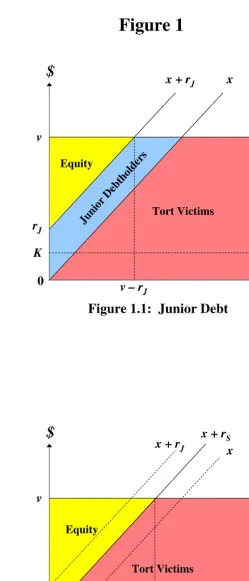
above, the private optimality of senior debt stems from its effectiveness as a judgment-proofing device. To illustrate the role of seniority, suppose first that the firm borrows K with (only) junior debt with the payment rate of rJ. Assume v −rJ < x so that insolvency arises with positive probability, in which case the (junior) creditor does not always receive her payment
rJ. This scenario is depicted in Figure 1.1.
[PLACE FIGURE 1.1 ABOUT HERE.]
For a given level of harm,x,the tort victim is paid min{x, v}, the junior creditor is paid min{rJ,max{v−x,0}}, and the firm receives max{v−x−rJ,0}(gross of effort cost). Notice that the repayment rate, rJ, is inflated to reflect the risk of non-repayment: rJ > K.
Suppose instead that the firm borrows K with senior debt, assuming for a moment the same payment rate rS = rJ > K. The firm would still receive max{v−x−rJ,0}, but the rent is redistributed from the tort victim to the lender: the lender now receivesrJ > K with certainty and the tort victim receives the remainder, min{x, v−rJ}. This redistributed rent can be easily shifted to the firm. Since the lender would receive a strictly higher payoff with senior rather than junior debt (holding the repayment rate fixed) she can be persuaded to charge a lower rate. In fact, the competitive capital market would drive the repayment rate down to a level that allows the lender to break even: rS =K. This is shown in Figure 1.2.
[PLACE FIGURE 1.2 ABOUT HERE.]
The firm extracts all of the redistributed rents, i.e., the entire gain from diluting the tort claims.
Importantly, Lemma 1 suggests that this judgment proofing strategy is socially desirable since the firm chooses a higher level of precautions with senior debt than with junior debt (or other junior claims). A senior claimant is assured repayment of the loan, unlike junior claimants, so the former charges a lower repayment rate the the latter. Hence, the firm is less likely to be insolvent with senior debt. Comparing Figure 1.1 to Figure 1.2 shows that, with senior debt, the firm is a residual claimant in more states of nature and thus has a greater incentive to reduce the harm to the tort victims.
Given Lemma 1, we can restrict attention to the senior-debt only financial structure for the firm. If the firm issues senior debt with anyK ∈[k, v], the break-even repayment rate is simply rS =K since the debt-holder has the seniority over tort victims. From (3) above the firm’s ex post payoff is
Hence, its ex ante payoff given effort e is
U0(K, e) := φ(K−k;θ)+
Z v−K
0
(v−K−x)f(x|e)dx−c(e) =φ(K−k;θ)+
Z v−K
0
F(x|e)dx−c(e),
where the equality follows from integration by parts.
The unregulated behavior of the firm, (K0, e0), must then maximize U0(K, e). The be-havior is characterized as follows. First, given any K ≥k, the firm’s effort e0(K) satisfies
Z v−K
0
Fe(x|e)dx=c
′
(e). (5)
Given this effort choice, the firm borrows K that satisfies
φ′(K−k;θ)−F(v−K|e0(K))−λ= 0, (6)
where λ≥0 is a Lagrangian multiplier satisfying λ(v−K) = 0.
These conditions reveal the nature of distortions on each choice. First, (5), when compared with (1), shows that the firm picks too little precaution: e0(K) < e∗
. As in Shavell (1986) and Summers (1983), the firm internalizes the harm it causes only when it is solvent, i.e., when x < v−K. Furthermore, e0(K) is decreasing in K. As the firm raises its borrowing
K, the likelihood of its insolvency rises, so its incentive for precautions worsens.
Next, (6) shows the firm borrows in excess of its productive use if θ > 0 and v −k < x
(the firm is inherently judgment proof). To see this, suppose to the contrary K = k. Then,
λ = 0, φ′
(0;θ) = 1 for θ > 0 and F(v −k) < 1, which contradicts (6). This overborrowing result can be interpreted as “strategic judgment proofing” on the part of the firm. When the firm borrows in excess of k, it suffers from its “hiding cost” 1−φ′
(K −k;θ). This hiding cost is negligible (by assumption) when K is close to k. There is a non-negligible benefit from over-borrowing, however. Whenever the firm is insolvent, the additional repayment to the lender comes out of the fund that would have been used for the tort award, given the seniority of the debt. Hence essentially, each additional dollar borrowed is paid out of the tort victims’ pocket with probability 1−F(v −K). Since the inefficiency cost is nil when borrowing slightly over k, the firm borrows more thank in equilibrium.
The firm’s excess borrowing has two negative welfare effects. Not only does it entail direct welfare cost associated with inefficient use of funds, but it also exacerbates the firm’s judgment proofness, and thus worsen’s the firm’s underinvestment in precaution.
In fact, one can see thatU0 is supermodular in (K,−e) and satisfies strict single crossing
firm completely judgment proofs itself by borrowing up to the cash flow limit, v, and thus chooses zero precaution.
Proposition 1 Without any policy intervention, the firm issues senior debt, borrows more than its is productive use (i.e., K0 > k), and takes too few precautions (i.e., e0 =e0(K0) < eF B). The firm’s excess borrowing increases and precaution decreases with θ, such that if
θ >θˆ, for some θˆ∈(0,1), the firm borrows v and chooses zero precaution.
Two remarks are worth noting. First, excessive borrowing is not necessarily limited to a situation where the firm is inherently judgment proof (i.e., v−k < x). Even when x≤v−k, so the firm is not inherently judgment proof, it may create “artificial” judgment-proofness by choosing a sufficiently high K. In the extreme case with θ= 1, for instance, the firm will completely judgment proof itself and pick zero precautions, even though there is no inherent judgment proofness. Second, it may be that W(K0, e0)<0, so the firm’s project may not be socially justifiable. Yet, U0(K0, e0)> U0(k,0)≥W(k,0)≥0, so the firm always operates. In other words, strategic judgment proofing may allow a socially unworthy project to be carried out.
5
Public Policy Responses
We consider various remedies to the firm’s judgment proofness/proofing problem. The oft-discussed remedies involve extending liability beyond the injurer to the lenders or senioritizing the bankruptcy status of tort claims. These two remedies share a common purpose of expand-ing the recovery of damages for the victims from a judgment-proof injurer. Yet, it is not clear how these remedies affect the incentives for the precaution and borrowing. More importantly, it is unclear if either remedy or some other remedy is socially optimal. To this end, we first establish more realistic welfare benchmark than the one established before, which will then serve as a welfare upper bound for alternative remedies.
5.1
Welfare Target with Moral Hazard
choose the precaution the planner wishes to implement (i.e., (IC)). Formally, this planner’s problem is
[SW] max
(K,r,e,ℓ)
W(K, e)
subject to
(K,r, e)∈ F satisfies (IR) and (IC), and ℓ∈ L
Although the regulators probably do not have either the information or the power to control the amount of borrowing or the terms of financial contracts of firms, the program [SW] yields a more realistic welfare target than the first-best level.
The next proposition characterizes the optimal borrowing and precaution behavior, (K∗
, e∗
), that the planner would wish to implement.
Proposition 2 (Constrained efficiency) The solution of the problem [SW] involves K∗
=k
and e∗
= e0(k). No liability is imposed on the lenders, ℓ(x) = 0, and the financial contract
involves only senior debt, r = (k,0).
This result suggests that the underprovision of effort chosen by the unregulated firm is attributed entirely to its excess borrowing. Had the firm borrowed K = k, then the firm would have chosen the (constrained) efficient level of precaution e0(k). The reason is the
following. The unregulated firm dilutes the tort claims by choosing a senior claim over junior claim and also borrowing beyond the productive use of fund. As seen in Lemma 1, senior debt in fact improves precaution taking. Excessive borrowing, however, worsens the precaution incentives. Proposition 2 thus suggests the crucial importance of curbing the overleveraging incentive. We show below that two oft-discussed remedies, subordination and lender liability, can discourage excessive borrowing, but introduce their own problems.
5.2
Mandatory Subordination
Under this policy regime, the firm is allowed only to use financial claims that are junior in bankruptcy priority to the tort claims. Given Step 2 of Lemma 1′
The firm’s effort choice, esub, is determined jointly with the repayment rate, rsub, as follows. Given the equilibrium choice esub,rsub must be chosen to satisfy the lender’s break-even condition (IR):
Z v
0
min{rsub, v−x}f(x|esub)dx =k. (7)
Given the repayment rate, the effort choice must satisfy the firm (IC), or the associated first-order condition:
Z v−rsub
0
Fe(x|esub)dx=c′(esub). (8)
Mandatory subordination means that, unless the project is inherently not judgment proof (x≤v−k), the lender must charge rsub> k to break even. This latter fact means, however, that the firm is more likely to be insolvent relative to the senior debt case, thus leading to too little precaution, i.e., esub < e0(k). Hence, the constrained efficient precaution level,
e∗
=e0(k), is not attainable by subordination. In fact, comparison of (8) with (5) reveals the
following.
Lemma 2 Mandatory subordination improves the firm’s precaution decision (relative to
un-regulated firm behavior) if and only if K0 > rsub, i.e., the firm would engage in sufficient
overleveraging absent regulation.
The sufficient condition identifies two circumstances in which this policy response would be effective. Suppose first the firm is not inherently judgment proof (x ≤ v −k). As we saw before, without any regulation, the firm would still borrow excessively, creating artifi-cial judgment proofness, and choose too little precaution. Mandatory debt subordination eliminates overleveraging, which in turn eliminates judgment proofness in this case. Hence,
rsub =k < K0, so the first-best precaution leveleF B will be attained under this policy regime. The second circumstance is when the firm suffers a very little efficiency loss from overbor-rowing (i.e., when θ ≈ 1). In this case, without subordination, the firm would overborrow to virtually its cash flow limit, K0 ≈ v and choose almost no precaution. Hence, the debt
subordination would clearly improve the welfare. The results are summarized as follows.
Proposition 3 Suppose the firm is allowed to employ only (standard) junior claims. Then,
the firm never borrows more than k, but chooses too little precaution esub < e∗ if and only
if x < v−k. Subordination improves social welfare (relative to unregulated behavior) if and only if x≤v−k or θ >θˆsub for some θˆsub <θ <ˆ 1.
In sum, subordination trades off two sources of precaution incentives. On the one hand, it eliminates overleveraging, which both improves the firm’s precaution incentives and econ-omizes on transactions costs of overborrowing. But at the same time, the switch from senior to junior debt worsens the firm’s incentives. Subordination is thus desirable whenever the former effect outweighs the latter, i.e., when θ is sufficiently high.
5.3
Lender Liability
We next consider lender liability. In this system, the lender bears the entire residual liability for the damages suffered by the tort victims when the firm is unable to compensate them. Since the additional liability imposed on the lender causes him to raise its repayment rate to a point that will allow him to break even, the liability is in fact shifted to the firm.
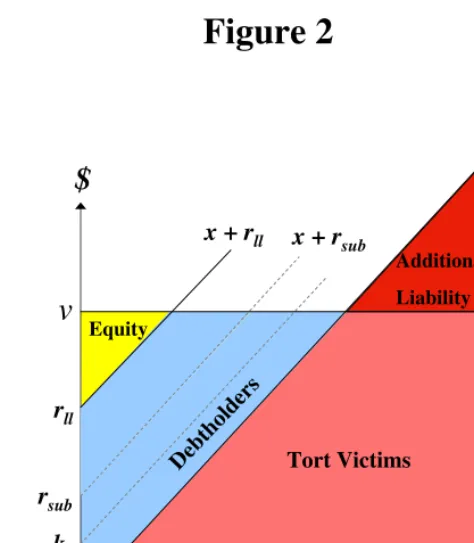
At first glance, lender liability looks similar to debt subordination. The residual liability on the part of the lender means that whatever the cash flow the firm generates must be first used to compensate the tort victims, so it effectively makes the lender’s (possibly senior) debt junior. Under this system, the firm thus cannot avoid liability by raising its debt. Hence, the firm would never borrow more than its productive use, i.e., Kll = k, just like the case of subordination. Indeed, if the social harm can never exceed the cash flow (x ≤ v), then lender liability is precisely the same as debt subordination. If the harm can exceed the cash flow (x > v), however, lender liability and debt subordination generate different incentives for care. In such a case, the lenders have far more to lose with unlimited lender liability: in addition to the risk of non-repayment of principal and interest, they also run the risk that the tort victims will sue them and recover damages from the lender’s personal assets. The additional liability of the lender is depicted in Figure 2 as the triangle above the cash flow
v.26
[PLACE FIGURE 2 ABOUT HERE.]
Anticipating higher future liability, the lenders will require an interest rate that is even higher than the rate with subordination, rll > rsub. This clearly reduces the firm’s equity stake, further diluting the incentives for care.
To be more precise, let (rll, ell) be the equilibrium repayment rate and precaution choice under lender liability. Then, as before, we must have
Z x
0
min{rll, v−x}f(x|ell)dx=k, (9)
26
If the harm never exceeds the cash flow (i.e., x ≤ v) then the additional liability triangle in Figure 2
and
Z v−rll
0
Fe(x|ell)dx=c
′
(ell). (10)
If x ≤v, then comparison of (7) with (9) reveals rll = rsub, so ell = esub. If x > v, however, the extra liability borne by the lender causes him to charge a higher rate, orrll > rsub, which means that the firm is more likely to be insolvent, and thus will have a lower incentive for precaution, i.e., ell < esub.
Proposition 4 If x≤v, then unlimited lender liability yields the same outcome as subordi-nation. If x > v, then unlimited lender liability induces lower precautions than subordination. In either case, the firm never borrows more than k. Lender liability improves social welfare relative to unregulated behavior if and only if x≤v −k or θ >θˆll for someθˆll∈[ˆθsub,θˆ).
Proof: Only the last statement requires a proof, which follows the same line of argument for Proposition 3 and is thus omitted.
As discussed earlier in the context of debt subordination, lender liability has both advan-tages and disadvanadvan-tages relative to having no regulation at all. The benefit of lender liability here is that it eliminates the incentive for over-leveraging, and this reduces wasteful spend-ing and improves the firm’s incentives for care. The cost of lender liability is that, takspend-ing the level of borrowing as fixed, the higher interest rate reduces the firm’s incentive to take precautions. The former effect outweighs the latter if and only if θ is above the threshold
ˆ
θll. While lender liability and debt subordination are equally effective at eliminating over-leveraging, the incentive problem is more pronounced with lender liability. Intuitively, the lender faces liability risks in addition to the risk of non-repayment of principal and interest, and the higher interest rate required by the lender exacerbates the incentive problem.
It is worth highlighting that the benefit of lender liability arises only due to the firm’s strategic judgment proofing, in the form of overleveraging. Lender liability is never beneficial if the firm’s borrowing is fixed. Further, the benefit of deterring over-leveraging applies only to senior claims. If all claims were junior (for instance because the firm has no securable asset), there would be no benefit from lender liability in our model:
Corollary 1 If the firm can only issue (standard) junior claims, then lender liability can only worsen the incentive for precaution, strictly so if x > v.
Proof: If the firm can only use junior claims, then it would use only junior debt (by Step 2 of Lemma 1′
subordination. The result then follows since mandatory subordination (strictly) dominates lender liability (if x > v).
This corollary generalizes the main result of Pitchford (1995) beyond his binary harm setup. This same logic would apply to placing liability on outside equityholders. An outside equity holder, anticipating future liability for the misconduct of the entrepreneur, would demand a greater proportion of the firm’s equity in return. This would leave the entrepreneur with a smaller proportion of the equity, diluting his incentives for care.
We next propose a liability rule that does attain constrained efficiency.
5.4
Optimal Liability Scheme: Limited Seniority Rule
Here, we introduce a liability rule, called Limited Seniority Rule, that implements the con-strained efficient outcome, (K∗
, e∗
), as defined in Proposition 2. Under this rule, a financial claim’s “seniority” is honored only up to a certain limit, k. For instance, if a firm borrowed
K > k with senior debt, say, then, in the bankruptcy court, only the amount k would be treated as “senior” debt, having a priority over tort claims, but the remaining portion would be treated as junior debt. Equivalently, this rule requires that the financial claims on the firm’s cash flow be “junior” up tov−k, while the remaining portion of cash flow, k, may be distributed according to the standard absolute priority rule.
The effect of this rule can be analyzed as follows. First, note that our earlier result concerning the private optimality of senior debt (i.e., Lemma 1′
) extends to this rule, so there is no loss in restricting attention to senior debt. Hence, suppose the firm obtains senior debt with K ≥k. Given an equilibrium repayment rate ˆr(K) the lender will receive
(
min{rˆ(K), v−x} if x≤v−k,
k otherwise.
Given that the lender anticipates the firm to choose precautions ˆe(K), the lender breaks even if
ˆ
r(K)F(v−rˆ(K)|eˆ(K)) +
Z v−k
v−rˆ(K)
(v −x)f(x|ˆe(K))dx+k(1−F(v−k|eˆ(K))) =K. (11)
Meanwhile, the firm’s incentive compatibility requires
Z v−rˆ(K)
0
Fe(x|eˆ(K))dx−c
′
(ˆe(K)) = 0. (12)
ˆ
r(k) = k into (12) shows that the firm’s precaution choice will be constrained efficient, i.e., ˆ
e(k) =e∗
.
It therefore remains to see if the firm would have the incentive to borrow more than k. Suppose indeed that the firm borrows K > k. Then, the firm’s ex ante payoff will be (with integration by parts)
ˆ
U(K) = φ(K−k;θ) +
Z v−rˆ(K)
0
F(x|eˆ(K))dx−c(ˆe(K)).
Differentiate this with respect to K, using the envelope theorem, to obtain:
ˆ
U′(K) = φ′(K−k;θ)−F(v−rˆ(K)|eˆ(K))ˆr′(K). (13)
Next, differentiate totally (11) to obtain
F(v−rˆ(K)|eˆ(K))ˆr′
(K) +
Z v−k
v−rˆ(K)
Fe(x|eˆ(K))dx
ˆ
e′
(K) = 1. (14)
Substituting (14) into (13) gives
ˆ
U′(K) = φ′(K−k;θ)−1 +
Z v−k
v−ˆr(K)
Fe(x|ˆe(K))dx
ˆ
e′(K)<0,
where the last inequality holds since φ′
(·;θ)≤1, Fe >0 ande′(K)≤0. Since the inequality yields a contradiction, we conclude that the firm never borrows more than k. The following conclusion is then immediate.
Proposition 5 The limited seniority rule that treats any borrowing beyond a limit, k, as junior to the tort claim implements the constrained efficient outcome (K, e) = (k, e∗
).
When compared with mandatory subordination and lender liability, the limited seniority rule involves lower compensation of the tort victims ex post. Nevertheless, the rule generates the best incentives for precautions by the firm. Also note that our rule respects absolute priority (up to a limit), and therefore implies less interference with the existing bankruptcy priority rules.
forcing all borrowing to be junior to the tort claim. The limited seniority rule with a limit set (inaccurately) in (0, k) will clearly dominate mandatory subordination and thus also lender liability. Likewise, the limited seniority rule will dominate unregulated behavior as long as the limit is set in (k, K0). Consequently, for a very broad range of “inaccurate” limits, the rule will
produce a better outcome than mandatory subordination, lender liabiltiy, or no regulation at all. In particular, in the absence of accurate estimate of k, a conservative approach that would limit “seniority” to the debt associated with initial setup investment will outperform the mandatory subordination and at the same time will prevent the overleveraging problem.27
6
Discussion
We conclude by discussing robustness of our findings as well as other remedies of judgment proofness.
6.1
Robustness of Findings
• Richer Contracting Possibilities and Lender Monitoring:
We have considered a broad set of financing contracts that encompass most of the com-monly observed financing arrangements. It is of (at least theoretical) interest to consider even richer contracting possibilities. For example, we can imagine junior claims that do not satisfy the monotonicity properties assumed in R, or senior claims whose payment require-ments depend on realized harm x, or the investor may be able to observe some informative signal of the firm’s effort. While contracts outside R are not common in reality, they are at least theoretically interesting since often such contracts may dominate the ones in R in performance.28
27
The important feature in deterring overleveraging is the exogeneity of the scope of senior treatment, namely, for the scope not to depend on the amount the firm actually borrowed, but rather to depend on the amount it ought to have borrowed. In this sense, the actual implementation of the rule may mimic “prudency” test of capital reimbursement of utilities: Often the state public utilities commissions reimburse the capital expenditures by utilities based on the amount they ought to have spent rather than the amount theyactually spent. Similarly, several scholars have suggested that the ideal remedy for breach of contract, “efficient expectation damages,” should not take into account the actual reliance of the breached-against party. Much like the prudence test, this remedy compensates the victim of breach only for the portion of the actual reliance by the victim that is justifiable from the social efficiency perspective. See Cooter and Eisenberg (1985), Craswell (1989) and Spier and Whinston (1995).
28
The model could also be extended to include the possibility of ex post monitoring by the investor. Indeed, holding a principal liable for the misdeeds of an agent may be warranted when the principal has the ability to prevent the agent from engaging in a harmful act. Con-versely, if the principal cannot observe or otherwise control the agent’s tort-causing behavior, then holding the principal liable will have no beneficial effect of preventing the harmful act.29
In fact, the negative view of Pitchford (1995) on lender liability can be seen as confirming this point, as recognized by Balkenborg (2001). Their views, however, were based on models where the injurer could not influence the degree of judgment proofness.30
As shown in our paper, when the injurer is able to judgment proof herself, the investor’s monitoring ability is not necessary for lender liability to be socially valuable. Even when the principal lacks the ability to monitor the agent’s behaviorex post, holding the principal liable for the harm caused by her agent can have a desirable effect on the contract signed with the agent ex ante. In our model, lender liability or the subordination of her claim causes the interest charges against the firm to rise. This jointly deters the lender and the firm from excessive leveraging and may even improve the firm’s incentive for precaution relative to the case without regulation. More generally, the policies of lender liability and the subordination of the lender’s claim gives the lender and the firm a joint incentive to write contracts ex ante
that lead to more efficient effort decisions.
In fact, improvements inex post monitoring and richerex ante contracting possibilities will likely strengthen a main tenet of our paper. Without any regulation, the lender’s improved ability to control the firm’s behavior via sophisticated monitoring and contracting will simply enable them to promote their joint interest more effectively. They will engage in a variety of judgment-proofing strategies, securitizing assets in clever ways to simultaneously create more firm value and protect that value from the reach of future tort victims. In short, richer contracts expand the range of effective judgment proofing strategies, allowing the firm and the lender to more effectively exploit the tort victims.
The social value of regulation may be even higher when the lender and the firm have
similar point.
29
See, however, Hay and Spier (forthcoming) where holding a manufacturer liable for the injuries caused by consumers while using the risky products reduces the level of the risky activity. For example, holding gun manufacturers liable for the deaths and injuries – including those caused by crimes – leads to higher gun prices and fewer guns sold.
30
more sophisticated contracts at their disposal. The policy interventions discussed above — subordination, lender liability, and limited seniority — all force the lender and the firm to jointly internalize the social harm they cause. An improved contract between the two parties enables them to implement the level of precaution in their best joint interest, and these policies can help to align their joint interest with the social welfare. In the extreme case, if the lender can monitor the firm’s precaution accurately, the agency problem between the two parties disappears. In this case, lender liability will yield the first-best outcome: The firm will borrow K = k with a contract that punishes the firm whenever it does not pick the first-best effort. The parties will have the incentive to sign such a contract since lender liability will force the firm to internalize the entire social harm.
• Victim Precautions:
Our analysis has assumed that the firm, and only the firm, can take precautions to avoid accidents. In reality, potential victims can also take precautions to avoid accidents and mitigate their damages in the event that they do occur. In the taxi cab example, pedestrians can take greater precautions and be more watchful when walking near traffic. Policies that “make the victim whole” following an accident — such as unlimited lender liability — will lead the victim to take too little care.31 Debt subordination performs better than unlimited
lender liability in this regard — since the victim bears a residual loss with debt subordination, the victim takes a higher level of care. Since the tort victim bears an even higher loss when debt is senior rather than junior, our Limited Seniority Rule performs best of all. With the Limited Seniority Rule, the junior status of the tort victim encourages greater care levels from the victim, and the lower interest rate encourages greater precautions by the firm.
• Uncertain Cash Flows and Capital Requirements:
Thus far, we have assumed that the cash flow, v, is deterministic and the productive requirement,k, is known. These assumptions, made primarily for simplicity, may not hold in reality. Our results are largely robust to relaxing these assumptions, however. Suppose the cash flow v is a random variable, distributed according to some cdf G(·) over [0,∞). Then, the choice of senior claims is no longer limited to senior debt, for the repayment can vary with the realized level of cash flow. Innes (1990) showed that debt is preferable to all other “monotonic” financial claims (which as noted earlier include all plausible financial claims) in a model without tort victims.32 By analogy, there would be little loss in restricting attention
31
The law and economics literature has suggested various solutions to these so-called bilateral accidents, including contributory negligence. Our framework assumes that the firm’s effort level is unobservable and not contractible, preventing the implementation of these negligence rules.
32
to senior debt here as well.
More importantly, the firm’s preference for senior debt over junior claims and its tendency for over-leveraging remain unchanged in this case, since the “judgment proofing” benefits that these practices offer do not depend on the stochastic nature of the cash flow. Hence, the firm will choose senior secured debt and borrow in excess of its productive use. Some of the remedies to this problem – namely subordination and lender liability – will lead to the same tradeoffs as discussed before. The optimality of the limited seniority rule would extend to this new environment, except that the scope of the “junior treatment,” v −k, would be random instead of deterministic.
• Activity Levels:
There is another potential benefit of regulation that hasn’t been addressed here: reducing the level of a harmful economic activity. In our analysis, the firm raised capital and stayed in business regardless of the regulations imposed. More generally, policy makers should be concerned with the effects that regulations have on the decision of firms to enter and remain in the market. This is especially of firms engaging in activities that harm bystanders, since these activities may not be socially desirable on balance. The three remedies discussed earlier perform differently in this regard. First, unlimited lender liability forces the firm and the lender to bear the full social harm caused by their activity. Conditional upon a suboptimal level of precautions – and assuming away any positive externalities generated by their being in business – the firm and the lender should make the correct decision about their activity level. Debt subordination, on the other hand, would lead to an inefficiently high activity level since the social costs are not fully internalized by the contracting parties. (Again, this is conditional upon the effort level, which we have shown is higher than under lender liability). The Limited Seniority Rule will lead to activity levels that are even higher still. This social cost would, to some extent, offset the social benefit of more efficient precautions. A full analysis of these important tradeoffs is beyond the scope of this paper.
6.2
Other Remedies
The three remedies to the judgment-proof problem discussed so far — debt subordination, lender liability, and limited seniority — all have focused on debt contracts and the regula-tion of bankruptcy. We will now discuss three addiregula-tional remedies — shareholder liability, mandatory liability insurance and punitive damages.
• Shareholder Liability
Our model has very important implications for shareholder liability.33 First, policies that
allow tort victims to seize the entrepreneur’s personal assets — home equity and retirement plans for example — would lead to improved incentives for care. Facing personal liability, the entrepreneur would better internalize the harms that he causes to society. This does not imply, however, that outside equityholders should be held liable for corporate torts. Indeed, holding outside equityholders responsible would worsen the entrepreneur’s incentives rather than improve them. An outside equityholder, anticipating future liability for tort damages beyond his equity stake, would demand a greater proportion of the company’s stock to compensate for that risk. (This greater proportion of stock is analogous to the higher interest rate that would be demanded by debtholders in the case of lender liability.) The entrepreneur is left with a smaller equity stake than otherwise, and hence less of an incentive to take precautions to avoid future liability. This insight provides some support for the rule of limited liability in US corporate law.
• Mandatory Liability Insurance
Mandating that the injurers purchase liability insurance is a simple way of ensuring the tort victims’ recovery of their court awards. Given adequate coverage of liability insurance, victims would receive their court judgments despite the injurers’ insolvency and the horror stories with taxi accidents told in the introduction would be avoided. Will the insurance create the right incentives for precautions, though? As Shavell (2004) observed, the answer depends critically on the monitoring ability by the insurers. If a full-insurance provider can monitor and control the injurer’s precaution level (say by conditioning its payout or insurance premium on this level), the provider will require the firm to choose a socially efficient level of precaution.
In practice, however, insurance providers are unlikely to possess fully effective monitoring capabilities. For instance, in the context of the taxi accidents, precautions would take the form of a taxi company’s screening for careful drivers in hiring and its training of drivers, as well as the monitoring of their driving practices, all of which requires an intimate involvement with the management of the business. It is unlikely that insurance providers’ monitoring and influence would have such a reach.
Without monitoring, liability insurance would have a damaging, rather than beneficial, effect on injurers’ precautions. To see this most clearly, suppose θ > θˆ so that the firm
33
would borrow up to its cash flow, v, absent any regulation. If the liability insurance has a partial coverage, and thus exposes part of the firm’s assets to tort liability, the firm would still borrow excessively to completely judgment proof itself.34 If the liability insurance has
complete coverage, then there is no need for further judgment proofing. Either way, the firm has no incentive to invest in precautions, for it is completely shielded from ex post liability. In other words, the standard moral hazard problem associated with insurance compounds the judgment proofing problem, which aggravates the incentives. Even in the case where
θ < θˆ, liability insurance is likely to generate even worse incentives than the three remedies discussed earlier, and will often worsen the firm’s unregulated behavior.
• Damage Inflation: Punitive Damages
The merits of punitive damages have been widely debated among legal scholars (see Polin-sky and Shavell (1998) for a survey). Punitive damages are most compelling when compen-satory damages, for various reasons, leaves victims undercompensated so that they do not provide adequate deterrence incentives to injurers.35 Since judgment proofness typically leaves
victims undercompensated, punitive damages may be one possible way to hold the judgment proof defendant accountable. While inflating damages can do little to extract payment from a bankrupt injurer, it can raise payment when the injurer is not bankrupt. Hence, it will increase the injurer’s ex ante expected payments.
One may think that punitive damages or other ways of inflating damages may be a superior alternative to the policy remedies discussed above. This is not necessarily the case, however.36
First of all, even without judgment proofing strategies, damage inflation has a dubious effect on incentives in the presence of judgment proofness. To see why, note that damage inflation does not affect the injurer’s payment when compensatory damages are high to begin with — the firm retains no value even when the award to the victim is uninflated. But damage inflation is likely to increase her payments when the compensatory damages are very low — the injurer is solvent whether or not the damages are inflated. Paradoxically, damage inflation imposes a greater punishment in exactly those states of nature that society would like to encourage.
To illustrate, recall the example in Section 2, except that now the social harm is either $10 or $1,000, with probability .9 and .1, respectively, if the injurer makes an effort (that
34
The idea here is that the firm can continue to borrow after signing the insurance contract, and that the insurance company cannot prevent this behavior.
35
Enforcement errors and exclusion of non-monetary harm can be reasons that victims may not recover full compensation from compensatory damage awards. See Polinsky and Shavell (1998).
36