Georgia State University
ScholarWorks @ Georgia State University
Public Health Theses School of Public Health
Summer 8-11-2015
Socio-Demographic Factors Associated with
Maternal Use of Oral Rehydration Therapy (ORT)
and Dispensary Treatment for Diarrhea among
Children Under Five Years Old: Pakistan DHS
(2012-13)
Summera Aziz
Follow this and additional works at:https://scholarworks.gsu.edu/iph_theses
This Thesis is brought to you for free and open access by the School of Public Health at ScholarWorks @ Georgia State University. It has been accepted for inclusion in Public Health Theses by an authorized administrator of ScholarWorks @ Georgia State University. For more information, please contact
Recommended Citation
ABSTRACT
Socio-Demographic Factors Associated with Maternal Use of Oral Rehydration
Therapy (ORT) and Dispensary Treatment for Diarrhea among Children Under
Five Years Old: Pakistan DHS (2012-13)
By
Summera Aziz
MD, King Edward Medical University, Lahore, Pakistan MPH –Epidemiology Candidate, (2014-15) Georgia State University
Abstract
Objectives: Diarrheal disease is a global health challenge that assumes gigantic importance with regard to child health in developing countries like Pakistan. Prompt medical attention and proper
use of Oral Rehydration Therapy (ORT) by mothers helps prevent dehydration and secondary
complications among affected children. However, ORT use among mothers in Pakistan is low.
This study seeks to examine how various sociodemographic factors impact the use of ORT and
dispensary treatment among mothers of children affected with diarrhea.
Methods: Data from Pakistan Demographic Health Survey (2012-2013) was used for the study. The study sample consisted of women aged 15-49 years old resident in Punjab region (N= 505)
with children under five years old who had diarrhea within two weeks of the survey. Chi-square
tests and logistic regression analyses were used to determine relationships between maternal
socio-demographic characteristics and use of ORT and dispensary care. P-values <0.05 were
considered statistically significant.
Results: After controlling for place of residence, educational level and frequency of watching television, caregivers whose children had fever with diarrheal episodes had nearly two-fold
increased odds of using ORT treatment [OR= 1.9, (95% CI: 1.28-2.82)], compared to those
whose children did not have fever. Similarly poor and middle class socioeconomic status (SES)
participants had 3 times increased odds [OR= 2.76, [95% CI: 1.1 -6.89)] of using dispensary
treatment when compared to upper class mothers. Place of residence was not a significant
predictor of ORT or dispensary use.
Discussion: These findings are consistent with other studies that show that mothers’
socioeconomic status are a good indicator of their knowledge about ORT use, and health care
of ORT use, or consultation at a dispensary, even though other studies have found significant
associations.
Conclusion: Interventions aimed at improving low-income mothers’ knowledge about diarrhea management can include lay medical personnel, such as dispensers, who are often the easily
accessible medical resource to this population. Therefore, dispensers should be provided with
further training to increase their knowledge and skills in treating children with diarrhea. Future
Socio-Demographic Factors Associated with Maternal Use of Oral Rehydration
Therapy (ORT) and Dispensary Treatment for Diarrhea among Children Under
Five Years Old: Pakistan DHS (2012-13)
By
SUMMERA AZIZ
MD, King Edward Medical University, Lahore, Pakistan MPH –Epidemiology Candidate, (2014-15) Georgia State University
A Thesis Submitted to the Graduate Faculty of Georgia State University in Partial Fulfillment of the Requirements for the Degree
MASTER OF PUBLIC HEALTH
APPROVAL PAGE
Socio-Demographic Factors Associated with Maternal Use of Oral Rehydration
Therapy (ORT) and Dispensary Treatment for Diarrhea among Children Under
Five Years Old: Pakistan DHS (2012-13)
By
Summera Aziz MD.
Approved:
__DR. Ike S Okosun_____ Committee Chair
Acknowledgements
Thank you to my advisor and my family for the encouragement and guidance throughout this study and writing experience.
Author’s Statement Page
In presenting this thesis as a partial fulfillment of the requirements for an advanced degree from Georgia State University, I agree that the Library of the University shall make it available for inspection and circulation in accordance with its regulations governing materials of this type. I agree that permission to quote from, to copy from, or to publish this thesis may be granted by the author or, in his/her absence, by the professor under whose direction it was written, or in his/her absence, by the Associate Dean, School of Public Health. Such quoting, copying, or publishing must be solely for scholarly purposes and will not involve potential financial gain. It is understood that any copying from or publication of this thesis which involves potential financial gain will not be allowed without written permission of the author.
Summera Aziz
Table of Contents
Acknowledgements ... 6
Author’s Statement Page ... 7
List of Figures ... 9
List of Tables ... 10
INTRODUCTION ... 11
Background ... 11
Purpose of Study ... 12
Research Questions ... 12
REVIEW OF THE LITERATURE ... 14
Treatment of Diarrhea ... 14
Pakistan’s Ministry Of Health And ORS Promotion Program ... 15
Maternal Health Care Seeking Behavior - Dispensary ... 16
Place of Residence... 17
METHODOLOGY ... 18
Data Source: ... 18
Data Collection ... 18
Geographic Information ... 19
Study Design and Participants ... 19
Measures and Variables ... 20
Data Analysis ... 23
RESULTS ... 24
Association between maternal residence and use of ORT treatment ... 27
Association between mothers’ sociodemographic factors and use of ORT treatment ... 29
Association between mothers’ sociodemographic factors and treatment from dispensary ... 29
DISCUSSION AND CONCLUSION ... 32
Discussion ... 32
Association with place of residence ... 32
ORT treatment and maternal sociodemographic characteristics ... 32
Dispensary treatment and maternal sociodemographic characteristics... 34
Implications of Findings ... 35
Conclusion ... 36
List of Figures
Figure 1: Flow chart of diarrheal cases under 5 years in Punjab
Figure 2: Distribution of Maternal use of ORT for Childhood Diarrhea in Total Sample (N=505)
Figure 3: Distribution of Maternal use of Medical dispensary for Childhood Diarrhea in Total
List of Tables
Table-1: Frequencies of ORT and dispensary treatment use by mother’s socio-demographic
characteristics whose children had diarrhea (N=505)
Table-2: Association between mother’s socio-demographic characteristics whose children had
diarrhea and use of ORT treatment (N=505)
Table-3: Association between mothers’ sociodemographic factors whose children had diarrhea
and treatment from dispensary (N=505)
CHAPTER I
INTRODUCTION
Background
Diarrhea is the passage of three or more watery stools per day. In infants and children
under five years of age, who are particularly vulnerable, the frequency of bowel movement may
increase up to ten stools per day. If left untreated, it leads to dehydration and severe malnutrition
in children (“World Health Organization (WHO)” 2009). Diarrheal disease is a second leading
cause of death among children under five in developing countries. Approximately 2.5 billion
children under five years of age suffer from diarrhea illness each year (Kosek, Bern, & Guerrant,
2003). More than half of these diarrheal cases occur in Africa and South Asia, where multiple
episodes of diarrhea cause serious outcomes and are more likely to result in death. There is a loss
of about 1.5 million lives each year due to diarrheal illness (“WHO", 2009).
In Pakistan, diarrheal illness accounts for an estimated 200,000 - 300,000 deaths
among children each year (Government of Pakistan and UNICEF, 1996). According to Pakistan
Medical Association (PMA), one child dies every minute from diarrhea and acute respiratory
infection (Pakistan Medical Association (PMA), 2011). Diarrheal disease is a global health
challenge that assumes gigantic importance with regard to infant health in the developing world.
Identifying the various factors that impact its occurrence and subsequent treatment is vital to
design effective and robust public health interventions.
Diarrhea illness and related dehydration can be prevented by proper and timely oral
rehydration treatment (ORT) by mothers at home (Alam & Ashraf, 2003). Recent studies have
shown that most mothers in Pakistan have indeed heard of ORS (Oral Rehydration Solution)
contributing to this occurrence may be urban/rural differences in access to available resources
among mothers of affected children (Mull & Mull, 1988). Urban-rural variations may be
associated with non-compliance with treatment or poor treatment practices among mothers.
Therefore, exploring the associations based on mother’s demographic variables and ORT can
substantially assist with determining practical interventions that are cost-effective and efficient in
the management of diarrhea in the pediatric populations in Punjab.
Purpose of Study
Although several studies have been conducted in other countries in the area of childhood diarrhea to demonstrate the treatment practices of mothers, in Pakistan only limited
studies have been carried out. This study is designed to provide further insight about the
relationship between mothers’ socio-demographic characteristics and management of childhood
diarrhea using oral rehydration therapy (ORT) and dispensary treatment.
Research Questions
The purpose of this study is to contribute to the existing body of literature on the
relationship between sociodemographic factors and maternal management of diarrheal disease in
Punjab. This study will examine the following questions and related hypotheses;
1) Is there any association between maternal place of residence and use of ORT for diarrheal
treatment in children under age five?
Hypothesis: Mothers who live in urban areas will be significantly more likely to use
2) Do ORT use among under-five old diarrhea subjects differ by mothers’
socio-demographic factors such as age, educational attainment, wealth index, availability of
electricity in household, watching television and child fever?
Hypothesis: There are differences between ORT use among under-five old diarrhea
subjects with respect to their mother’s socio-demographic factors such as age, educational
attainment, wealth index, availability of electricity in house, watching television and child fever.
3) Do medical treatment of a dispensary among under-five old diarrhea subjects differ by
mothers’ socio-demographic factors such as age, educational attainment, wealth index,
availability of electricity in household, watching television and child fever?
Hypothesis: There are differences between medical treatment use among under-five old
diarrhea subjects with respect to their mother’s socio-demographic factors such as age,
educational attainment, wealth index, availability of electricity in house, watching television
and child fever.
CHAPTER II
REVIEW OF THE LITERATURE
Treatment of Diarrhea
Many cases of diarrhea can be easily treated at home by increasing fluid intake
and continuing feeding during diarrheal illness (“WHO | Diarrhea,” 2009). In 1980, the United
Nations Children’s Fund (UNICEF) launched the revolution for child survival and development
by focusing its efforts on four methods – growth monitoring, breastfeeding, immunization, and
the use of oral rehydration salt (ORS) as the best treatment for dehydration caused by diarrhea.
Child mortality can be reduced by using good quality care, timely use of cost-effective
interventions like ORT and utilization of immediate health provider in underdeveloped countries
(“UNICEF/WHO" 2014).
ORT (Oral rehydration treatment)
Oral rehydration solution (ORS) is the gold standard treatment option in childhood
diarrhea. It is an inexpensive, immediate and a simple way to treat this disease at home as it
improves dehydration by replacing lost fluids (Deen, 2003). Management of diarrhea is
considered incomplete without the use of ORT. Numerous studies have documented the
effectiveness of oral rehydration therapy in the management of diarrheal disease in children
under five. The annual numbers of death attributed to diarrhea in this age group fell from 4.6
million to 1.5 million from 1980 till 2000 after the use of ORS became the standard treatment
regimen (Victora et al, 2000).
Oral rehydration therapy (ORT) is an important modality in controlling mortality
National Institute of Health (NIH), has made good progress in providing ORT for children
suffering from diarrheal disease in Pakistan (Wardlaw, et al, 2010). Known by the brand name,
NIMKOL (which is derived from the Urdu word for salt, Nimak), the ORS packets are common
in Pakistan. When used as directed, ORT is effective for treatment of dehydration in 80% of
acute diarrhea cases (Mull & Mull, 1988). Some fraction of these cases with co-infection and
serious complications require antibiotics or intravenous therapy (Mull & Mull, 1988). Recent
studies have found that only 39% of children under the age of five receive ORT in developing
countries (“WHO” 2009: Wardlaw, et al, 2010).
Pakistan’s Ministry Of Health And ORS Promotion Program
In 1984, Pakistan’s Ministry of Health, in collaboration with the NIH and UNICEF
launched a multimillion-dollar Oral Rehydration Solution Therapy (ORT) program across the
country to reduce the burden of this disease (Donald E. Morisky et al., 2002). For more than a
decade, this program has promoted the use of ORS in the country through widespread
educational campaigns to reduce the morbidity and mortality related to the diarrheal disease
(Donald E. Morisky et al., 2002).
The Punjab government spends large sums of money on educating caregivers through
media campaigns as part of the ORT program, but so far, because of very low literacy rate
among rural female population and lack of convenient access to media, this media adventure has
not borne desirable results. Mothers still do not know how to make proper ORS solution from the
ORS packet. According to recent study, among 91% of mothers who have heard of ORS, only
one-third (34.6%) of them administered it during diarrheal episodes of their children (Mull &
message, these programs are failing to change the behavior of caregivers in treating childhood
diarrhea (Donald E. Morisky et al., 2002: Mull & Mull, 1988). This non-compliance can
arguably be traced back to the lack of general education and lack of awareness as well as to the
differences in poor living conditions prevailing in places of residence. All these factors are
adding to difficulties of the low-income families that now suffer high infant and child morbidity
and mortality because of this debilitating and ill-managed malady (Das, Salam, & Bhutta, 2014:
Halvorson, 2004).
Maternal Health Care Seeking Behavior - Dispensary
In most of the Punjab areas, available basic health care facilities are inadequate to
serve the target communities. Modern health care resources such as private clinics, small
hospitals and midwifery centers are abundant in or near the towns and small rural dispensaries
can be seen in some areas. Most people seek health care from dispensaries, lady health workers,
and traditional healers including hakims, herbalists and molvis (religious curer) who serve both
rural and urban areas (Mull & Mull, 1988: Shaikh & Hatcher, 2005: Halvorson, 2004).
The inherent cultural practices adopted by the caregivers in the management of
childhood diarrhea have been studied in one Kashmir village (Ahmed et al., 2009). They showed
that about 28% and 9 % of respondents have used ORT in past and during the current diarrheal
episodes respectively. Thus, despite the widespread ORS campaigns, caregivers still use
inappropriate medical services and alternative therapies to treat diarrhea in remote areas of
country (Ahmed et al., 2009: Hudelson, 1993: Mull & Mull, 1988).
Place of Residence
The epidemiology and burden of diarrheal disease varies according to the region and
place of residence. This is due to the lack of access to safe water, inadequate sanitation, and poor
hygienic conditions in most developing countries. In fact, about 88 percent of deaths related to
diarrhea globally are attributable to unsafe water, poor sanitation and lack of hygiene (“WHO |
Diarrhoea,”2009). Place of residence is an important determinant for treating diarrheal illness
with ORT in developing countries (Coreil & Genece, 1988). According to the WHO, in
developing countries, children in urban areas (42 %) are more likely to receive ORT treatment
than these residing in rural areas (38%) (“WHO | Diarrhea,” 2009). Researchers have found that
the use of ORT depends primarily on local living conditions, household environment, and
traditional socio-economic setup (Ali, Atkinson, & Underwood, 2000).
In Pakistan, health care facilities are inadequate to address the need of the population
especially in urban slums and shantytowns. Significant efforts have been made in strengthening
the public health sector during the past decade. However, despite many improvements, diarrhea
remains a major cause of mortality and morbidity among childrenin these areas due to unsafe
CHAPTER III
METHODOLOGY
Data Source:
Data from Pakistan Demographic Health Survey (DHS) 2012-2013 was used for this
study. This study was restricted to “Woman Questionnaire” that specifically included
information about child health for children who were born in the last five years.
Data Collection
Pakistan Demographic Health Survey (2012-2013)wasconducted with the help of
ministry of National Health Services (NHS) and implemented by the National Institute of
Population Studies (NIPS). The DHS data in Pakistan was administered through household
questionnaire. Completed questionnaire were entered into the Computer Assisted Field Editing
(CAFÉ) system for further reviewing and editing by the field editors in the field while interviews
were taking place from October 2012 until April 2013 (“Demographic Health Survey (DHS)”
2012).
The Pakistan Bureau of Health Statistics (PBS) provided all the household listings and
sample design to this survey for making sample areas across the country. The sample unit of this
population was considered as small area called enumeration block in urban cities and towns.
Each block consists of average 200 to 250 household and further divided into low, middle and
high-income categories. Thus, there were 26,543 enumeration blocks. In rural areas, lists of all
villages, dehs or mouzas were prepared and used as unit of analysis for sampling frame (DHS,
Geographic Information
Pakistan has four province and one federally administrative “Tribal Area” (formerly
known as the Northern Areas). The Punjab is a land of five-rivers and is most populous province
of Pakistan. Nearly 70 percent of the Punjab’s population live in rural areas. (“Punjab Health
Department,” 2012). The Punjab has the highest rate of deaths among children under the age of
five. Diarrheal illness is a second major cause of mortality and morbidity in this age group and it
kills 27,000 kids every year in Punjab ("Diarrhea in Punjab", 2015:“Punjab Health Department”
2012).
Study Design and Participants
This study was a cross sectional design. The participant’s residence was categorized as
urban (in any of the cities and towns) and rural (outside cities or towns). Children included in the
study were those under the age of five years who had diarrhea two weeks before the survey as
reported by the household mothers. A sample size of 3,800 households was estimated for the
survey in Punjab. The information on diarrheal disease was gathered by asking caregivers
whether their child had experienced diarrheal episode at any time during the two weeks
preceding the interview. If the child had had diarrhea, the mother was asked about diarrheal
episodes, treatment patterns and usage of ORS. The final sample for this study was made up of
505 women who have children under 5 years old and had diarrhea within two weeks of the
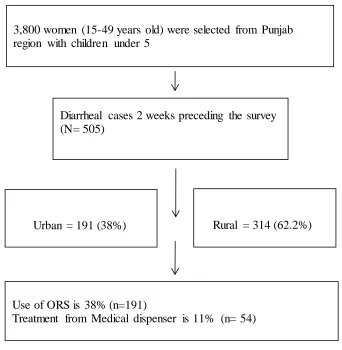
survey. The final sample for this study included 191 (38%) urban and 314 (62.2%) rural women.
Figure 1. Flow chart of diarrheal cases under 5 years in Punjab
Measures and Variables
The selected independent variables were chosen based on literature review for the maternal
management of childhood diarrhea by use of ORT and medical dispensary treatment.
Other independent variables were age, highest education, wealth status, availability of electricity,
the frequency of watching TV and child having fever.
Diarrhea
Rural = 314 (62.2%)
3,800 women (15-49 years old) were selected from Punjab region with children under 5
Diarrheal cases 2 weeks preceding the survey (N= 505)
Urban = 191 (38%)
Use of ORS is 38% (n=191)
Treatment from Medical dispenser is 11% (n= 54)
Diarrheal disease was defined as having three or more watery stools in a twenty-four hours
duration.
Type of place of residence
Participant’s residence was defined as either urban or rural. Participants were categorized as rural
living if they reside outside cities and towns. Urban area consists of a city or town and mostly
populated area with more amenities.
Oral Rehydration Therapy (ORT)
Oral rehydration therapy is one of the known methods for correcting or treating dehydration
caused by diarrhea.
Dispensary shop
A shop where medicines and medical supplies are dispensed. Free and inexpensive medical
advice are available in these medical shops. A person who works here is called dispenser and
usually he does not require any certification or diploma to work here.
Children under five years of age (0-59 months)
This variables related to prenatal/postnatal care and children’s health are only available for
children born in the last five years. (DHS 2012-13)
Children who had diarrhea recently
Children ill with diarrhea (as defined by the respondent—child’s mother) at any time during the
two weeks preceding the interview. Recoded into Diarrhea = 0 when no diarrhea, Diarrhea= 1
(Yes) when have diarrhea, last 24 hours and last two weeks before the survey.
Woman age
Women of reproductive age (15-49) were included for individual interview in this survey (DHS,
Maternal education
Maternal education was registered as the highest education level attained and were grouped into
three categories (primary/elementary level (5th grade), middle school, high school and higher
education).
The wealth-index (socio-economic) status
The wealth-index (socio-economic) status was classified as poor, middle class, rich or richer.
It was based on data from the household characteristics, type of drinking water source and toilet
facilities (shared or not). Assets used for the socio-economic computation included both large
(for example, land, farmhouses, houses and car ownership) and small household items
comprising of radio sets, television, telephone, electric fans, etc. Wealth index were recoded into
three categories into ‘poor’, ‘middle’ and ‘upper class’.
The availability of electricity for individual household
The availability of electricity was coded in yes, no or not in daytime.
Frequency of watching television
Woman’s general exposure to electronic multimedia was recorded as none, once or less than
Data Analysis
The analysis was done using IBM SPSS and SAS 9.4 software. The survey data was
analyzed in relation to two dependent variable ORT (Oral dehydration therapy) and treatment
from dispensary. Respondent variables included place of residence, maternal age, education
attainment, wealth status, household availability of electricity, and frequency of watching TV. In
addition, one measure of the child health status was studied: whether child had fever in last two
weeks with diarrheal episodes or not.
The data was analyzed in three phases. First, frequency distribution of dependent and
independent variables were computed. Second, univariate (unadjusted) analyses were performed
among each independent variables and outcome variables of use of ORT and medical dispensary
treatment. In the third step, multiple logistic regression analyses were performed to determine
association between selective independent variables and dependent variables (ORT and
dispensary care) controlling for place of residence, wealth index, woman age, watching TV and
child status of fever, using only those independent variables that were significant in the
univariate level of statistical analysis.
Odds ratios and respective 95% confidence intervals were calculated to determine if
an association exists between maternal place of residence and ORT and Dispensary care.
Potential confounding variables that were controlled for included age and socio-economic status,
watching TV (as use of multimedia for health awareness) and child having fever (as health status
CHAPTER IV
RESULTS
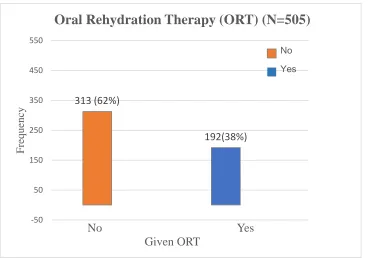
A total of n=192 caregivers reported giving ORT treatment and n=54 received treatment through
medical dispensary for childhood diarrhea under the age of five years, two weeks before the
survey in Punjab (n=505).
Figure 2: Distribution of Maternal use of ORT for Childhood Diarrhea in Total Sample (N=505)
Figure 2, displays graphical distribution for dependent variable, maternal use of ORT in
Punjab. Only 38 % (n= 192) respondents used ORT for childhood diarrhea in the study sample
(N=505).
313 (62%)
192(38%)
-50 50 150 250 350 450 550
Fre
quenc
y
No Yes Given ORT
Oral Rehydration Therapy (ORT) (N=505)
[image:25.612.74.442.225.483.2]Figure 3: Distribution of Maternal use of Medical dispensary for Childhood Diarrhea in Total Sample (N=505)
Figure 3, displays the distribution of medical dispensary usage by mothers for diarrhea treatment
for children in urban and rural areas. About 11% of study participants used medical dispensary
for the treatment of their sick children. The proportions of the maternal use of ORT and medical
dispensary treatment for childhood diarrhea in Punjab has shown in Table-1.
451(89.3%)
54(10.6%)
-90 10 110 210 310 410 510
F
re
que
nc
y
No Yes Dispenser Treatment Use
Table-1Frequencies of ORT and dispensary treatment use by mother’s socio-demographic characteristics whose children had diarrhea (N=505)
Footnotes:
Frequency was calculated by N (%)
P value <0.05 was considered statistical significant and calculated by chi-square test ORT = Oral rehydration therapy,
Table-1 findings show the proportions of the maternal use of ORT and medical dispensary
treatment for childhood diarrhea in Punjab. Out of those caregivers (n=54) who used medical
dispensary treatment, 84 % (n=45) were from rural area.
Treated with Treated with ORT Diapensary meds.
All Variables (N= 505) N= 192 (38%) N= 54 (10.6%)
All n (%) p-value n (%) p-value
By Place of Residence 0.16 <0.001
Rural 314 112 (35.6) 45 (14.33)
Urban 191 80 (41.9) 9 (4.71)
By Woman Age (Years) 0.83 0.81
< 30 yrs. 310 119 (38.3) 34 (10.9)
> 30 yrs. 195 73 (37.6) 20 (10.3)
By Woman Education 0.21 0.001
≤ Primary (5th grade) 353 128 (36.26) 48 (13.6)
> Primary 152 64 (42.11) 6(4)
By Wealth Index 0.08 <0.001
Poor 152 48 (31.5) 28 (18.42)
Middle class 127 47 (37.01) 17 (13.39)
Upper class 226 97 (42.9) 9 (3.9)
By Household Electricity 0.11 0.82
None 16 3 (18.7) 2 (12.5)
24 hrs. 415 178 (39.4) 49 (10.86)
Night time only 38 11 (29) 3 (7.8)
By Frequency of Watching
TV 0.53 0.63
None 126 46 (36.5) 16 (12.7)
< 1/wk 137 48 (35) 15 (10.95)
≥ 1/wk 242 98 (40.5) 23 (9.5)
By Child Had Fever in last 2 wks 0.001 0.54
No 187 54 (28.8) 18 (9.6)
Association between maternal residence and use of ORT treatment
In this study sample, place of residence was not associated with caregiver’s use of
ORT treatment for childhood diarrhea (p-value =0.16). Likewise, there was no association
between all other independent variables and ORT use except child having fever. Among children
who had diarrhea and fever (n=317) two weeks before the survey, 43% (n=138) received ORT
treatment in the study sample (P-Value= <0.05). The most significant predictors of medical
dispensary use were place of residence, maternal education and wealth status (P-Value= <0.05).
The univariate analyses were performed among each independent variables and
outcome measure of ORT use. Odds ratios and respective 95% confidence intervals were
calculated to determine if an association exists between child treatment with ORT and maternal
place of residence. There was 1.3 times increased odds of using ORT for childhood diarrhea in
urban mothers as compared to rural mothers in Punjab (95% CI: 0.89-1.87). However, the
Table-2: Association between mother’s socio-demographic characteristics whose children had diarrhea and use of ORT treatment (N=505)
Variable Unadjusted OR
(95% CI)
*Adjusted OR
(95% CI)
Place of Residence
Urban 1.3 [0.89, 1.87] 1.05 [0.67, 1.63]
Rural (ref) 1 1
Woman age (Years)
< 30 yrs. (ref) 1 1
> 30 yrs. 0.96 [0.66, 1.39] 0.98 [0.67, 1.44]
Woman education ≤ Primary (5th
grade) (ref) 1
> Primary 1.27 [0.86, 1.88] NS
Wealth index
Poor (ref) 1 1
Middle class 1.27 [0.77, 2.09] 1.34 [0.79, 2.28] upper class 1.63 [1.05, 2.51] 1.6 [0.92, 2.8]
Has electricity
None (ref) 1
24 hrs. 2.82 [0.8, 10.05] NS
Night time only 1.76 [0.41, 7.43]
Frequency of watching TV
None (ref) 1 1
< 1/wk. 0.93 [0.56, 1.55] 0.73 [0.42, 1.26] ≥ 1/wk. 1.18 [0.76, 1.84] 0.96 [0.57, 1.6]
Child had fever
No (ref) 1 1
Yes 1.89 [1.3, 2.8] 1.9 [1.28, 2.82]
Footnotes:
Statistical significant confidence interval value are in bold letters
OR (odds ratio) and 95% CI (confidence interval), Reference category =‘1’
NS – Not significant in bivariate analysis OR did not control for confounding.
Association between mothers’ sociodemographic factors and use of ORT treatment
Table-2 shows the association between selected independent variables (women residence,
maternal age, wealth status, education attainment, availability of electricity, child fever) with
ORT use.
The result of the univariate analysis indicated that, mothers in the upper class
socioeconomic status (SES) were 1.63 times more likely to use ORT as compared to poor
mothers whose children had diarrhea two weeks before the survey [OR= 1.63, (95% CI:
1.05-2.51)]. However, after controlling for education, wealth index, and frequency of watching TV,
the relationship was no longer statistically significant. Caregivers whose children had fever with
diarrheal episodes had nearly two-fold increased odds of using ORT treatment, in bivariate [OR=
1.89, (95% CI: 1.3-2.8)] and multivariate analysis [OR= 1.9, (95% CI: 1.28-2.82)] respectively.
There was no significant association between caregiver’s age and frequency of watching TV
with maternal use of ORT.
Association between mothers’ sociodemographic factors and treatment from dispensary
Table 3, shows the results of the analysis between selected independent variables and maternal
use of dispensary for diarrhea treatment in Punjab.
As univariate analysis has shown, rural residence, maternal education and wealth index were
associated with increased use of dispensary for diarrhea treatment. There were about four times
increased odds of using dispenser services among rural mothers when compared to urban
mothers [OR= 3.38, (95% CI: 1.61 -7.1)]. Likewise, being less educated (< 5th grade) [OR= 3.8,
(95% CI: 1.6 -9.15)] and belonging to poor and middle class was significantly associated with
increased odds of using dispensary treatment for childhood diarrhea, [OR= 5.44, (95% CI: 2.48
Table-3 Association between mothers’ sociodemographic factors whose children had diarrhea and treatment from dispensary (N=505)
Footnotes:
Statistical significant confidence interval value are in bold letters OR = odds ratio, 95% CI = confidence interval
Reference category =‘1’
NS – Not significant in bivariate analysis OR did not control for confounding. * Adjusted for education, wealth index, and frequency of watching TV
However, after adjustment for potential confounding variables, wealth index was the only
variable that remained significantly associated with the use of dispensary care.
Variable
Place of Re s ide nce
Urban (ref) 1 1
Rural 3.38 [1.61, 7.1] 1.58 [0.67, 3.71]
Woman age
< 30 yrs. 1.07 [0.6, 1.9]
> 30 yrs. (ref) 1 NS
Woman e ducation
≤ Primary (5th grade) 3.8 [1.6, 9.15] 2.03 [0.8, 5.2]
> Primary (ref) 1 1
We alth inde x
Poor 5.44 [2.48, 11.91] 3.84 [1.47, 10.1]
Middle class 3.72 [1.61, 8.63] 2.76 [1.1, 6.89]
upper class (ref) 1 1
Has e le ctricity
None 1.66 [0.25, 11.06]
24 hrs. 1.42 [0.42, 4.8] NS
Night time only (ref) 1
Fre que ncy of watching TV
None 1.38 [0.7, 2.72] 0.68 [0.32, 1.43]
< 1/ wk. 1.17 [0.58, 2.32] 1.01 [0.5, 2.06]
≥ 1/ wk. (ref) 1 1
Child had fe ve r
None 0.83 [0.45, 1.51] NS
Yes (ref)
*Adjusted OR (95% CI) Unadjusted OR
The participants with poor class socioeconomic status (SES) had about four times
increased odds [OR= 3.84, [95% CI: 1.47 -10.1)] and mothers belonging to middle class had 3
times increased odds [OR= 2.76, [95% CI: 1.1 -6.89)] of using dispensary treatment as compared
to upper class mothers.
CHAPTER V
DISCUSSION AND CONCLUSION
Discussion
The primary objective of this study was to examine the association between
maternal socio-demographic factors and the use of ORT and dispensary for the treatment of
diarrhea in Punjab.
Association with place of residence
Overall, this study yielded no significant association between maternal place of
residence and treatment of diarrhea with use of ORT and medical dispensary in children under
age of five years. Results from the logistic regression analyses demonstrated that maternal place
of residence, age, education attainment, and wealth index were not significant predictors of ORT
use among participants. Strikingly, this result is inconsistent with findings by other literature in
this field (Coreil & Genece, 1988) which found significant association between ORT use and
maternal place of residence. Researcher observed that there was increase rate of usage of ORT in
urban mothers, which is not supported by this study. Although there were 42% (n=80) of
mothers in urban area who gave ORT treatment to children having diarrhea in urban sample
(n=191) but it was not significantly associated with maternal place of residence. (P-value
=>0.05)
ORT treatment and maternal sociodemographic characteristics
This study yielded significant association between fever among children who had
diarrhea and use of ORT treatment (table-2). In univariate analyses, upper class SES and child
were controlled in multivariate logistic regression, the net effect of child fever remained
significant (Table-3).
This study found that mothers who correctly perceived the signs of severity with
child fever were more likely to seek care and gave ORT to sick children. Clinical symptoms
indicating the severity of diarrhea, such as fever were better perceived as important signs of
infection and dehydration by mothers who sought care and used ORT (Quadri et al., 2013).
This pattern was relatively consistent with previous studies (Mull & Mull, 1988: Hudelson,
1993). Probably, it was due to the fact that many caregivers did not recognize the child diarrhea
as an ‘illness’ earlier unless it was accompanied by fever and other serious outcomes. In these
circumstances, ill children get ORT treatment late in the disease process when caregiver seek
health care advice for fever (Mull & Mull, 1988: Shaikh & Hatcher, 2005).
Hudelson, (1993) has described in detail about caregiver’s health seeking behavior
in poor neighborhood of Managua where ORS use was associated with clinic attendance, which
was also observed in this study findings. It is not surprising that while ORS is widely available,
caregivers of diarrhea patients do not commonly use it until they get advice from health care
system. Researchers have found that mothers generally do not have much knowledge and
awareness of this disease and usually believe in alternative therapies to treat childhood diarrhea.
There is an important relationship in mother’s knowledge of their children disease and influence
on caretaking it. The better she knows the causes of diarrhea, the more efficiently she can
manage it with accessible resources (Malik et al., 1992).
In Punjab, most of the families live below the poverty line. The minimum wages are
Pak. Rs. 9000 (approx. US90$) per month (Rehman, Shaikh, & Ronis, 2014). Additionally, there
proportion of any family’s budget. This may have contributed to health seeking behavior of such
families. Mothers of ill children may delay seeking medical care until they get comorbid serious
infections (fever) (Shaikh & Hatcher, 2005: Rehman et al., 2014).
Dispensary treatment and maternal sociodemographic characteristics
In univariate analyses, rural residence, less education attainment (< 5th grade), low
and middle class SES were found to be associated with increased use of dispensary for diarrhea
treatment. When residence, education and wealth were controlled in multivariate logistic
regression, the net effect of lower and middle class SES remained significant (Table-4).
Specifically, our results indicates that there was statistically significant increased
odds of using dispensary treatment for childhood diarrhea among the lower and middle class
mothers than mothers belonging to wealthier families. This study finding was consistent with
previous studies, which found an association between maternal practices for diarrheal
management and their socio-economic status (Malhotra & Upadhyay, 2013: Coreil & Genece,
1988).
Rehman’s study in this area, confirmed the findings from the existing literature, and
found the association between family income and choice of health care provider for consultation.
Mothers with upper class usually sought private health care services earlier and poor mothers
prefer to go to the small dispensaries or Govt. clinic where they can get free advice and cheap
medicines over the counter (Rehman et al., 2014). Consistent with the prior results (Coreil &
Genece, 1988), child diarrheal treatment was associated with maternal residence and material
wealth. It is more likely, that respondents who accessed dispenser for diarrheal treatment were
Most strikingly, dispensary have become common in Pakistan. People can buy
anything from corner stores without any prescription (Rehman et al., 2014). These findings are
also reported in other literature (Ali et al., 2000: Hudelson, 1993). Probably, living in rural areas
is associated with an increased likelihood of use of dispenser treatment because of poor
infrastructure and limited Government health care resources. In the rural communities, poor
infrastructure, cost and distance to health facilities presented additional barriers to ORS use in
one study in Kenya (Blum, et al, 2011).
The results regarding the mother’s management of diarrhea suggest that cost of the
healthcare services is an important factor in the use of ORT and treatment from the dispensary.
This study findings suggest that ability to pay for the health care services may still serve as a
barrier to manage childhood diarrhea in mothers with poor socioeconomic status (Ali et al.,
2000).
Implications of Findings
This study highlighted the need to increase awareness among the mothers for the
diarrheal disease knowledge and identifying of alarming signs and symptoms in children so that
mothers can manage it readily at home with increase fluids and continued feedings. Importantly,
in the rural residence, the more access to dispenser for diarrheal treatment provide another
avenue for educational interventions for mothers of sick children. Families can easily reach to
dispenser in less cost and it can be a valuable finding for the policy makers and public health
advisors to promote ORS rehydration through these channels. The dispenser are relatively
cheaper to train and do not require any lengthy study period, a lot could be trained to serve in
Substantially, more research is needed to assess the knowledge and behavior patterns
of mothers for managing childhood diarrhea in the local context of their cultural and religious
background.
Some limitations must be considered in the interpretation of the results from this
study. Limitations of data collection and quality are noteworthy. Especially in some rural area, it
was hard to collect all information from household’s mothers due to female privacy and other
religious issues. Furthermore, the researcher could not go to each home due to law and regulation
issues in some areas (DHS, 2012-13). For the in-depth study of maternal care of childhood
diarrhea, there might be new challenges to health care professionals to pursue and adoption of
more simple, effective ways of prevention of communicable diseases in this region.
Conclusion
In conclusion, these results show the importance of promoting healthy behavior in
mothers with poor socioeconomic status through household health education sessions, for proper
management of childhood diarrhea. These findings are consistent with other related studies in
this region and have its implications for future researchers and child health policy- planners.
There is a need of a well-organized government program to ensure the continued supply of ORS,
training and education of health workers so that the mortality and morbidity related to diarrheal
REFERENCES
Ahmed, F., Farheen, A., Ali, I., Thakur, M., Muzaffar, A., & Samina, M. (2009). Management of
Diarrhea in Under-fives at Home and Health Facilities in Kashmir. International Journal
of Health Sciences, 3(2), 171–175.
Alam, N. H., & Ashraf, H. (2003). Treatment of infectious diarrhea in children. Paediatric
Drugs, 5(3), 151–165.
Ali, M., Atkinson, D., & Underwood, P. (2000). Determinants of Use Rate of Oral Rehydration
Therapy for Management of Childhood Diarrhoea in Rural Bangladesh. Journal of
Health, Population and Nutrition, 18(2), 103–8.
Blum, L. S., Oria, P. A., Olson, C. K., Breiman, R. F., & Ram, P. K. (2011). Examining the use
of oral rehydration salts and other oral rehydration therapy for childhood diarrhea in
Kenya. The American Journal of Tropical Medicine and Hygiene, 85(6), 1126–1133.
http://doi.org/10.4269/ajtmh.2011.11-0171
Coreil, J., & Genece, E. (1988). Adoption of oral rehydration therapy among Haitian mothers.
Social Science & Medicine (1982), 27(1), 87–96.
Das, J. K., Salam, R. A., & Bhutta, Z. A. (2014). Global burden of childhood diarrhea and
interventions. Current Opinion in Infectious Diseases, 27(5), 451–458.
http://doi.org/10.1097/QCO.0000000000000096
Deen, J. L. (2003). Evolution in the recommendations for oral rehydration therapy according to
World Health Organisation guidelines: where to go from here? Journal of the Indian
“Diarrhoea kills 27,000 kids in Punjab every year” - thenews.com.pk. (n.d.). Retrieved July 22,
2015, from
http://www.thenews.com.pk/Todays-News-5-314951-Diarrhoea-kills-27000-kids-in-Punjab-every-year
Donald E. Morisky, Snehendu B. Kar, Abdul Sattar Chaudhry, Kai Ren Chen, Magda Shaheen,
& Kirstin Chickering. (2002). Update on ORS Usage in Pakistan: Results of a National
Study. Pakistan Journal of Nutrition, (3), 143.
Halvorson, S. J. (2004). Women’s management of the household health environment: responding
to childhood diarrhea in the Northern Areas, Pakistan. Health & Place, 10(1), 43–58.
Hudelson, P. M. (1993). ORS and the treatment of childhood diarrhea in Managua, Nicaragua.
Social Science & Medicine (1982), 37(1), 97–103.
Kosek, M., Bern, C., & Guerrant, R. L. (2003). The global burden of diarrhoeal disease, as
estimated from studies published between 1992 and 2000. Bulletin of the World Health
Organization, 81(3), 197–204.
Malhotra, N., & Upadhyay, R. P. (2013). Why are there delays in seeking treatment for
childhood diarrhoea in India? Acta Paediatrica (Oslo, Norway: 1992), 102(9), e413–418.
http://doi.org/10.1111/apa.12304
Malik, I. A., Bukhtiari, N., Good, M. J., Iqbal, M., Azim, S., Nawaz, M., … Ahmed, A. (1992).
Mothers’ fear of child death due to acute diarrhoea: a study in urban and rural
communities in northern Punjab, Pakistan. Social Science & Medicine (1982), 35(8),
1043–1053.
Mull, J. D., & Mull, D. S. (1988). Mothers’ concepts of childhood diarrhea in rural Pakistan:
what ORT program planners should know. Social Science & Medicine (1982), 27(1), 53–
One child dies every minute in Pakistan: Report. (n.d.). Retrieved April 12, 2015, from
http://tribune.com.pk/story/131565/one-child-dies-every-minute-in-pakistan-report/
PK, P. (1996). Government of Pakistan and UNICEF country programme of cooperation 1996
-1998 : master plan of cooperation.
Public health: 27,000 children in Punjab die of diarrhoea annually. (n.d.). Retrieved July 22,
2015, from
http://tribune.com.pk/story/877619/public-health-27000-children-in-punjab-die-of-diarrhoea-annually/
Punjab Health Profile | Health Department. (n.d.). Retrieved July 22, 2015, from
http://health.punjab.gov.pk/?q=Punjab_Health_Profile
Quadri, F., Nasrin, D., Khan, A., Bokhari, T., Tikmani, S. S., Nisar, M. I., … Zaidi, A. K. M.
(2013). Health care use patterns for diarrhea in children in low-income periurban
communities of Karachi, Pakistan. The American Journal Of Tropical Medicine And
Hygiene, 89(1 Suppl), 49–55. http://doi.org/10.4269/ajtmh.12-0757
Rehman, A., Shaikh, B. T., & Ronis, K. A. (2014). Health care seeking patterns and out of
pocket payments for children under five years of age living in Katchi Abadis (slums), in
Islamabad, Pakistan. International Journal for Equity in Health, 13, 30.
http://doi.org/10.1186/1475-9276-13-30
Shaikh, B. T., & Hatcher, J. (2005). Health seeking behaviour and health service utilization in
Pakistan: challenging the policy makers. Journal of Public Health (Oxford, England),
27(1), 49–54. http://doi.org/10.1093/pubmed/fdh207
UNICEF/WHO joint report on preventing and treating the second leading killer of children.
Victora, C. G., Bryce, J., Fontaine, O., & Monasch, R. (2000). Reducing deaths from diarrhoea
through oral rehydration therapy. Bulletin of the World Health Organization, 78(10),
1246–1255.
Wardlaw, T., Salama, P., Brocklehurst, C., Chopra, M., & Mason, E. (2010). Diarrhoea: why
children are still dying and what can be done. Lancet, 375(9718), 870–872.
http://doi.org/10.1016/S0140-6736(09)61798-0
WHO | Diarrhoea: why children are still dying and what can be done. (n.d.). Retrieved March 11,
2015, from
http://www.who.int/maternal_child_adolescent/documents/9789241598415/en/
UNICEF Report: enormous progress in child survival but greater focus on newborns urgently
needed. (n.d.).
Pakistan Demographic Health Survey (DHS) 2012-13 Report