ScholarWorks @ Georgia State University
ScholarWorks @ Georgia State University
Middle-Secondary Education and Instructional Technology Dissertations
Department of Middle-Secondary Education and Instructional Technology (no new uploads as of Jan. 2015)
Summer 6-23-2010
Preservice Teachers' Use of Lesson Study in Teaching Nature of
Preservice Teachers' Use of Lesson Study in Teaching Nature of
Science
Science
Amy McDowell Georgia State University
Follow this and additional works at: https://scholarworks.gsu.edu/msit_diss
Part of the Education Commons
Recommended Citation Recommended Citation
McDowell, Amy, "Preservice Teachers' Use of Lesson Study in Teaching Nature of Science." Dissertation, Georgia State University, 2010.
https://scholarworks.gsu.edu/msit_diss/65
This Dissertation is brought to you for free and open access by the Department of Middle-Secondary Education and Instructional Technology (no new uploads as of Jan. 2015) at ScholarWorks @ Georgia State University. It has been accepted for inclusion in Middle-Secondary Education and Instructional Technology Dissertations by an authorized administrator of ScholarWorks @ Georgia State University. For more information, please contact
This dissertation, PRESERVICE TEACHERS‘ USE OF LESSON STUDY IN TEACHING NATURE OF SCIENCE, by AMY VIRGINIA MCDOWELL, was prepared under the direction of the candidate‘s Dissertation Advisory Committee. It is accepted by the committee members in partial fulfillment of the requirements for the degree Doctor of Philosophy in the College of Education, Georgia State University.
The Dissertation Advisory Committee and the student‘s Department Chair, as representatives of the faculty, certify that this dissertation has met all standards of excellence and scholarship as determined by the faculty. The Dean of the College of Education concurs.
_______________________________ ______________________________
Geeta Verma, Ph.D. Lynn Hart, Ph.D.
Committee Chair Committee Member
_______________________________ ______________________________
Edward Lomax, Ph.D. Lisa Martin-Hansen, Ph.D.
Committee Member Committee Member
_______________________________ Date
_______________________________ Dana L. Fox, Ph.D.
Chair, Department of Middle-Secondary Education and Instructional Technology
_______________________________ R. W. Kamphaus, Ph.D.
By presenting this dissertation as a partial fulfillment of the requirements for the
advanced degree from Georgia State University, I agree that the library of Georgia State University shall make it available for inspection and circulation in accordance with its regulations governing materials of this type. I agree that permission to quote, to copy from, or to publish this dissertation may be granted by the professor under whose direction it was written, by the College of Education‘s director of graduate studies and research, or by me. Such quoting, copying or publishing must be solely for scholarly purposes and will not involve potential financial gain. It is understood that any copying from or publication of this dissertation, which involves potential financial gain, will not be allowed without my written permission.
All dissertations deposited in the Georgia State University library must be used in
accordance with the stipulations prescribed by the author in the preceding statement. The author of this dissertation is:
Amy Virginia McDowell 166 Madison Avenue
Temple, GA 30179
The director of this dissertation is:
Dr. Geeta Verma
Department of Middle-Secondary Education and Instructional Technology
College of Education Georgia State University
166 Madison Avenue Temple, Georgia 30179
EDUCATION:
Ph.D. 2010 Georgia State University
Teaching and Learning
M.Ed. 2005 State University of West Georgia
Math and Science Education
B.S. 1998 University of Alabama
Early Childhood and Elementary Education
PROFESSIONAL EXPERIENCE:
2010 – Present K-5 Science Endorsement Facilitator Douglas County Schools, Georgia
1999 –Present Teacher of Science
Douglas County Schools, Georgia Tuscaloosa City Schools, Alabama
2009 Graduate Research Assistant
Georgia State University
2007 Graduate Teaching Internship, TEEMS and TADS programs
Georgia State University
PROFESSIONAL SERVICE:
2009 - Present Research Journal Reviewer,
Journal of Research in Science Teaching
2007 - Present Fairplay Middle School,
Science Department Chair
2003 – 2008 Fairplay Middle School/Bright Star Elementary
Tutoring Coordinator
PRESENTATIONS AND PUBLICATIONS:
McDowell, A. & Martin-Hansen, L. (2009, January). Exploration of preservice teachers’ experiences using lesson study to integrate nature of science while in the field. Paper presented at the Association of Science Teacher Education, Hartford, CT. Verma, G., Hernandez, G.,McCrary, T., McDowell, A., Miller, K., & Voss, K. (2008,
January). Using case based pedagogy for professional development in science education. Paper presented at the Association of Science Teacher Education, St. Louis, MO.
McDowell, A. (2007, October). Using the Japanese lesson study with preservice teachers. Research forum at the Annual Conference of the Southeastern Association for Science Teacher Education, Valdosta, GA.
Pecore, J., Vega-Lokey, A., & McDowell, A. (2007, December). Using video technology to enhance instructional practice. Workshop facilitated at the National Science Teachers Association Regional Conference, Birmingham, AL.
PRESERVICE TEACHERS‘ USE OF LESSON STUDY IN TEACHING NATURE OF SCIENCE
by
Amy Virginia McDowell
The purpose of this study was to explore preservice teachers‘ lived experiences in
a lesson study focused on teaching and learning nature of science (NOS). The body of
knowledge about shifting pre- and in-service novice NOS understandings is substantial.
The focus of science education research is now exploring ways to move these informed
NOS understandings into classroom practice (Abd-El-Khalick & Lederman, 2000b).
The research questions guiding the study were (a) how do preservice teachers‘
understandings of NOS shift as a result of the lesson study experience?, and (b) how does
the reflective practice that occurs in lesson study influence preservice teachers‘ transition
of NOS tenets into classroom practice? The participants in this study represented a
sample of graduate preservice teachers, who were part of a middle and secondary science
teaching alternative certification program in a southeastern university. In the first
summer semester of this certification program, the participants were immersed in reform
based science instruction; a section of which included NOS teachings (INTASC, 2002).
In the following semester, participants were placed in a practicum setting; where the
exploration of the preservice teachers‘ teaching of NOS was supported through the
modified lesson study framework.
Data sources included the Views on Nature of Science – Form B (VNOS-b),
interviews, and lesson study portfolios. Analysis of NOS understandings was guided by
instruments found in literature associated with the VNOS-b (Lederman et al., 2002) and
deepening of participants‘ NOS understandings. Of particular significance was that
results indicated a deepening of NOS pedagogical content knowledge for those
participants functioning at higher levels of reflection. The study‘s results‘ contributes to
two knowledge bases. First it provides insight to how lesson study can be used in the
United States in alterative teacher preparation programs. Second, it contributes to what is
understood about how to support the transition of NOS understandings into classroom
by
Amy Virginia McDowell
A Dissertation
Presented in Partial Fulfillment of Requirements for the Degree of
Doctor of Philosophy in
Teaching and Learning in
the Department of Middle-Secondary Education and Instructional Technology
in
the College of Education Georgia State University
Copyright by Amy Virginia McDowell
ii
ACKNOWLEDGMENTS
Finishing this dissertation was a collective effort and by no means my sole product. Family and friends are at the core of this accomplishment, constantly providing me with encouraging words to get through tougher times. My husband, Greg, has been supportive and patient with me during long nights, early mornings, and years lost. Throughout this endeavor it has been his faith and belief in me that pushed my gait.
To my committee I am also grateful. Drs. Verma and Martin-Hansen have been a part of this endeavor from the start. Dr. Verma‘s voice and expectations are evident in the quality of this dissertation. Her honesty, efficiency, and clarity were unprecedented; attributes of an amazing teacher that I hope one day to emulate. To Dr. Martin-Hansen I owe the inception of this dissertation. It was in her seminar class that I first became intrigued by NOS and because of her that I began studying Japanese Lesson Study. Dr. Hart‘s expertise in Japanese Lesson Study was invaluable. From countless discussion with her I gained an in-depth understanding of lesson study that resulted in a quality research design. For Dr. Lomax I am grateful for his willingness to join this committee at the last minute. His contributions and insight to areas of reflection contributed to analysis and discussions in the findings.
Aside from my committee, many faculty members at Georgia State have worked closely with me by providing time for discussion, introducing me to various people, and agreeing to share their classrooms. Dr. Puvirijah worked diligently with me during data collection in the summer course. He spent countless hours reflecting with me on the quality of instruction and the participants‘ experiences. In the fall, Drs. Demir and Martin-Hansen also assisted in providing the lesson study experiences, as well as, shared their expertise and knowledge with me. Finally, Dr. Williams introduced me to Dr. Hart, a connection that proved especially important.
I also want to express my sincerest gratitude to my fellow doctoral student, Beth Allyn. Long hours on the phone, member checking, editing, saving back-up drafts of chapters, talking me down from cliffs, and reminding me of due dates, forms, and money owed were just a few of the things that Beth Allyn did to help make completing this program a real possibility.
iii
TABLE OF CONTENTS
Page
List of Tables ...v
List of Figures ... vii
Abbreviations ... viii
Chapter 1 INTRODUCTION ...1
Purpose of the Study ...4
Significance of the Study ...5
Lesson Study ...9
Theoretical Framework ...12
Overview of Methodology ...17
Summary ...18
2 REVIEW OF THE LITERATURE ...20
Introduction ...20
Transitions in Science Teacher Preparation ...20
Constructivism in Reform Curriculum ...23
Nature of Science ...26
Lesson Study ...44
Summary ...53
3 METHODOLOGY ...54
Introduction ...54
Research Methodology ...58
Research Design...61
Data Sources ...63
Participants and Settings ...70
Data Collection ...92
Data Analysis ...106
Trustworthiness of Qualitative Research ...120
4 FINDINGS ...124
Introduction ...124
Lesson Study at Lolash Middle School ...125
Lesson Study at Deer Crossing Middle School ...151
Lesson Study at Muddy Banks Middle School ...171
Cross Case Analysis ...191
Summary ...214
5 DISCUSSION ...224
Introduction ...224
Analysis and Conclusions ...225
iv
Implications in Science Teacher Preparation Programs ...244
Future Research ...252
Limitations of the Study...253
Summary ...256
REFERENCES ...257
v
LIST OF TABLES
Table Page
1 Timeline for Data Collection ...93
2 Timeline for NOS Experience, Summer 2009 ...93
3 Timeline for Lesson Study Experience, Fall 2009 ...101
4 Timeline of Data Analysis ...107
5 Sample Analysis of Participants‘ NOS Understandings (Empirical NOS) ...109
6 Sample Analysis of Participants‘ NOS Understandings (Scientific Methods)...110
7 Sample Analysis of Participants‘ NOS Understandings (Tentative NOS) ...112
8 Sample Analysis of Participants‘ NOS Understandings (Functions of Theories and Laws) ...113
9 Sample Analysis Strategy for Levels of Reflection (Focus Dimension) ...116
10 Sample Analysis Strategy for Levels of Reflection (Inquiry Dimension) ...117
11 Sample Analysis Strategy for Levels of Reflection (Change Dimension) ...119
12 Summary of Analysis while Planning for the Research Lesson ...146
13 Summary of Analysis during First Delivery of Research Lesson (Linda)...147
14 Summary of Analysis in Structured Reflection of the Research Lesson ...148
15 Summary of Analysis while Developing the Modified Research Lesson ...148
16 Summary of Analysis while Reteaching the Research Lesson (John) ...149
17 Summary of Analysis during Reflection on Modified Research Lesson ...149
18 Summary of Analysis while Planning for the Research Lesson ...167
19 Summary of Analysis during Reflection and Development of Modified Research Lesson ...167
20 Summary of Analysis during Reflection on Modified Research Lesson ...168
21 Summary of Analysis while Planning for the Research Lesson ...186
22 Summary of Analysis during Delivery and Reflection of the Research Lesson...187
23 Summary of Analysis during Delivery and Reflection of the Modified Research Lesson...188
24 Cross Case Analysis within Planning Phase of Lesson Study ...193
25 Cross Case Analysis of Participant Generated Data Collection Tools ...195
vi
27 Cross Case Analysis of Dimensions and Levels of Reflection after
Initial Delivery ...201
28 Cross Case Analysis of Modified Research Lessons ...206
29 Cross Case Analysis of Delivery of Modified Research Lesson ...208
30 Cross Case Analysis of Dimensions and Levels of Reflection after Second
Delivery...211
31 Cross Case Analysis of Dimensions and Levels of Reflection among
vii
LIST OF FIGURES
Figure Page
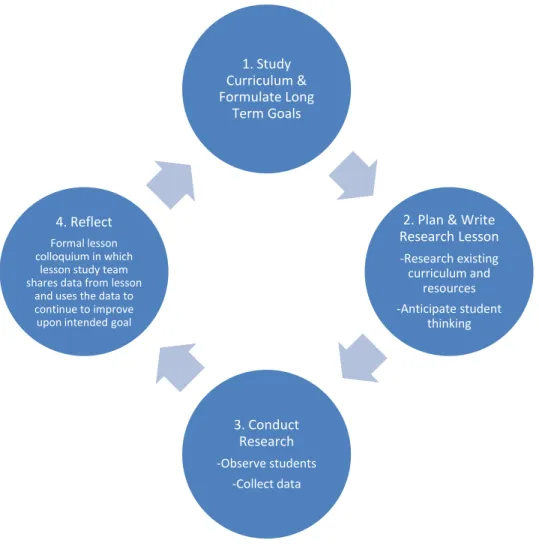
1 Visual Representation of Japan‘s Lesson Study Cycle ...11
2 Nature of Science Concept Cartoon ...96
3 Participant Responses During Theories and Laws NOS Experience...97
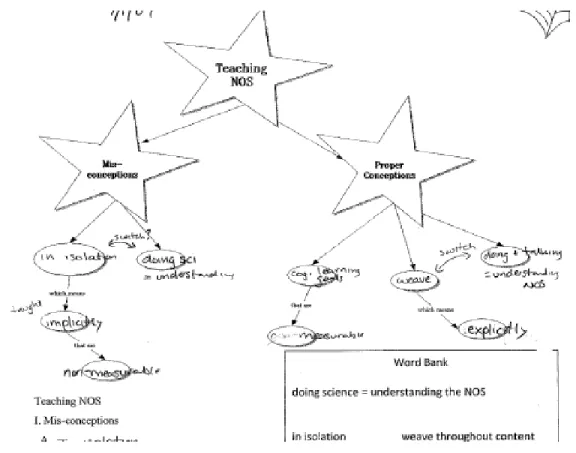
4 Teaching NOS Concept Map ...99
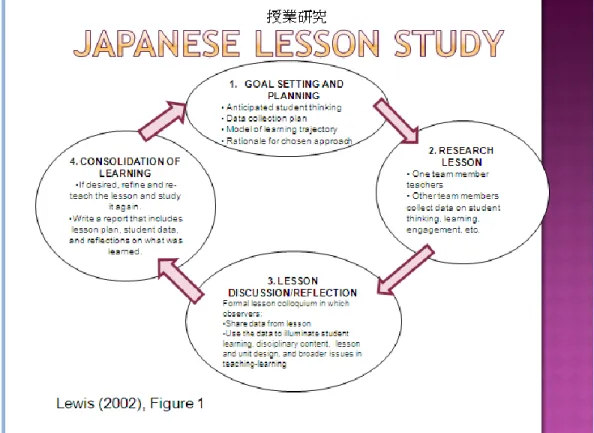
5 Visual Representation of Japan‘s Lesson Study Cycle ...103
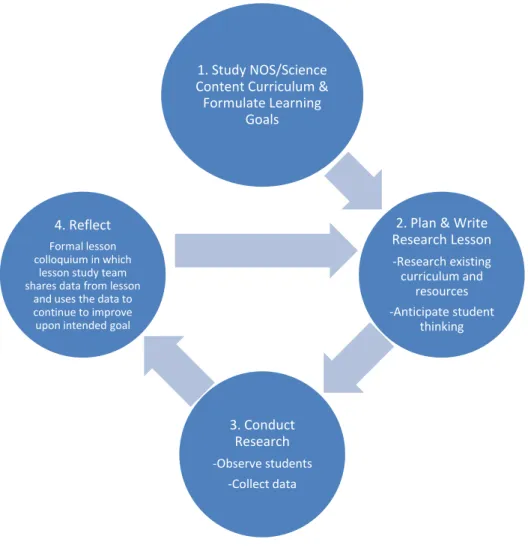
6 Visual Representation of Modified Lesson Study Framework ...104
7 Overview of Research Lesson at Lolash Middle School ...125
8 Lolash Middle School Participant Generated Data Collection Tool ...131
9 Modifications in the Research Lesson ...141
10 Data Collection during Delivery of the Modified Research Lesson ...144
11 Overview of Research Lesson at Deer Crossing Middle School ...153
12 Data Collection Tool for Deer Crossing Middle School ...156
13 Published Version of Student Handout ...165
viii
ABBREVIATIONS
INTASC Interstate New Teacher Assessment and Support Consortium
NOS Nature of Science
NRC National Research Council
NSES National Science Education Standards
NSTA National Science Teachers Association
CHAPTER 1
INTRODUCTION
For the United States, ―Science For All Americans: Project 2061,‖ details an
approach to reform in education, specifically in science, mathematics, and technology
(American Association for the Advancement of Science (AAAS), 1993). This seminal
reform document informs national standards and benchmarks for literacy, such as the
National Science Education Standards (NSES) for K-12 (NRC, 1996), the National Board
for Professional Teaching Standards (NBPTS, 1996) and the National Science Teachers
Association (NSTA) Standards for Science Teacher Preparation (NSTA, 2003). At
different levels of education, these standards and benchmarks set minimum cognitive
abilities and behavioral expectancies as they relate to the teaching and learning of science
content, the nature of science, and the processes of science. Meeting these minimum
standards would ideally lead to a scientifically literate nation of citizens, where the
―knowledge of the nature of science can enable individuals to make more informed
decisions with respect to scientifically based issues‖ and provide a ―defense against
unquestioning acceptance of pseudoscience and of reported research‖ (NSTA, 2003, p.
14). Furthermore, an outpouring of literature published after the 1999 Third International
Mathematics and Science Study (TIMMS) brought to the public‘s attention a declining
trend in standardized math and science scores among students in the United States in
comparison to students of other countries, especially Japan (Stigler, Gozales, Kwanaka,
Knoll, & Serrano, 1999). While this standardized approach to education is not one that
most philosophers of science education would advocate, it is undeniable that the results
redirected political agendas in the arena of science education. In The Teaching Gap
(Stigler & Hiebert, 1999), detailed analysis was provided from the 1999 Video Study of
TIMSS. In a portion of The Teaching Gap, Stigler and Hiebert (1999) emphasize
Japanese reflective teaching practices aimed at improving student learning; practices
rendered in stark contrast to those of the United States.
This dissertation study draws from both results of the 1999 Video Study of
TIMMS analyzed in The Teaching Gap and NSTA (2003) standards to explore a
framework for teacher preparation consistent with the reform needs in science education
as it relates to integrating nature of science (NOS) understandings into the classroom,
using reform-based reflective practices. NSTA (2003) states that science teacher
candidates must demonstrate competency and preparedness in teaching nature of science
concepts, outlining three gateways of performance required. Consistently, NSTA (2003)
addresses the need for future science teachers to plan and implement curriculum
consistent with NSES:
Teacher candidates should engage in planning and implementing lessons and units of instruction early and often, and should be responsible for demonstrating such planning throughout the programs. With little experience in teaching, candidates may find such planning difficult and time-consuming. There is a tendency among novices to fall back upon activities for their own sake, rather than deliberately plan a lesson or a unit with concern for how it might be made more effective…Candidates can be asked to formally assess the internal consistency of their plans using program criteria and may create a reflective narrative to explain that assessment. (p. 24)
Rendered in stark contrast to the United States‘ reflective practices in teacher
training, Japanese practices commonly include what is known as lesson study. The
success of Japanese schools has inspired several school systems and teams of educators
modeling that of Japan‘s Lesson Study (Fernandez & Yoshida, 2004; Fernandez, Cannon
& Chokshi, 2003; Lewis, 2002a; Lewis, Perry & Hurd, 2004; Watanabe, 2002). Through
lesson study, Stigler and Hiebert (1999) asserted that Japan has more successfully made
the shift in professional development recommended by the National Research Council
(1996) than has the United States itself. Stigler and Hiebert (1999) are not alone in the
assertion. For example, Lewis and Tsuchida (1997) report ―grassroots, teacher-initiated
study circles and publicly supported study groups dot Japan‘s educational landscape‖
with an estimated 10 to 50 percent of elementary teachers as members of Japan‘s research
groups (p. 319). The framework from which Japanese lesson study operates actually
coincides with many recommendations, including those outlined earlier in the NSTA
(2003) Standards for Teacher Preparation.
NSTA (2003) emphasizes the need for preservice teachers to actively reflect on
ways for improving student learning. For example, standard ten (NSTA, 2003)
emphasizes the need for future science teachers to continuously reflect on their practices,
―striving continuously to grow and change‖ (NSTA, 2003, p. 30). NSTA (2003)
recommends active engagement in reflection, using resources such as other students,
colleagues, and supervisors and collaborating within this community of experts
continuously demonstrating a commitment to science teaching through ―examination of
one‘s own teaching, experimentation with new approaches, and the sharing of insights
with other teachers‖ (p. 31). NSTA (2003) standards for teacher preparation also
advocate for future educators to demonstrate competencies in content knowledge,
planning skills, success in engaging their students in relevant science issues, and inquiry
2003) emphasizes three competencies science teachers must possess and demonstrate as
it relates to current understandings of nature of science (NOS). These criteria include a
contemporary understanding of science as an epistemology and discipline, and
successfully engaging students in NOS studies (NSTA, 2003, p. 16). While the
requirement to demonstrate effective NOS instruction in the classroom might seem
simplistic, its successful transition poses a problem for many preservice teachers in
teacher training programs (Abd-El-Khalick & Lederman, 2000b; Lederman, 1992).
Purpose of the Study
The research in this dissertation study explored preservice teachers‘ use of lesson
study as they transitioned in teaching nature of science (NOS) curriculum outlined in the
National Science Education Standards for K-12 (NRC, 1996). Lesson study has
experienced long term success in Japan‘s education system as a means for professional
growth and reflection; thereby prompting members of the United States research
community to begin exploring its features for possible use in the United States. Lewis,
Perry, and Murata (2006) anticipate a lack of success with lesson study in the United
States as long as the knowledge base of the research community is structured around two
seminal pieces of literature (Fernandez & Yoshida, 2004; Lewis, 2002b). This research
contributes to literature in its exploration of the lesson study experiences of graduate
level preservice science teachers‘ as they focus on ways to transition NOS curriculum
into their classroom practice. The potential this holds in adding significant data to the
knowledge base of how science teacher preparation programs can both promote NOS
curriculum and foster the development of reflective practitioners is unparalleled.
prepare preservice teachers ―to learn from teaching when they enter the profession‖
(p. 49). In the argument presented, Hiebert et al. (2007) call for teacher preparation
programs to provide opportunities for preservice teachers to learn how to analyze
teaching in terms of student learning. The researchers hypothesize that this can be
accomplished by developing knowledge, skills, and dispositions which would contribute
to the preservice teacher‘s ability to study and improve teaching over time.
Abd-El-Khalick and Lederman (2000b) call for research efforts in science education which seek
to identify or isolate factors which ―constrain or facilitate the translation of teachers‘
conceptions of NOS into classroom practice‖ (p. 696). Inspired by the reviewed
literature, this research study seeks to explore how preservice teachers experience lesson
study as a reflective, analytical process for transitioning their teaching and learning of
NOS content strands.
Research Questions
1. How do preservice teachers‘ understandings of NOS shift as a result of
the lesson study experience?
2. How does the reflective practice that occurs in lesson study influence
preservice teachers‘ transition of nature of science tenets into classroom
practice?
Significance of the Study
When preservice teachers enter science teacher preparation programs as graduate
students seeking to earn alternative certification, they have often been taught a body of
existing scientific knowledge through lecture and validation labs. Unfortunately, the
teachers‘ background of what science teaching should be like, or pedagogical content
knowledge (Boyer, 1987; Dunkin & Barnes, 1986; Parsons, 1997). This understanding of
how science works and its resulting body of knowledge is inconsistent with how science
education researchers currently view the inclusion of NOS in classroom practice
(McComas, Clough, and Almazroa, 1998). Additionally, science education researchers
have long held beliefs that teachers‘ views of NOS are directly related to its integration in
the classroom (Lederman, 1992). Therein lies a contradiction of epistemologies between
contemporary NOS tenets promoted in teacher training programs and that of the
preservice teachers‘ personal backgrounds (Lederman, Gess-Newsome & Latz, 1994).
This means students former experiences in science classrooms are traditionally
characterized by lecture and validation labs, which is pedagogy typically minimized in
current science teacher training programs. Long held assumptions in science education
research as to the relationship between these beliefs and teaching actions drives research
of NOS in teacher training programs (Abd-El-Khalick & Lederman, 2000b; Lederman,
1999; McComas, 1998).
After a review of relevant research, McComas et al. (1998) attest to the influence
of understanding NOS on teachers‘ actions, stating, ―teachers consider the nature of what
they perceive their discipline to be and those views are translated in ways they
themselves may find surprising‖ (p. 19). King‘s (1991) research illustrates this point.
King (1991) interviewed thirteen preservice teachers in a science curriculum and
instruction course, after their student teaching experiences, to explore the preservice
teachers‘ teaching and learning goals. King (1991) anticipated that this exploration
backgrounds existed in order to suggest corrections. In one of the interviews a
participant came to understand the disparity between how she was taught and her own
teaching style. The participant stated,
I learned science as a collection of facts, with no knowledge of how those facts came to be facts, or why those facts are considered facts. When I talk about teaching my students to think critically, I guess what I mean is that they have that historical and philosophical knowledge so that they understand and appreciate the hows and whys. I wonder how I‘ll be able to teach this way, given my shallow knowledge of science. The only thing I feel prepared to do now is to teach my students the facts I learned. (King, 1991, p. 139)
King reports that the preservice teachers in his study frequently complained about how
difficult it was to incorporate inquiry, discovery, and critical thought into their teaching.
Differences in ideas of the philosophy and sociology of how science works and the
scientific knowledge that comes out of science work, reflects one of the issues faced in
the strife to promote the inclusion of NOS tenets among preservice science teachers‘
experiences.
One significant line of inquiry in science education research has centered on ways
for improving preservice teachers‘ understandings of NOS. As a result, a tremendous
body of literature informs and continues to contribute to NOS curriculum in teacher
preparation programs (McComas et al., 1998). As NOS curriculum has been researched,
it has successfully provided evidence for ways to improve NOS understandings for
preservice teachers. Described in detail of Chapter Two are four streamlined approaches
to integrating NOS in teacher training repeatedly reported in the literature as improving
NOS understandings (McComas et al., 1998). These approaches include NOS in
methods courses, NOS in science content classes, authentic experiences ―doing‖ science,
improved NOS understandings at the preservice level transferring into classroom
practice, has been inconsistently reported (e.g., Abd-El-Khalick, Bell, & Lederman,
1998; Bell, Lederman, & Abd-El-Khalick, 2000; Black, 2003; Schwartz & Lederman,
2002). Clough (1997) argues that even while some preservice teachers have had the
aforementioned experiences with NOS, there is additional need to provide support in
learning how to integrate contemporary NOS understandings when teaching science
content. Clough (1997) states that while preservice teachers might have informed NOS
understandings, they do not ―possess strategies to incorporate it into instruction‖ (p. 197).
The lack of transition of informed NOS understandings into classroom practice from
preservice through the first several years of full time teaching poses an issue (Bell et al.,
2000; Bentley & Fleury, 1998; Clough, 1997; Nott & Wellington, 1998).
Guidelines serving as a resource for NOS instruction and expectations in teacher
training programs, such as those expressed by Interstate New Teacher Assessment and
Support Consortium (INTASC), outline the needs for teachers to ―understand the central
concepts, tools of inquiry, application and structure of science‖ in various science content
areas including NOS (INTASC, 2002, p. 10). INTASC (2002) standards, and NSTA
(2003) performance standards for teacher preparation, recommend explicit, reflective
instruction and first-hand experience in relation to contemporary views of NOS for
preservice teachers. Abd-El-Khalick and Lederman (2000b) additionally argue the need
for preservice teachers to be provided a conceptual framework within the context of
content, activities, sociology of science, etc. through means of explicit, reflective
instruction. Barring that the preservice teacher has an informed understanding of NOS,
activities would promote pedagogical content knowledge and the integration of NOS in
classroom practices.
However, the transition of NOS into classroom practice transcends this
assumption with a growing body of research to support the complexity of this issue
(Abd-El-Khalick et al., 1998; Bell et al., 2000; Black, 2003; Schwartz & Lederman, 2002).
While preservice teachers‘ conception is a variable to consider, well documented are the
myriad difficulties for preservice teachers in understanding and integrating NOS into
classroom practice. Factors shown to impact this implementation include the isolation of
NOS outside of any authentic science experience, time constraints, management issues,
subject matter knowledge, institutional constraints, NOS content knowledge, NOS
beliefs, and level of comfort associated with integrating NOS (Abd-El-Khalick et al.,
1998; Bell et al., 2000; Lederman & Zeidler, 2001; Smith & Scharmann, 1999). Early
research, which highlights the difficulties preservice teachers‘ experience in transitioning
NOS into classroom practice, brings to the forefront the significance of this study. As
lesson study encompasses each of these issues, it provides a reflective framework for
opening discussion about teaching NOS and student learning, as well as, a supportive
environment for redirecting preservice teachers‘ attention to the intended cognitive
outcomes.
Lesson Study
According to Lewis (2002a), Stigler and Hiebert (1999), and Yoshida (1999),
several essential features characterize Japanese Lesson Study: curriculum goals, lesson
development, and reflection. Japanese teachers participating in lesson study begin by
Examples of these goals might be: ―To develop instruction that ensures students‘ basic
academic abilities, fosters their individuality, and meets their individual needs‖ (Lewis,
2002b). The curriculum goals of Japanese Lesson Study are reflected in the top of
Figure 1. As illustrated in the second part of the visual, the participating teachers then
develop a research lesson. The research lesson typically targets a particular weakness, a
difficult topic for the teachers, or a subject that has recently changed. When planning the
research lesson, the participating teachers work collaboratively for several sessions using
a myriad of resources to integrate the common goal into an instructional plan.
After the research lesson is developed, the participating teachers then turn their
attention to how students react to the delivery of the instructional plan. In Figure 1, this
is referred to as conducting research. In Japan, teachers are seen as researchers,
especially as they participate in lesson study. As a result, when the lesson study group
observes the lesson taught by one of the members, the ultimate focus is student learning
and development. Observations during the research lesson typically center on student
engagement, student conversations, and overall disposition during the lesson. Analogous
to a participant observer, teachers involved in the research lesson, observe the students
throughout the delivery of the lesson, take notes on student reactions to the research
lesson, and make every attempt to see instruction through the students‘ eyes (Lewis,
2002b). In the reflective dialogue that follows, the participating teacher who delivered
the lesson shares his/her perspective of the students‘ specific reactions during the lesson
(e.g. involvement, disposition, responsiveness, demeanor, etc.). Other participants in the
lesson study group add to this discussion by sharing observations and making suggestions
Figure 1. Visual representation of Japan‘s lesson study cycle. Reprinted from Lewis, Perry, Murata, 2006, p. 4.
feature of Japanese Lesson Study is represented in the fourth portion of Figure 1, which
as indicated, then leads to a continuation of the cycle.
This continuation exists when the lesson study group re-visits the instructional
plan to make modifications based on reflections, observations, and suggestions from the
first delivery of the research lesson. The modified research lesson will often be
re-delivered and others outside the lesson study group are invited to observe. In the final
draft, the research lesson is published as a teaching resource, accessible for others to use. 1. Study
Curriculum & Formulate Long
Term Goals
2. Plan & Write Research Lesson
-Research existing curriculum and
resources -Anticipate student
thinking
3. Conduct Research
-Observe students -Collect data
4. Reflect
Formal lesson colloquium in which
lesson study team shares data from lesson
Collectively, these features of Japanese Lesson Study work to form a culture of teaching
focused on improving student learning by improving instruction. This proposed research
serves to describe the specific reflective experiences of preservice teachers participating
in a modified version of Japanese Lesson Study in a secondary science teacher
preparation program in the United States. This modified version is described in further
detail within the methods chapter.
Theoretical Framework
Models of teaching and learning NOS using explicit, reflective, activity based
approaches have been moderately successful in the transition to reform based practices
(Abd-El-Khalick et al., 1998; Bell et al., 2000). Research providing evidence of
successful transitions typically reflect a constructivist approach to teaching, where
learning is an active, reflective, socially mediated process (Clough, 1998; Schwartz &
Lederman, 2002). Generically described, a constructivist approach to teaching operates
with the understanding that a learner comes to understand their current way of knowing,
and then engages in a series of activities whereby a new or different way of
understanding emerges. Lawson (1995) describes how humans construct knowledge in
the following way.
Order imposed by the human mind is always a created thing. That
creation is found to be true or false by testing through behavior. The mind creates from sensory data and then imagines the creation to be true to allow the generation of an expectation, which is then tested in the external world. If the expectation is met, the creation is retained. If not, the creation must be replaced. (Lawson, 1995, p. 2)
Constructivism incorporates a wide array of principles, all of which emulate science
practice: (1) people construct meaning about new experiences from prior experiences, (2)
Holford, & Griffin, 2003). Experiences where competing ideas are evaluated, compared,
and reconstructed in relation to NOS tenets have played a significant role in teacher
training programs (e.g. Hammrich & Blouch, 1998).
In consideration of the participants who were asked to participate in this study,
constructivist based theories of the adult learner will now be expounded upon.
Andragogy, a term coined by Malcolm Knowles, is the study of adult learning. Knowles
makes the assumption that an individual who reaches the stage of adulthood is a self
directed learner, in the sense that he/she is motivated to learn in order to be able to
effectively handle future situations. Consistently, Elias, Merriam, and Caffarella (1991)
assert an adult‘s self motivation and direction toward growth as an educator is best
accomplished through discovery, experience, collaboration, and interaction with peers.
Andragogy suggests that effective adult learning environments also involve the adult in
planning learning experiences, the creation of personal objectives and goals, and both self
and peer reflection (Knowles, 1980). In addition, adult learners are motivated to learn if
they are told why they are learning the information and can see its benefits. According to
Knowles, for an adult learner, his/her experiences act as a resource that are constantly
being used to construct new understandings. Understanding in these ways is a continuous
process of restructuring prior ideas and constructing new ideas.
Lesson study echoes aspects of constructivism and andragogy. For example, the
lesson study framework supports reflection on pedagogy and evidence based decision
making aimed to impact student learning. Inquiry into one‘s own teaching in this way
supports personal autonomy; in that it promotes the preservice teachers‘ taking
knowledge for the preservice teachers. One way in which this new knowledge is
generated is in the transactions within the lesson study team and the practicum experience
itself. This environment is important for developing insights into professional situations
that are critical for developing practice and informing future practice.
It is also the agreement of many in science education that reflection on these
experiences is critical to the success of adult transformative learning. Maudsley and
Scrivens (2000) connect theories of inquiry into one‘s own teaching arguing, ―reflective
practice unites discussion of critical thinking with experiential learning‖ (p. 539).
Harrison, Lawson, and Wortley (2005) explain that reflection is embedded within the
process of sense making because it ―involves a process in which evidence from our
practice may be examined and explored, in which personal theories may be found
adequate, or not, and in which alternative understandings may be formulated‖ (p. 422).
Freire (1972) asserts that an unmasking of reality should be followed by critical
intervention in order to transform it. In addition, for Friere (1970), thought and action are
indissoluble aspects of a praxis where ―mere reflection is nothing but verbalism…and
there is not transformation without action‖ (p. 61). Friere believes in the liberating
potential of education, especially when critical analysis of an experience is coupled with
action. Similarly, Harrison et al. (2005) assert ―insights (into professional situations) are
important for developing practice but only if they can lead to further action‖ (p. 423).
Harrision et al. (2005) further explain that critical reflection on practice involves a
challenge to existing thoughts, therefore implying change.
The reflective processes of lesson study meets each of these criteria, providing
specific NOS tenets in a cyclical manner that promotes both personal and others‘ NOS
understandings. Furthermore, expounding upon the second criteria above, Rodgers
(2002) synthesizes the work of Dewey (1933, 1944) to include six phases which mirror
scientific processes. These phases include (a) an experience, (b) interpretation of the
experience, (c) identifying the problem or question that emerges out of the experience,
(d) generating an explanation for the problem or question, (e) ramifying the explanation
into a hypothesis, and (f) experiment with the hypothesis. Features of lesson study can
be categorized into each of these phases.
Within the andragogical constructivist framework of lesson study, meaning
making is socially and collaboratively constructed with others and in self reflection.
Examining how meanings are derived and actions taken based on these meanings
theoretically underpins symbolic interactionism. ―The meaning people give to their
experience and their process of interpretation are essential and constitutive, not accidental
or secondary to what the experience is.‖ (Bogdan & Biklen, 2007) Symbolic
interactionism holds true to the idea that meanings are always up for negotiation and
subject to peer pressure, again emulating scientific practice. Necessary for the success of
peer and self reflection, is a language that promotes action or reaction to the particular
area of professional growth being sought. The meanings derived from these experiences
further promote the social constructivist goal of social transformation in addition to the
type of meaning making sought in human constructivism. The transformation of
informed NOS tenets conjoined with the integration of these understandings into
Independent, social, and human constructivism represents merely three of the
constructivist branches of teaching and learning. This is by no means comprehensive of
constructivist branches but definitely envelopes the whole of constructivism that was
illuminated in this study. Lesson study as a medium for reflection about teaching and
learning NOS tenets holds true to the main tenet of constructivism that knowledge is
constructed by the individual in an active process of interaction within particular
contexts. Particular contexts in this case further mimic (social) constructivism in that the
framework of lesson study demands collaborative support and preservice teacher
construction of knowledge, as opposed to the more traditional method of transmitting
knowledge. The preservice teachers were required to socially negotiate meaning,
representing both symbolic interactionism and human constructivism, through self and
peer reflection within the instructional environment where lesson study was used to
situate their learning. The shared knowledge that evolved from this exploration was
indeed deemed personally relevant, representing individual constructivism. While not
part of the focus of this study, this shared knowledge will quite possibly impact further
social interactions the participants have with other communities of learners. This would
further represent social constructivism.
This active process of socially constructing new meanings of what it is teach and
learn NOS, required that the preservice teachers were engaged in meaning making with a
team of others. This allowed the opportunity to examine the processes of lesson study
and the dialogue supported within its framework. Particular attention was given to the
dialogue between team members in order to explore how levels of reflection may have
the lesson study framework to promote the professional growth of all involved. Since
preservice teachers cite other classroom concerns to take precedence in their thoughts and
reflections, specifically as it relates to reflecting on how to integrate NOS curriculum,
symbolic interactionism also allowed the opportunity to examine if this is negated
through the lesson study process. Symbolic interactionism also allows an opportunity to
examine if lesson study supported the development of pedagogical content knowledge
associated with meaning making of inquiry teaching practices of NOS curriculum. If this
development of knowledge or skills associated with teaching NOS were acquired during
the lesson study, then there was an authentic opportunity to examine how this resulted in
a negotiation of perspectives and possibly changed the future practices of the preservice
teachers.
Overview of Methodology
This dissertation study was explored through qualitative research methodology,
particularly a single case study of multiple lesson study teams. The inquiry itself called
for an exploration which would illuminate the experiences of preservice teachers teaching
nature of science (NOS) curriculum. This case study sought to gain understanding as to
―how‖ preservice teachers teach and learn about NOS through lesson study, a
contemporary phenomenon, within the context of their practicum experiences. Yin
(2006) presents each of these criteria, posing of a ―how‖ question(s), contemporary
phenomenon, and real-life context, as necessary components for case study to be an
appropriate choice of research methods. Within this case study it was further intended to
explore reflective practices in general and the transferability of explicit NOS teaching as
program, e.g. lesson study, further supports the use of case study methods for this study
(Stake, 1995; Yin, 2006).
Yin (2006) asserts that a quality case study design includes five elements:
questions, propositions, units of analysis, sources of evidence linked to the propositions,
and strategies for data analysis. In this dissertation study, the research questions broadly
inquire into how lesson study experiences impact the transition of NOS curriculum for
preservice teachers. Based from the theoretical framework, propositions imply that the
explicit, reflective NOS experiences conjoined with the lesson study experiences will
foster the teaching and learning of NOS for the preservice teachers. Units of analysis in
this study were the preservice teachers that comprised the lesson study teams. Complete
lesson study teams ideally consisted of a minimum of one to three preservice teachers,
cooperating teachers within the K-12 public school, and the university supervising
teacher. Sources of data linking the propositions to data analysis include open-ended
questionnaires, interviews, researcher provided reflection frameworks (e.g. web based
forum for open discussion, lesson study overview), field notes, and a reflective portfolio
that included the research lesson along with other related artifacts which are a product of
participating in lesson study. Analysis of these qualitative data sources were guided by
the work of Lederman, Abd-El-Khalick, Bell, and Schwartz (2002) and Ward and
McCotter (2004). Realizing the overview provided here warrants further explanation;
details of each aspect of this research design are further expounded upon in chapter three.
Summary
Science educators are charged with the responsibility of generating students who
educators to teach NOS, it is necessary that they themselves have an informed
understanding. Additionally, recognizing the (a) dynamic nature of the scientific
enterprise and (b) diverse experiences and levels of understanding among their students
also requires science educators to continuously reflect upon and improve upon their
teaching of NOS. One way to foster both the teaching and learning of NOS and the
development of a reflective practitioner is to actively engage in the related experiences
and practices. The purpose of this dissertation study was to explore the impact of lesson
study, a reform-based reflective framework, on preservice teachers‘ experiences in
teaching NOS. To accomplish this, participants‘ initial understandings of NOS were first
assessed. Then, the preservice teachers participated in a series of explicit, reflective NOS
activities (Clough, 1998; Lederman et al., 1998). NOS understandings were re-assessed
at the conclusion of these activities. In the following semester, the reflective framework
of lesson study was introduced during the fall practicum experience. Preservice teachers
engaged in a modified version of an actual lesson study process, at which times, multiple
sources of data were collected to inform the research questions. At the conclusion of this
experience, preservice teachers were requested to complete a final assessment of their
NOS understandings and submit a portfolio reflective of their lesson study experiences.
Through the combination of these experiences, I believed informed understandings of
contemporary NOS would prevail. I also believed that participating in this modified
lesson study framework would provide these preservice teachers with a deepened
understanding of the performance needs of a quality science educator, specifically
CHAPTER 2
REVIEW OF THE LITERATURE
Introduction
For more than a decade, priorities in current science teacher preparation have
focused reform movements toward constructivist theories of learning that emphasize
critical thinking, evidence based decision making, and ultimately transformative learning
experiences (National Science Teachers Association [NSTA], 2003; National Research
Council [NRC], 1996). In this chapter, a historical overview of transition occurring in
science teacher preparation programs will first be provided. Within this overview, review
of competing views of nature of science (NOS) will be outlined, followed by a summary
of the consensus view of NOS curriculum in both K-12 and teacher education. This
section of the literature review includes a summary of the literature on this consensus
view of appropriate NOS curriculum as it pertains to the myriad approaches to training
science educators. Finally, at the core of the study is a review of the literature pertinent
to Japanese Lesson Study. Lesson study serves as the context within which this study
will be guided, therefore warranting the need for specific emphasis on how research
indicates it correlates to current recommendations in science teacher training education.
Transitions in Science Teacher Preparation Curriculum
With the publication of the National Science Education Standards (NSES) in
1996, reform was set in motion to create a scientifically literate nation of high school
graduates (NRC, 1996). Science literacy is defined by the NSES as the ability to
critically analyze data, its source(s) and processes, express informed positions on
participating in society. (NRC, 1996, p. 22) Several years earlier, the American
Association for the Advancement of Science (AAAS, 1993) published Benchmarks for
Scientific Literacy, pushing for increased scientific literacy among high school graduates
as defined by specific skill sets and a core of scientific understanding. Hurd (1998)
contends the roots of scientific literacy defined by these pragmatic means dates back in
the United States to the presidency of Thomas Jefferson. However, its importance was
not realized until Sputnik, the first successful satellite to orbit Earth, was launched by the
Soviet Union. In the United States, the post Sputnik era prompted significant
government funding for research and curriculum reform in science education. With this
shift to a new priority came willingness by politicians to consider reform which would
ultimately lead to the United State regaining the competitive edge over other nations in
the areas of science and technology. While the needs of the today‘s nation have changed,
political motivation to work toward progress in science has not subsided over the
decades. Current focus in science education as stated in the American Recovery and
Reinvestment Bill of 2009 targets improvements in science education for the
transformation of the economy and for additional funding for research in areas directly
related to science (e.g. clean energy, stem cell research, and healthcare).
Beliefs among progressive educators describe evolving ideas and practices that
aim to make schools more effective and efficient agencies of a democratic society. Early
supporters of progressive education emphasized a child-centered curriculum, social
re-constuctionism, and participating citizens (Schugurensky, 2002). Some progressive
educators also believed curriculum should be based on cooperative social skills, critical
outcomes needed to be challenged, verified, and reconstructed in the search for a possible
truth. John Dewey, a philosopher who influenced this progressive line of thinking in the
United States spent his life working diligently to experiment with these ideals of
progressive education (Urban & Wagoner, 1999).
Although there are numerous differences of style and emphasis among
pedagogical progressives, most share the conviction that democracy means active
participation by all citizens in social, political and economic decisions which affect their
lives. For historians, the 1890s began what is referred to as the Progressive era, a time of
myriad reforms in reaction to industrialization and related economic and social problems
(Urban & Wagoner, 1999). It experienced some ebbs and flows of mainstream
pedagogical practice through specific movements, such as the School Gardening
Movement (Kohlstedt, 2008). The education of engaged citizens within this era
emphasized diversity among abilities, interests, ideas, needs, and cultural identity as well
as the development of socially competent citizens. These beliefs were upheld by
pedagogy emphasizing curriculum relevant to the students and a student centered
approach to learning. Yet, in spite of such movements, traditional practice of teacher
centered education held steadfast at work. In addition, while the Soviet satellite launch
some fifty years later reignited political interest in science education, progressive ideals
of relevant curriculum and student centered pedagogy had long been abandoned by most
in public education. For those working in schools, emphasis at this time was on
classroom control, obedience, and a structured, imposed curriculum (Urban & Wagoner,
Constructivism in Reform Curriculum
As is often the case with new paradigms, the importance and attention given to
Dewey‘s work did not come until much later, but it continues to inspire many political
and educational theorists (Urban & Wagoner, 1999). The influence of Dewey‘s
principles is evidenced in all of education, but for the purposes of this dissertation,
specific science education reform documents will be highlighted fromK-12 with the
National Science Education Standards (NRC, 1996) and in teacher training with the
Interstate New Teacher Assessment and Support Consortium (INTASC) model core
standards for science teaching.
John Dewey‘s philosophy and educational theory emphasizes the experiences of
everyday life. Dewey describes three characteristics of the relationship which he
believed to exist between knowing and doing.
The first is the obvious one that all experimentation involves overt doing, the making of definite changes in the environment or in our relation to it. The second is that experiment is not a random activity but is directed by ideas which have to meet the conditions set by the need of the problem inducing the active inquiry. The third and concluding feature, in which the other two receive their full measure of meaning, is that the outcome of the directed activity is the construction of a new empirical situation in which objects are differently related to one another, and such that consequences of directed operations form the objects that have the property of being known. (Dewey, 1938, p. 70)
In contrast to traditional practices, Dewey conceptualizes teaching and learning that
begins and ends with the student and society at the core of its goals. Dewey believed that
for educational growth to take place, students must continually reorganize and
reformulate past experiences in light of new experiences. Dewey also believed students‘
experiences in school should combine the past and present, so as to provide a background
knowing is not the act of an outside spectator but of a participator inside the natural and
social scene, then the true object of knowledge resides in the consequences of directed
action‖ (Dewey, 1938, p. 157). Dewey‘s early writings stressed the importance of a
functioning relationship between learning activities and student experiences outside the
classroom, as well as the nature of the learning process.
In one powerful example of how Dewey‘s philosophies on experiential learning
has influenced science reform, ―Project 2061: Benchmarks for Science Literacy,‖
describes science teaching as a weaving of the philosophy and sociology of science and
the acquisition of scientific knowledge (AAAS, 1993). Specifically stating,
. . . the emphasis should overwhelmingly be on gaining experience with the natural and social phenomena and on enjoying science…By gaining lots of experience doing science, becoming more sophisticated in conducting investigations, and explaining their findings, students will accumulate a set of concrete experiences on which they can draw to reflect on the process. (AAAS, 1993, p. 4)
Dewey‘s theory of learning contextualizes learning situations, emphasizing that students
both construct knowledge from prior and lived experiences, continuously moving around
a continuum to expand conceptual understanding.
Dewey held to these principles, elaborating and detailing these ideas as he
continued to prosper and gain respect in the field (Dewey, 1938). In relation to teacher
training, Dewey maintains his philosophies of experiential learning writing of ―practical
deliberation‖ where educators systematically learn to resolve issues in teaching practices.
Dewey (1933) explains that reflective practice is a meaning making process where
understanding evolves in the space moving from one experience to another. Reflection
what is thought to be known and a new experience. It is a systematic way of thinking,
communal, and requires a disposition which values personal and intellectual growth.
Rodgers (2002) writes extensively on the undeniable ―cry for accomplishment in
systemic, reflective thinking‖ while simultaneously arguing that what is meant by
reflection and thinking is often delineated too quickly. Rodgers (2002) emphasizes that
reflection is often reduced to standards and vague definitions, it lacks a common
language, and it is difficult to research as a result of an unclear sense of what it means.
Rodgers (2002) sought to clarify what is meant by reflection and thinking from Dewey‘s
works. Dewey (1933) writes of reflection as a complex, rigorous enterprise that takes
time. Rodgers (2002) in acknowledging the difficulty associated with making sense of
Dewey‘s style of writing, attempts to characterize Dewey‘s concepts of reflection in four
criteria. These criteria include:
1. Reflection is a meaning-making process that moves a learner from one experience into the next with deeper understanding of its relationships with and connections to other experiences and ideas. It is the thread that makes continuity of learning possible, and ensures the progress of the individual and, ultimately, society. It is a means to essentially moral ends.
2. Reflection is a systemic, rigorous, disciplined way of thinking, with its roots in scientific inquiry.
3. Reflection needs to happen in community, in interaction with others.
4. Reflection requires attitudes that value the personal and intellectual growth of oneself and of others. (Rodgers, 2002, p. 845)
Reflective practice in science education has earned attention as national science
education reform documents have begun to discuss the development of a reflective
practitioner. For example, both INTASC (2002) and NSTA (2003) state that science
teacher preparation programs should provide opportunities for preservice teachers to
preservice teachers‘ ―practical deliberation‖ about NOS tenets is of utmost importance.
Reflective of the outlined principles of learning and reflection, the core of this proposed
research is a practicum teaching experience using a reflective framework. This study has
been designed in order to begin understanding the potential for both transforming
preservice teachers‘ contemporary understandings of NOS and the development of
relevant pedagogical content knowledge. An overview of literature examining past and
present curriculum definitions of NOS follows. This historical account of the literature
aims to lead into a discussion on NOS curriculum in teacher training programs. By
reviewing this line of literature, insight to the issues of transitioning NOS curriculum
faced by preservice teachers is gained.
Nature of Science
Views on Nature of Science
Project 2061 (AAAS, 1993) describes the scientific enterprise as an activity for
understanding how the world works. Project 2061 (AAAS, 1993) advocates for students
to understand the relevance of science as it relates to their future adult lives in a
democracy where ―they will be in a position to influence what public support will be
provided for basic and applied science…and should be able to understand discussions of
science issues in the news‖ (p. 14). Each of these components described in Project 2061
(AAAS, 1993) collectively define what is commonly referred to as scientific literacy.
Ten years prior to Project 2061, the 1983 report, A Nation at Risk: An Imperative for
Educational Reform broughtto public attention the importance of students being capable
of informed decision making about currently relevant, personal and social issues
action comes a need for those responsible for educating students to understand aspects of
nature of science (NOS), ways of knowing and doing in relation to science, as it
continues to be a main feature of today‘s times (AAAS, 1993).
Nature of science refers to science as a way of knowing, an epistemology, or
those values and beliefs necessary for the development of scientific knowledge
(Lederman, 1992; Lederman & Zeidler, 1987). Abd-El-Khalick and Lederman (2000a)
assert that ―no consensus presently exists among philosophers of science, historians of
science, scientists, and science educators on a specific definition for NOS, ‖ but that this
should not be disconcerting given the ―multifaceted, complex, and dynamic nature of the
scientific endeavor‖ (p. 666). In summarizing the changes of science education‘s
conception of NOS over the last 100 years, Abd-El-Khalick and Lederman (2000a)
recount that the scientific community has moved from the early 1900s where NOS was
equivalent to ―the scientific method‖ through the 1960s with emphasis on process skills
such as inferring, observing, and designing experiments; into the twenty first century
where a growing body of psychological and sociological factors began to influence the
defining characteristics of NOS. As early as 1982, the National Science Teachers
Association (NSTA) asserted that socially mitigated inquiry based methods played a
central role in NOS, as well as an understanding of the tentative nature of scientific
knowledge.
Understanding NOS in this way and how it influences students, teacher training,
and professional development continues to have relevance in current lines of research and
science curriculum (Abd-El-Khalick & Lederman, 2000a; Bybee, 1997; DeBoer, 1991;
what constitutes NOS (Abd-El-Khalick & Lederman, 2000a; Duschl, 1990), aspects of
NOS such as those outlined by McComas (2004) are generally accepted. These generally
accepted tenets ultimately define the scope of NOS included within science standards for
educators and students. Understanding of the agreed upon NOS tenets by students and
adults alike, is nationally supported in reform documents as they each assert that this
informed understanding is crucial to a scientifically literate nation capable of
participating in a democratic society (AAAS, 1993; NRC, 1996; NSTA, 2003).
According to McComas (2004), core NOS tenets deemed necessary for scientific
literacy include the following: (a) Scientific data is reviewable by peers and justifies
conclusions. (b) Commonalities exist in the production of knowledge, but there is no
single scientific method by which science knowledge progresses. (c) Scientific
knowledge is tentative. (d) Laws are generalizations or patterns of nature. Theories are
explanations for how laws hold up. (e) Science is creative. (f) Science can be subjective.
(g) Science works within a larger historical, cultural, and social enterprise. (h) Science
and technology are not synonyms, but they do impact each other. (i)Science has limits.
Benchmarks for Science Literacy for K-12 (AAAS, 1993), NSES for K-12 (NRC, 1996),
INTASC (2002), and NSTA (2003) all place standards for science educators and K-12
students to demonstrate an understanding of these NOS tenets through various
inquiry-based methods. What is most unfortunate is that both K-12 students and science
educators do not consistently show retention of these more informed views
(Abd-El-Khalick & Akerson, 2004; Duschl, 1990; Lederman, 1992, 1995, 2007).
Misconceptions surrounding NOS tenets are an important aspect of research
Ogborn, 1988; Lederman, 1992). Akerson, Buzzelli, and Donnelly (2008) have reported
that many elementary teachers misinterpret the term ―nature of science‖ to mean
something to do with nature rather than ―the essence of science itself‖ (p. 748).
Furthermore, among students of all ages inaccurate perceptions of science and scientists
have been described in much research (Fort & Varney, 1989; Mead & Metraux, 1957;
Newton & Newton, 1992). Several examples include the belief in universal step by step
process for conducting science work (Lederman, 1992), the belief that science can be
proven correct (Aguirre, Haggerty, & Linder, 1990), and theories can become laws with
enough evidence (Abd-El-Khalick & BouJaoude, 1997). Gallagher (1991) claims the
knowledge base of scientific knowledge for the public comes from two primary sources,
the school and media. Boylan (1992) also suggests that these perceptions represent
students‘ knowledge of public stereotype constructed through a sundry mediums; ranging
from television, museums, news paper articles, conversations with family, movies, the
Internet, and so on. Akerson et al. (2000) assert that preservice teachers learning science
content through traditional courses from a range of college departments lacking in any
systemic reform of science teaching will continue to be highly likely to hold naïve views
of NOS. As these conceptions typically reflect an inaccurate view of science, curriculum
reform works to change these conceptions in teacher training programs.
NOS Instruction in Teacher Training Programs
The need for informed understandings of NOS among preservice teachers has
been advocated since the late 1960s (Lederman, 1992). Lederman (1992) asserts, ―if
teaching is viewed as a purposeful and conscious act, a teacher must possess an adequate