ScholarWorks @ Georgia State University
ScholarWorks @ Georgia State University
African-American Studies Theses Department of African-American Studies
4-26-2010
Voices of the Earth: A Phenomenological Study of Women in the
Voices of the Earth: A Phenomenological Study of Women in the
Nation of Gods and Earths
Nation of Gods and Earths
Ahmon J. Keiler-Bradshaw
Georgia State University
Follow this and additional works at: https://scholarworks.gsu.edu/aas_theses
Part of the African American Studies Commons
Recommended Citation Recommended Citation
Keiler-Bradshaw, Ahmon J., "Voices of the Earth: A Phenomenological Study of Women in the Nation of Gods and Earths." Thesis, Georgia State University, 2010.
https://scholarworks.gsu.edu/aas_theses/2
This Thesis is brought to you for free and open access by the Department of African-American Studies at
VOICES OF THE EARTH: A PHENOMENOLOGICAL STUDY OF WOMEN IN THE
NATION OF GODS AND EARTHS
by
AHMON J. KEILER-BRADSHAW
Under the Direction of Dr. Cora Presley
ABSTRACT
Historically, Black women have often been excluded from the discussion on leadership. This
thesis argues that the leadership roles of the women in the Nation of Gods and Earths are
consis-tent with the concepts of both Africana womanism and Black women’s leadership. However,
through an analysis of Earth’s oral testimonies, this research concludes that though racism is the
reevaluate the sexism that exists within its doctrine and practice. By doing so, the group can
be-gin to recognize Black women’s leadership and utilize it more effectively. The Nation should
collectively transform its gender inequality, in a way that does not compromise its culture, as a
means of successfully sustaining and strengthening itself and the communities of which it serves.
VOICES OF THE EARTH: A PHENOMENOLOGICAL STUDY OF WOMEN IN THE
NATION OF GODS AND EARTHS
by
AHMON J. KEILER-BRADSHAW
A Thesis Submitted in Partial Fulfillment of the Requirements for the Degree of
Masters of Arts
in the College of Arts and Sciences
Georgia State University
Copyright by
VOICES OF THE EARTH: A PHENOMENOLOGICAL STUDY OF WOMEN IN THE
NATION OF GODS AND EARTHS
by
AHMON J. KEILER-BRADSHAW
Committee Chair: Dr. Cora Presley
Committee: Dr. Cora Presley
Dr. Sarita Davis
Dr. Layli Phillips Maparyan
Electronic Version Approved:
Office of Graduate Studies
College of Arts and Sciences
Georgia State University
DEDICATION
ACKNOWLEDGEMENTS
First, I wish to acknowledge the One Source of which my beloved elder, Baba
Medaho-chi Zannu, called “The Ultimate Reality.” I wish to acknowledge the forces of nature, which
were born from that Source. I acknowledge my Ancestors, parents, and all my living family and
friends. I acknowledge all the elders who have provided me guidance. I wish to acknowledge
the Earths who participated in this research. I would like to acknowledge the African-American
Studies Department at Georgia State University. I would like to give special thanks to my
com-mittee members, Dr. Davis, Dr. Maparyan, and Dr. Presley, for all of their guidance, patience,
and constructive criticism. Finally, I must thank Dr. Denise Davison for all of her positive
TABLE OF CONTENTS
ACKNOWLEDGEMENTS ... v
CHAPTER 1: INTRODUCTION………..1
BACKGROUND OF THE PROBLEM... 3
BACKGROUND OF THE NATION OF GODS AND EARTHS ... 3
PROBLEM STATEMENT ... 20
PURPOSE ... 21
SIGNIFIGANCEOF THE STUDY... 22
NATURE OF THE STUDY ... 24
RESEARCH QUESTIONS... 25
DESIGN ... 25
RESEARCH STATEMENT ... 26
THEORETICAL FRAMEWORK ... 26
DEFINITIONS ... 29
ASSUMPTIONS ... 30
SCOPE, LIMITATIONS, AND DELIMITATIONS... 31
SUMMARY ... 32
CHAPTER 2: REVIEW OF THE LITERATURE ... 33
INTRODUCTION... 33
DEFINING BLACK WOMEN'S LEADERSHIP………...………33
WOMANISM AND AFRICANAWOMANISM... 55
LITERATURE ON THE EARTHS ... 62
SUMMARY……….69
CHAPTER 3: RESEARCH METHODS ... 71
INTRODUCTION... 71
DESIGN ... 73
POPULATION... 74
SAMPLING ... 75
DATA COLLECTION... 77
DATA ANALYSIS ... 78
VALIDITY THREATS... 79
SUMMARY ... 80
CHAPTER 4: FINDINGS... 81
INTRODUCTION………...81
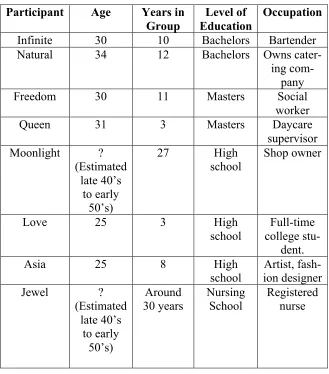
THE PARTICIPANTS... 83
OVERVIEW OF THE FINDINGS ... 90
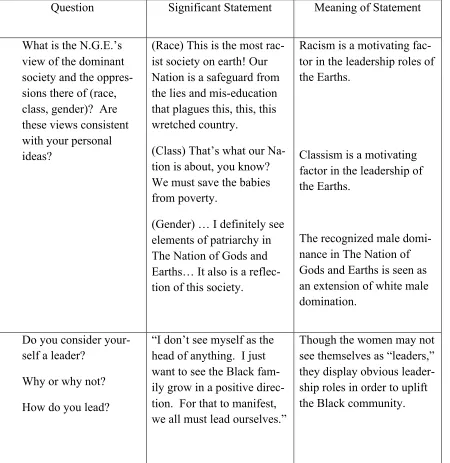
TABLE 1………..99
SUMMARY ... 113
CHAPTER 5: CONCLUSIONS, RECOMMENDATIONS, AND LIMITATIONS…………..………..115
INTRODUCTION………...115
RECOMMENDATIONS ... 131
RESEARCHER’S POSSIBLE LIMITATIONS ... 133
SUMMARY ... 134
EPILOGUE ... 136
SUGGESTIONS FOR PROGRESSION ... 138
BIBLIOGRAPHY ... 143
APPENDIX A………147
APPENDIX B ... 148
APPENDIX C ... 149
CHAPTER 1: INTRODUCTION
There exists a group that has influenced the culture and ideologies of young Black
and Brown people around the world. Much of the semantics and attitudes found within
hip-hop culture came directly from this organization. This group is known as the Nation
of Gods and Earths.1
This group, whose teachings are largely based in the ideology of the Nation of
Is-lam, has been considered both controversial and blasphemous because Father Allah, the
founder of the Nation of Gods and Earths, taught underprivileged Black youth in Harlem
that their nature was divine.2 He taught that every Black man is God, and therefore
su-preme to all in existence. He taught that the sun symbolized God, which is the center of
the solar system. The Black woman is symbolized by the earth, which gives birth to life
and revolves around the sun. Father Allah’s aim was to uplift his students in a time when
Black people were considered inferior.3
Historically, there has been a tendency for scholars and authors who study Black
liberation movements to ignore, belittle, or leave out the positions and perspectives of its
women members due to pervading male dominance.4 Sadly, like most male dominated
1 Wakeel Allah. In the Name of Allah (Atlanta, GA: A-Team Publishing, 2007), 3. 2 Ibid, 137-40.
3 Michael Muhammad Knight, The Five Percenters (Oxford, England: Oneworld
Publica-tions, 2007), xi-xv.
4 Maulana Karenga. Introduction to Black Studies (3rd ed.)(Los Angeles, CA: Sankore
scholarship and literature, writings on Black women in The Nation of Gods and Earths
have followed this same tendency of exclusion and/or de-emphasis.5 The particular
per-spectives and roles of the women in this Nation have mainly been unrevealed. This void
in the literature gives an unfair outlook and perspective on the women in The Nation of
Gods and Earths, who were and are instrumental in the group and its effect on the Black
community.6 This work will focus on the leadership roles of these women from their
per-spective. The study aims to help give voice and agency to a segment of the population
that has not enjoyed equal recognition. It will further the scholarship on Black women’s
leadership, which is essential in understanding and progressing the Black community as a
whole.
Chapter 1 describes the purpose of this study, which was to explore and better
un-derstand the nature of Black women's leadership roles in the Nation of Gods and
Earths.The background of the problem explains the history of The Nation of Gods and
Earths and the research, or lack there of on the women in this group. Chapter 1 also
ex-plains the significance of exploring this topic, which is to add to the body of literature on
Black women’s leadership, the women in the Nation of Gods and Earths, and to give
needed attention to an important part of the Black community. The nature of the study,
which is qualitative, will be discussed. An introduction to the conceptual framework is
also included in this chapter. The chapter ends with a list of definitions important to the
study, the assumptions of the researcher, and the scope, limitation, and delimitations of
the study. A summary of the chapter has also been included.
5 Knight, 215.
6 Eboni Joy Asiatic. “Letters From The Staff of The 14th Degree and Beyond.” The 14th
BACKGROUND OF THE PROBLEM
Because of racism and male dominance in academia and society in general, there
has been a tendency for writers who document Black organizations to ignore or
deem-phasize the leadership roles of Black women. Due to this exclusion, it becomes
neces-sary for the researcher to describe what these roles were.7
The leadership roles of the women in The Nation of Gods and Earths, which
empha-size the communal and holistic progression in leading people, are also overlooked in the
majority of the literature.8 Because the Nation of Gods and Earths is male-centered, the
story of the Earths is rarely heard. In order to properly assess the leadership roles of
these women, research was conducted in order to help give them voice and agency in
both the women’s lives and the academic world.
BACKGROUND OF THE NATION OF GODS AND EARTHS
The History of the Nation of Islam
In order to understand the history of the Nation of Gods and Earths, it is incumbent upon
the researcher to examine the history of its predecessor, The Nation of Islam. If it were
not for the Nation of Islam, the Nation of Gods and Earths would be nonexistent as
Fa-ther Allah, its founder, maintained much of the basic tenants of the Nation of Islam while
forming his own nation. It must be stated that much of the literature on the Nation of
Is-
7 Karenga, 49-50.
8Beloved Allah, “The Greatest Story Never Told,” Glinenation.com,
lam is male centered, as the group is patriarchical in nature.9 The purpose of this section
is to reveal the beginnings of the Nation of Islam, its belief system, and its role in the
creation of the Nation of Gods and Earths.
The beginnings of the Nation of Islam date back to 1930. This was the first year of
the Great Depression, which was a time of hardship and despair for Americans in general,
and Black people in particular.10 Black communities around America were suffering.
Ac-cording to Beloved Allah, in some cities the infant mortality rate was twice as much as
the white infant mortality rate. The Black Death rate often exceeded the white birth rate.
Homelessness, disease, and several other negative factors plagued the Black
commu-nity.11
During this very challenging time, the founder of the Nation of Islam surfaced in
De-troit, Michigan, according to Nation of Islam teachings.12 His name was Master Farad
Muhammad. Though it has been suggested by some writers that Farad Muhammad may
not have existed, for the purposes of this discussion, Farad Muhammad is treated as an
actual historical personage as his existence is the cornerstone of Nation of Islam
cosmol-ogy.13 The date was July 4th, 1930, which is ironically the day that America celebrates its
independence from British rule. This was the first time that Master Farad Muhammad
was said to publicly announce the independence of the Black race. Farad Muhammad was
known as a peddler of items in the poor Black communities in Detroit. He was said to be
9 Knight, 215. 10 Wakeel Allah, 25. 11 Beloved Allah, 1.
12Elijah Muhammad, Message to the Black Man (Atlanta, GA: MEMPS Publishing,
1964), xiv.
very light skinned. In fact, it would later be revealed that Farad Muhammad was indeed
of mixed heritage.14
According to the documented history, Muhammad began spreading his message
of liberation theology by going door to door in Detroit, Michigan, posing as a peddler of
eastern merchandise. He taught his customers that the bible was used to oppress Black
people. He taught that Black people were Muslims and that their true religion was
Is-lam.15 He also taught that white people were the natural enemies of Black people. These
teachings began to attract Black people who felt subjugated by the white supremist
soci-ety. Farad Muhammad began meeting with Black people in their living rooms,
base-ments, and anywhere he could get his message across. He increasingly encouraged
Blacks to reject the white man’s Christianity, as it was this religion, which mentally
en-slaved Black people. According to the literature, Farad Muhammad taught that
Armaged-don, the biblical term for the last battle on Earth, was to occur.16 The battle was to be the
white race against the Black race. Embracing Islam, according to Muhammad, was the
only way in which Blacks could triumph in this final battle.
Of the reported hundreds of people who followed Master Farad Muhammad, one
man surfaced who would later become known as “The Messenger of Allah.” This man
was once known as Elijah Poole. Master Farad Muhammad later gave him the name
Eli-jah Muhammad. While several Black people in Detroit knew Farad Muhammad as “The
14Muhammad, 23.
15 Allah Noor, The Supreme Understanding (Lincoln, NE: Writers Club Press, 2002),
57-8.
16Elijah Muhammad. The Fall of America. (Newport, VA: The National Newport News
Prophet,”Elijah Muhammad would insist that Farad Muhammad was actually “The All-
Wise and Living- God.”17
Elijah Muhammad, whose father was a Baptist preacher,was born in 1897 in
Sandersville, Georgia. Elijah encountered severe racism all his life, being from a poor
southern town in Georgia. Elijah Muhammad was forced to quit school at a very young
age in order to help his family financially.18 As he came of age in segregated Georgia, he
married a woman named Clara Evans who eventually bore him eight children. In order to
obtain a better life for his family, he eventually moved to Detroit Michigan in 1923.
Muhammad worked for several companies for many years, soon realizing that Northern
racism was just as alive as southern racism. When the Great Depression hit Detroit,
Eli-jah Muhammad and his family were strongly affected. Muhammad lost his job and was
unable to find work. It was at this time that his brother, Charlie Poole, introduced him to
a man who would change his life forever. This man was known as Master Farad
Muhammad.
Elijah began attending Master Farad Muhammad’s lectures. Elijah Muhammad
was very impressed by the level of insight and intelligence displayed by Farad
Muhammad. Remembering the biblical verses taught to him by his father at an early age,
Elijah was convinced that Master Farad Muhammad was the coming of “The One” that
the world had been waiting.19 Elijah Muhammad later claimed that Master Farad
17 Ibid, 38-9.
Muhammad was both the Christ returned as taught by the bible and the Mahdi, a savior
figure found in Islamic teachings.20
Farad Muhammad and Elijah Muhammad became extremely close. Farad Muhammad
disclosed secrets to Elijah that he shared with nobody else. He and Farad Muhammad
co-authored a manual called The Secret Ritual of the Nation of Islam.21 This manual was in
question and answer format. This manual is still used today by both The Nation of Islam
and The Nation of Gods and Earths. The manual has been known as “The Lessons” since
its disclosure. They are core to both of the previous organizations mentioned. The
les-sons contain both exoteric and esoteric teachings designed to liberate the minds of Black
people.22 Among these teachings are the ideas that the Black man is divine by nature and
the white man is the devil by nature. The Lessons also gave information on the different
measurements of the Earth, the weight of the Earth, the number of Black people on the
planet, and other scientific figures, which were to give Black people an accurate
percep-tion of their place in the world. Farad Muhammad taught that Black people were of the
Tribe of Shabazz, which was the original Black nation of the planet.23
The two Muhammads began to see membership of the Nation of Islam grow in a rapid
manner, and they decided to add more structure to their organization. They established
“Temples of Islam” and began opening schools called “Universities of Islam.” These
in-dependent Black institutions existed at a time when most Blacks had little ownership of
any significant property. Within the Temple of Islam, there existed two units that would
20 Ibid, 31.
21 Wakeel Allah, 51. 22 Ibid, 51-2.
focus on the gender roles in the group. The group that was exclusively for the men was
called “The Fruit of Islam.” The group that was exclusively for the women was called
“The Muslim Girls Training Class (MGT).”24 Because of the focus of this thesis on
women, the later unit will be briefly touched upon. The MGT instructed women on how
to cook, clean, raise family, and “be civilized” at home and abroad. Women were not
encouraged to be leaders in any way other than in domestic affairs.
Farad and Elijah began traveling, setting up Temples of Islam in Chicago, Illinois and
Milwaukee, Wisconsin. All three of the temples thrived. The police began harassing the
organization, placing Farad Muhammad in jail on several occasions due to trumped up
charges. The police found Farad to be a threat because he was encouraging self-reliance
amongst Black people. Despite the harassing actions of the police department, the Nation
of Islam remained successful. By 1934, The Nation of Islam claimed to have over 25,000
members.25
It took about three years for Farad Muhammad to create a group that was functioning
well enough for him to step back almost completely from active leadership. According to
the literature, Farad began preparing The Nation of Islam for life without him. In June of
1934, Master Farad Muhammad totally disappeared from Detroit, never to resurface in
America again. His disappearance remains a mystery to this day.26
24Five Percent Homepage, (n.d.) “Supreme Mathematics”, Sunsite.edu,
http://sunsite.unc.edu.nge(accessed October 15, 2008)
Things became increasingly difficult for Elijah Muhammad once Master Farad
Muhammad departed. He was forced to relocate to the Temple in Chicago due to threats
on his life by outsiders and those of the group that began to resent Elijah Muhammad.
Though faced with constant danger, Muhammad immediately returned to spreading his
message of Black liberation across America. In the next couple of years Elijah
Muhammad came in contact with an imprisoned convict who would come to be known
by the world as Malcolm X. Before encountering the teachings of Muhammad, Malcolm
X was known as Malcolm Little. At the time, Malcolm X was serving a sentence for
robbery. While Malcolm was incarcerated, his brother began sending Malcolm letters
that told him of Elijah Muhammad’s teachings. The letters encouraged Malcolm to give
up cigarettes and pork, which the Muslims taught was poison. Malcolm’s brother,
Phil-bert, had claimed that he found the true religion of the Black man. Malcolm X began
in-corporating the teachings of the Nation of Islam into his daily prison life. He became
disciplined and took responsibility for his own education by constantly reading and
studying.27 In August of 1952, he was finally released from prison and decided to move
to Detroit to be near his family and the Nation of Islam. Malcolm X was so dedicated
and devoted in his membership to the Nation of Islam that he was promoted to assistant
minister of Temple #1 within one year of his prison release. Malcolm X began spending
the majority of his time recruiting members from the Black community in Detroit.28
27Malcolm X, The Autobiography of Malcolm X (New York, NY: Ballatine
Books, 1964).
Elijah Muhammad was so impressed by Malcolm’s loyalty and work ethic that he
as-signed Malcolm X to establish Temples all along the east coast. Malcolm X had
estab-lished at least five temples in different cities by the year 1954. In June of the same year,
Elijah Muhammad appointed Malcolm X as minister of Temple #7 in Harlem, New York.
The membership began to grow amongst the Muslims. Malcolm X was very charismatic
in speaking to Harlem’s Black population, often successfully challenging the racism of
police and other government officials. It was this expression of strength that drew people
of Harlem like Dora Smith and her husband Clarence Smith, eventually known as Father
Allah.29
The History of Father Allah and The Nation of Gods and Earths.
Father Allah, the founder of the Nation of Gods and Earths, was born as Clarence
Smith on February 22, 1928 in Danville, Virginia. He experienced all the racial prejudice
indicative of a small southern town in the 1930’s and 1940’s. He and his family had
sev-eral incidents with racist whites in the segregated south. The Smith family decided to
move to Harlem, New York due to racial incidents and a need for more financial
secu-rity.30 In Harlem, Clarence Smith took on several odd jobs from selling fruit to shining
shoes. By 1946 and Clarence Smith was becoming known in the pool halls as a “pool
shark.” During his teenage years, Smith developed a love of gambling, which would
be-come a life long habit. Smith had two children by 1951. It was not until he met his wife,
Dora Smith, that he settled down and produced four more children.31
29 Beloved Allah, 1. 30 Ibid, 2.
Clarence Smith joined the armed service in October of 1952, during the Korean
War. Smith was known as a very heroic soldier who put his life on the line in battle
sev-eral times. He received sevsev-eral medals for his acts of bravery in the war. Once he
re-turned to America, he completed his time in the army, which ended in 1960.32
Returning to Harlem, Clarence Smith immediately became aware of important
changes that had taken place during his time in the army. His wife, Dora Smith had
joined Temple #7 and declared herself a Muslim. This temple was led by Malcolm X, the
spokesperson for the Nation of Islam at the time. Smith’s wife invited him to service at
the temple. Clarence Smith was impressed by the discipline and military-like presence of
the Nation of Islam. The captivating speaking of Malcolm X further impressed him.
Clarence Smith was fascinated by the teachings of the Nation of Islam, which
empha-sized that the Black man was divine and the white man was the devil. He was also
im-pressed with the history of the Nation of Islam and its devotion to Black people. 33
Malcolm X was so eloquent in describing the plight of Black people and the need for
practical solutions to Black problems, that Clarence Smith felt compelled to join the
Na-tion of Islam. While attending classes, Smith learned the rules of Islam according to
Eli-jah Muhammad. He learned of the separation philosophy developed by the group. The
Nation of Islam taught that Black people must separate from whites, whose ingrained
ra-cism made them impossible to live with. He learned of the gambling, drug, and diet
re-strictions of the Muslims. He also learned of the theology of the Muslims, which
pro-fessed that Master Farad Muhammad was God and Elijah Muhammad was the messenger
of God.34 After going through the proper initiation steps, Clarence Smith was accepted
into the Nation of Islam. In the Nation of Islam, one is given an “X” to replace one’s last
name. This was done because The Nation of Islam rejected the European names that
were forced upon Blacks during slavery. Because Clarence Smith was the 13th Person
named Clarence to join Temple #7, he was given the name Clarence 13X.35
This induction into the organization presented a major shift in 13X’s life. The Nation
of Islam proved to be more morally strict than the U.S. military. It was a new day for
13X, and he was willing to adhere to the strict rules of Elijah Muhammad. He found
em-ployment as a painter in the organization and became a very active member. The temple
became a secure foundation for Clarence and Dora.
13X moved quickly through the ranks of the Nation of Islam, memorizing the core
lessons of the group while he progressed. In order to be a part of the male unit of the
temple, the Fruit of Islam, 13X was expected to recite long passages of The Lessons at
any time. This internalization of The Lessons was very influential to 13X’s mental
growth. After passing several examinations, 13X became an official member of the Fruit
of Islam. He worked loyally for the Nation of Islam in many capacities, the most
impor-tant being security.36
With the growth of the Nation of Islam, due largely to Malcolm X’s work and
popu-larity, many things began to change. Malcolm X was suspended in 1963 from the Nation
of Islam for comments he made about President John Kennedy’s assassination. Malcolm
34 Wakeel Allah, 70-1. 35 Ibid, 80-2.
X was already being criticized by other members for deemphasizing The Lessons and the
importance of Elijah Muhammad. During this same period, 13X would find himself in
conflict with the Nation of Islam.37
Clarence 13X was eventually expelled from The Nation of Islam just as Malcolm
X was. The reason for his expulsion is up for debate. There are a few theories that exist
on this topic. Some of these theories will be discussed. First, it has been suggested that
13X was expelled for his gambling practices. A second suggestion of why 13X was
ex-pelled was for having parties where drinking and smoking occurred. A third theory is that
13X was expelled because he extended God-hood to all Black men, not just Master Farad
Muhammad. A final theory put forth is that Clarence 13X left because he no longer
wanted to work with Malcolm X, whom many felt was straying from the teachings of the
Nation of Islam. Whatever the case, the fact remains that Clarence 13X separated from
the Nation of Islam in 1963.38
Clarence 13X “hustled” and gambled to make ends meet. It was very difficult to
sur-vive in those days in Harlem. He and a former member of The Nation of Islam named
Justice felt that they were obligated to bring the teachings of the Nation of Islam to the
people of Harlem. 13X never denied these teachings even after he left the Nation of
Is-lam. He felt that all Black people could benefit from The Lessons and began exposing
The Lessons to the adults in the Harlem community. Unfortunately, the adults proved too
set in their ways. They were largely uninterested in what he had to say.39
In1964 Clarence 13X decided to change his name to “Allah.” He did so according to
the Nation of Islam’s teaching that the Black Man was indeed God (Allah in Arabic).
Allah, as he shall be called from now on, decided that he would target the youth. He felt
that the children would be more receptive to his wisdom. Allah believed that the children
were the key in establishing any nation. Allah knew that in order to attract the youth, he
needed to speak a language that would interest them. It was at this time that Allah and
some of his peers created what is known as “Supreme Mathematics” and “Supreme
Al-phabets.” These systems of “understanding the universe” gave “divine” attributes to the
numbers 0-9 and the letters of the alphabet.40 The Supreme Mathematics and an example
of its application will now be illustrated:
0=cipher, 1=knowledge, 2=wisdom 3=understanding, 4=culture freedom, 5=power
re-finement, 6=equality, 7=God, 8= build/destroy, and 9=born.
A Supreme Mathematics equation would look like this:
Knowledge + wisdom = understanding.41
According to the literature, there are several ways of interpreting this type of equation.
For this review, it is not necessary to delve into the particulars of these two systems.42
Allah brought the Supreme Mathematics and Supreme Alphabets, as well as the core
lessons of The Nation of Islam to the poorest parts of Detroit in order to recruit young
40 Ibid, 132-4.
people who society had forgotten and neglected. He chose nine young men known as the
“first born.” These young men were charged with the responsibility of memorizing
Al-lah’s teachings and spreading them to other youth. These youth, who were often
delin-quent and detached from their immediate family, began to call their teacher “Father
Al-lah” as a term of respect and endearment. Allah named to his newly formed group, “The
Five Percenters.” This name derived from one of the core lessons of The Nation of Islam,
which divides the world into three groups of people based on three percentages. The first
group is the 85%, considered to be the dumb, deaf, and blind. These people have no
knowledge of themselves and thus are easily manipulated. The second group is the 10%,
who are “the bloodsuckers of the poor.” These people have enough knowledge to control
the 85% and do so in every capacity. The final group is the 5%, who are “the poor
right-eous teachers.” This group is not misled by the 10% because they have knowledge of
themselves. The 5%’s responsibility is to free the 85% from the 10%’s rule by giving the
85% the proper knowledge of themselves.43 Allah taught his students that they were the
5%, hence the name Five Percenters.44
The role of women in the organization according to Father Allah will now be explored.
First, Allah taught that the Black man was the creator of existence. He likened the Black
man to the sun because, according to Allah, the Black man was the center of his family in
the same way that the sun was the center of the solar system. Allah taught that the Black
woman was likened to the earth in that she gave birth to life and revolved around the
43Farad Muhammad, The Five Percent Homepage. “Lost Found Muslim Lessons Nos. 1
& 2”, Sunsite.edu, http://sunsite.unc.edu.nge (accessed November 20, 2008).
Black man. Thus, Black men were “Gods” and Black women were “Earths.” Though
patriarchical in nature, Allah’s ideology insisted that Black women were “mothers of
civilization” and “Queens.”45 Though Allah recognized the Earths, the literature is often
negligent in giving descriptive accounts of their roles within the organization.
Until Allah was killed on June 12, 1969, he and The Five Percenters were active
participants in the community while spreading their ideology to other boroughs in New
York and eventually to other cities as well. Allah’s entire focus was to “teach the
ba-bies.” He accomplished much in the five years that he led The Five Percenters. Allah
developed a school for his students in Harlem that still exists today. This school is
known as “Allah’s School in Mecca.” Allah also formed a relationship with the mayor,
John Lindsay, and thus involved his students in government programs designed for
youth.46 The Five Percenters were put in summer programs, volunteer workshops, and
they were even enrolled in a program that allowed them to take complimentary plane
rides. All of these accomplishments gave underprivileged boys and girls the chance to
have experiences they never could have imagined. The mayor thought that by reaching
out to Allah, he could better understand the disadvantaged youth of Harlem. The Five
Percenters were accused of being criminals and anti-white. Rather than indulge in these
negative accusations, the mayor soon realized that the work of Father Allah was actually
reforming delinquent youth.47
Allah also introduced gatherings called “Show & Proves” and “Parliaments.” These
gatherings were a chance for the young Five Percenters to socialize and further develop
their memorization and understanding of their teachings. Allah had created a family out
of the young Black people who were often isolated and rejected by society.48
After Allah was shot and killed on June 12, 1969 by an unidentified shooter, the Five
Percenters went through a period of crisis and transition. Allah had tried to prepare his
youth for his eventual passing. He told them that once he was gone, it would only take
his Five Percenters to come together and they would see him. Allah expressed his desire
for The Five Percenters to change their name to “The Nation of Gods and Earths” once he
passed away. His reasoning behind the name change is Allah’s assertion that once he
died, his students would become a full nation. Unfortunately, many of the youth he had
taught Godhood had turned back to drug abuse and crime out of sorrow and a lack of
leadership.49
The Nation of Gods and Earths from Allah’s death until contemporary times.
Though Allah passed and the Nation of Gods and Earths went through a dismal
transi-tional period, the seeds he planted began sprouting in the North Eastern part of the United
States. Initially, the numbers of Gods and Earths attending the gatherings instated by
Al-lah had dwindled. It was not until 1970 that a party was thrown that attracted Gods and
Earths from different areas. This party along with the holding of a well-attended “Show
& Prove” gathering were signs that the Nation of Gods and Earths was being revived.50
From the mid-seventies to the late eighties that the Nation of Gods and Earths began
gaining popularity amongst young people all around the country. They were intrigued
48 Ibid, 36.
with the teachings of Allah. His teachings were a sort of liberation theology for young
People of Color. The youth were attracted to the message of Godhood and the teachings
that white society was inherently evil. Their everyday experiences in a racist society
aligned with Allah’s teachings.
The Nation of Gods and Earths were and are known for their unique teaching
meth-ods. In the eighties, the group gained recognition for their public displays of teaching
their lessons. The young Gods were known for their street savvy and captivating speech.
Often they would form into a circle known as a “cipher.” In this circle, they would
ex-press their knowledge of Allah’s teachings. The Earths were not included in these
ci-phers, as the teachings of Allah did not encourage this.51
This method of sharing knowledge in a cipher attracted many youth. In fact, the
be-ginnings of the Hip-Hop culture, which has now become a global phenomenon, are
largely attributed to the influence of The Nation of Gods and Earths. Hip-Hop culture
was created by Black urban youth in New York during the seventies. “Rap music,” the
musical element of the Hip-Hop culture became the voice of urban Black America. The
same mastery of language and street savvy that was indicative of the Nation of Gods and
Earths was found in the lyrics of rap music.52 Many of the earlier rap performers were
either influenced by the verbal delivery of the Gods and Earths, or were members of the
group itself. Some of these rappers include Rakim, Public Enemy, Lakim Shabazz, and
Just-Ice. It would also be through this art form that the ideology of the Gods and Earths
would be spread worldwide.53
In the nineties, many rap groups were born that claimed membership in the Nation of
Gods and Earths. These artists include Brand Nubian, Digable Planets, Wu-Tang, Poor
Righteous Teachers, and Pete Rock and C.L. Smooth. At this time, we see the emergence
of female artists who also promoted the teachings of Allah. Both Erykah Badu and Lady
Bug of The Digable Planets had been influenced by Allah’s teachings and included them
in their music. These two women were extremely successful and earned popularity
worldwide. The nineties was perhaps the first time that we heard the Earth’s point of
view on a large scale, showing that The Lessons did help to influence and give voice to
some women.
In contemporary times, The Nation of Gods and Earths have changed in some key
ar-eas. The members of the group from the sixties, seventies, and eighties are much older
now. Many of them have children of their own. What once was a nation of young people
has blossomed into a nation of all ages. The older Gods and Earths now find themselves
in a similar position to their Father Allah. They are now the teachers of the youth.54
According to Wakeel Allah, the Nation of Gods and Earths is no longer made up of only
poor and disadvantaged youth. Gods and Earths are found in all walks of life and hold
several different occupational positions. There are even Gods and Earths in the military,
though the group does not encourage enlistment. Because there exists no official roster
of the group, it is hard to calculate the exact number of Gods and Earths in America.
Their membership is no longer limited to the eastern part of the United States. The
Na-tion of Gods and Earths can be found in most of the major cities in the U.S. and even
some smaller cities, According to authors such as Wakeel Allah. There also exist many
grassroots publications that are distributed by the group’s members, which promote the
philosophy of The Nation of Gods and Earths.55
PROBLEM STATEMENT
The women of the Nation of Gods and Earths have been given little focus in the
literature on the group. The leadership positions and perspectives of these women have
been largely ignored by the available literature. The purpose of this study was to explore
and better understand the nature of Black women's leadership roles in the Nation of Gods
and Earths, filling a void in the literature on both the group and the role of the Earths in
the group. The study seeks to get a better understanding the nature of leadership
dis-played by these women, who like women in other Black organizations, have been
deem-phasized.
This thesis is a non-experimental descriptive study.56 Eight women who play
leader-ship roles in the Nation of Gods and Earths were personally interviewed in order to assess
their leadership roles. The women were selected based on whether they see themselves
as playing leadership roles in the organizations. The Earths interviewed were chosen
based on the snowball method.
55 Ibid, 320.
56 William M.K. Trochim and James P. Donnelly, The Research Methods Knowledge
PURPOSE
This thesis argues that the leadership roles of the women in the Nation of Gods
and Earths are consistent with the concepts of both Africana womanism and Black
women’s leadership. However, through an analysis of Earth’s oral testimonies, this
re-search concludes that though racism is the most pervading obstacle faced by Black
peo-ple, The Nation of Gods and Earths must address and reevaluate the sexism that exists
within its doctrine and practice. By doing so, the group can begin to recognize Black
women’s leadership and utilize it more effectively. The Nation should collectively
trans-form its gender inequality, in a way that does not compromise its culture, as a means of
successfully sustaining and strengthening itself and the communities of which it serves.
The primary method utilized in this study, personal interviews, is qualitative in
na-ture.57 The purpose of this study was to explore and better understand the nature of Black
women's leadership roles in the Nation of Gods and Earths. Qualitative methods are the
most appropriate means to collect and analyze this data. Because this study will include
data that is not numerical, quantitative methods have not been incorporated.
The research phenomenon in this study is leadership. The leadership paradigm for
this study is based on the unique aspects and concepts particular to Black women’s
lead-ership. Black women’s leadership tends to be proactive in nature, group-centered, and
makes a linkage between theory and practice. Black women’s leadership utilizes both
traditional and non-traditional methods, which differs from traditional leadership
para-digms that tend to be hierarchical and ego-centered.58
The research design selected for this study is non-experimental. Because there are no
control groups and multiple measures were not used, a non-experimental approach is
most appropriate for this study.59 Eight women who consider themselves leaders within
the group were selected from communities in The United States of America. The method
of interviewing reflects a non-experimental design in the case of this study.
SIGNIFIGANCEOF THE STUDY
This study explains the leadership roles of the women in the Nation of Gods and
Earths from their point of view. This study is significant because it explores little known
territory about these women and their effect in their organization and the Black
commu-nity as a whole. This research is important in that it helps give voice to Black women
who are rarely heard. The results of this study shed light on the significance of the
women in the organization in relation to the group, their families, and their communities.
This thesis will show that the women of the Nation of Gods and Earths play an
instru-mental role in the organization and the communities of which they live, though their
ac-complishments and views have often been neglected or ignored primarily because of
elements of racism and sexism.
58 Melina Reimann Abdullah, “Self-defined Political Leadership Among Black Women:
Proactive Group-centered Activism Beyond The Confines Of Liberal Reform.” (PhD diss., American Political Science Association, 2003), 1, 4-21.
Historically in academia, the study of Black women has been either negligible or
non-existent. Unfortunately, this same exclusion or de-emphasis of Black women can be
found in the field of Black studies as well.60 In studies of organizations such as the
Na-tion of Islam and the Black Panthers, many writers have painted a picture of female
sub-missiveness. This limited viewpoint has been challenged by scholars in the area of Black
Women’s studies, which emerged in response to the inaccurate portrayal of, and missing
literature on Black women in the academy. This study will aide in further illuminating
the roles and accomplishments of Black women in social organizations, helping to fill the
void in the literature concerning women in the Nation of Gods and Earths.
This study can also serve as a tool of agency for Black women currently and in the
future. With more concrete examples of the indispensible part that Black women have
played in maintaining and progressing the Black community, Black females will have
even more examples of the legacy and efficiency of Black women’s leadership.
The research offers suggestions for an active addressing of the gender inequalities
within the organization. It is argued that the ideas and perspectives of the Earths be
rec-ognized and utilized to further the success of the group.
NATURE OF THE STUDY
The qualitative approach selected is phenomenology. Phenomenology allowed
the researcher to find the core meaning of the connective leadership roles of the women
in the group.61 According to Creswell, “…a phenomenological study describes the
mean-ing for several individuals of their lived experience of a concept or phenomenon.”62 The
researcher intended to approach this subject from a subjective viewpoint, meaning from
the viewpoint of the women being studied. Phenomenology entails discovering what is
“reality” from the point of view of the people being studied. Because this research is
in-terested in the leadership roles of the women in the Nation of Gods and Earths, the
method of personal interviews was conducted with eight Earths. The method of personal
interviewing provided the means of ascertaining the perceptions of the subjects in this
research. 63
The purpose of this study was to explore and better understand the nature of Black
women's leadership roles in the Nation of Gods and Earths. Qualitative methods were the
most appropriate means to collect and analyze this data. Because this study included data
that is not numerical, quantitative methods have not been incorporated.
61John Creswell, Qualitative Inquiry & Research Design (Thousand Oaks,
CA: Sage Publications, Inc., 2007), 57-8.
RESEARCH QUESTIONS
This study entailed finding the answers to the following research questions:
1) What principles and practices of the Nation of Gods and Earths appeal to women?
2) How do the Earths conceptualize issues of gender inequality within the Nation of Gods
and Earths?
3) In what ways have racism, classism, and sexism influenced the Earth’s leadership
roles?
4) How do the Earths define, perceive, and demonstrate leadership roles?
These research questions were chosen because they aim to get to the essence of
the participants views on their organization, their leadership roles, and ideas on their lives
in relationship to those roles. Included are questions which seek to reveal the
partici-pants’ attraction to the Nation of Gods and Earths, the aspects of the doctrine that inspire
the participants, their views on various topics concerning the group and larger society,
and their roles as leaders. The questions are used in chapter five as categories of analysis.
DESIGN
The design for this phenomenological study was experimental in nature. A
non-experimental design is appropriate for this study as there is only one group being
re-searched. Unlike experimental designs, there was no random assignment. A
gather and assess exploratory research. Because the women in this study were
inter-viewed in a non-comparative fashion, a non-experimental design was the most
appropri-ate design for this study.64
RESEARCH STATEMENT
The purpose of this study was to explore and better understand the nature of Black
women's leadership roles in the Nation of Gods and Earths. The research on the women
in question has been negligent, as most focus in the literature has been on the men in the
organization. This study sought to put women and their contribution to the organization
and their communities in the proper context.
Many Black organizations formed in the 1960’s have been guilty of putting women in
a secondary position.65 It is possible that the Nation of Gods and Earths, also formed in
the 1960’s, has followed suit in this area.
THEORETICAL FRAMEWORK
Phenomenology and Africana Womanist Thought
As previously stated, this study was approached from a phenomenological
view-point. Phenomenology focuses on several members of a group and describes the
com-monalities of their experiences. A phenomenon is chosen in order to understand the core
importance, or essence of that phenomenon. The two types of phenomenology are
her-meneutical phenomenology and transcendental phenomenology. Herher-meneutical
phe-nomenology focuses more on the perceptions of the researcher. It emphasizes certain
themes and attempts to describe and analyze the data based on those themes.66
The second type of phenomenology, which will be utilized for this research,
tran-scendental phenomenology, focuses on identifying a phenomenon and collecting data
from many people who have that shared experience. The researcher identifies relevant
quotes and makes them themes that describe both what the participants experienced and
how they experienced the phenomenon.67
In choosing the primary framework for this study, the literature on Africana
womanism as presented by Clenora Hudson-Weems, was the most appropriate.
Accord-ing to Hudson-Weems, “Africana womanism” is an ideology created and designed for all
women of African descent. It is grounded in African culture, and therefore, it necessarily
focuses on the unique experiences, struggles, needs, and desires of Africana women.”68
In the tradition of Maria Stewart, modern scholars like Hudson-Weems, Layli
Phillips, and Alice Walker have furthered the research, which highlight the unique
phe-nomena of Black women’s experiences. Hudson-Weems, in particular, distinguishes
Af-ricana womanism from philosophies such as feminism and Black feminism. The primary
distinction between classical feminism, womanism, and Africana womanism, according
to Hudson-Weems, is that though Africana womanism notes the importance of fighting
66 Creswell, 59. 67 Ibid, 59.
68 Clenora Hudson-Weems, Africana Womanism: Reclaiming Ourselves (Troy, MI:
gender oppression, “Africana women and men dismiss the primacy of gender issues in
their reality, and thus dismiss the feminist movement as a viable framework for their
chief concerns.” The primary oppression faced by Black women is that of existing in a
white supremacist society, according to Hudson-Weems.69
Black feminism does recognize the triad of oppression faced by Black women as
racism, classism, and sexism. Black feminists and some womanists see all oppressions as
having equal weight in their effect on Black women’s lives. Conversely, Africana
wom-anism, as presented by Clenora Hudson-Weems, is quite clear in its assertion that racism
is the primary force that suppresses and exploits the Black family and thus, the Black
woman.70 She says, “If our goal in life is to be achieved- that is the survival of our entire
race as a primary concern for African women- it will have to come from African men and
women working together.71
A commonality amongst Womanist scholars is the consensus that traditional
feminism as defined by white women is inappropriate in assessing the lived experiences
of Black women. Historically, white women’s fight for equal rights was one initiated by
upper class women for other upper class white women. According to Hudson-Weems,
poor women and women of color were rarely even considered in the plight for “gender
equality.” Africana womanism continues to have stark differences from traditional
femi-nism, being that black women face a myriad of challenges that are unique to their
reali-ties. Further, Africana womanism tends to be more universal in nature in that it demands
the eradication of all forms of oppressions that affect Black women, not just sexism.72 In
explaining what a womanist is, Layli Phillips says, “A womanist is triply concerned with
herself, other Black women, and the entire Black race, female and male- but also all
hu-manity, showing an ever-expanding and ultimately universal arc of political concern,
em-pathy, and activism.”73 Some elements of Phillips’ womanism were used in this research
as a means of analysis, as several of her concepts on womanism overlap with Africana
Womanism. Again, the main distinction between Africana womanism and Phillips’
womanism is that Africana womanism identifies race as the primary concern for Black
women. Both writers.
DEFINITIONS
The Nation of Gods and Earths- (Also known as The Five Percenters) - An organization
started in the 1960’s by Father Allah. The goal of this group is to give “self knowledge”
to young Black people who are often subjugated by a racist and classist society.74
God- The Black man who has knowledge of self according to the teachings of Father
Al-lah. In The Nation of Gods and Earths, God is often represented by the sun.75
Earth-The Black woman who has knowledge of self according to the teachings of Father
Allah. In The Nation of Gods and Earths, the Black woman is represented by the earth,
which revolves around the sun and gives birth to life.76
72 Ibid, 31-3.
73 Layli Phillips, The Womanist Reader, ed. Layli Phillips (New York: Routledge Tay
lor and Frances Group, 2006), xxiii.
Leadership- The term leadership in this sense is defined by the unique characteristics of
Black women’s leadership. Black women’s leadership tends to be proactive in nature,
group-centered, makes a linkage between theory and practice, and utilizes both traditional
and non-traditional methods. Black women’s leadership differs from traditional
leader-ship paradigms, which tend to be hierarchical and ego-centered.77 According to Abdullah,
“the key difference between these traditional models and the one utilized by Black
women is that where the traditional model includes a component of asymmetry as a
re-quirement for leadership, Black women’s leadership derives its legitimacy from
symmet-rical relationships among movement members.”78
ASSUMPTIONS
One assumption presented by the researcher in this study was that the women
be-ing interviewed would provide honest responses to the questions asked. In any interview,
the possibility that the interviewee will lie, exaggerate, or withhold viable information
exists. A second assumption was that the researcher’s understanding of the answers given
would be concise and unbiased. In interviewing, it is possible to miss important actions
made by the interviewee. There was a possibility that the researcher’s bias or personal
outlook affected the results of interviewing individuals. A third assumption was that the
sample population of eight women was sufficient to ascertain the general perspectives of
the women in the group. A fourth assumption was that the women in this study wanted to
be interviewed, and that the researcher would have access to the proposed population.
SCOPE, LIMITATIONS, AND DELIMITATIONS
The scope of the research in this study was to assess the leadership roles of the
women in the Nation of Gods and Earths based on their point of view. Personal
inter-views were used to ascertain these women’s perspectives. One limitation may have been
that the researcher interviewed more women from one region of the country than another.
For instance, the imbalanced focus on the women in Atlanta may affect the accuracy of
the results, as women in Harlem may have different and more direct experiences with the
Nation of Gods and Earths.
The interview questions posed to the women in this study were both personal and
broad. Therefore, some of the results could be generalized to women in the Nation of
Gods and Earths. The more personal questions presented to the women produced
non-generalized results.
One of the delimitations in the study is that this was not a study of the men in this
organization. Further, this was not a study of Black women in general. This study
SUMMARY
Chapter 1 was an introduction to the study. This study explores the nature of
Black women's leadership roles in the Nation of Gods and Earths. The chapter
intro-duced the problem statement, purpose, significance, and nature of the study. A research
statement, the conceptual framework of Clenora Hudson-Weems, and the definitions of
important terms are also included in chapter 1. The chapter ends with the description of
the assumptions of the researcher and the scope, limitation, and delimitations of the
study. This chapter is meant to give a brief overview of this study. Chapter 2 presents a
CHAPTER 2: REVIEW OF THE LITERATURE
INTRODUCTION
In order to properly research and analyze the leadership roles of the women in the
Nation of Gods and Earths, it was necessary to explore the relevant history,
documenta-tion, and theory that pertain to Black women’s ledership. It was also necessary to review
and assess the seminal works on the Nations of Gods and Earths. This literature review is
divided into four sections. The first explores seminal works on Black Women’s
leader-ship, its aspects, uniqueness, and definition. The second section is a review of the
litera-ture on the history of Black women’s leadership of the club movements, the civil rights
era, and the Black power time period. The third section is an exploration of the seminal
literature on womanism and the chosen framework of this thesis, Africana womanism.
This section reviews the different ideas of womanism and Africana womanism. The
fourth section examines three seminal works on the Nation of Gods and Earths. This
sec-tion reveals the content of the literature and its relasec-tion to the women in the group.
DEFINING BLACKWOMEN’S LEADERSHIP
The purpose of this study was to explore and better understand the nature of Black
women's leadership roles in the Nation of Gods and Earths. The phenomenon of
the Earths in their lives. Some of the core works on Black women and leadership were
explored as to offer an understanding on the key aspects of Black women’s leadership.
According to Melina Reimann Abdullah, self-defined leadership among Black
women is comprised of four key elements: “1) it is proactive in nature, 2) it is
group-centered, 3) it requires a linkage between theory and practice and 4) it utilizes both
tradi-tional and non-traditradi-tional methods.”79 The author insists that traditional leadership
para-digms emphasize the separation of the leader and the led. Conversely, Black women’s
leadership erases the line between leaders and the people. Because of this inclusive
prac-tice in leadership, Black women’s activism is often overlooked. Abdullah insists that,
“For Black women, politics is power and all genres are in some way related and therefore
can be defined as political if one so chooses.”80
The author makes clear distinctions between Black women’s leadership and white
male, white female and Black male-centered leadership, all of which tend to be
hierarchi-cal in nature. Interesting enough, Abdullah claims that the first three forms of leadership
share more similar elements than not. Black women take on a “group-centered” sort of
leadership. According to the author, the issue with other progressive movements and
groups is that they follow a white male paradigm. She states, “The problem with most
feminist and race-based movements has been the desire to achieve the status of the
op-pressor. In essence, such movements are largely reformist rather than revolutionary.
Those that make efforts toward fundamental transformation often limit their analyses of
power systems and activities to empower a single, narrowly defined group as opposed to
working to end oppressions in all its forms.”81
Another unique aspect of Black women’s leadership is its flexibility. Black
women’s leadership embraces both traditional and non-traditional tactics depending on
the circumstance. Hence, Black women can serve in traditional leadership roles such as a
politician, while still incorporating the four elements of Black women’s leadership.82 As
the author points out, “Black women leaders are defined not so much by the titles that
they hold or the public recognition received, but the actual contribution that is made to
the collective.” 83 Traditional (White male) leadership does the opposite -putting titles,
personal gain, and public position over the welfare of those being led. Black women’s
leadership, more often than not, is community based and purposely so.84
Abdullah’s piece is relevant to this research as it gives a broader paradigm of
leadership based on Black women’s particular forms of leadership. This research entails
extracting and accessing Black women’s viewpoints of leadership within the Nation of
Gods and Earths. Abdullah’s four aspects of Black women’s leadership help give this
study an applicable lens through which to the view the phenomenon of leadership.
Allen also challenges classical “Eurocentric notions and meanings of
leader-ship.”85 According to the writer, Black women have been historically placed in
“subordi-nate positions.” Allen argues that Black women had to discover other methods of
leader-ship. Black women’s leadership in America “is a history of collective struggle to
main-
81 Ibid, 21. 82 Ibid, 32. 83 Ibid, 33. 84 Ibid, 35.
85 Beverley Lundy Allen, “A Re-articulation of Black Female Community Leadership:
tain cultural traditions in the black community.”86
Allen gives three areas in which Black women’s leadership exists: 1) “Black
fe-male leadership exemplifies survival techniques in family, church and community
orga-nizations that encompass the creativity and commitment for group well-being.”; 2) black
female networks are dynamic and interrelated entities that form a matrix of
reinforce-ments that hold the black community together while developing leadership for a better
future; and 3) Black female leadership represents the collective experience and action
to-ward community empowerment.”87
Allen insists that many Black women do not embrace the term leader as it has
elitist implications. Unlike traditional ideas of leadership, Black women’s leadership is
not based on concepts of individual power and domination.88 The writer suggests her
own definition of what she calls “Black female community leadership. That definition is,
The struggle for group survival whereby group collective experience, and group socioemotional supports, as well as the instrumental aspects of developing and maintaining internal female networks for institution building, merge to form collective action for cultural maintenance and black community empowerment.89
Allen’s research, like Abdullah’s emphasizes the unique type of leadership that
Black women have exhibited throughout history. Her definition on this unique type of
leadership gives a broader understanding of the variable in this particular research on the
women in the Nation of Gods and Earths. A classical analysis based on traditional
con-cepts of leadership is irrelevant in that they are not based on the values, tactics, and
expe-riences of Black women. This “re-articulation” of the ideas dealing with leadership is
necessary in describing and analyzing the Earths interviewed in this study.90
Rosser-Mims, another writer on the details of Black women’s leadership, claims
that Black women’s leadership emerged from the advent of white supremacy. The
lead-ership roles that have defined Black women’s leadlead-ership include, “serving in
nontradi-tional leadership roles in the church, serving as matriarchs of families, leading their
fami-lies out of poverty, and leading behind the scenes in political and civil rights activist
movements for social change.”91
Rosser-Mims suggests that the goal of Black women’s leadership is to uplift the
entire Black community. The ego-centered ideas of traditional leadership are rejected by
Black women’s leadership’s ideals of collective growth.92Rosser-Mims also criticizes
traditional Black leadership, which tends to be male dominated. The writer says, “Black
women have been silenced because of the cultural expectations of the primacy of racial
solidarity and racial loyalty over gender issues.”93 The writer feels that Black women
have been “demonized” and “ridiculed” for bringing the sexism of Black male leadership
to light. The subordinate roles that Black women are forced to play have caused Black
women to have to take nontraditional means of leading.
Rosser-Mims, Allen, and Abdullah all call for a re-evaluation of both the
phe-nomenon of leadership and the types of leadership roles that Black women have
under-taken. Rosser-Mims includes raising families and behind-the-scenes service as legitimate
90 Ibid, 3.
91 Dionne M. Rosser-Mims, An Exploration Of Black Women’s Political Leadership
De-velopment (Athens, GA., 2005), 12.
forms of leadership. The seminal literature agrees upon the basic tenets of Black
women’s leadership. In this research on the Earths, Abdullah’s description of Black
women’s leadership serves as the primary tool of analysis. Again, the four elements of
Black women’s leadership, according to Abdullah are, “1) it is proactive in nature, 2) it is
group-centered, 3) it requires a linkage between theory and practice and 4) it utilizes both
traditional and non-traditional methods.”94Allen’s descriptions of Black women’s
leader-ship overlap with Abdullah’s in many ways and have also been utilized in this study.
What seems to be missing is further analysis of some of the elements of Black
women’s leadership that have or would exist outside of oppressive forces. In other
words, are there aspects of this type of leadership that would exist amongst Black women
despite white male oppression? The writers fail to link Black women’s leadership to
pre-colonial Africa and the methods of Black women leaders at that time. Though the focus
of the literature and this study are on black women in America, it would be more
reveal-ing to put the topic of Black women’s leadership in context of ancient Africa.
THE HISTORY OF BLACK WOMEN’S LEADERSHIP
In order to put this study in proper context, the history of Black women’s
leader-ship must be noted and analyzed. The works written on the Earths must also be
re-viewed, understood, and put in context. Further, the concept of leadership and the
framework of Africana womanism must be discussed and comprehended as they relate to
this study. The following literature review achieves all of these tasks in order to provide
a thorough literary background in discussing the leadership of the Earths.
Black women’s leadership has historically been a cornerstone of Black
organiza-tions and social movements. This phenomenon can be traced back to the days of
en-slavement and well before that time period. For the purpose of this study, the Black
women’s clubs of the period between 1850 and 1920 will be the first examples of black
women’s leadership reviewed.
In Knupfer’s work, Toward A Tenderer Humanity And A Nobler Womanhood,
the author documents African-American women’s clubs in “turn of the century
Chi-cago.”95 Knupfer analyzes these women’s leadership and activism from a “multilayered”
analytical perspective which includes an examination of social stratification and
commu-nity ethos, but also relies heavily on a Black feminist framework that combines the triple
oppressions experienced by Black women; racism, classism, and sexism. She relies
pri-marily on primary research, as the clubwomen wrote their perspectives on a variety of
topics. Records, speeches, letters, articles, and addresses were obtained and analyzed in
order to give an accurate portrayal of the women in the club movements in Chicago
Illi-nois.96
The author discovered a significant number of women’s clubs in Chicago, totaling
more than 150.97 These clubs, created and led by black women, tackled such issues as
95 Anne Meis Knupfer, Toward A Tenderer Humanity And A Nobler Womanhood (New
York, NY: New York University Press, 1996), 2.