C A S E R E P O R T
Open Access
Twice recurrent gallstone ileus: a case report
Rhys Jones
1*, Daniel Broman
1, Richard Hawkins
2and David Corless
1Abstract
Introduction:Gallstone ileus is a rare cause of bowel obstruction and results from the passage of gallstones into the bowel.
Case presentation:We present the case of an 83-year-old Caucasian woman who had three episodes of gallstone
ileus, each of which was managed with simple enterotomy. This sequence is one of the first reported in the medical literature and may be seen to challenge the traditional surgical approach of enterotomy alone.
Conclusions:The available evidence comparing enterotomy alone with combined enterotomy, cholecystectomy,
and fistula closure in the management of gallstone ileus is reviewed. Neither approach is clearly identified as superior, but available series suggest that simple enterotomy may be safer than a combined approach and does not result in a higher rate of recurrent biliary disease.
Keywords:Recurrent gallstone ileus, enterotomy, fistulectomy
Introduction
Gallstone ileus occurs when gallstones migrate from the gallbladder to the bowel through a cholecysto-enteric fistula, causing a mechanical obstruction. Investigation of suspected cases with abdominal computed tomog-raphy (CT) will generally show gallstones in the bowel lumen with proximal dilatation. Patients are often frail and elderly, and so surgical treatment is generally lim-ited to stone retrieval through an incision in the bowel wall known as an enterotomy [1]. Owing to the risk of recurrent gallstones and associated complications, some surgeons advocate a “one-stage” repair comprising cholecystectomy and fistula closure in addition [2]. We present the case of a patient who had three episodes of gallstone ileus and a review of the evidence comparing these two operative techniques.
Case presentation
An 83-year-old Caucasian woman with rheumatoid arth-ritis and a large hiatus hernia was admitted with a one-day history of severe abdominal pain and vomiting. She was tachycardic, tachypnoeic, and pyrexial. Abdominal examination revealed tenderness and peritonism to her right iliac fossa. Her bowel sounds were diminished.
Serology revealed a white blood cell count of 16.1g/dL, and plain abdominal radiographs revealed no obvious perforation or obstruction. A differential diagnosis of ap-pendicitis and cecal carcinoma was considered, and the decision to operate was made. At laparotomy through a lower midline incision, palpation of the small bowel revealed that a large impacted gallstone in the mid-ileum was causing patchy mesenteric necrosis. There was free fluid in the right iliac fossa but no perforation. A 12cm length of ileum was resected, and a primary stapled anastomosis was performed. The gallbladder was found to be packed with stones. No fistula was identi-fied, but the dissection was limited by dense fibrosis.
After initial signs of recovery, our patient developed worsening abdominal pain on the fourth post-operative day, and abdominal CT was undertaken (Figure 1). The scan revealed a low-grade small bowel obstruction due to a laminated ileal gallstone, a fistula between the gallbladder and duodenum, and a further stone in the gallbladder. After a trial of conservative management, a second laparotomy on day nine revealed a gallstone impaction in the distal small bowel and a contained leak in the original ileal anastomosis. The stone was removed through a transverse enterotomy, and the anastomosis was refashioned with sutures. The inflam-matory mass in the right upper quadrant, with the re-sidual gallbladder stone, was palpable but not disturbed. The post-operative recovery was complicated * Correspondence:[email protected]
1
Department of Surgery, Leighton Hospital, Middlewich Road, Crewe, Cheshire CW1 4QJ, UK
Full list of author information is available at the end of the article
by a Clostridium difficile infection, but our patient returned home to independent living four weeks after the second procedure.
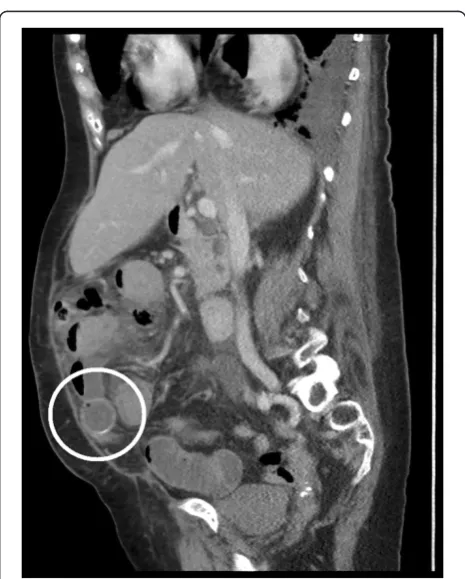
[image:2.595.55.283.83.653.2]Twelve months later, she presented with a further epi-sode of central abdominal pain associated with vomiting and distension. An ultrasound scan revealed a contracted gallbladder with a 10mm common bile duct, and intravenous antibiotics were commenced for a pre-sumed cholecystitis. She failed to settle, and a CT scan revealed free intraperitoneal gas and fluid, a persistent cholecysto-duodenal fistula, and a further gallstone obstructing the small bowel. This gallstone corre-sponded in size and shape to that seen in the gallbladder 12 months earlier (Figure 2). At laparotomy, a limited small bowel resection was performed for perforation proximal to a gallstone obstruction. The stone was removed, and a hand-sewn anastomosis was per-formed. Her post-operative recovery was again compli-cated by a C. difficile infection in addition to a prolonged period of respiratory failure managed with a tracheostomy in critical care. She was discharged to her own home six weeks after surgery and made a good recovery. Two months after discharge, magnetic resonance cholangiopancreatography did not visualize any residual gallbladder stones.
Figure 2Sagittal computed tomography image shows a calculus in the distal small bowel with proximal dilatation.
Figure 1Computed tomography scan performed after the initial laparotomy.(a) Coronal computed tomography image of a cholecysto-duodenal fistula. (b) Coronal computed tomography image of small bowel calculus with proximal dilatation. (c) Axial computed tomography image of an additional calculus in the gallbladder.
Joneset al. Journal of Medical Case Reports2012,6:362 Page 2 of 5
[image:2.595.305.538.413.703.2]Table 1 Comparative studies in the management of gallstone ileus
Enterotomy One-stage repair Comparison Authors Year Follow-up
(range) in months
N Operative mortality
Operative morbidity
Recurrent biliary disease
N Operative mortality
Operative morbidity
Recurrent biliary disease
Operative mortality
Operative morbidity
Recurrent biliary disease
Reisner and Cohen [1] 1994 NR 801 11.7% NR NR (6% RGSI) 113 16.9% NR NR (5.3% RGSI) Favors E (NS) NR NR
Rodriguez-Sanjuanet al. [4] 1997 40 (4–96) 16 18.8% NR 6.3% 9 33.3% NR 22.2% Favors E (NS) NR Favors E (NS) Dokoet al. [8] 2003 0.5 (0–2) 11 9.1% 27.3% NR 18 11.1% 61.1% NR Favors E (NS) Favors E (P = 0.043) NR Tanet al. [9] 2004 24 (8–56) 7 0.0% 57.1% 0.0% 12 0.0% 58.3% 0.0% Equal Favors E (NS) Equal
Eenterotomy,Nnumber,NRnot reported,NSnon-significant,RGSIrecurrent gallstone ileus.
Journal
of
Medical
Case
Reports
2012,
6
:362
Page
3
o
f
5
sereports.com
/content/6/1
Discussion
Gallstone ileus accounts for around 25% of mechanical small bowel obstruction in patients over 65 years of age [3]. A history of biliary symptoms is variable and the ob-struction can be intermittent, and so diagnosis is often delayed. Generally patients are women and often are frail and face a post-operative mortality rate of more than 10% [4].
Operative management is challenging. Simple enterot-omy risks further stones and the potential complications of cholangitis, pancreatitis, and recurrent gallstone ileus. Conversely, cholecystectomy and fistula repair within dense adhesions risk duodenal injury and biliary leak. Both options have an associated mortality in the popula-tion in quespopula-tion.
In the case described, it is unclear whether the stone removed at the second laparotomy was in the gallblad-der or the bowel lumen at the time of the first operation. Twelve months later, the CT images suggest that a fur-ther stone had migrated into the bowel. Our experience demonstrates the importance of inspecting the entirety of the small bowel at the time of the initial laparotomy and illustrates that late recurrence of gallstone ileus, al-beit rare, can occur [5].
To the best of our knowledge, this is only the third reported case of twice recurrent gallstone ileus [6,7]. The recent timing of the two previous reports suggests that the phenomenon is becoming more common, pre-sumably as a result of the increasing age of the popula-tion, and prompted us to revisit the evidence comparing enterotomy alone with the one-stage approach in the initial management of the condition.
To date, the largest review of reported cases of gallstone ileus, which consisted of 1001 cases, was published by Reisner and Cohen in 1994 [1]. The findings are fre-quently quoted, but the work is limited by the heterogen-eity of the reports analyzed. We undertook an electronic literature search to identify all subsequent published com-parisons of enterotomy alone versus one-stage repair in the management of gallstone ileus. The terms “gallstone ileus” and “gallstone obstruction” were inserted into PubMed, reference lists were checked, and Scopus (Scien-ceDirect) was used to identify the citations of key articles. We identified eight comparative studies, of which three comprised at least five patients in each arm. The smaller studies were excluded. Three primary endpoints of opera-tive mortality, operaopera-tive morbidity, and recurrent biliary disease were considered. Operative complications were defined as those preceding discharge from hospital. Recur-rent biliary disease is defined as cholecystitis, choledocho-lithiasis, cholangitis, recurrent gallstone ileus, pancreatitis, or cholangiocarcinoma during follow-up. The findings of the three studies identified, in addition to those of Reisner and Cohen, are presented in Table 1.
In their combined series, Reisner and Cohen [1] pub-lished operative mortality rates of 16.9% for one-stage repair and 11.7% for enterolithotomy (P <0.17). The three more recent series also suggest a non-significant excess in operative mortality following one-stage repair. Where reported, comparison of morbidity between the two procedures appears to favor enterotomy and this finding was statistically significant in the study by Doko
et al. [8]. There are no data comparing one- or two-stage repair with simple enterotomy in the context of re-current gallstone ileus. Interestingly, none of these papers reported an increased frequency of recurrent bil-iary disease at follow-up. They do, however, illustrate two important points: the high levels of comorbidity in this patient group and the increased operating times associated with one-stage repair [8,9].
These studies all describe small, retrospective, non-randomized series without predetermined follow-up. Given the rarity of the presentation, the inconsistency of pre-operative diagnosis, and the frailty of many patients, formal randomized analysis is unlikely to provide a more definitive set of answers in the future.
Conclusions
Gallstone ileus is a surgical emergency affecting a high-risk population. Although there remains no strong evi-dence in favor of enterotomy alone or one-stage repair, the available data suggest that enterotomy is safe and not associated with increased long-term biliary complications.
Consent
Written informed consent was obtained from the patient for publication of this case report and accompanying images. A copy of the written consent is available for re-view by the Editor-in-Chief of this journal.
Abbreviation
CT: Computed tomography.
Competing interests
The authors declare that they have no competing interests.
Authors’contributions
DB collated patient data relevant to the case report. RJ reviewed the medical history, wrote the manuscript, and performed the literature review. RH reviewed the radiology and contributed to the writing of the manuscript. DC contributed to the writing of the manuscript. All authors read and approved the final manuscript.
Author details
1Department of Surgery, Leighton Hospital, Middlewich Road, Crewe,
Cheshire CW1 4QJ, UK.2Department of Radiology, Leighton Hospital, Middlewich Road, Crewe, Cheshire CW1 4QJ, UK.
Received: 27 May 2012 Accepted: 19 September 2012 Published: 24 October 2012
References
1. Reisner RM, Cohen J:Gallstone ileus: a review of 1001 reported cases.
Am Surg1994,60:441–446.
Joneset al. Journal of Medical Case Reports2012,6:362 Page 4 of 5
2. Clavien PA, Richon J, Burgan S, Rohner A:Gallstone ileus.Br J Surg1990, 77:737–742.
3. Day EA, Marks C:Gallstone ileus: review of the literature and presentation of thirty-four new cases.Am J Surg1975,129:552–558.
4. Rodríguez-Sanjuán JC, Casado F, Fernández MJ, Morales DJ, Naranjo A: Cholecystectomy and fistula closure versus enterolithotomy alone in gallstone ileus.Br J Surg1997,84:634–637.
5. Buetow GW, Glaubitz JP, Crampton RS:Recurrent gallstone ileus.
Surgery1963,54:716–724.
6. Hussain Z, Ahmed MS, Alexander DJ, Miller GV, Chintapatla S:Recurrent recurrent gallstone ileus.R Coll Surg Engl2010,92:W4–W6.
7. Vagefi PA, Ferguson CM, Hall JF:Recurrent gallstone ileus: third time is the charm.Arch Surg2008,143:1118–1120.
8. Doko M, Zovak M, Kopljar M, Glavan E, Ljubicic N, Hochstadter H: Comparison of surgical treatments of gallstone ileus: preliminary report.
World J Surg2003,27:400–404.
9. Tan YM, Wong WK, Ooi LL:A comparison of two surgical strategies for the emergency treatment of gallstone ileus.Singapore Med J2004,45:69–72.
doi:10.1186/1752-1947-6-362
Cite this article as:Joneset al.:Twice recurrent gallstone ileus: a case report.Journal of Medical Case Reports20126:362.
Submit your next manuscript to BioMed Central and take full advantage of:
• Convenient online submission
• Thorough peer review
• No space constraints or color figure charges
• Immediate publication on acceptance
• Inclusion in PubMed, CAS, Scopus and Google Scholar
• Research which is freely available for redistribution