Computer Information Systems Dissertations Department of Computer Information Systems
Summer 8-12-2014
Genres of Inquiry in Design Science Research: Applying Search
Genres of Inquiry in Design Science Research: Applying Search
Conference to Contemporary Information Systems Security
Conference to Contemporary Information Systems Security
Theory
Theory
Mala Kaul
Follow this and additional works at: https://scholarworks.gsu.edu/cis_diss
Recommended Citation Recommended Citation
Kaul, Mala, "Genres of Inquiry in Design Science Research: Applying Search Conference to Contemporary Information Systems Security Theory." Dissertation, Georgia State University, 2014.
https://scholarworks.gsu.edu/cis_diss/56
In presenting this dissertation as a partial fulfillment of the requirements for an advanced degree from Georgia State University, I agree that the Library of the University shall make it available for inspection and circulation in accordance with its regulations governing materials of this type. I agree that permission to quote from, to copy from, or publish this dissertation may be granted by the author or, in his/her absence, the professor under whose direction it was written or, in his absence, by the Dean of the Robinson College of Business. Such quoting, copying, or publishing must be solely for the scholarly purposes and does not involve potential financial gain. It is
understood that any copying from or publication of this dissertation which involves potential gain will not be allowed without written permission of the author.
All dissertations deposited in the Georgia State University Library must be used only in accordance with the stipulations prescribed by the author in the preceding statement.
The author of this dissertation is:
Mala Kaul
Department of Computer Information Systems J. Mack Robinson College of Business Georgia State University
35 Broad St. NW, 9th Floor Atlanta, GA 30302
The director of this dissertation is:
Dr. Richard Baskerville
Department of Computer Information Systems J. Mack Robinson College of Business Georgia State University
GENRES OF INQUIRY IN DESIGN-SCIENCE RESEARCH: APPLYING SEARCH CONFERENCE TO CONTEMPORARY INFORMATION SYSTEMS SECURITY THEORY
BY
MALA KAUL
A Dissertation Submitted in Partial Fulfillment of the Requirements for the Degree
Of
Doctor of Philosophy
In the Robinson College of Business
Of
Georgia State University
GEORGIA STATE UNIVERSITY ROBINSON COLLEGE OF BUSINESS
Copyright by Mala Kaul
This dissertation was prepared under the direction of the MALA KAUL Dissertation Committee. It has been approved and accepted by all members of that committee, and it has been accepted in partial fulfillment of the requirements for the degree of Doctoral of Philosophy in Business Administration in the J. Mack Robinson College of Business of Georgia State University.
Richard Phillips, Dean
DISSERTATION COMMITTEE
_________________________________
Chair: Dr. Richard Baskerville, Computer Information Systems, Georgia State University
_________________________________
Dr. Lars Mathiassen, Center for Process Innovation, Georgia State University
_________________________________
Dr. Veda C. Storey, Computer Information Systems, Georgia State University
_________________________________
Genres of Inquiry in Design-Science Research: Applying Search Conference to Contemporary Information Systems Security Theory
BY
Mala Kaul
August 2014
Committee Chair: Dr. Richard Baskerville
Major Academic Unit: Computer Information Systems
This dissertation investigates the core subject of knowledge in design-science research (DSR). In contrast to natural and social sciences that are more explanatory in nature, design-science research is concerned with solving complex practical problems that are ill-defined or of a “wicked” nature. At the same time, as in any research activity, science research is also concerned with the production of knowledge. In the process of design-science research, the researcher must act as both designer and scientist. Design knowledge is distinct from scientific knowledge, however, and must be evaluated against a different set of criteria. Since the DSR process is iterative the scope of DSR knowledge can evolve, abstracting general (nomothetic) knowledge from situated (idiographic) artifacts or, alternately, applying abstract knowledge to situated settings. General knowledge is different from situated knowledge and must be evaluated accordingly.
In the current design-science literature, situated (idiographic) knowledge is associated with design, and abstract (nomothetic) knowledge is associated with science. This dissertation proposes that design can be abstract and that science can be situated in scope. The purpose of the dissertation is to identify the problems with the current conceptualization of contributions in DSR, offer an alternative view of the design-science paradigm as one having multiple genres of inquiry, provide the criteria for framing and evaluating design-science contributions, and describe how this will help address some of the current debate and clarify the current discourse.
The dissertation is structured in three parts. Part I employs a theoretical argument to develop a framework for these genres of inquiry in science research and demonstrates how the evaluation criteria for design-science research studies change as the research moves from one genre to another. Part II is an empirical study that uses a search conference method to apply the bindpoint model (Baskerville and Lee 2013), an explanatory design theory to the problem of information security risk resulting from consumerization and BYOD (bring your own device). Part III reflects on the learning from the theoretical and the practical discourse and provides the contributions and opportunities for future research.
I would like thank Dr. Lars Mathiassen, Dr. Veda Storey and Dr. Merrill Warkentin for serving on my committee and for always being there to help and guide me. I am extremely grateful for the time that they so generously made for me. Their insightful advice and
encouraging feedback were crucial in helping me develop and complete this dissertation. From them I have learned the art and science of scholarship.
I would especially like to extend a heartfelt thank you to my advisor Dr. Baskerville who made this a thought-provoking and rewarding experience. He spent countless hours guiding and advising me and also sharing his keen insights. It was inspiring to watch him “think” and “synthesize” and I greatly appreciate how he nurtured my interest in conceptual work. He was always available to share his advice, even when he was in different parts of the world or sitting at an airport. I would like to thank him for all that he has done from me these past four years. I am so fortunate to have had the opportunity to learn so much from him. His guidance and support were invaluable in my scholarly journey.
I would like to thank the entire faculty in CIS and CEPRIN. I have been so fortunate to learn so much from each one of you. Thank you to Dr. Ramesh for always being there to provide advice and to Dr. Stucke who always had a cheerful smile and a solution to every problem. I reserve a special thank you for Dr. Veda Storey for being not only my committee member but also my colleague, mentor, and friend. To my friends and PhD colleagues, I extend a big thank you for your help and support through these years.
I could not have done this without the support of my family and deeply value their support and patience. A special thank you to my husband Sandeep who provided the
encouragement to get me started and has kept me motivated to seeing this through. The biggest thank you goes to my son Raghav and daughter Ragya, for always supporting me and for
TABLE OF CONTENTS
ACKNOWLEDGEMENTS ... 7
TABLE OF CONTENTS ... 8
LISTOFTABLES ... 11
LISTOFFIGURES ... 12
LISTOFAPPENDICES ... 13
1 INTRODUCTION AND OVERVIEW ... 14
1.1 THEORETICAL DISCOURSE... 15
1.2 PRACTICAL DISCOURSE ... 21
1.3 STRUCTURE OF THE DISSERTATION ... 24
1.4 SUMMARY OF CONTRIBUTIONS ... 27
PART I: THEORETICAL DISCOURSE: GENRES OF INQUIRY IN DESIGN-SCIENCE RESEARCH... 29
2 THEORETICAL BACKGROUND OF DESIGN-SCIENCE RESEARCH ... 30
2.1 DEFINITION OF DESIGN-SCIENCE RESEARCH ... 30
2.2 OUTPUTS OF DESIGN-SCIENCE RESEARCH ... 32
2.3 DISTINGUISHING DESIGN AND SCIENCE IN DESIGN-SCIENCE RESEARCH ... 39
2.4 DISTINGUISHING DESIGN-SCIENCE RESEARCH FROM ROUTINE DESIGN ... 41
2.5 ROLE OF KNOWLEDGE IN DESIGN-SCIENCE RESEARCH ... 42
2.6 RESEARCH TERMS AND CONCEPTS ... 58
2.7 DEFINING “GENRES OF INQUIRY” ... 59
2.8 DUALITIES IN DESIGN-SCIENCE RESEARCH ... 64
3 PLURALISTIC VIEW OF DESIGN-SCIENCE RESEARCH: MULTIPLE GENRES OF INQUIRY ... 74
3.1 GENRE OF INQUIRY 1:NOMOTHETIC DESIGN ... 78
4 TWO ILLUSTRATIVE CASES ... 83
4.1 ILLUSTRATIVE CASE 1: CYBERGATE (ABBASI AND CHEN 2008) ... 83
4.2 ILLUSTRATIVE CASE 2:THE VARIETY ENGINEERING METHOD (ROSENKRANZ AND HOLTEN 2011) ... 89
5 DISCUSSION OF THE THEORETICAL DISCOURSE ... 94
PART II: PRACTICAL DISCOURSE: AN IS SECURITY THEORY ... 102
6 THE BYOD PROBLEM SETTING ... 108
6.1 CONSUMERIZATION AND BYOD ... 108
6.2 IMPACT OF BYOD ... 110
6.3 BLURRING OF PERSONAL AND WORK USE ... 111
6.4 DYNAMICALLY CHANGING TECHNOLOGY; HETEROGENEOUS CONFIGURATIONS ... 112
6.5 DEVICE LOSS ... 113
6.6 LACK OF ORGANIZATIONAL CONTROL/GOVERNANCE ISSUES ... 113
7 THEORETICAL BACKGROUND FOR SECURITY DESIGN THEORY ... 116
7.1 TECHNOLOGICAL AUTONOMY... 116
7.2 EXPERIENTIAL DESIGN ... 117
7.3 INDIVIDUAL INFORMATION SYSTEMS ... 119
7.4 ORGANIZATIONAL INFORMATION INFRASTRUCTURES ... 119
7.5 COMPLEX ADAPTIVE SYSTEMS (CAS) THEORY AND WHY AN INFORMATION INFRASTRUCTURE (II) IS A CAS ... 122
7.6 APPLYING THE CAS THEORY AND THE BINDPOINT THEORY TO THE BYOD CONTEXT... 123
8 EMPIRICAL METHODOLOGY: SEARCH CONFERENCE ... 126
8.1 RESEARCH APPROACH: ENGAGED SCHOLARSHIP ... 126
9 ADAPTATION OF SECURITY THEORY: RE-THEORIZING OF THE BINDPOINT MODEL ... 165
9.1 DEVELOPMENT OF THE DESIGN PRINCIPLES FOR BYODSECURITY ... 165
9.2 DEVELOPMENT OF THE DESIGN RULES FOR BYODSECURITY ... 168
9.3 DESIGN RULES FOR BYODSECURITY ... 171
10 DISCUSSION OF THE PRACTICAL DISCOURSE ... 185
PART III: REFLECTIONS AND LEARNING FROM THE THEORETICAL AND PRACTICAL DISCOURSES ... 190
11 REFLECTIONS ON THE BYOD ANALYSIS USING THE GENRES OF INQUIRY ... 191
11.1 UNPACKING THE DUALITY OF DESIGN-SCIENCE AND NOMOTHETIC–IDIOGRAPHIC RESEARCH... 191
11.2 DESIGN THEORIZING IN THE CONTEXT OF GENRES OF INQUIRY ... 197
11.3 MOVEMENT OF THE DESIGN THEORIZING PROCESS THROUGH THE DIFFERENT GENRES OF INQUIRY ... 204
11.4 EVALUATION OF THE INQUIRY PROCESS IN THE PRACTICAL DISCOURSE AGAINST THE EVALUATION CRITERIA DEVELOPED IN THE THEORETICAL DISCOURSE ... 206
12 LEARNING FROM REFLECTIONS ON THE THEORETICAL AND PRACTICAL DISCOURSE ... 210
12.1 LEARNING FROM REFLECTIONS ON THE THEORETICAL DISCOURSE ... 210
12.2 LEARNING FROM REFLECTIONS ON THE PRACTICAL DISCOURSE ... 218
13 CONCLUSION ... 223
13.1 CONTRIBUTIONS... 223
13.2 LIMITATIONS AND FUTURE RESEARCH ... 226
13.3 SUMMARY ... 227
APPENDICES ... 231
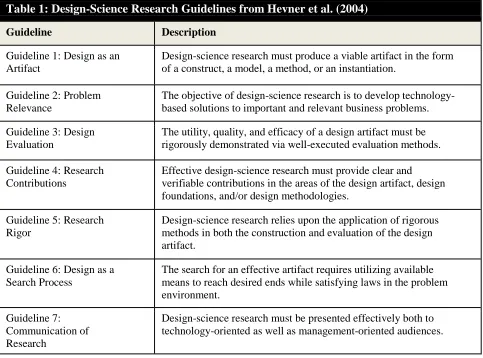
Table 1: Design-Science Research Guidelines from Hevner et al. (2004) ... 49
Table 2: Summary of Key Terms ... 61
Table 3: Four Genres of Inquiry: Nature and Dynamic Criteria for Justification and Evaluation of Design-Science Knowledge ... 77
Table 4: Search Conference Participant Details ... 149
Table 5: Summary of Findings from Problem Discussion ... 158
Table 6: Examples of Design Considerations Emerging from Data ... 163
Table 7: Design Theorizing Components of Bindpoint Model for BYOD Security ... 167
Table 8: Development of Design Rule Set ... 170
Table 9: Abstraction of Knowledge versus Type of Knowledge ... 196
Genres of Inquiry in Design-Science Research
LIST OF FIGURES
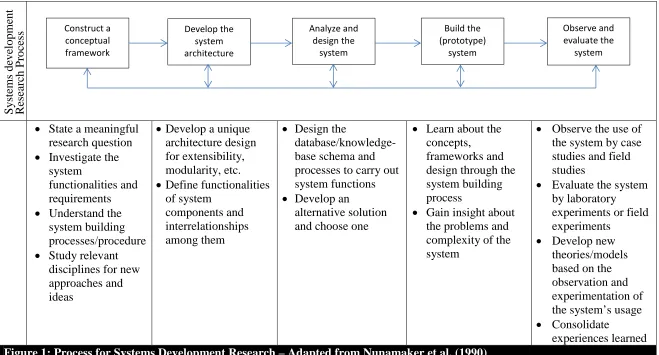
Figure 1: Process for Systems Development Research – Adapted from Nunamaker et al.
(1990) ... 44
Figure 2: Information Systems Design Theory from Walls et al. (1992) ... 46
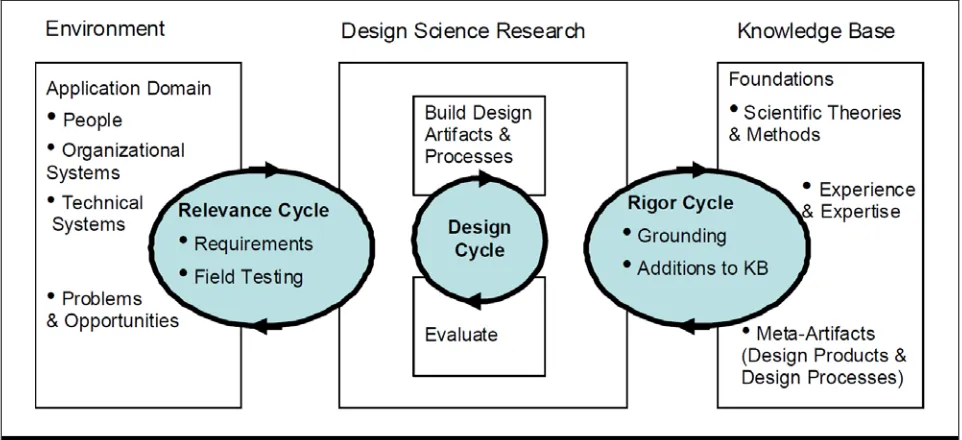
Figure 3: Three CycleView of Design-Science Research from Hevner (2007) ... 48
Figure 4: General Design Cycle from Vaishnavi and Kuechler (2007) ... 51
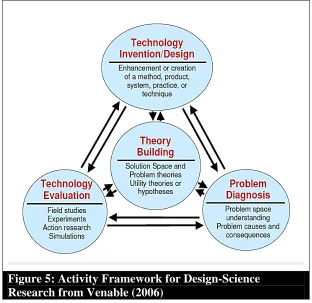
Figure 5: Activity Framework for Design-Science Research from Venable (2006) ... 54
Figure 6: Design-Science Research Methodology from Peffers et al. (2007) ... 55
Figure 7: Explanatory Design Theory from Baskerville and Pries-Heje (2010) ... 57
Figure 8: Action Design Research (ADR Method) from Sein et al. (2011) ... 58
Figure 9: Distinguishing Four Genres of Inquiry in Design-Science Research ... 74
Figure 10: Knowledge Moments in the CyberGate Study by Abbasi and Chen (2008) ... 88
Figure 11: Knowledge Moments in the VEM Study by Rosenkranz and Holten (2011) ... 93
Figure 12 : General Framework for Applying the Search Conference Method ... 141
Figure 13: The Three Domain Experts for BYOD Security ... 146
Figure 14: Model of Acceptable Security from Du and Zhan (2002) ... 174
Figure 15: Bindpoint Model of Acceptable Security – Adapted from Du and Zhan (2002) 174 Figure 16: The BYOD Design Theorizing Process Mapped to the Genres-of-Inquiry Matrix ... 204
Genres of Inquiry in Design-Science Research
LIST OF APPENDICES
Appendix A: Historical Background of Search Conferences from Leith (2004) ... 231
Appendix B: Search Conference Planning Considerations ... 232
Appendix C: Sample Search Conference Brochure ... 237
Appendix D: Sample Flip Chart Images from the Search Conference ... 239
Appendix E: Selected Representative Quotes from the Search Conference ... 240
1 INTRODUCTION AND OVERVIEW
Design-science research is increasingly being acknowledged as an important research
paradigm in Information Systems research. This recognition is supported by significant efforts
to establish the methodological and theoretical grounding for the appropriate conduct and
articulation of such research. However, despite these efforts, there is still limited consensus on
what constitutes a good contribution in design-science research. The realm of design focuses on
the artifact as the contribution, whereas the realm of science favors design theory. Current
design-science thinking assigns primacy to either the artifact or to theory, to design or to science.
Knowledge is marginalized in this presentation. This dissertation offers an alternate viewpoint
by focusing on the primacy of the knowledge contribution of design-science research. The
purpose of the dissertation is to show how the contribution of design-science research is clarified
by centering on knowledge.
This dissertation shows that different forms of knowledge emerge throughout the life
cycle of a design-science project and derive a framework that describes the characteristics of
these different types of knowledge that are the output of design-science studies. These different
kinds of knowledge accompany different goals and boundaries and must therefore be evaluated
according to different criteria. Therefore, the dissertation also develops evaluation criteria to
address the different viewpoints on knowledge contributions of design-science research. By
offering a pluralistic framework for approaching the conduct, articulation, and evaluation of
Section 1.1, “Theoretical Discourse,” provides the motivation and rationale for
employing this pluralistic view of design-science research in order to better position and evaluate
such research efforts. Based on this motivation, the overall research objective is described.
Section 1.2, “Practical Discourse,” provides a description of the business problem. Section 1.3
provides a structure of the dissertation and, finally, Section 1.4 provides a summary of the key
contributions and why they are important.
1.1 Theoretical Discourse
Design-science research is an approach for conducting research in Information Systems.
Over the past few years, the focus in IS moved from its technological origins in information
technology (IT) to the managerial and social aspects that recognized a more systemic view.
Coinciding with the call to return to the IT artifact (Orlikowski and Iacono 2001) and the call for
professional relevance of IS research (Benbasat and Zmud 2003; Hirschheim and Klein 2003),
there has been momentum in IS research toward recognizing and formalizing design-science
research as an alternative to behavioral or social science research (Hevner and Chatterjee 2010;
Vaishnavi and Kuechler 2004). Significant efforts have been made to establish the foundations
of design-science as a research paradigm (Hovorka 2010; Iivari 2007) and to clarify its
epistemological positioning (Goldkuhl 2012; Gregor and Hevner 2011; Niehaves et al. 2012).
There has also been much scholarly activity (and debate) around defining design-science
research characteristics, design methodologies, design theorizing, proposing evaluation criteria
(Hevner et al. 2004; Pries-Heje et al. 2008), and articulating its knowledge outcomes (Gregor
Despite these efforts in formalizing its epistemological and methodological base,
design-science research has yet to make a substantial impact within IS research as attested by the limited
number of publications in IS journals. As an example, “the total number of design-science
publications in MISQ since 2006 accounts for less than 5 percent of the total publications in the
journal” (Goes 2014, p. iv). Gregor et al. (2013) contend that “[d]esign-science research has yet
to attain its full potential impact on the development and use of Information Systems due to gaps
in the understanding and application of design-science research concepts and methods” (p. 337).
As publication rates edge up cautiously, design-science scholars continue to discuss the lack of
clarity around what constitutes a good design-science research contribution. The design view
favors the development of an artifact, while the science view favors the development of abstract
knowledge. Gregor and Hevner (2013) refer to the design-theory camp (Gregor and Jones 2007;
Markus et al. 2002; Walls et al. 1992; Walls et al. 2004) and the pragmatic-design camp (Hevner
et al. 2004; March and Smith 1995; Nunamaker Jr and Chen 1990), with the two camps placing
comparatively more emphasis on design theory or artifacts, respectively, as research
contributions.
The tension between design and science within this paradigm is most apparent in efforts
to articulate and analyze the role of theory and its use and development throughout the various
stages of design-science research studies (e.g., Goldkuhl 2004; Gregor and Jones 2007;
Pries-Heje et al. 2008; Vaishnavi and Kuechler Jr 2007; Walls et al. 1992). Much debate remains
around whether, in addition to artifacts, a theoretical contribution is central to, or even necessary,
in design-science research studies (e.g., Baskerville et al. 2010; Gregor and Hevner 2013; Österle
et al. 2010). Echoing the supposed contradiction between design and science, this debate
design solution as presented by the artifact and the contrasting creation of abstract knowledge
(Goldkuhl 2012; Gregor and Hevner 2013).
Design-science research has a dual mandate – the utilization and application of
knowledge (and theory) for the creation of novel or innovative artifacts that engender change or
improvement in existing situations or problem spaces and the generation of new knowledge.
This is accomplished by the ability of design-science research to produce knowledge and change
(Simon 1996). The process of design-science research is iterative and incremental. Therefore, knowledge production and artifact generation, while concomitant, may not necessarily be
synchronous. Knowledge building may occur through reuse of past artifacts, creation of new
ones, reflection about the design process or about the artifact, or even in design instruction
(Cross 1982), thus resulting in different types of knowledge creation. The concept of reflection
has been articulated by Schön (1983) and Mathiassen (1998). In design-science research, such
knowledge-in-action emerges through the study of designs and design processes (Mathiassen and
Purao 2002; Purao et al. 2008). The artifacts generated can take several forms, such as
constructs, models, methods and instantiations (March and Smith 1995), technological rules,
design principles (Markus et al. 2002; Sein et al. 2011), and design theories (Gregor and Jones
2007; Walls et al. 1992).
The differing positions in design-science research arise for a number of reasons. First,
there is a difference in the goals of design versus the goals of science (Gregor and Hevner 2013).
Design is generally associated with the construction or instantiation of an artifact or more
specific/idiographic knowledge, while science is usually associated with the theoretical aspect of
the research or the more generalizable/nomothetic form of knowledge. Second, design is
the term design can be used either as a noun, indicating an artifact or product view, or as a verb,
indicating more of a process view. Therefore, deriving an understanding from a design-science
study will be based on what the knowledge is, that is, what is being acquired – is it knowledge
represented by the artifact, does it pertain to learning from the process of designing the artifact,
or does the knowledge relate to how the artifact interacts with the environment that it is placed
in? This ambiguity is compounded by the complex and iterative nature of the design process.
Moreover, since design-science is a research lens and not a specific method, the inquiry process
could have a number of different entry points into research and follow a number of potentially
different paths (Peffers et al. 2007).
The differences between the goals of design and science are expressed in terms of utility
and truth. For example, design centers on the creative and experiential knowledge of the
designer, the key to which is utility, whereas science centers on efforts to produce rigorous,
justifiable knowledge, the key to which is truth. The focus of design uses knowledge to create a
new world, whereas the focus of science is to study the world to create new knowledge
(Verkerke et al. 2013). Such apparent contradictions seem to shape the essence of this newer
research paradigm, developing research that makes meaningful design and science contributions
in a way that is beyond just the “science of design” or “designing with science.” It involves
creating knowledge through the analysis of a given design problem, synthesis of solutions based
on this analysis, and evaluation of the solution.
While the design of novel artifacts is considered more valuable by some (Hevner et al.
2004; March and Smith 1995), for others, science is more important because it yields valuable
theories (Gregor and Jones 2007; Walls et al. 1992). There is yet another viewpoint (that of
importance of design theories but does not insist on a kernel theory-based grounding of design
theories (Fischer et al. 2010). In analyzing the respective contributions valued by the
design-oriented view and the science-design-oriented view, it would appear that the more abstract the form of
knowledge contribution, the more scientific it is considered, while the more specific the
knowledge contributions, the more it corresponds to the design view. Yet, design is inherently
abstract, although it is true that a particular instantiation of a design may be very specific.
Similarly, scientific knowledge can be more or less abstract. Both perspectives in this lingering
dispute assume that one of these definitive views of a design-science research paradigm will
prevail.
There is a general association of design with relevance and science with rigor. In the
design-science research literature, design is generally associated with the building and evaluation
of the artifacts that provide relevance, while science is generally associated with the theorizing
aspects of design-science and reflective of rigor (Hevner 2007; Hevner et al. 2004). The tension
between design and science becomes pronounced due to this dual nature of design-science
research. Yet design, though inherently creative, can be conducted rigorously. Similar tensions
between engineering design and a more creative user-centered design have been found in the
human–computer interaction (HCI/CHI) community, where it has been demonstrated that
creative design can be pursued rigorously (Wolf et al. 2006). Although design-science is used in
fields such as education, human–computer interaction, and engineering design, the theoretical
discussion in this dissertation is restricted to design-science research in Information Systems.
This research argues that seeking to resolve the design-science debate by giving primacy
to any one aspect of design-science research, be it design or science, will not resolve the
design-science research can result in building knowledge from the interaction of the design and design-science
processes. Moreover, the focus on the knowledge process will also address a third form of
tension in design-science research – the design product versus the design process debate. The
focus on knowledge will yield clarity in terms of knowledge goals, since knowledge is inherent
in the designed product, the design process, and in the critical reflection of the process of
designing the product (artifact). For example, the product viewpoint sometimes conflates the
artifact with design and the theory with science (Fischer et al. 2010). By focusing instead on the
knowledge processes of design-science studies, the research shows how the artifact is
intertwined with both science and design and how the theories are also intertwined with both
design and science.
In order to address the above identified sources of tension in design-science research, this
research advances an alternate viewpoint to the current conceptualization of design-science
research. Design-science research is primarily a research lens, and the ultimate objective of
research is knowledge. By unpacking the design aspect from the science aspect of
design-science research, it is possible to find that design can be abstract or specific, and similarly,
science can also be abstract or specific. Given the iterative nature of the design-science research
process, it is possible that the research process at a particular moment can be more focused on
the design process, and at another moment, it can be more focused on the science process;
similarly, at one moment the research process could be focused on developing abstract
knowledge, and at another moment, it could be developing more situated or specific knowledge.
This conceptualization presents design-science research as a multifaceted paradigm in which the
knowledge in artifacts and theories can develop and benefit from their dependence on each other.
1.2 Practical Discourse
In today’s business environment, connectivity is a key commodity for all business people
regardless of their level in the enterprise. In order to stay connected, many individuals use their
own mobile devices such as phones, tablets, or laptops in business settings. This phenomenon,
known as BYOD (bring your own device), has been aided by the increasing availability of
high-performance devices, connectivity to the Internet, and productivity tools. BYOD has significant
benefits for both individuals and their employers (Lee et al. 2013). Research from Dell estimates
that BYOD can extend workplace flexibility and add as many as 460 productivity hours a year
for each mobile employee by enabling ubiquitous access to the enterprise systems and data.1
BYOD usage by employees varies from 40 percent to 75 percent, depending on the region and
industry.2 According to Washington-based market research firm Osterman Research, there are
now nearly twice as many personally owned iPhones, iPads, and Android devices that are
brought into the workplace by individuals than corporate-issued counterparts.3
Although BYOD is a widespread phenomenon, it has many associated risks. If the
enterprise opens up its systems without due precautions, it becomes vulnerable to the risk of data
loss and other exposures of its IT systems. Lost or stolen devices create a key concern for data
security. Individuals and organizations are also concerned about the impact of BYOD on
personal privacy and organizational confidentiality (Lee et al. 2013). This balance between
security and privacy is a key challenge that needs to be addressed within the overall BYOD
policy structure (Lee et al. 2013; Smith et al. 2011). Given the extent of the problem and its
1
http://www.telegraph.co.uk/technology/mobile-phones/9646349/Smartphones-and-tablets-add-two-hours-to-the-working-day.html, accessed August 7, 2014.
2 Ibid.
3 http://docs.media.bitpipe.com/io_10x/io_106764/item_609873/
rapidly advancing pace, it is essential that strong fundamental principles be developed for BYOD
security management, since these are needed to provide a bedrock for the overall security policy
and infrastructure of the organization.
This research aims to speak to this challenge by providing a basis for the overall security
framework that will address the security challenges that organizations face due to complexities
created by BYOD. In design-science research, the process of design theorizing involves
mapping the design problem to one or more design solutions and arriving at an optimal solution
to manage the problem. The research problem confronting us is the necessity to conduct design
theorizing in the highly complex sociotechnical environment pertaining to BYOD. The specific
objective of the design theorizing activity in this research is to address the organizational
adaptation of its information infrastructure to be able to securely interact with individually
provided Information Systems.
Generally, in organizational settings, security is implemented in the Information Systems
by confining the behavior of the system using well-formed security controls that guide the
functioning of the system in a predictable manner (Baskerville 1992). However, in the
contemporary technological landscape, the environment is complex and fast changing.
Therefore, there must be an alternate method to predictable security controls. A recent design
theoretic explanation for addressing security in complex and dynamic environments provided by
Baskerville and Lee (2013) proposes the use of a bindpoint model that computes the BYOD risk
instead of using predictable security controls. Through an illustrative case, Baskerville and Lee
suggest that this theory could be applied in a BYOD scenario. While this design theory provides
a persuasive argument, testing it empirically will not only enable evaluation of the theory but
propose a design theory to address the dynamic complexity in shared, open, heterogeneous and
evolving socio-technical systems of information infrastructures (IIs) and “illustrate their design
principles by analyzing the history of Internet exegesis” (p. 1). Although this theory is
promising due to its focus on the shared and evolving Information Systems, the theory has yet to
be evaluated empirically to investigate whether it can be applied to the BYOD context. Using a
design theorizing approach (Baskerville and Pries-Heje 2010; Walls et al. 1992), this research
applies the bindpoint model and the infrastructural components of the complex adaptive system
theory to derive design principles for the design of secure BYOD systems.
Current Organizational Information Systems interacting with individually furnished
devices and systems are complex adaptive systems. The CAS theory (Hanseth and Lyytinen
2010; Holland 1995) provides a theoretical framing device (kernel theory), to apply (and
develop) the bindpoint model (Baskerville and Lee 2013) for designing robust and secure
information infrastructures that can address the security issues arising from BYOD. The CAS
theory helps to apply adaptive thinking, while the bindpoint design theory helps to view each
component (within an information infrastructure) in a simple way that interacts with another
component within the larger information infrastructure.
In terms of the problem domain, the research scope is limited to extending a
general-purpose solution to address the problem of BYOD security. Therefore, there is a certain level of
abstraction to the design solution evaluated and refined in this dissertation. The practical
discourse provides an evaluated general framework, a set of design principles, and
accompanying rules for application in BYOD security settings. In this case, the term “general”
is used in a definition similar to van Aken’s (2004) “technological rule,” which he defines as “a
performance in a certain field of application”(p. 24). He adds that the term “general” “means
that it is not a specific solution for a specific situation, but a general solution for a type of
problem” (p. 24). The set of solutions that this dissertation presents is at a level of abstraction
that makes it “transferable.” The design-science research in this dissertation does not attempt to
produce an instantiation of a BYOD security system. That task is reserved for future research.
The dissertation focuses on BYOD security as one result of consumerization on the
organization. Other aspects of consumerization, such as cloud computing, are not the focus of
this research. There are other aspects of importance in designing organizational information
infrastructures (such as improved usability, hedonic attributes, and others) that are not examined
in this dissertation, since the research focus is on security design only.
1.3 Structure of the Dissertation
Part I of the dissertation is conceptual. It comprises the theoretical discourse and offers a
pluralistic viewpoint of the design-science research paradigm that enables a more nuanced
treatment of design-science research studies as they proceed through iterations of development.
This part introduces the terminology and the concepts that help identify and analyze the goals
and scope of the knowledge processes in design-science research. This analysis yields two
dualities that aid in understanding the differing ways in which the knowledge claims of
design-science studies can be justified and evaluated. These two dualities lead to four distinctly
different styles of approaching the process of inquiry in design-science research. These four
styles help to explain the interoperation of differing knowledge processes and goals present in
design-science studies. The presence of multiple styles of knowledge is illustrated with two
examples of design-science research studies. These examples demonstrate how different paths to
these different paths lead to different kinds of knowledge contributions. Further, these examples
illustrate how the criteria for justifying and evaluating the knowledge in design-science can
change as the study processes evolve, and they elucidate the application of the relevant
evaluation guidelines for the different forms of knowledge contributions.
Part I is structured as follows. First, a review of the literature in Chapter 2 provides a
background of current perspectives on design and scientific contributions and the role of
knowledge in design-science research. This is followed by Chapter 3, which develops the
discourse offering an alternate, multigenre viewpoint for framing design-science contributions.
This chapter then describes the development of the multigenre framework and articulates the
evaluation guidelines for each of the genres. Chapter 4 illustrates the application of the
multigenre framework using two exemplar design-science research studies. Finally, Chapter 5
concludes Part I with a discussion of learning from the theoretical discourse, the contributions to
research and practice, and related limitations and implications.
Part II is an empirical study that uses a design-science research lens to determine a
solution for the problem of organizational information security risk management resulting from
the phenomenon of consumerization and BYOD (bring your own device). A research
methodology called “search conference” is applied to evaluate and extend a design theory in the
context of information security risks arising due to consumerization and the BYOD
phenomenon. This section has three functions: 1) to report the results of the research study on
BYOD security; 2) to provide a demonstration of design theorizing; and 3) to apply an
established future-oriented, participative, strategizing technique called search conference for the
purpose of design theorizing and to demonstrate how search conferences can be used for
Part II is structured as follows. First, the BYOD landscape and the problem setting are
described in Chapter 6. Chapter 7 provides a review of the literature and the theoretical framing
that will guide the development of design theory for BYOD security. Following this, Chapter 8
describes the research approach and provides a detailed review of the search conference
methodology, its main use in participative strategizing, and its adaptation for design theorizing.
Chapter 9 describes the employment of search conference for adapting an existing design theory
for BYOD, along with the conduct of the search conference and its findings. Chapter 10 wraps
up the practical discourse with a discussion of learning from this study, the contributions of the
empirical study to practice and theory, and related limitations and implications.
Part III provides a discussion on the learning from Parts I and II, describes the key
contributions of this research, illustrates its theoretical and practical implications, and outlines
the path for future research. This section is structured as follows. Chapter 11 describes the
knowledge goals that the theoretical discourse seeks to advance. It examines how the multigenre
framework proposed in Part I of the study extends the current thinking in design-science
methodology and its implications specifically for the evaluation and justification of knowledge.
Then it examines the development of design theorizing using an empirical study in Part II. It
relates the findings of the empirical study conducted in Part II in the context of the multigenre
framework developed in Part I and shows how different forms of knowledge goals require
different forms of evaluation. Chapter 12 discusses what was learned from the reflections on
both the theoretical discourse and the practical discourse. Chapter 13 concludes the dissertation
by summarizing the contributions of this research and describing potential future research on this
1.4 Summary of Contributions
This dissertation contributes to the ongoing discussion in the area of design-science research
methodology and design theorizing by offering empirical and theoretical evidence in support of a
multigenre perspective of design-science research. The dissertation relates to both research and
practice and therefore combines a theoretical discourse with a practical discourse. Part I
advances a multidimensional lens for design-science research inquiry with the objective of
providing clarity on the different type of knowledge that can be created during the design-science
research process. Consequently, different evaluation criteria are needed to validate different
kinds of knowledge production. Design-science is “fundamentally a problem-solving paradigm”
(Hevner et al. 2004, p. 76). It is therefore appropriate for engaged research practices where the
“researcher actively pursues the solving of pertinent and practical problems in a local context.”
Part II of the dissertation applies design-science research for the evaluation of a design
theory in a practical setting with the aim of solving a particularly complex problem of
information security in the BYOD context. The resulting contribution of this study is as follows:
First, the research provides empirical evidence to demonstrate how to develop a method to
address BYOD security. The bindpoint model is evaluated and refined to derive design
principles for addressing BYOD security. For these principles, a set of design rules is provided
for designing information security systems for BYOD security. These rules may be of
considerable interest to practitioners as a tool to help streamline inter-organizational processes
and to design secure Information Systems in dynamic contexts such as BYOD. Second, a
framework for examining BYOD in future research is offered. This framework would assist
model for using search conferences is provided. This framework may serve as a template for
similar initiatives in other Information Systems research contexts.
Finally, in terms of contribution to the design-science research knowledge-base, the
practical discourse in Part II of this dissertation demonstrates how a design-science research
project can move through different genres of inquiry resulting in different types of knowledge.
Thus, it provides an empirical example of the conceptual framework that is developed in Part I.
Overall, the theoretical and practical parts of the dissertation provide the development of
a conceptual frame and accompanying evaluation criteria followed by an empirical case
regarding IS security, which illustrates the application of the framework and the criteria. It is
intended that collectively, Parts I and II will be useful in addressing the debate around the design
and science aspects of design-science research, provide a useful solution for a contemporary
security issue, and demonstrate the novel use of the search conference, thus contributing to both
research and practice. Part III synthesizes what has been learned from Parts I and II by analyzing
the practical discourse on BYOD in terms of the theoretical discourse on genres of inquiry. This
section also reflects on what has been learned in the practical and theoretical discourse and
Kaul | Dissertation | PART I: THEORETICAL DISCOURSE: GENRES OF INQUIRY IN
DESIGN-SCIENCE RESEARCH 29
P
ARTI:
T
HEORETICALD
ISCOURSE:
G
ENRES OFI
NQUIRY IND
ESIGNKaul | Dissertation | THEORETICAL BACKGROUND OF DESIGN-SCIENCE RESEARCH 30
2 THEORETICAL BACKGROUND OF DESIGN-SCIENCE RESEARCH
This chapter examines how design-science research has been defined in the literature while
paying specific attention to the descriptions of the design, science, and knowledge aspects of
design-science research. It also describes the best-known design-science methodology
frameworks and summarizes the seminal views on design theorizing.
2.1 Definition of Design-Science Research
The origins of the Information Systems design-science research tradition can be traced to
Simon’s The Sciences of the Artificial (1996). Simon defined design as the process by which
designers “[devise] courses of action aimed at changing existing situations into preferred ones”;
he distinguished it from “natural sciences and social sciences, [which] try to understand reality,
[whereas] design-science attempts to create things that serve human purposes” (p. 55).
In recent years, design-science research has become prominent in Information Systems
research and has garnered a paradigmatic status. Simon’s definition of design-science has been
described as “the process of exploration through design in order 1) to explore new solution
alternatives to solve problems, 2) to explain this explorative process, and 3) to improve the
problem-solving process” (Holmström et al. 2009). Design-science research is a “lens,” or set of
synthetic and analytic techniques and perspectives, for conducting Information Systems research
(Vaishnavi and Kuechler 2004). “Design-science research involves the creation of new
knowledge through design of novel or innovative artifacts (things or processes that have, or can
have, material existence) and analysis of the use and/or performance of such artifacts along with
reflection and abstraction – to improve and understand the behavior of aspects of Information
Kaul | Dissertation | THEORETICAL BACKGROUND OF DESIGN-SCIENCE RESEARCH 31
paradigm seeks to extend the boundaries of human and organizational capabilities by creating
new and innovative artifacts, including constructs, models, methods, and instantiations” (p. 75).
Mathiassen and Nielsen (2008) define design-science in terms of relevance to practitioners as
follows: Design research is focused on “designing various forms of artefacts with the purpose of
supporting stakeholders engaged in IS practices” (p. 6).
Iivari and Venable (2009) define design-science research “as a research activity that
invents or builds new, innovative artifacts for solving problems or achieving improvements, that
is, design-science research creates new means for achieving some general (unsituated) goal, as
its major research contributions. Such new and innovative artifacts create new reality, rather
than explaining existing reality or helping to make sense of it” (p. 4). According to Hevner and
Chatterjee (2010), design-science research can be defined as: “a thing or process by which a
designer answers questions relevant to human problems, thereby contributing new knowledge to
add to the body of scientific evidence and new knowledge creation. The artifact is both useful
and fundamental in understanding that problem” (p. 5). Venable and Baskerville (2012) define
design-science as “research that invents a new purposeful artefact to address a generalized type
of problem and evaluates its utility for solving problems of that type” (p. 142).
From the above, three key aspects of design-science research emerge: 1) the design,
analysis, and evaluation of new or innovative artifacts; 2) the purpose of addressing a
generalized type of problem; and 3) the creation of new knowledge. Therefore, for the purpose
of this dissertation, design-science research is defined as:
A set of analytical and synthesizing techniques that involve the design, construction,
analysis, and evaluation of new or innovative artifacts, with the purpose of addressing a
Kaul | Dissertation | THEORETICAL BACKGROUND OF DESIGN-SCIENCE RESEARCH 32
2.2 Outputs of Design-Science Research
Design-science research is considered fundamentally different from both the
theory-building and theory-testing approaches, which model themselves after the natural sciences and
seek explanation based on observation. According to Hevner et al. (2004), “design-science …
creates and evaluates IT artifacts intended to solve identified organizational problems” (p. 77).
According to Peffers et al. (2007), such artifacts may include constructs, models, methods, and
instantiations (Hevner et al. 2004; March and Smith 1995), social innovations (van Aken 2004),
and new properties of technical, social, and/or informational resources (Järvinen 2007b). Thus, a
design-science research artifact “includes any designed object with an embedded solution to an
understood research problem” (Peffers et al. 2007).
Walls et al. (1992) define an additional component in such research – meta-requirements.
They discuss theory development as an integral part of the design-science research process.
However, there is no perfect agreement in the literature on the outcomes of design-science
research. Vaishnavi and Kuechler (2004) note, “Even within design research communities there
is lack of consensus as to the precise objective – and therefore the desired outputs – of design
research.” Below is a summary of the different types of design-science research contributions.
March and Smith (1995) describe four types of IT artifacts that are produced through the
design-science research process; these are commonly stated as design-science research
outcomes.
Constructs: Constructs comprise the formal or informal conceptualization of the problem
andthe solution within a domain. They “provide the language in which problems and solutions
are defined and communicated” (Hevner et al. 2004). Entities, attributes, relationships,
Kaul | Dissertation | THEORETICAL BACKGROUND OF DESIGN-SCIENCE RESEARCH 33
(March and Smith 1995). Consensus, participation, and satisfaction are examples of informal
constructs pertaining to the operationalization of cooperative work (Kraemer and King 1988) as
described by March and Smith (1995).
Methods: Methods are algorithms or guidelines that explicate how to perform a task to
solve a problem. They provide guidance on how to search the solution space in order to solve
problems (Hevner et al. 2004). Methods can also demonstrate feasibility, enabling the
assessment of an artifact’s suitability to its intended purpose. They also “enable researchers to
learn about the real world, how the artifact affects it, and how users appropriate it” (Hevner et al.
2004). Methods can be formalized as mathematical algorithms or be stated informally in the
form of best practices or approaches to address a problem or guidelines (Hevner et al. 2004;
March and Smith 1995). For example, Storey et al. (2008) design an information search
methodology termed “CONQUER” (CONtext-aware QUERy processing), which improves the
semantic content of Web queries.
Models: A model is a set of propositions or a representation describing the relationship
between constructs. Models use constructs to represent the link between the design problem and
its solution space. For example, the entity–relationship model (Chen 1976) provides the problem
definition for an information system design task and provides a solution to the requirements
definition task. In natural science, models can be used to represent phenomena in terms of the
relationship between constructs. However, in design-science, although models may describe a
link between constructs, they are concerned more with utility than with truth, as in the case of
natural science models (March and Smith 1995). Thus, they must be useful for designing;
further, they generally represent a certain level of abstraction and may therefore be silent on
Kaul | Dissertation | THEORETICAL BACKGROUND OF DESIGN-SCIENCE RESEARCH 34
Instantiations: Instantiations operationalize constructs, models, and methods in their
environment. Therefore, they can be used to provide a demonstration of the feasibility and
effectiveness of models and methods. They can then become objects of study leading to learning
about the behavior of the artifact in its environment. However, an instantiation may precede the
development and formalization of construct methods and models and may be based on prior
knowledge or intuition. In such a case, the study and use of the instantiated artifact can lead to
the formalization of constructs, methods, or a model (March and Smith 1995).
In their seminal paper on design-science research methodology, Hevner et al. (2004)
follow March and Smith’s (1995) classification of the design-science artifact. Hevner et al.
(2004) state, “We include not only instantiations in our definition of the IT (information
technology) artifact but also the constructs, models, and methods applied in the development and
use of Information Systems. We do not include people or elements of organizations in our
definition nor do we explicitly include the process by which such artifacts evolve over time” (p.
82).
Design propositions: Romme (2003) proposed the notion of design propositions that
explicate design knowledge in the form of scientific propositions in order to produce knowledge
that is both actionable as well as open to validation. These propositions can take the form of
causal statements or rules, such as “In situation S, to achieve outcome O, perform action A.”
These propositions can be grounded in empirical research as well as tested, learned, and applied.
This definition of design-science output attempts to link or bridge the process aspect of design
with the variance aspect of science by providing a common vocabulary. Romme (2003) clarifies
Kaul | Dissertation | THEORETICAL BACKGROUND OF DESIGN-SCIENCE RESEARCH 35
to propositions that have been successfully tested in practice or through experimentation and that
are grounded in empirical evidence.
Technological rules: According to van Aken (2004), “[T]he mission of design-science is
to develop knowledge for the design and realization of artefacts, that is, to solve construction
problems, or to be used in the improvement of the performance of existing entities, that is, to
solve improvement problems” (p. 224), and a typical design-science research product is a
technological rule. van Aken (2004) modifies Bunge’s (1967) definition of a technological rule,
that is, “an instruction to perform a finite number of acts in a given order and with a given aim”
(p. 132), as follows: “a chunk of general knowledge linking an intervention or artefact with an
expected outcome or performance in a certain field of application” (p. 228). From van Aken’s
definition, it is clear that his conceptualization of the generalizability of the technological rule is
somewhat moderated to be tested for applicability in a specific context.
Van Aken describes the “field-tested” and “grounded” technological rule as Mode 2
knowledge, or knowledge that is not just “purely academic and mono-disciplinary (Mode 1
knowledge)” but rather, “multidisciplinary and aimed at solving complex and relevant field
problems” (Van Aken 2005). Here he diverges from the definition of Mode 2 knowledge from
Gibbons et al. (1994) that is context-specific and does not yield generalizable knowledge. He
argues that technological rules can be evaluated in specific settings but that the knowledge can
be transferable to other similar contexts.
New properties of technical, social, or informational resources: Järvinen (2007b)
describes new properties of technical, social, or informational resources as design-science
outputs. He argues that “advances in technical, human (organizational), and informational
Kaul | Dissertation | THEORETICAL BACKGROUND OF DESIGN-SCIENCE RESEARCH 36
addition to the utility function of technological innovations, technology can be used innovatively
to create products for hedonic uses. Further, he distinguishes between knowledge resident in the
technological artifact from tacit knowledge or expertise of humans. His argument for expanding
the scope of design-science artifacts to include human and informational resources beyond
Hevner et al.’s (2004) description of design-science outputs is based on centralizing the
knowledge function of the design artifact. According to Järvinen (2007b), design-science
knowledge can be contributed not only by the technological system, but also through interaction
with humans and with informational data and knowledge.
Design principles: Following Dasgupta (1996), (Purao 2002) defines design principles as
“any technique or frame of reference about a class of artifacts or its characteristics that facilitates
creation, manipulation and modification of artifactual forms” (p. 21). Design principles form the
foundations of a design theory (Walls et al. 1992). Describing Walls’ design theory, Markus et
al. (2002) state: “A design theory comprises 1) a set of user requirements derived from kernel
theory, 2) principles governing the development process, and 3) principles governing the design
of a system (that is, specifying and implementing its features)” (p. 182). They offer a design
theory for emergent knowledge processes as a set of principles that lends guidance to developers
and provides rules for selecting appropriate features for designing systems with unstructured or
emergent requirements (Markus et al. 2002).
Design patterns: Although not explicitly described as artifacts in the design-science
literature, design patterns can serve as both inputs to the design-science process and results of
the process. Gregor and Jones (2007) note that “[t]he design patterns approach arose in
architecture (Alexander et al. 1977) and sought to describe a particular problem within a context,
Kaul | Dissertation | THEORETICAL BACKGROUND OF DESIGN-SCIENCE RESEARCH 37
have found application in a range of disciplines as diverse as object-oriented design (Gamma et
al. 1995), systems analysis (Fernandez 1998), and the architecture of enterprise systems (Fowler
2002)” (p. 318). Holmström et al. (2009) suggest that design patterns are the “documentation of
successful solution designs or means-ends propositions, that is, solution designs where the
required number of intended consequences have been confirmed and a satisfactory number of
unintended consequences co-opted” (p. 75). For example, Kolfschoten and De Vreede (2009)
describe the development and evaluation of a design-science research effort that uses design
patterns to create and transfer collaborative work practices that can be enabled by group support
systems.
In the process of the activity of designing, designers draw upon their knowledge,
experience, and expertise of the design domain. A large proportion of the activity of designing
includes reusing and reworking existing designs. In Information Systems, such knowledge about
previous designer outcomes exists prevalently in the form of design patterns (Fach 2001;
Vaishnavi and Kuechler 2007). Patterns are well-accepted and effective in software engineering
because such knowledge is gained through design experience and can be reused for new designs
through the structural specification of system architectures (Shaw 1991). The basic notion is that
there are fundamental elements in designs. A design pattern names, labels, abstracts, and
identifies the key aspects of a common design structure that makes it useful for creating a
reusable object-oriented design (Gamma et al. 1995).
At its simplest level, design patterns are metaphors for reusable behaviors and structures
that have occurred in previous design activities (Fach 2001). Patterns invite experiential reuse
that provides the link to design knowledge (Purao et al. 2003). Patterns do not require limitation
Kaul | Dissertation | THEORETICAL BACKGROUND OF DESIGN-SCIENCE RESEARCH 38
of design. Instead, they emphasize the aspects that are quintessential to human knowledge
transfer. The idea of reuse of the elements of the design itself is a desirable one. For example,
service-oriented architecture is a high-level design architecture aimed at providing reuse to
developers, and the services one chooses could have patterns that are related (Schmidt 1995).
From a design-science contribution perspective, design patterns are especially useful because,
while design patterns may emerge from empirical observations, they can also have a normative
function. Therefore, patterns help the designer connect theory, empirical evidence, and
experience with the design problem.
Theories: There is much debate regarding theories as an artifact or the output of
design-science research. Although their framework describes Information Systems development rather
than design-science research, Nunamaker Jr and Chen (1990) describe the development of a
design theory as the final stage of the systems development research process. Walls et al. (1992)
prescribe an Information Systems design theory (ISDT) that “integrates normative and
descriptive theories into design paths intended to produce more effective Information Systems”
(p. 36). On the other hand, March and Smith (1995) state that “[r]ather than producing general
theoretical knowledge, design scientists produce and apply knowledge of tasks or situations in
order to create effective artifacts” (p. 253). Thus, they espouse that the ultimate objective of
design-science research activities is to construct or produce an artifact (constructs, models,
methods, instantiations) and to then evaluate it by determining how well the artifact performs.
Following Walls et al. (1992), develop theory-based design principles for emergent
knowledge processes and state that the “value of an IS design theory is to reduce developers’
uncertainty by restricting the range of allowable system features and development activities to a
Kaul | Dissertation | THEORETICAL BACKGROUND OF DESIGN-SCIENCE RESEARCH 39
success, and to stimulate research” (p. 181). The idea of “better theories” as an output of
design-science research is based on Purao (2002) and Rossi and Sein (2003). Gregor and Jones (2007)
stress the importance of expressing design knowledge as design theories. Kuechler and
Vaishnavi (2008) believe that “kernel theories can both inform DSRIS [design-science research
in Information Systems] efforts and can in turn be refined and developed by DSRIS” (p. 490).
According to Winter (2008), “Although theory building is not design-science research, theories
as ‘intermediate’ artefacts need to be included in the system of relevant artefacts for IS
design-science research.” In Purao et al. (2008), Storey notes that “[a] theory base that can drive the
need for an artifact is most useful in guiding the design of the actual artifact” (p. 534). Venable
(2006) states that theorizing is an essential output of design-science research and should be in the
form of utility theories.
2.3 Distinguishing Design and Science in Design-Science Research
The difference between design and science has been significantly analyzed in the
design-science literature. Herbert Simon made an argument on the dissimilarity between design-science and
design in his famous writings on design (Simon 1996). He does not argue that researchers must
abandon the idea of scientific methods as a ground for design, but he does advocate that these
methods have limitations and that the research should only talk about “bounded rationality”
when it comes to design. He also clarifies the important distinction between the nature of the
“real” world (the realm of science) and the artificial world (the realm of design). Rittel and
Webber (1973) argue that real-world problems have the characteristic of being “wicked
problems,” and as such, they are not “solvable” and have to be approached using completely
different means. Schön (1983) developed a similar but more radical idea. According to Schön
Kaul | Dissertation | THEORETICAL BACKGROUND OF DESIGN-SCIENCE RESEARCH 40
be more precise, that are not even “problems.” He claims that design is about “problem setting,”
not about “problem solving.” Rather than a scientific view of design, he proposed “reflective
practice,” or the “epistemology of practice implicit in the artistic, intuitive processes which some
practitioners do bring to situations of uncertainty, instability, uniqueness, and value conflict” (p.
49),arguing that design is all about “messy situations.”
According to Cross (2001), early design methodologists have attempted to distinguish
design from science. Alexander (1964) states, “Scientists try to identify the components of
existing structures, designers try to shape the components of new structures” (p. 130). Cross
(2001) quotes Gregory (1966) as follows: “The scientific method is a pattern of problem-solving
behavior employed in finding out the nature of what exists, whereas the design method is a
pattern of behavior employed in inventing things ... which do not yet exist. Science is analytic;
design is constructive” (p. 50). Simon (1996) distinguishes [the science of] design from natural
sciences as follows: “[T]he natural sciences are concerned with how things are ... design on the
other hand is concerned with how things ought to be” (pp. 132-133). It must be noted in this
definition that Simon is referring to the science of design.
Hubka and Eder (1987) define design-science as an aggregation of knowledge in the area
of design, which includes concepts of technical information and of design methodology. Further,
they note that design-science includes knowledge related to the phenomena of the systems that
are to be designed, as well as related to the design process. Cross reaffirms that Hubka and
Eder’s definition of design-science “extends beyond ‘scientific design,’ in including systematic
knowledge of design process and methodology as well as the scientific/technological
Kaul | Dissertation | THEORETICAL BACKGROUND OF DESIGN-SCIENCE RESEARCH 41
Cross describes design knowledge as knowledge
about the artificial world and how to contribute to the creation and maintenance of that world. Some of it is knowledge inherent in the activity of designing, gained through engaging in and reflecting on that activity. Some of it is knowledge inherent in the artefacts of the artificial world (e.g., in their forms and configurations – knowledge that is used in copying from, reusing or varying aspects of existing artefacts), gained through using and reflecting upon the use of those artefacts. Some of it is knowledge inherent in the processes of manufacturing the artefacts, gained through making and reflecting upon the making of those artefacts. And some of each of these forms of knowledge can also be gained through instruction in them” (Cross 2001 p. 5).
This passage describes three different kinds of design-related knowledge: knowledge of
the design domain, knowledge about the design contribution (product), and knowledge of the
design process or the process of designing. Therefore, design knowledge encompasses all
aspects, including “build and evaluate” and “theorize and justify.”
2.4 Distinguishing Design-Science Research from Routine Design
Vaishnavi and Kuechler (2004) distinguish design-science research from other design
efforts by emphasizing the production of new knowledge. These latter design efforts that
Vaishnavi and Kuechler (2004) refer to as “routine design” may be conducted using
state-of-the-art technologies and result in state-of-the-state-of-the-art products. Another aspect of differentiation between
design-science research and routine design is the element of risk, or the unknowns that are
acceptable in design-science research but are usually avoided or minimized in the conduct of
routine design (Vaishnavi and Kuechler 2004). According to Hevner et al. (2004), routine
design differs from design-science research in the application of existing knowledge for solving
organizational problems. They identify “the key differentiator between routine design and
design research” to be “the clear identification of a contribution to the archival knowledge-base
of foundations and methodologies” (p. 81). Hevner and Chatterjee (2010) point out that clearly