2017 2nd International Conference on Computer Science and Technology (CST 2017) ISBN: 978-1-60595-461-5
Research on Embedded Biometrics Technology
Xing-jing DU
1,a,*and Ming-xiong GUO
21North China Institute of Science and Technology, Beijing East Yanjiao City, 065201, China
2Beijing CLP Huaqiang Welding Engineering Technology Co., Ltd Beijing Daxing District, 102601, China
a[email protected] *Corresponding author
Keywords: Embedded, Fusion, Biometric identification.
Abstract: Biometrics instead of traditional recognition methods have received more and more attention. In order to realize the portable embedded biometrics system, the status of biometrics at home and abroad was analyzed, Fingerprint, face and iris recognition were studied. The hardware and software structure of the embedded biometric system were designed to achieve the ARM and DSP dual-core microprocessor biometric.Using fingerprints, face and iris image carried out recognition experiments and then got a good recognition results.
Introduction
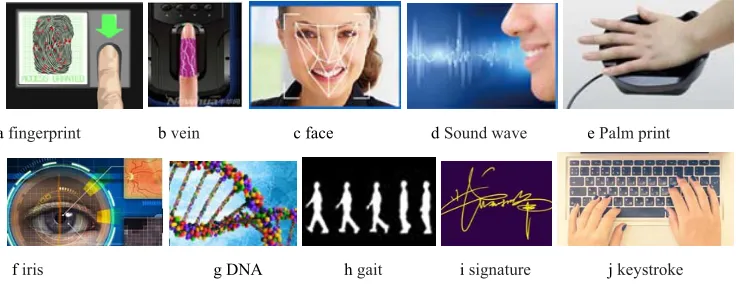
Biometrics has begun to replace the traditional methods of identification, such as passwords and keys, and has become a research hotspot and applied to various fields. Biometrics includes physiological feature recognition and behavior feature recognition, Physiological characteristics include fingerprints, veins, face, sound, palm, iris, DNA, etc.; behavior characteristics include gait, signature, keystrokes and so on, a variety of biological features (a-j) are shown in Fig.1 . With the development of computer technology, biometrics and embedded technology, more and more biometrics are transferred from PC to portable embedded electronic products [1]. The embedded biometric recognition system has the advantages of unity, stability, small size, portability and so on. It has wide application value and practical significance.
a fingerprint b vein c face d Sound wave e Palm print
[image:1.612.121.491.500.642.2]f iris g DNA h gait i signature j keystroke Figure 1. Biological characteristics image.
Currently, fingerprint recognition [2] is about 66.7%, face recognition about 11.4%, iris recognition about 8.0%, speech recognition about 3.0%, vein recognition 2.4%, palm recognition 1.8%.
Current Situation at Home and Abroad
Biometrics has been applied to various fields, from the private sector to the government, from consumption to security. It has become a key technology for national security and a trend of international development.
Foreign Current Situation
Abroad, biometric identification has been applied to the private sector to government, from consumer to security in all areas. In Japan and South Korea, a large number of notebook computers, mobile phones use a fingerprint identification technology; In Europe and the United States, fingerprints used in the retail, catering, education, finance, medical and other fields; The United States has more than ten thousand fingerprint payment supermarkets; Britain has hundreds of fingerprints library. After the 9.11 terrorist attacks, The United States and Japan pay more attention to the development of security systems, There have been automatic face recognition system, such as visage developed a face tools recognition system, cognate developed Face VACE-SDK system, LAU developed the Hunter system[3]. USVISIT (US Visiting
System) is expected to invest 10 billion US dollars, requiring all 27 visa-free countries to be in the United States e-passport holders passport holders face images; The European Union also requires all passports with face and fingerprint images of the chip; The United Kingdom, Australia, New Zealand, Japan and other countries for foreigners’ face image acquisition. British Professor John Daugman developed the first iris recognition system prototype. Beginning in 2000, the United States, the iris pass used in the airline pilots, crew service staff, airport staff.
Domestic Research Status
Domestic, One category is derived from the Chinese Academy of Sciences Biometrics Research Institute, the Hong Branch in the Division, in the Division film knowledge, the Ke Aosen business as a biometric provider has the advantage of research and development; One type are the production and development enterprises, they are a strong theory into the product's ability and marketing capabilities, Such as Shanghai Silver morning, aerospace Golden Shield, Beijing Walker Group Elvis series, the era of Jie Cheng, Shenzhen Li Shield, Shenzhen Ke good and so on. Domestic biometrics mainly focus on fingerprint and facial image recognition, Face recognition has been applied to banks, hospitals, government departments. In 2012, national Defense University Xie Jianbin team successfully developed a finger vein feature recognition system.
Embedded Biometric Identification System Design
The embedded biometrics system includes hardware and software components, Hardware includes the core version, extended version, transfer board; Software has portable tailoring operating system, inter-module driver, function to achieve the program. The whole system is divided into four modules:
image sensor chip is used to complete the design of the image acquisition device in combination with the specific control circuit.
Transmission Module: The collected composite biometric data is transferred to the processor (CPU) for processing.
Display and processing module: The CPU processes the multiplexed information and displays it on the liquid crystal display (LCD).
Recognition algorithm implementation module: Pre-programmed algorithms are used to process the images and identify them.
System Hardware Design
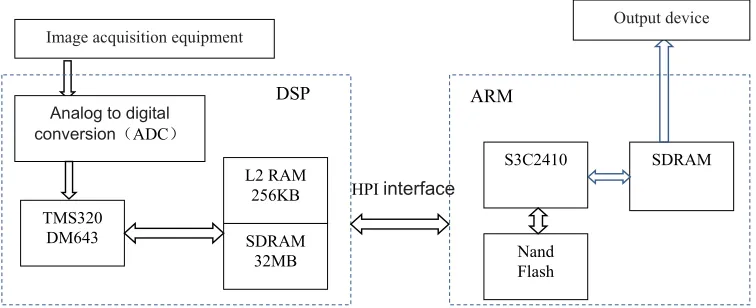
[image:3.612.171.417.349.443.2]ARM and DSP processor is the current technology mature, the useful wide range microprocessors, In the system, the processor complete the image reception, control and storage, data transmission, image display, reset circuit, power input and a variety of interfaces, And uses the processing algorithm to process the received data to support the whole system operation. Make full use of DSP microprocessor strong computing power to achieve multi-feature recognition, The Linux operating system is embedded in the ARM microprocessor to realize the control and interface of the embedded multi-feature recognition system. The control ability of the ARM microprocessor is combined with the compute ability of the DSP processor to improve the system efficiency, as shown in Fig.2.
Figure 2. System hardware structure.
First, the embedded multi-feature recognition system is investigated and researched. The data processing capability of the DSP processor is combined with the microprocessor ARM to build a Linux operating system platform to realize the communication between DSP and ARM. Recognition system is shown in Fig.3.
Figure 3. ARM and DSP dual-core system design. Analog to digital
conversion(ADC)
TMS320 DM643
Image acquisition equipment
SDRAM 32MB L2 RAM
256KB
DSP
HPI interface
S3C2410
Nand Flash
SDRAM
ARM
Output device
Acquisition equipment 1 ……. Acquisition equipment n
DSP processor
[image:3.612.119.497.525.679.2]System Software Design
[image:4.612.110.499.213.252.2]Linux operating system is used as an embedded operating system software, all module drivers are associated with the linux system, all applications are based on the linux operating system. The data acquisition process is controlled by the associated application. Multi-channel data multiplexing module, Image data time-sharing uses the camera interface to achieve non-interference multi-channel acquisition. the Identify program on the host after debugging a good transplant to the target machine running. The embedded compound biometrics system consists of multi-channel acquisition, buffer storage, sequential logic, multi-channel data transfer, ARM processor development, driver and application software,as shown in Fig.4.
Figure 4. Embedded system software module.
Biometric Identification Results Analysis
Face segmentation and threshold determination are analyzed. Fingerprint filtering, refinement and angle matching were analyzed. Experiments were carried out to locate the iris, segmentation, denoising and matching
Face Recognition Results
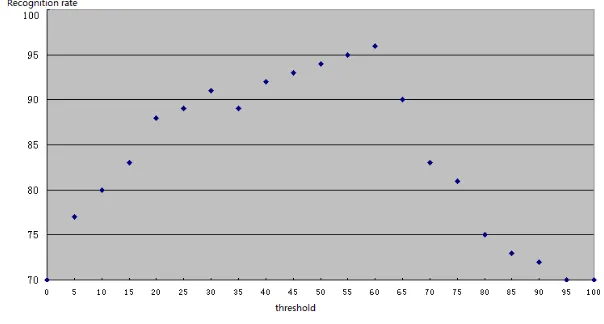
[image:4.612.153.455.412.574.2]Use many classifiers to detect the face in pictures and determine the position and segmentation. Fig.5 is the matching threshold and recognitional rate relationship.
Figure 5. Threshold and recognition rate.
Fingerprint Recognition Result
Table1. Bucket screw diameter. Angle value Images Number Proportion%
0-0.1 17 8.5
0.1-0.2 33 16.5
0.2-0.3 47 23.5
0.3-0.4 50 25
0.4-0.5 22 11
0.5-0.6 19 9.5
above 11 5.5
Table 2. Dustpan shape angle.
Screw diameter Images Number Proportion%
0-500 9 4.5
500-1000 50 25
1000-2000 25 12.5
2000-3000 55 27.5
3000-4000 10 5
4000-5000 8 4
5000 above 43 21.5
Iris Recognition
The iris is segmented, normalized and de-noised as shown in Fig.6.
original image normalized expansion eliminate sound
Figure 6. Iris positioning and pretreatment.
Experimental Results
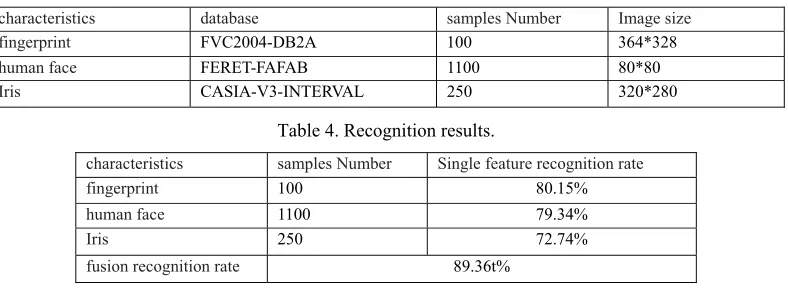
Using fingerprint, face, iris fusion recognition, experimental samples such as Table 3, PC host on the recognition rate as shown in Table 4, the fusion recognition improves the recognition rate.
Table 3. Experimental Samples.
characteristics database samples Number Image size fingerprint FVC2004-DB2A 100 364*328
human face FERET-FAFAB 1100 80*80
[image:5.612.113.507.543.688.2]Iris CASIA-V3-INTERVAL 250 320*280
Table 4. Recognition results.
characteristics samples Number Single feature recognition rate
fingerprint 100 80.15%
human face 1100 79.34%
Iris 250 72.74%
fusion recognition rate 89.36t%
The biometric technology is analyzed, and the biometrics recognition technology is studied. The dual kernel structure of the embedded biometric system is proposed, and the ARM processor and the DSP processor are combined to realize the biometrics.
References
[1] ZHU, Huan. Design of embedded multi-mode biometric recognition system based on ARM [D], 2009, Harbin: Harbin Engineering University.
[2] LUO, Li. Research and Implementation of Real-time Iris Image Quality Evaluation Algorithm [D], 2008, Sichuan: University of Electronic Science and Technology of China.
[3] Wang, Jun. Hand vein recognition technology research [D], 2015, Beijing: China University of Mining and Technology
[4] Zhang, Ji. Machine biometric identification based on machine learning method of key issues [D], 2015, Jinan: Shandong University.
[5] Gu, Fei. Study on Unconstrained Iris Recognition System [D], 2016, Jilin: Jilin University.
[6] Daugman, J. High confidence visual recognition of persons by a test of statistical independence[J]. Pattern Analysis and Machine Intelligence, IEEE Transactions on, 1993, 15(11):1148-1161.
[7] Wildes, R. P. Iris recognition: an emerging biometric technology[J]. Proceedings of the IEEE, 1997,85(9):1348-1363.
[8] Ma, L., Tan, T., Wang, Y., et al. Personal identification based on iris texture analysis[J]. Pattern Analysis and Machine Intelligence, IEEE Transactions on, 2003,25(12):1519-1533.
[9] Miura, N., Nagasaka, A., Miyatake, T. Feature extraction of finger vein patterns based on iterative line tracking and its application to personal identification[J]. Systems and Conputers in Japan, 2004, 35(7):61-71.