2017 3rd International Conference on Electronic Information Technology and Intellectualization (ICEITI 2017) ISBN: 978-1-60595-512-4
Comparison of Index Analysis Tools
for Big Data Platforms
Hongyue Liu, Wan Zhang, Xin Xu and Yi Liu*
ABSTRACT
From the simple release of information to provide users with a wide range of services is the new media in the mobile Internet era of development trends. The paper gives a detailed description of the unique indices of the major new media platforms, and analyzes and studies their common points and differences. The new media matrix of China National Petroleum Corporation (CNPC) is used as a sample to analyze it in detail. The focus of the paper is on the analysis section and the calculation section.
BACKGROUND
The big data revolution is a new opportunity and a new challenge for any modern country. Companies and government agencies are increasingly taking big data for analysis on their future development direction and some important decisions. So the development of big data is a natural and natural thing for them[2].
Through the research of this topic, it can help the development of big data in the new media industry. According to the existing new media platform index analysis tool and the new media big data analysis platform respectively, this will help the further development of new media[1].
________________________
BAIDU INDEX AND MICRO INDEX
Baidu index is a data sharing platform owned by Baidu, which is one of the oldest and most important statistical analysis platforms of the Internet. The analysis of Baidu's index is based on the behavior data of Baidu's massive users. The Baidu index has four main functional modules: trend research, demand mapping, public opinion insight and crowd portraits[4].
Micro Index is a data analysis tool for SinaWeibo. The microindex is divided into two modules: the hot word index and the influence index. The hot word index mainly has four functions: hot word trend, real-time trend, regional interpretation and attribute analysis. In Sina Weibo, the most popular Chinese microblogging system on the Web, a hashtag is defined more explicitly as a keyword that can represent the topics of a microblog (also called Weibo) and be used for microblog retrieval[1].
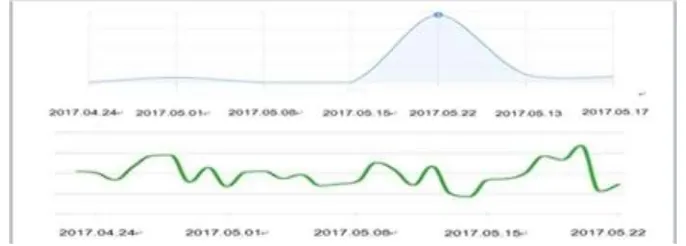
Figure 1 shows the results of Baidu index and Microindex of Beijing institute of costume institute on May 23, 2017.
On the whole, the basis of micro index analysis is the behavior data and blog data of the vast number of users of Weibo. This is an index product that reflects the development of different events in different fields.
WECHAT INDEX AND TOUTIAO INDEX
The analysis of WeChat's index is based on the behavior data of WeChat's massive users. It currently includes only WeChat search, public number articles and friends circles. Through a comprehensive analysis of these data, the heat condition of keywords in WeChat is obtained[5].
WeChat index indicators including the analysis of the calculation in this period of time the accounts published articles on the number of total number of reading, the average reading, the highest reading the number, the total number of thumb up, on average, reading the number, the highest reading the number, the total number of thumb up, average reading of peak number and thumb up rate.
The Toutiao index is the data product of headline. It is an index analysis tool launched by the center today. Toutiao indexes can provide big data analysis of hot events to individuals or businesses that need it. Its analysis results include the analysis data, visualization charts and reports needed by individuals or enterprises.
Figure 2shows the results of Wechat index and Toutiao index of Beijing Institute of costume institute on May 23, 2017.
NEW RANK INDEX AND QINGBO INDEX
[image:3.612.126.469.424.547.2]NRI was introduced by the New Rank. It was introduced on the basis of a huge amount of data and depth of user feedback combined with expert advice. This index
[image:3.612.91.501.608.683.2]Figure 2. Comparison of Search Results between Wechat Index and Toutiao Index Keyword.
TABLE I. THE VARIABLES OF THE NEW RANK INDEX. The total
number of reading
Average reading
Maximum reading
Headline reading
The total number of
thumb up
Average thumb up
can reflect the heat and development trend of the new media. The new media here mainly refers to WeChat, Sinaweibo and Toutiao.
The Qingbo index is the leading third-party new media data search engine in China. Its unique algorithm of WCI, BCI and OCI has become the evaluation standard of various departments, central enterprises and top 500 enterprises[6].
The new rank index will give different kinds of coefficients to different categories, but Qingbo index would not do so. The new rank index is more nuanced and targeted in this regard. TABLE I shows the variables of the New Rank index.TABLEII shows the variables of the Qingbo index.
The Example Analysis
Through the investigation of WeChat matrix of China national petroleum corporation, this paper can compare the similarities and differences between the new rank index and the Qingbo index. Data source: new rank database, China national petroleum corporation WeChat matrix account, February 2017 data.
Daqing oil field’s new rank index is 661.95.CHNP’s new rank index is 651.65.As can be seen from the following examples, since the new rank index has a higher overall reading weight, the new rank index of Daqing oil field is higher than that of China petroleum and natural gas pipeline bureau. Since the average daily reading weight of the Qingbo index is low, the Qingbo index of China's oil and gas pipeline is still higher than Daqing oilfield.
For CNPC, the new rank index is more suitable to measure the operating effect of Petrochina's account. The algorithm of the new index is relatively more scientific,
TABLE II. THE VARIABLES OF THE NEW RANK INDEX. Average daily reading The average number Maximum reading Headline reading Average daily thumb up Average every thumb up Maximum number of thumb up
[image:4.612.93.501.529.602.2]0.32 0.36 0.12 0 0.08 0.09 0.03
TABLE III. THE NEW RANK INDEX OF CHPC. Name Release The total
number of reading Maximum reading Average reading The total number of thumb up WCI Daqing oil field
25/52 100000+ 6992 2020 1405 585.1
CHPC 15/18 67903 10580 3772 2334 6444.12
THE BIG DATA AREA ANALYSIS
Search for the WeChat subscription containing regional keywords in the new rank database as a sample of the overall analysis of the region. Data from October 2016 to March 2017 were collected and analyzed and 184249 data were obtained.
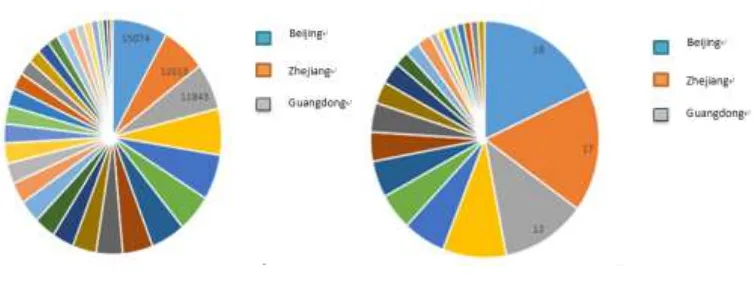
In the collected data samples, Beijing, Zhejiang and Guangdong have the most data samples. As shown in Figure3, Beijing has 15074, accounting for 8.18% of the total sample. Zhejiang 12013, accounting for the overall sample 6.52%; Guangdong 11,843, accounting for 6.43% of the total sample.
[image:5.612.116.493.281.422.2]The new index of 184249 data was calculated. The results are ranked by high and low in the new rank index. The top100 list of WeChat Subscription is shown in Figure 4.
Figure 3. Data sample analysis. Figure4.The geographical distribution of Top100.
CONCLUSIONS
In the paper, the unique index of the major new media platforms are described in detail and their similarities and differences are analyzed. Traditional analytical tools can indeed help the development of new media[2].
ACKNOWLEDGEMENT
Foundation of China (No. 61502279), and the General Program of Science and Technology Development Project of Beijing Municipal Education Commission (No. KM201710012008).
REFERENCES
1. Zhibin, Zhao, Jiahong, et al. Modeling Chinese Microblogs with Five Ws for Topic Hashtags Extraction[J]. Tsinghua Science & Technology, 2017, 22(2):135-148.
2. Pew Research Center's Project for Excellence in Journalism .New Media Old Media[EB/OL]. Journalism.2010-05-23.
3. Jones Robert, The origin and development of new media [J]. International Review of Business, 2014, 7(2): 157-169.
4. Yihua Huang, Background and Significance of Big Data [EB/OL].China Big Data Network.2014-08-27. In Chinese
5. Yizhi Ni. The development dilemma and trend of traditional media and new media in the era of big data [J]. News World, 2014(10):14-15. In Chinese