London School of Economics and Political Science
Evidence, process or context? Examining the factors that
drive coverage decisions of pharmaceuticals by Health
Technology Assessment bodies in Europe
Karin H. Cerri
A thesis submitted to the Department of Social Policy at the
London School of Economics for the degree of Doctor of
Declaration of Authorship
I certify that the thesis I have presented for examination for the MPhil/PhD degree of the London School of Economics and Political Science is solely my own work other than where I have clearly indicated that it is the work of others (in which case the extent of any work carried out jointly by me and any other person is clearly identified in it).
The copyright of this thesis rests with the author. Quotation from it is permitted, provided that full acknowledgement is made. This thesis may not be reproduced without the prior written consent of the author.
Abstract
In Europe, Health Technology Assessment (HTA) bodies produce coverage decisions that guide public funding of pharmaceuticals. This thesis examines and weights those factors that drive HTA coverage decisions, focusing on the National Institute for Health and Clinical Excellence (NICE) in England and Wales, the Scottish Medicines
Consortium (SMC), the Dutch College voor Zorgverzekeringen (CVZ), and the French Haute Autorité de Sante (HAS). To address the research question, a dataset of
approximately 1000 HTA coverage decisions by NICE, SMC, CVZ and HAS from the period 2004-2009 was created, containing more than 30 clinical, economic, process and socio-economic factors extracted from published HTA reports. A three-category outcome variable was used, defined as the decision to ‘recommend’, ‘restrict’ or ‘not recommend’ a technology. Multivariate analyses were conducted to assess the relative contribution of the explanatory variables on coverage decisions both within and
between HTA bodies.
Results demonstrate that different combinations of clinical/economic evidence, process and socio-economic factors drive HTA coverage decisions by NICE, SMC, CVZ and HAS. In addition, the same factor may behave differently according to the nature of the coverage decision. The analysis further suggests there is a significant difference
Acknowledgements
Contents
1 INTRODUCTION ... 12
1.1 OVERVIEW:REGULATION OF THE PHARMACEUTICAL MARKET IN EUMEMBER STATES ... 13
1.2 FUNDING REQUIREMENTS IN EUROPE AND THE ROLE OF HTA ... 15
1.3 IMPLICATIONS OF HTA DECISIONS FOR PATIENTS, PROVIDERS, MANUFACTURERS AND HEALTH POLICY MAKERS ... 21
1.4 RESEARCH QUESTION ... 27
1.5 REFERENCES ... 28
2 FRAMING THE RESEARCH QUESTION ... 33
2.1 THEORETICAL MODELS FOR UNDERSTANDING COVERAGE DECISION-MAKING ... 35
2.2 LITERATURE REVIEW... 40
2.2.1 Impact of evidence on HTA decision-making ... 41
2.2.2 Process-related factors that impact on the payor decision ... 49
2.2.3 Healthcare and welfare context – impact on HTA coverage decision ... 54
2.3 GAPS IN THE LITERATURE AND IMPLICATIONS FOR THIS RESEARCH ... 56
2.4 ANALYTICAL FRAMEWORK ... 58
2.5 REFERENCES ... 61
3 METHODS ... 67
3.1 HTA DECISION-MAKING: HYPOTHESISED DRIVERS ... 67
3.2 CREATING THE DATASET – A NEW AND UNIQUE PLATFORM FOR ANALYSIS ... 70
3.2.1 Defining the sample for analysis ... 71
3.2.2 Determining the explanatory variables for inclusion in the dataset ... 72
3.2.3 Data sources ... 76
3.2.4 Data extraction ... 78
3.3 STATISTICAL ANALYSIS ... 78
3.3.1 Descriptive statistics ... 79
3.3.2 Multivariate analysis – considerations ... 80
3.3.3 Multivariate analyses ... 87
3.4 DISCUSSION ... 90
3.5 REFERENCES ... 93
4 EMPIRICAL ANALYSIS OF NICE COVERAGE DECISIONS ... 96
4.1 NICE APPRAISAL PROCESS ... 97
4.2 METHODS ... 99
4.2.1 Sample ... 100
4.2.2 Outcome variable ... 100
4.2.3 Explanatory variables ... 101
4.2.4 Data extraction form ... 101
4.3 RESULTS ... 107
4.3.1 Sample characteristics ... 107
4.3.2 Descriptive statistics ... 108
4.3.3 Multivariate analysis results ... 119
4.4 DISCUSSION ... 122
4.4.1 Pattern of NICE decision-making ... 123
4.4.2 Impact of clinical evidence and disease characteristics on NICE decision-making ... 123
4.4.3 Economic evidence and its impact on NICE decision-making ... 125
4.4.4 Number of technologies appraised simultaneously impacts on NICE decision-making ... 126
4.4.5 Year of appraisal impacts on NICE decision-making ... 128
4.4.6 Limitations ... 129
4.5 REFERENCES ... 131
5 EMPIRICAL ANALYSIS OF SMC COVERAGE DECISIONS ... 134
5.1 SMCAPPRAISAL PROCESS ... 135
5.2 METHODS ... 137
5.2.1 Sample ... 137
5.2.2 Outcome variable ... 138
5.2.3 Explanatory variables ... 138
5.2.4 Data extraction form ... 138
5.2.5 Statistics ... 143
5.3 RESULTS ... 143
5.3.1 Sample characteristics ... 143
5.3.2 Descriptive statistics ... 144
5.3.3 Multivariate Analysis ... 153
5.4 DISCUSSION ... 157
5.4.1 Pattern of SMC coverage decisions ... 158
5.4.2 The role of clinical evidence factors in SMC decision-making ... 159
5.4.3 The role of economic evidence in SMC decision-making ... 160
5.4.4 No clear impact of process or socio-economic context variables on SMC decision-making 162 5.4.5 Limitations ... 162
5.5 REFERENCES ... 164
6 EMPIRICAL ANALYSIS OF CVZ COVERAGE DECISIONS ... 167
6.1 CVZAPPRAISAL PROCESS ... 167
6.2 METHODS ... 171
6.2.1 Sample ... 172
6.2.2 Outcome variable ... 172
6.2.3 Explanatory variables ... 173
6.2.5 Statistics ... 179
6.3 RESULTS ... 179
6.3.1 Sample characteristics ... 179
6.3.2 Descriptive statistics ... 179
6.3.3 Multivariate analysis ... 190
6.4 DISCUSSION ... 194
6.4.1 Pattern of CVZ coverage decisions ... 195
6.4.2 Role of clinical evidence and disease characteristics on CVZ decision-making ... 195
6.4.3 Role of Economic evidence in CVZ decision-making ... 196
6.4.4 Role of process and socio-economic context variables in CVZ decision-making ... 197
6.4.5 Limitations ... 197
6.5 REFERENCES ... 200
7 EMPIRICAL ANALYSIS OF HAS COVERAGE DECISIONS ... 202
7.1 HASAPPRAISAL PROCESS ... 203
7.2 METHODS ... 205
7.2.1 Sample ... 206
7.2.2 Outcome variable ... 206
7.2.3 Explanatory variables ... 207
7.2.4 Data extraction form ... 208
7.2.5 Statistics ... 212
7.3 RESULTS ... 212
7.3.1 Sample characteristics ... 212
7.3.2 Descriptive statistics ... 213
7.3.3 Multivariate analysis ... 222
7.4 DISCUSSION ... 228
7.4.1 Pattern of HAS decision-making ... 228
7.4.2 The impact of clinical evidence and disease characteristics on HAS decision-making ... 228
7.4.3 The impact of socio-economic context on HAS decision-making ... 231
7.4.4 Limitations ... 232
7.5 REFERENCES ... 235
8 EMPIRICAL ANALYSIS OF A POOLED DATASET OF NICE, SMC, CVZ AND HAS COVERAGE DECISIONS ... 237
8.1 METHODS ... 237
8.1.1 Sample ... 238
8.1.2 Variables ... 238
8.2 STATISTICAL ANALYSES ... 241
8.3 RESULTS ... 244
8.3.1 Sample characteristics ... 244
8.3.3 Multivariate analysis ... 254
8.4 DISCUSSION ... 265
8.4.1 Pattern of coverage decisions in pooled analysis ... 266
8.4.2 The impact of clinical variables and disease characteristics on decision-making within a pooled HTA analysis ... 266
8.4.3 The impact of economic evidence on decision-making within a pooled HTA analysis .... 266
8.4.4 The impact of the appraisal process on decision-making within a pooled HTA analysis 267 8.4.5 The impact of socio-economic context on decision-making within a pooled HTA analysis 268 8.4.6 The “HTA body effect” ... 268
8.4.7 Limitations ... 269
8.5 REFERENCES ... 272
9 CONCLUSION ... 273
9.1 THESIS OVERVIEW ... 273
9.2 DISCUSSION OF RESULTS ... 276
9.2.1 NICE ... 276
9.2.2 SMC ... 281
9.2.3 CVZ ... 285
9.2.4 HAS ... 289
9.2.5 Pooled analysis ... 293
9.3 GENERAL LIMITATIONS ... 295
9.4 HOW THIS THESIS CONTRIBUTES TO THE LITERATURE ... 297
9.5 IMPLICATIONS OF THIS RESEARCH ... 299
9.5.1 Heterogeneity between HTA bodies - implications for healthcare systems and patients . 299 9.5.2 Implications for the pharmaceutical sector: reward for innovation? ... 303
9.5.3 Implications for harmonizing the evidence needs of regulatory and reimbursement agencies 306 9.5.4 Implications for a harmonised European HTA system ... 307
9.6 RECOMMENDATIONS FOR FUTURE RESEARCH ... 308
9.7 REFERENCES ... 309
List of Acronyms
ABPI Association of the British Pharmaceutical Industry
ACD Appraisal Consultation Document
Afssaps Agence française de sécurité sanitaire des produits de santé ACE inhibitors angiotensin-converting enzyme inhibitors
AIFA Agenzia Italiana del Farmaco
ASMR Amelioriation du Service Medicale Rendu BBC British Broadcasting Corporation
BNF British National Formulary BSR British Society of Rheumatology
CDR Canadian Drug Review
CEPS Comité Economique des Produits de Santé CEA Cost Effectiveness Analysis
CFH Commissie Farmaceutische Hulp CVZ College voor Zorgverzekeringen
CI Confidence Interval
CML Chronic Myeloid Leukemia CNS Central Nervous System
CUA Cost Utility Analysis
CVZ College voor zorgverzekeringen DALE Disability Adjusted Life Expectancy
DEMESP Direction de l’Evaluation Medicale, Economique et de Sante Publicque
EEC European Economic Community
EMA European Medicines Agency
EU European Union
EUnetHA European Network of HTA
EFPIA European Federation of Pharmaceutical Industries and Associations FAD Final Appraisal Determination
FDA Food and Drug Administration
DH Department of Health
NHS National Health Service HAS Haute Autorité de Sante
HTA Health Technology Assessment ICER Incremental Cost Effectiveness ratio
IHTA International Health Technology Assessment
INAHTA International Network of Agencies for Health Technology Assessment INAMI Institut national d’assurance maladie-invalidité, Belgium
IRP Independent Review Panel, SMC ISD Information Services Division GDP Gross Domestic Product
GVS Geneesmiddelenvergoedingssysteem
GBP Pound sterling
OECD Organisation for Economic Co-operation and Development PET Positron emission tomography
PBAC Pharmaceutical Benefits Advisory Committee
PCT Primary Care Trust
PhRMA Pharmaceutical Research and Manufacturers of America MTA Multiple Technology Appraisal
NICE National Institute for Health and Clinical Excellence
NDC New Drugs Committee
NOS Nederlandse Omroep Stichting NPAF New Product Assessment Form
NZa Nederlandse Zorgautoriteit
QALY Quality Adjusted Life Year
RCF Rarer Cancers Forum
RCT Randomised Controlled Trial
SMC Scottish Medicines Consortium
STA Single Technology Appraisal Anti-TNF Anti-tumour Necrosis Factor
TAR Technology Appraisal Report
TA Technology Appraisal
USA United States of America
UK United Kingdom
VBP Value-Based Pricing
Conflict of Interest Statement
I, Karin Cerri, declare that during the time of writing this thesis, I was an employee of Bristol-Myers Squibb (B-MS) within the European Health Economics and Outcomes Research (HEOR) department.
As Associate Director within the HEOR department, my work involved generating and packaging clinical and economic data to support access to B-MS medications within a European treatment setting. In particular, a key task in which I participated was the creation of HTA submissions detailing the clinical and economic characteristics of B-MS medications to reimbursement/HTA bodies across a number of European Member States.
1
Introduction
“Our job is to make sure taxpayers’ money is only spent on healthcare that works and is good value” (NICE statement on BBC Breakfast News, 13th May 2008)
“It's a system of blocking. They're [NICE] not looking at patients and saying "how can we fund it?", they are saying, "how can we not fund it?"…[Cancer] medicines are licensed and working yet we in Britain aren't allowed to access them. While we wait for Nice to decide, patients are dying.” (Kate Spall1 on BBC Breakfast News 13th May 2008)
The quotations above juxtapose different perspectives on the public funding of
pharmaceutical technologies within the healthcare system, raising interesting questions about how funding decisions are made, and the impact this may have on patients, as well as on providers, manufacturers and health policy makers. In the heavily regulated European pharmaceutical market (Maynard and Bloor 2003; Mossialos et al. 2004), one of the areas under considerable regulation is the public funding of pharmaceutical technologies. Health Technology Assessment (HTA) is a process that exists in several European Union (EU) Member States to advise healthcare systems on the appropriate use of a new technology and whether it should be recommended for public funding. Examples of HTA agencies include the National Institute for Health and Clinical Excellence (NICE) in England and Wales, the Scottish Medicines Consortium (SMC), the Commissie voor Zorgverze (CVZ) in the Netherlands and the Haute Autorité de Sante (HAS) in France.
This chapter aims to set the scene for this thesis by presenting the context and rationale for the research question, and by setting out how the thesis is structured. Firstly, the extent and nature of the regulation of the pharmaceutical market in EU Member States is analysed and the concept of HTA is introduced. Coverage decisions and their implications for patients, providers and manufacturers are highlighted in the third
section of this chapter, and finally the research question is outlined, along with an outline of the chapters that lie ahead.
1.1 Overview: Regulation of the Pharmaceutical Market in EU Member States
The pharmaceutical market in the EU is heavily regulated for several reasons. Firstly, the presence of regulatory mechanisms to control the level of drug utilisation reflects the oligopoly structure of the pharmaceutical industry and its tendency for monopoly-like power, as well as the characteristics of health system users and its various providers (physicians etc) (McGuire et al. 2004). Secondly, regulation of pharmaceuticals is necessary due to the fact that patients lack complete information about treatment options, and that both patients and providers (due to their ‘third party’ status) are seldom in a position to bear the full cost of utilisation of pharmaceuticals (Mossialos et al. 2004; Vogel 2004). In addition, other factors have led to the increased involvement of national governments and supra-national governing bodies (i.e. the European
Commission) in the regulation of access to healthcare. These include the existence of complex stakeholder relationships, i.e. the provider/payer/patient ‘triangle’ that characterizes healthcare systems (Reinhardt 1990), the ‘imperfect’ nature of the
healthcare market (Abel-Smith and Grandjeat 1978; Jacobzone 2000; Barr 2001; Dukes 2003; McGuire et al. 2004), and the shift towards a greater use of market forces in the distribution of healthcare (Rice et al. 2000).
Such regulation impacts on the entire ‘life-cycle’ of pharmaceuticals along their path from discovery in the laboratory to patient use. There are a series of key requirements which must be satisfied, both before and after marketing authorisation has been granted. Such requirements can be categorised into pre- and post-marketing authorisation
requirements and are designed to impact on patients, providers, payers and the industry (either individually, or in combination). Pre-marketing authorisation requirements mark key milestones in the discovery and development process of a compound – a process in which, for example, one out of every 10,000 potential medicines investigated by research-based pharmaceutical companies makes it through the research and
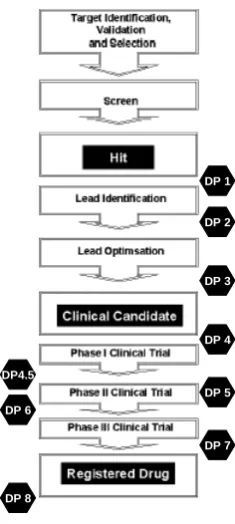
and costing US$800 million (or around €552-€690 million)2 (European Commission 2009). Pre-marketing authorisation requirements cover various stages of the discovery and development phase, and consist of nine key decision points. These decision points are accurately illustrated by Garret et al. (2003), who provide an analysis of the process with which an anti-tumour target is identified, validated and selected, developed into a clinical candidate, and finally, developed into a registered medication for cancer therapy (Figure 1.1).
Figure 1.1 Drug discovery and development process
Source: Adapted from Garret et al. 2003.
Note: DP - decision point
In contrast to the relative homogeneity of the pre-marketing authorisation requirements across products and geographies, Member States differ in the types of requirements that they have put in place to manage patient access to medications once marketing
authorisation is granted. After marketing authorisation, a series of nationally-led payer, provider and patient-related requirements determine patient use and access to
pharmaceuticals. In response to specific welfare and healthcare systems, Member
2
While there is some debate as to the magnitude of the cost of drug development (Permanand 2006; EU Commission 2009), the literature is in agreement on the fact that the ‘entry’ costs into the market for the pharmaceutical companies are high.
DP 6
DP 7
DP 8
DP 5 DP4.5
DP 4 DP 3 DP 2 DP 1
DP 6
DP 7
DP 8
DP 5 DP4.5
States have adopted distinctive combinations of payer-led requirements (Pricing and Reimbursement (P&R), budget allocation, Heath Technology Assessment), tools aimed at providers (clinical guidelines, gate-keeping mechanisms) and tools aimed at patients (co-payments for medications, doctor’s visits to obtain prescription). The next section focuses on payer-led funding requirements in EU Member States to regulate the funding of pharmaceuticals, with a particular focus on Health Technology Assessment (HTA).
1.2 Funding requirements in Europe and the role of HTA
“The [Dutch] government policy aimed at reducing drug expenditure appears to bear fruit. Total drug expenditure increased this year by 2.6 percent to 5.2 million [euros] per year. In 2007 the increase was three times as high.” (NOS 2008, p1)
The EU, with its 27 Member States, spends €138 billion annually on pharmaceuticals (EU Commission 2009). Regulations to control and optimise public spending on pharmaceuticals exist in all Member States, initiated and implemented by those entities within the healthcare system that manage pharmaceutical budgets and expenditure, often referred to as payers. Prior to examining the use of such mechanisms and the variation between Member States in their use, the concepts of ‘payers’ and ‘funding requirements’ are outlined.
Payers represent the actors within the healthcare system that are responsible for budget allocation and management, either directly, by being accountable for a budget, or indirectly by providing guidance on the allocation of budgets to pharmaceuticals3. The term ‘payers’ represents a heterogeneous pool of actors within the healthcare system. Payers can exist at each level of the healthcare system, whether national, regional or local. National-level payers are those entities, such as Ministries of Health, that hold a budget for pharmaceutical expenditure at the national level. Reimbursement committees (e.g. the INAMI in Belgium) are also examples of national-level payers – while not necessarily having direct accountability for the pharmaceutical budget, they issue guidance on which pharmaceuticals should be covered by the healthcare system. A further example, in Italy, is the authority for evaluation of pharmaceutical products at
3 While noting that requirements for patient copayment for medication exist in several Member States, for
the national level (AIFA), which grants price approval, determines reimbursement criteria, and is responsible for liaising with the Ministry of Health to publish the price and reimbursement criteria in the national ‘Gazzetta’. Regional level payers are those that hold budgets or have responsibilities for pharmaceuticals at a sub-national level. For example, in Italy, which is comprised of 20 regions, each region has independent responsibility for its own pharmaceutical budget and expenditure. Finally, there are local level payers such as hospital formulary committees, hospital pharmacists, or hospital budget holders that hold responsibility for funding and providing access to pharmaceuticals within their local jurisdiction. To continue the Italian example, the hospitals within each region (assuming a technology is a compound destined for use in a hospital setting), has its own individual procedures for budget allocation and formulary decisions. The combined pool of payers within the healthcare system is collectively responsible for the purchasing of pharmaceutical technologies, aided by the use of funding regulations.
Regulations on public funding of pharmaceuticals, depending on the perspective adopted, can be labelled differently. From a manufacturer perspective, regulations linked to the funding of compounds have been defined as ‘4th hurdles’ in the literature (Maynard and Bloor 2003; Taylor et al. 2004). From the perspective of the health care system, these regulations are not perceived as ‘hurdles’ but as ‘tools’ to aid the
achievement of system objectives, including assurance of the quality of services provided, and the efficiency of drug utilisation (Saltman et al. 1998; Mrazek 2002; Maynard and Bloor 2003; Mossialos et al. 2004). Whether labelled from a
manufacturer or health care system perspective, the attributes of these regulations remain the same.
states, although within the context of the ‘subsidiarity principle’4, health care systems differ to some extent in the mechanisms that have been set up to guide public funding of pharmaceuticals (Permanand 2006).
In Europe, the implementation of the subsidiarity principle means that the use and characteristics of funding requirements, as well as their management and
implementation, fall largely, if not totally under member state competency (rather than centralized EU competency). This allows for variations in the nature of funding requirements and funding decisions between Member States (G10 Medicines Group 2002). Such variation can be attributed in part to the fact that industrial policy, public health, and health policy objectives influence the nature of pharmaceutical regulation (Permanand 2006). Industrial policy objectives focus on ensuring the productivity of the pharmaceutical industry in Europe, as well as the realisation of a single European market, which is the remit of the EU Commission. In Europe, the pharmaceutical sector employs more than 600,000 people (Kanavos et al. 2011). In contrast, public health objectives related to pharmaceutical regulation focus on ensuring public health by providing patients with access to efficacious, safe and high-quality medicines. The European Medicines Agency’s (EMA) ‘registrational requirement’ acts as a safeguard for patient health in this respect and addresses public health objectives. Finally, health policy objectives aim to balance equity and efficiency of distribution of effective
therapies for the patient population (Mossialos et al. 2004; Vogel 2004). Indeed, from a theoretical perspective, effective healthcare provision requires a balance between two potentially conflicting objectives – on the one hand i) an increase in efficiency in the production process, through the minimisation of government intervention, freely competitive markets allowing free pricing and no regulatory intervention by
government bodies; and on the other hand ii) the search for an equitable distribution in society of the benefits derived from health care inputs through government intervention, such as price controls (Vogel, 2004).
How the balance is struck between industrial policy, public health and health policy objectives varies between countries, in part due to differences in welfare systems which
4 The notion of subsidiarity can be defined as “the principle that a central authority should have a
reflect societal preferences. Wiktorowicz (2003) analysed the approach to pharmaceutical regulation adopted by the USA, Canada, Britain and France by considering five features for analysis – representation, process, stance, institutional power, and resources. This was coupled with an institutional framework approach to help clarify the patterns observed in the selected countries. The results of this analysis highlighted important differences in the approaches adopted towards pharmaceutical regulation, reflecting differences in how countries aim to balance objectives of timeliness of the decision-making processes along with the demanding regulatory requirements.
Figure 1.2 aims to summarise the key forces mediating the regulatory mechanisms that govern healthcare access in a particular healthcare system, and to highlight the focus of this research within the overall context. The diagram starts with the three key
Figure 1.2 Context for analysis: the healthcare system and the influence of healthcare objectives and the welfare system on regulatory mechanisms
Pricing and reimbursement requirements are present in most EU Member States, although their nature varies (Mossialos et al. 2004; Kanavos et al. 2011). For example, in Belgium, as in Austria, Greece, Portugal, Spain and Switzerland, price and
reimbursement submissions occur as parallel but separate processes, while in the United Kingdom price approval is required, but there is currently no required reimbursement submission (Mossialos et al. 2004). In Finland, France, Italy, the Netherlands and Sweden a combined pricing and reimbursement procedure exists. Four distinct
approaches to the regulation of pricing of pharmaceuticals have been identified (Mrazek 2002) – fixed pricing, cost-effectiveness pricing, profit controls and reference pricing. These approaches can be combined, and EU Member States differ in the approaches adopted (Kanavos et al. 2011). Beuscart et al. (2010) show that in France the final coverage decision actually represents a series of processes lasting several years, designed to ensure public funding is spent on technologies that bring an added benefit and that are safe and of high quality. The steps include obtaining the European
marketing authorisation, control of quality by the Agence française de sécurité sanitaire des produits de santé (Afssaps), submission to the Haute Autorité de santé (HAS) for reimbursement assessment, and final negotiation with the Comite economique des produits de santé (CEPS) to finalise the reimbursed price (Beuscart et al. 2010).
Industrial Policy
Public Health
Health Policy Provider
Patient
Payor
Output (health utility)
3 Healthcare Objectives Welfare system Regulation Tools Healthcare “Triangle” 1 6 5 4 3 2 Industrial Policy Public Health
Health Policy Provider
Patient
Payor
Output (health utility)
Health Technology Assessment (HTA) is an important requirement which exists in several EU member states. HTA can be defined as a:
The systematic evaluation of the properties, effects, and/or other impacts of health care technology (HTAi 2010)
The assessment of the evidence and the subsequent appraisal of the evidence represent two distinct stages within HTA (Sorenson 2010), and successful implementation of HTA requires multi-disciplinary assessment of the range of social, economic, clinical and healthcare system organisational consequences stemming from the introduction of a new technology relative to the existing standards of care (EUnetHTA 2010; Velasco-Garrido and Busse 2005; Henshall et al. 1997; HTAI 2007).
The nature of HTA has evolved over time - since its debut in the 1970s as a tool for controlling the use of expensive medical equipment (Jonsson and Banta 1999), HTA’s remit is now broader in scope and includes pharmaceutical technologies in its
assessment programme. While originating in the USA, HTA is now established in many EU Member States (Jonsson 2002; Banta and Oortwijn 2000a, 2000b; Gulacsi 2001; Oliver et al. 2004; Velasco-Garrido and Busse 2005; Sorenson 2010). Economic evaluations are becoming an increasingly wide-spread requirement across European countries (Kanavos et al. 2000;Nuijten et al. 2001; Drummond 2003; Nuijten and Kosa 2004, Kanavos et al. 2011). The nature of HTA varies between European countries both in terms of the assessment of the evidence and the appraisal of the evidence, as well as in the role of HTA within each healthcare system (Jonsson 2002; Banta and Oortwijn 2000; Gulacsi 2001; Oliver et al. 2004; Velasco-Garrido and Busse 2005; Sorenson 2010).
1.3 Implications of HTA decisions for patients, providers, manufacturers and health policy makers
“[In France] Between 1990 and 2009, public prices of reimbursed medicines decreased by 20.6%, although in the same time period, inflation increased by 38.4%”5 (Les Entreprises du Medicament 2010 p1)
“Scottish cancer patients should be able to access the same standards of cancer care as their English counterparts.” (RCF Chief Executive Andrew Wilson in Herald Scotland 2010 p1)
This thesis distinguishes between coverage of pharmaceuticals – which reflects the willingness to fund a particular technology that is deemed to be of value – and reimbursement of pharmaceuticals, which is the implementation of the coverage decision in regulatory mechanisms that allows for their inclusion/exclusion from a reimbursement list and from use within a healthcare system. HTA bodies vary in the nature of recommendations they make, the evidence and processes they use to make such recommendations, and whether their recommendations have an advisory or regulatory role (Sorenson 2010, Sorenson et al 2008). For example, the CVZ will concurrently examine the degree of value of intervention and whether it should be funded by the healthcare system (i.e. coverage), but also the price of the intervention and whether the technology should be clustered, independently priced, or placed on an ‘expensive drug’ list (i.e. reimbursement). In France, on the other hand, the HAS, and specifically the Comitee de Transparence, issues advice on the value of the technology for a particular population (ASMR) and advises on the patient population eligible for treatment (i.e. coverage), while the CEPS negotiates price and volume agreements with manufacturers on the basis of the ASMR rating provided by the HAS (i.e.
reimbursement) (Sorenson 2010)6. Technologies with an ASMR rating of V are those that represent no incremental value and can only be considered for reimbursement if its cost is below that of its comparator7, highlighting that there is no willingness to fund
5 Original quotation: “Entre 1990 et 2009, les prix publics des médicaments remboursables ont diminué
de 20,6% alors que dans le même temps, l'inflation augmentait de 38,4%”
6 For technologies with an ASMR I-III rating the healthcare system is willing to pay more (premium)
over standard of care as they are associated with significant incremental benefit, while technologies with an ASMR IV rating can expect to receive the same level of funding as that obtained by their comparator technology.
7 It is unclear however, to what extent manufacturers in France who receive an ASMR V rating opt for a
such technologies without cost savings. The decision output by the HAS diverges from NICE, SMC and the CVZ which consider both coverage and reimbursement in their decision-making, and in which non-recommendations preclude the inclusion on reimbursement lists, or highly discourage the use of the technology. With the considerable intricacies and heterogeneity in the reimbursement mechanisms and pharmaceutical pricing policies in place, this thesis aims to focus on assessing the factors driving the willingness to fund a particular technology, rather than the reimbursement mechanisms and negotiations that follow.
Coverage decisions represent a key point within the complex decision-making process that governs funding and access for pharmaceuticals. Coverage decisions are of interest because of their implications for patients, providers, manufacturers and health policy makers.
There is particular interest from multiple stakeholders in HTA because of the implications that coverage decisions can have on access to pharmaceuticals, and on health outcomes. From an efficiency-driven approach, access to health care can be justified from an economic perspective because of its presumed benefits in improving the health of the population (both from a clinical point of view but also from a
productivity point of view) (Gulliford and Morgan 2003). However, such an approach may disregard the needs of vulnerable populations (e.g. the elderly, those with mental health problems, prisoners etc.). An assessment of the level of access to healthcare necessitates consideration of various components including the comprehensiveness of the services offered, when and to whom these are offered, and how such services impact on health outcomes (Gulliford and Morgan 2003). Two facets of ‘access’ become apparent in the literature and are of relevance in any analysis of access. From one perspective, access can be defined as equal utilisation of healthcare resources
(Donabedian 1972 in Gulliford and Morgan 2003). Alternatively, access can be defined as the availability of a service, where access is about equal opportunity, not equal utilisation (Mooney 1983). National HTA bodies fit within the latter definition of access, in that they have the ability to define the availability of a therapy, by
The implications of coverage decisions for patients and providers are more visible when HTA bodies decide not to reimburse a product for a particular patient population, as highlighted in the following excerpt: “…[Cancer] medicines are licensed and working yet we in Britain aren't allowed to access them. While we wait for NICE to decide, patients are dying” (Kate Spall on BBC Breakfast News, May 13th 2008). Thus, non-recommendations from HTA bodies can be perceived as decisions that reduce treatment options for particular patient groups. The excerpt also highlights the potential
implications linked with coverage decisions for health outcomes, in this example, death.
While recognising the role of broader medical and non-medical factors on health outcomes such as the life expectancy of the population, the literature does provide evidence that links access to pharmaceuticals with better health outcomes. There are several studies reported in the literature that assess the impact of pharmaceutical access, as measured by levels of pharmaceutical expenditures, on life expectancy. Within OECD countries, Miller and Frech (2000) calculated the ratio of money spent on pharmaceuticals versus the life expectancy gain and concluded that pharmaceutical consumption was associated with a statistically significant positive effect on life expectancy. In a further study by Frech et al. (2004), the authors confirmed that a strong statistical effect was observed between pharmaceutical consumption and life expectancy at both 40 and 60 years.
In addition, they also examined the impact of pharmaceutical consumption on quality of life, using disability adjusted life expectancy (DALE) as the measure of quality of life. In their analysis they found that pharmaceutical use was associated with an even larger effect than that observed on life expectancy: positive statistically significant effects of pharmaceutical utilisation on DALE were observed both at birth and at 60 years. In examining the relationship between pharmaceutical expenditure and life expectancy, Caliskan (2009) took the methodology one step further by adjusting for other factors known to have an impact on life expectancy, including socio-economic status, lifestyle factors and demographic factors. The results suggest that pharmaceutical expenditure impacts positively on life expectancy, and further note that this effect varies by age and gender. A similar study examining the relationship between pharmaceutical
et al. 2005). In addition, the authors examined variations in pharmaceutical expenditure among the Canadian provinces and demonstrated that provinces with higher
pharmaceutical spending were those provinces with better health outcomes (as
measured by infant mortality and life expectancy, among other endpoints). The authors estimated that if all provinces were to increase pharmaceutical spending to the level of the ‘high spending’ provinces, this could lead to an additional 6 months of life
expectancy at birth and an estimated 584 fewer infant deaths annually and (Cremieux et al. 2005).
In parallel to studies on the impact of pharmaceutical access on life expectancy and infant mortality, a study in Germany examined the role of pharmaceutical interventions on the decline in cardiovascular-related deaths (Häussler et al. 2007). The analysis involved examining specific types of pharmaceutical interventions, alongside other medical interventions, to assess to what degree the introduction of pharmaceutical interventions impacted on mortality from cardiovascular causes. The results of the regression analysis found that the different types of pharmaceutical interventions tested (from use of ACE inhibitors and channel blockers, to the use of diuretics and beta-blockers) had individually and collectively statistically significant effects on the decline of mortality.
Coverage decisions not only have implications for patients and providers but also for the pharmaceutical market and health-policy makers. Within the European internal market, pharmaceuticals are categorised like any other good, meaning that free movement and access to the market is advocated and required as a condition for
coverage decision-making process, which Member States are requested to implement (unless a ‘clock-stop’ is required due to the need for further data/clarification) 8.
Despite the existence of the above directive for more than 20 years, and the presence of a centralised procedure for granting marketing authorisation since 1993 (EEC No. 2309/93 (The Council of the European Communities 1993), variation between EU Member States in the availability of medications continues to be documented in the literature (Anis et al. 2001; Wilking and Jonsson 2005; IMS 2007; Jonsson and Wilking 2007). Wilking and Jonsson (2005), and Jonsson and Wilking (2007) provide evidence of variation in the diffusion of new medications for cancer illnesses in Europe, which suggests that access to new cancer therapies is to a large extent dependent on a patient’s country of residence. Specifically, the authors venture to suggest (but not test)
processes that augment variation in access to care, including the drug approval process, the role of health economics in decision making, and budgetary issues. In Jonsson and Wilking (2007), these factors are re-examined over a larger sample size (both in terms of drugs and countries), but data on the impact of factors such as reimbursement processes and cost-effectiveness requirements is still lacking.
As documented by IMS data collected between 2002 and 2006, there appears to be variation between EU Member States in the number of novel medications accessible to patients, and also variation in the time taken by the decision-making authorities to grant access to medications (Figure 1.3). In the majority of cases, the time between
marketing authorisation and a final coverage decision was often higher than the 180 days stipulated in the EU Transparency Directive. This analysis was recently repeated and confirmed earlier results, highlighting that significant variation remains between EU Member States in the percentage of licensed pharmaceuticals available for prescription (39% to 86%), and in the time taken to complete pricing and reimbursement processes (88 to 392 days) (EFPIA 2010).
8 It should be noted that the European Commission has recently launched a consultation on the EU
Transparency Directive, with the aim to modernize the directive to reflect the changes in the EU pharmaceutical market over the past 20 years.
Figure 1.3 Range of time (days) between EMA marketing authorisation and market access (hospital and retail combined)
Source: IMS 2007.
Note: In this IMS analysis, time to market access refers to the time from marketing authorisation to the availability of the technology funded by the particular healthcare system. For the UK, while technologies can be prescribed within the NHS shortly after marketing authorisation, the market access of the technology is limited until it has completed HTA procedures within the UK.
Variation in the availability of medications and the average time to access them could be influenced by a number of factors, including the nature of the decision-making procedures, but also the manufacturer’s submission strategies (for example, launching in free-pricing countries first), product characteristics (therapeutic value), country GDP, and the objectives of the welfare and health care systems. The need for Member States to work harder to adhere to the Transparency Directive is highlighted in 2002 in the G10 Report, which recommends that “… Member States should examine the scope for improving time taken between the granting of a marketing authorisation and pricing and reimbursement decisions in full consistency with Community Legislation” (G10
Medicines Group 2002 p. 13).
Thus, coverage decisions are of interest because of their far reaching consequences for patients, health care providers, manufacturers and health policy makers. HTA bodies face distinct pressures from each of these stakeholders when making their decisions. Therefore, it is important to understand what factors are in fact driving patterns of coverage decisions within and between HTA agencies.
0 200 400 600 800 1000 1200 1400 1600 1800 Slov akia Belgi um Pola nd Fran ce Hung aryItaly
Slove nia
Czec h Rep
ublicSpain Gree
ce
Nether lands
Finlan d Portu gal Swed en Switz erla nd Norw ay Esto nia Irela nd Ger
many UK US
Da
y
s
1.4 Research Question
This introductory chapter has aimed to provide the context and rationale for the research question of this thesis. Across EU Member States, the pharmaceutical market is heavily regulated, and public funding of pharmaceuticals is guided by specific processes and regulations, which vary across countries. Such variation across EU Member States is in large part due to diverse approaches reflecting differences in national healthcare and welfare objectives. This is accompanied by an observable variation in the level of access to medication between EU Member States. European Member States implement regulations aiming to control the cost of supplying medications to the healthcare system by deciding what technology should or should not be publicly funded, and if it is, under what conditions (its price, who should have access to it, and who should prescribe it). HTA is a specific type of assessment required in many European countries to obtain public coverage of pharmaceutical technologies. Within this context, HTA bodies have a role in defining whether public funding should be allocated to the technology. The interest in analysing such coverage decisions is heightened by the fact that ultimately the decisions may not only impact on medication price and volume, but are also likely to impact on patients’ access to medications, as well as on the behaviour of prescribers, manufacturers and policy makers. Moreover, the need for difficult decision-making with regard to healthcare spending and allocation of resources is amplified as demand for healthcare increases while at the same time governments and healthcare providers struggle to manage healthcare expenditure, giving rise to tensions between HTA agencies, the public, healthcare providers, manufacturers and health policy makers. In this context of difficult decision-making, there is a recognised need for the transparent communication of the processes and criteria adopted by HTA bodies in making
decisions about public funding and granting (or not) of access to pharmaceuticals. This thesis analyses the factors that drive HTA coverage decisions and public funding of pharmaceuticals in a selection of European countries, namely UK, France, and the Netherlands.
Specifically, this thesis aims to:
through which technologies were appraised and the socio-economic context in which the appraisals took place.
• Explore the impact of such factors on coverage decisions. Given the multidisciplinary nature of HTA decision-making and the high degree of stakeholder involvement in and around HTA decision-making, it is hypothesised that HTA coverage decisions are influenced not only by the evidence supporting the technology, but also by the
assessment processes used and the context in which they operate. This will be tested by identifying, for each HTA body, the set of explanatory variables that significantly impact on its decision outcomes, while adjusting for the presence of other confounding factors. Decision outcomes will be defined as the log odds of restriction versus recommendation or non-recommendation versus recommendation.
• Assess whether HTA bodies (NICE, SMC, CVZ, HAS) differ in terms of the coverage decisions they make. This hypothesis will be tested in a pooled analysis in which the HTA effect will be assessed while adjusting for a range of confounders.
In order to address the research question, the thesis is structured into nine chapters. Following this introductory chapter, the second chapter identifies gaps in the literature that this thesis seeks to address, and provides the analytical framework for the research. The methods chapter (Chapter 3) identifies the sets of factors that, through the literature review, have been identified as potential determinants of coverage decisions, and the methods by which these factors will be considered in single HTA and pooled analyses. Chapters 4 to 7 present the quantitative analyses performed to assess the factors driving coverage decisions individually within each of the four HTA bodies included in the research. Chapter 8 examines the factors driving coverage decisions across the pooled sample of appraisals from the four HTA bodies and Chapter 9 presents the conclusions and key policy implications.
1.5 References
Abel-Smith, Brian, and P Grandjeat. 1978. Pharmaceutical consumption: trends in expenditure : main measures taken and underlying objectives of public intervention in this field. Luxembourg: Office for Official Publications of the European Communities.
Banta, D., and W. Oortwijn. 2000a. Health technology assessment and health care in the European Union. Int J Technol Assess Health Care 16 (2):626-35.
———. 2000b. Introduction: health technology assessment and the European Union. Int J Technol Assess Health Care 16 (2):299-302.
Beuscart, R., Chazardb, E., and Soufa, N. 2010. De l’innovation au remboursement / From innovation to reimbursement. IRBM 31 (1): 26-29.
Barr, NA. 2001. The welfare state as piggy bank: information, risk, uncertainty, and the role of the state: Oxford University Press.
Caliskan, Z. 2009. The relationship between pharmaceutical expenditure and life expectancy: evidence from 21 OECD countries. Applied Economics Letters 16: 1651-1655
Cremieux, P. Y., M. C. Meilleur, P. Ouellette, P. Petit, M. Zelder, and K. Potvin. 2005. Public and private pharmaceutical spending as determinants of health outcomes in Canada. Health Econ 14 (2):107-16.
Drummond, MF. 2003. The use of health economic information by reimbursement authorities. Rheumatology 42 (Suppl. 3):iii60-iii63.
Dukes, M, ed. 2003. Drugs and money : prices, affordability and cost containment Amsterdam: IOS Press Ohmsha.
EUnetHTA. 2011. “HTA definition”
nd February 2011.
European Commission. 2009. Pharmaceutical Sector Inquiry – Final Report. Adoption Date: 8 July 2009.
European Federation of Pharmaceutical Industries and Associations (EFPIA). 2010. Patients W.
Frech, A., Miller, R.D. 2004. The Effects of Pharmaceutical Consumption and Obesity on the Quality of Life in the Organization of Economic Cooperation and
Development (OECD) Countries. PharmacoEconomics 22(2): 25-36 G10 Medicines Group. 2002. High Level Group on innovation and provision of
medicines; recommendation for action. Belgium: European Communities. Garrett, M. D., M. I. Walton, E. McDonald, I. Judson, and P. Workman. 2003. The
Gulacsi, L. 2001. Health technology assessment in Central and Eastern Europe. Eurohealth 7:34–36.
Gulliford, M., and Morgan, M., eds. 2003. Access to Health Care. New York: Routledge.
Häussler, B., Schiffhorst, G., Gothe, H. and Hempel, E. 2007. The impact of pharmaceuticals on the decline of cardiovascular mortality in Germany. Pharmacoepidemiology and Drug Safety 16: 1167–1176.
Henshall C., W. Oortwijn, A. Stevens, A. Granados, and D. Banta. 1997. Priority-setting for health technology assessment. Theoretical considerations and practical approaches. Priority-setting subgroup of the EUR-ASSESS Project. International Journal of Technology Assessment in Health Care 13:144-185. HTAI. 2007. Health Technology Assessm
upload/HTA_resources/AboutHTA_Policy_brief_on_HTA_Introduction_to_Obj ectives_Role_of_Evidence_Structure_in_Europe.pdf. Viewed on 2 June 2009. IMS. 2007. Patients W.A.I.T. Indicator - Phase 7 Report: IMS.
Jacobzone, S. 2000. Pharmaceutical policies in OECD countries: reconciling social and industrial goals: Organisation for Economic Co-operation and
Development.
Jonsson, E. 2002. Development of health technology assessment in Europe - a personal perspective. International Journal of Technology Assessment in Health Care 18 (2):171-183.
Jonsson, E., and D. Banta. 1999. Treatments that fail to prove their worth. Interview by Judy Jones. BMJ 319 (7220):1293.
Jonsson, B., and Wilking,N. 2007. A global comparison regarding patient access to cancer drugs. Annals of Oncology 18: iii1-iii78.
Kanavos, P, P Trueman, and A Bosilevac. 2000. Can economic evaluation guidelines improve efficiency in resource allocation? The cases of Portugal, the
Netherlands, Finland, and the United Kingdom. International Journal of Technology Assessment in Health Care 16 (4):1179-1192.
Les Entreprises du Medicament (LEEM). 2010. Évolution des prix des médicaments en France.
Maynard, A. and Bloor, K. 2003. Dilemmas In Regulation of the Market for Pharmaceuticals. Health Affairs 22: 31-41.
McGuire, A., M. Drummond, and F. Rutten. 2004. “Reimbursement of
Pharmaceuticals in the European Union” in E. Mossialos, M. Mrazek and T. Walley (Eds) Regulating Pharmaceuticals in Europe. Striving for Efficiency, Equity and Quality. United Kingdom: Open University Press.
Miller, RD, and HE Frech. 2000. Is there a link between pharmaceutical consumption and improved health in OECD countries? Pharmacoeconomics 2000 18 (Suppl. 1):33-45.
Mooney, G. H. 1983. Equity in health care: confronting the confusion. Eff Health Care 1 (4):179-85.
Mossialos, E., Mrazek, M., and Walley, T. 2004. Regulating pharmaceuticals in Europe: striving for efficiency, equity and quality. Maidenhead, UK: Open University Press.
Mrazek, M. 2002 Comparative Approaches to Pharmaceutical Price Regulation in the European Union. Public Health 43: 453-461.
Nuijten, MJC, P Berto, G Berdeaux, J Hutton, F.-U Fricke, and F.A. Villar. 2001. Trends in Decision-Making Process for Pharmaceuticals in Western European Countries: A Focus on Emerging Hurdles for Obtaining Reimbursement and a Price. The European Journal of Health Economics 2 (4):162-169.
Nuijten, M. J., and J. Kosa. 2004. Pricing of pharmaceuticals. Assessing the pricing potential by a pricing matrix model. Eur J Health Econ 5 (2):110-5.
Oxford English Dictionary. 2011. Second edition. Online version March 2011. http://www.oed.com:80/Entry/193007. Viewed on 05 April 2011.
Oliver, A, E Mossialos, and R Robinson. 2004. Health technology assessment and its influence on health-care priority setting. International Journal of Technology Assessment in Health Care 20 (1):1-10.
Permanand, G. 2006. EU pharmaceutical regulation: the politics of policy-making. Manchester: Manchester University Press
Reinhardt, U.E. 1990. Economic relationships in health care, in OECD Health Care Systems in Transition: The Search for Efficiency. Paris: Organisation for Economic Co-operation and Development.
Rice, T., Biles, B., Brown, E., Diderichsen, F., and Kuehn, H. 2000. Reconsidering the Role of Competition in Health Care Markets: Introduction. Journal of Health Politics, Policy and Law 25: 863-873.
Saltman, R., Figueras, J., and Sakellarides, C. (Eds). 1998. Critical Challenges for Health Care Reform in Europe. Buckingham, UK: Open University Press. Sorenson, C. 2010. Use of comparative effectiveness research in drug coverage and
pricing decisions: a six-country comparison. Issue in International Health Policy Volume 91. USA: The Common Wealth Fund.
Taylor, R S, M F Drummond, G Salkeld, and S D Sullivan. 2004. Inclusion of cost effectiveness in licensing requirements of new drugs: the fourth hurdle. BMJ 329 (7472):972-975.
The Council of the European Communities. 1989. Council Directive 89/105/EEC ———. 1993. Council of Regulation (EEC) No 2309/93.
Velasco Garrido, M., and Busse, R. 2005. Health Technology Assessment—An Introduction on Objectives, Role of Evidence, and Structure in Europe. Policy Brief. Brussels, European Observatory on Health Systems and Policies. Vogel, R. J. 2004. Pharmaceutical pricing, price controls, and their effects on
pharmaceutical sales and research and development expenditures in the European Union. Clin Ther 26 (8):1327-40; discussion 1326.
Wilking, N, and B Jonsson. 2005. A pan-European comparison regarding patient access to cancer drugs. Stockholm: Karolinksa Institutet and Stockholm School of Economics.
2
Framing the Research Question
In order to frame the research question, an introductory example is presented, which summarises the coverage decisions by two HTA agencies, the Scottish Medicines Consortium (SMC) in Scotland and the Transparency Commission of the Haute Autorité de Santé (HAS) in France. In 2007, both the HAS and the SMC reviewed a request for reimbursement of dasatinib, a new therapy for the treatment of chronic and advanced phases of chronic myeloid leukaemia (CML). The excerpts below summarise the advice given by both HTA bodies:
Scottish Medicines Consortium (SMC) Drug advice on dasatinib: “dasatinib [...] is accepted for restricted use within NHS Scotland for the treatment of adults with chronic myeloid leukaemia (CML) with resistance or intolerance to prior therapy including imatinib mesylate.
It should be restricted to use in patients who are in the chronic phase of the disease. The manufacturer’s justification of the treatment’s cost in relation to its health benefits for the accelerated or blast phases was not sufficient to gain acceptance by SMC” (SMC 370/07 2007 p.1)
Commission de la Transparence (Haute Autorité de Santé) advice on dasatinib12:
“In chronic phase chronic myeloid leukemia (CML), after resistance or intolerance to previous therapy including imatinib, Sprycel brings an ASMR of level II (important) compared to current treatment. In accelerated or blast phase chronic myeloid leukemia after resistance or intolerance to imatinib and in acute Ph+ lymphoblastic leukemia after resistance or intolerance to previous therapy, Sprycel brings and ASMR of level I (major) compared to current treatment” (Commission de la Transparence 2007 p. 11)
1 “Dans la LMC en phase chronique, après résistance ou intolérance à une thérapie antérieure incluant
imatinib, Sprycel apporte une ASMR de niveau II (importante) par rapport à la prise en charge thérapeutique actuelle. Dans la LMC en phase accélérée ou blastique après résistance ou intolérance à l’imatinib et dans la leucémie aiguë lymphoblastique Ph+ après résistance ou intolérance à une thérapie antérieure, Sprycel apporte une ASMR de niveau I (majeure) par rapport à la prise en charge
thérapeutique actuelle.”.
As highlighted by the quoted excerpts, both HTA agencies come to a similar decision with regard to the public funding of dasatinib for chronic phase CML, but not for advanced stages of CML. The SMC and HAS recommended dasatinib for the treatment of chronic phase CML. The SMC states that dasatinib is “accepted for restricted use” while the Transparency Commission grants it an ASMR of level II. The “amélioration du service médical rendu” (ASMR) is a rating which aims to capture the extent to which a medication can improve the outcomes for patients and address significant unmet medical need. A rating of ‘I’ is given to those medicines considered to bring a
significant medical improvement, versus a rating of ‘V’ for those medicines considered to provide no improvement. Thus, by giving an ASMR rating of ‘II’, the Transparency Commission recognises that dasatinib brings an important medical improvement versus the standard of care (imatinib) in the treatment of chronic phase CML. However, opposing decisions were made with regard to the recommendation of dasatinib for treatment in the advanced phases of the disease. In Scotland, the SMC did not recommend use of dasatinib in advanced phases of CML. In contrast, the French Transparency Commission awarded dasatinib an ASMR rating ‘level I’ for treatment of advanced phase CML for providing a major medical improvement to patients.
Within this particular case-study, what are the factors that can explain the coverage decisions made in France and in Scotland with regard to dasatinib? Was the same evidence (clinical and economic) considered by both HTA bodies? Are the decision-making processes different and could that explain their recommendations? Perhaps the healthcare system, welfare system and societal context influenced the HTA agencies’ decision? Is a difference in recommendations made by these two bodies consistently observed, or is this a one-off difference? This example sets the scene for the focus of this research project – that is, the in-depth analysis of what factors drive HTA coverage decisions.
This chapter aims to frame the research question by combining theoretical and empirical elements to develop an analytical framework that can be used to analyse coverage decisions and the factors driving these decisions. The chapter is divided into four sections. The first section provides an overview of theoretical approaches to
have been associated with coverage decisions. The third section highlights the gaps and limitations of the currently available literature, and identifies those gaps which the thesis will attempt to address. The final section brings together the theoretical concepts and empirical data to propose an analytical framework that will help shape the methods adopted to address the research question.
2.1 Theoretical models for understanding coverage decision-making
The need to prioritise resources in a healthcare system is linked to two phenomena: firstly, the demand for health and healthcare by the population and secondly, the recognition that the resources available to meet those demands (i.e. healthcare) are limited. This has put pressure on healthcare systems to develop ways to prioritise the use of healthcare resources. Indeed, from a theoretical perspective, priority-setting within the healthcare system requires an equilibrium between two potentially
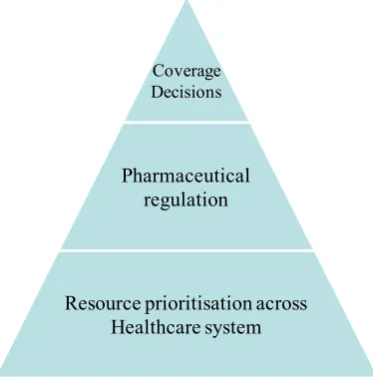
conflicting objectives – on the one hand (i) the objective of increasing the efficiency of the production of health gains for the population, through freely competitive markets allowing free pricing and no regulatory intervention by government bodies; and on the other hand (ii) the objective of achieving an equitable distribution in society of the benefits derived from health care resources through government intervention (Vogel, 2004). HTA decision-making on whether to recommend a new medication for public funding is a specific example of prioritisation of resources within a healthcare system. Figure 2.1 (below) outlines how coverage decisions fit within the concept of priority setting. The complexity around evaluating priority-setting decisions and their success is linked to the fact that various criteria can be used in prioritizing healthcare resources, such as: ethical considerations, efficiency considerations and effectiveness
considerations (Sibbald 2009; Al et al. 2004; Permanand 2006). If a healthcare system objective is to strive for effectiveness over efficiency, the prioritisation exercise would yield different results as supposed to a healthcare system that aims to sacrifice some efficiency gains to give more weight to ethical considerations, for example.
In Europe, when making funding decisions, HTA bodies can be influenced by
(Directorate General for Enterprise). Public health objectives related to pharmaceutical regulation focus on ensuring public health by providing patients with access to
[image:36.595.233.420.266.460.2]efficacious, safe and high quality medicines. The European Medicines Agency’s (EMA) ‘registrational requirement’ acts as a safeguard for patient health in this respect and addresses Public Health objectives. Finally, health policy objectives aim to balance equity and the efficiency of distribution of effective therapies for the patient population (Mossialos et al. 2004; Vogel 2004).
Figure 2.1 HTA Coverage Decisions as a mechanism of prioritisation of resources within the healthcare system
Due to the complexity surrounding priority-setting decisions, a number of different suggestions have been made regarding how to make decision-making more systematic. An important development recorded in the literature over the last few decades is the move towards evidence-based policy and evidence-based medicine as a means of making prioritisation decisions more rational, systematic, justifiable and transparent (Daniels and Sabin 1997; Drummond, Schwartz et al. 2008). Within the sphere of coverage decision-making, the HTA movement can be linked to this phenomenon, developed as a means of systematically evaluating evidence to come to a conclusion about the utilisation and funding of a new health technology.
Theoretical models have been developed to characterise how evidence has or can be used in policy-making. In social policy, several theoretical models have been proposed to explain how and to what extent evidence is incorporated in policy-making (Weiss 1979). For this research question, two particular models proposed by Weiss are
Coverage Decisions
Pharmaceutical regulation
relevant: (i) the ‘problem-solving model’ because it represents what evidence-based funding strives for, and (ii) the ‘interactive model’ which represents the situation where decisions are influenced by diverse factors, many of which are not evidence-based.
The premise of the ‘problem-solving model’ is that evidence, especially developed to answer a specific policy problem, is directly applied to solve the policy decision problem, in this case, coverage decisions. As outlined by Weiss (1979), the ‘problem-solving model’ suggests that evidence is integrated in decision-making through the following steps: “… definition of pending decision → identification of missing
knowledge → acquisition of social science research → interpretation of the research for the decision context → policy choice” (Weiss 1979 p. 428). Thus, in this model, the evidence is tailor-made to answer a specific policy-maker’s question and assumes that evidence is the primary influencer of the decision. It also assumes that, by directly influencing the decision, the evidence will also lead to a rationalization of resource use in accordance with the evidence. Furthermore, one of the key conditions of this model is that there is alignment between the researcher and decision-maker in terms of the problem definition and objectives.
There are several challenges however, when it comes to the implementation of the ‘problem-solving model’ in HTA decision-making. First of all, the model assumes that all evidence consistently supports a specific decision which is preferable to all other possible decisions (Weiss 1979). However, in reality, different sources of evidence can conflict with each other, and the need to combine different sources of evidence involves subjective value judgments about which aspects of the evidence are of greater or lesser relevance to the decision-problem.
“The problem that remains is: priority setting involves the adjudication between many relevant values and that people (and disciplines) will disagree about which values should dominate in any specific priority setting context and there is no agreed upon normative approach for resolving the disagreement” (Sibbald et al. 2009 p. 10).
This suggests it is important to distinguish between accessibility to high-quality,
relevant evidence which this model emphasizes, and the second step which involves the acceptability of the evidence, which is linked to the value judgements that surround the decision-problem, as highlighted by Sibbald et al. (2009) and Williams and Bryan (2007).
Another implementation challenge associated with the ‘problem-solving model’ is that it assumes that there are only two stakeholders, namely the decision-maker and the researcher. However, in reality, in many circumstances this is not the case. For example, NICE implements a broad and complex consultation programme for each of its appraisals to ensure that a variety of stakeholders are consulted and involved in the appraisal process. Stakeholders in the NICE process include clinicians, patient groups, carer groups, manufacturers. Stakeholders involved in the SMC process are equally varied. One of the key stakeholders for the HAS is the CEPs, the committee which uses HAS output to negotiate a reimbursed price. The ‘problem-solving’ model does not factor in the role of these additional stakeholders in the coverage decision-making process.
included the assessment of five different cost-utility models that pointed to different base case incremental cost-effectiveness results. Thus, despite a significant volume of economic evidence, the uncertainty for the Appraisal Committee remained – to the extent that the final appraisal allocated a range cost-effectiveness ratio for adalimumab, rather than a specific number, due to the lack of consensus.
A final challenge to the implementation of the ‘problem-solving’ model is that it assumes aligned objectives between the evidence provider and the decision-maker. However, there are empirical examples where objectives are not shared by both parties, and where objectives are unclear. For example, Al et al. (2004) describe four HTA decision-makers working at different decision-nodes within the system that had different objectives when making prioritisation decisions (i.e. equity considerations, efficiency considerations etc.). The authors stress the need to clarify objectives between HTA and the evidence provider so that the evidence is helpful in solving the decision-problem. The authors also show that there are implicit HTA preferences that influence their objectives, which correlates well with qualitiative findings from other research done on HTA preferences (Anell and Persson 2005; Haslé-Pham et al. 2005; Sinclair et al. 2008; Vuorenkoski et al. 2008). Thus, the objectives of HTA decision-making are not always transparent and known to the researcher or healthcare system.