2016 3rd International Conference on Information and Communication Technology for Education (ICTE 2016) ISBN: 978-1-60595-372-4
1 GENERAL INSTRUCTIONS
Energy and environmental protection is a hot issue in the field of engine development has been a concern. It has abundant natural gas reserves, low cost, high combustion efficiency advantages, the engine can achieve fuel with good economy and emission targets.
At home and abroad in recent years the study of natural gas combustion engine focused on system configuration, gas supply system, EGR system, and natural gas co-firing impact on engine performance, natural gas engine design modifications are also relevant reports. However, relatively little research on the ignition system parameters on engine idling gas emissions and catalyst light-off conditions emissions.
Therefore, on a compressed natural gas CNG engine to carry out ignition energy, ignition timing idling emissions from combustion catalytic converters and exhaust emissions operating mode transient changes of the influence of the energy to explore the CNG engine to reduce emissions, to lower emissions standard potential.
2 TEST RIG AND ENVIRONMENT
Experimental research paper, a 1.5L electronically controlled multi-point injection, in-line, naturally aspirated engine, the main parameters as shown in Table 1.
Main laboratory equipment: AVL PUMA engine bench measurement and control system, GH0563 type oil consumption meter, AMK ACNA 160 electric dynamometer, HORIBA MEXA-7100DEGR Straight mining type exhaust gas analyzer, engine stand with 592 systems and automotive drum type ETAS test-bed. Test ambient atmospheric pressure is 101kPa, temperature 25 ℃. Experimental study of comparative tests, the test data is not corrected.
Table 1. Main parameters of research engine.
Intake Natural aspirate Cylinder Number 4
Displacement/L 1.5 Fire order 1-3-4-2 Combustion shape Pent shape Rated power/speed/(kW/r/min) 80/6000 Maximum Turque/speed/(N·m/r/min) 240/2000~4500
Compression ratio/(-) 10.4 Gas Injection Mode Multi-point Valve and Timing System DOHC DVVT
Bore×Stroke/mm×mm 75×84.5
Testing Research on Effects of Ignition System Parameters on
Emission Performance of Gasoline Engine Fueled with
Compressed Natural Gas
Xianqing Shen
Hefei Vocational and Technical College, Hefei, Anhui 238000, China
Zhaoming Huang
Hehai University Wentian College, Maanshan, Anhui 238000, China
Li Wang
Xuancheng Vocational and Technical College, Xuancheng, Anhui 242000, China
3 TEST RESULTS AND ANALYSIS
3.1 Effects of ignition energy on idle speed
emissions
[image:2.612.63.289.195.367.2]In the engine test bench, keep running gas engine idling condition, the excess air ratio control in the vicinity of 1, idling condition set ignition advance angle is 10°CA, respectively, the ignition coil charging time of 3ms, 4ms and 5ms of HC, CO emission test of the test results shown in Figure 1 and Figure 2.
[image:2.612.325.539.226.726.2]Figure 1. Effects of Charging Time on HC at Idle Speed.
Figure 2. Effects of Charging Time on CO at Idle Speed.
As can be seen from Figure 1, with the increase of the ignition system ignition coil charging time, HC emission shows a clear downward trend; and CO emissions with the ignition coil charging time is not sensitive to changes. HC decline is because of the ignition coil charging time increases gradually increased ignition energy, nuclear fire changed after the formation of large ignition timing, speed up the flame propagation velocity, resulting in the burning time is shortened, in-cylinder combustion temperature and pressure rise, in favor of HC oxidation; CO produced while the engine is the main
subject of the excess air ratio, ignition energy is not directly related to the size. It is believed that when the gas engine is running at idle condition, it is possible by increasing coil charging time, increased ignition energy, promote rapid combustion, to reduce HC emissions targets.
3.2 Effects of ignition advanced angle on steady
emission of CNG engine
Were carried out outside the gas engine running characteristic conditions, the ignition angle for each point in the original condition on the basis of advance ignition angle 6°CA, 9°CA, 12°CA and 15°CA, experimental research HC, CO, NOx and the variation in the torque. The results are shown in Figure 3, Figure 4, Figure 5 and Figure 6.
[image:2.612.62.291.389.577.2]Figure 3. Effects of Ignition Advanced Angle on HC.
Figure 4. Effects of Ignition Advanced Angle on CO.
[image:2.612.336.532.577.733.2]Figure 6. Effects of Ignition Advanced Angle on turque.
From Figures 3, 4 and 5 can be seen, the amplitude of the ignition advance angle increases, HC showed a gradual rise in the law, CO essentially unchanged, NOx is greatly increased. Analysts believe that increasing the ignition advance angle, so that the piston combustion time point before top dead center increases, the burning time is shortened after top dead center; after the piston moves from top dead center down, due to the shorter combustion time, precipitated from the slot HC hard to be oxidized, the HC emissions rise; and CO emissions are substantially determined by the excess air ratio, so basically unchanged; the main conditions of NOx generated high temperature, high-temperature and high-temperature oxygen-rich duration, the ignition advance angle, so that the maximum combustion temperature rises, so a substantial increase in NOx emissions.
6 shows the torque variation diagram shows that the torque increases as the ignition timing of the first rise, then fall slightly. This is due to excessive ignition advance angle will lead to peak combustion pressure appears before TDC, affect the engine torque output. Considering Select the ignition advance angle 12°CA, to deliver optimized compromise HC, CO, NOx emissions and torque output.
3.3 Effects of ignition advanced angle on transient
emission of CNG engine
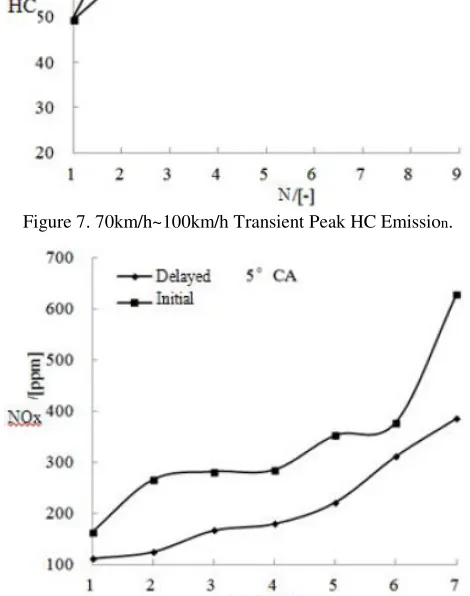
On the basis of the original engine ignition timing based on the delayed ignition angle 5°CA, experimental study 70km/h~HC and NOx catalytic converter 100km/h acceleration time after transient test results in Figures 7 and 8 shown.
Data in Figure 7 shows that natural gas engine transient delayed ignition angle can cause HC emission peak increased slightly, to launch HC emissions factors is more complex, the main subject of the excess air ratio control, time window and catalytic ignition angle control under the original emission factors; and NOx emissions by large combustion temperature impact, so the cause
delayed ignition angle after the maximum combustion temperature drops, NOx emission reductions, emissions presented variation of FIG.
[image:3.612.319.552.141.335.2]Transient control ignition angle greater impact on the drive-ability of the engine, so the engine into the transient calibration, the premise of ensuring good driving properties by reducing the ignition angle, effectively reduce NOx emissions from the engine.
Figure 7. 70km/h~100km/h Transient Peak HC Emission.
Figure 8. 70km/h~100km/h Transient Peak NOx Emission.
3.4 Effects of ignition system on catalytic ignition
mode
The firing angle of each point in the original condition on the basis of advance ignition angle 6° CA, 9°CA, 12°CA and 15°CA, conducted a natural gas engine catalytic converter light-off conditions runtime engine catalytic converter front Effects of temperature of the test. The results are shown in Figure 9.
[image:3.612.316.551.224.522.2]gas temperature with the ignition advance angle decreased.
Figure 10 shows the front engine catalytic converter temperature changes at different excess air ratio and different ignition coil charging time conditions. With the increase of excess air coefficient, exhaust temperature first and then increased and then decreased; increase exhaust gas temperature with the ignition coil charging time increases. Analysts believe that when the excess air ratio is small, incomplete combustion of natural gas, exhaust temperature to drop, as the excess air ratio is large, the flame spread rate of decline, the impact of the maximum cylinder combustion temperature, the exhaust gas temperature peaks in excess air ratio of 1.01 near to 1.05, then the natural gas combustion speed, complete combustion. Ignition coil charging time increases, increased ignition energy, nuclear fire ignition timing windows are formed larger, accelerate the combustion speed, so that the maximum combustion temperature, and therefore the exhaust gas temperature increases the charging time of the ignition coil rises.
Figure 9. Effects of Ignition Advanced Angle on Exhaust Gas Temperature.
Figure 10. Effects of Excessive Air Ratio on Exhaust Gas Temperature.
The above test results and analysis can be considered, natural gas engines in operation since catalyst combustion conditions, the ignition coil charging time should increase to increase the ignition energy, while appropriately delayed ignition timing, promote post-combustion engines to improve exhaust temperature, so that the catalytic converter to quickly reach the ignition temperature to reduce engine emissions.
4 CONCLUSION
Firstly, natural gas engine idle condition is running, the ignition coil charging time is increased ignition energy can be increased to obtain a lower HC emission performance.
Secondly, characteristics of the outer conditions, natural gas engines HC and NOx emissions as the ignition advance angle increased gradually increased, but no significant change in CO emissions.
Thirdly, to maintain a good driving premise, reduce the ignition angle, HC emissions increased slightly, but the transient NOx emissions dropped significantly.
Fourthly, the temperature of the exhaust gas catalytic converter is a decisive factor in NEDC fuel and pollutant emissions before the 100s; ignition coil charging time increases, delayed ignition angle, can enhance the engine exhaust gas temperature, rapid ignition and reduce pollutant emissions.
5 ACKNOWLEDGMENT
Thanks to the support and efforts from Hefei Vocational and Technical college for the essay work and publishing.
REFERENCES
[1]M. A. Kalam, H. H. Masjuki, T. M. I. Mahlia, etc. . Experimental Test of a New Compressed Natural Gas Engine with Direct Injection[C]. SAE Paper 2009011967, 2009.
[2] Jiao, Yun-jing, Dong Hong, Zhang Hui-ming, et al. Effect of combustion chamber geometry on combustion process in spark ignition natural gas engine[J]. Chinese Internal Combustion Engine Engineering, 2009, 30(4): 28~33 [3] Zheng, Zun-qing, Yao Ming-fa, Lin Zhi-qiang, et al.
Development of Combustion System of an Electric Controlled Lean Burn CNG Engine for Meeting China Stage Ⅳ Emission Regulations[J]. Chinese Internal Combustion Engine Engineering, 2009, 30(5): 7~11 [4] Sauhard Singh, Anil Bhardwaj, Reji Mathai, etc..
Evaluation of Long Drain Gas Engine Oil on Heavy Duty Engine Using Hydrogen Blended CNG[C]. SAE Paper 2015010966, 2015
[image:4.612.61.292.319.487.2] [image:4.612.59.292.515.710.2][6] Roussos G. Papagiannakis, Dimitrios T. Hountalas, Constantine D. Rakopoulos. Combustion and Performance Characteristics of a DI Diesel Engine Operating from Low to High Natural Gas Supplement Ratios at Various Operating Conditions[C]. SAE Paper 2008011392, 2008. [7] Amrit Singh, David Anderson, Mark Hoffman. An
Evaluation of Knock Determination Techniques for Diesel-Natural Gas Dual Fuel Engines[C]. SAE Paper 2014012695, 2014.