University of Huddersfield Repository
Elmogla, Mahmoud
Corporate social reporting in a transition economy: the case of Libya
Original Citation
Elmogla, Mahmoud (2009) Corporate social reporting in a transition economy: the case of Libya. Doctoral thesis, University of Huddersfield.
This version is available at http://eprints.hud.ac.uk/id/eprint/9047/
The University Repository is a digital collection of the research output of the University, available on Open Access. Copyright and Moral Rights for the items on this site are retained by the individual author and/or other copyright owners. Users may access full items free of charge; copies of full text items generally can be reproduced, displayed or performed and given to third parties in any format or medium for personal research or study, educational or notforprofit purposes without prior permission or charge, provided:
• The authors, title and full bibliographic details is credited in any copy; • A hyperlink and/or URL is included for the original metadata page; and • The content is not changed in any way.
For more information, including our policy and submission procedure, please contact the Repository Team at: [email protected].
1
CORPORATE SOCIAL REPORTING IN
A TRANSITION ECONOMY: THE
CASE OF LIBYA
MAHMOUD ELMOGLA
A Thesis Submitted to the University of Huddersfield
in Partial Fulfilment of the Requirements for the
Degree of Doctor of Philosophy
University of Huddersfield
Business School
Department of Accountancy
2
CORPORATE SOCIAL REPORTING IN
A TRANSITION ECONOMY: THE
CASE OF LIBYA
MAHMOUD ELMOGLA
PhD
3
Abstract
The social and economic environments of developing countries differ from those of liberal market economies of the developed countries, and the differences are reflected in the accounting disclosure practices. Recent years have shown an increased attention paid by accounting research to Corporate Social Responsibility and Disclosure which is recognized as having the potential to enhance the transparency of business enterprises’ social influence, enabling the wider society to hold business enterprises more accountable for their operations. Corporate Social Responsibility and Disclosure practices in most developing countries remain fairly rudimentary and relatively few studies have focused on the corporate social responsibility disclosure practices in such countries.
The aim of this study is to investigate corporate social responsibility disclosure in Libyan companies’ annual reporting in the light of the country’s economic, social and political environment. In particular, it seeks to map current corporate social disclosure in annual reports and to understand various parties’ views of that practice and its possible future development.
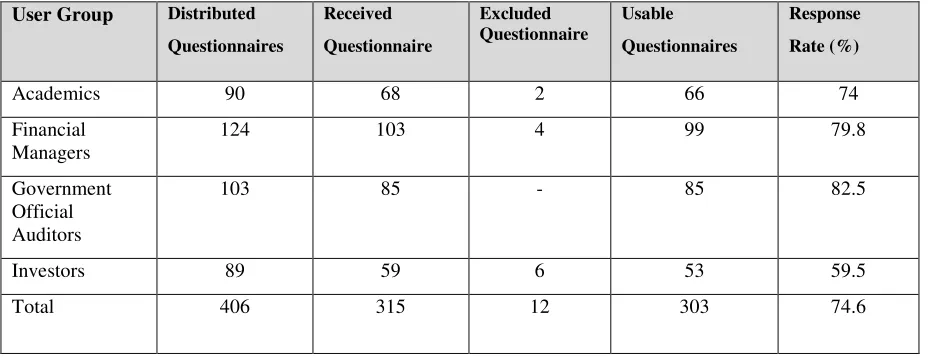
To achieve the aim and particular objectives of the study it was necessary to utilise more than one research method. Firstly, a descriptive method is used to provide an overview of accounting and its environment in a developing country, and the economic, social and political environment in Libya. Secondly, empirical evidence covering a five year period across a sample of private and public companies in Libyan environment is presented using content analysis to analyse the companies’ annual reports. Finally, an empirical survey by personally delivered and collected questionnaire of 303 participants in four groups of research participants (academic accountants, financial managers, government officials and investors) was performed to explore the views and perceptions regarding corporate social reporting in Libya.
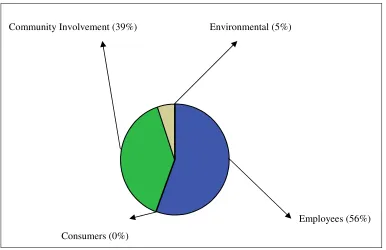
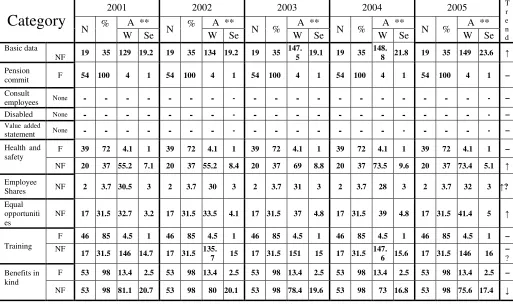
The content analysis showed that Libyan companies generally disclose some information related to social responsibility. However, the amount of information is low compared with counterparts in developed countries. Employee and community involvement are the themes that the companies disclose most information about.
4
Contents
CORPORATE SOCIAL REPORTING IN A TRANSITION ECONOMY: THE CASE OF
LIBYA ... 1
Abstract ... 3
Acknowledgements ... 10
Chapter One: Introduction and Outline of the Study ... 12
1.1 Introduction and Background ... 13
1.2 Background, Literature and Justification for the Research ... 14
1.3 Research Aims ... 18
1.4 Research Method ... 19
1.5 Research Importance and Contribution ... 21
1.6 Structure of the Thesis ... 22
Chapter Two: Corporate Social Reporting and Disclosure: A Review of the Literature ... 24
2.1 Introduction ... 25
2.2 A Definition and Brief History of Corporate Social Reporting Practice ... 27
2.3 The Scope and use of Corporate Social Reporting and Disclosure Practice ... 33
2.4 Theories for Approaching Corporate Social Reporting and Disclosure practice ... 38
2.4.1 Political Economy Theory ... 41
2.4.2 Legitimacy Theory ... 44
2.4.3 Stakeholder Theory ... 49
2.5 A Survey of Corporate Social Reporting Studies ... 61
2.6 Conclusion ... 83
Chapter Three: The Libyan Environment ... 84
3.1 Introduction ... 85
3.2 The Libyan Environment and Its Accounting Practices ... 85
3.2.1 The Influence of Culture ... 87
3.2.2 The Influence of Political Environment ... 89
3.2.3 The Influence of the Legal System ... 91
3.3 Overview of the Libyan Economy ... 93
3.4 Accounting Practices and Auditing ... 96
3.4.1 Statutory requirements ... 96
3.4.2 The Influence of Accounting Practices and Principles from Abroad ... 99
3.4.3 Libyan Accounting Education ... 100
3.5 The Structure and Content of Annual Reports and Disclosure Practices ... 103
3.6 Conclusion ... 105
Chapter Four: Research Methodology and Methods ... 107
4.1 Introduction ... 109
4.2 Philosophical Assumptions ... 111
4.2.1 Ontology ... 112
4.2.2 Epistemology ... 112
4.2.3 Human Nature ... 113
4.3 Research Methods ... 113
5
4.4.1 Content Analysis ... 119
4.4.2 Questionnaire ... 134
4.5 Summary and Conclusion ... 149
Chapter Five: The Content Analysis ... 151
5.1 Introduction ... 152
5.2 Trends in Social Disclosure ... 152
5.3 Trends within Social Disclosure ... 153
5.3.1 Trends in Employee Disclosure ... 154
5.3.2 : Trends in Community Involvement Disclosure ... 168
5.3.3 : Trends in Environmental Disclosure ... 174
5.4 Summary and conclusion ... 179
Chapter Six: Findings of the Questionnaire Survey ... 181
6.1 Introduction ... 182
6.2 Background Information of Respondents ... 182
6.2.1 Academics ... 182
6.2.2 Financial Managers: ... 183
6.2.3 Governmental Official Auditors ... 183
6.2.4 Investors ... 183
6.2.5 Summary of Key Points ... 183
6.3 The main purpose (s) of Corporate Disclosure ... 185
6.4 Analysis of Perceptions on the Wider Disclosure of Corporate Social Responsibility Information ... 192
6.4.1 Perception on the Disclosure of Corporate Social Responsibility Information in Libya ... 192
6.4.2 Perception on the Company's Social Responsibility ... 196
6.4.3 Perception on the Method of Corporate Social Responsibility Disclosure ... 200
6.4.4 Perception on the Motivation for Companies’ Social Responsibility ... 201
6.4.5 Perception on the Location of Corporate Social Responsibility Disclosure ... 204
6.4.6 Perception on the Main Reasons for not Making Corporate Social Responsibility Disclosure in Libyan Companies ... 205
6.4.7 Perception on Methods of Establishing Disclosure ... 209
6.4.8 Perception on Right to Information ... 210
6.5 Disclosure Information about the Following Categories of Social Information ... 213
6.6 Summary and Conclusion ... 217
Chapter Seven: Summary and Conclusion... 218
7.1 : Introduction ... 219
7.2 Discussion of Results ... 242
7.2.1 Research aim one: the amount and type of social disclosure by Libyan companies... 242
7.2.2 Research aim two: trends and patterns in corporate social disclosure ... 242
7.2.3 Research aim three: stakeholders estimation of the usefulness of current social disclosure and the possible future development ... 242
7.2.4 Research aim four: using the finding derived from meeting objectives one to three in order to reflect upon social accounting in transition economies ... 242
7.3 Implications for the Interpretations of Corporate Social Reporting and Disclosure ... 242
7.4 Contributions and Recommendations: ... 242
7.5 Limitations and Further Research ... 242
6
7.5.2 Further Research ... 242
7.6 Conclusion ... 242
References ... 243
Appendices ... 256
Appendix A: Questionnaire Covering Letter ... 257
Appendix B: Research Questionnaire ... 259
Appendix C: Arabic Translation of the Research Questionnaire ... 266
7
List of Tables
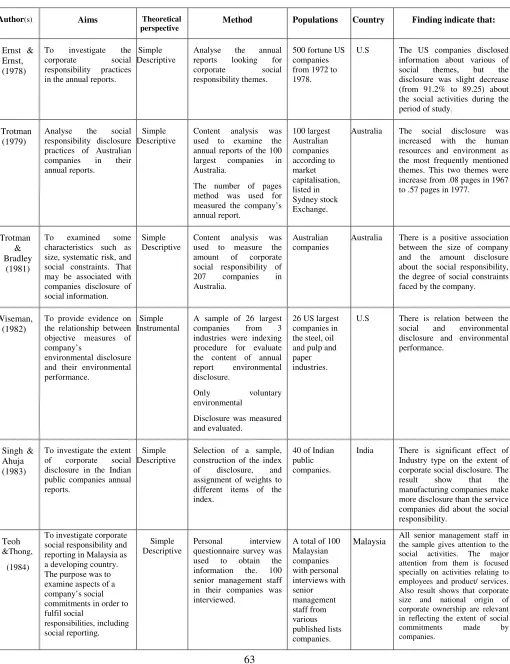
Table 2-1: Summary of previous studies ... 63
Table 4-1: Alternative Terms for the Research Paradigm ... 116
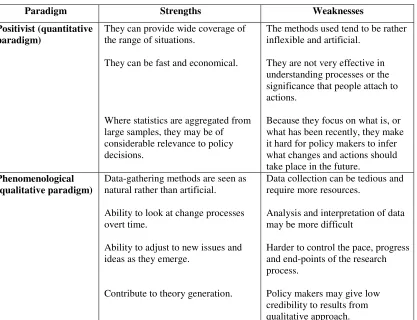
Table 4-2 Strengths and Weaknesses of Positivistic and Phenomenological Paradigms ... 117
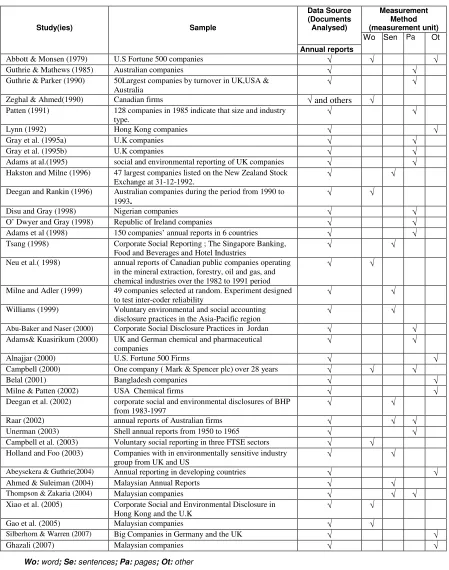
Table 4-3: Summary of Studies that Used Content Analysis as A Research Method ... 122
Table 4-4: Response Rate (content analysis) ... 134
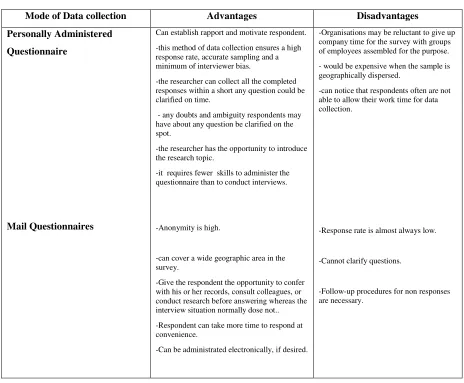
Table 4-5: Advantages and Disadvantages of Questionnaires ... 136
Table 4-6: Response rate for the questionnaire survey ... 149
Table 5-1: Companies' Disclosure of Corporate Social Responsibility Information ... 153
Table 5-2: Employee Disclosure (Total) ... 156
Table 5-3: Employee Disclosure (Oil companies / Government) ... 157
Table 5-4: Employee Disclosure (Industrial Companies / Government) ... 159
Table 5-5: Employee Disclosure (Industrial Companies / Private) ... 160
Table 5-6: Employee Disclosure (Service Companies / Government) ... 162
Table 5-7: Employee Disclosure (service companies / Private) ... 163
Table 5-8: Employee Disclosure for all Companies 2005 ... 165
Table 5-9: Community Involvement Disclosure (Total) ... 168
Table 5-10: Community Involvement Disclosure (Oil Companies / Government) ... 169
Table 5-11: Community Involvement Disclosure (Industrial / Government) ... 170
Table 5-12: Community Involvement Disclosure (Industrial / private) ... 170
Table 5-13: Community Involvement Disclosure (Service Companies / Government) ... 171
Table 5-14: Community Involvement Disclosure (Services Companies /Private) ... 173
Table 5-15: Community Involvement Disclosure for All Companies ... 174
Table 5-16: Environmental Disclosure (Companies / Total) ... 176
Table 5-17: Environmental Disclosure (Oil companies / Government) ... 176
Table 5-18: Environmental Disclosure (Industrial Companies / Government) ... 177
Table 5-19: Environmental Disclosure All Companies 2005 ... 178
Table 6-1: Highest Educational Qualifications of Respondents ... 184
Table 6-2: Place of Study ... 184
Table 6-3: Experience of Respondents ... 185
Table 6-4: Experience in Accountancy of Respondents ... 185
Table 6-5: The Important that the Target Groups attach to the Purpose(S) of Corporate Annual Reports ... 187
Table 6-6: The purpose(s) of Corporate Annual Reports: Different Groups Views ... 191
Table 6-7: The Important that the Target Groups attach to the Corporate Social Responsibility ... 193
Table 6-8: Perception on the Disclosure of Corporate Social Responsibility Information in Libya ... 195
Table 6-9: The Important that the Target Groups Attach to the Company’s Social Responsibility Disclosure ... 197
Table 6-10: Perception on the Company’s Social Responsibility Disclousre ... 199
Table 6-11: Methods of Corporate Social Responsibility Disclosure ... 201
Table 6-12: The Important that the Target Groups Attach to the Motivation for Companies’ Social Responsibility ... 202
8
Table 6-14: Location of Corporate Social Responsibility Disclosure ... 205
Table 6-15: The Important That the Target Groups Attach to Reasons Behind ... 206
Table 6-16: Main Reasons for not Making Corporate Social Responsibility Disclosure in Libyan Companies ... 208
Table 6-17: Methods of Establishing Disclosure ... 209
Table 6-18 : The Important That the Target Groups Attach to Right to Information ... 210
Table 6-19: Perception on Right to Information ... 212
Table 6-20: The Important that the Target Groups Attach to Disclosure Information about the Following Categories of Social Information Related to Companies ... 214
9
List of Figures
Figure 5-1: Proportion of Disclosure (2005) ... 154 Figure 5-2: Basic Data Disclosure (Words- non Financial) for All Companies 2005 ... 165 Figure 5-3: Training Disclosure (Words-Non Financial) for All Companies 2005 ... 166 Figure 5-4: Benefits in Kind Disclosure (Words-non Financial) for All Companies 2005 ... 166 Figure 5-5: Community Disclosure (Words- non financial) for All companies (2005) ... 174 Figure 5-6: Environmental Disclosure (Words-Non Financial) for all Companies 2005 ... 178 Figure 5-7: Waste, Pack, Pollution, Recycle, Product, Land Disclosure (Words-non Financial)
10
Acknowledgements
I am indebted to many people in the process of writing this research. My greatest debt
is to my supervision team, my director of studies Professor Chris Cowton, for believing in me, helping me to develop my ideas, and for the compassionate support
he has given me through the years. In fact, no words can fully describe my gratitude to
him. He has always been there to listen, to counsel and to help fashion, and stretch out
ideas that were most appropriate for the research. In simple words, he is a very
knowledgeable and professional academic whom. I consider myself fortunate and
honoured to have had as my mentor and director of studies. My second supervisor, Dr.
Messaoud Mehafdi, has also been very generous with his time and excellent advice on the questionnaire and on the final draft of this thesis. I am grateful for their kindness,
encouragement and patience.
My thanks also go to:
The Libyan Government, particularly the General Committee of Education and the
Elmergib University for giving me this chance and sponsoring me to study for a Doctorate at the University of Huddersfield Business School; all the 54 companies in Libya who participated in this study; all the respondents to the questionnaire survey for willingly finding the time to complete the questionnaire; also, all the other people
who gave me enormous assistance, particularly during the period I spent in Libya to
gather the data for this research. Without the generous help of all these people, data
collection would have been difficult, if not impossible.
Last but not least, I would not be the person who I am today without the endless
sacrifices, support, prayers, love, and motivation of my beloved mother. Her patience
and endurance throughout the years, in which I was studying for my degree in the UK,
could not be possibly compensated for but hopefully rewarded by its successful
completion. I am also obliged to my brothers and my sister for their support and
11
To
To
To
To
My Mother
My Mother
My Mother
My Mother
Brothers and sisters
Brothers and sisters
Brothers and sisters
Brothers and sisters
My Wife
My Wife
My Wife
My Wife Amal
Amal
Amal
Amal
My
My
My
My Daughters
Daughters
Daughters
Daughters
R
R
Raaaayan
R
yan
yan
yan
Rawan
Rawan
Rawan
Rawan
My Son
My Son
My Son
My Son
12
Chapter One
Introduction and Outline of the Study
1.1 Introduction and Background...13
1.2 Background, Literature and Justification for the Research...14
1.3 The Research Aims...18
1.4 Research Methods...19
1.5 Research Importance and Contribution……...21
13
1.1 Introduction and Background
The aim of this chapter is to explain and justify the focus of the research reported in
this thesis (corporate social reporting by Libyan companies through their annual
reports) and to provide an overview of the research and thesis. The term Corporate
Social Reporting has been variously defined and used. Gray, Owen, & Maunders
(1987, p. 3) have defined it follows:
…The process of communicating the social and environmental effects of organizations’ economic action to particular interest groups within society and to society at large. As such it involves extending the accountability of organizations (particularly companies), beyond the traditional role of providing a financial account to the owners of capital, in particular, shareholders. Such an extension is predicated upon the assumption that companies do have wider responsibilities than simply to make money for their shareholders.
Such a definition of corporate social reporting arguably omits certain aspects of social
accounting practice (e.g. management accounting on social issues), but it describes
well corporate social reporting, which has emerged in response to a combination of
public opinion, investors’ assessment and changes in the corporate self-concept in
developed countries. Corporate social reporting and disclosure provides information
about, for example, employment, products, community involvement, energy, and the
prevention or reduction of pollution (Gray et al., 1987; Mathews, 1997). Concerning
the role of business in the community, corporate social reporting is an extension of the
financial disclosure system that reflects the wider expectations of society. Since
the1960s, social disclosure has shown sporadically, with particular interest in
corporate social responsibility. As a result, corporate social reporting and disclosure
have become a hot topic of discussion and investigation among academic accounting
researchers (Gray, 2001; Mathews, 1997).
Also the volume and richness of corporate social reporting by large companies has
risen over the last three and half decades (Smith, Adhikari, & Tondkar, 2005) –
particularly since 1990, when environmental concerns stimulated interest in
environmental reporting, and more recently on a broader front. This growth has been
accompanied by a large number of academic studies (e.g. Adams, Coutts, & Harte,
1995; Golob & Bartlett, 2007; Gray, Kouhy, & Lavers, 1995a; O’Riordan &
14
This chapter provides the foundation for the research reported in this thesis. It
discusses the rationale and motivation for the research, aim and objectives. It also
contains a summary of the methodology applied, as well as the structure of the thesis
presented.
1.2 Background, Literature and Justification for the Research
Corporate social reporting and disclosure has been the subject of debate for some time
and was one of the main areas of debate in the literature, of the field, especially in the
1970s, 1990s and 2000s. However, the special focus in the 1990s was on the
environmental issues, at the end of this century both social and environmental
accounting and disclosure issues became embedded in organisational convention.
In particular, several studies have been undertaken to observe the developments that
have taken place in companies’ annual reports to give information about social and
environmental performance on a par with the concern over social accounting and
disclosure. Studies in social disclosure in general and in annual reports in particular
were looking for various issues some were looking for the relationship between social
responsibility and other themes related to companies such as level of income, the type
of companies and the size of the companies. Moreover, some of these studies were
especially looking for the social information in companies annual reports in both
developed and developing countries (Andrew, Gul, Guthrie, & Teoh, 1989; Bowman
& Haire, 1976; Cormier & Gordon, 2001; Ernst & Ernst, 1978; Singh & Ahuja, 1983;
Smith et al., 2005; Trotman, 1979; Tsang, 1998).
Thus, research has shown that some companies operating in the developed countries
adjusted their annual reports to embrace social and environmental issues, at least to
some extent. The companies use this material to highlight their achievements in
reducing pollution, protecting the environment, and addressing employees’ welfare,
for example. Moreover, they address other various social welfare issues that would be
of interest to society at large (Gray, Owen, & Adams, 1996). Although companies can
communicate their messages in many different ways, Tilt (1994) found the annual
report to be the most commonly used for corporate social information; and the annual
report has been found to be an important source of information for many users
15
about social and environmental performance; separate reporting and websites as well
have achieved some prominence in developed countries in recent years.
In this context, Hopwood (1996) argued that corporate annual reports have become a
highly sophisticated product of the corporate design environment, the main purpose of
which is to proactively construct a particular visibility and meaning rather than
revealing. Therefore, corporate annual reports create the picture of corporation, and
stakeholders are inclined to think and act on that. To construct this picture, the modern
corporate annual reports use the tools of management, marketing and communication
theory. The corporation discloses this information, financial and social, as the aims of
corporations have evolved from the idea of concentrating on making profit only to
providing services to society in conjunction with profit making (Alsairrafi, 1990).
These new aims have allowed the corporation to become more involved with society.
As a result, users now expect to receive timely information, including information
about social performance, to give them the opportunity to make decisions or take
action concerning companies’ behaviour (Swift, 2001). Moreover, the aim of
corporate social reporting should be to disclose information that benefits the users and
the society at large (Naser & Abu-Baker, 1999). This information should consider
which stakeholders’ influences would be most salient to business. Consequently,
companies must decide at the outset which stakeholders they are targeting (when
generating this information), find out what stakeholders think, and what they want
(Wheeler & Elkington, 2001). Moreover, it is expected that the usefulness of
information for making decisions should be the primary quality to seek in deciding
what is to be reported and how that reporting is to be done. For information to be
useful, many authors arrange the attributes that accounting should possess, for
example relevance, reliability, timeliness and understandability (Accounting
Standards Steering Committee, 1975). Gray (1990) argues that by providing this
additional environmental (and social) information we can firstly keep organizational
decision-makers informed about the use of economic resources and, secondly, inform
the public about the way in which organizations are using the resources.
Therefore, to emphasize their achievement in reducing pollution, protecting the
16
industrialised countries have recently tailored their annual reports to embrace sections
on social issues. Other social welfare issues that would be of interest to society at
large are also addressed in these company’s annual reports. As these project ethical
and social concerns they become more relevant to the users (Gray et al., 1996). The
social issues which are addressed by companies have attracted academics concerning
the study of corporate social responsibility and reporting practices, especially in
developed countries.
From the literature it can be noticed that there have been many empirical studies
undertaken in Western Europe, Australia and the USA. The majority of comparative
research of corporate social reporting focused on analyses and evaluations of the
similarities and differences of corporate social reporting practices in these countries
alone (e.g. Campbell, 2000; Ernst & Ernst, 1978; Guthrie & Parker, 1990). However,
it can be dangerous to generalize the findings of these researches to less developed
countries because the stage of economic and social development is likely to be a
significant factor affecting corporate social disclosure practices. Adams (2002) in this
context argues that the results of empirical research must be interpreted with caution.
Although, in summarising some of the literature on corporate social reporting most
studies undertook so far were concentrated on large firms and the samples vary from
study to another in terms of both size and type of composition. Differences in country
and period of time with different explanatory variables also make generalisations
questionable. Moreover, accounting practice in general and social practices in
particular seem to be affected by culture and national differences as well (Mathews,
1993). In this context, Gray et al. (1995a) also find that the nature and volume of
corporate social reporting tends to vary both over time and between different
economies, with the issues regarded as important in other places or different periods.
Although several research studies show that annual reports disclose information
relevant to the discharge of environmental and social responsibility (Adams, Hill, &
Roberts, 1998; Mathews, 1997), the number of studies is limited, even in developed
countries where practice is changing quickly, and it is extremely limited in developing
countries (Abu-Baker & Naser, 2000). Companies in these latter countries provide an
opportunity for researchers to study the growth of corporate social responsibility and
17
planned economy to open market such as Libya. Researchers take this opportunity
also to find out if Libyan companies provide the same social responsibility
information provided in the economies of in the developing or developed countries,
and also to know if this information which is disclosed is useful for the stakeholders to
help them acquire a clear picture about the companies’ social performance and
disclosure. Findings will add some contribution to the social responsibility disclosure
literature.
The change from planned to market economy requires various tasks. The first is
systematic transformation, meaning the change of the economic system from
state-ownership and central planning to private state-ownership and market allocation of
resources. The second is financial stabilization, meaning the end of the pre-reform
monetary overlong, high repressed and open inflation, and large fiscal deficits. The
third is structural adjustment, meaning the initial reallocation of resource in the
economy following the introduction of market force. The last and long-term task is the
implementation of a framework to promote rapid economic growth. These four tasks
are interrelated, yet conceptually distinct (Sachs, 1996). Moreover, this transition
imposes restructuring of companies, the liberalization of trade and finance and to be
able to polarize influx of direct investment. This change places pressure on accounting
systems to be able to prepare and provide acceptable information about financial,
social and environmental performance that users need for decision-making and
strategic planning. Moreover, this information should not only be used for the
transition period, but also in helping the company’s challenges in the future.
Companies in the Libyan case were controlled and supervised by the Libyan
government. But after the transition from a planned to a market-based system which
started a few years ago, some companies are becoming private and others are
restructuring and under the control of the General Board of Ownership Transfer of
Public Companies and Economic Units (this association is delegated to achieve the
program of transferring public companies to the private sector).
The Libyan context provides a potentially interesting opportunity for researching
corporate social reporting practices and related issues. Investigation of the Libyan
18
countries especially ones in the transition economy stage, and also will contribute to
literature specialising in the Arab countries, a region that is still deeply rooted in the
conventional social and economic structures of the past (Jahamani, 2003).
Investigating the corporate social reporting and disclosure in Libya will provide an
additional insight into corporate reporting. And it will aid in understanding the
accounting practices in a Libya which is seeking to gradually veer away from
socialism towards a more western capitalist system. Therefore, the finding of this
research can complement those of other similar studies in Arab nation or other
developing countries (e.g. Abu-Baker & Naser, 2000; Al-Khater & Naser, 2003;
Jahamani, 2003; Naser & Abu-Baker, 1999).
This current study’s main purpose is to address the above mentioned imbalances
through an examination of corporate social reporting by Libyan companies over a
five-year period from 2001 to 2005. According to Kisenyi & Gray (1998) studying
third world countries such as Libya is important for conducting research to steadily
learn more about social and environmental accounting and disclosure practices in the
English-speaking and European countries. They added:
…we still know too little about practices in ex-colonial, smaller and/or emerging countries. Learning about these countries -such as who did there Uganda where there study complete - is not only valuable for stimulation it offers to the jaded palettes of western scholars but also, more importantly, it can provide vivid challenges to the presupposition baggage with which Western research typically approach issues.
This study has chosen Libyan companies for two reasons. First, Libya is a developing
country and it is at a transition stage; as a result accounting information in annual
reports needs to be researched to meet users’ need. Second, little research relating to
accounting information disclosure practices and, in particular, corporate social
disclosure practice has been undertaken in Libya previously.
1.3 Research Aims
The main aim of this research is to investigate social accounting in a transition
economy in a less developed country, namely Libya. To achieve this aim, the research
19
1- To document the amount and type of social disclosure by Libyan companies in
annual reports.
2- To identify trends and patterns in corporate social disclosure and to explore
possible reasons for these.
3- To evaluate the usefulness of current social disclosure for user groups and to
ascertain their opinion of possible future developments, and to compare their
opinions with companies’ intentions
4- To use findings derived from meeting objectives one to three in order to reflect
upon social accounting in transition economies.
The research is concerned to make suggestions about the future development of
corporate social disclosure in Libya. Thus it seeks to map the existing state of
corporate social disclosure in Libya and to ascertain its trend. This is important as a
benchmark for understanding the practice on which users are commenting and the
likelihood of their future desires being satisfied without policy interventions. A
second way of conceiving of the research as a whole is to see the user opinions as
providing an input to the evaluation of current practice. Although the research may be
seen as a package of related aims or questions, it is not possible to use a single method
to address them all. Thus, as discussed below and further in Chapter Four,
complementary research methods have been employed, each appropriate to the
elements of the research aims being pursued.
1.4 Research Method
This section provides a summary of the research methodology used to meet the
research aims. Chapter Four of this study provides the specification of the detailed
methodology used, including the rationale for the selection of the research
methodology. In order to develop a fuller and richer picture of these companies’ social
disclosure, two methods were utilised in this research to gather the data, namely a
content analysis of annual reports and a questionnaire survey.
20
context of this kind of disclosure in a developing country with a transition economy.
The data was used to achieve the research aims one and two. The content analysis
technique, according to Neuendorf (2002), is considered the fastest growing in
quantitative research. The literature introduced a number of definitions concerning
content analysis techniques in the area of quantitative message analysis. One of the
earliest definitions of it viewed it as “a research technique for the objective,
systematic and quantitative description of the manifest content of communication”
(Berelson,1952:179 cited in Milne & Adler, 1999). Content analysis technique defined
as process “A research technique for making replicate and valid inferences from data
to their context.” (Krippendorff, 1980, p. 21). Abbott & Monsen (1979) also argued
that content analysis is a technique for gathering data that consists of codifying
qualitative information in anecdotal and literary from into categories in order to drive
quantitative scales of varying levels of complexity. Content analysis is used in many
fields such as literature, history, journalism, political science, education, psychology
and so on (Neuman, 2003). Because content analysis allows corporate social
disclosure to be systematically classified and compared, it is useful for determining
trends (Milne & Adler, 1999) It is used by numerous studies as a data gathering tool
(see Chapter Four).
The exploratory stage of the data collection process employed a form of content
analysis to extract data on social activity from annual reports of Libyan companies.
According to Abu-Baker & Naser (2000), who undertook work in a developing
country, the general corporate social reporting is little used, so it is likely that most of
the information provide is trough the annual report. This makes annual reports in these
countries a valuable source of information.
The specific measurement instrument used in this study was derived from the work of
Gray, Kouhy, & Lavers (1995b), which is based on the earlier work of Ernst & Ernst
(1978) and Guthrie & Mathews (1985). The approach investigated categories within
three measurements:
1- Theme: A) Trends in Employee disclosure: Basic data, Pension commit, Consult employees, Disabled, Value added statement, Health and safety, employee Shares,
21
B) Trends in Community Involvement Disclosure: Charity and Political, and
Community.
c) Trends in environmental disclosure: Environmental Policy, Financial data,
Sustainability, Energy, Environmental audit, Waste, Pack, Pollution, Recycle,
Product, Land, and Environmental Others.
2- Evidence: monetary, quantitative (not monetary) and descriptive. 3- Amount: proportion of the word count and sentences.
The Questionnaire Survey aimed to determine how the key stakeholders perceived corporate reporting in general and social disclosure in particular, with the data being
used to answer research question three. The questionnaire was the most popular
method used by the majority of previous studies in term of investigating individuals’
views in relating to corporate social disclosure issues (see Chapter Four).
The questionnaire in this study was divided into three parts based on the areas
identified in the literature (see Appendix A). The first part related to the respondents’
perception about corporate annual reporting in general. The second part asked to the
respondent’s questions to know their opinion about social disclosure and the reasons
and motivation behind disclosure for corporate social responsibility information. The
respondents were asked to indicate their opinion on a five-point Likert scale. The third
part of the questionnaire requested general information on the respondents’
background and the positions of the respondents. The questionnaire was pre-tested
twice. The first pilot study of the questionnaire was produced in UK with a
supervision team and then colleagues. The second phase of the pilot study was
conducted in Libya. Comments and suggestions were incorporated in the last version
of the questionnaire. The final Arabic questionnaire was distributed in the final
survey.
1.5 Research Importance and Contribution
Compared to developed countries, research studies considering corporate social
responsibility reporting and disclosure in emerging and transitional economies is still
22
studied how Libyan companies satisfy perceived needs for information relating to
social and environmental impacts and how they might do that with the provision of
information to develop in the future. Therefore, the main expected contributions of
this research:
(1) This research contributes to the limited studies on corporate social disclosure
conducted in developing economies in general (see Chapter Two for a review
of studies).
(2) In particular, it gives insight into corporate social disclosure of practices in
Libya, which is an Arab example of a developing country with a transition
economy.
(3) Particular features of the study are: first, an examination of trends over five
years period rather than taking a one-year snapshot, which is more usual in the
literature; and second, relating the results of content analysis to users’ views.
Again, it is unusual to combine the two sorts of study in one project.
1.6 Structure of the Thesis
The thesis is structured into seven chapters:
Chapter One provides an introductory outline of the research and highlights the rationale and motivation for this study. It also explains the objectives of the study and
provides a summary of the research methodology.
Chapter Two introduces the topic of corporate social reporting and disclosure, reviewing the relevant literature. It discusses the definitions of corporate social
reporting as well as its context and scope. The different disclosure theories which
have been proposed as appropriate for explaining or directing corporate social
reporting are also reviewed in this chapter. Finally, a summary of the nature and
content of corporate social reporting studies undertaken in both developed and
developing countries is provided.
Chapter Three the purpose of this chapter is to cover the background of Libyan companies in order to provide a context for the empirical research and a basis for later
23
characteristics on the social practices of Libyan companies. It focuses Libyan social,
political, economic and legal systems, and the state of accounting education.
Chapter Four develops the research methodology and methods underpinning the study. Philosophical assumptions that guide any academic research project are
outlined. These include ontology, epistemology, human nature and methodology.
Moreover, the differences between positivism and phenomenology and qualitative and
quantitative approaches are discussed in this chapter. The criteria for the research
methods selected are presented, including design, data gathering and analysis
techniques employed.
Chapters Five and Chapter Six presents the findings of the data gathering and analysis, focusing on content analyses of annual reports and the finding of a
questionnaire survey respectively. They also summarise and briefly discuss the
results.
Chapter Seven discusses the findings, provides conclusions, and considers possible explanations of, and implications for, corporate social reporting practices of Libyan
companies. A highlight of the limitations of the study is also provided. Based on the
study, conclusions, recommendations and recommendations for future research in
24
Chapter Two
Corporate Social Reporting and Disclosure:
A Review of the Literature
2.1 Introduction...25 2.2 A Definition and Brief History of Corporate Social Reporting Practice...27
2.3 The Nature and the Scope of Corporate Social Reporting...33
2.4 Theories for Approaching Corporate Social Reporting and Disclosure Practices...38 2.4.1 Political Economy Theory...41
2.4.2 Legitimacy Theory...44
2.4.3 Stakeholders Theory...49
2.5 Survey of Corporate Social Reporting Studies...61
25
2.1 Introduction
In recent years much attention by companies and researchers has been given to
corporate social reporting and disclosure mainly it is an issue that touches different
important aspects of concern to us all. Becoming a topical area of discussion issue in
many countries around the world (Samuel & Walter, 2009), it arose as a travelling
companion to the social responsibility debates in the 1960s and early 1970s, when the
earlier researchers examined corporate social responsibility and disclosure activities
in many areas including inter alia, environmental issues, equal opportunity policies,
employee concerns, energy policies and community involvement (Epstein, Flamholtz,
& McDonough, 1976; Mathews, 1997). During this period there were social, political
and economic pressures on corporate managers to be socially responsible. The
accounting profession recognized the importance of the corporate social accounting
issue, when in 1973, the study Group on Objectives of Financial Statements reflected
on the importance being placed on social accounting by stating that one of the basic
objectives of corporate reporting should be to report on those activities of enterprise
that affects society particularly when such activities can be determined and described
or measured. As Gray, Owen & Adams (1996, p. 67) argued, corporate social
reporting in the early 1970s was a response by business to satisfy its obligation of
accountability to society. However, in the main it was inconsistent, incomparable,
unverified and declarative rather than quantitative and positive (American Institute of
Certified Public Accounting, 1977). It can also be noticed that the earlier studies
resulted in normative statements about the kinds of measuring and reporting systems
that should be employed by companies.
However, as a result of the world recession of the mid-late 1970s, the location for
such disclosure at this time was the company’s annual/financial report (American
Institute of Certified Public Accounting, 1977; Schreuder, 1979), and the information
that was disclosed in this period in general terms considered to be incomplete and
imprecise. Reporting and disclosure seemed to decline, both as a phenomenon and as
an area of academic activity (Harte & Owen, 1991; Mathews, 1997). However, the
26
which were published by some companies (Gamble, Hsu, Kite, & Radtke, 1995). In
the early 1990s, more attention was given to the environmental disclosure issue rather
than social reporting and disclosure in general, following the so-called green
revolution and the growing concern with business ethics (Gray, Javad, Power, &
Sinclair, 2001). However, in the early stage the environmental reports were
considered by many to be public relations documents containing more photographs
than quantitative data and as a result were termed ‘green glossies’ (Jones, 2002). By
the late 1990s more companies started to disclose environmental information in these
annual reports, and the amount of information also increased (Brown & Deegan,
1998; Deegan & Rankin, 1999; Jones, 2002). In recent years, all themes of corporate
social disclosure, including environmental issue, concerned many researchers in a
large number of academic studies and this changed the society’s view of companies
responsibility over the years from just making profit and providing jobs for members
of society and, operating within the confines of requirement of the law. The
companies’ annual reports were to embrace sections on social issues; the companies
needed to highlight their achievement in reducing pollution, protecting the
environment and addressing employees’ welfare. The companies’ annual reports
addressed several social issues that would be of interest to society at large, and annual
reports according to Gray et al. (1996) projected ethical and social concerns of
becoming more relevance to users.
The purpose of this chapter is to review the literature on the concept, nature,
importance and scope of corporate social reporting in order to prepare for the study of
corporate social reporting in Libya. The reviewing of the nature and content of
corporate social reporting and disclosure studies in both developed and developing
countries is one of the main purposes of this chapter. A definition and brief history of
corporate social reporting will be the focus of the next sections 2.2 and, 2.3 as well as
a discussion on the nature and the scope of corporate social reporting and disclosure
practice, the theories of corporate social disclosure will be introduced in section 2.4;
27
2.2 A Definition and Brief History of Corporate Social Reporting Practice
The earliest discussion in corporate social reporting appear to date from late 1960S
and early 1970S when it arose as a companion to the social responsibility and become
the subject of considerable analysis until now, whilst the history of corporate social
responsibility probably dates back much longer. During this time many definitions
have been presented in the accounting literature regarding corporate social reporting.
One of the earliest definitions of corporate social reporting was offered by Elias &
Epstein (1975, p. 36) as “reporting on some aspect of the business organization’s
social activities, performance or impact”. Since then many endeavours have been
undertaken to define this issue as precisely as possible adopting different views.
However, the term corporate social reporting, as argued by authors such as Gray,
Owen, & Maunders (1987), Mathews (1993), Parker 1991, Perks (1993), is sometimes
used in relation to ‘social accounting’. But it might cause confusion as it may be used
to indicate very different things (for example, it is used to mean national accounting).
Thus, for the purpose of introducing some structure into the discussion into the
corporate social reporting, Mathews (1984; 1993) classifies the subject into four
major categories, namely:
(1) Social Responsibility Accounting:
It refers to disclosures of financial and non-financial, quantitative or qualitative information about the activities of the enterprise...alternative terms in common use are social responsibility disclosure and corporate social reporting.
(2) Total Impact Accounting:
It is used to refer to the aggregate effect of the organisation on the environment. To establish this effect it is necessary to measure both private and public costs (externalities).
(3) Socio-Economic Accounting:
It is the process of evaluating publicly funded activities, using both financial and non-financial measures. The entire activity should be evaluated, with a view to making judgments about the value of the expenditure involved in relation to the outcomes achieved.
(4) Social Indicators Accounting:
28
this analysis should be of interest to national policy makers and other participants in national and regional political processes.
In addition, Mathews (1993, p. 65) gives more attention to voluntary disclosure rather
than compulsory when he defined the corporate social reporting as
Voluntary disclosures of information, both qualitative and quantitative made by organisations to inform or influence a range of audiences. The quantitative disclosure may be in financial or non-financial terms
Some other authors disagree with Mathews’ (1993) definition which only focus on the
voluntary disclosure and ignore the other type of disclosure which might be important
to push the companies to disclose some social information to the users .
On the other hand Gray et al. (1987) define corporate social reporting as
The process of communication the social and environmental effects of organizations’ economic actions to particular interest groups within society and to society at large. As such, it involves extending the accountability of organisations (particularly companies), beyond the traditional role of providing a financial account to the owners of capital, in particular, shareholders. Such an extension is predicated upon the assumption that companies do have wider responsibilities than simply to make money for their shareholders.
Similarly, Perks (1993) stated that corporate social reporting is reporting not only to
interest groups such as shareholders, investors and creditors, but also reports to a
broader range of groups such as employees and society at large. Gray et al. (1996)
argued that corporate social reporting can be constructed to provide any type of
information or with any sort of focus that is related to social responsibility. In this
context , Ramanathan (1976) asserted that by providing visibility or disclosure of the
impact of a company activity upon society, social accounting evaluates how well a
company is fulfilling its social contract. From this argument it can be noticed that
most authors agreed with the idea of social disclosure in both voluntary and
mandatory types to push the organisations to provide some information about their
social activities to different user groups.
A number of countries such as Denmark, Sweden, Norway and Netherlands have
started to impose regulations on industry, making it a mandatory requirement to report
on social performance (Gray & Bebbington, 2001; O’Dwyer, 2002). Moreover, Ince
29
The corporate social reporting definition should be flexible, open-ended and should be changed though time. This proposition may also suggest that the corporate social reporting definition should be changed according to time when a corporate social reporting definition is required for purpose of a study being carried out. That is to say, it should be purpose-driven. The purpose of one writer may be different from that of another”.
From this can be said that the definition should be meeting the purpose of the study
and it depends on the researcher according to the aims of the study. So the definition
might be changed from time to time and from study to another and that is dependent
on the aims of the studies.
It can be said that over the last few decades society’s view of business organizations
responsibilities has changed. In the review of the development of social accounting
(including all social themes such as environmental, employees, consumer, investors
and community involvement) in the past years, according to Mathews (1997), the
significant period considers the literature from a time when the subject was introduced
as 1971-1980, and in this period the subject was also theoretically underdeveloped.
During this time a few studies addressed the issue in unsophisticated and mainly
descriptive way (Brockhoff, 1979; Epstein et al., 1976; Ernst & Ernst, 1978; Grojier
& Stark, 1977). A normative development of number of social accounting modules
was the major characteristic of this period (Dierkes, 1979; Estes, 1972; Ramanathan,
1976) in this time serious efforts have been made to develop a normative theory for
corporate social reporting (Ramanathan, 1976; Roberts, 1992; Ullmann, 1985). On the
other hand, philosophical discussions were limited. Most of the contributions in this
period were related to the ‘social’ dimension rather than ‘environment’ dimension of
corporate social reporting research. In this context, Ernst & Ernst (1978) revealed that
companies disclosed social information which concerned employees, environment,
energy related, community involvement and other issue related with social
responsibility.
It has been emphasized (Adams et al., 1998; Gray et al., 1996; Guthrie & Parker,
1990) that the corporate social responsibility and disclosure phenomenon is lacking a
systematic practice. The first identified attempts coming from these scholars at “total
impact reporting” during the 1970s involving efforts to provide a comprehensive
picture of an organisation’s interactions with its external environment. During the
30
Europe and UK). In this period most corporate reporting studies were descriptive and
examined the extent and volume of disclosure, studies of corporate social reporting
were developed and the dominance of the USA (see for example Ernst & Ernst, 1978)
is shown in the American corporate social reporting (Gray et al., 1996). However,
this had all but disappeared by the mid 1980s as a result of the changing business
climate (Burchell, Clubb, & Hopwood, 1985; Gray et al., 1995a; Gray et al., 1987).
Environmental accounting was the noticeable focus issue in corporate social reporting
research during the latter part of the 1981-1990 with Gray’s (1990) being particularly
influential, the environmental reporting become to some degree common corporate
social reporting practice. The notable feature in this period was that the empirical
studies became more sophisticated and analytical rather than being merely
descriptive, and some of them made an effort to investigate explanatory factors such
as corporate size, industrial affiliation and country of origin for corporate social
reporting rather than just producing more descriptive studies of practices work
(Cowen, Ferreri, & Parker, 1987; Guthrie & Parker, 1990).
The period since 1991 carried on the legacy of the previous decade with
environmental accounting research outstripping social accounting research. Thinking
and writing on environmental accounting continued to dominate the corporate social
reporting agenda. This shift can be attributed to major environmental problems and
disasters which in turn led to increased public awareness of the environment as an
issue of concern with an area of corporate environmental social responsibility
disclosure, sustainability, environmental protection polices.However, it can be noted
that there is an increasing numbers of studies from the mid-nineties which were
concerning themselves with social accounting practices. Social reporting as a result
returned to the social accounting research agenda after a long time of relative absence
from late 1970s to the mid 1990s (Adams, Hills, & Roberts, 1995a; Gray et al., 1995a,
1995b). Since 1996, examination of the social dimension of social and environmental
accounting was growing under the acronym of SEAAR (social and ethical accounting,
auditing and reporting) (Adams & Harte, 1998; Adams & Kuasirikun, 2000; Belal,
2000; Owen, Swift, & Hunt, 2001; Owen, Swift, Humphrey, & Bowerman, 2000).
Moreover, at the same time corporate social reporting studies concentrated on
31
broader social reporting (Gray et al., 1995a, 1995b; Neu, Warsame, & Pedwell, 1998;
Patten, 1992). Corporate social research studies also changed its focus during the last
decade with increased attention on the new wave of social accounting. Research
appears to have become a phenomenon spanning developing countries and developed
countries at the same time. In the context of globalisation and the worldwide presence
of multinationals, social responsibility issues are gaining significance throughout the
supply chains in the developing countries. In recent years the number of major
companies proclaiming their social responsibility in Europe, the USA and Australia
as well showed a significant increase such companies were backing up their claims by
producing substantial paper, or web based, environmental and social reports (Cooper
& Owen, 2007). This increase was due to the companies’ attitudes and perceptions of
their stakeholders, enabling the benefits of positive relationships to deliver business
advantage (Business In The Community 2003).
Therefore, in conclusion it can be noted that there is no common definition of the
general concept of corporate social reporting. In this respect, Elias & Epstein (1975)
stated that “social reporting does not have a single accepted definition”, they argued
that in earlier studies over the years many definitions have been presented. Mathews
(1997) also stated “that the social divinations despite some differences, especially
where authors cannot decide whether disclosures are expected to be voluntary, or in
compliance with legal or quasi-legal requirements, or whether disclosure must be
quantitative or financial, to be regarded as a part of the accounting process”. However
the nature and volume of corporate social reporting might be the reasons definitions
differ according to the time of the studies and the countries studied, with the issues
considered important in one country, or at one particular point in time, being regarded
as less important in other countries or other periods (see for example, Gray &
Bebbington, 2001; Gray et al., 1995a).
Therefore, a specific and narrow definition of corporate social reporting cannot
capture its dynamic nature and would most likely meet with objections, since
interested parties perceive it differently (Elias & Epstein, 1975). Ince (1998) proposed
that a specific definition should be flexible, open-ended and should be also changed
32
a study being carried out. The corporate social definition thus, should be flexible, able
to change from time to time and also should help particular purposes.
In this context the definition should be applicable for this study is: the process of
evaluating and disclosing social and environmental activities, using both qualitative
and quantitative ways (may be in financial or non-financial terms). The social and
environmental activity information should cater for to the particular interest groups
within society and to society at large.
In the related literature several themes have been used to classify corporate social
responsibility and reporting. These include: Employee; Products; Environment;
Energy; and Community Involvement (Gray et al., 1995b; Gray et al., 1987;
Mathews, 1993; Perks, 1993). Some of the studies were focusing on one category of
corporate social responsibility and reporting. The environmental issue for example,
has been investigated by many studies, especially in the 1990s in both developed and
developing countries (e.g. Abu-Baker & Naser, 2000; Adams & Kuasirikun, 2000;
Ahmad, 2004; Cowen et al., 1987; Gray et al., 1995a).
From the discussion of corporate social reporting and disclosure, it can be found that
there is a mixture of information related to the corporate social and environmental
aspects, statement, and reporting which can be however, considered as an essential
part of corporate social reporting and disclosure (Burchell, Cooper, & Sherer, 1982;
Gray et al., 1987; Mathews, 1993). That is to say, research on corporate social
reporting has moved from descriptive work in most early studies to more
sophisticated content analysis based studies. The studies which concerned themselves
with the theoretically part were under taken by researchers since 1980s to explain
corporate social reporting and disclosure practices. The recent trend amongst
corporate social reporting researchers is to conduct more qualitative studies based
interviews to offer richer explanations of corporate social reporting practices.
Furthermore, the focus of research with the corporate social reporting also changed in
the last decade, during the first part of decade the concern of environmental
accounting research was the most important part for researchers concerned, in the
second of decade the research on social accounting re-emerged. These changes came
33
changes taking place over the years to meet the stakeholder’s needs. That is explained
from the development of organisations responsibilities from just making profit and
providing jobs for members of society to concern with social issue such as reduction
of pollution, protecting the environment, and addressing employees’ welfare and other
welfare issues that would be of interest to society at large in recent years. Most listed
companies nowadays, especially in developed countries, include a section in their
annual reports or other media to highlight their achievement about thesocial issues.
The reports are now projecting ethical and social concerns and becoming more
relevant to the users (see Gray et al., 1996). This information that the companies
enclose in their reporting is not for financial gain or loss; it is geared for wider social
and economic aspects of the companies’ interests.
One might argue that stakeholders can receive beneficial information from social
reporting and disclosure; to illustrate the scope of corporate social reporting and
disclosure. It is of paramount importance to articulate what constitutes social
information. Thus the following section is devoted to discussing the nature and the
scope of this information.
2.3 The Scope and Use of Corporate Social Reporting and Disclosure Practice
Corporate social information might include (see for example, Craig, 2002; Gray et al.,
1995b; Hackston & Milne, 1996; Williams & Pei, 1999) employment/ employees
reports, value added statements, information related to environment and energy usage,
information related to communities involvements and the well-being of society,
information related to consumers and products, statement of transactions in foreign
currency, statements of corporate objectives, statements of regional flow of funds,
statements of regional distribution of assets, ecological reports and information
related to natural resources conservation.
Employment/ Employees Reports and Disclosure
These kinds of reports disclose information relating to companies’ activities in the
many aspects affecting employment and employees. Many authors (see for example,
Accounting Standards Steering Committee, 1975; Gray et al., 1987; Mathews, 1993)
34
employed, the average remuneration, equal opportunities, employee share in
ownership and employment of the disabled, the education and training programmes
and health and safety practices. It can also cover information about employee
consultation and trade union information.
Moreover, it has been suggested that the users of the corporate annual reports need
more details about the workforce and the company’s employment policies. That is
companies should publish information with regard to many factors affecting
employment and the employee (Accounting Standards Steering Committee, 1975).
Value added statements
Corporate Report (Accounting Standards Steering Committee, 1975) suggested that
such reports should include a value-added statement, concept which defines the
income accruing to the enterprise after payments to external parties for goods and
services. According to Staden (2003) the value added statement reports on the
calculation of the value added and its allocation among the stakeholders in business
enterprise. Samuels (1990b) suggested that “ one method of measuring wealth
creation is to look at the value added of different sectors or different companies”. The
value added statement is that a corporation is not in business simply to generate
income, but more importantly to distribute its income to its different stakeholders: (a)
employees-wages; (b) creditors-interest; (c) stockholders-dividends; (d) governmental
agencies-taxes; and (e) the company itself-retained earnings (Hegde, Bloom, &
Fuglister, 1997; Radebaugh & Gray, 2002).
Information related to environment and energy usage
This kind of disclosure comes to meet the objectives of some companies’ stakeholders
who are concerned about the environmental issues. Disclosure in this instance
concentrates on providing information about the organisation’s effect on the physical
environment. The information provided to the stakeholders is about environmental
policies, impact, processes and audits, environmental related expenditures and the
environmental benefits of products, pollution control and activities related to
prevention or repair of environmental damage, protection of natural resources, other
environmental activities information. And also the information related with energy
35
However, the most popular types of disclosure internationally are ones related directly
to environmental policies and the environmental impacts of products and processes
(O’Dwyer & Gray, 1998).
Information related to community involvements and the well-being of society
Information related with these issues such as community involvement and public
welfare, sponsorship and advertising, charitable donation of cash, products or
employee services to support established community activities, events, organisations,
education and arts, health and