2017 International Conference on Computer Science and Application Engineering (CSAE 2017) ISBN: 978-1-60595-505-6
Parallel Method of Signed Distance Function
Based on Normal Radiation
Shaofeng Jiang*, Qiao Chu and Suhua Yang
Department of Biomedical Engineering, Nanchang Hangkong University, 696 Feng He South Avenue, 330063 Nanchang, China.
ABSTRACT1
Signed distance function has important application in image processing such as level set based image segmentation and feature extraction. With higher and higher image resolution, the computational efficiency of signed distance function directly effects the computational time of image processing. To reduce the time cost, an improved source scanning method was proposed. This method first calculated the signed distance to the close curve of the pixels on the normal line, then calculated the signed distance of all the pixels based on source scanning method, which can reduce the iteration time and improve the computational efficiency. This method was also performed in parallel way on CUDA. Experiments show the proposed parallel method is faster than lower envelope based method and the Voronoi diagram based method.
INTRODUCTION
Image segmentation is an important technology in the field of image processing, mainly used in target recognition and understanding, playing a very important role in the field of image-based artificial intelligence. At the same time, image segmentation is also a classic problem, developing without finding a common method until now. Common segmentation techniques include threshold-based segmentation methods, boundary-based segmentation methods, and region-based segmentation methods. The segmentation method based on level set proposed by Osher and Sethian [1,2] is a kind of boundary-based segmentation method which become the biggest research hotspot in image segmentation in recent years, due to deal well with the problem of topology change. Signed distance function (SDF) is usually used in the initialization and updating process of the level set calculation. The so-called signed distance function is the nearest distance between the point in the image and the point on the closed curve. The signed distance function is not only used in level set based segmentation but also used in the 3D visual feature extraction and pattern recognition in computer vision [3-4]. The time complexity of SDF is O(N×M), N is the number of points in image , and M is the number of points on closed curve. It is important to quickly and accurately calculate the SDF and improve the efficiency of the level set method.
computational complexity is O (N×L), L is the number of neighborhood points, but the FIFO can not be implemented by parallel algorithm. If the simple scanning method is used, that scans the image twice (or more) to complete all signed distance calculation, the complexity of the scanning algorithm is O (K×N×L), where K is the number of times of scanning the image. Since the calculation of each point in the image is independent, this method is conveniently handled by the parallel method, and the computational complexity of the parallel computation is O (K×L). In the 1990s, researchers proposed the source scanning method [6], the fast marching method [7], the lower envelope based method [8-9] and the Voronoi diagram based method [10]. The source scanning method is a kind of a raster scanning method, finding the contour points (source points) and the grid point which locate on the same characteristic line (the normal to contour C) and the signed distance is calculated as distance from the source point to the grid points. The computational complexity is O (K×N×L). The fast marching method takes the closed curve as the starting point, radiating from the normal direction, and uses the fast matching method to calculate the signed distance. The computational complexity of this method is O (NlnM). The lower envelope based method transforms two-dimensional SDF into two independent one-dimensional SDFs for each row (or column) of the image, and uses lower parabola envelope based method to calculate one-dimensional distance. The computational complexity of this method is O (2N). The Voronoi diagram based method constructs the Voronoi diagram where it intersects the horizontal lines passing through the image pixel centers. The computational complexity of this method is O (N).
This paper improves the source point scanning method, and proposes a generation method of signed distance function based on normal radiation. The method first calculates the normal direction of the point on the closed curve, and then only linearly diffuses in the normal direction to obtain the distance of the partial point, at last scans the whole image 2 times by calculating the distance between point and the source point of the 3×3 neighborhood point of this point to obtain the distance values of these points. As the method does not gradually spread, so the method of image scanning time is less than normal scanning method. Although the least computational complexity of the method adapting serial computing is O(2×N×L+1+R), R is the row number of image, the method is very suitable for parallel implementation, and the least computational complexity is Only O (18 + R). Since 2003, GPU computing power is far more than the CPU. For the advantages of parallel computing, except displaying the traditional graphics image, GPU is also used for image segmentation, registration and other general calculation [11-12]. NVIDIA in 2007 in published a new unified computing architecture CUDA based on the C language, programming for parallel computing with expanding slightly C. This article used NVIDIA's GPU to complete all the parallel computing on the CUDA platform.
SIGNED DISTANCE FUNCTION CALCULATION
The signed distance function is defined as follows:
Up-down Down-up Down-down Up-up
Where Up-down Down-up Down-down Up-up represents the shortest distance between the point (x, y) and the
closed curve C. Constructing the signed distance function is generally carried out in two steps. First, we construct the signed table which judges whether each grid point (x, y) on the image is located inside or outside the closed curve, and then calculate the shortest distance function value for each grid point to C. Multiplying the sign by the distance can get the signed distance function for each grid point.
Calculation of Sign
This paper used the scanning method proposed by Zhang Bo in 2017 to construct a signed table. The steps of this method are below:
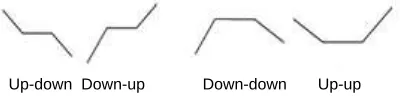
(1) Building the shape of the curve points by dividing them into four types in Figure 1;
[image:3.612.195.395.255.305.2]Up-down Down-up Down-down Up-up
Figure 1. Four shape types of the curve points.
(2) Beginning with the first pixel of each line in the image (which can be considered to be outside the curve), scan from left to right along the line, if the up-down or down-up types are encountered, invert the sign. When encountering the kinds of down-down or up-up boundaries, the sign is remained.
The first step in this method can be done in parallel way, and the computational complexity is O (1). The second scanning step can be completed in parallel with the computational complexity O (R), R is the row number, so overall computational complexity is O (1 + R).
Distance Calculation
The distance function calculation method proposed in this paper has the following steps:
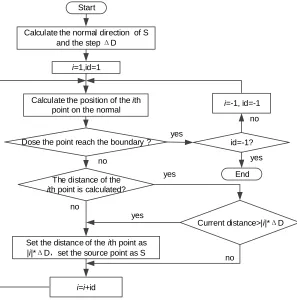
distance of the point on the normal can be obtained by accumulation of the step length, which is much faster than the calculation using the Euclidean distance (involving two subtractions, two multiplications, one addition and one square operation). The calculation flow chart is shown in Figure 3.
P S1
S3
S4 S2
[image:4.612.230.364.126.260.2]
Figure 2. Source points and the corresponding normal.
(2) After step 1, there are points in the image which the normal lines do not pass over (these points are far away from the closed curve), and the distance from these points have not been yet calculated. In order to obtain the distance of these points, this paper scans the whole image to obtain the distance by calculating the distance between the point and the source point of the neighborhood points of this point. So by at least twice scanning, all the points of the distance value could be obtained.
Calculate the position of the ith point on the normal
Start
Dose the point reach the boundary ? Calculate the normal direction of S
and the step ΔD
no
yes
i=-1, id=-1 i=1,id=1
Set the distance of the ith point as |i|*ΔD,set the source point as S
i=i+id The distance of the ith point is calculated?
Current distance>|i|*ΔD no
yes
yes
no id=-1?
End yes no
[image:4.612.152.449.399.699.2]Parallel Computing
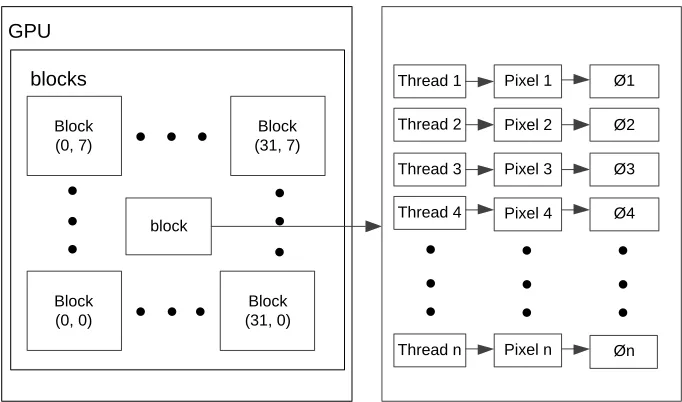
This paper uses the NVIDIA 950 graphics card on the CUDA platform to perform the general GPU parallel computing, and completes the parallel signed distance function calculation proposed in this paper. As the amount of the pixels in the image are huge, it is necessary to use thread blocks to organize so many threads. The whole image is generally considered as a grid, and each grid region corresponds to a thread block. Thus, each pixel on the image corresponds to a thread. As shown in Figure 4, to deal with a 256×256 image, assigning 32×8 thread blocks to construct a grid, that is, the image is divided into 32×8 blocks, each thread block allocates 8×32 threads. A thread calculates the signed and distance values of a pixel. The steps of the parallel computing method are listed below:
(1) Assign the threads as shown in Figure 4, let each thread correspond to a pixel; Calculate the normal direction and shape type of each point on the closed curve in parallel way. The complexity of the process of calculating is O (1).
(2) Allocate R threads, let each thread correspond to a line in the image; scan each line from left to right and calculate the signed value using the curve shape in parallel way. The calculation complexity is O (R).
(3) Assign the threads as shown in Figure 4, let each thread correspond to a pixel; calculate the normal radiation for each point on the closed curve and get the distance of each point on the normal in parallel way. The calculation complexity of this step is O (1).
(4) Assign the threads as shown in Figure 4, let each correspond to a pixel; for each point in the image, calculate the distance between the point and the source point in the neighborhood points to get the distance value of these points. So by at least twice scanning, all the points of the distance value can be obtained. The computational complexity of this step is at least O (2×8).
The computation complexity requires at least O (18+R) for the whole process, which is fast enough to achieve real-time processing.
GPU
blocks
block
Block (0, 0)
Block (31, 7)
Block (31, 0) Block
(0, 7)
Thread 1
Thread 2
Thread 3
Thread 4
Thread n
Pixel 1
Pixel 2
Pixel 3
Pixel 4
Pixel n
Ø1
Ø2
Ø3
Ø4
[image:5.612.126.467.466.667.2]Øn
EXPERIMENTS
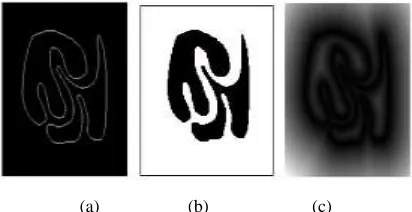
The experimental platform for this paper is Lenovo desktop computer with Windows7 64-bit operating system, intel i7-4790 3.6GHz CPU, 8G memory, Nvidia GTX950 graphics. The method is programmed using C language in visual studio 2008 platform. The experimental 256×256 image in Figure 5 (a), has a more complex topology, and is suitable for testing calculation of the signed distance function. Figure 5 (b) shows the signed distance through the parallel method proposed in this paper, and the maximum of the error value is only 1, the calculation time is only 1.4ms. It can be seen that the parallel signed distance function calculation method mentioned in this paper is fast and accurate.
[image:6.612.203.409.229.335.2](a) (b) (c)
Figure 5. The result of SDF, (a) the input image, (b) the image of sign, (c) the image of distance.
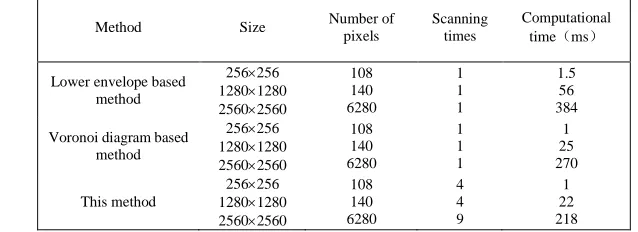
In this paper, 256×256, 1280×1280 and 2560×2560 images are used to compare the computational efficiency. When the maximum of distance error is less than 1, the method proposed in this article, source scanning method, the lower envelope based method and the Voronoi diagram based method are compared. The results of the serial calculation are shown in TABLE I, and the parallel calculation results are shown in TABLE II. As the lower envelope based method and the Voronoi diagram based only have serial algorithms, so in both of tables, they showed serial algorithm. In TABLE I, the lower envelope based method and the Voronoi diagram based method have the least time cost. The source scanning method and the method proposed in this paper are required repeated scanning to achieve a little error, so the calculation time is longer. Because of using the normal radiation to get the distance of the part of points in the image, under the same error degree the method proposed in this paper required less scanning times than the source scanning method, so the calculation efficiency is much higher than the source scanning method.
TABLE I. THE COMPARISON OF COMPUTING EFFICIENCY IN SERIAL PERFORMING.
Method Size Number of
pixels
Scanning times
Computational time (ms)
Source scanning method 256256 468 39 874
Lower envelope based
method 256256 468 1 2
Voronoi diagram based
method 256256 468 1 2
This method 256256 468 11 280
TABLE II. THE COMPARISON OF COMPUTING EFFICIENCY IN PARALLEL PERFORMING.
Method Size Number of
pixels
Scanning times
Computational time(ms)
Lower envelope based method
256256 12801280 25602560
108 140 6280 1 1 1 1.5 56 384
Voronoi diagram based method
256256 12801280 25602560
108 140 6280 1 1 1 1 25 270 This method
256256 12801280 25602560
108 140 6280 4 4 9 1 22 218 CONCLUSIONS
In this paper, we proposed a fast calculation method of signed distance function to improve the source scanning algorithm, and implement parallel algorithm based on the GPU parallel computing on CUDA platform. The experiment results show that the computation efficiency is much better than that of the source scanning algorithm. Using the parallel method, the calculation speed is faster than other methods with high computation efficiency. Therefore, the method proposed in this paper is an effective method for calculating the signed distance function. The next work will focus on the lower envelope based method and the Voronoi diagram based method, by improving them with parallel algorithm.
ACKNOWLEDGEMENT
This work if funded by the National Natural Science Foundation of China (Grant No. 61162023), the Aerospace Sciences Foundation of China (Grant No.2016ZC56005), the key research project of Jiangxi Province, China (Grant No. 20171BBG70052 and Grant No.20161BBE50080).
REFERENCES
1. Sethian, J. A. 1999. Level Set Methods and Fast Marching Methods: Evolving Interfaces in
Computational Geometry, Fluid Mechanics, Computer Vision, and Materials Science. London: Cambridge University Press.
2. Osher, S. and Sethian, J. 1998. “Fronts Propagating with Curvature-dependent Speed: Algorithms
Based on Hamilton-Jacobi Formulation,” J. Comput. Phys., 79: 12-49.
3. Sharma, O., and Agarwal, N. 2017. “Signed Distance Based 3D Surface Reconstruction from
[image:7.612.130.449.171.287.2]4. Guo, D., Li, C., Wu, L. and Yang, J. 2017. “Improved Marching Tetrahedral Algorithm Based on
Hierarchical Signed Distance Field and Multi-scale Depth Map Fusion for 3D Reconstruction,” J. Vis
Commun. Image. R., 48: 491-501.
5. Fabbri, R., Costa, L.D.F., Torelli, J.C. and Bruno, O.M. 2008. “2D Euclidean Distance Transform
Algorithms: A Comparative Survey,” Acm. Comput. Surv., 40(1):178-187.
6. Tsai, Y.R. 2002. “Rapid and Accurate Computation of the Distance Function Using Grids,” J.
Comput. Phys., 178(1):175-195.
7. Sethian, J.A. 1996. “A Fast Marching Level Set Method for Monotonically Advancing Fronts,”
Proc. Nat. Ac. Seience, 93: 1591-1694.
8. Felzenszwalb, P.F. and Huttenlocher, D.P. 2012. “Distance Transforms of Sampled Functions,”
Thero. Comput. Syst., 8(19): 415-428.
9. Mishchenko, Y. 2015. “A Fast Algorithm for Computation of Discrete Euclidean Distance
Transform in Three or More Dimensions on Vector Processing Architectures,” Signal. Image. Video.
P., 9(1):19-27.
10. Breu, H., Joseph, G., Kirkpatrick, D. and Werman, M. 1995. “Linear Time Euclidean Distance
Algorithms,” IEEE. T. Pattern. Anal., 17(5):529-533.
11. Feng, C., Zhao, D., and Huang, M. 2016. “Image Segmentation Using CUDA Accelerated Non-local
Means Denoising and Bias Correction Embedded Fuzzy C-means,” Signal. Process., 122:164-189.
12. Fluck, O., Vetter, C., Wein, W., Kamen, A., Preim, B. and Westermann, R. 2011. “A Survey of