2017 International Conference on Computer Science and Application Engineering (CSAE 2017) ISBN: 978-1-60595-505-6
Design of Precise Poverty Alleviation Management
Information System based on Big Data
Huan Liu*, Mei Zhang and Huan Xia
School of Information, Guizhou University of Finance and Economics, 550025 Guizhou, China
ABSTRACT
This article analyzed the current situation of poverty in Guizhou province. Taking Taijiang County as an example, this article investigated the causes of poverty in Guizhou province, and then proposed to set up the precise poverty alleviation management information system based on big data. The author used object oriented development mode to realize the system. This system, from requiring analysis, system modeling, database designing, data analyzing and functions achieving, was designed and developed. Finally, the author concluded and prospected the further development of the system.
INTRODUCTION
Guizhou province gathered a large number of poor population [1]. At present, there was different degree of poverty at home or abroad. Wu Jun [2] studied the status of poverty alleviation in southwest Guizhou, analyzed the business process and realized some partial subsystems. Li Tong [3] studied the Qiannan state of reality, analyzed and researched the Qiannan Sandu County, and the precise poverty alleviation related to the management of business processes. Big data plays an important role in our society [4]. On one hand, big data provides many opportunities in different research areas, on the other hand, it brings many challenges [5-6]. Big data is used in different areas, such as, data analytics, knowledge discovery and so on [7]. Information systems have been investigated by many researchers for example Dwivedi [8] presented information systems theory which explained and predicted our future digital city. Through reviewing the documents and materials, the author found that the research on precise poverty alleviation system is lacking, especially in Guizhou province. Thus the study of big data precise poverty management information system has practical significance.
RESEARCH ON THE CURRENT SITUATION OF POVERTY
Design collection program Field collection Design database Design website page Entry data Database accept Data cleaning Big data analysis
Figure 1. Technical road figure.
(1) Research content
This paper mainly collected the basic information of the poor households, the distribution information of agricultural products, and the poverty reasons, etc.
(2) Research methods
The design of the collection scheme was mainly for rural households and rural managers (usually refers to college students). Because most people in Taijiang didn’t know how to use computer, we carried out to use questionnaire. The village managers or investigation teams were asked to help people in Taijing to finish questionnaires. This article went deep into the investigation of the grassroots level so as to meet each household. The major survey methods were questionnaire which included two ways: online and offline.
DEMAND ANALYSIS Business Needs Analysis
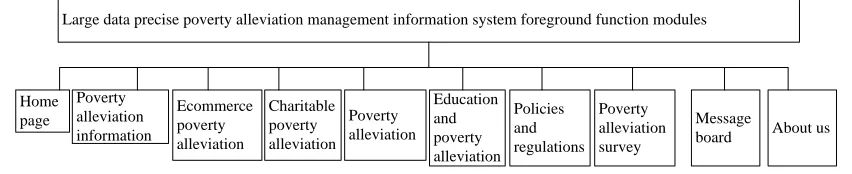
The author chooses Taijiang County as a pilot program to build big data precise poverty alleviation management information system. This system according to the development characteristics of Taijiang in Guizhou province was designed and developed. Big data precise poverty alleviation management information system included ten subsystems, which were shown in Figure 2:
Large data precise poverty alleviation management information system foreground function modules
Home page Poverty alleviation information Ecommerce poverty alleviation Charitable poverty alleviation Poverty alleviation Education and poverty alleviation Policies and regulations Poverty alleviation survey Message
board About us
Figure 2. Large data precise poverty alleviation management information system front functional diagram.
Home page: This part was to display the hot and new information of the other nine parts of poverty alleviation management information system in Taijiang.
[image:2.612.88.514.446.533.2]Charitable poverty alleviation: This column was to provide donating information, publish donation information and logistics tracking. The users can view the traces of donated items to ensure timely and accurate delivery of poverty alleviation materials at any time. Charitable donations, made full use of the network to raise the way to avoid the "intermediary effect" of The Public Interest Organizations. To achieve precise poverty alleviation on the "C2C" model, this subsystem was developed to help local innovation and entrepreneurs to understand the latest national policy and provide innovative entrepreneurial ideas and to help people who had entrepreneurial intentions to complete business.
Entrepreneurship Poverty alleviation: This part was to provide the latest policy for starting a business, business information and show the current entrepreneurship poverty alleviation policies in Taijiang county.
Education poverty alleviation: This subsystem was mainly developed to encourage university students and teachers to participate teaching poverty alleviation activities, for example "the three to countryside activity". Education and poverty alleviation system, mainly relies on the school and social forces. The university students and teachers can be convened to carry out some education poverty alleviation activities, for instance three to the countryside, and help poor areas’ education. The indicators assessment system was formed to reward outstanding people and help the government understand and solve poverty of education and so on.
Poverty alleviation survey: This part was major to meet the user according to the questionnaire to fill out the corresponding information in the system, and timely to grasp the progress of poverty alleviation work in different places.
Message board: This functional system was to collect users’ comment information. Users according to their limits of authority to make recommendations according to the use of the system and to publish valuable remarks according to the site of poverty alleviation information.
About us: The major introduction of the system developers contact information were presented in this part. Background module function diagram design, was shown in Figure 3:
Logging data real-timely
Large data precise poverty alleviation management information system
Login in Management the ten
[image:3.612.115.465.485.544.2]subsystems Manage user rights Audit information
Figure 3. Background module functional diagram design.
SYSTEM ANALYSIS AND DESIGN
System Design
(1) Integrated Design
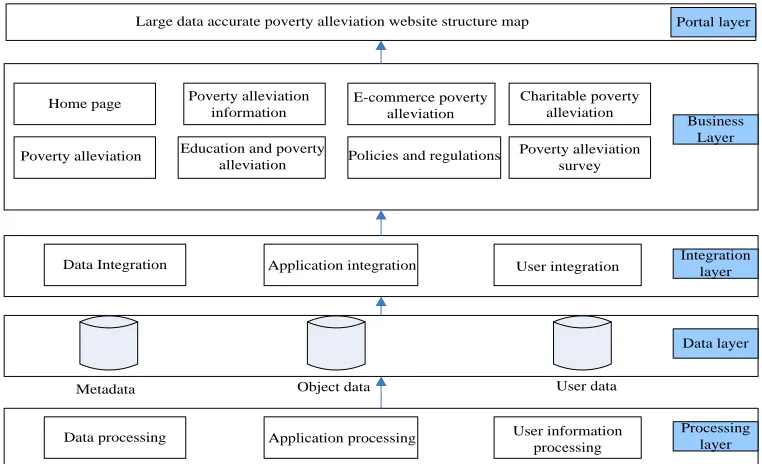
This system integrated the users’ basic information, which can assist the precise poverty alleviation work accurately and efficiently. The integrated structure design of the system is shown in Figure 4:
Portal layer Large data accurate poverty alleviation website structure map
Home page
Poverty alleviation survey Poverty alleviation
information
E-commerce poverty alleviation
Charitable poverty alleviation
Poverty alleviation Education and poverty
alleviation Policies and regulations
Business Layer
Data Integration Application integration User integration Integration layer
Data layer
Metadata Object data User data
Data processing Application processing User information processing
Processing layer
Figure 4. Structure diagram of big data precise poverty alleviation management information system.
Big data precise poverty alleviation management information system had five layers: processing layer, data layer, integration layer, business layer and portal layer.
(2) Role Design
[image:4.612.112.493.150.382.2]The roles involved in the big data precise poverty alleviation management information system were as follows: poor households, village officials, system administrators, and county-level poverty alleviation offices users, charitable donations and discipline inspection and other senior management personnel. TABLE I clearly described role information of this system.
TABLE I. ROLE INFORMATION TABLE.
Role Authority and responsibility
Poor households Browsing, and looking through the policies. Registered or modify personal information
Village officer
The village officers were responsible for filling in the real information of the poor
households, and collected the poor people's willingness to help the poor, collecting
poor agricultural information.
Discipline Inspection Commission and other senior
management
Commission and other senior management personnel had the highest authority of the management information system, and you can supervise
the work of various
subordinate departments to ensure accurate and efficient poverty alleviation work.
System Modeling
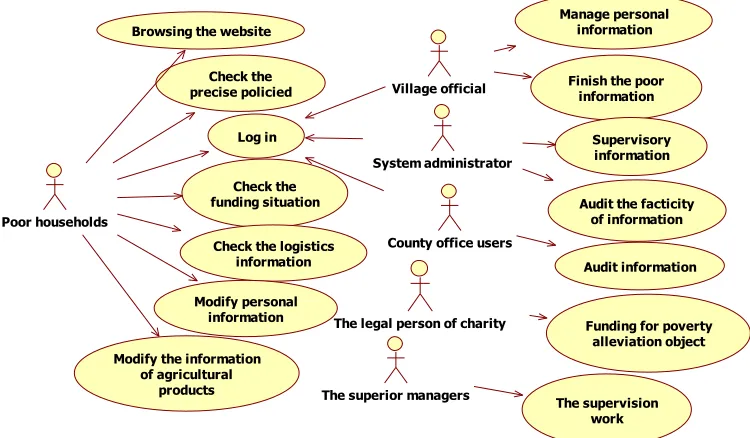
In this article, taking charity poverty alleviation system as an example, and it used UML standard modeling language to model the big data precise poverty alleviation information management system. The author used case diagram in UML which can express the functional requirements of the system in details. Figure 5 described the interaction process of system and use.
Poor households
County office users Village official
System administrator
The legal person of charity
The superior managers Browsing the website
Check the precise policied
Log in
Check the funding situation
Check the logistics information
Modify personal information
Modify the information of agricultural
products
Manage personal information
Finish the poor information
Supervisory information
Audit the facticity of information
Audit information
Funding for poverty alleviation object
[image:5.612.111.486.249.468.2]The supervision work
Figure 5. System use-case diagram.
(1) System timing diagram
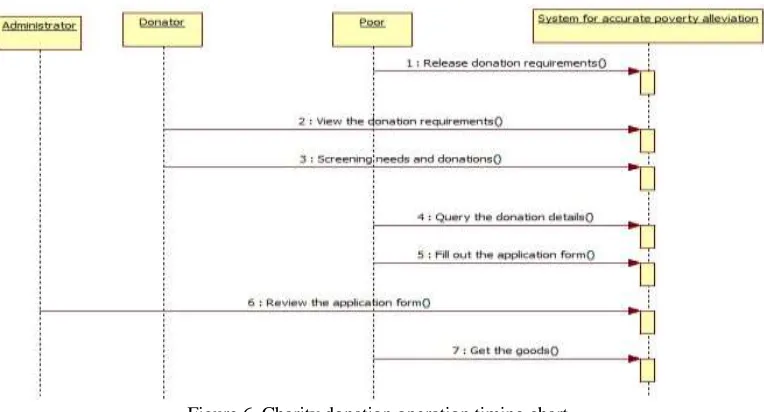
This article used timing diagrams to describe the chronological order and message of each role interaction. Figure 6 clearly described the charity donation interaction process.
Database Tables
Figure 6. Charity donation operation timing chart.
TABLE II. POOR HOUSEHOLDS TABLE.
Field name Data type Null? Restrictions Remarks
Pid int N Primary key household number
Pname Char(10) N Householder name
Pidcard Char(30) N Uniqueness identification number
Padress Char(50) N Home address
Ppostnum Char(30) N Zip code
Pcontact Char(30) Y Contact information
Pphoto Jpg N photo
Pjob Char(30) N employment status
TABLE III. AGRICULTURAL PRODUCTS TABLE. Field name data type Null? Restrictions Remarks
Gid Int N Primary key Agricultural product number
Gname Char(20) N Name of agricultural product
Gtype Char(20) N Agricultural product category
Gkind Char(20) N Variety
Ginfor Char(50) Y Details of agricultural products
Gweight Char(20) Y Weight of agricultural products
Gnum Char(20) Y Number of agricultural products
Ptime Data Y Feeding start time
Sell Char(10) N Whether to sell it
Sdata Char(50) N Expected sale period
Sprice Char(20) Y Estimated product price
TABLE IV. DONATION STATUS TABLE. Field name data type Null? Restrictions Remarks
Did int N Primary key Donation number
Vid int N Village number
CONCLUSIONS
This article studied the current situation of poverty alleviation of Taijiang in Guizhou province and the limitations of poverty alleviation work. This article put forward the construction plan of big data precise poverty alleviation system. The system can meet the basic needs of users in different roles. The system monitored agricultural products’ basic information in real time which supported E-commerce poverty alleviation and government decisions. This system encountered the difficulty of data storage in the development process. The collected data was too large to store with a small database which was not easy to expand. The solution was to use cloud storage. The lack of the system was that this system was currently only designed and developed for Taijiang county, which, at present, can’t meet the needs of the entire Guizhou province, after the success at Taijiang, this system will gradually be improved to meet Guizhou province and even to meet poverty-stricken areas of the whole country.
ACKNOWLEDGEMENT
This article is funded by the National Natural Science Fund Project (The key technology research of complex curved objects in 3-d modeling based on point cloud, 41261094), and the Science and Technology Fund project of Guizhou Province Science and Technology Department (The laser point cloud 3D geometric modeling research of complex curved objects, Qian Kehe Foundation [2016] 1020), and the Natural Science and Technology Top-notch Talent Fund Project of Guizhou Province Education Department, (The laser point cloud 3D digital modeling research of complex curved objects, Qian Jiaojia KY word [2016] 069).
REFERENCES
1. Qian Futong. 2014. “On the province of poor people issued the amount of poor village identification scale notice,” Guizhou province poverty alleviation and development office, pp. 30-43.
2. Wu Jun. 2015. “Qian southwest accurate poverty alleviation information system analysis,” Yunnan University, pp. 43-55.
3. Li Tong. 2015. “Accurate poverty alleviation management system research and analysis at Qiannan Sandu county in Guizhou province,” Yunnan University, pp. 23-43.
4. Boyd, Dana, Crawford, and Kate. 2011. “Six Provocations for Big Data,” Social Science Research Network: A Decade in Internet Time: Symposium on the Dynamics of the Internet and Society, pp. 78-63.
5. Reichman, O.J. Jones, M.B. and Schildhauer, M.P. 2011. “Challenges and Opportunities of Open Data in Ecology,” Science, pp. 703–705.
6. Snijders, C. Matzat, U. and Reips, U.-D. 2012. “Big Data: Big gaps of knowledge in the field of Internet,” International Journal of Internet Science, pp. 1–5.
7. Dedić, N. and Stanier, C. 2017. “Towards Differentiating Business Intelligence, Big Data, Data Analytics and Knowledge Discovery,” Heidelberg: Springer International Publishing, pp. 285. 8. Dwivedi, Yogesh K., Wade, Michael R., Schneberger, and Scott L. (Eds.) 2013. “Information