2017 International Conference on Computer Science and Application Engineering (CSAE 2017) ISBN: 978-1-60595-505-6
A Practical Password Management Scheme based on Computer
Hardware Information and IC card
Jie Xu1, Zhongtian Jia1,2*, Bo Zhang1,2 and Minyao Ma3
1
School of Information Science and Engineering, University of Jinan, Jinan 250022, China
2
Provincial Key Laboratory for Network Based Intelligent Computing, University of Jinan, 250022 Jinan, China
3
School of Mathematics and Computer Science, Guizhou Education University, 550018 Gui-yang, China
ABSTRACT
Since the twenty-first Century, the Internet has brought great convenience to our life, following with a large number of network accounts registered on kinds of websites or Internet systems. The management of these accounts and their passwords has become a public problem needed to be solved. Recently, there have been a lot of works trying to answer this question in the literature. However, there isn’t a practical method suitable for a variety of occasions. In this paper, we propose a novel password management scheme to address this issue by binding the computer hardware’s identifier and an IC (Integrated Circuit) card. The accounts and passwords of the third-party systems are stored in a secure repository of a computer. Any manipulations of the accounts and passwords must be authenticated, in which only the user who can provide the computer, the IC card and the management password is accepted by the system. Therefore,with only one password, which is called management password, the administration of all the other accounts and passwords can be achieved. Additionally, we can login into a third-party system automatically if its’ login API is public. Practicability and security analysis show that the proposed scheme is practical and secure, and can be applied in many situations.
INTRODUCTION
Network technologies have been brought great convenience to our daily life. For example, you are almost able to buy daily necessities on the Internet without going out home. You can video chat through a Gmail account with friends from all over the world. However, in order to get the service provided by an application, one must register with it in advance, in which one needs to define an account name and provide a secure password for later login [1]. Therefore, the number of the account and password pairs that one should maintain are increasing continuously. Recent studies show that the average number of the account and password pairs managed by a person is more than ten. It is a commonplace to forget the password or even the account name ever registered on a website. Thus, how to manage the account and password pairs is becoming a challenge [2].
dictionary attacks. Some people adopt generic password, which is maybe very strong, for every account registered on the Internet. Regrettably, it is easy to become the target of the library hit attack [3]. This means all the accounts using the generic password will be in the risk of masquerade attacks [4]. Additionally, there are other people like to keep all their passwords in a notebook or computer file. This method looks simple and convenient because it can help people remind the registered accounts and their corresponding passwords. Nevertheless, once a password-recorded notebook or computer file is lost or stolen, then all accounts and their passwords will be in the risk.
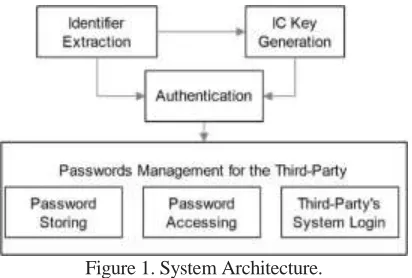
Figure 1. System Architecture.
To solve this problem, we propose a practical password management scheme based computer hardware and IC card in this paper. The architecture of the proposed method is shown in Fig.1. First, an ID (Identification) information is drawn from a computer’s hardware, such as CPU, motherboard, memory etc. Then, an IC key is extracted from the ID information and written into the IC card. Along with the IC key, a few random numbers are also written into the IC card, which will be used for encryption key’s generation subsequently. The third party’s accounts, their corresponding passwords and login entrances are stored in a secure repository of the computer. Any access to the secure repository must be authenticated. To authenticate an access, the IC card should be inserted into the computer. Then, IC key is recalculated on the basis of the computer’s hardware. If the recalculated IC key is equal to that read from the IC card, the access is allowed. Else, the access is denied. In addition to the account and password management, the system provides automatically login the platform of the third party according to the corresponding address stored in the secure repository. The contribution of the paper has three aspects: 1) propose a password management scheme based on computer’s hardware and IC Card, through which all kinds of passwords can be administrated with one management password and an IC card; 2) present a method to login to the third party’s system; and 3) analyze the practicability and the security of the proposed scheme.
RELATED WORKS
Recently, there are a large number of works about online password management in literature. As early as 1998, the password management idea had been proposed by Michael for communication network, in which one of the communication parties maintained a list of passwords and adopted a scheme to distribute them among the other parties to obtain secure communications[5]. But this is not the real meaning of the user account and password management program for the Internet applications studied in this paper.
It was not until 2005 that how to administrate the accounts and passwords became a problem and began attracting the interest of researchers [6]. Kerr et al. proposed such a method related to user accounts and their corresponding passwords management. Their patent utilized a universally accessible location to store the accounts and their passwords. To obtain adequate security, both the client side and server side were encrypted. However, investigations done by Chiasson, van Oorschot and Biddlet showed that many password management proposals were lack of formative and summative usability tests and not practical. Users do not feel they are needed or provide greater security [7].
In 2007, Vu K. P. L. presented a method and a series of recommendations to improve the online password security and memorability. However, tries to strengthen password security and memorability just by generating such a kind of passwords [8]. In the same year, Jeff Yan also discussed the contradictory of password security and memorability. He believed that it should depend on the application system itself to help users to select a strong and easy memorable password [9].
In 2010, Al-Sinani and Mitchell investigated the problem and presented a design for account and password management using Windows CardSpace [10]. The followed analysis, presented by Li et al. in 2014 [11], showed that the main popular Web based password manager were all vulnerable in diverse aspects, such as logic and authorization mistakes, misunderstanding of the Web security model etc. Zhao, and Yue also analyzed the website base password managers. They not only uncovered their vulnerabilities and showed how to exploit by the attacker to steal users’ passwords, but also proposed a password administration method based on cloud computing for Web based applications [12]. Then,Stajano et al. proposed a semantic labels method in 2015, in which the password manager could extract the meaning of the form on the web page and parse their password policy [13]. By these designs, they tried to improve the functions of the password manager embedded in the web browser.
this paper, we propose a more convenient method which is discussed in the following sections.
THE PROPOSED SCHEME
In this section, we discuss our scheme in the following five subsections: A, B, C, D, and E.
Assumptions and Security Aims
ASSUMPTIONS
The IC card issued by the system must be kept secretly;
The password, called management password in the proposed scheme, is secure.
SECURITY AIMS
Anyone can’t access the accounts and passwords if the computer, the issued IC
card or the management password is absent;
The user can access the accounts and passwords if he can provide the computer, the issued IC card and the management password.
Identifier Extraction
In order to construct a secure area in a computer’s hard disk for sensitive information, necessary encryption is indispensable. Therefore, how to generate the encryption key is the critical factor. In our design, the third party’s sensitive information, such as accounts and passwords are encrypted and stored in the hard disk of a given computer. Accordingly, any access to these data can only be performed on this given computer. Hence, the proposed scheme extracts an ID information from the computer’s hardware, including CPU, motherboard, hard disk, memory, etc. Firstly, the information read from the CPU should include the serial number, the number of cores, and the default frequency. Secondly, the information fetched from the motherboard should contain the serial number, date of manufacture. Thirdly, the information drawn from the hard disk should have the serial number, the storage capacity, cluster size. Finally, the information extracted from the memory should cover the serial number and capacity. The ID information extraction phase includes the following two steps.
Step1: Fetch hardware information from the CPU, mother board, hard disk and memory, and assign them to four variables 𝑀1, 𝑀2, 𝑀3, 𝑀4, respectively.
𝑀1 ← 𝐶𝑃𝑈𝐼𝑛𝑓𝑜,
𝑀2 ← 𝑀𝑜𝑡ℎ𝑒𝑟𝐵𝑜𝑎𝑟𝑑𝐼𝑛𝑓𝑜,
𝑀3 ← 𝐻𝑎𝑟𝑑𝐷𝑖𝑠𝑘𝐼𝑛𝑓𝑜,
𝑀4 ← 𝑀𝑒𝑚𝑜𝑟𝑦𝐼𝑛𝑓𝑜.
Step2: Calculate the ID information 𝐼𝐷𝐼𝑛𝑓𝑜 as an identifier of the selected computer.
IC Key Generation
In this subsection, we discuss the IC key generation module as the following six steps. At first, the generation process needs to call the Identifier extraction module, through which an ID information based on a given computer is extracted. Then, the ID information and the management password are hashed using a hash function. The hashed value is written into a blank IC card. Additionally, some random numbers are also written into the blank IC card as well. The IC key and the random numbers will be used in the authentication module and the password management module, subsequently. The hashed ID information stored in the IC card, is called an ICKey in the remainder parts of this paper. Finally, the IC key generation module must be destroyed from the current computer. The ICKey variable should be deleted. The memory storing of this module must be overwritten. These manipulations intend to prevent any possible potential key leakage and key tempering.
Step1: Execute subsection B to get the ID information: 𝐼𝐷𝐼𝑛𝑓𝑜.
Step2: Get the user-input password, which is called management password, and assign it to the variable𝑈𝑃𝑎𝑠𝑠𝑤𝑜𝑟𝑑.
Step3: Compute the IC key using a hash function.
𝐼𝐶𝐾𝑒𝑦 = 𝐻(𝐼𝐷𝐼𝑛𝑓𝑜 ∥ 𝑈𝑃𝑎𝑠𝑠𝑤𝑜𝑟𝑑) (2) Here, 𝐻(⋅) is hash cryptography algorithm.
Step4: Generate several of random number using a pseudo- random function.
𝑟1 = 𝑟𝑎𝑛𝑑(), 𝑟2 = 𝑟𝑎𝑛𝑑(), ⋯ , 𝑟𝑇 = 𝑟𝑎𝑛𝑑(). (3) Here, 𝑟1, 𝑟2, ⋯, 𝑟𝑇 is random numbers. 𝑇 is system parameter, and 𝑟𝑎𝑛𝑑() is a pseudo- random function.
Step5: Write the ICKey and the 𝑟1, 𝑟2, ⋯, 𝑟𝑇 into the IC card.
Step6: Destroy the IC key generation module and empty corresponding variables and memory from the current computer.
Authentication Module
The authentication module includes the following three steps.
Step1: Execute subsection B get ID information: 𝐼𝐷𝐼𝑛𝑓𝑜′.
Step2: Recalculate the IC key according to the 𝐼𝐷𝐼𝑛𝑓𝑜′ and the input password:
𝑈𝑃𝑎𝑠𝑠𝑤𝑜𝑟𝑑′.
𝐼𝐶𝐾𝑒𝑦′= ℎ𝑎𝑠ℎ(𝐼𝐷𝐼𝑛𝑓𝑜′||𝑈𝑃𝑎𝑠𝑠𝑤𝑜𝑟𝑑′) (4)
Step2: Insert the IC Card into the computer.
Step3: Compare 𝐼𝐶𝐾𝑒𝑦′ with ICKey stored in the IC card, if the two values are the same, allow the user to execute Password Management Module. Else, Denied.
Password Management Module
manipulate the account information, should own the computer, the IC card issued by this system, and the management password and pass the system’s authentication.
PASSWORDS SECURE STORING
The steps of password storing for third party’s system is discussed as the following.
Step1: Authenticates the user according to the steps given in subsection D. If he/she passes the authentication, the user is permitted to do the following steps. Else, Denied.
Step2: Encrypts the accounts and passwords using a symmetric cryptographic algorithm.
{
𝑐1 = 𝐸𝑘[𝑈1||𝑃1] 𝑐2 = 𝐸𝑘[𝑈2||𝑃2]
⋯
𝑐𝑛 = 𝐸𝑘[𝑈𝑛||𝑃𝑛]
(5)
𝑘 = 𝐻(𝐼𝐷𝐼𝑛𝑓𝑜||𝑟𝑖) (6) Here, 𝑈𝑖 (0 ≪ 𝑖 ≤ 𝑛) is the account name of the third-party system. 𝑃𝑖 (0 ≪ 𝑖 ≤ 𝑛) is the corresponding password of the third-party system. 𝑐𝑖 (0 ≪ 𝑖 ≤ 𝑛) is the ciphertext of 𝑈𝑖 and 𝑃𝑖. || is string concatenation operator. 𝐼𝐷𝐼𝑛𝑓𝑜 is the identifier information of the special computer generated in the subsection B. 𝑟𝑖 (0 ≪ 𝑖 ≤ 𝑇) is random number reading from the IC card. 𝐻(⋅) is a hash function. 𝐸𝑘 is a secure symmetric cryptography algorithm.
TABLE I. STORING FORMAT.
Landing Entrance Ciphertext of Account and Password
𝐿1 𝑐1
𝐿2 𝑐2
⋯ ⋯
𝐿𝑛 𝑐𝑛
Step3: Store the landing entrances and the ciphertexts of the accounts and passwords in the hard disk of the computer as shown in TABLE I.
Here, 𝐿𝑖(0 ≪ 𝑖 ≤ 𝑛) is the landing entrance of third-party’s system. 𝑐𝑖(0 ≪ 𝑖 ≤ 𝑛) is the ciphertext of 𝑈𝑖 and 𝑃𝑖. If the user has more than one account in a same system, which means 𝑐𝑖 and 𝑐𝑗 are for the same system, then 𝐿𝑖 = 𝐿𝑗 (𝑖 ≠ 𝑗).
PASSWORDS ACCESSING
If the user just wants to search an account or a password that has been registered in a certain site, he should insert his IC card into his computer, which is used for the secure storing, and accept the authentication of the system. The operating steps are as follows.
Step1: Inserts his IC card into the computer and accepts the system’s authentication as subsection D. If he/she passes the authentication, he/she obtains the access rights. Else his access is denied.
Step2: User locates the entrance 𝐿𝑖 of the third-party’s system.
THIRD PARTY SYSTEM’S LOGIN
When the user needs login to the third-party’s system, the IC Key and Random Number in the IC Card are used for system authentication and decryption. The account and it corresponding password are filled in the blanks of the application program or login interface of the third-party’s system and login to the system after the user makes the login command. The specific operation steps are as follows.
Step1: As Step1-Step3 in the above subsection after authentication and get the plaintext of 𝑈𝑖 and 𝑃𝑖.
Step2: Confirm the login account. If it is not a suitable one, the user should examine the other entrance in the repository table and look for the intend account.
Step3: The account and password are filled in the blanks of the third-party’s system login interface automatically.
Step4: login to the system according to the user’s login command.
PRACTICABILITY AND SECURITY ANALYSIS
[image:7.612.86.509.522.606.2]Practicability and security are two key factors to a password management method. In our design, the IC card acts as a private credential like the key of a lock. Accounts and passwords of the third party are stored in a computer. Only the one who owns the computer, the IC card and the management password can manage the third party’s accounts and passwords. This kind of design separates the storage and the authorization spontaneously. It has three merits: 1) the accounts and passwords usually does not need to be carried with you and only be accessed when you forget the password, 2) credentials to be kept secretly are very simple, and 3) the secret is sharing in computer hardware, IC card and the managing password. Usually, when we register a new account on one site or system, it needs to access the secure repository and insert the new account, password, and system entrance to the repository. If we want to login to a site or system, we just insert the IC card and manipulate as described in section E. Therefore, the system, which uses fewer cryptographic calculations as shown in TABLE II, is very practicable.
TABLE II. NUMBER OF ENCRYPTION USED IN EACH PROCESS.
Times of Hash Times of Symmetric Encryption
Identifier Extraction 1 0
IC Key generation 1 0
Authentication Module 2 0
Passwords Secure Storing 1 1
Passwords Accessing 4 1
authentication as discussed in subsection III.E.b. Anyone who has not the computer, the IC card or the management password will be denied by the system authentication. Hence, the security can also be ensured.
CONCLUSIONS
In this paper, we propose a novel password management scheme for the third party’s accounts. The third party’s accounts, passwords, login entrances are stored in a computer securely. Any accessing to the accounts and passwords must be authenticated by a trinity protective measure which requires verifying the computer, the IC card, and the system management password. The method not only solves the memorability problem of passwords, but also prevents the risk of passwords leakage. In practice, if the third party can open its API interface, the proposed system can help user login to his/her third party’s system automatically. By such design, it can increase the convince of login process of the third party’s platform and protect the security of the accounts and passwords as much as possible.
ACKNOWLEDGEMENT
This work is supported by the Natural Science Foundation of Shandong Province (No. ZR2013FL003, ZR2014FL011), the Science and Technology Foundation Project of Guizhou Province (No. QianKeHeJiChu[2016]1115), the Youth Science and Technology Talent Project of Guizhou Provincial Education Department (No. QianJiaoHe-KY-Zi[2016]220), the “YiTiLiangYi” Special Project of Guizhou Education University (No. 2016YTLY10).
REFERENCES
1. Chen, T., and Chen. 2011. “Designing and implementing new dynamic web password login method,”
J. Computer Applications & Software. 28(7): 31-34.
2. Durrani M.N. and Shamsi J.A. 2014. “Volunteer Computing: Requirements, Challenges, and Solutions,” J. Journal of Network and Computer Applications, 39: 369-380.
3. Corona I., Biggio B. and Maiorca D. 2016. “AdversariaLib: An Open-source Library for the Security Evaluation of Machine Learning Algorithms Under Attack,” J. arXiv preprint arXiv:1611.04786. 4. Kholidy H.A., Baiardi F. and Hariri S. 2015. “DDSGA: A Data-driven Semi-global Alignment
Approach for Detecting Masquerade Attacks,” J. IEEE Transactions on Dependable and Secure Computing, 12(2): 164-178.
5. Heinz Sr M. W. 1998. “Password Management System over a Communications Network,”:U.S. Patent. 5, 812,764[P]. 1998-9-22.
6. Kerr D. A., Medina D., Peloquin M.A. and Venditti R J. 2005. “Universal userid and password management for internet connected devices,”: U.S. Patent. 6,859,878[P]. 2005-2-22.
7. Chiasson, S., Oorschot, P. C. V. and Biddle R. 2006. “A Usability Study and Critique of Two Password Managers,” C. In: Proc. 15th USENIX Security Symposium.
8. Vu K. P. L., Proctor R.W. and Bhargav-Spantzel A. 2007. Tai B L, Cook J, Schultz E E. “Improving Password Security and Memorability to Protect Personal and Organizational Information,” J. International Journal of Human-Computer Studies, 65(8): 744-757.
10. Al-Sinani H. S. and Mitchell C.J. “Using CardSpace as a Password Manager,” C. IFIP Working Conference on Policies and Research in Identity Management. Springer Berlin Heidelberg, pp.18-30.
11. Li Z., He W., Akhawe D. and Dawn S. 2014. “The Emperor's New Password Manager: Security Analysis of Web-based Password Managers,” C. USENIX Security, pp. 465-479.
12. Zhao R. and Yue C.. 2014. “Toward a Secure and Usable Cloud-based Password Manager for web Browsers,” J. Computers & Security, 46: 32-47.
13. Stajano F., Spencer M., Jenkinson G. and Jenkinson G. 2015. “Password-manager Friendly (PMF): Semantic Annotations to Improve the Effectiveness of Password Managers,”M. Technology and Practice of Passwords, Springer International Publishing, pp. 61-73.
14. Yuchen H.E., Wang R. and Shi W. 2016. “Implementation of a TPM-Based Security Enhanced Browser Password Manager,” J. Wuhan University Journal of Natural Sciences, 21(1):56-62. 15. McCarney D., Barrera D., Clark J., Chiasson, S., and Oorschot, P.C.V. 2012. “Tapas: Design,
Implementation, and Usability Evaluation of a Password Manager,” C. Proceedings of the 28th Annual Computer Security Applications Conference. ACM, pp. 89-98.