2017 International Conference on Computer Science and Application Engineering (CSAE 2017) ISBN: 978-1-60595-505-6
Solving Cooperative Anti-Missile Weapon-Target Assignment
Problems using Hybrid Algorithms based on
Particle Swarm and Tabu Search
Zhichao Liu*, Zhangsong Shi, Ling Wu and Yujie Xiao
Electronic Engineering College, Naval University of Engineering, No.717, Jiefang Avenue, Qiaokou District, Wuhan City, Hubei Province
ABSTRACT
Taking soft and hard weapon of a single warship cooperative anti-missile as background, under the fully research on the shipboard hard and soft weapon layered defense model, the firepower unit correlation matrix is put forward, which could simplify the problem complexity, minimizing the negative impact of the combination of firepower units while fighting against the same direction incoming missile targets. At the same time, in traditional weapon-target assignment, the maximum probability of joint damage or the minimum total expected survival rate of the target is usually set as the optimization goal, which result in firepower resources great waste. Aim to this problem, the minimum resource consumption model is established as the optimization goal, and we take the kill probability to the targets as an important constraint condition. The value of kill probability to each target can be set according to the incoming targets threaten degree and the firepower resources consumption. The minimum resource consumption model is solved by the hybrid optimized algorithm based on particle swarm and tabu search, the simulation results show that this method is more reasonable and feasible, in line with the realistic scenarios due to the algorithm could stop calculate at any time and give the current best solution.
INTRODUCTION
technical support for the compatibility of hard weapon. The literature [6] through the quantitative description of airspace resources, according to the occupy time of the hard weapon in the airspace grid, modify the fire unit shooting program, cooperative use the weapons. Their common ground is only focused on the compatibility of firepower unit, the research on weapon-target assignment, and the integrated use of hard and soft weapons is not enough.
Considering the actual situation ,in order to cooperative use the hard and soft weapon to fight against more batches incoming missile targets under the limited resources of a single ship, based on the above research, this paper puts forward the firepower unit correlation matrix, and under the premise of meet the kill probability index P and the constraint of weapon resource, the minimum resource consumption model is established and the hybrid algorithm based on particle swarm and tabu search is used to solve this problem.
THE COOPERATIVE ANTI-MISSILE MODEL OF A SINGLE SHIP WITH THE MINIMUM RESOURCE CONSUMPTION
Modern sea combat environment has become increasingly complex, in addition to the enemy’s action will influence the performance of the firepower units, the firepower units themselves will influence each other. In order to reduce the adverse effects between firepower units, find out its best combination to fight against the incoming missiles, this paper put forward the correlation matrix Gcm, which indicating the mutual influence of firepower units on the kill probability to targets.
Gcm = [
𝑔11 ⋯ 𝑔1𝑛
⋮ ⋱ ⋮
𝑔𝑛1 ⋯ 𝑔𝑛𝑛
]
The element 𝑔𝑖𝑗 in correlation matrix Gcm is a positive number ranges from 0 to 1, indicating that the adverse effects of weapon i on weapon j. The element 𝑔𝑖𝑗 generated automatically by expert knowledge, firepower compatibility judgment, intelligent reasoning and the related test methods, which are not a research focus in this paper.
Model assumption:
(1) The number of unassigned incoming missile targets is m, denoted 𝑇1,𝑇2,…𝑇𝑚, The number of free firepower units is n, denoted 𝑊1, 𝑊2,…𝑊𝑛 , and the corresponding amount of resources is 𝑄1,𝑄2,…𝑄𝑛, where m <n.
(2) Each fire unit can only shoot one target at the same time, each target will be shoot and could be assigned two or more free firepower units.
Let 𝑋𝑖𝑗 denote the decision variable. If the firepower unit i is assigned to target j,
target j. 𝑃𝑖𝑗∗ is a matrix of 1*n, where the elements represent the cumulative effect of
other firepower units on the firepower unit i in the weapon-target assignment scheme for target j.
𝑃𝑖𝑗∗ = 𝑋𝑗∗ Gcm (1)
The minimum resource consumption of weapon-target assignment model is as follows Min C=∑𝑛𝑖=1∑𝑚𝑗=1𝐶𝑖𝑗𝑋𝑖𝑗 (2)
𝑃𝑗=1-∏𝑛𝑖=1[1 − 𝑃𝑖𝑗(1 − 𝑃𝑖𝑗∗)𝑋𝑖𝑗]≥P (3)
∑𝑛𝑖=1𝑋𝑖𝑗 ≥1 (4)
∑𝑚𝑗=1𝑋𝑖𝑗 ≤ 𝑄𝑖 (5)
𝑋𝑖𝑗 =0 or 1 i=1,2,…n; j=1,2,…m (6) Where 𝐶𝑖𝑗 is the resource value, (3) (4) indicates that each incoming missile should be assigned at least one firepower unit, and the kill probability to each incoming missile should meet the kill probability index P, (3) Where P can be set by the commander or the system according to the target threat degree or the resource consumption.
THE HYBRID OPTIMIZED ALGORITHM BASED ON PARTICLE SWARM AND TABU SEARCH
Particle swarm algorithm is simple in operation and strong in global search ability, but it is slow to run at the later stage, and the precision of solution is not high [7]. The tabu search algorithm is weak in global search ability, strong in local search ability and fast in convergence [8]. The combination of the two algorithms can effectively improve the search ability to the optimal solution.
Discrete Particle Swarm Optimization Algorithm
firepower units. Each particle length is equal to the number of firepower units n, the particle is composed of the target number, which is arranged in the order of the free firepower unit number, indicating a possible weapon-target assignment scheme. Assume there have 5 free firepower units, 3 incoming targets, particle [1,0,2,3,1] said that 𝑊1, 𝑊5 is assigned to 𝑇1, 𝑊2 is free, 𝑊3 is assigned to 𝑇2, 𝑊4 is assigned to
𝑇3.
The particle is the key of PSO algorithm, which update their speed and position information by learning the individual best position and the global best position. The formula of the typical particle velocity and position is as follows:
𝑣𝑙𝑗(𝑡 + 1)=w𝑣𝑙𝑗(𝑡)+ 𝑐1 𝑟1(𝑝𝑙𝑗(𝑡) − 𝑥𝑙𝑗(𝑡))+ 𝑐2 𝑟2(𝑝𝑔𝑗(𝑡) − 𝑥𝑙𝑗(𝑡)) (7)
𝑥𝑙𝑗(𝑡 + 1)= 𝑥𝑙𝑗(𝑡) +𝑣𝑙𝑗(𝑡 + 1) (8) Where w is inertia weight, c1, c2 are learning factors, which represent the attraction of the individual best position and the global best position to a particle. 𝑟1 and 𝑟2 are random numbers ranges from 0 to 1. Aiming at this problem, the update formula for the position and velocity of particle is redefined as follows:
𝑋𝑙(t + 1)=𝑐2⊕𝐹3(𝑐1⊕𝐹2(w⊕𝐹1(𝑋𝑙(t)), 𝑝𝑙(𝑡)), 𝑝𝑔(𝑡)) (9)
Where the position vector 𝑋𝑙=(𝑥𝑙1,𝑥𝑙2… 𝑥𝑙n); 𝑝𝑙=(p𝑙1,𝑝𝑙2… 𝑝𝑙n) is the
individual best position vector of particle l; 𝑝g=(p𝑔1,𝑝𝑔2… 𝑝𝑔n) is the global best position vector of particles; w,c1,c2 all ranges from 0 to 1. Ψ𝑙,Ф𝑙 is the temporary
variables, Ψ𝑙(t)=w⊕𝐹1(𝑋𝑙(t)), Ф𝑙(t)=𝑐1⊕𝐹2(Ψ𝑙(t), 𝑝𝑙(𝑡)), 𝑋𝑙(t + 1)=𝑐2⊕
𝐹3(Ф𝑙(t), 𝑝𝑔(𝑡)), position update formula defined as follows:
Ψ𝑙(t)={𝐹1(𝑋𝑙(t)), 𝑟𝑎𝑛𝑑() < 𝑤
𝑋𝑙(t), 𝑟𝑎𝑛𝑑() ≥ 𝑤
(10)
This formula corresponding to the first paragraph in formula (7), which represents a replacement operation of the particle position vector with probability w, if the rand () <w, generating two random numbers a and b ranges from 0 to n, and then swap the value of position a and position b. Which means a replacement operation between targets of the firepower unit a to attack and the firepower b to attack. When rand () > w, Ψ𝑙(t) = 𝑋𝑙(t).
Ф𝑙(t)={𝐹2(Ψ𝑙(t), 𝑝𝑙(𝑡)), 𝑟𝑎𝑛𝑑() < 𝑐1
Ψ𝑙(t), 𝑟𝑎𝑛𝑑() ≥ 𝑐1
(11)
corresponding position vector of 𝑝𝑙. When r and ()>c1, Ф𝑙(t)=Ψ𝑙(t), calculate formula (10).
𝑋𝑙(t + 1)={𝐹3(Ф𝑙(t), 𝑝𝑔(𝑡)), 𝑟𝑎𝑛𝑑() < 𝑐2
Ф𝑙(t), 𝑟𝑎𝑛𝑑() ≥ 𝑐2 (12) This formula corresponding to the third paragraph in formula (7), which represents a crossover operation of the particle position vector with probability 𝑐2, if the rand () < 𝑐2, generating two random numbers a and b ranges from 0 to n, and then the value of the particle position vector from a to the b is crossed with the value of the corresponding position of 𝑝𝑔(𝑡). When r and () > 𝑐2, 𝑋𝑙(t + 1)=Ф𝑙(t), calculate formula (11). After formula (10) (11) (12) iterative update ceaselessly, the final 𝑝𝑔(𝑡) is the global optimal solution.
Tabu Search Algorithm
Tabu search algorithm is a result of artificial intelligence, which introduced by a flexible taboo storage structure and the corresponding criteria to avoid the roundabout search. And through the breaking taboo strategies, some of the fine state in the taboo table can be forgive, thus to ensure diversity of the search, ultimately achieve the global optimization [9]. The good initial solution can effectively improve the convergence rate and the optimal solution quality. The main idea is to give an initial solution and select a number of candidate solutions by using the neighborhood function. If the candidate solution is better than the current optimal solution, then replace the current optimal solution and update the taboo table according to the rules. Else, select the optimal solution in the candidate solutions as the current solution, update the taboo tables according to the rules. Repeat the iterative process until meet the preset stop rules.
In an iterative cycle, the 𝑝g(𝑡) obtained by the discrete particle swarm algorithm,
which is used as the initial solution of the tabu search algorithm, and make any two
values in 𝑝g(𝑡) is 0 as the candidate set. If a particle is better than the current optimal
solution 𝑝g(𝑡), then update 𝑝g(𝑡), else, make any one values in 𝑝g(𝑡) is 0 as the
candidate set, if a particle is better than the current optimal solution 𝑝g(𝑡), then update
𝑝g(𝑡), if there is no improvement, end the taboo search and determine whether the end
SIMULATION STUDY
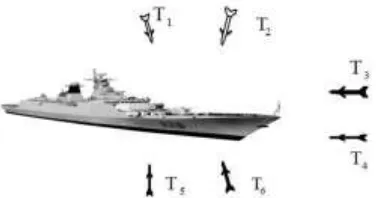
Suppose that a warship have 10 free soft and hard firepower units 𝑊1,𝑊2,⋯,𝑊9, 𝑊10, in a certain moment, where 𝑊2 and 𝑊5 are passive dilute chaff jamming and active jamming, and the rest are naval guns and ship-to-air missile firepower units. A soft weapon assigned to a target has the same kill probability to other missile targets in the same direction at the same time. A number of air targets 𝑇1, 𝑇2, 𝑇3, 𝑇4, 𝑇5, 𝑇6 attack from three directions at the same time, as is shown in Figure 1.
The kill probability of weapon to target as is shown in TABLE Ⅰ, the Resource
Value 𝐶𝑖 of free Firepower Unit as is shown in TABLE Ⅱ.
Figure 1. The attack of anti-ship missile.
TABLE Ⅰ. THE KILL PROBABILITY OF WEAPON TO TARGET.
Target weapon
𝑾𝟏 𝑾𝟐 𝑾𝟑 𝑾𝟒 𝑾𝟓 𝑾𝟔 𝑾𝟕 𝑾𝟖 𝑾𝟗 𝑾𝟏𝟎
𝑻𝟏 0.57 0.52 0.89 0.91 0.42 0.79 0.65 0.78 0.77 0.65
𝑻𝟐 0.49 0.55 0.81 0.88 0.38 0.93 0.76 0.75 0.79 0.68 𝑻𝟑 0.56 0.43 0.81 0.93 0.43 0.78 0.72 0.79 0.82 0.73 𝑻𝟒 0.42 0.48 0.93 0.76 0.45 0.88 0.66 0.91 0.88 0.77
𝑻𝟓 0.5 0.61 0.85 0.79 0.39 0.82 0.85 0.86 0.68 0.62 𝑻𝟔 0.55 0.46 0.86 0.85 0.46 0.76 0.78 0.79 0.75 0.85
TABLE Ⅱ. THE RESOURCE VALUE OF FREE FIREPOWER UNIT.
Firepower
Unit 𝑾𝟏 𝑾𝟐 𝑾𝟑 𝑾𝟒 𝑾𝟓 𝑾𝟔 𝑾𝟕 𝑾𝟖 𝑾𝟗 𝑾𝟏𝟎
The Resource
Value 𝑪𝒊
3 0.8 9 12 1.4 8 6 7 8 5
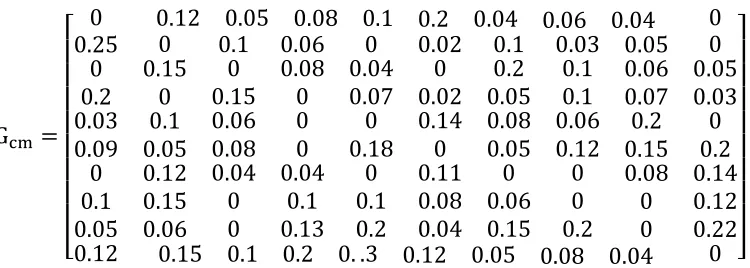
[image:6.612.199.387.246.345.2] [image:6.612.97.494.401.525.2]Gcm =
[
0 0.12 0.05 0.08 0.1 0.2 0.04 0.06 0.04 0
0.25 0 0.2 0.03 0.09 0 0.1 0.05 0 0.15 0 0.1 0.05 0.12 0.15 0.06 0.1 0 0.15 0.06 0.08 0.04 0 0 0.06 0.08 0 0 0 0.04 0.1 0.13 0 0.04 0.07 0 0.18 0 0.1 0.2 0.02 0 0.02 0.14 0 0.11 0.08 0.04 0.1 0.2 0.05 0.08 0.05 0 0.06 0.15 0.03 0.1 0.1 0.06 0.12 0 0 0.2 0.05 0.06 0.07 0.2 0.15 0.08 0 0 0 0.05 0.03 0 0.2 0.14 0.12 0.22
0.12 0.15 0.1 0.2 0. .3 0.12 0.05 0.08 0.04 0 ]
The parameters of the simulation are as follows: the number of particles is 80, the values of c1 and c2 are 0.8, the initial inertia coefficient w is set to 0.9, and decreases to 0.4 linearly. The kill probability for all incoming targets is 0.8, that is, 𝑃𝑗>0.8. With the increase in the number of iterations, resource consumption as is shown in Figure 2.
[image:7.612.112.487.57.191.2]When the resource consumption is 49.2, Pgt=[0,4,2,1,2,3,5,4,0,6].
Figure 2. The number of iterations and resource consumption.
When the resource consumption is 47.8, Pgt=[0,4,2,1,0,3,5,4,0,6]. When the resource consumption is 43.8, Pgt=[0,2,4,0,0,1,2,5,3,6].
In the 50 iterations, the minimum value of resource consumption is 43.8, and the optimal weapon-target assignment particle is Pgt = [0,2,4,0,0,1,2,5,3,6].
As can be seen from the Figure 2, with the increase in the number of iterations, the resource consumption of weapon-target assignment strategy is decreasing. In the case of battlefield, the decision maker or procedure may terminate the iteration based on the relationship between the resource consumption and the arrival time of the incoming targets, output the current optimal solution of weapon-target assignment.
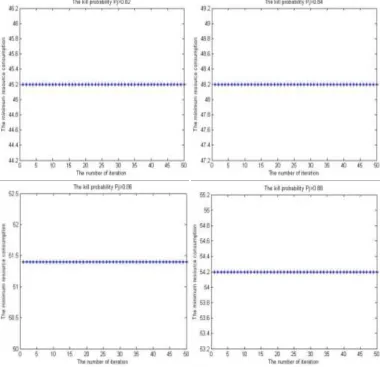
set the step to 0.2, increase the kill probability index P, the result as is shown in Figure 3.
Set P equal to 0.82, the minimum resource consumption is 45.2 in the 50 iterations, and the best particle Pgt=[0,2,3,0,3,1,5,2,4,6].
Set P equal to 0.84, the minimum resource consumption is 48.2 in the 50 iterations, and the best particle Pgt=[0,6,0,1,4,2,3,4,5,6].
Set P equal to 0.86, the minimum resource consumption is 51.4 in the 50 iterations, and the best particle Pgt=[2,0,1,3,5,0,5,4,2,6].
Set P equal to 0.88, the minimum resource consumption is 54.2 in the 50 iterations, and the best particle Pgt=[3,6,1,2,1,5,0,4,3,6].
[image:8.612.97.477.261.628.2]Set P equal to 0.9, there has no efficient solution. Considering there still has one free firepower unit, the step can set to a smaller number than 0.2, continue the calculation until meet the terminate condition.
CONCLUSIONS
In weapon-target assignment, take single warship’s soft and hard weapon cooperative anti-missile as background, the correlation matrix is proposed in this paper. On the premise of meet the kill probability index P to incoming targets, in order to fight against more batches of incoming targets, the minimum resource consumption model is established. This paper use an anytime algorithm to solve the multi-weapon and multi-target assignment problem. The simulation results show that the proposed method can quickly obtain the current optimal combination of soft and hard weapons for the incoming targets, and output the current optimal solution of weapon-target assignment at any time, according to the relationship of available firepower resources and the targets arrival time.
REFERENCES
1. Jian-dong Qin, Chang-Feng Xing, and Ling Wu. 2012. “Research on the compatibility of
shipboard soft and hard weapons for cooperative anti-missile,” J. Ship Science and Technology,
34(7) :114-117.
2. Song-lina Zeng, Wen-Yun Wang, and Hai-jian Chen. 2011. “Hard and Soft Weapon Antimissile
Coordinated Decision-Making Based on Hybrid Particle Swarm Optimization Algorithm,” J.
Modern Defence Technology, 39(3):31-37.
3. Hong-jun Wang, and Zhong-xian Chi. 2011. “Shipboard hard and soft weapon anti-missile
decision-making optimization based on collaboration,” J. Control and Decision, 22(3):299-303.
4. Yi-wei Li, and Chang-feng Xing. 2007. “Analysis of intersection of shot plane and study of methods of weapon control,” J. Journal of Naval University of Engineering, 19(3):94-97. 5. Yi-wei Li, and Wenliang Yang. 2009. “Research on Technique of Firepower Compatible for
Warship,” J. Ship Electronic Engineering, 29(1):21-23.
6. Liang Yu, Chang-feng Xing, and Zhang-song Shi. 2013. “Modeling of airspace resource for
cooperative air-defense operation,” J. Journal of Naval University of Engineering, 26(1):54-59.
7. Dang Cong Tran, and Zhijian. Wu. 2016. “Adaptive Multi-layer Particle Swarm Optimization
with Neighborhood Search,” J. Chinese Journal of Electronics, 15 (06):1079-1088.
8. Jie Xiong, Dong-sheng Yang, and Yun-sen Wang. 2015. “Application of Genetic-Tabu Search
Algorithm in Industrial Robot Structural Parameter identification,” J. Modular Machine Tool &
Automatic Manufacturing Technique, 12(2): 4-7.
9. Hao XU. 2011. “A discussion on Tabu Search Parameters Setting,” J. Mechanical & Electrical