Chapter 18
An Examination and Analysis of a Learner’s Errors
from the Perspective of a Pedagogical Grammar
Farah Chaudary and Mario R. Moya
University of East London, United Kingdom
Abstract
Attitudes towards errors in language learning are changing as a result of recent contributions coming from the field of pedagogical grammar, which take into consideration notions of error analysis, contrastive analysis and the study of interlanguage. Errors, we argue, should be considered as opportunities to develop learners’ language awareness to further their learning, and as instances for teachers to design more effective remedial work. Through the analysis of a learner’s written assignment, Corder’s (1967) model of error analysis is applied in order to identify errors leading an understanding of the reasons behind the occurrence of inconsistencies produced by a speaker of Arabic learning English as a foreign language. Whilst the results point to prevalent negative interferences between the two languages, the main outcome of the study is centred on the value of errors as opportunities for both learners and instructors and on the salient role of feedback.
Introduction
to be reinforced in future lessons and, as such, these are seen to form the real language curriculum, a view held by many pedagogical grammars. This paper, therefore, aims to (1) present and discuss the theoretical background on error analysis whilst reflecting on the role of errors in SLA, and (2) identify and analyse the errors taken from a learner’s written work following the framework put forward by Dulay, Burt, and Krashen (1982).
Literature Review
To begin, we acknowledge that there is a difference between “mistakes” and “errors.” This difference is sustained not only from a linguistic perspective, but also from a psychological one. In terms of linguistics, Lennon (1991, p. 182) defines an error as “a linguistic form or combination of forms which, in the same context and under similar conditions of production, would, in all likelihood, not be produced by the speakers’ native speaker counterparts.” Although such a definition is essential to form a methodology for the identification of an error, the reference to a native speaker norm is, undoubtedly, problematic in the sense that there exists a wide range of the target language (for instance, regional, dialectal or colloquial varieties). Conversely, Corder (1967, p. 166) argues that a mistake shows a temporary lapse in language use, a “slip of the tongue,” which is usually remedied in no time. These two perspectives enable us to view error as a reflection of what a learner still has not learnt as this reveals a gap in language knowledge; a mistake, on the other hand, is a temporary failure in the use of a language sub-system, resulting from some momentary mental lacunae or twist of the tongue.
The study of learner language and of “incorrect” language usage is usually traced back to the 1950s and 1960s when behaviourist theories of language learning were dominant in the field of linguistics. According to the behaviourist view, learners’ errors were signs of imperfect teaching methods or evidence of failure; they were obstacles to language learning which should be avoided. Traditional language approaches, which fell into the behaviourist model, had a different view of the implications of error than today’s approaches. The audiolingual method was one of these in which error was avoided at all costs, and error correction was considered imperative (Brown, 2007). Although the behaviourist teaching model realised the inevitability of errors, it endeavoured to either avoid them or eliminate them as soon as they had been made. This was because behaviourism saw SLA as a process of habit development by way of repetition (Lightbown & Spada, 2013).
nonetheless paved the way for linguists and language teachers towards a more cognitive approach. The Chomskyan effect in linguistics soon gave birth to one of the most controversial studies in applied linguistics: contrastive analysis (CA). CA was based on Lado’s (1957, p. 2) assertion that “those elements that are similar to [the learner’s] native language will be simple for him [sic], and those elements that are different will be difficult.” Lado put forward systematic procedures which involved contrasting languages and forecasting certain difficulties learners might encounter. According to the CA hypothesis, the errors that a learner makes in the target language are caused by the interference of the first language and these are mainly because of the negative transfer created by the differences in the two language systems (Lado, 1957). While CA was effective in providing explanations as to why learners make errors in L2, it was not substantially supported by practical evidence, and many of the difficulties (e.g., spelling) foreseen by CA were not actually observed in the performance of the learners (Corder, 1967).
The lack of empirical evidence to uphold CA led researchers to explore different grounds on which to investigate learner errors. In 1967, Corder called for a more systematic alternative to CA, one which could analyse and explain the majority of errors made by learners, “not just those resulting from negative transfer of the native language” (Brown, 2007, p. 259). Corder (1967, p. 162) argued that errors were not merely “annoying, distracting…by-products of the process of learning,” but they could “provide evidence of the system of the language that [a learner] is using at a particular point in the course” (p. 167). He also noted that errors were significant in three ways:
1)
They informed the teacher about the progression of the learner in the
target language,
2)
They provided the researcher with information regarding the methods
or strategies the learner used,
3)
They were devices employed by the learner in order to discover the
nature of the target language.
Corder (1967) laid out the rationale and methodology for what is known as error analysis (EA). EA was an important step in the field of SLA in that it drew attention to the value of errors in the learning process (Corder, 1967). Despite its contributions, EA is not flawless. First of all, determining the actual source of errors is a virtually impossible task, and secondly, EA fails to account for certain communicative strategies such as avoidance (substituting a required form with one that the learner feels comfortable using).
native and target languages” (Brown, 2007, p. 256). Interlanguage can then be seen as a learner’s progressive and systematic constructions towards the approximation of the target language rather than “pathologies to be eradicated,” as once proclaimed by Richards and Sampson (1974, p. 17). This trial and error phase has shown linguists and researchers that learners are actually testing out the input they receive from their environment in an attempt to reach a target language norm. Furthermore, studying the features of interlanguage may explain the psycholinguistic and cultural underpinnings of SLA.
Methodology
After this brief overview of the theoretical background of error analysis, we now proceed to the identification and analysis of one of the participants’ errors. Participants in the study were Saudi students at beginner level (A1). They had been studying English as a Foreign Language (EFL) for four months, and at the time of the study, they were attending a two-hour class, five times a week. Living in an EFL environment where Arabic is the official language, they had limited exposure to English outside the classroom. The participant from which the sample is derived was required to write a paragraph using the simple present tense to talk about likes, dislikes, and everyday routine (Appendix A).
Corder (1967) notes that errors are an indication of “how far towards the goal the learner has progressed and, consequently, what remains for him to learn” (p. 167). Thus, by analysing the errors a learner makes, it may be possible to achieve an understanding of that learner’s learning strategies and the state of his interlanguage. To do so, Corder (1974) suggests the following consecutive steps in conducting an error analysis: collection, identification, description, explanation, and evaluation of errors. According to this sequence, after collecting a corpus of learner language, the errors therein are specified; however, devising a procedure of error identification is not an easy undertaking because it initially entails distinguishing an error from a mistake. The third step in Corder’s order – the description of errors – involves paying “attention to the surface properties of the learners’ utterances” (Ellis, 1994, p. 54). To this end, a systematic arrangement of errors (generally known as a taxonomy) needs to be established. There are two commonly used taxonomies: (1) a linguistic taxonomy, which primarily uses descriptive grammar as its basis, and (2) a surface structure taxonomy, which takes into account “the ways surface structures are altered” (Dulay, Burt, & Krashen, 1982, p. 150). It is noteworthy that these two taxonomies are not wholly discrete; Burt and Kiparsky’s The Gooficon: A Repair Manual for English (1972) can be considered a successful combination of both, where errors are categorized as global (those which hinder communication) and local (those which cause a minor interference in the overall message).
not be understood as merely designating a single source to each error. Rather, it can be viewed as an attempt “to formulate an integrated understanding of the process of second language acquisition” (Brown, 2007, p. 263). One of the most prevalent explanations in terms of the psycholinguistic sources of errors is the distinction between interlingual and intralingual errors, where the former is basically the result of transfer from L1 (“interference”) and the latter is the effect of (over)generalisation within the target language (Selinker, 1969).
There are, indeed, other distinctions regarding the causes of errors, such as epistemic, sociolinguistic or discoursal. However, the field of SLA is mainly concerned with the psychological aspect of learner errors. As a general rule, it is best to “be extremely cautious when claiming to have identified the cause of any given error type” (Schachter & Celce-Murcia, 1977, p. 448).
Findings and Discussion
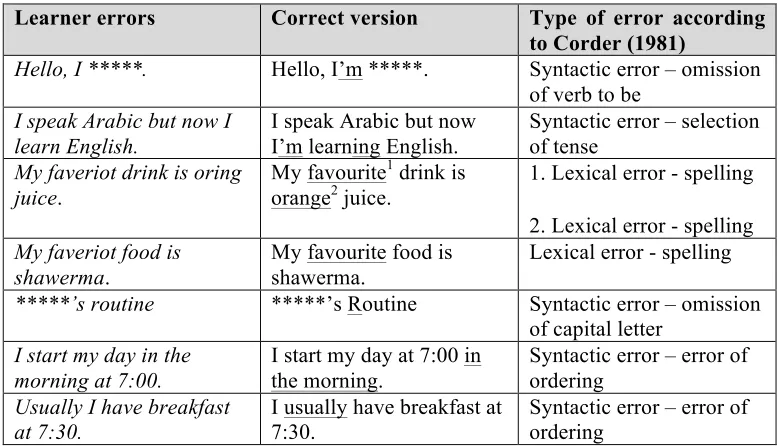
[image:5.482.50.442.364.590.2] [image:5.482.50.439.365.588.2]Table 1 illustrates the errors in the participant’s script (Appendix A). The table identifies inconsistencies whilst providing the correct (desirable) structures and a classification of the errors based on the surface structure taxonomy with the addition of spelling and punctuation errors.
Table 1
Errors found in the participant's script
Learner errors Correct version Type of error according to Corder (1981)
Hello, I *****. Hello, I’m *****. Syntactic error – omission of verb to be
I speak Arabic but now I learn English.
I speak Arabic but now I’m learning English.
Syntactic error – selection of tense
My faveriot drink is oring juice.
My favourite1 drink is orange2 juice.
1. Lexical error - spelling 2. Lexical error - spelling My faveriot food is
shawerma.
My favourite food is shawerma.
Lexical error - spelling *****’s routine *****’s Routine Syntactic error – omission
of capital letter I start my day in the
morning at 7:00.
I start my day at 7:00 in the morning.
Syntactic error – error of ordering
Usually I have breakfast
Learner errors Correct version Type of error according to Corder (1981)
Then go to the English institute.
Then I1 go to an2 English institute.
1. Syntactic error – omission of subject 2. Syntactic error – selection of article I have lunch at 1:00 and
always I watch TV after lunch.
I have lunch at 1:00 and I always watch TV after lunch.
Syntactic error – error of ordering
I listen sometimes to music when clean my home or cook.
I sometimes1 listen to music when I2 clean my home or cook.
1. Syntactic error – error of ordering
2. Syntactic error – omission of subject At the evening sometimes
with my family I drink arabic coffee and eat cake.
In1 the evening,2 I sometimes3 drink Arabic4 coffee and eat cake with my family5.
1. Syntactic error – selection of preposition 2. Syntactic error – omission of comma 3. Syntactic error – error of ordering
4. Syntactic error – omission of capital letter 5. Syntactic error – error of ordering
Always I eat dinner early and tow hour later go to bed.
I always1 eat dinner early and two2 hours3 later I4 go to bed.
1. Syntactic error – error of ordering
Learner errors Correct version Type of error according to Corder (1981)
I go at the weekend my mother home.
I go to1 my mother’s2
home at the weekend3. 1. Syntactic error – omission of preposition 2. Syntactic error – omission of possessive ’s 3. Syntactic error – error of ordering
She cook for me delicious kabsa.
She cooks1 delicious
kabsa for me2. 1. Syntactic error – selection of tense 2. Syntactic error – error of ordering
We have fun time together.
We have a fun time together.
Syntactic error – omission of indefinite article Also I go on Saturday to
Red Sea Mall to shopping.
Also,1 I go to Red Sea Mall to shop2 on Saturday3.
1. Syntactic error – omission of comma 2. Syntactic error – selection of word form 3. Syntactic error – error of ordering
It is a mall very big. It is a very big mall. Syntactic error – error of ordering
This my routine. This is my routine. Syntactic error – omission of verb to be
Thank you for you1 read
about my day.
Thank you for reading2 about my day.
1. Syntactic error – addition of object pronoun 2. Syntactic error – selection of word form
For a more comprehensive analysis of the participant’s script, syntactic and lexical errors were sub-categorised as errors of omission, addition, selection, and ordering. These sub-categories allowed for a more systematic analysis. Following Corder’s taxonomy of errors (Corder, 1981), omission errors account for missing elements which are obligatory in a given structure and, therefore, must be present. Addition errors are those where an element which is not needed is present. Selection errors are inconsistencies where an incorrect item is presented instead of the correct one. Ordering errors are, as the name suggests, items that are present and are correct but in the wrong order.
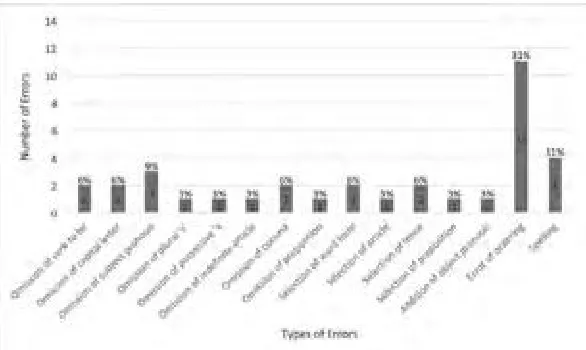
[image:8.482.51.344.218.393.2]In order to have a better perspective of the types of errors that were accounted for under the syntactic and lexical factors, Figure 1 summarises this information.
Figure 1:
A summary of the participant's errors following Corder's (1981)
taxonomy
With a total of 31%, incorrect word or phrase order represents the most common type of error in the participant’s script. This is followed by inconsistencies in spelling (11%) and errors of omission of subject pronouns (9%). Other inconsistencies such as in selecting the correct tense or word form, omission of commas, of the verb “to be,” and of capital letters, each contribute to 6% of all errors. The least common types of errors include a) omissions of plural and possessive markers, indefinite articles and prepositions; b) errors of choice of articles and prepositions; and c) errors of addition, especially of object pronouns. All of these account for 3% of the total.
after nouns (Smith, 2001), and the participant’s construction “It is a mall very big” (line 15) to describe a shopping mall is an example of negative interference. According to Krashen (1982), learners use their mother tongue to help them in the production of the TL. Another factor for consideration relates to the right-to-left writing orientation of the Arabic script which can cause Arabic-speaking learners of English to misread letters within words as a result of a different eye movement. This seems to be the case of the spelling mistake in line 12, for instance, where the participant spelt “tow” instead of “two.” Other factors that hinder the accuracy of spelling are mirror shapes such as ‘b’ and ‘d’, the reversed question mark and malformation of individual letters especially in cursive English writing (Smith, 2001). These, however, were not found in the sample.
In order to address the less common errors identified in the script, the following characteristics of the Arabic language, as highlighted by Smith (2001), should be considered. The Arabic language does not have a system of the present verb “to be” or the gerund; hence, errors of omission and/or addition of these items are common. There is also no indefinite article in Arabic, so learners often omit it in English. On the other hand, the definite article has extensive use in the Arabic language causing negative interference in sentence construction, particularly when discussing possession. For example, for an Arabic speaker it is common to say, “The book of teacher” or “This is book the teacher” whereas in English these equate to awkward constructions which can be categorized as developmental errors in Corder’s (1967) taxonomy.
Interest in the analysis and interpretation of learners’ errors has been resurrected in the last two decades as a result of new insights coming from the field of pedagogical grammar. Different authors — including Odlin (1994), Ortega (2003), and Keck and Kim (2014) — argue that this is a hybrid discipline or a cross-fertilization of three broad areas of applied linguistics. Ortega (2013, p. 1) describes pedagogical grammar as being made up of three inter-related areas: (a) linguistic description (data-based accounts of grammar), (b) second language acquisition (research that explores how and when particular systems are acquired by L2 learners), and (c) second language instruction (research that explores the relative effectiveness of different instructional approaches. The analysis of learners’ errors as undertaken in this study illustrates how the above areas are, in fact, closely related. However, such an analysis would be incomplete if the outcomes are not communicated to the learners via feedback that includes developmental information to enable them to improve accuracy. This is what Nunan (1998) calls feedforward. In a study carried out in Australia, Nunan (1998) reports that learners value error correction; consequently, the role of feedback is critical.
vary. Effective feedback, therefore, requires good timing, clear content, and focus. Providing students with information about what they produced and the quality of their work can help them to translate feedback into a meaningful context. This part of the process is essential as effective teacher feedback can help learners in the generation of their own cognitive feedback or meta-learning, enabling students to link a task with the actions they carried out to achieve a language outcome. This cognitive feedback serves as an opportunity for learners to assess their own language production and performance and for them to seek ways to improve further (Butler & Winne, 1995). Additionally, meta-learning can help learners to study smarter — not harder — by directing their focus to constructions which have been incorrectly or partially addressed so they are more aware of trouble spots (Brookhart, 2008). Whilst some instructors tend to focus only on focused marking and feedback (i.e., comments relating to one grammar aspect), the script analysed in this paper (Appendix A) was edited to show every error for the purpose of analysis. The ways in which feedback is given and received appear to be culturally influenced (de Luque & Sommer, 2000). For instance, in Saudi Arabia, learners appreciate and request the correction of every single error, and the use of colours other than red is favoured to reduce the negative connotation of that colour (Baghzou, 2011).
Conclusion
From the analysis of the script in this paper, confirmed by other research (e.g., Smith, 2001), we have noted that speakers of the Arabic language tend to make syntactic errors connected to word order in English sentences. Most of the inconsistencies arise from the manner in which time and adverbial phrases are placed differently in both languages. Errors of omission cause structural errors which the students may not identify independently. This is due to the fact that certain structural elements, such as the verb “to be,” do not exist in Arabic. Having learners exposed to the individual elements that form a grammatically accurate sentence in English, using strategies such as noticing or consciousness-raising, appears to be an effective remedy to improve understanding of word order. Other type of errors, such as those of omission, can be addressed by presenting words in sequences that enable learners to attain a better understanding of sentence structures in English.
teachers in the design of remedial work. In fact, Nunan (1998) considers errors to be the “real curriculum,” one that indicates the areas to focus on in future lessons to improve learners’ performance in the TL.
We can say that, once considered undesirable, errors have attained a more respectable status by virtue of new developments in language studies leading to more benign and accepting attitudes. It is true that errors committed while learning a language are quite possibly the most authentic and tangible pieces of evidence teachers or researchers can access. If learners have been rightfully assigned a central role in a learning environment, then the more we know about their trial and error attempts at producing the target language, the better we can adapt ourselves to their needs rather than impose upon them “our preconceptions of how he ought to learn, what they ought to learn and when theyhe ought to learn it” (Corder, 1967, p. 169).
References
Baghzou, S. (2011). The effects of content feedback on students’ writing. Ankara Universitesi Dilve Tarih-Coğrafya Fakultesi Dergisi, 512, 169-180.
Brookhart, S. (2008). How to give effective feedback to your students. Alexandria, VA: ASCD.
Brown, H. (2007). Principles of language learning and teaching (5th ed.). New York, NY: Pearson.
Burt, M., & Kiparsky, C. (1972). The Gooficon: A repair manual for English. Rowley, MA: Newbury House.
Butler, D. L., & Winne, P. H. (1995). Feedback and self-regulated learning: A theoretical synthesis. Review of educational research, 653, 245-281.
Chomsky, N. (1972). Language and mind (enlarged edition). New York, NY: Harcourt Brace Jovanovich.
Corder, S. (1967). The significance of learners' errors. International Review of Applied Linguistics, 54, 161-170.
Corder, S. (1974). Error analysis. The Edinburgh course in applied linguistics, 3, 122-131.
Corder, S. (1981). Error analysis and interlanguage. Oxford, UK: Oxford University Press.
De Luque, M. F., & Sommer, S. M. (2000). The impact of culture on feedback-seeking behavior: An integrated model and propositions. Academy of Management Review, 25(4), 829-849.
Ellis, R. (1994). The study of second language acquisition. Oxford, UK: Oxford University Press.
Harmer, J. (1998). How to teach English: An introduction to the practice of English language teaching. Harlow, UK: Longman.
James, C. (1998). Errors in language learning and use: Exploring error analysis. London, UK: Longman.
Keck, C., & Kim, Y. (2014). Pedagogical grammar. Amsterdam, The Netherlands: John Benjamin Publishing Company.
Krashen, S. D. (1982). Principles and practice in second language acquisition. Oxford, UK: Pergamon.
Lado, R. (1957). Linguistics across cultures: Applied linguistics for language teachers. Ann Arbor: University of Michigan Press.
Lennon, P. (1991). Error: Some problems of definition, identification, and distinction. Applied Linguistics, 122, 180-196.
Lightbown, P., & Spada, N. (2013). How languages are learned. Oxford, UK: Oxford University Press.
Nunan, D. (1988). Syllabus design. Oxford, UK: Oxford University Press.
Odlin, T. (1994). (Ed.) Perspectives on pedagogical grammar. Cambridge, UK:Cambridge University Press.
Ortega, L. (2003). Doctoral seminar in SLA: Innovative research on pedagogical grammar. [Course syllabus for ENG703.] English Department, Northern Arizona University.
Ortega, L. (2013). Ways forward for a bi/multilingual turn in SLA. In S. May (Ed.), The multilingual turn: Implications for SLA, TESOL, and bilingual education (pp. 32-53). London, UK: Routledge.
Richards, J. (1974). Error analysis: Perspectives on second language acquisition. London, UK: Longman.
Richards, J., & Sampson, G. (1974). The study of learner English. In J. Richards (Ed.), Error analysis: Perspectives on second language acquisition (pp. 3-18). London, UK: Longman.
Schachter, J., & Celce-Murcia, M. (1977). Some reservations concerning error analysis. TESOL Quarterly, 11(4), 441-451.
Selinker, L. (1969). lnterlanguage. IRAL, 3, 114-132.
Selinker, L. (1972). Interlanguage. International Review of Applied Linguistics in Language Teaching, 10, 209-232.
Smith, M. (2001). David A. Kolb on experiential learning. Accessed July 30, 2018. https://www.infed.org
Appendix A
1
5