University of Huddersfield Repository Kelly, Philip Fred
A model for the use of cost information in AMT environments
Original Citation
Kelly, Philip Fred (1995) A model for the use of cost information in AMT environments. Doctoral thesis, University of Huddersfield.
This version is available at http://eprints.hud.ac.uk/id/eprint/9284/
The University Repository is a digital collection of the research output of the University, available on Open Access. Copyright and Moral Rights for the items on this site are retained by the individual author and/or other copyright owners. Users may access full items free of charge; copies of full text items generally can be reproduced, displayed or performed and given to third parties in any format or medium for personal research or study, educational or notforprofit purposes without prior permission or charge, provided:
• The authors, title and full bibliographic details is credited in any copy; • A hyperlink and/or URL is included for the original metadata page; and • The content is not changed in any way.
For more information, including our policy and submission procedure, please contact the Repository Team at: [email protected].
A MODEL FOR THE USE OF COST
INFORMATION IN AMT
ENVIRONMENTS
Philip Fred Kelly
A thesis submitted to the University of Huddersfield in partial
fulfilment of the requirements for the degree of Doctor of Philosophy
June 1995
The University of Huddersfield in collaboration with David Brown
ABSTRACT
This thesis provides a critical review of the way in which cost information is used as a basis for decision-support across the broad range of manufacturing activity and goes on to propose and develop a model for the more effective use of such information. The research "bridges" the functions of engineering, management and accounting and is innovative in the way that it places recent research in the area of management accounting into the context of engineering and management decision-making.
The review of current practice is based upon published material, a survey of practice in three manufacturing organisations and upon extensive experience gained by the author in industry, "Teaching Company Scheme" (TCS) supervision and supervision of industry based undergraduate projects concerned with cost management. The research reveals widespread belief on the part of engineers, managers and accountants, that current approaches and practices with respect to the use of cost information do not provide a sufficiently accurate and realistic base for decision-support and goes on to identify the underlying reasons for this belief. Analysis and discussion is provided to support the hypothesis that "Traditional approaches and practices with respect to the detennination, communication and use of cost information do not provide a satisfactory basis for decision-support in today's highly competitive and technologically advanced markets".
PREFACE
The research described in this thesis is broadly based and multi-disciplinery in its nature,
drawing extensively from the considerable industrial and academic experience of the
author. The work is innovative in the way in which it applies and integrates "new"
approaches to the use of cost information and does not represent an attempt to develop
particular approaches at the "detail" level. The primary aim of the research was to enable greater understanding of the "whole" and to provide a "platform" for more
"focused" research at the detail level.
One of the major challenges associated with the work was that of "bridging" the
functions of engineering, management and accounting i.e. placing recent developments in
the areas of management accounting, concurrent engineering and structured project
management into the context of engineering and management decision-making.
Experience gained by the author in industry, "Teaching Company" supervision and in
supervision of industry based undergraduate projects concerned with cost management,
was of considerable value in carrying out the work.
Having completed the research the author is reminded of a conference several years ago,
at which the late John Burbidge posed a question to one of the speakers. The speaker
gave a comprehensive reply and was thanked by Professor Burbidge. Professor
Burbidge went on to say that "I remain confused but upon a much higher plane". It is intended that the work described in this thesis will provide the basis for a continued
The broad nature of the research was reflected in the supervisory team and I am indebted
greatly to:
Dr Kevin Barber (Total Technology Unit - UMIST) for his guidance and support as
Director of Studies, his breadth of understanding and his ability to pose very "pointed"
questions.
Prof. Colin Drury (Reader in Accountancy - University of Huddersfield) for essential guidance and advice concerning accounting issues and for his enthusiasm and interest
with respect to the broader aspects.
Dr Bill Weston (Associate Dean - School Of Engineering, University of Huddersfield)
for his support and help as a mechanical/manufacturing engineer and as a "sympathetic"
boss.
The major industrial input to the research was provided by three companies and it would
not be practical to mention all the staff to whom I am indebted. I would however like to
thank in particular:
Jim Vigor, Roger Bailey and David Sheard (David Brown Vehicle Transmissions)
Mark Ridgeway, Dick Granger and Steve Harper (Joseph Rhodes Ltd.)
Dave Martin, Ian Littlejohn and Dave Marshall (Kent Introl Ltd.)
Thanks are due also to my wife Sandra and to my children Marie, Daniel and Rebecca,
for supporting me and accepting my virtual absence from family life for long periods over
CONTENTS
Page
Abstract ...
iPreface ...
11Contents ...
IV1.0 Introduction ... '" ... ... ... ... ...
11. 1 Background ... 1
1. 1.1 Sources of Cost Information. ... 2
l.l.2 Application of Cost Oriented Information. ... 3
. l.l.3 Strategic Issues ... 4
1.1.4 Market Trends. ... 4
1.1.5 Advanced Manufacturing Technology (AMT). ... 5
1. 1.6 Conclusion ... 5
1.2 Research Objectives ... 5
1.2.1 Critical Review. ... 5
l.2.2 Development of a Conceptual Model. ... 5
l.2.3 Recommendations for Further Work. ... 6
1.3 Approach ... ~... 6
1.3.1 Phase One ... 6
1.3.3 Phase Three... 7
1.4 Hypotheses ... 8
1.4.1 Initial Hypothesis... 8
1.4.2 Supplementary Hypothesis ... 8
2.0 Review And Analysis Of Current Practice And
Published Research . ...
92.1 Corporate/Strategic Activity... 11
2.2 Marketing/Sales... 14
2.3 Product Design. ... 16
2.3.1 Background ... 16
2.3.2 Design For Economic Manufacture and Concurrent Engineering ... 20
2.3.3 An Information Model For Engineering Product Design ... 27
2.3.4 Industrial Survey... 28
2.3.5 Discussion and General Conclusions... 32
2.4 Manufacturing Systems Engineering - System Design and Process Planning... 36
2.4.1 Manufacturing System Design... 36
2.4.2 Process Planning... 39
2.4.3 Computer Aided Process Planning ... 41
2.4.4 Industrial Survey... ... ... ... .... ... 42
2.4.5 Discussion and General Conclusions... 45
2.5 Production Planning, Procurement and Shop Floor Operations ... 48
2.5.1 Production Planning... 48
2.5.2 Procurement ... 50
2.5.3 Shop Floor Operations... 51
2.5.4 Discussion and General Conclusions... 52
2.6 Quality Costs... ... ... ... ... ... ... ... 53
2.7 Finance and Accounting... 56
2.7.1 Product Costing. ... ... 56
2.7.3 Investment Analysis... 59
2.7.4 The Continuing Role of Management Accountants... 63
2.8 Summary and Conclusions... 64
3.0 "New" Approaches To Cost Accounting ...
693. 1 Activity Based Costing... 69
3.1.1 Background. ... 69
3.1.2 Principles of Activity Based Costing. ... 74
3.1.3 Discussion... 78
3.2 Throughput Accounting. ... 79
3.2.1 Background ... ,... 79
3.2.2 Principles of Throughput Accounting ... 80
3.2.2 Discussion ... 81
4.0 Review And Analysis Of The Current And Potential
Role Of IT ...
83" 4.1 Communication Systems ... 844.1.1 Standard for Exchange of Product Data (STEP) ... 85
4.1.2 Computer Aided Acquisition and Logic Support (CALS) .... 86
4.1.3 Object Oriented Design (OOD)... ... ... ... 86
4.1.4 Open Systems Interconnection (OSI)... ... 87
4.2 Analytical Tools ... 87
4.2.1 Discrete Event Simulation... ... 88
4.2.1.1 Generation of Business Oriented Performance Indices in Manufacturing System Simulation. ... 92
5.0 Structured "Project" Approaches To Organisation And
Control Of Manufacturing Activity
0... 1005.1 Structured Approaches to Project Management... 103
5.l.1 Work Breakdown Structure (WBS)... 103
5.l.2 Organisation Breakdown Structure(OBS)... 104
5.l.3 Two Dimensional Project Structure - The "Cost Account" ... 105
5.l.4 Cost Breakdown Structures (CBS)... 106
5.2 Logical Network Structure... 108
5.3 Performance Measures For Project Management. ... 108
5.4 Software For Structured Project Management. ... III
6.0 Supplementary Hypothesis ...
1157.0 Development Of The Model ...
1167.1 Specification of the Model. ... 117
7.2 Outline Structure of the Model ... 118
7.3 Operation of the Model. ... 120
7.3.1 Periodic Review of Activities and Products (ABC) ... 120
73.2 Short Term Factors in Product Design... 125
7.3.3 Long Tertn Issues... 126
7.4 Investment Analysis and the Assignment of Overhead ... 127
7.5 Product Life Cycle Cost Account (PLCCA) ... 130
7.6 Issues of Implementation... ... 132
8.0 Exemplar Application Of The Conceptual Model ...
1348.1 Introduction ... 134
8.2 Background ... 135
8.2.1 The Company ... 135
8.2.2 Company Products ... ... 136
8.3 Revised Approach to Product Costing ... 140
8.3.1 Outline .. ... ... ... ... ... .... 140
8.3.2 Volume Related Costs ... 141
8.3.3 Support Related Costs. ... ... ... ... ... 147
8.4 Overall Operation of the New Approach/System ... 151
8.4. 1 Revised Structure for Product Costing ... 151
8.4.2 Structure of the Overall System ... 151
8.4.3 Links Between the System Elements ... 152
8.5 Detailed Information Provided by the New Approach ... 156
8.6 Company Interpretation of Results ... 159
8.7 Simulation ... 162
8.8 Implications for Design and Process Planning ... 164
8.9 Summary and Conclusions ... 165
9.0 Conclusions ...
16610.0 Recommendations For Further Work ...
169References ... '...
170Appendices ...
177Appendix 1 Questionnaire... .. 178
Appendix 2 Application of Multiple Linear Regression ... 191
1.0
INTRODUCTION
For the majority of manufacturing organisations the overall business objective is the
maximisation of long run profitability. If profit is defined as simply the difference
between revenues and total cost, then it is clear that the acquisition, analysis and
dissemination of accurate cost oriented information is of fundamental importance to
effective decision-making. This programme of research aims to establish the degree to
which current techniques and practice with respect to the determination, dissemination
and use of cost information, supports effective decision-making. A further aim of the
research is to critically review recent developmentsfmitiatives in the areas of cost
accounting, design management, manufacturing management and IT and to develop an
integrated and effective approach to their application. A considerable amount of
research has been carried out within the various "disciplines" by other workers but
relatively little has been published with respect to its integration and practical application.
1.1 BACKGROUND
The following sections (1.1.1 to 1.1.6) are intended to provide an overview of the areas
and issues which will be addressed and hence the scope of the work. The concepts and
1.1.1
Sources of
Cost Information
Traditional approaches to the determination of manufacturing cost are effective in the aggregation of costs for financial accounting purposes, but do not provide a suitable basis for determination of the cost associated with particular products/services Kaplan [1] and Drury et al [2]. Kaplan [1] and Bellis-Jones [3] claim that firms are unaware frequently that some products which appear to yield healthy profits are in fact being produced at a loss. It follows that some products which have been discontinued, as a result of their apparent lack of profitability, may in fact have been important contributors to the overall profitability of a firm.
Johnson and Kaplan [4] contend that most of the management accounting practices currently in use, had been developed by 1925 and as such are not relevant to the highly competitive and increasingly technological manufacturing environment of today. While the views of Kaplan and Johnson are not accepted universally they do enjoy considerable support [5], [6], [7], and [8]. The most widely supported approach to radical change in the area of management accounting is that of "activity based costing"(ABC), developed by Kaplan and Cooper [9] and [10]. It is claimed that ABC allows for more accurate allocation of overhead to particular products and that it provides a focus on the activities that "drive" cost. An alternative or complementary approach is that of "throughput accounting"(TA) , as proposed by Galloway and Waldron [11] and by Schmenner [12]. Throughput accounting takes the emphasis away from the identification of accurate/relevant product costs and concentrates on promoting the adoption of manufacturing decisions which will maximise saleable/profitable output over a given period.
that if performance criteria relate only to consideration of cost, the motivation and
pre-occupation of managers, engineers etc., will focus on this criterion to the exclusion of
marketing, managerial and strategic issues [16], [17] and [18].
1.1.2 Application of Cost Oriented Information
While it may be argued that the major responsibility for establishing, maintaining and
developing systems for the acquisition, analysis and dissemination of cost oriented
information, together with the publication of appropriate cost performance indices, lies
with the management accounting function, responsibility for the effective application of
such systems, indices and information is less well defined. A wide range of functions,
from marketing and design to production and distribution, are involved in ,making
decisions which could/should make use of cost oriented information. There is much
evidence to suggest that production managers, engineers and others use and/or respond
to cost information and performance indices in an unstructured and ill informed manner [8]. Functional divisions and behavioural factors often result in the pursuit of local
objectives which are counter productive in terms of achieving the overall objectives of
the firm. The need for a structured model for the application of appropriate concepts,
techniques and performance indices, as a basis for integrated and effective
decision-making, has been identified [15], [2] and [7]. Tayles [7] goes on to stress the need for
collaboration between management accountants and engineers in such developments.
While there is ample evidence of well directed research, on the part of the accounting
profession, concerning the development of more appropriate concepts and techniques,
relatively little or nothing has been published with respect to the practical application of
the new approaches across the broad range of manufacturing activity. What activity
there is tends to be rather specialised and does not emphasise the effective application
and integration of new approaches. Notable exceptions to this general trend include the
work on investment analysis by Primrose and Leonard [18] and Hamblin and Hundy
[19], the work on quality costs by Plunkett and Dale [20] and the work on assembly
Recent initiatives in the area of "concurrent engineering" (CE) [22] and [23] provide an
excellent basis for formalising the integration/co-ordination of engineering and business
activity. There is however little integration of such initiatives with the new approaches
to management accounting referred to in section 1.1.1 (a notable exception is the work
of Dolinsky and Vollmann [24]).
1.1.3 Strategic Issues
In today's volatile and competitive markets the need for an appropriate, well
communicated and well implemented business/manufacturing strategy is recognised
widely as being a pre-requisite for long term profitability, It is essential that the management accounting and decision support systems are supportive of the strategy and
promote rather than hinder its effective implementation. There is ample evidence to
suggest that this is not the case for large sections of UK manufacturing industry [16]. A
report by Ingersoll Engineers [25] in 1991 gave "a picture of financially driven
companies with short term objectives" and is supported by Keegan and Eiler [26].
1.1.4 Market Trends
The increasing variety, complexity and technological content of products, together with
reductions in product life expectancy, has placed enormous demands on the functions of
engineering product design and process planning. It is widely acknowledged that
70%-80% of the cost of a typical manufactured product is built in at the design stage [27] and
[28] and yet this area remains the least well served in terms of management accounting
and other cost related information [3], [27] and [29]. The situation is exacerbated by the
beliefs, attitudes, perceptions and education of most engineers (design and manufacture)
with respect to cost issues. This is compounded by the fact that many engineers have
little or no understanding of the costing systems employed in their organisation and
therefore have little idea of what really "drives" the cost of their product. Many
engineers tend to view cost issues as the domain of the accountant and therefore
1.1.5 Advanced Manufacturing Technology (AMT)
The increased application of AMT to the manufacture of products, in the form of CAD,
automation, information technology (IT), etc., is both an opportunity and a threat. The
rapid deployment of these new technologies is one of the primary reasons for the
accelerating loss of relevance of traditional management accounting [4]. Information
technology, in the form of integrated systems for collecting, analysing and disseminating
information quickly and accurately, does however offer the scope for dramatic
improvements in the effectiveness with which cost oriented information may be
employed. F or such systems to be effective they must be based upon an integrated
model for decision-making across the whole range of manufacturing activity.
1.1.6 Conclusion
It is clear that the development of an effective model for the use of cost information must be built upon a sound understanding of current practice across the "boundaries" of
engineering, accounting and operations management. Such an approach must therefore
combine and co-ordinate the expertise and judgement of management accountants,
operations managers and engineers at all "levels" of the organisation[7].
1.2 RESEARCH OBJECTIVES
1.2.1 Critical Review
To provide a critical review of the effectiveness of current approaches, techniques and
practices with respect to the determination communication and use of cost information in
decision support and thus to provide a basis for the development of more effective
approaches.
1.2.2 Development of a Conceptual Model
To provide a model which may act as a logical framework for helping organisations to
approaches to the provIsion and use of cost information and to implement systems
relevant to their particular circumstances. A considerable amount has been published
concerning work in the individual areas of accountancy, engineering and management but
relatively little of the work addresses the issue of applying new concepts, techniques and
approaches in an integrated and effective manner.
1.2.3 Recommendations for Further Work
Identify the scope and need for further work, at a more detailed/specialised level, to
implement and develop the model in practical industrial situations.
1.3 APPROACH
1.3.1 Phase One
A. A review of current practice and attitudes with respect to the use of cost oriented
information in the various functional areas of manufacturing. Particular emphasis was
given to the areas of engineering product design and process planning and manufacturing
system design. Inputs to this aspect of the work included: published material, expert
advice, Teaching Company experience and interviews with industrial personnel.
B. A review of recent and current developments in the area of management accounting,
which was carried out largely by reference to the extensive published material in this
area. The need for an extensive survey into current practice, with respect to
management accounting, was made unnecessary by the publication of a comprehensive
survey by Prof. J C Drury et. al. [2], the survey did not however provide information relating to why particular techniques/practices were employed. Information relating to
why particular techniques are employed was obtained from other sources of published
c.
Consideration of the current and potential role of IT in its widest sense. Input in this area was largely on the basis of published material, attendance at seminars and personalexperience relating to the practical application of computers in the areas of: project
management, process planning/estimating and manufacturing system simulation.
1.3.2 Phase Two
Evaluation of the work carried out in phase one and development of a general
approach/structure, together with a strategy for its effective implementation. It was
determined that the approach/structure should take into account the following:
Management accounting/costing issues
Information systems
Organisational issues
New technology (in particular IT)
Strategic issues
Operational issues
Behavioural issues
One of the most important aspects of this phase was the search for a common vocabulary
for cost oriented information across the various functional areas.
1.3.3 Phase Three
Identification of the scope for further work, in particular that associated with practical
1.4 HYPOTHESES
In order to provide a clear aim for the research it was decided to establish an initial
hypothesis to focus the information gathering and analysis associated with the first stage
of the work. Following completion of the first stage (and validation of the initial
hypothesis) a supplementary hypothesis was established as a focus for the innovative
work which was to follow.
1.4.1 Initial Hypothesis
Traditional approaches and practices with respect to the determination, communication
and use of cost information do not provide a satisfactory basis for decision support in
today's highly competitive and technologically advanced markets.
1.4.2 Supplementary Hypothesis (Following Review and Analysis of Current
Practice and Published Research)
Integration of the concepts, principles and techniques associated with "activity based
costing", "throughput accounting", "structured" project management and "concurrent
engineering" provides a foundation for the effective use of cost oriented information in
AMT environments. Implementation of such an approach may act as a focus for
providing organisation structures and manufacturing strategies appropriate to the
2.0
REVIEW AND ANALYSIS OF
CURRENT PRACTICE AND
PUBLISHED RESEARCH
The majority of manufacturing organisations employ organisation structures based upon
relatively traditional "functional" division of activity. Typical division would be as
follows:
Corporate/Strategic Activity
Marketing/Sales
Research and DevelopmentlProduct Design
Manufacturing Systems Engineering (System Design and Process Planning)
Production Planning , Procurement, and Shop Floor Operations
Shop Floor Operations and Supervision
Quality
Finance and Accounting
Maintenance
Personnel
Distribution and Customer Service
It was decided that the most sensible approach to a review of current practice would be
product design, manufacturing systems engineering, production management and shop
floor operations and supervision.
As stated in 1.3.1 inputs to this aspect of the research included: published material,
expert advice, Teaching Company experience and interviews with industrial personnel.
Appendix 1.1 details the basic information sought and Appendix 1.2 shows a
questionnaire which was originally intended to form the basis for detailed interviews in
the collaborating companies i.e. David Brown Vehicle Transmissions, Joseph Rhodes Ltd
and Kent Intro1. In practice it was found more productive to use a less structured
approach for the interviews and staff from the key areas of: product design,
manufacturing engineering, production management and accounting were interviewed
over periods ranging from 2 hours to 4 hours. It was encouraging to find frequently that staff who had originally agreed to a "short" interview of 30 to 40 minutes were
sufficiently interested in the project to spend a considerable amount of time in discussion,
following the information gathering.
In addition to the detailed interviews carried out within the collaborating companies, 30
of the basic questionnaires were completed by part-time students currently in full-time
employment in a wide range of functions and industries. The main aim of the survey was
to establish:
• The nature and availability of cost information.
• Use of cost information.
• Techniques and approaches used to support decision-making.
• Knowledge and understanding of costing systems employed in the company.
• Knowledge and understanding of general principles of costing and new
developments.
2.1 CORPORATE/STRATEGIC ACTIVITY
Twiss [30] points out that the need for "strategic thinking" has been widely appreciated
in recent years and that most large companies now have some fonn of strategic planning.
Strategic planning may be defined as a systematic analysis of all the factors which
impinge on the current and potential operations of the finn, both internal and external.
This would include consideration of the company's "strengths and weaknesses", together
with potential "opportunities and threats", leading to the identification of an appropriate
set of corporate objectives and policies appropriate to their achievement. The
fonnulation of corporate objectives and corporate strategy is influenced and constrained
by the aspirations/mission of the owners and senior managers of the company.
Strategic planning at the corporate level provides the basis for strategic planning at the
functional level e.g. in the areas of marketing, manufacturing and product development.
The process is iterative rather than sequential, in that detailed consideration of strategic
issues at the functional level may necessitate a review of particular aspects of corporate
objectives/strategy. The process of strategic planning is covered extensively in the
"literature" and numerous models for strategy fonnulation have been proposed [31], [32]
and [33].
A key issue in strategic planning is determination of the profitability associated with
current and potential areas of activity. As stated in section 1.1.1 there is a widely held belief that current management/cost accounting systems do not provide accurate/relevant
information at the product level. It follows therefore that an organisation wishing to base its business development on its more profitable areas of activity may find it difficult,
if not impossible, to accurately identify/quantify these areas. This may be one of the
factors contributing to Ingersoll Engineers "picture of financially driven companies with
short tenn objectives" referred to in section 1.1.3. This "picture" of manufacturing
industry is supported by evidence gained from research into current practice; the majority
of respondents/contributors had little or no confidence in the ability of their company's
One of the companies has, in recent years, moved from a cost accounting system which
provided an hourly rate for each individual machine tool, to a system which provides a
uniform hourly rate for machining operations in specified work centres, the work centres
comprising machine tools of different type, age and level of sophistication. This action
was taken in order to "simplify the financial accounting system" and to "reduce the
tendency of internal customers to specify the use of lower cost machines, leaving higher
cost machines (typically relatively new and sophisticated machine tools) idle". It was
stated by one respondent that as capital invested in equipment could not be "uninvested"
there was little point in wasting effort trying to identify the costs associated with
particular machine tools. Performance measurement within the company was on the
basis of actual hours versus standard hours. While this approach has some merit in
providing simplified systems for financial accounting and the monitoring of
manufacturing productivity/efficiency, it makes it difficult if not impossible to provide
useful information relating to the cost implications of mediumllong term decisions
relating to product mix, product development and investment. It creates also an environment in which the performance of new capital plant is difficult to access in terms
of cost/profit and the special costs of individual machines/facilities which require a
relatively high level of support (e.g. the programming and maintenance costs of CNC
machine tools) are lost in the general overhead. Strategy formulation and strategic
investment in this company was, in practice; based upon operational and market factors
such as capacity, quality and delivery, without reference to accurate/meaningful data
concerning the cost implications of various alternatives.
A second company, involved in the manufacture of large, special purpose machinery
operated costing systems which allocated cost on the basis of direct labour i.e. a
universal allocation of "factory overhead" per direct labour hour. While this approach
appeared to facilitate "balancing of the books", in that manufacturing costs were
allocated to orders, there was little faith that the allocation reflected, accurately, the
actual resources and effort expended on the various machine configurations. In periods
however as markets became more competitive and margins were reduced, the need to
identify and control the cost of particular machine types and configurations became of
paramount importance. The company's costing system was not capable of providing
accurate information at the product level and this presented a serious handicap to
strategy formulation and implementation. It is perhaps significant that this company has
"ceased to trade".
A third company operated two different systems for the estimation of product cost: one
operated by the marketing department (based on historical costing) and one operated by
the production engineering department (based upon process planning and synthetic data).
There was no integration or correlation between the two systems and considerable
confusion as to which set of data would provide the most appropriate basis for medium
to long term decision-making.
The general impression gained from the research was one of firms being reactive, with
respect to "bottom line" problems i.e. tending to resort to "across the board" cost cutting
and contraction rather than the selective contraction and expansion/development which
may be more appropriate to long term profitability. This tendency towards cost
reduction at the operational level, as opposed to cost management at the strategic level is
corroborated by Shields and Young [34].
Capital investment is one of the most important issues associated with the
implementation of corporate strategy and it would appear logical that the method used to
allocate the capital cost of new plant to particular products (depreciation) should be
compatible with the approach/assumptions used for its financial justification. In general
terms this would mean that investments would ultimately (i.e. after their implementation)
be identified as good or bad by their effect on the costs associated with the products
against which they were justified and by reference to the company's performance
measures. This, however, is frequently not the case - accountants select a standard
method of depreciation, appropriate in terms of financial accounting and tax
justification of the investment [35]. This promotes a situation where there is a mismatch
between information used for the purposes of product costing and information used for
decision-making. The situation is further complicated by the "cavalier" attitude of many
engineers and managers to the issue of investment analysis, typified by this quotation
from one of the respondents: "If we declared all the costs associated with new capital
plant the accountants would not let us buy anything". A common objective for engineers
and managers, when involved in capital investment decisions, is to "beat the accountants"
rather than to ensure that they are proposing a sound business investment for the
company. The lack of co-ordination between approaches to capital investment, product
costing and performance measurement, apparent in the majority of the firms considered,
is a barrier to the effective formulation and implementation of corporate strategy. This
issue is discussed further in section 2.7.3.
2.2 MARKETING/SALES
Marketing is the pnmary link between an organisation and its environment [36].
Manufacturing organisations prosper in relation to the extent to which they identify and
satisfy the needs/wants of their customers in the long run. The initial role of marketing is
therefore to identify and quantify the needs/wants of existing and potential customers and
to disseminate this information to other functional areas within the organisation, as a
basis for decisions concerning corporate and manufacturing strategy, product design and
product support. A further more obvious role is in the promotion, sale and distribution
of the firm's products/services. Information provided specifically by the marketing
function includes: product opportunities (types of product), magnitude and distribution
of product demand, product pricing and product requirements in relation to reliability,
maintenance, product life and customer support. An effective marketing approach will accommodate the constraints of capability and capacity inherent in the firm's
manufacturing facilities, together with consideration of the profitability associated with
Marketing professionals regard themselves as "business oriented" individuals, at the
"sharp end" of the company/customer interface and would claim to give detailed
consideration to the issues of price, cost, and profit in their approach to decision-making.
In practice the situation with most of the companies considered appears rather different,
with marketing/sales personnel concentrating on volume, price (as determined by the
market) and delivery (as determined by the market). There appears often to be a belief
that it is solely the responsibility of the manufacturing function to ensure that total
m~ufacturing cost for a particular product is below selling price and that delivery "promises" are met. The belief that a full "order book" is in its own right an indication of
marketing/sales success appears to be common.
In two of the companies considered, major orders were undertaken on the basis of fixed
price and delivery with little or no reference, on the part of the sales personnel, to their
colleagues in design, manufacture, procurement and production planning. In one of
these companies (manufacture of large special purpose machinery) new orders were
treated as projects and a formal approach, which included the use of project management
software, was taken. The project planning did not, however, commence until after the
price and delivery date of the new order had been agreed. Short time scales and a lack of
useful information systems were quoted as a major reason for this situation.
Two of the companies considered had. introduced a "project team" approach, along the
lines set out by Parnaby [37], with multi-disciplinary teams, including design engineers,
manufacturing engineers, marketing personnel and accountants, working on the
development of new products. While this approach was considered to be highly effective
it placed considerable demands upon staff time and was therefore restricted to
large/expensive projects, with the more mundane day to day activity being managed by
more "traditional" approaches.
The competitive advantages offered by AMT /eIM are frequently understated in the financial appraisal of manufacturing systems [38] and are not capitalised upon by
reduced lead time, increased flexibility, increased quality and improved information
systems is essential to manufacturing decision-making and the marketing function must
increasingly playa role in this area.
The general impression gained from the research is that sales and marketing personnel
tend to operate largely on the basis of experience, intuition and various "rules of thumb"
for the estimation of cost. Company information systems did not appear to be geared to
providing cost information appropriate to the sales/marketing function and as stated in
2.1, in one company the sales department operated its own cost estimation system
without reference to other cost estimation systems in the company.
2.3 PRODUCT DESIGN
2.3.1 Background
Numerous models of the "design process" have been proposed over many years e.g.
[39], [40], [41] and [42]. A common feature of such models is the portrayal of product
design as a wide ranging activity which extracts, synthesises and analyses information
from most if not all of the functional areas of the organisation, in the pursuit of designs
which will be successful in the market place and be economic in their manufacture.
Nevins [42] suggests that the traditional approach to product design involves discrete
sequential progression from identification of market need/want to product production see
Figure 1. It is suggested that the process is iterative in that problems identified at later stages of the sequence may necessitate modification of decisions made earlier in the
sequence. A working party of the I Prod E [43] described a detailed drawing as "not
just an instruction to manufacture; it is a financial authority stating tolerances, materials
and construction that will demand the inevitable and irreversible expenditure of money".
In the majority of cases the models treat the issue of cost as part of "design optimisation"
and promote the use of techniques such as "value engineering" and "value analysis".
sources of cost information [44] and it is suggested that much of the cost information which is used is flawed [38]. Pahl and Beitz [39], Sheldon et al [44] and Dewhurst and Boothroyd [45] stress the importance of using cost information at the conceptual design stage and this is supported by the results of work carried out at Rolls Royce [43] see Figure 2. Sheldon et al [44] refer to the high "leverage" associated with design activity, it follows therefore that a move towards consideration of cost at the conceptual stage of design may have a considerable negative effect if it is based upon poor/inappropriate cost information.
Market Needs
I
Product Performance Specifications
I
Product Design
I
Production Production Investment
System ~ System ~ Decision Methods Technology Specification
I
Production System Design
I
[image:27.700.123.550.301.746.2]Production Cost Model
Figure 1 Traditional Approach To Product Design (Nevins [42])
tendency to concentrate on consideration of function rather than manufacturing cost and
profitability [24], [43], [44], [46] and [47]. This situation arises in part as a result of the
organisational structures and cultures within which engineers operate and in part as a
result of the traditional education, attitudes and beliefs of engineers themselves.
Traditional organisation structures in the UK have encouraged functional separation
rather than integration [48]. A tendency for over specialisation and narrow focus results
from this situation and is particularly prominent in the "technical" functions associated
Cost
" ' - - - - Committed
~spent
I.
Design1
Development1
ManufactureFigure 2. Typical Proportion Of Cost Committed And Actual Spend At Successive Project Stages (I Prod E [43]).
Time
with manufacture [49]. The pursuit of functional/departmental goals is often reinforced
by the presence of local performance indices (usually based upon some measure of
[image:28.704.85.596.258.698.2]objectives [8]. Functional separation appears to be at its greatest between business
oriented and technically oriented personnel.
It has been suggested [50] that engmeers are task oriented and have occupationallprofessionalloyalty rather than organisational loyalty. This is explained to
some extent by the education and training of engineers~ Kidd [51] suggests that engineers have traditionally been trained in narrow technical disciplines and lack the knowledge and
ability to deal with non-technical issues. The engineer's lack of business awareness in
particular results in a poor ability to operate as part of a "business team" [33] and may
explain the apparently poor relationship between engineers and accountants [52]. It has also been argued that accountants have a narrow "focus" and tend to emphasise the role
of external financial reporting [7].
The "information vacuum" associated with product designers is at its greatest in the area
of cost data; cost/accounting information is not generally available to engineers and even
if it were is unlikely to be understood by them [21]. Cost accounting information tends
to be in a form appropriate (at least by tradition) to the reporting aspect of business
management and not to the support of decision-making with respect to product design
[24]. The lack of timely, appropriate and understandable cost information to the design
function reinforces the attitude of traditional designers i.e. that consideration of cost is
peripheral to their activity and is the domain of the accountant. The situation is
something of a "vicious circle" in that while product designers are content to work
without appropriate cost information they are unlikely to actively promote change in the
company's reporting systems, but until such time as the reporting systems provide timely,
appropriate and understandable information they are likely to be content with the
"vacuum". It is possible that the introduction of "target costing" (discussed in more
2.3.2 Design For Economic Manufacture And Concurrent Engineering
In recent years considerable and well directed effort has been expended in providing
more effective models/approaches for "design for manufacture", typified by the work of
Pamaby et. al. [37]. The evolution of formal approaches to "concurrent" or
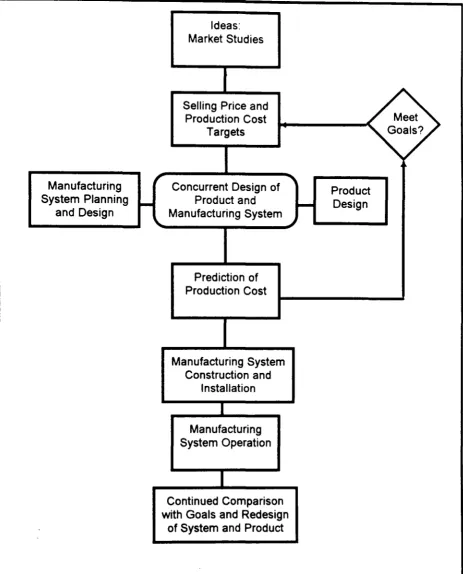
"simultaneous" engineering (CE and SE) is typified by the model proposed by Nevins
[42], see Figure 3. CE has two primary objectives:
1. Compression of product lead times by means of parallel rather than sequential
completion of the activities associated with the design and launch of new products, see
Figure 4a. and 4b.
2. Optimisation of the "whole life" costs associated with developing, launching and
supporting new products. This is achieved by means of integrating decision-making
across the various functional activities. Whole life costs include marketing, conceptual
design, detail design, product testing, manufacturing system provision, process planning,
product manufacture, packaging, distribution and product support (warranty claims,
maintenance, customer support etc.). Some researchers (Sheldon et. al. [44]) suggest
that the whole life costs should include those associated with the operation of the
product, as this will influence the ultimate success of the product in terms of the market.
It must be noted however that this last premise assumes a rational, economic and well informed market.
The benefits claimed for a CE approach may be summarised by reference to Figure 5.
(based upon a paper by Gould [53]). CE usually involves a project team approach to
the development of new products and often includes a "target cost" for the product being
Ideas: Market Studies
Selling Price and
Production Cost Meet
Targets Goals?
,
Concurrent Design of ..,
Manufacturing Product
System Planning I - Product and 10- Design and Design Manufacturing System
\.. ~
Prediction of Production Cost
Manufacturing System Construction and
Installation
Manufacturing System Operation
Continued Comparison with Goals and Redesign
of System and Product
[image:31.700.123.587.47.621.2]Process Planning
PrototypefT est
Manufacture
Planning For: product launch,
packaging, distribution and
support.a_~~fQQI
_ _~~"~'
iIiIiI~""
.
~""·-~
··
·~'
·
f---~
!
Product supportC::::::: [image:32.700.24.658.21.945.2]PRODUCT LEAD TIME
~I
Figure 4a. Traditional Approach To Product Design.
Marketing/Product Need
Process Planning
PrototypefT est
Manufacture
Planning for Product Launch Etc.
Product Su
l
PRODUCT LEAD TIMEJ
Expenditure
Product Launch (CE)
Product Launch (Traditional) Steady State Cost (CE)
Time
Steady State Cost (Traditional)
Figure 5 "Life Cycle" Cost Curves For Traditional And Concurrent Approaches To Product Design.
Target Costing -
While target costing may appear to be a relatively simple concept itseffective application requires careful consideration. Target cost setting is apparently
straightforward i.e. market price less required profit margin equals target cost. This
approach however does not necessarily take into account the profit volume
considerations; a lower selling price may provide an increased level of sales which may
in tum allow more efficient/effective manufacturing methods to be employed. The
product design team must therefore have the capability of carrying out "what if' analysis
on various combinations of total cost, selling price and sales volume in order to establish
the most appropriate target cost and target volume for the product. This is a
[image:33.704.120.641.92.481.2]various options (i.e. the very basis of target costing rests upon the availability of accurate
product cost information).
Having expressed these reservations it must be stated that target costing does provide a
good initial focus for the project team but does not in itself lead to the search for
"continuous improvement" promoted in many companies. There remains a need to
provide performance criteria which will promote iteration in the design process to
provide the most appropriate combination of product price and product cost. In some
cases the overall profitability of a company may be maximised by a combination of
"optimum" processes with respect to some products and "sub-optimum" processes with
respect to others. There is need for the development of an approach that uses "product
models" and "system models" in the determination of appropriate designs, this is
discussed further in sections 4.2 and 7.0. It is possible that the concept of "flexible" product design, where the actual design/process route is not fixed until the point of
manufacture, may be of value in this respect. The concept of flexible product
design/process planning is discussed in section 2.4.2 .
Comprehensive coverage of the basic principles of CE is provided by references [42],
[54] and [55] and the increasing relevance of IT with respect to the effective
implementation of CE is discussed in section 4.2.
Axiomatic Design -
Development of approaches to design for economic manufacturehas often been based upon the principle of "axiomatic" design [55] and [56] i.e. a set of
rules which if adhered to will "optimise" a design under various headings.
Examples
1. Use as few separate parts as possible - reduce assembly cost.
2. Use symmetrical parts - reduce machining cost.
3 . Avoid separate fasteners - reduce assembly cost.
4. Minimise the number of holes - reduce machining cost.
The axiomatic approach does however have a major weakness in that it does not provide
any means of quantifying the "trade offs" between alternatives posed by "competing"
to minimise the manufacturing cost of sheet metal parts might be stated as "all bend lines
in sheet metal should be in a single plane; avoid side holes and depressions". In practice
the inclusion of side depressions may allow the piece to be multi-functional, containing
fastener holes or other functional pieces - this may increase the cost of the sheet metal
part but reduce the overall cost of the product.
In industry experienced product designers use their judgement in assessing trade off's and
make decisions accordingly. It is clear that the ability of product designers to make good
decisions would be improved if they had access to cost information which could indicate
the order of cost associated with particular decision combinations. Two approaches in
particular appear to lend themselves to the indication of cost implications at the
conceptual design stage:
1. Feature based cost estimation.
2. Parametric cost estimation.
Feature Based Cost Estimation
is a concept that has been in existence for someconsiderable time. A feature based system using a commercial CAD system was
developed by Plummer and Hannam in 1983 [57] but emphasised the rationalisation of
"turned'·' components rather than the provision of comparative cost estimates (an
axiomatic approach was taken). More recently work has been carried out by Wi erda
[58] and Gao [59]. The work of Wi erda is of particular relevance as he suggests that a
feature based product model may act as a central reference for several
disciplines/locations, see Figure 6.
Parametric estimating
is based upon the underlying empirical relationship betweencertain key parameters/attributes of classes of products and their cost. It may be
appropriate in some circumstances to take a parametric approach to estimating the cost
of individual features but in such cases care must be taken to avoid any tendency to
"optimise" at the feature level rather than at the overall product level. The empirical
of existing data relating to actual products and actual costs. Such systems however, are
of value only in cases where a company's cost accounting system is able to identify with
sufficient accuracy the cost of manufacture of particular products. Parametric systems
must of necessity be adaptive i.e. they must automatically track trends in parameter/cost relationships caused by changes in manufacturing capability, material costs, labour rates
etc., such systems may therefore respond automatically to changes associated with any
re-structuring of the cost accounting system. Periodic re-evaluation of parameter/cost
relationships could be influenced more strongly by recent data e.g. the equivalent of the
adaptive exponential smoothing techniques used in demand forecasting. Parametric
estimating requires the introduction and maintenance of a structured data base of
products and associated costs i.e. it can operate only in situations where information
Designer
Engineer
Process Planner
Other Users
USER INTERFACE
APPLICATIONS INTERFACE
Geometric Model
Finite Element Model
Manufacturing Model
Other Application
[image:36.698.121.584.335.734.2]Models
Figure 6 Feature Based Product Model - As A Data Base For Several Disciplines And Applications (Wierda [58]).
systems are formalised and effective. Valuable work has been carried out by Mileham et.
moulded components. The practical application of multiple linear regression is discussed
in section 4.2.2 and an example of an industrial application (which originated from this
research) is decribed in Appendix 3.1.
It follows that the effective implementation of CE principles must be accompanied by cost information systems which support the designer in making complex decisions across
traditional functional boundaries. The requirement to consider the various functional
aspects in parallel leads to a situation where engineers must make decisions with only
partial information [61] - something for which they have traditionally been ill equipped. CE requires the product designer/engineer to make the transition from
technologist/technician to co-ordinator see Figure 7 [62].
Manufacturing Inspection Marketing
Serviceability Sales
- Assembly Function Packaging
Figure 7. The Engineering Product Designer As Co-ordinator(McNeil [62])
2.3.3 An Information Model For Engineering Product Design
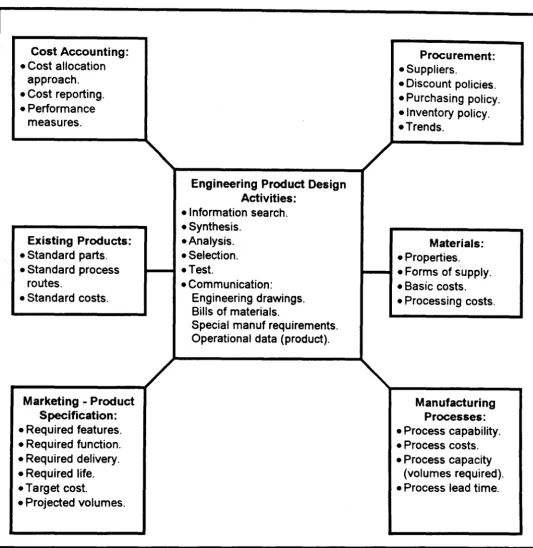
Against the background provided in 2.3.1 and 2.3.2 and in the context of this research it
is appropriate to formulate an information model for the engineering design process.
The model is illustrated in Figure 8. Consideration of the range of information flows
[image:37.698.121.572.366.642.2]against which to evaluate current practice and may also help to provide a basic structure for the development of improved approaches.
Cost Accounting: Procurement:
• Cost allocation • Suppliers.
approach. • Discount policies.
• Cost reporting. • Purchasing policy.
• Performance • Inventory policy.
measures. .Trends.
Engineering Product Design Activities:
• Information search. • Synthesis.
Existing Products: • Analysis. Materials:
• Standard parts. • Selection. • Properties.
• Standard process • Test. • Forms of supply.
routes. • Communication: • Basic costs.
• Standard costs. Engineering drawings. • Processing costs.
Bills of materials.
SpeCial manuf requirements. Operational data (product).
Marketing - Product Manufacturing
Specification: Processes:
• Required features. • Process capability.
• Required function. • Process costs.
• Required delivery. • Process capacity
• Required life. (volumes required).
• Target cost. • Process lead time.
[image:38.704.107.641.89.637.2]• Projected volumes.
Figure 8 An Information Model For Engineering Product Design.
2.3.4 Industrial Survey
designers, in general, work within an infonnation vacuum with respect to cost information, having little or no understanding of, or contact with, the cost accounting systems employed within their companies.
Company A
In company A the senior designer had a wealth of experience in engineering design and business. He understood and was "reasonably satisfied" with his finn's cost accounting system, which involved the allocation of a "blanket" overhead on the basis of "direct" hours. There was no direct use of cost infonnation at the conceptual design stage - it was stated that the main input was the experience of the designer i.e. the design process being seen as the application of solutions which had been adequate in the past. Estimates of product cost were established after detail design and in some cases this was after the communication of a quotation to a customer. The respondent appeared to be relatively satisfied that the estimating and cost accounting systems were valid, because estimates (based upon a blanket overhead per direct hour) were broadly in line with costs eventually allocated to actual products by the finn's accounting system. In this company this equates effectively to a comparison between direct hours estimated and direct hours charged. On further consideration the respondent agreed that the costing system was not likely to reflect accurately the real cost of particular products.
Detail design i.e. specification of drives, component parts etc. was left to a team of detail draughtsmen who again used experience to establish details which would result in "ease of manufacture" and minimum expenditure on materials and component parts. No input in terms of the estimated overall cost of particular options was used in the design process.
Company B
In this company a project approach to major design schemes had been adopted. Formal
procedures for design project management existed as part of a new IS09000 proposal.
The project stages covered are:
preliminary design
quotation
detailed design
prototype costing
*
audit*
It was stated that in practice the design audit was carried out rarely, due to pressure ofwork.
Staff involved in engineering design had no formal training with respect to the firm's cost
accounting systems and knew little or nothing about the actual build up of cost for
particular products. The design function rely upon informal input from the production
engineering function to provide a "design for manufacture element" but no procedure or
mechanism exists to ensure that this input is effective. A suggestion that this approach
may represent simply an attempt to remove the "rough manufacturing edges" from a
design rather than being an effective procedure for minimising production cost,
commensurate with quality, function and delivery was not refuted.
Routine design work in the form of: new products with relatively low value,
customisation of existing products and modification to existing products is a significant
proportion of design activity and has little input from production engineering prior to
process planning. Feedback tends to be provided only in situations where some aspect of
a design provides severe difficulty for its manufacture.
It was stated that the design function has "little or no interaction with the cost
performance from a manufacturing cost aspect is provided from the review of products which have not provided an appropriate "contribution" to the business i.e. in practice the only designs to be reviewed are those which have resulted in observed apparent losses (a standard time/cost is determined after process planning). This situation may tend to promote mediocre, safe designs rather than the innovative designs which might be promoted by effective techniques for assessing the cost of particular designs before they move to the stage of process planning.
The design team were highly motivated and aware of the major influence that their decisions would have upon product cost but did not feel that they had sufficient information (in an appropriate and understandable fonn) upon which to base cost oriented decisions. It was stated that infonnation relating to current costs of various materials in different fonns of supply and standard component costs would be of great value. The idea of a "feature based approach" to cost estimation was discussed and met with a favourable response
Company C
The company operate a business team approach in particular product areas - it was
observed that the team in the business area studied did not include an accountant. A
computerised data base for cost estimation based upon historical cost is being set up.
While this will improve the speed of providing quotations it will do nothing to improve
the accuracy of cost estimation or feedback to product designers.
2.3.5 Discussion and General Conclusions
The literature survey and the industrial survey indicate that engineering product design is
in fact carried out in what may be described as a partial "information vacuum". Figure 9
(Actual Information Flows In Engineering Product Design) is a modified version of
Figure 8 (Information Requirements For Effective Engineering Product Design). Figure
9 illustrates the poor and in some cases non-existent links between the design function and the functions of: cost accounting, purchasing and capacity planning/scheduling.
The major sources of information actually used by designers are highlighted in Figure 9
and relate to:
• Product Function and Product Features, supplemented by:
• Ease of Manufacture (standard parts, standard processes etc.)
• Materials Properties
• Forms of Material Supply
• Material Cost (basic)
The evidence provided in previous sections suggests that:
A. Engineers do not make effective use of the information available within their
organisations.
and
B. Much of the cost information available is either inaccurate, inaccessible or in an
Cost Accounting: • Cost allocation
approach. • Cost reporting. • Performance
measures.
EXisting Products: • Standard ~arts.
• Standard ~rocess
routes.
• Standard costs.
Marketing - Product Specification: • Reguired features. • Reguired function. • Reguired delive~.
• Required life. • Target cost.
• Projected volumes.
Engineering Product Design Activities:
• Information search. • Synthesis. • Analysis. • Selection. • Test. • Communication: Engineering drawings. Bills of materials.
Special manuf. requirements. Operational data (product).
strong links _ _ _ _ _ _ _ _ _
weak links
Procurement: • Suppliers.
• Discount policies. • Purchasing policy. • Inventory policy. • Trends .
... - - - -_ _ ...1
Materials: • Pro~erties. • Forms of su~~I~.
• Basic costs. • Processing costs.
Manufacturing Processes: • Process ca~abilit~.
• Process costs. • Process capacity
(volumes required). • Process lead time.
Factors which tend to be emphasised by product designers are underlined.
Figure 9 Actual Information Flows In Engineering Product Design.
Table 1 summarises the factors involved, together with their ramifications. It is clear therefore that an improved approach to engineering product design must embrace each
of the following:
1. The basic understanding of engineering product designers with respect to concepts,
FACTOR
Multi-level organisation structures with strong functional divisions.
Engineers general lack of knowledge and understanding with respect to principles of costing and costing systems.
Perception of many engineers that cost is an issue peripheral to their activity.
Narrow focus of
engineers - in particular the tendency for
professional rather than business orientation.
Accountants and
accounting systems tend to focus on reporting for external consumption.
Lack of integrated, company wide
information systems.
Lack of cost oriented information in a form understood easily by non-accountants. Lack of cost oriented performance measures which promote the pursuit of overall
business effectiveness.
RAMIFICATIONS
Departmental/functional loyalties may result in pursuit of localised objectives.
Little "cross fertilisation" and integration of decision-making.
Poor communication.
Poor ability in interpretation of available cost information.
Inability to understand, in detail, how the build up of product cost is influenced by design decisions.
Poor communication bet
![Figure 1 Traditional Approach To Product Design (Nevins [42])](https://thumb-us.123doks.com/thumbv2/123dok_us/393890.1039709/27.700.123.550.301.746/figure-traditional-approach-product-design-nevins.webp)
![Figure 2. Typical Proportion Of Cost Committed And Actual Spend At Successive Project Stages (I Prod E [43])](https://thumb-us.123doks.com/thumbv2/123dok_us/393890.1039709/28.704.85.596.258.698/figure-typical-proportion-committed-actual-successive-project-stages.webp)


![Figure 6 Feature Based Product Model - As A Data Base For Several Disciplines And Applications (Wierda [58])](https://thumb-us.123doks.com/thumbv2/123dok_us/393890.1039709/36.698.121.584.335.734/figure-feature-based-product-model-disciplines-applications-wierda.webp)
![Figure 7. The Engineering Product Designer As Co-ordinator(McNeil [62])](https://thumb-us.123doks.com/thumbv2/123dok_us/393890.1039709/37.698.121.572.366.642/figure-engineering-product-designer-ordinator-mcneil.webp)