2017 2nd International Conference on Manufacturing Science and Information Engineering (ICMSIE 2017) ISBN: 978-1-60595-516-2
Research on Progressive Die Design System
Based on Rule-engine
Shaoling Li and Yilin Wang
ABSTRACT
This paper describes a knowledge-based progressive die design system integrated with rule engine technology. Firstly, the basic framework of the progressive die design main modules based on the knowledge engineering is constructed. Second, the author studies the key technologies of the design system. Finally, the system has been put into practice. The dynamic design process of the die base module is demonstrated, which verifies the feasibility and intelligence of the system. 1
INTRODUCTION
Progressive die design especially using for production automotive structural parts is complex and difficult because of the sophisticated procedure, the high quality demand, the complicated knowledge. The quality of progressive design depends to a large extent on the designer’s skill, experience and knowledge. Therefore, it’s really necessary to develop a die design system to increase efficiency.
During the recent decade, some researchers reported to have developed intelligent CAD systems for progressive die. For example, S. Kumar, R. Singh, et al. [1] developed a knowledge-based system for selection of progressive die components using KBE approach. J.Q. Zheng, Y.L. Wang, et al. [2] developed a design system for automobile panels progressive dies based on the parametric die template. But this systems can hardly handle automotive structural parts which have relatively sophisticated geometry. Thus, there is a stern need to develop an intelligent design system, especially for automotive structural parts.
This paper presents an intelligent progressive die design system combining knowledge-based engineering and rule-engine AI technology to assist the designer to accomplish automatic design.
SYSTEM STRUCTURE
Process of Progressive Dies
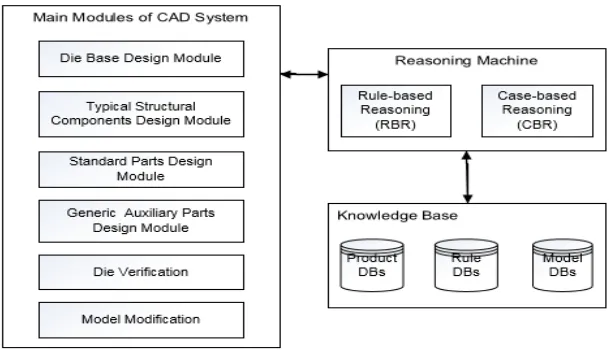
As is well known, progressive dies have a complicated dynamic non-linear complex process. A typical progressive die design [3] process consists of some similar stages: 1)Engineering initialization and strip product features extraction; 2)Die base design; 3)Typical structural components design, such as piercing, bending, forming, drawing, flanging, cam components; 4)Standard parts design, such as screw, pin, lifting, guide plate, nitrogen system; etc. This increases the similarity of the Progressive dies design and frequency of using standard and typical components. Therefore, it’s possible to look into the typical structures to divide the design system into common modules before developing the design system.
Systematic Framework
Figure 1. Structure of design system.
KEY TECHNOLOGY
The Establishment of Knowledge Model
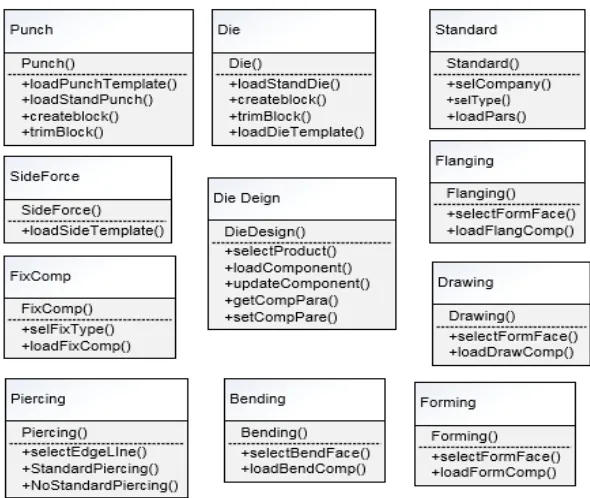
In order to developing KBE systems that are platform independent, well-structured and having high level of knowledge reuse, we should create a global knowledge model for the system, which contains inheritance, encapsulation and extensibility. The knowledge model stores and expresses the relevant geometric and non-geometric information of the product as well as the rules and experiences of design, analysis and engineering. Usually the ontology-based [4] approaches for modelling the product information and design rules for the intelligent system are employed. It has been used to systematically illustrate all things and explore the differences and relationships among entities. In the field of mold design, a considerable part of conceptual knowledge does not change with instances.
Figure 2. The ontology model of the typical components design module.
The Acquisition and Express Method of Knowledge
The technical knowledge for the development of system is collected through die design manual, industrial standards. There are different kind of knowledge of the progressive die design system, so only a single express method of knowledge is difficult to fully describe all information of the system. The current express methods of knowledge include predicate logic, semantic network, frame, production rule, object-oriented express method, etc.
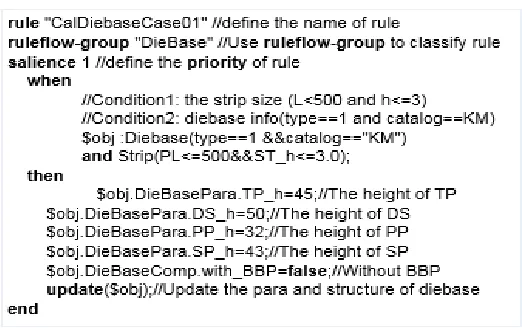
Figure 3. A die base design rule written in DRL language format.
This design system employs Java Drools, an open source engine software which based on the Rete algorithm to develop knowledge base. Not only does it increase the object-oriented interaction capabilities of the Java language, it also offer a kind of standard rule format with the DRL language. Each rule consists of a rule header, a condition and an action. The existing object matches condition and actions are executed when the rule is triggered. An example of a design rule is presented to show the rule written format in DRL language, as shown in Figure 3.
The Reasoning of Knowledge
EXAMPLES FOR DESIGN
[image:6.612.307.484.111.265.2] [image:6.612.108.276.117.267.2]
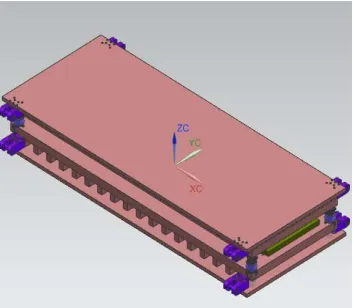
Figure 4. User interface of die base design. Figure 5. An instance of die base design.
This system is based on UG8.5 platform, using JNI (Java Native Language) and XML (Extentsible Markup Language) to realize the data exchange of design system and knowledge base. Taking the die base design as an example, the specific results are shown in figures as follows.
CONCLUSIONS
The thesis combines knowledge-based engineering theory and the rule-engine technology, and explored the system structure and key technologies for developing the design system of progressive dies. The design example shows that by using KBE and rule-engine technology, the developed module can realize the dynamic design process. Although the system is limited to the design of progressive dies only, yet it can be extended further for the design of other types of dies also. However, How to express the hidden knowledge of die design in knowledge base is still a difficult point.
REFERENCES
1. S. Kumar, R. Singh. A. 2007. Knowledge-based system for selection of progressive die components [J]. Journal of Achievements in Materials and Manufacturing Engineering, 20(1-2). J.Q. Zheng, Y.L. Wang. 2007. KBE-based stamping process paths generated for automobile panels. The International Journal of Advanced Manufacturing Technology, 31(7-8): 663-672. 2. S. Kumar, R. Singh. A. 2011. An automated design system for progressive die [J].
Expert Systems with Applications, 38, 4482–4489.