R E S E A R C H A R T I C L E
Open Access
The reliability of suicide statistics: a systematic
review
Ingvild Maria Tøllefsen
1,2*, Erlend Hem
2and Øivind Ekeberg
1,2Abstract
Background:Reliable suicide statistics are a prerequisite for suicide monitoring and prevention. The aim of this study was to assess the reliability of suicide statistics through a systematic review of the international literature.
Methods:We searched for relevant publications in EMBASE, Ovid Medline, PubMed, PsycINFO and the Cochrane Library up to October 2010. In addition, we screened related studies and reference lists of identified studies. We included studies published in English, German, French, Spanish, Norwegian, Swedish and Danish that assessed the reliability of suicide statistics. We excluded case reports, editorials, letters, comments, abstracts and statistical analyses. All three authors independently screened the abstracts, and then the relevant full-text articles. Disagreements were resolved through consensus.
Results:The primary search yielded 127 potential studies, of which 31 studies met the inclusion criteria and were included in the final review. The included studies were published between 1963 and 2009. Twenty were from Europe, seven from North America, two from Asia and two from Oceania. The manner of death had been re-evaluated in 23 studies (40-3,993 cases), and there were six registry studies (195-17,412 cases) and two combined registry and re-evaluation studies. The study conclusions varied, from findings of fairly reliable to poor suicide statistics. Thirteen studies reported fairly reliable suicide statistics or under-reporting of 0-10%. Of the 31 studies during the 46-year period, 52% found more than 10% reporting, and 39% found more than 30% under-reporting or poor suicide statistics. Eleven studies reassessed a nationwide representative sample, although these samples were limited to suicide within subgroups. Only two studies compared data from two countries.
Conclusions:The main finding was that there is a lack of systematic assessment of the reliability of suicide statistics. Few studies have been done, and few countries have been covered. The findings support the general under-reporting of suicide. In particular, nationwide studies and comparisons between countries are lacking.
Background
In recent decades, research on suicide and suicidal beha-viour has expanded. Preventing suicide and reducing suicidal behaviour are important targets of the World Health Organization (WHO) [1]. The WHO has esti-mated that, worldwide, about one million people die by suicide every year, representing a global annual suicide rate of 16 per 100,000 people [2]. In addition, the sui-cide attempt rate is about 10-15 times more frequent than the suicide rate [3,4]. These suicide estimates are based on national mortality statistics, with suicide rates ranging from no suicides per 100,000 people per year in
countries such as Egypt, Haiti and Honduras, to more than 30 suicides per 100,000 people per year in Belarus, the Russian Federation and Lithuania [5].
Most countries in the industrialized world started to register the cause and manner of deaths at the end of the 19th or the beginning of the 20th century. WHO member states use the International Classification of Diseases (ICD) to classify diseases and death certificates. The first edition, known as the International List of Causes of Death, was adopted in 1893. Even with this long tradition of classification, it is difficult to compare statistics between countries and periods because of dif-ferences between countries in methods of classification and registration, and because the manner of registration has changed over time.
* Correspondence: [email protected] 1
Department of Acute Medicine, Oslo University Hospital Ullevaal, PO Box 4956, Nydalen NO-0424 Oslo, Norway
Full list of author information is available at the end of the article
National mortality registers have been used in the past few decades for surveillance and research on suicide, and can be used to examine the effects of preventive strategies and priorities in health policy. Epidemiological or socio-demographic theories about suicide and the effects of intervention depend on reliable suicide statis-tics. Many scientists have pointed out this challenge [6,7], but to our knowledge, no systematic research has been done in this field.
The aim of this study was to assess the reliability of suicide statistics through a systematic review of the international literature.
Methods Search strategy
The first author (IMT) searched for relevant literature up to June 2009 in five databases: EMBASE (from 1980), Ovid Medline (from 1950), PsycINFO (from 1806), the Cochrane Library (from 1993) and PubMed (from 1950). The search strategy included subject headings/MeSH terms and free text. MeSH headings and free text included the terms “suicide”combined with“reliability”, “test reliability”, “validity”, “test validity”,“ reproducibil-ity”, “reproducibility of results”, “cause of death” and “death certificates”. The search was restricted to humans. The search was not restricted by language, publication type or study design (Additional file 1). In addition, related studies and reference lists of identified studies were screened. Update searches were performed in October 2010, but no new studies were found.
Study selection
All abstracts identified using the above search strategy were reviewed. The first author (IMT) excluded studies that were obviously irrelevant to this review. Then, the three authors screened the abstracts for relevancy, and independently reviewed the abstracts of all potentially relevant studies. Studies were included if they met the inclusion criteria of having the aim of studying the relia-bility of suicide statistics, and being published in Eng-lish, German, French, Spanish, Norwegian, Swedish or Danish.
Studies were excluded if they were case reports, edi-torials, letters, comments, statistical analyses or studies only presented as abstracts. Any disagreements or differ-ences in the extracted data between authors were resolved through consensus. If there were any doubts, we included the abstract and read the full text of the article. After excluding articles based on the abstracts, the authors performed a second, stricter screening by examining full-text reports of the remaining records. Disagreements regarding the eligibility were resolved through consensus. Reasons for exclusion were docu-mented. We included all studies on the reliability of
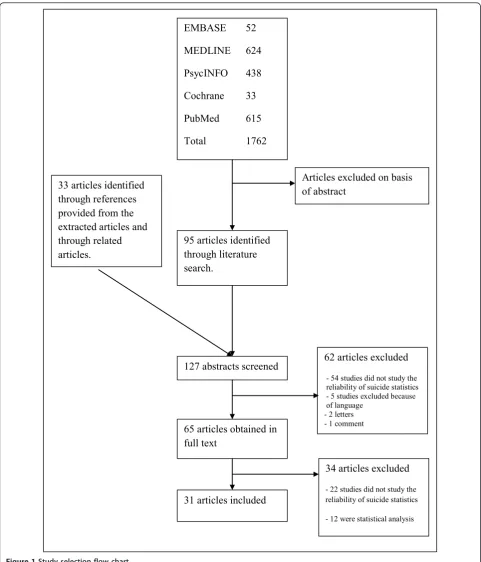
suicide statistics. The process of study inclusion is shown in Figure 1.
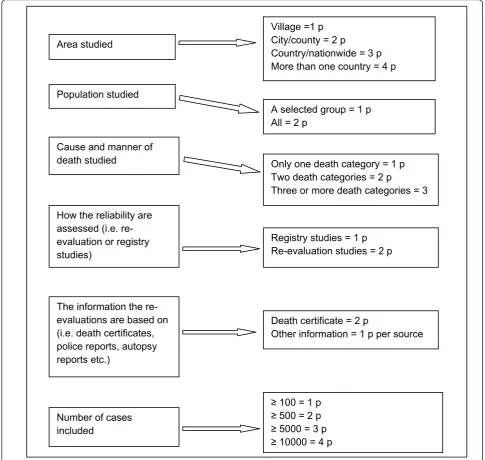
We did not attempt a meta-analysis because of metho-dological differences across studies. We assessed the methodological quality of the included studies using six criteria; area studied, population studied, cause and manner of death studied, how the reliability were assessed, the information the re-evaluations were based on, and number of cases included. The criteria of assess-ment of methodological quality are shown in Figure 2.
Three ways of assessing the reliability of suicide statistics There are three ways to assess the reliability of suicide statistics: re-evaluation studies, registry studies and sta-tistical analyses. Re-evaluation studies are studies where the manner and cause of death were re-evaluated. Regis-try studies are studies where two cause-of-death regis-ters are compared. Statistical analyses are studies where the suicide rate is calculated by adding other categories of manner and cause of death, usually undetermined deaths, open verdicts, and unintentional poisoning and drowning. We excluded statistical analyses from this review because the choice of which other categories of manner or cause of death to include often relies on reg-istry or re-evaluation studies.
Analyses
Some studies did not calculate the percentage of under-reporting, but calculated a study suicide rate and com-pared it with the official suicide rate. In those studies in which it was possible to estimate the percentage of under-reporting, we calculated the percentage by divid-ing the difference between the study and official suicide rates by the official suicide rate (under-reporting = (study suicide rate-official suicide rate)/official suicide rate).
Results Study selection
The primary search yielded 127 potential studies. Of these, 31 studies [8-38] met the inclusion criteria, with a population of 46,401 cases in the final review. Three of the studies did not describe the exact number of cases, and were excluded from the total number of cases. Of the 96 excluded articles, 76 were excluded because they did not study the reliability of suicide statistics, 12 were statistical analyses, two were letters, one was a comment and five were excluded because of language (Romanian, Portuguese, Czech, Serbian, Dutch).
Study characteristics
Methodologies and sample size
40-3,993). Six studies were registry studies, with a total population of 31,436 cases (range: 195-17,412). The remaining two studies were combined registry and re-evaluation studies, with a total population of 3,170 cases
(442 and 2,728 cases). Eight re-evaluation studies evalu-ated a nationwide representative sample, although these samples were limited to suicide within subgroups. Three registry studies evaluated a nationwide sample. Only EMBASE 52
MEDLINE 624
PsycINFO 438
Cochrane 33
PubMed 615
Total 1762
33 articles identified through references provided from the extracted articles and through related articles.
95 articles identified through literature search.
Articles excluded on basis of abstract
127 abstracts screened
65 articles obtained in full text
62 articles excluded
- 54 studies did not study the reliability of suicide statistics - 5 studies excluded because of language
- 2 letters - 1 comment
31 articles included
34 articles excluded
- 22 studies did not study the reliability of suicide statistics
[image:3.595.57.539.87.650.2]- 12 were statistical analysis
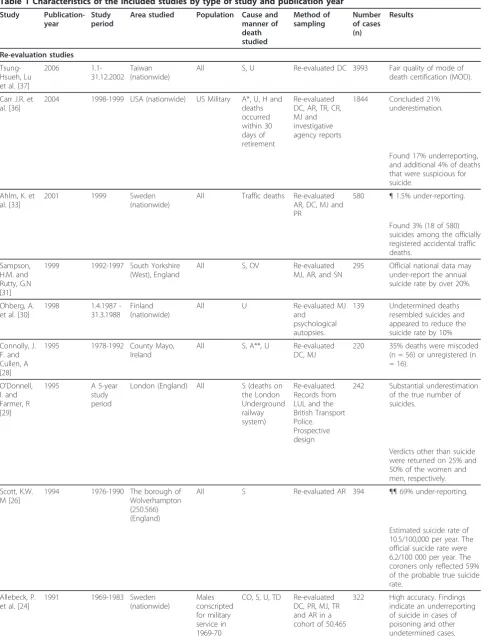
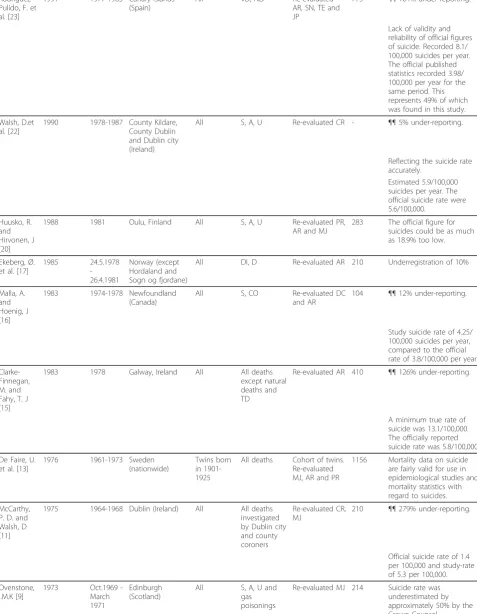
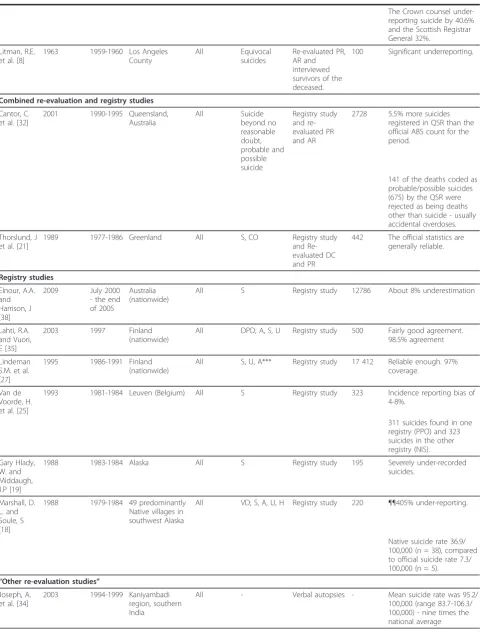
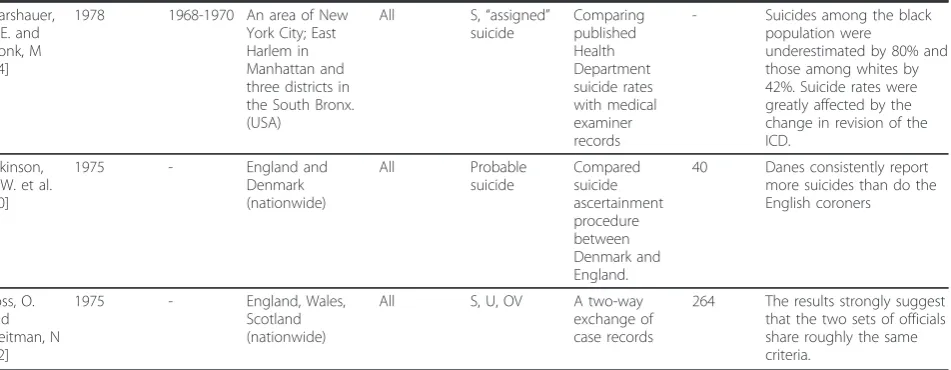
two studies compared data from two or more countries. Characteristics of the included studies are presented in Table 1.
Year and location of studies
The included studies were published between 1963 and 2009. Fourteen studies were published between 1963 and 1989, ten between 1990 and 1999 and seven after 2000. Twenty were from Europe, seven from North America, two from Asia, and two from Oceania.
Characteristics of the study population
Of the included studies, one re-evaluated the reliability of suicide statistics within the military system. Two
studies examined the causes of death in cohorts: one of young males conscripted for military service and one of twins. The other studies included all deaths within defined time periods, locations or subgroups according to the manner of death. Some studies evaluated only suicides, whereas others included homicides, accidents and undetermined deaths.
Analysis of the included studies
The main conclusions of the studies varied, with find-ings ranging from fairly reliable suicide statistics to con-siderable under-reporting. Thirteen studies (42%) reported fairly reliable suicide statistics or
under-Population studied Area studied
Cause and manner of death studied
How the reliability are assessed (i.e. re-evaluation or registry studies)
The information the re-evaluations are based on (i.e. death certificates, police reports, autopsy reports etc.)
Number of cases included
Village =1 p City/county = 2 p
Country/nationwide = 3 p More than one country = 4 p
A selected group = 1 p All = 2 p
Only one death category = 1 p Two death categories = 2 p
Three or more death categories = 3
Registry studies = 1 p Re-evaluation studies = 2 p
Death certificate = 2 p
Other information = 1 p per source
[image:4.595.55.541.90.550.2] S S S S
Table 1 Characteristics of the included studies by type of study and publication year
Study Publication-year
Study period
Area studied Population Cause and manner of death studied Method of sampling Number of cases (n) Results Re-evaluation studies Tsung-Hsueh, Lu et al. [37]
2006 1.1-31.12.2002
Taiwan (nationwide)
All S, U Re-evaluated DC 3993 Fair quality of mode of death certification (MOD). Carr J.R. et
al. [36]
2004 1998-1999 USA (nationwide) US Military A*, U, H and deaths occurred within 30 days of retirement Re-evaluated DC, AR, TR, CR, MJ and investigative agency reports
1844 Concluded 21% underestimation.
Found 17% underreporting, and additional 4% of deaths that were suspicious for suicide.
Ahlm, K. et al. [33]
2001 1999 Sweden (nationwide)
All Traffic deaths Re-evaluated AR, DC, MJ and PR
580 ¶ 1.5% under-reporting.
Found 3% (18 of 580) suicides among the officially registered accidental traffic deaths.
Sampson, H.M. and Rutty, G.N [31]
1999 1992-1997 South Yorkshire (West), England
All S, OV Re-evaluated MJ, AR, and SN
295 Official national data may under-report the annual suicide rate by over 20%. Ohberg, A.
et al. [30]
1998 1.4.1987 -31.3.1988
Finland (nationwide)
All U Re-evaluated MJ and
psychological autopsies.
139 Undetermined deaths resembled suicides and appeared to reduce the suicide rate by 10% Connolly, J.
F. and Cullen, A [28]
1995 1978-1992 County Mayo, Ireland
All S, A**, U Re-evaluated DC, MJ
220 35% deaths were miscoded (n = 56) or unregistered (n = 16).
O’Donnell, I. and Farmer, R [29]
1995 A 5-year study period
London (England) All S (deaths on the London Underground railway system) Re-evaluated. Records from LUL and the British Transport Police. Prospective design
242 Substantial underestimation of the true number of suicides.
Verdicts other than suicide were returned on 25% and 50% of the women and men, respectively. Scott, K.W.
M [26]
1994 1976-1990 The borough of Wolverhampton (250.566) (England)
All S Re-evaluated AR 394 ¶¶ 69% under-reporting.
Estimated suicide rate of 10.5/100,000 per year. The official suicide rate were 6.2/100 000 per year. The coroners only reflected 59% of the probable true suicide rate.
Allebeck, P. et al. [24]
1991 1969-1983 Sweden (nationwide) Males conscripted for military service in 1969-70
CO, S, U, TD Re-evaluated DC, PR, MJ, TR and AR in a cohort of 50.465
Table 1 Characteristics of the included studies by type of study and publication year(Continued)
Rodriguez-Pulido, F. et al. [23]
1991 1977-1983 Canary Islands (Spain)
All VD, ND Re-evaluated AR, SN, TE and JP
775 ¶¶ 104% under-reporting.
Lack of validity and reliability of official figures of suicide. Recorded 8.1/ 100,000 suicides per year. The official published statistics recorded 3.98/ 100,000 per year for the same period. This represents 49% of which was found in this study. Walsh, D.et
al. [22]
1990 1978-1987 County Kildare, County Dublin and Dublin city (Ireland)
All S, A, U Re-evaluated CR - ¶¶ 5% under-reporting.
Reflecting the suicide rate accurately.
Estimated 5.9/100,000 suicides per year. The official suicide rate were 5.6/100,000.
Huusko, R. and Hirvonen, J [20]
1988 1981 Oulu, Finland All S, A, U Re-evaluated PR, AR and MJ
283 The official figure for suicides could be as much as 18.9% too low. Ekeberg, Ø.
et al. [17]
1985 24.5.1978 -26.4.1981
Norway (except Hordaland and Sogn og fjordane)
All DI, D Re-evaluated AR 210 Underregistration of 10%
Malla, A. and Hoenig, J [16]
1983 1974-1978 Newfoundland (Canada)
All S, CO Re-evaluated DC and AR
104 ¶¶ 12% under-reporting.
Study suicide rate of 4.25/ 100,000 suicides per year, compared to the official rate of 3.8/100,000 per year.
Clarke-Finnegan, M. and Fahy, T. J [15]
1983 1978 Galway, Ireland All All deaths except natural deaths and TD
Re-evaluated AR 410 ¶¶ 126% under-reporting.
A minimum true rate of suicide was 13.1/100,000. The officially reported suicide rate was 5.8/100,000. De Faire, U.
et al. [13]
1976 1961-1973 Sweden (nationwide)
Twins born in 1901-1925
All deaths Cohort of twins. Re-evaluated MJ, AR and PR
1156 Mortality data on suicide are fairly valid for use in epidemiological studies and mortality statistics with regard to suicides. McCarthy,
P. D. and Walsh, D [11]
1975 1964-1968 Dublin (Ireland) All All deaths investigated by Dublin city and county coroners
Re-evaluated CR, MJ
210 ¶¶ 279% under-reporting.
Official suicide rate of 1.4 per 100,000 and study-rate of 5.3 per 100,000. Ovenstone,
I.M.K [9]
1973 Oct.1969 -March 1971
Edinburgh (Scotland)
All S, A, U and gas poisonings
Table 1 Characteristics of the included studies by type of study and publication year(Continued)
The Crown counsel under-reporting suicide by 40.6% and the Scottish Registrar General 32%.
Litman, R.E. et al. [8]
1963 1959-1960 Los Angeles County
All Equivocal suicides
Re-evaluated PR, AR and interviewed survivors of the deceased.
100 Significant underreporting.
Combined re-evaluation and registry studies Cantor, C.
et al. [32]
2001 1990-1995 Queensland, Australia
All Suicide beyond no reasonable doubt, probable and possible suicide
Registry study and re-evaluated PR and AR
2728 5.5% more suicides registered in QSR than the official ABS count for the period.
141 of the deaths coded as probable/possible suicides (675) by the QSR were rejected as being deaths other than suicide - usually accidental overdoses. Thorslund, J
et al. [21]
1989 1977-1986 Greenland All S, CO Registry study and Re-evaluated DC and PR
442 The official statistics are generally reliable.
Registry studies Elnour, A.A. and Harrison, J [38]
2009 July 2000 - the end of 2005
Australia (nationwide)
All S Registry study 12786 About 8% underestimation
Lahti, R.A. and Vuori, E [35]
2003 1997 Finland (nationwide)
All DPD; A, S, U Registry study 500 Fairly good agreement. 98.5% agreement Lindeman
S.M. et al. [27]
1995 1986-1991 Finland (nationwide)
All S, U, A*** Registry study 17 412 Reliable enough. 97% coverage.
Van de Voorde, H. et al. [25]
1993 1981-1984 Leuven (Belgium) All S Registry study 323 Incidence reporting bias of 4-8%.
311 suicides found in one registry (PPO) and 323 suicides in the other registry (NIS). Gary Hlady,
W. and Middaugh, J.P [19]
1988 1983-1984 Alaska All S Registry study 195 Severely under-recorded suicides.
Marshall, D. L. and Soule, S [18]
1988 1979-1984 49 predominantly Native villages in southwest Alaska
All VD; S, A, U, H Registry study 220 ¶¶405% under-reporting.
Native suicide rate 36.9/ 100,000 (n = 38), compared to official suicide rate 7.3/ 100,000 (n = 5).
“Other re-evaluation studies” Joseph, A.
et al. [34]
2003 1994-1999 Kaniyambadi region, southern India
reporting of 0-10%. Of the 31 studies from the 46-year period, 52% (16 of 31 studies) found more than 10% under-reporting, and 39% (12 of 31 studies) found more than 30% under-reporting or poor suicide statistics. A summary of the conclusins of the included studies are presented in Table 2.
Analysis of methodological quality
When summarizing the quality scores three studies [24,33,36] got a sum score≥15, representing good qual-ity. One of these studies concluded fairly reliable suicide statistics, one 0-10% under-reporting and one concluded 11-30% under-reporting. Twenty-one studies got a sum score 10-14 [8,9,11-13,15-17,20-23,27-32,35,37,38] and seven studies sum score≤9 [10,14,18,19,25,26,34]. Five of the studies with quality sum score≤9 concluded > 30% under-reporting or poor suicide statistics, one con-cluded 0-10% under-reporting. The quality sum score and the conclusions of the studies are presented in Table 3
Discussion
Summary of main results
The main finding was that few studies on the reliability of suicide statistics have been done in recent years, and few countries have been covered. There were only two studies from Asia and none from Africa, where a large proportion of the global population resides. Thirteen of the 31 studies included in this review concluded with fairly reliable suicide statistics or under-reporting of
0-10%. Of the 31 studies from the 46-year period, 52% found more than 10% under-reporting, and 39% found more than 30% under-reporting or poor suicide statis-tics. Eleven studies evaluated a nationwide sample, and only two studies compared data from two or more countries. Only three studies got a good quality sum score. It is a trend that studies with high quality sum score concluded with fairly reliable suicide statistics or under-reporting of 0-10%, while studies with poorer quality sum score tends to conclude with more than 30% under-reporting or poor suicide statistics, but too few studies are done to make an absolute conclusion. We have put most emphasis on the studies with the best methodological quality. These studies support our main findings. We cannot make any conclusions about the reliability of suicide statistics based only on the lack of research. Theoretically, the reliability might be good in spite of the lack of studies. In countries with official suicide rates close to zero, one might argue that the reliability was good. It is important to study the reliabil-ity of suicide statistics, and since the data are very dif-ferent in the various countries, we find it of importance to study both the validity and reliability. As there are few studies, and about half of them concluded with underreporting of suicide, we think that our main find-ing, that the reliability of suicide statistics is question-able and calls for more studies, is fear.
[image:8.595.64.540.102.287.2]Reliability does not necessarily imply validity. A reli-able measure is measuring something consistently, but it Table 1 Characteristics of the included studies by type of study and publication year(Continued)
Warshauer, M.E. and Monk, M [14]
1978 1968-1970 An area of New York City; East Harlem in Manhattan and three districts in the South Bronx. (USA)
All S,“assigned” suicide
Comparing published Health Department suicide rates with medical examiner records
- Suicides among the black population were
underestimated by 80% and those among whites by 42%. Suicide rates were greatly affected by the change in revision of the ICD.
Atkinson, M.W. et al. [10]
1975 - England and Denmark (nationwide)
All Probable suicide
Compared suicide ascertainment procedure between Denmark and England.
40 Danes consistently report more suicides than do the English coroners
Ross, O. and Kreitman, N [12]
1975 - England, Wales, Scotland (nationwide)
All S, U, OV A two-way exchange of case records
264 The results strongly suggest that the two sets of officials share roughly the same criteria.
Aaccident,ADall deaths,ARautopsy-/forensic-/post-mortem reports,COcontroversial/unclear/no cause of death reported,CRcoroner/medical examination records,Ddrowning,DCdeath certificates/report,DIdeaths from intoxication,DPDdrug poisoning deaths,H: homicide,JPjudicial proceedings,MJmedical-/ hospital journal/-report,NDnatural death where insufficient medical information exists to permit the issuing of a death certificate stating that the cause of death was a natural one.OVopen verdict,PRpolice reports,Ssuicide,SNsuicide note,TEtestimonies of relatives and witnesses,TDtraffic deaths,TRtoxicology reports,
Uundetermined,VDviolent deaths,A* accidents by handgun, overdose, asphyxia, drowning and falling.A** road traffic accidents, fires in domestic dwellings and drownings were excluded.A*** motor vehicle accident, drowning, poisoning
¶ The authors have calculated the under-reporting: Found 18“new suicides”, total 1219 suicide and suicide rate 13.76/100,000 in Sweden in 1999 (data from Socialstyrelsen)
may not measure what it claims to do. A thorough for-ensic and psychological autopsy may be the most valid method to determine the cause of death, e.g. suicide. If the statistics consistently underreported suicide, the methods could be reliable enough to justify multivariate analyses of determinants and multivariate evaluations of interventions. In the present study, the causes of death were assessed by official statistics and the researchers had the intention of measuring the same phenomenon. Accordingly, we consider that comparing official suicide statistics and external assessments reflects both reliabil-ity and validreliabil-ity.
Studying the reliability of suicide statistics is a com-plex task. First, some suicides might have been missed in the administrative processes of national mortality sta-tistics. Second, in some cases, determining the manner of death (i.e., suicide, accident, undetermined/open ver-dict, or natural death) requires subjective interpretation of the intention of the deceased. Different methodolo-gies used in the included studies need to be considered, including the main difference between re-evaluation and registry studies, the variations in the cause and manner of deaths studied, the quality of the compared registers, the competence of the evaluators, the number of re-evaluations of each case and the information the re-eva-luations are based on (i.e., death certificates, police reports, autopsy reports, etc.). One can imagine that a greater number of suicides could be found by also examining undetermined deaths/open verdicts and acci-dents. Some studies (statistical studies) have studied the under-reporting of suicide by comparing the suicide rate with the rate of deaths of undetermined intent [39,40], and in recent years, the UK has added injury/poisoning
of undetermined intent and sequelae of intentional self-harm/event of undetermined intent to the official cide rate, in the belief it will provide a more reliable sui-cide rate [41]. We excluded statistical studies in this review article, but in a national and longitudinal per-spective these studies are important for indicating relia-bility of suicide statistics, and further, effects of suicide prevention. Studies included in this review were pub-lished in many different countries between 1963 and 2009. Hence, different editions of the ICD are used in these studies, which may also affect the results to a cer-tain extent [42].
Strengths and limitations
[image:9.595.56.538.101.182.2]Some limitations of the present study should be consid-ered. The search strategy, including literature search and reference list screening, was developed by one of the authors, and this search strategy may not have cap-tured all relevant studies. Manually searching reference lists located 33 further studies not captured in the data-base searches. The selection of keywords and MeSH terms that were used may not have covered all pub-lished articles on the reliability of suicide statistics. The choice of databases also needs to be considered. The five selected databases may not have indexed all poten-tial studies, and some relevant studies may not have been included. Medline is the largest component of PubMed, and both databases were selected in the pre-sent study because they do not have the same MeSH terms, and therefore more studies were found searching both http://www.nlm.nih.gov/pubs/factsheets/dif_med_-pub.html. In retrospect, it is conceivable that using only one of these databases might have saved time, and we Table 2 Brief summary table
Conclusions Total number of studies (n) Re-evaluation studies Registry studies
0-10% under-reporting 7 4 3
Fairly reliable suicide statistics 6 3 3
11-30% under-reporting 4 4 0
> 30% under-reporting 10 9 1
Poor suicide statistics 2 1 1
The two combined re-evaluation and registry studies are in this table registered as registry studies.
The two studies were they exchanged data between countries (Ross O. et al. [12] and Atkinson M.W. et al. [10]) are not included in this table.
Table 3 Summary quality sum score
Conclusions Quality sum score≤9 Quality sum score 10-14 Quality sum score≥15
0-10% under-reporting 1 5 1
Fairly reliable suicide statistics 0 5 1
11-30% under-reporting 0 3 1
> 30% under-reporting 4 6 0
Poor suicide statistics 1 1 0
[image:9.595.55.543.641.722.2]might have found more studies by selecting a different database or manually searched relevant journals. It is possible that our search did not identify all of the rele-vant original studies [43]; for example, the publications of national statistics bureaus are not indexed in the databases, but we are confident that our research strat-egy has been good enough to identify the majority of the relevant original studies. Even though we may have missed some studies, we find it unlikely that this would have changed our main conclusions. For practical rea-sons, only published studies were sourced, but it seems unlikely that publication status would be a source of bias in the present study.
One strength of this review is that related studies and all reference lists of the included studies were screened, minimizing the number of potentially missed studies. Another strength is that the three authors independently screened all abstracts and full-text articles, minimizing the chance of a relevant study being excluded.
Future studies
The fact that few studies have been published in recent years, makes further studies clearly needed, particulary nationwide studies, studies in countries with low suicide rates and other under-investigated countries, and studies including comparisons between countries.
Conclusion
There are only few studies on the reliability of suicide statistics, and based on those studies, we cannot draw firm conclusions about the reliability of existing suicide statistics. Few studies have been published in recent years. Nationwide studies in particular are lacking, and only two studies compared data between countries.
This systematic review conforms to the PRISMA state-ment [44].
Additional material
Additional file 1: Search terms.
Acknowledgements
This study was supported by a grant from the South Eastern Norway Regional Health Authority.
Author details
1
Department of Acute Medicine, Oslo University Hospital Ullevaal, PO Box 4956, Nydalen NO-0424 Oslo, Norway.2Department of Behavioural Sciences in Medicine, Institute of Basic Medical Sciences, Faculty of Medicine, University of Oslo, PO Box 1111, Blindern NO-0317 Oslo, Norway. Authors’contributions
All authors contributed equally to the conception and design of the study, the selection of studies, and to the final version of the manuscript. IMT developed the search strategy, interpreted the data and drafted the manuscript. All authors read and approved the final manuscript.
Competing interests
The authors declare that they have no competing interests.
Received: 21 March 2011 Accepted: 14 February 2012 Published: 14 February 2012
References
1. World Health Organization:Mental Health. Policy and ServicesGeneva; 2011. 2. World Health Organization:World Health Report 2003: Shaping the Future
Geneva; 2003.
3. Welch SS:A review of the literature on the epidemiology of parasuicide in the general population.Psychiatr Serv2001,52:368-375.
4. Schmidtke A, Bille-Brahe U, DeLeo D, Kerkhof A, Bjerke T, Crepet P, Haring C, Hawton K, Lonnqvist J, Michel K,et al:Attempted suicide in Europe: rates, trends and sociodemographic characteristics of suicide attempters during the period 1989-1992. Results of the WHO/EURO multicentre study on parasuicide.Acta Psychiatr Scand1996,93:327-338. 5. World Health Organization:Country Reports and Charts2010 [http://www. who.int/mental_health/prevention/suicide/country_reports/en/index.html]. 6. Johansson LA, Pavillon G, Anderson R, Glenn D, Griffiths C, Hoyert D,
Jackson G, Notzon FS, Rooney C, Rosenberg HM,et al:Counting the dead and what they died of.Bull World Health Organ2006,84:254.
7. Pearson-Nelson BJ, Raffalovich LE, Bjarnason T:The effects of changes in the world health organization’s international classification of diseases on suicide rates in 71 countries, 1950-1999.Suicide Life Threat Behav2004,
34:328-336.
8. Litman RE, Curphey TJ, Shneidman ES, Farberow NL, Tabachnick N:
Investigations of equivocal suicides.JAMA1963,184:924-929.
9. Ovenstone IM:A psychiatric approach to the diagnosis of suicide and its effect upon the Edinburgh statistics.Br J Psychiatry1973,123:15-21. 10. Atkinson MW, Kessel N, Dalgaard JB:The comparability of suicide rates.Br
J Psychiatry1975,127:247-256.
11. McCarthy PD, Walsh D:Suicide in Dublin: I. The under-reporting of suicide and the consequences for national statistics.Br J Psychiatry1975,
126:301-308.
12. Ross O, Kreitman N:A further investigation of differences in the suicide rates of England and Wales and of Scotland.Br J Psychiatry1975,
127:575-582.
13. de Faire U, Friberg L, Lorich U, Lundman T:A validation of cause-of-death certification in 1,156 deaths.Acta Med Scand1976,200:223-228. 14. Warshauer ME, Monk M:Problems in suicide statistics for whites and
blacks.Am J Public Health1978,68:383-388.
15. Clarke-Finnegan M, Fahy TJ:Suicide rates in Ireland.Psychol Med1983,
13:385-391.
16. Malla A, Hoenig J:Differences in suicide rates: an examination of under-reporting.Can J Psychiatry1983,28:291-293.
17. Ekeberg O, Jacobsen D, Enger E, Frederichsen P, Holan L:The reliability of suicide statistics in Norway.Tidsskr Nor Laegeforen1985,105:123-127. 18. Marshall DL, Soule S:Accidental deaths and suicides in southwest Alaska:
actual versus official numbers.Alaska Med1988,30:45-52.
19. Hlady WG, Middaugh JP:The underrecording of suicides in state and national records, Alaska, 1983-1984.Suicide Life Threat Behav1988,
18:237-244.
20. Huusko R, Hirvonen J:The problem of determining the manner of death as suicide or accident in borderline cases.Z Rechtsmed1988,100:207-213. 21. Thorslund J, Misfeldt J:On suicide statistics.Arctic Med Res1989,
48:124-130.
22. Walsh D, Cullen A, Cullivan R, O’Donnell B:Do statistics lie? Suicide in Kildare- and in Ireland.Psychol Med1990,20:867-871.
23. Rodriguez-Pulido F, Sierra A, Gracia R, Doreste J, Delgado S, Gonzalez-Rivera JL:Suicide in the Canary Islands, 1977-1983.Acta Psychiatr Scand
1991,84:520-523.
24. Allebeck P, Allgulander C, Henningsohn L, Jakobsson SW:Causes of death in a cohort of 50,465 young men-validity of recorded suicide as underlying cause of death.Scand J Soc Med1991,19:242-247. 25. van de Voorde H, Hooft P, Mulkers U:On the influence of data source in
aggregated data studies: a comparative study of suicide information based on death certificates and judicial files.J Epidemiol Community Health1993,47:73-75.
26. Scott KW:Suicide in Wolverhampton (1976-1990).Med Sci Law1994,
27. Lindeman SM, Hirvonen JI, Hakko HH, Lonnqvist JK:Use of the national register of medico-legal autopsies in epidemiological suicide research. Int J Legal Med1995,107:306-309.
28. Connolly JF, Cullen A:Under-reporting of suicide in an Irish county.Crisis
1995,16:34-38.
29. O’Donnell I, Farmer R:The limitations of official suicide statistics.Br J Psychiatry1995,166:458-461.
30. Ohberg A, Lonnqvist J:Suicides hidden among undetermined deaths. Acta Psychiatr Scand1998,98:214-218.
31. Sampson HH, Rutty GN:Under-reporting of suicide in South Yorkshire (West): a retrospective study of suicide and open verdicts returned by HM Coroner, 1992-1997.J Clin Forensic Med1999,6:72-76.
32. Cantor C, McTaggart P, De LD:Misclassification of suicide-the contribution of opiates.Psychopathology2001,34:140-146.
33. Ahlm K, Eriksson A, Lekander T, Bjornstig U:All traffic related deaths are not‘fatalities’-analysis of the official Swedish statistics of traffic accident fatalities in 1999.Lakartidningen2001,98:2016-2022.
34. Joseph A, Abraham S, Muliyil JP, George K, Prasad J, Minz S, Abraham VJ, Jacob KS:Evaluation of suicide rates in rural India using verbal autopsies, 1994-9.BMJ2003,326:1121-1122.
35. Lahti RA, Vuori E:Fatal drug poisonings: medico-legal reports and mortality statistics.Forensic Sci Int2003,136:35-46.
36. Carr JR, Hoge CW, Gardner J, Potter R:Suicide surveillance in the U.S. Military–reporting and classification biases in rate calculations.Suicide Life Threat Behav2004,34:233-241.
37. Lu TH, Sun SM, Huang SM, Lin JJ:Mind your manners: quality of manner of death certification among medical examiners and coroners in Taiwan. Am J Forensic Med Pathol2006,27:352-354.
38. Elnour AA, Harrison J:Suicide decline in Australia: where did the cases go?Aust N Z J Public Health2009,33:67-69.
39. Kelleher MJ, Corcoran P, Keeley HS, Dennehy J, O’Donnell I:Improving procedures for recording suicide statistics.Ir Med J1996,89:14-15. 40. Speechley M, Stavraky KM:The adequacy of suicide statistics for use in
epidemiology and public health.Can J Public Health1991,82:38-42. 41. Office for National Statistics:Suicide Rates in the United Kingdom, 2000-2009
Newport; 2011.
42. Jansson B, Johansson LA, Rosen M, Svanstrom L:National adaptations of the ICD rules for classification-a problem in the evaluation of cause-of-death trends.J Clin Epidemiol1997,50:367-375.
43. Dickersin K, Scherer R, Lefebvre C:Identifying relevant studies for systematic reviews.BMJ1994,309:1286-1291.
44. Moher D, Liberati A, Tetzlaff J, Altman DG:Preferred reporting items for systematic reviews and meta-analyses: the PRISMA statement.Int J Surg
2010,8:336-341. Pre-publication history
The pre-publication history for this paper can be accessed here: http://www.biomedcentral.com/1471-244X/12/9/prepub
doi:10.1186/1471-244X-12-9
Cite this article as:Tøllefsenet al.:The reliability of suicide statistics: a systematic review.BMC Psychiatry201212:9.
Submit your next manuscript to BioMed Central and take full advantage of:
• Convenient online submission
• Thorough peer review
• No space constraints or color figure charges
• Immediate publication on acceptance
• Inclusion in PubMed, CAS, Scopus and Google Scholar
• Research which is freely available for redistribution