2016 Joint International Conference on Artificial Intelligence and Computer Engineering (AICE 2016) and International Conference on Network and Communication Security (NCS 2016)
ISBN: 978-1-60595-362-5
Structure Design of the Information Capture System
Based on the Internet of Things
Li QIU
1,a, Bing-Sheng LIU
2,b*1College of Management and Economics, Tianjin University, Tianjin 300072, China
2The key laboratory of film electronic and communication device, Electronic and Information
Engineering College, Tianjin University of Technology, Tianjin 300384, China
a[email protected], b[email protected]
*Corresponding author
Keywords: Architecture of the Internet of Things, Spectrometer, RFID, Remote Control.
Abstract. The features, the architecture, the hardware connection, the application software and the transfer protocol of the information capture system based on the internet of things are presented in this paper. This technology of the internet of things enhances the real-time and remote control ability, and improves the production efficiency and quality. It will play a more important role in the industrial production.
Introduction
Internet of things is one of the information industries after the computer, Internet and the mobile communication network. Developing with the trend of the IT innovation, the Internet of things has a lot of broad application including intelligent transportation, environmental protection, public service and security. [1,2]
Internet of things which with high sensitivity sensor is the best method to detect or to control, and also plays an important role in many fields.[3] Some traditional meter belongs to precise laboratory instrument, it is difficult to work in the harsh environment, can not realize on-line measurement and cannot share the data collected in time. The meter based on the Internet of things can effectively solve the difficulties encountered in industrial application and extend the measurement function.
The Character of Information Capture System Based on the Internet of Things
Besides the traditional functions, the information capture system based on the Internet of things can also get information of the material tested by the RFID and make the managers and decision makers easier to obtain the data by the network no matter when and where they are. Comparing with the traditional method, the system based on the Internet of things has the following special features.
Remote Control
The data collected can be transmitted to remote client for observation and analysis through the internet according to the transfer protocol; the control commands from the remote client can also
been sent to the system which parses the commands according to the transfer protocol and reacts in
terms of commands such as setting the parameters of spectrometer or doing measurements.[4] With the remote control function, the system can work easier in the toxic or polluted cases, and make the tester has no limit on the geographical position, and increase the flexibility of the measurement.
Monitoring the Specific Subject On-line
monitoring, for example, in the pharmaceutical production process, it is easy to record serial number of unqualified product and discard it.
Fusion Measurement for Information
Sometimes the system is needed to analyze various properties of the material at the same time, off-line detection usually has a lag, can not accurately describe the real-time process and the tedious separation process usually produces error in results. Internet of things technology can make the multiple meters works under the different range as a measurement system, and join together of the data acquired. Then all the data are send to server, the server analyzes the data by use of the designed model and gets the results. For instance, in the pharmaceutical production process, every step requires measuring material physical characterization including solid grain size, humidity, mixing uniformity, viscosity, hardness and so on. The off-line measurement cannot get the character of different properties at the same time, while the meter under the internet of things can finish the real-time and fusion measurement.[6,7]
The Whole Process Quality Control
The meter based on the internet of things analyses the composition in every step of industrial production and can effectively monitor the product quality. For example, there are a series of operations including the mixing, reaction, forming and packing in the process of the pharmaceutical preparation and even one mistake occurring in any step will cause the serious consequence. Using Internet of things meter, with on-line product quality inspection and production scheduling system, can make the optimum decision for the material consumption, energy consumption in the whole process of the production.
The Architecture of System Based on the Internet of Things
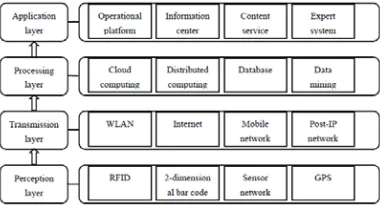
[image:2.612.212.402.443.546.2]The architecture of Internet of things includes the perception layer, transmission layer, processing layer and the application layer as shown in Figure 1. [8] The architecture of system based on Internet of things is similarly designed.
Figure 1. The Architecture of the Internet of Things.
The Data Perception Layer
Data perception layer's function is used to sense the environment around the device, to process and judge the percept information, to respond according to the corresponding rules, and send the intermediate results or the final result to the transmission layer. The perception layer is in the front of the Internet of things, in addition to capturing the real world information, and also can control the object processed. Therefore, it is also known as the interactive perception layer. [9]
The data acquisition is completed by the conversion module and the A/D conversion module. RFID is used to record the static attributes, such as the serial number, quality, color, etc. Before the meter runs, there are some parameters needed to be set such as scanning type, scanning rate, scanning step, slit width, amplification factor and so on.
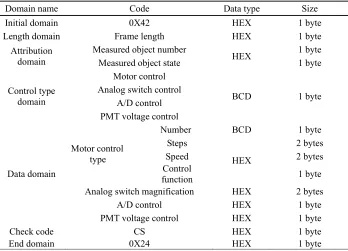
network should include the initial domain, the measured material property domain, the control type or data type domain, the data domain and the check code. The initial domain is the character description of network meter, the attribute domain records static properties of the measured material, such as the serial number, state and so on. Due to the spectrometer's operation is different, the length of the data description is also different, and so the frame length is not fixed.
The Data Transmission Layer
The data transmission layer is responsible for the transfer of the data between the perception layer and the processing layer. It provides an information channel to realize the purpose that all the devices can be connected.
The transfer method of the meter based on the internet of things can be divided into cable access and wireless access according to the different working environment. If the meter takes the cable access, an network chip can be embedded in the spectrometer, which is used to make the MAC address identification, data frame assembly/split and transceiver, CRC code calibration, timeout retransmission, link integrity test, etc. If the meter takes the wireless access, WIFI module or ZIGBEE module will be integrated in the meter.
The Data Processing Layer
The data processing layer provides the public data storage and processing functions for the application system of the Internet of things. Under the support of the high performance computing technology, the information is processed in real-time, also the data mining, store, management, control is done. It provides an efficient and reliable technology support platform for the upper management and industry application.
The data storage is some tables created for the collected data, such as data table, parameters setting, etc. In the table, at least one valid keyword is needed for data searching, and the index is needed. The main work of the data mining is that the useful, potential, unknown information is gotten from a large amount of data. There are two aspects in the measurement data mining based on internet of things. One is that the processing layer analyzes the tested parameters depend on the capture instrument; the other is that it finds the characteristic and law from the data to guide the production.
The Application Layer
The management platform and working platform is constructed in the application layer. The operating interface is different as the different industry asks for different measurement and control, but several parts must be included such as the client login, equipment register, result display, function control, etc. The application layer of the data capture system under the Internet of things is a deep integration of network and the professional technique. In addition, in order to provide accurate information service, the professional knowledge must combine with the industry production management, information management, organization and scheduling.
The Implementation of the Internet of Things The Hardware Structure
The structure of system based on the Internet of things should include data acquisition module, motor control module, analog signal processing module, RFID module and network transmission module. The first three are the functions of the traditional capture system. The network transmission module and RFID module are the hardware characters of the system under the Internet of things, so that only the two parts are introduced. ARM11 is adopted as the main controller chip of the spectrometer and network access is the cable connection.
Network transformer is mainly used to enhance the signal, make further transmission distance, and isolate chip from external. Network interface realizes connection with external network.
Figure 2. Connection of Network Hardware.
[image:4.612.215.404.342.406.2]The Radio Frequency Identification (RFID) Module. The radio frequency identification module includes reader-writer and electronic tag, the connection is shown in Figure 3. The first working step is power on the reader-writer and then it emits electromagnetic wave in the working area. Secondly, when the electronic tag goes into the area, it receives the reader-writer signals, and the data is analyzed by the demodulation circuit the result is sent to the data logic control part to complete the data storage and other operations. Thirdly, reader-writer receives the data that electronic tag send and checks the data validity by decoding and error checking .[11] Lastly, reader-writer sends data which have been verified to the controller. The level switch chip needed to convert electronic voltage level between the main controller and the reader-writer.
Figure 3. Connection of RFID Hardware.
The Application Software
Table 1. The Definition of the Downward Transfer Data Frame.
Domain name Code Data type Size
Initial domain 0X42 HEX 1 byte
Length domain Frame length HEX 1 byte
Attribution domain
Measured object number
HEX 1 byte
Measured object state 1 byte
Control type domain
Motor control
BCD 1 byte
Analog switch control A/D control PMT voltage control
Data domain
Motor control type
Number BCD 1 byte
Steps
HEX
2 bytes
Speed 2 bytes
Control
function 1 byte
Analog switch magnification HEX 2 bytes
A/D control HEX 1 byte
PMT voltage control HEX 1 byte
Check code CS HEX 1 byte
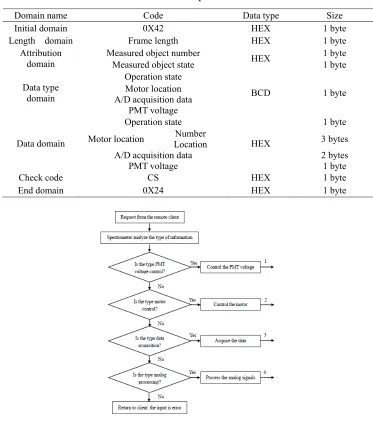
[image:4.612.133.481.485.736.2]The Communication Protocol. The communication protocol is the standard of the data format for remote communication between the client and the capture system. Two directions transmit can provide data exchange in the network to make ensure the communication smoothly. The communication protocol complies with the principles of reliability and scalability, and refers to the standard of Ethernet protocol. Table 1 and table 2 is the definition of data frame between the client and the spectrometer.
Table 2. The Definition of the upward transfer Data Frame.
Domain name Code Data type Size
Initial domain 0X42 HEX 1 byte
Length domain Frame length HEX 1 byte
Attribution
domain Measured object number Measured object state HEX 1 byte 1 byte
Data type domain
Operation state
BCD 1 byte
Motor location A/D acquisition data
PMT voltage
Data domain
Operation state
HEX
1 byte
Motor location Location Number 3 bytes
A/D acquisition data 2 bytes
PMT voltage 1 byte
Check code CS HEX 1 byte
[image:5.612.118.491.180.595.2]End domain 0X24 HEX 1 byte
Figure 4. The Flow Chart of Function Analysis.
The Flow Chart of Application Program. The data capture system will receive the commands from the client and parses them depend on the communication protocol and makes the different responses according to the request from client, the flow chart of the software is shown in figure 4.
Follow the flow chart, the data capture system can complete the control from the client and feedback information.
Summary
to perceive any information from objects and it transfer information reliably and intelligently, it can easily be used in the industry working line for monitoring and control, to get the real-time information of object, so the application rang of the system under the technology of internet of things must be greatly enlarged.
Reference
[1]Draft C., October, Kranenburg R.V., et al. The internet of things [J]. IEEE Eighth International Conference on Intelligent Sensors, Sensor Networks & Information Processing, vol. 46, no. 4, pp. 333-338, 2013.
[2]Hongbo Zhu, et al. Survey on the internet of things[J]. Journal o f Nanjing University of Posts and Telecommunications(Natural Science), vol. 31, no. 1, pp. 1-9, 2011.
[3]Anbing Zhao. Design of measurement and control system with ARM for fluorescence spectrophotometer [D]. Tianjin:Tianjin University of Technology, 2013.
[4]Zheng L. Design and realization of online real-time monitoring system for swing-ARM of infrared spectrometer [J]. Computer Applications and Software, vol. 29, no. 1, pp. 220-223, 2012. [5]Changpeng He. RFID application research for discrete manufacturing [J]. Jisuanji Jicheng Zhizao Xitong, vol. 20, no. 5, pp. 1160-1170, 2014.
[6]Xiaoliang Wang, et al. Applications of near infrared spectrometer in the pharmacy [J]. Northwest
Pharmaceutical Journal, vol. 24, no. 3, pp. 228-230, 2009.
[7]Guoliang Li, et al. Applications of Raman Spectrometer in Process Monitoring [J], Guangdong Chemical Industry, vol. 35, no. 5, pp. 106-109, 2008.
[8]Gubbi J., Buyya R., Marusic S., et al. Internet of Things (IoT): A vision, architectural elements, and future directions [J]. Future Generation Computer Systems, vol. 29, no. 7, pp. 1645-1660, 2013. [9]Yigang Han, et al. The internet of things [M]. China Machine Press, 2012.
[10]Jiaqi Sun, et al. Network principle and application [M]. Beijing Institute of Technology Press, 2010.