2016 Joint International Conference on Artificial Intelligence and Computer Engineering (AICE 2016) and International Conference on Network and Communication Security (NCS 2016)
ISBN: 978-1-60595-362-5
Privacy-area Aware All-dummy-based Location Privacy Algorithms
for Location-based Services
Huan ZHAO
1,a,*, Xiao-Ling YI
1,b, Jiao-Long WAN
1,c1College of Computer Science and Electronic Engineering, Hunan University, Changsha, Hunan, China
a[email protected], b[email protected], c[email protected] *Corresponding author
Keywords: Location Privacy, Location-Based Services (LBSs), K-anonymity, Dummy.
Abstract. Location-Based Services (LBSs) have become one of the most popular activities in our daily life. With the rapid advance of LBSs, there are more threats to users’ privacy. For this reason, while enjoying the convenience provided by LBSs, we have to protect our location privacy. In this paper, we propose two all-dummy-based location privacy algorithms to achieve k-anonymity for privacy-area aware users in LBSs. Different from previous work, on the client side, our method can prevent the center attack and border attack through transforming the actual location to an anchor and the request we send to the LBSs doesn’t contain the actual location of the user. On the server side, we use a rough query before precise query to reduce the processing time and transmission bandwidth. It only returns the results that the client needs. Evaluation results show that our methods can provide more effective privacy protection and lower computation and communication cost.
Introduction
With the popularity of mobile devices and the rapid development of social network, location-based services (LBSs) have been one of the most popular activities in our daily life. Nowadays people can enjoy the benefits from various tailored and personalized LBS anytime and anywhere. For example, you can get the nearest restaurant or the gas station via LBS.
While enjoying various LBSs, users also face the threats of location privacy disclosure. The users’ location information is usually closely linked with the users’ identity information, such as, the name of their company, home address, health status, religious beliefs, etc. Therefore, more and more users focus on the location privacy protection.
Spatial cloaking is a widely used method in location privacy protection. It ensures a user’s location is mixed with at least k candidates. It collects k users’ locations and sends the minimum region including those k users to the server as q query instead of the user’s exact location. Gruteser et al. [10] first introduced k-anonymity into location privacy. It tries to blur a user’s exact location by generating a cloaking region which includes a query issuer and k-1 other users. Current research aligns on developing techniques to elaborate on k-anonymity [3-8, 15] that process a user’s query with protecting privacy during the access of LBSs. However, these kinds of approaches always rely on a location anonymizer to enlarge the cloaking region.
achieve k-anonymity for mobile users without employing the location anonymizer and considering the privacy-area. However, the real location of the user is on the border, and the border may still be attacked.
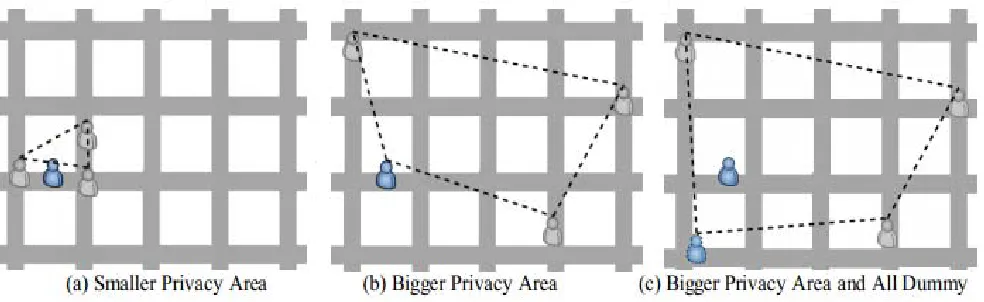
To solve the problem, in this paper, we propose two privacy-area aware dummy-based location privacy algorithms, which are developed from the methods mentioned in [2] to achieve k-anonymity without the true location and against the center attack and border attack. We use a simple example shown in Fig. 1 to illustrate our concerns. In Fig. 1(a), the adversary can easily to guess the actual location of the user. Fig. 1(b) is the method in [2] to achieve a bigger privacy area, but it still can be attacked on the border. In our proposed method, we send the whole dummy locations to the server like Fig. 1(c). Due to the lack of true location, we cannot directly calculate two location’s relation and we use an estimation method. We follow client/server modal and don’t need the trusted third party. Our proposed method just requires the server returns the results what the client needs, which can save a lot of bandwidth.
[image:2.612.69.561.312.463.2]The rest of this paper is organized as follows. In section II, we review related word of our methods. Then, in section III, we introduce some preliminaries of our work and we describe our proposed method and implementation in detail. Following in section IV, we explain our experiment and empirically evaluate our solutions. Finally, we conclude in section V.
Figure 1. Motivation.
Proposed Method
Our proposal assumes a client/server architecture. And our methods anonymize a user’s location with all the dummies based on Shokri et al.’s framework [1] in a real environment.
Definitions and Assumptions
Definition 1: , , … , is the position that user submitted to the server, where the 1 is a dummy location around the user’s actual location.
Definition 2: Query in this paper is a location-dependent query, which is abstracted as Q = (pos, d, <S, k>, K, req), where parameter is the mobile user location, parameter d is the query radius, parameter <S, k> means it should provide k locations and its privacy area is no smaller than S, parameter K is the number of required return and parameter req denotes user-specified predicates. With the privacy-area aware and location dummy approach, it is converted into Q’= (POS, d, <S, k>, K, req), where POS contains k dummy locations. The query Q’ hides the user location.
users are closer, the greater number generated in a hidden area of the dummy location falls within the scope of the query.
Privacy-Area Aware Dummy Generation Algorithms
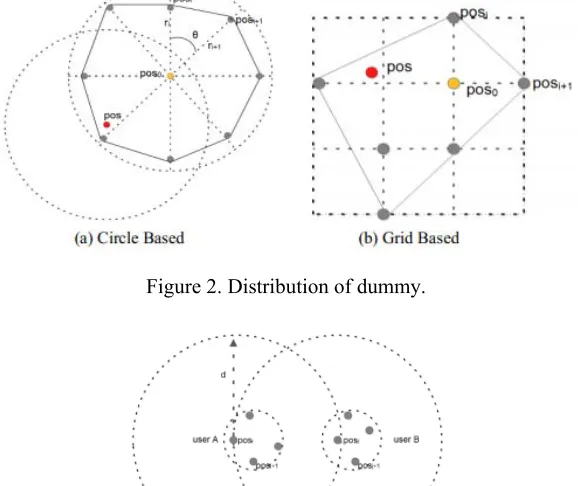
[image:3.612.163.454.196.439.2]We are interested in approaches that aid in satisfying <S, k> and can against the center attack and border attack. We thus propose two improved privacy-area aware dummy generation algorithms based on [2]. The one algorithm employs a circle to constrain all dummy positions, while the other uses a uniform grid.
Figure 2. Distribution of dummy.
Figure 3. Anonymity query.
Circle-Based All Dummy Algorithm. We use an example shown in Fig. 2(a) to illustrate our circle-based all dummy algorithm. We consider the example where k=8 and is the user location. The user-defined privacy region S provides us a way to determine the radius of the virtual circle. From paper [2], taking into account the requirement S, we could get an upper bound radius
2 ∙ / ∙ sin 2 / . Let ∙ r, we then get:
s ̃ ∙ ∙ ∙ sin ∙ ∙ ∙ ∙ sin ∙ 0 1 (1)
This indicates that by carefully choosing , we can get a guarantee on the privacy area of the location privacy query generated based on a virtual circle.
As it’s considered in paper [2], the more coefficient is close to 1, all positions are closer to the virtual circle edge and the real user location is less randomly. But our method sends all dummies to the server without the real user’s location, it is safer than those send k-1 dummies with one real location.
Algorithm 1 CircleAllDummy
Input: user position pos, privacy area S, anonymity k, coefficient
Output: dummy location set P
1: ← ∅, ← /
2: ← ∙ / ∙
3: ′ ← ∙
4: , ← . ∙ ∙ ,
5: , ← . ∙ ∙ ,
6:
7: ← ,
8: , ← ∙ ∙ ,
9: , ← ∙ ∙ ,
10:
11: 12:
Algorithm 2 GridAllDummy
Input: user position pos, privacy area S, anonymity k, coefficient
Output: dummy location set P
1: ← ∅, ← √ , ← √
2: ← ⁄
3: ← ∙
4: , ← ,
5: , ← ,
6: ← ,
7: ← ,
8:
9: , ← , ∙ ,
10: , ← , ∙ ,
11:
12: 13:
Grid-Based All Dummy Algorithm. We use an example shown in Fig. 2(b) to illustrate our grid-based all dummy algorithm. We consider the example where k=6 and is the user’s location. Taking into account the privacy requirement S, we get the side length √ . Then we divide the area with side length into c cells, where √ , and we let each cell’s length ⁄ 1 .
The algorithm, called GridAllDummy, is shown in Algorithm 2. It first initializes an empty set P, calculates the number of cells c, the side length and each cell’s length (lines 1-2). Then, it determines the virtual user at random (lines 3-5), so that in either direction its distance to falls
in 0, ∙ √ , where is the offset coefficient of the user position, and 0 1. It attaches the virtual
user positon to each direction (lines 6-7). It then generates k dummy locations randomly based on from that virtual grid. Finally, dummy location set P is returned.
Server-Side Processing
Having received a location privacy query Q’= (POS, d, <S, k>, K, req) from a mobile client, the server processes this according to predicate req, and returns K required query results.
rough radius D which satisfied the inequality √ . Then, we use the record of the times less than d as the first metric of two locations’ relationship and we use the summation of distance as the second metric.
The algorithm underlying the server-side module is presented in Algorithm 3. We first initializes empty set R, T, W and server gets the target user’s position data (lines 1-2). Next, server randomly selects a dummy location from the target user’s query and also randomly selects a dummy location from other user, and calculates the distance. If their distance is less than D, server will add user’s ID and position data to W using hash table (lines 3-15). Then, for each user in W, server compares their distance with target user, records the overlap time and calculates the distance (lines 18-30). Then, if overlap time is greater than 0, server adds a triple to T, otherwise continue (lines 31-36). Then, server sorts T by primary keyword repeat descend and secondary keyword distance descend (line 38). Then, server packages the first K in T as a result set (line 39). Finally, R is returned (line 40).
Algorithm 3 ServerCompare
Input: position privacy query Q’, privacy area S, anonymity k, query radius d, nearest neighbor number K, others’ position set userDataSet
Output: K-nearest neighbor set R
1: ← ∅, ← ∅, ← ∅
2: ← ′
3: ← ,
4: ←
5: ∈
6: ← ,
7: ←
8: ←
9: ,
10: ←
11: ←
12: 13: 14: 15:
16: ∈
17: ← , ←
18: ←
19:
20: ←
21:
22: ←
23: ,
24: ←
25: 26: 27:
28: ← ,
29: 30: 31:
32: ← , ,
33:
34: 35: 36: 37:
38: ←
39: ← :
Communication Cost Analysis
Upstream Communication Cost. It is easy to know that a 2D location takes up 8 bytes. Every user sends k locations to the server, so the size of a raw request is expressed as:
8 (2)
Restructuring a raw query request by putting all x coordinate values in front of y values. The cost can be reduced to roughly 16√ [2].
Downstream Communication Cost. In our proposed method, we return the request K groups of locations to the user. The size in bytes of a raw result message without packing is:
8 ∙ (3)
With the packing described in reference [2], the result message size shrinks to 8K.
Performance Evaluations Settings
In our experiments, we use the central part of the Changsha, Hunan Province, China to simulate data set. All datasets are normalized to a 10000*10000 square 2D space on the server side. All algorithms run on a Windows 7 PC with 3.2GHz Intel Dual-Core E6700 CPU and 2GB RAM. The parameters are shown in Table 1 with default values given in bold. And we use 0.75 as the default in the CircleAllDummy algorithm and 0.5 as the default in the GridAllDummy algorithm.
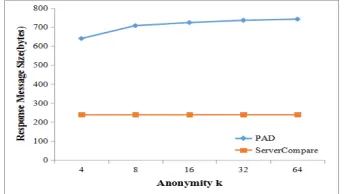
[image:6.612.221.394.405.502.2]Figure 4. Downstream communication cost.
Table 1. Simulation Parameters Settings.
Parameters Settings
Spatial extents ( ) 1000∙1000
User dataset cardinality N 50K, 100K, 200K, 500K, 800K, 1000K
Anonymity k 2, 4, 8, 16, 32, 64
Privacy region areas S ( ) 802π, 1002 , 2002π, 3002π, 4002π, 5002π
Query radius d (m) 100, 200, 300, 500, 800, 1000
Communication Cost
Our method in the paper just reduces the downstream communication cost, so only the downstream communication cost is analyzed here. As is shown in Fig. 4, under different anonymity k, the server returns the message size in bytes in our ServerCompare method is smaller than the PAD’s. The PAD not only returns the real user requirement, but also returns extra k-1 group useless results, thus resulting in a tremendous waste of bandwidth. However, our proposed method only returns the results the client needs, significantly reducing bandwidth utilization.
Server-Side Cost
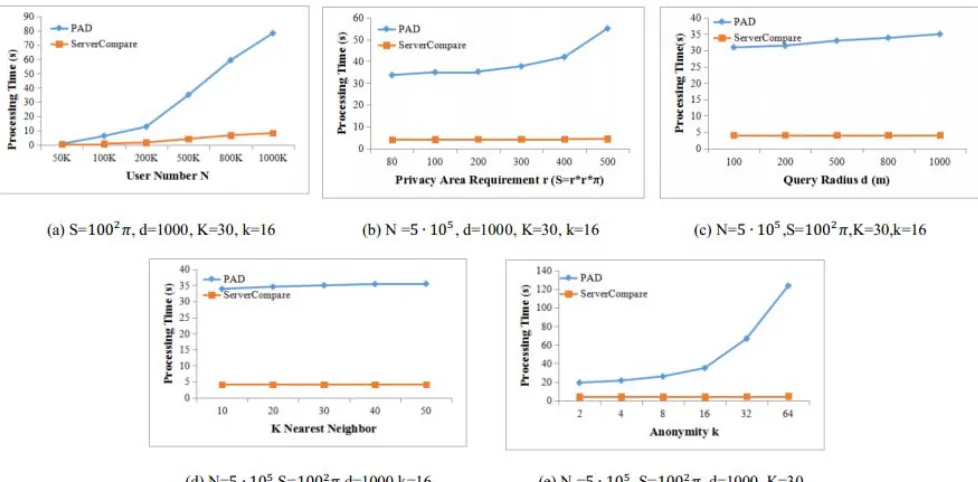
[image:7.612.68.557.260.501.2]Fig. 5 reports on how the server-side module processing time is affected by five parameters against the PAD and our method. As we known, the processing time is influenced by user density, query radius d, privacy area requirement S, nearest neighbor number K and anonymity k. It is seen that our methods can effectively reduce the processing time on the server side under different condition.
Figure 5. Server-side processing time.
Privacy Area
Figure 6. Privacy area.
Result Accuracy Rate
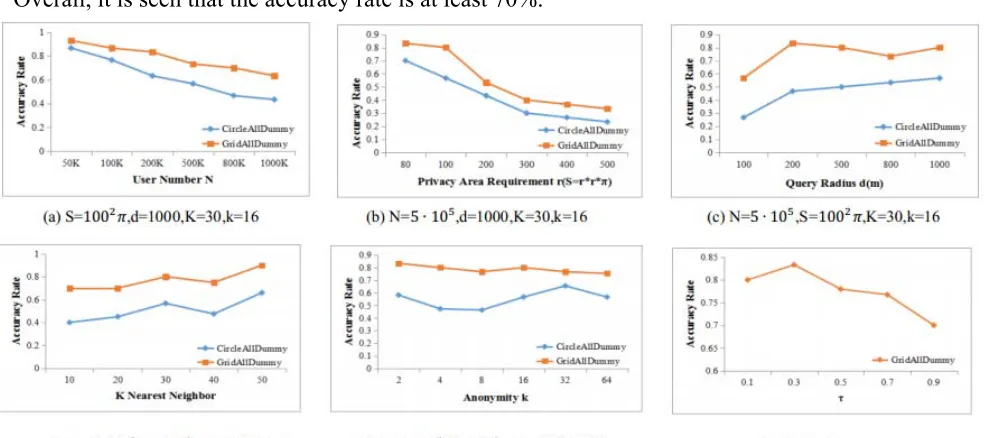
In the server side, by group of data comparison, we are still unable to accurately determine whether the true location of B is in the range of A for the reason that we use all dummy locations as shown in Fig. 3. It can bring some errors. It’s necessary to analyze the accuracy of the query results.
Fig. 7(a) (b) (c) (d) (e) report on the effect on the result accuracy rate of CircleAllDummy and GridAllDummy for varying user number N, privacy area requirement S, query radius d, nearest neighbor K and anonymity k. It reports that the accuracy of GridAllDummy algorithm is a little better than CircleAllDummy algorithm. Fig. 7(a) shows that as user number increases, the accuracy of results decrease. The reason is that when user number increases, the user density is rising. Fig. 7(b) (c) report that as privacy area requirement S growing, the accuracy of results drop dramatically, and as query radius d grows, the result accuracy totally improved. Fig. 7(b) (c) indicate that as the ratio of S/d larger, the accuracy becomes lower. Fig. 7 (d) shows that as K increases, the accuracy of results is also rising. The reason is that when K is large enough, the impact from random error become very weak. Fig. 7(e) describes that as the anonymity k grows, the result accuracy doesn’t improve significantly. Fig. 7 (f) reports on the effect on the accuracy rate of GridAllDummy for varying . When is smaller than 0.3, the result accuracy rate grows with . However, when is larger than 0.3, the accuracy rate will drop with growing of it.
[image:8.612.62.554.472.691.2]Overall, it is seen that the accuracy rate is at least 70%.
Conclusion
In this paper we have proposed privacy-area aware all-dummy-based location privacy algorithms for location-based services and we have used a new query anonymization method in server-side. The results show that our method can effectively reduce communication cost. We design two location transformation and all dummy generation algorithms that take into account privacy area requirements. The followed performance evaluation shows the effectiveness of our proposed algorithms. Our algorithms can produce acceptable range of privacy area. And there are some errors because user sends all dummy locations to the server. We have analyzed how the different factors affect the error. One of our future research is to minimize the errors through choosing the best parameters.
Acknowledgement
This work was sponsored by the Scientific Research Plan of Changsha Science and Technology Department (k1403027-11).
References
[1] R. Shokri, G. Theodorakopoulos, C. Troncoso, J.P. Hubaux, and J.Y. Le Boudec, Protecting location privacy: optimal strategy against localization attacks, in Proceedings of the 2012 ACM Conference on Computer and Communications Security, ACM, pp. 617-627, 2012.
[2] H. Lu, C.S. Jensen, M.L. Yiu, Pad: privacy-area aware, dummy-based location privacy in mobile services, in Proceedings of the Seventh ACM International Workshop on Data Engineering for Wireless and Mobile Access, ACM, pp.16-23, 2008.
[3] H. Hu, J. Xu, 2PASS: Bandwidth-optimized location cloaking for anonymous location-based services, in Parallel and Distributed Systems, IEEE Transactions on, vol. 21, no. 10, pp. 1458-1472, 2010.
[4] B. Gedik, L. Liu, Protecting location privacy with personalized k-anonymity: Architecture and algorithms, in Mobile Computing, IEEE Transactions on, 7(1), pp. 1-18, 2008.
[5] M.F. Mokbel, C.Y. Chow, W.G. Aref, The new Casper: query processing for location services without compromising privacy, in Proceedings of the 32nd International Conference on Very Large Data Bases, VLDB Endowment, pp. 763-774, 2006.
[6] B. Bamba, L. Liu, P. Pesti, and T. Wang, Supporting anonymous location queries in mobile environments with privacy grid, in Proceedings of the 17th International Conference on World Wide Web, ACM, pp. 237-246, 2008.
[7] A. Hossain, A.A. Hossain, J.W. Chang, Spatial Cloaking Method Based on Reciprocity Property for Users' Privacy in Road Networks, Computer and Information Technology (CIT), 2011 IEEE 11th International Conference on. IEEE, pp. 487-490, 2011.
[8] H. Lee, T. Kim, J.W. Chang, A Privacy-Protected k-NN Query Processing Algorithm Based on Weighted Adjacency Graph for Location-Based Services, in Advanced Science Letters, 21(3), pp. 341-345, 2015.
[10] M. Gruteser, D. Grunwald, Anonymous usage of location-based services through spatial and temporal cloaking, in Proceedings of the 1st International Conference on Mobile systems, Applications and Services, ACM, pp. 31-42, 2003.
[11] R. Kato, M. Iwata, T. Hara, A. Suzuki, X. Xie, Y. Arase, and S. Nishio, A dummy-based anonymization method based on user trajectory with pauses, in Proceedings of the 20th International Conference on Advances in Geographic Information Systems, ACM, pp. 249–258, 2012.
[12] H. Kido, Y. Yanagisawa, and T. Satoh, An anonymous communication technique using dummies for location-based services, in Pervasive Services, 2005. ICPS’05. Proceedings. International Conference on. IEEE, pp. 88–97, 2005.
[13] A. Suzuki, M. Iwata, Y. Arase, T. Hara, X. Xie, and S. Nishio, A user location anonymization method for location based services in a real environment, in Proceedings of the 18th SIGSPATIAL International Conference on Advances in Geographic Information Systems, ACM, pp. 398–401, 2010. [14] R. Kato, M. Iwata, T. Hara, A. Suzuki, A dummy-based anonymization method based on user trajectory with pauses, in Proceedings of the 20th International Conference on Advances in Geographic Information Systems, ACM, pp. 249-258, 2012.