2017 2nd International Conference on Wireless Communication and Network Engineering (WCNE 2017) ISBN: 978-1-60595-531-5
I-PON Based Full-service FTTH Solution for Broadcasting
Hai-liang FENG and Yuan-jia GONG
Academy of Broadcasting Science, SAPPRFT, ChinaKeywords: FTTH, IP, Broadcasting.
Abstract. As the rapid growth of cable TV business, the existing HFC based network and business
architecture are facing more and more challenges. We propose an IP based cable TV FTTH solution, which significantly improves the broadcasting bandwidth, provides full service including high quality VOD/OTT and significantly differs from the other telecom video business solution such as IPTV.
Introduction
Since the late 1980s, radio and television network has been made great progress. At present, China’s cable TV users are close to 200 million. Cable operators across the country have almost completed the digital cable TV. As the rapid growth of cable TV service, the existing HFC based network and business architecture are facing more and more challenges.
Firstly, the frequency point and bandwidth are severely limited. The live bandwidth pressure is increasingly severe since there are so many programs, especially HD/SD simulcast on satellite TV channels in accordance with the requirements prescribed by SARFT. Add to the continuous development of high capacity video business, i.e., HDTV, 4K/8K UHDTV and so on, there will be a serious shortage of the traditional broadcasting bandwidth resources.
Secondly, in order to meet the demands of high bandwidth and use of the existing coaxial networks, manufacturers have proposed corresponding solutions, such as PON + RF overlay, PON+EOC, PON+LAN, etc. The above solutions are able to improve the existing of data transmission bandwidth, but there are still many inherent defects. For example, the requirement of optical power is high in the CATV analog receiver, ranging from -8dBm to +2dBm. However, the link loss of EPON system is 26dB. Therefore, EDFA is required to amplify the CATV optical signal to over 17dBm, causing the nonlinear effects, such as Stimulated Brillouin Scattering (SBS), Self-Phase Modulation (SPM) and Stimulated Raman Scattering (SRS), etc., which will cause the deterioration of the system performance index. With the incessant maturity of FTTH, increasing investment of the existing bidirectional HFC network is not the best choice for broadcasting operators.
In order to solve the problem of lack of HFC frequency point and bandwidth, an IP based cable TV FTTH solution is put forward in this paper. Meanwhile, it is also able to improve the business deployment capability of broadcasting operators.
10G FTTH Solution
As one solution of the Technical Specification for CATV Network Fiber To The Home (C-FTTH),
Live platform
10G Broadcasting
Switch
NVOD platform
VOD platform
OTT platform
Internet
Firewalls Front
end
Data Switch
Provincial Backbone Transmission
Network
s 10G Broadcasting
Switch
10GEOptical amplifier
OTT Push
OLT end 10GE two-way data signal 10GE one-way broadcst signal
FTTH community Wifi
Living room
IP secondary terminal Gb FTTH
gateway secondary IP terminal
Study
bedroom Outdoors’business
Figure 1. The structure of the system.
Key Technology Implementation
In order to implement the above IP based FTTH solution of cable TV, the following technologies are used for each key part.
IP encapsulation of broadcast TV data
Audio and video contents are compressed and coded in accordance with MPEG-2, MPEG-4, H.264, H.265 or AVS standards. In the transmission layer, the first encapsulation is made in TS package format and different unit streams are identified by PID. Then multiple TS packages of the same program are combined as payload to be encapsulated into UDP packets. Each program is distinguished by the UDP destination port number ranging from 1 to 65535. As UDP packets payload, are further encapsulated into IP packets. The multicast address (range from 224.0.0.1 to 239.255.255.255) are used as destination IP address. Different multicast addresses can further distinguish different types of programs and applications [2].
All-IP of front-end devices
In our solution, All-IP of all front-end devices, namely connecting the front-end devices through networks, such as video encoder, scrambler, EPG server, VOD server, etc. Then the signal will be sent to the metropolitan area network via fiber in the 10G convergence switch.
More general switches and other network devices are used instead of the dedicated devices in radio and television system such as ASI exchange matrix, QAM modulator, RF power amplifier, etc. Compared to those dedicated devices, they are widely used in telecom networks and enterprise networks, and have great advantages in price and stability.
10G broadcast supported smart terminals
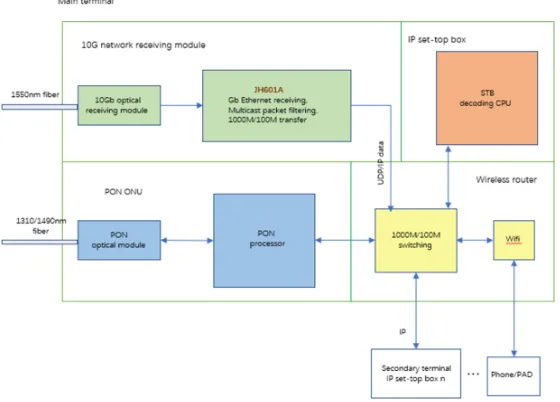
Figure 2. The structure block diagram of the integrated gateway set-top box.
The smart terminals mainly include:
10G network receiving module, functions as a traditional set-top box tuner, including 10G optical receiving module and JH601A chip. Under the control of the program instructions, the selected IP program stream will be sent to the IP decoder through 1000M/100M switching chip to decode the program. Compared to the traditional set-top box tuner, in which only one program stream output can be selected at the same time. However, at most 50 program streams can be selected simultaneously in 10G network receiving module.
PON ONU module, including PON optical module and PON processor, which provides 1G
bidirectional data channel for the set-top box.
STB decoding module, which uses the latest 4 core processor and run Android system,
supporting 4K decoding and various internet applications.
WIFI (AP) module, providing network access for other terminals such as mobile phone and PAD, which enables these terminals to broadcast high quality live video programs and connect to the internet at high speed.
1000M/100M switching module, providing network access for the secondary terminals and PC.
The selection of broadcast signal encryption technology
Since all terminals can share bandwidth through IP broadcast transmission of the live signal, it is necessary to encrypt the live content. Due to the cancellation of the reuse process, the selection of encryption technologies will be more flexible, both card and card free CA or DRM are supported.
Support for All Service
According to the characteristics of uplink/downlink traffic, the current business on the radio and telecom networks can be divided into two types:
Symmetric business: voice communication, video communication, etc.
Asymmetric business: video live, video on demand (OTT/VOD), video surveillance, VR,
games, webpage, email, file downloads, etc.
The common feature of asymmetric services listed above is that the downlink
(network→terminal) requires high bandwidth (1Mbps ~100Mbps), the uplink (terminal→network)
requires low bandwidth (10Kbps~100Kbps). Video and game business become the main source of income for television operators and telecom operators. In addition to the above requirements of bandwidth, the QoS of the network (error, packet loss, delay, delay jitter) also has a great impact on the quality of business and user experience [3].
uplink and downlink) and GPON (1.25Gbps for uplink and 2.5Gbps for downlink), cannot meet the hundreds of times uplink/downlink rate of the above asymmetric business.
For supporting video on demand (OTT/VOD), we have designed and implemented a new transmission solution, which enables OTT and VOD video streams to reach the set-top box through the Gigabit broadcast channel.
The VOD system adopts RTSP/RTP protocol, where the control path and data path are separated. The I-PON system has a 10G downlink channel and an EPON/GPON bidirectional channel, so it is easy to adapt to the existing VOD system. The Gb IP broadcast transmitters (I-TMUX) customize many functions to replace IPQAM, which used as the front-end convergence switch. The original VOD front-end system can be used in I-PON FTTH system with no changes.
Most OTT systems adopt HTTP/TCP protocol, where the transmission does not distinguish between control paths and data paths. The OTT set-top box runs an APP agent program that receives the requests from the OTT on-demand program and sends it to I-TMUX in the front-end. The request message is converted by I-TMUX and sent to the OTT server. The downlink data of OTT server, added UDP header, will be encapsulated as UDP multicast packets in I-TMUX. When received by the APP agent of the terminal, the UDP packets will be unpacked to restore the original protocol packets, then sent to the OTT on-demand program as shown in Figure 3.
Push server group
I-PON cell phone
OLT
BO system
I-TMUX
Load balacing
The core switch of backbone network
I-PON main terminal
HFC terminal
(set-top box + cell phone) normal data
flow
normal data flow
normal data flow
OTT special request
OTT special request ITMUX agent
request
video from push server to ITMUX
GE 10GE
10GE OTT special
request from set-top box
normal data flow
APP agent
OTT VOD
Figure 3. Transmission solution.
Compared with the existing VOD/OTT transmission solution, the above transmission solution has the following advantages:
The VOD/OTT video streams are transmitted on the dedicated channel, which do not pass
through the operator's internal IP routing network or the cache routers at all levels and different paths of transmission. So QoS (error, packet loss, delay, delay jitter) has been greatly improved and the common video carton or mosaics can be eliminated, which is difficult to solve for the existing OTT/IPTV.
There is no limit to the bitrate of single VOD/OTT video stream and perfectly support for high
quality programs such as 4K/8K/HDR.
over different physical channels, and physical isolation effectively guarantees the broadcast security.
It supports any other asymmetric services well, which is conducive to the future business expansion of the operators.
The common network attack does not work since signaling (request) and business (video) are separated. Thus, the security of the network is greatly improved.
The Overall Advantages of I-PON System
The downlink baseband IP channel and two-way channel are separated and do not interfere with each other. Multiple services are converged and have great advantages in both broadcasting and broadband.
The access network is passivity-based, the construction is simple, the maintenance is
convenient and both effectiveness and reliability are improved.
All IP bearing, live broadcast business adopts IP broadcast, the cost of construction is lower compared to IPTV metropolitan area network.
The capacity of downlink transmission channel can reach 10Gb and 4K, 8K Ultra HD programs
are seamlessly supported.
It can provide large bandwidth VOD push streams with no IPQAM investments.
The cost of 10G to the home is reduced by the terminal dedicated IC. The Ethernet output is seamlessly connected to the home network.
There is no need to change the front-end device (with IP output) since it is compatible with the
DVB in the broadcast system.
It supports the full service of symmetric and asymmetric business and provides a great business
expansion area for future.
Conclusion
In this paper, we propose the full-service Gb FTTH solution based on I-PON, which significantly improves the TV broadcasting bandwidth, overcomes many problems of the existing bidirectional HFC network and reduces the comprehensive operating costs. This solution provides broadcasting operators with differentiated quality broadcast and on-demand business, which differ from the existing telecom IPTV and provide more competitive services.
References
[1] Kyeong Soo Kim, On the evolution of PON-based FTTH solutions, Information Sciences. SJES002002550150 21-30
[2] Minglei Fu, Zichun Le, Jinhua Hu, Xia Fei, Triplexer Monitor Design for Failure Detection in FTTH System, J. Opt. Commun. Joc-2012-0032 203-210