6
I
January 2018
253
©IJRASET (UGC Approved Journal): All Rights are Reserved
Design and Performance Evaluation of Power
Driven Piston Type Multi-crop Chipper
John Prenaie E. Magpili1, Ronalyn S. Datu2, Jerrel S. Reyes3, Prescilla B. Manalo4
1, 2, 3, 4
Agricultural Engineering Department, Mindoro State College of Agriculture and Technology, Philippines
Abstract: Power-driven piston type multi-crop chipper was designed to improve chipping operation of micro, small-scale and medium (MSMEs) chip processors, to introduce new mechanism different from the existing conventional chippers, and develop a low costs, efficient and easy to operate and maintain chipping machine fabricated out of locally available materials. The machine was driven by 0.5 hp electric motor and was made up of dual chipping section to upscale chipping capacity. It was composed of blade plate and blades, connecting rods, pistons, crankshaft, hopper, discharge chute, chipping collector, frame, machine support, power transmission and pulleys and belt cover. The machine performance was tested using the following parameters: feeding capacity (FC), chipping capacity (CC) and chipping efficiency (CE) as to percentage of whole and damaged chips with acceptable thickness. Outcomes of the test showed that the machine has an overall FC and CC of 139.58 kg.hr1 and 139.02 kg.hr1, respectively. The machine’s has a CE of 95.48%. Whole chips obtained were 95.63% and the damaged chips were 4.37% of the total input materials. The developed machine is efficient, easy to operate and maintain. These generally make the machine acceptable for commercialization. It was tested for ripe and unripe cardaba banana (Musa sp.), potato (Solanum tuberosum) and sweet potato (Ipomea batatas).
Keyword: Power driven, Piston type, multi-crop chipper, cardaba banana, potato, sweet potato
I. INTRODUCTION
Presently, there are numerous inventions and innovations made and continuously conducted to mechanize chipping production not only locally but also internationally. In the Philippines developments were made to improve and increase production of chips from banana, potato, sweet potato and other crops for it helps provide income from local and international exports. However, still the level of mechanization in the country in terms of agricultural processing and value adding is low compared to other countries [1]. Commercially available machineries are relatively high in cost, from which most of the micro to small scale chip producers are not capable of purchasing. Thus, micro, small and medium enterprises (MSMEs) as a result, prefer to perform the chipping process manually to reduce cost of production. Manual slicing is said to be time consuming, laborious, unhygienic, resulted to poor output quality and less volume [2], [3], [4], [5].
Relatively, the commonly used mechanism for chipping of crops such as plantain is through rotary cutting knives powered by belts and electric motor [3], [7]. Efforts were made by researchers in designing rotary slicers for banana however, requirements of small
scale processing industries were not addressed [5]. For example, [8]develop a potato slicing machine which also employs the rotary
slicing mechanism using knife operated by an electric motor however, its efficiency still needs to be improved.
Most of developing countries usually grow huge volume of root and tuber crops especially in rural areas [9] as well as banana and this serves as one of the major sources of income for farmers and farm families. Thus, the challenge nowadays is to balance creativity, engineering and applications to maximize output not just to benefit processing companies but more of helping people in the grassroots level, MSMEs, the farmers, and their community. With the aforementioned context this paper would like to introduce the use of piston-type mechanism that will serve as the driving force to push various commodities like cardaba banana, potato and sweet potato to be sliced into of a set of blades that can be oriented vertically, horizontally, or in a slant position to produce either circular, longitudinal and slant shape of chips and to evaluate its performance in terms of feeding and chipping capacity, and chipping efficiency as to percentage of whole and damaged chips. Furthermore, it aims to develop a low costs, efficient and easy to operate and maintain chipping machine fabricated out of locally available materials.
II. MATERIALSANDMETHODS
A. Description of the Power Driven Piston Type Multi-crop Chipper
254
©IJRASET (UGC Approved Journal): All Rights are Reserved
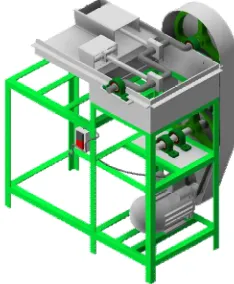
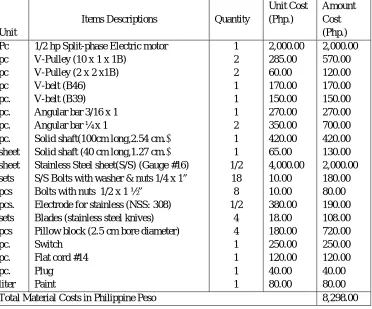
[image:3.612.151.420.128.293.2]available and cost-effected materials (Table 1). The machine was formed through the development of different assemblies namely; blade plate, connecting rods, pistons, crankshaft, hopper, discharge chute, chips collector, frame (upper and lower), machine support, pulleys and belt cover, and power transmission (switch, ½ hp electric motor, pulley and belts).
Fig. 1 Design of the power-driven piston type multi-crop chipper
[image:3.612.252.369.397.539.2]The newly fabricated Power Driven Piston -Type Multi Crop Chipper which was composed of two chipping sections with two pistons placed parallel to each other maximizes the complete revolution of the crankshaft (Fig.2). The shaft has an average rotational speed of 73 rpm. It can attain a uniform thickness of chips that ranged from 1-3 mm depending upon the blade spacing in the in the blade assembly (Fig. 4)
Fig. 2 Perspective view of the invention showing two pistons placed parallel to each other
[image:3.612.230.371.584.716.2]255
©IJRASET (UGC Approved Journal): All Rights are Reserved
[image:4.612.124.496.348.657.2]The machines overall dimension is 72 cm long x 50 cm wide and 95 cm high (Fig.4). Maintenance of the machine can be performed easily since all its parts were detachable. Provision for safety of operator against moving parts during machine operation was also attained by means of covers. It can be operated by one person.
Figure 4. The actual fabricated Power Driven Piston Type Multi - Crop Chipper
TABLEI
SUMMARY OF SPECIFICATION OF MATERIALS AND COSTS FOR THE CONSTRUCTION OF THE POWER DRIVEN PISTON TYPE MULTI-CROP CHIPPER
Unit
Items Descriptions Quantity
Unit Cost (Php.) Amount Cost (Php.) Pc pc pc pc pc. pc. pc. pc. sheet sheet sets pcs pcs. sets pcs pc. pc. pc. liter
1/2 hp Split-phase Electric motor V-Pulley (10 x 1 x 1B)
V-Pulley (2 x 2 x1B) V-belt (B46) V-belt (B39) Angular bar 3/16 x 1 Angular bar ¼ x 1
Solid shaft(100cm long,2.54 cm.Ѳ)
Solid shaft (40 cm long,1.27 cm.Ѳ)
Stainless Steel sheet(S/S) (Gauge #16) S/S Bolts with washer & nuts 1/4 x 1” Bolts with nuts 1/2 x 1 ½”
Electrode for stainless (NSS: 308) Blades (stainless steel knives) Pillow block (2.5 cm bore diameter) Switch
Flat cord #14 Plug Paint 1 2 2 1 1 1 2 1 1 1/2 18 8 1/2 4 4 1 1 1 1 2,000.00 285.00 60.00 170.00 150.00 270.00 350.00 420.00 65.00 4,000.00 10.00 10.00 380.00 18.00 180.00 250.00 120.00 40.00 80.00 2,000.00 570.00 120.00 170.00 150.00 270.00 700.00 420.00 130.00 2,000.00 180.00 80.00 190.00 108.00 720.00 250.00 120.00 40.00 80.00
Total Material Costs in Philippine Peso 8,298.00
B. Performance Evaluation
256
©IJRASET (UGC Approved Journal): All Rights are Reserved
used were the following: Feeding Capacity (FC) kg/hr, Chipping Capacity (CC) kg/hr, Chipping Efficiency and quality of chips as to whole and damage. Five hundred (500) grams for each samples were used during testing and were replicated three (3) times.
C. Feeding Capacity (FC), in kg/hr
This is the amount of peeled unripe and ripe bananas, potatoes and sweet potatoes that can be feed into the machine per unit time FC = Wi x 3.6 ……….(Equation 1)
To
where:
Wi = weight of the input ripe and unripe bananas, potatoes and sweet potatoes, g
To = total operating time, sec
3.6 = Conversion factor
D. Chipping Capacity (CC), in kg/hr
It refers to the amount of the peeled unripe and ripe bananas, potatoes and sweet potatoes that can be processed by the machine either whole chips or damaged chips per unit of time (kg/hr) under crosswise, lengthwise and slant form per unit time.
CC = Wc x 3.6 ……….(Equation 2) To
where:
Wc = weight of the chipped ripe and unripe bananas, potatoes, and sweet potatoes, g
E. Chipping Efficiency (CE), in %
This is defined as the percentage by output of the undamaged or whole chips over the total quantity of the chipped bananas (unripe and ripe), potatoes and sweet potatoes collected to the chipping outlet.
CE = Wc – Wd x 100 ………(Equation 3)
Wc
where:
Wc = weight of the chipped bananas, potatoes and sweet potatoes, g
Wd = weight of the damaged chipped bananas, potatoes and sweet potatoes, g
F. Percentage Whole and Damaged chips (CW & CD), in %
Percentage of whole chips is the total volume of completely chipped unripe and ripe bananas, potato and sweet potato over the total weight of chips collected in the chipping outlet during the chipping operation multiplied by 100, expressed in %. While the percentage of damaged chips is the total volume of deformed, broken, discoloured, or thicker than 4 mm chipped unripe and ripe bananas, potatoes, and sweet potatoes produced by the machine over the total volume of chips collected to the chipping outlet multiplied by 100, expressed in %.
CW = Cw x 100 ………(Equation 4)
Ct
Where:
Cw = weight of the whole chipped bananas, potatoes and sweet potatoes, g Wt = weight of the total chipped bananas, potatoes and sweet potatoes, g
DC = Dc x 100 ………(Equation 5)
Ct
Where:
Cw = weight of the damaged chipped bananas, potatoes and sweet potatoes, g Ct = weight of the total chipped bananas, potatoes and sweet potatoes, g
III.RESULTSANDDISCUSSION
A. Feeding Capacity (FC)
257
©IJRASET (UGC Approved Journal): All Rights are Reserved
0 20 40 60 80 100 120% whole % damaged
Unripe banana
Ripe banana
Potato
Sweet potato
Average
[image:6.612.197.412.130.237.2]tested crops. Meanwhile, among the crops tested ripe banana obtained the highest average FC tested in three replications valued at 159.43 kg/hr while potato on the other hand projected the lowest average FC of 122.36 kg/hr. This could be attributed to the fibre quality of the crops.
Fig. 5 Results of Feeding Capacity, expressed in kg/hr
[image:6.612.198.394.379.473.2]B. Chipping Capacity (CC)
Fig.6 indicates the value of machine’s CC. The same with the FC, ripe banana attained the highest CC among the sampled crops having a value of 158.98 kg/hr, at the same time potato also ranked last, valued at 121.04 kg/hr, thus, it can be concluded that amount CC is directly proportional to FC. To sum it up, the average CC of the developed chipper for all the crops tested is still high with 139.02 kg/hr. In general, due to high value of FC and CC obtained by the chipping machine in all the crops, it is recommended to be used for chipping. It could be gleaned from the result based on CC that the machine can chip more ripe banana, compared to other crops. Therefore, for the newly fabricated chipping machine the harder the commodity the lower the value of FC and CC.
Fig.6 Results of Chipping Capacity expressed in kg/h
[image:6.612.204.398.603.699.2]C. Chipping Efficiency
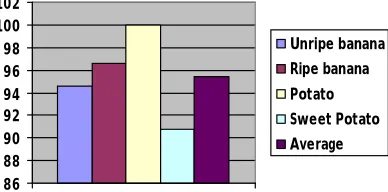
Fig.7 shows the CE of the machine. The test conducted resulted to overall chipping efficiency of 95.48% for all the sampled crops which is considerably high. Somehow, the machine projected the highest chipping efficiency of 100% for potato while sweet potato achieved the least CE having an average of 90.80%. It only means that the efficiency of the machine in chipping the sampled crops in uniform thickness is not affected by any of the crops. Therefore, Power Driven Piston Type Multi - Crop Chipper is an efficient tool that can be used in chipping operation not only for banana but for other crops as well, unlike other chipping machine that are intended for banana only.
Fig.7 Results of chipping efficiency expressed in percentage
258
©IJRASET (UGC Approved Journal): All Rights are Reserved
D. Percentage of Whole Chips and Damaged Chips
[image:7.612.203.400.161.284.2]The results (Fig.8) clearly shows the total percentage whole and damaged chips (Fig.10 and 9) obtained by the machine in different crops tested. A perfect average percentage of 100% whole chips were obtained from potato while sweet potato instead gained the least percentage of whole chips at 90.80%. Generally, the machine attained an overall percentage of whole chips of 95.63% which means that it efficiently perform its designed function and is highly recommended for commercial utilization.
Fig.8 Percentage of whole and damage chips
Fig 9. Damaged chips of unripe and ripe bananas and sweet potato. No damaged chips for potato
[image:7.612.94.480.328.426.2]
Fig 10. Whole chips of unripe and ripe bananas, potato and sweet potato.
IV.CONCLUSIONS
A. The developed Power Driven Piston – Type Multi Crop Chipper can be used effectively by MSMEs in chipping ripe and
unripebanana, potato, and sweet potato; thus principle applying of chipping with the use of piston type chipper with motor as power source is feasible.
B. Physical characteristic of the crops to be chipped affects the Feeding Capacity and Chipping Capacity of the machine
C. The type of crops subjected to chipping does not affect the Chipping Efficiency of the machine.
D. Speed of the each piston of 73 rpm was reasonable which enables the operator to load the crops at proper timing resulting to less
damaged chips produced.
V. ACKNOWLEDGMENT
The researchers wishes to acknowledge the following individuals for the moral and financial support extended through their leadership and administration at Mindoro State College of Agriculture and Technology (MinSCAT) which contributes a lot in the realization of this study: Dr. Jesse T. Zamora, MinSCAT President, Dr. Christian Anthony C. Agutaya, Vice President for Research, Extension and Development and Engr. Jerrel S. Reyes, Director for Research.
0 20 40 60 80 100 120
% whole % damaged
259
©IJRASET (UGC Approved Journal): All Rights are Reserved
REFERENCES [1] (2017) PhiMech.[online] website. Available: http://www.philmech.gov.ph/.[2] Nagaratna, C. T. Ramachandra, Ambrish Ganachari, R.S. Roopa, Sunil Shirwal and, M.P.Amitkumar, "Performance evaluation of aloe vera leaf slicing machine" International Journal of Current Microbiology and Applied Sciences, vol. 7 no. 4, pp. 97–106. doi:10.20546/ijcmas.2017.608.453, 2017.
[3] F. B. Akande, and T. B. Onifade, "Modification of a plantain slicing machine". Innovative Systems Design and Engineering, vol. 6, no.10, pp. 41–52, 2015. [4] B. E. Okafor, and V. C. Okafor, "Design of a plantain chips slicing machine". International Journal of Engineering and Technology, vol. 3 no.10, pp. 928–932,
2013.
[5] S. P. Sonawane, G. P. Sharma, and A. C. Pandya, "Design and development of power operated banana slicer for small scale food processing industries". Research in Agricultural Engineering, vol.57, pp. 144–152. January 2011.
[6] G. Y. Obeng, "Development of a mechanised plantain slicer". Journal of Science and Technology. vol. 24, No. 2, pp. 126-133, 2004.
[7] T. B. Onifade, "Design and fabrication of a three-hopper plantain slicing machine" American Scientific Research Journal for Engineering, Technology, and Sciences (ASRJETS), vol.17 no. 1, pp. 61–80, 2016.
[8] A. O. Yusuf, and I. Abdullahi, "Development of a potato slicing machine". Continental J. Engineering Sciences, vol.2, pp. 49–57. 2007.
[9] B. O. Bolaji, S. B. Adejuyigbe, and S. P. Ayodeji, "Performance evaluation of a locally developed cassava chipping machine". South African Journal of Industrial Engineering, vol. 19 no.1, pp. 169–178, 2008.