Copyright © 2004, American Society for Microbiology. All Rights Reserved.
Rapid Quantification of
Yersinia enterocolitica
in Pork Samples by a
Novel Sample Preparation Method, Flotation, Prior to
Real-Time PCR
Petra Wolffs,
1Rickard Knutsson,
2Bo¨rje Norling,
3and Peter Ra˚dstro¨m
1*
Applied Microbiology, Lund Institute of Technology, Lund University, SE-221 00 Lund,1Medprobe, IDEON
Science Park, Scheeleva¨gen 17, SE-223 70 Lund,2and Quintessence Research AB, Ma˚larva¨gen 9,
SE-746 93 Ba˚lsta,3Sweden
Received 25 August 2003/Returned for modification 2 November 2003/Accepted 14 November 2003
The development of real-time PCR thermal cycles in the late 1990s has opened up the possibility of accurate quantification of microorganisms in clinical, environmental, and food samples. However, a lack of suitable sample preparation methods that allow rapid quantification of the nucleic acids, remove PCR inhibitors, and prevent false-positive results due to DNA originating from dead cells has limited the use of quantitative PCR. We have used for the first time a new variant of density gradient centrifugation, called flotation, as a user-friendly sample preparation method prior to PCR. This paper describes the use of this sample
prepara-tion method, without DNA purificaprepara-tion, for direct detecprepara-tion and quantificaprepara-tion of Yersinia enterocolitica in
PCR-inhibitory meat juice from pork. Flotation combined with qPCR could overcome PCR interference in juice
from pork, as was shown by amplification efficiencies of 1.006ⴞ0.021 and 1.007ⴞ0.025, which are comparable
to the amplification efficiency obtained for purified DNA samples (1.005ⴞ0.059). Applying flotation to meat
juice samples containing natural background flora and spiked with different levels ofY. enterocoliticashowed
that direct quantification ofY. enterocoliticawas possible down to a level of at least 4.2ⴛ103CFU per ml of
meat juice, even in the presence of 106 CFU of background flora per ml. Finally, the results showed that
samples containing large amounts of Y. enterocolitica DNA did not result in a positive PCR signal. This
indicates that the risk of false-positive results due to detection of DNA originating from dead cells can be greatly reduced by using flotation prior to PCR.
Since real-time PCR thermal cycles became commercially available in the late 1990s, the technology has been recognized as an outstanding tool in molecular diagnostics (4, 8, 19). In comparison with conventional PCR, real-time PCR facilitates automation, computerization, and quantification of nucleic ac-ids. Also, real-time PCR, with its increased sensitivity, speed, and precision and its wide dynamic range (2, 10), has found successful applications in food microbiology. Recently, numer-ous rapid real-time PCR assays for qualitative detection of pathogens have been developed (3, 13, 14). To allow such detection, several requirements must be met during sample preparation: (i) PCR-inhibitory substances must be removed, (ii) target nucleic acids or cells must be concentrated, (iii) heterogeneous samples must be converted into a homoge-neous sample (25), and (iv) detection of dead cells must be prevented (10). Culture enrichment, DNA extraction, or a combination of both is often used to meet these goals (15). However, these steps are time-consuming, and their elimina-tion can be regarded as one of the main challenges left on the way to the most rapid PCR detection possible.
Aside from the need for rapid qualitative detection, there is also a need for quantification of the bacterial load (6, 22). To allow quantitative measurements, one additional requirement for sample preparation is that the selected method should not
influence the amount of target, or should do so only in a controlled and predictable manner. This means that enrich-ment cannot be used prior to quantitative PCR (qPCR). Con-cerning DNA purification, which is presently almost exclusively used, there may be some disadvantages. Studies have indicated that the quality and yield of DNA available after purification can depend on the purification method, sample composition (20), and target (29), and variations in both yield and quality can affect the final quantification data (22).
This study demonstrates the use of a novel sample prepara-tion method, called flotaprepara-tion, based on density gradient cen-trifugation. The benefits of density gradient centrifugation as a sample pretreatment method are well established and include (i) the possibility of separating biological matrix particles and microorganisms with different buoyant densities (17); (ii) maintaining cell viability, which allows isolation and analysis of the microorganisms (24); and (iii) speed and easy handling. In contrast to sedimentation, after flotation the target is concen-trated at the top of the density gradient, which has the advan-tage of reducing recontamination during recovery of the target. The aim of this study was to develop a flotation-qPCR method that did not involve a DNA purification step for the rapid detection and quantification of Yersinia enterocolitica from pork juice using real-time PCR. Furthermore, the inten-tion was to demonstrate the performance of flotainten-tion in the reduction of PCR inhibition, obtaining of homogeneous PCR samples from heterogeneous food samples, and separation of living cells from DNA originating from dead cells.
* Corresponding author. Mailing address: Applied Microbiology, Lund Institute of Technology, Lund University, P.O. Box 124, SE-221 00 Lund, Sweden. Phone: 46 46-222 3412. Fax: 46 46-222 4203. E-mail: [email protected].
1042
on May 15, 2020 by guest
http://jcm.asm.org/
MATERIALS AND METHODS
PCR samples.Strains ofYersiniaand background flora (BGF) (Table 1) were grown overnight in tryptone soy broth (Oxoid CM129; Unipath, Basingstoke, United Kingdom) at 28°C. CFU were counted using tryptone-glucose-meat ex-tract agar plates (Merck, Darmstadt, Germany) or, for specificYersinia deter-mination, cefsulodin-irgasan-novobiocin agar plates (Yersinia Selective Agar Base; Unipath). DNA was purified using an EasyDNA kit (Invitrogen, Gro-ningen, The Netherlands). The concentration of DNA was fluorimetrically de-termined using a TD-700 fluorimeter (Turner Designs, Sunnyvale, Calif.), and the DNA was diluted to appropriate concentrations in sterile Millipore water. Minced pork meat was bought at a local store, and meat juice collectors (Sarstedt, Nu¨mbrecht, Germany) were filled with the meat and subjected to cycles of repeated freezing and thawing (between three and six cycles) to release the juice. Undefined BGF from pork was grown by inoculating 50 ml of tryptone soy broth with 5 g of minced pork and incubating it overnight. Pig feces were acquired from a local slaughterhouse and homogenized as described before. Human blood was withdrawn from a healthy subject, and both feces and blood samples were frozen before use.
Buoyant density centrifugation.Throughout the study, three different colloi-dal density gradient media, all formulated from RediGrad (Amersham Bio-sciences AB, Uppsala, Sweden) were used: BactXtractor-L (BX-L; density, 1.058 g/ml; pH 7.5; osmolality, 322 mosmol/kg), BactXtractor-M (BX-M; density, 1.132 g/ml; pH 7.5; osmolality, 300 mosmol/kg), and BactXtractor-H (BX-H; density, 1.309 g/ml; pH 7.5; osmolality, 340 mosmol/kg) (QRAB, Ba˚lsta, Sweden). For all three media, the pH was adjusted with 1 M HCl and the osmolality was adjusted by the addition of ultrapure (99.99%) NaCl, using a Roebling osmometer (Labex Instruments AB, Helsingborg, Sweden). The final densities of BX-L and BX-H were reached after dilution and concentration of RediGrad. After the pH and the osmolality had been set, BX-M had a density of 1.132 g/ml and needed no further adjustment. The densities were measured using a DMA46 density meter (Instrument AB Lambda, Stockholm, Sweden).
The buoyant densities of microorganisms and food particles were determined as described by Pertoft (24). Briefly, 6 ml of BX-M was mixed with 2 ml of sample, 2 ml of physiological saline, and 50l of a density marker bead (DMB) solution (Amersham Biosciences AB) in a plastic 15-ml conical tube. Centrifu-gation was performed in a Braun-Sigma 4-15C laboratory centrifuge (Sigma, Osterode am Harz, Germany) at 10,000⫻gavg(averagegforce) for 30 min at room temperature, using a fixed-angle rotor (12170-H) for the 15-ml tube. A plot describing the densities of different locations in the self-generating gradient was made by measuring the distance from the bottom of the tube to the different layers of DMBs and plotting the known densities of the different DMBs (in grams per milliliter) versus distance (in centimeters).
Flotation.Based on the buoyant densities determined for microorganisms and food sample particles, appropriate flotation setups can be designed. A flotation setup was composed of layers of density gradient solutions, each layer with a different density. The goal of flotation is to separate and concentrate the target microorganism from the food matrix and the BGF. To achieve accumulation of the target, it is concentrated at the interface of two layers by choosing a top layer with a lower density than the target and a bottom layer with a higher density than the target. The opposite strategy can be adopted for the BGF and the food sample matrix. By choosing as narrow a density window as practically possible, the target will be separated from most of the BGF and the food matrix.
Experimental setup for flotation-qPCR.The flotation-qPCR procedure uses flotation 1 (Fig. 1) and takes place in the following seven steps. (Step 1) The sample is mixed with BX-H (1:3) and is loaded into a clean tube to form the bottom layer of the discontinuous gradient. (Step 2) The middle and top layers are carefully layered on top of the bottom layer. (Step 3) The discontinuous gradient is centrifuged for 15 min at 4,500⫻gmax (maximumg force) in a swinging-bucket rotor. (Step 4) Samples (1 ml) are taken from the interface, using sterile 2-ml syringes. (Step 5) The samples are added to 2-ml tubes, diluted with physiological saline to 2 ml (to obtain a density of the solution that allows pelleting of cells), and centrifuged at 13,000⫻gmaxin a benchtop centrifuge for 5 min. (Step 6) A fivefold concentration step is performed by removing 1.8 ml of the supernatant and resuspending the cells in the remaining 0.2-ml samples containingY. enterocoliticacells. (Step 7) Finally, the samples are analyzed by real-time PCR and viable counts are obtained.
Real-time PCR conditions.A primer set targeting a 0.3-kb part of the 16S rRNA gene fromY. enterocolitica(16) was used to develop a real-time PCR assay using the LightCycler instrument (Roche Diagnostics, Mannheim, Germany) (28). The PCR mixture consisted of 0.75 U ofTthDNA polymerase (Roche Diagnostics); 1⫻ Tth DNA polymerase buffer (Roche Diagnostics); 4 mM MgCl2; 0.4M each primer; 0.2 mM (each) dATP, dCTP, dGTP, and dTTP; 10,000-fold-diluted SYBR Green I (Roche Diagnostics); and 4l of sample. The total volume was 20l. For purified DNA, each amplification started with a denaturation step of 1 min at 95°C followed by 40 cycles of 0.1 s of denaturation at 95°C, 5 s of annealing at 60°C, and elongation for 15 s at 72°C, and finally a single fluorescence measurement and 25 s of final elongation. For samples containing whole cells, prior to real-time PCR, the samples were heated for 5 min at 95°C to enhance cell lysis, and during PCR, three additional minutes of initial denaturation and 10 s of denaturation per cycle were added to obtain sufficient cell lysis. Amplification was followed by a melting curve analysis be-tween⫹65°C and⫹95°C, and finally, a cooling step for 1 min at⫹40°C. During amplification, the fluorescence was measured in channel F1 and display mode F1. The quantification data, in terms of crossing-point (Cp) values, expressed as fractional cycle numbers and representing the intersection of the log-linear fluorescence curve with a threshold crossing line, were determined by using the second-derivative method of the LightCycler Software, version 5.3 (Roche Di-agnostics).
[image:2.603.307.543.72.212.2]Linear range of amplification and amplification efficiency.Tenfold dilutions ofY. enterocoliticaDNA between 1 mg/ml and 1 fg/ml, or of cell cultures between 108and 100CFU/ml, were used to obtain standard curves. All measurements were run in independent triplicate runs. After amplification, the results from the melting curve were analyzed, and the Cp values of all samples that gave a positive specific product peak between 88 and 92°C were plotted against the log of the initial DNA or cell concentration. From this graph, the linear range was deter-mined. After determination of the linear range of amplification, linear regression
TABLE 1. Buoyant densities of selected bacteria
Organism Straina density (g/Buoyant
ml)b
Acinetobacter calcoaceticus SMRICC 66 1.070–1.075
Brochothrix thermosphacta SMRICC 347 1.100–1.102
Hafnia alvei SMRICC 370 1.070–1.080
Pseudomonas lundensis SMRICC 456 1.050–1.055
Serratia liquefaciens SMRICC 365 1.065–1.070
Y. enterocolitica IHI 41526 1.084–1.090
Y. enterocolitica Y79 1.076–1.081
Yersinia intermedia Y344 1.087–1.090
aIHI, National Public Health Institute (KTL), Helsinki, Finland; SMRICC,
Swedish Meats R&D Culture Collection, Lund, Sweden; Y, Norwegian School of Veterinary Science, Oslo, Norway.
bAverage measurements of triplicate runs. FIG. 1. Overview of the two flotation strategies investigated.
(A) One-step flotation, consisting of three layers. TheYersinia recov-ery location (the location ofYersiniacells after centrifugation) is at the interface of the two top layers. The buoyant densities of the different colloidal solutions are shown. (B) Two-step flotation. Both steps con-tain two-layer flotations. During step 1, Yersiniaconcentrates at the bottom of the tube and is recovered from there to be used in step 2. TheYersiniarecovery location in step 2 is on top of the top layer. *, layer composed of 3 ml of BX-H solution mixed with 1 ml of sample, resulting in a density of⬃1.200 g/ml.
on May 15, 2020 by guest
http://jcm.asm.org/
was used to calculate the slope of the Cp-versus-log initial DNA or cell concen-tration plot using the points in the linear range. From this slope, the amplifica-tion efficiency (E) was calculated using the following equation:E⫽(10⫺1/slope) ⫺1 (11).
PCR inhibition studies.To establish the reduction in PCR inhibition after flotation, runs using two different flotation setups containing meat juice with its natural BGF but lackingY. enterocoliticawere made. After flotation, samples were collected at theYersiniarecovery locations. By spiking these samples with a dilution series ofY. enterocoliticaDNA and applying real-time PCR, the PCR efficiency in the samples was determined. This was compared to analysis of the same DNA dilution series added to untreated meat juice and pure water. Also, to test for the general applicability of flotation as a sample preparation method, two different matrices, pig feces homogenate and human blood, were run in the same manner.
RESULTS
Flotation. There are three main components in the food
samples that ideally need to be separated from each other by flotation: (i) the target organism, Y. enterocolitica; (ii) the BGF; and (iii) the meat juice sample components. In order to perform flotation, the buoyant densities of Y. enterocolitica, several microorganisms found in pork (Table 1), and unde-fined BGF grown from pork and pork matrix were determined. Analysis of these three components in different tubes with self-generating gradients showed that the buoyant densities of these components differ. Y. enterocolitica Y79 (the model strain used for testing the flotation setups) was found to have a buoyant density of 1.076 to 1.081, and different populations of undefined BGF were found to have buoyant densities in the ranges of 1.062 to 1.065, 1.074 to 1.076, and 1.102 to 1.110. Finally, the meat juice sample contents concentrated at differ-ent buoyant densities of 1.066 to 1.070 and⬍1.018. The com-ponents of the meat juice which give the sample a red color, presumably hemoglobin and myoglobin, did not form a band in the density gradient. Rather, the color had the same distribu-tion before and after centrifugadistribu-tion.
Based on the buoyant densities obtained for BGF, meat juice, andY. enterocolitica, two flotation setups were designed (Fig. 1). Both were intended to exclude as much of the meat juice sample components and the BGF as possible from the
Yersinia recovery location. One setup (flotation 1) allowed
separation in one step, and the other (flotation 2) employed two successive centrifugation steps. The two-step procedure allowed easy sampling with less chance of recontamination of the recovered cells, since the target microorganism was recov-ered at the top of the density gradient after step 2. Running samples containing all three components in both setups showed that the red-colored fraction of the meat juice re-mained in the bottom layer, where the sample was loaded. Part of the BGF and the fractions of the meat juice with the lowest buoyant densities were found on the top of the density gradient in flotation 1 and were removed after the first centrifugation step in flotation 2. The fractions of the BGF and the meat juice with the highest buoyant densities were mainly found at the lower interface in flotation 1 and after the second centrifuga-tion step in flotacentrifuga-tion 2. In the first setup, theYersiniarecovery location was at the interface of the top two layers. In the second setup,Y. enterocoliticawas recovered from the top of the upper layer after the second centrifugation step.
PCR inhibition studies.When PCR mixtures containing
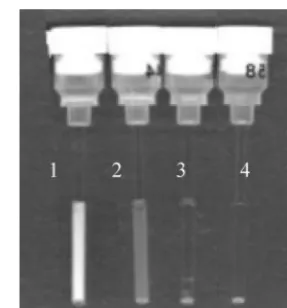
un-treated meat juice (20% [vol/vol]) were run, a solid white
precipitate was formed in the LightCycler capillaries that to-tally prohibited fluorescence measurements (Fig. 2). Dilution of the samples to concentrations of 2, 0.2, and 0.02% (vol/vol) showed that only at 0.02% could the formation of precipitate be avoided, making real-time PCR measurements possible.
The amplification efficiency obtained after qPCR of diluted meat juice samples containingY. enterocoliticaDNA was com-pared to the amplification efficiencies obtained from the rele-vant fractions (i.e., fractions recovered from the Yersinia re-covery location) of undiluted meat juice samples subjected to the one- and two-step flotation protocols. The results showed that improved efficiencies could be obtained for the undiluted meat juice subjected to flotation, even compared to 1,000-fold-diluted meat juice without flotation (Table 2). The efficiencies of⬃0.950 obtained for the flotation-treated samples, however, still deviate more from 1.000 than the value for purified DNA (1.005). To overcome this, the annealing step and/or the elon-gation step was extended by 20 s. The results show that am-plification efficiencies can be increased to values of⬃1.007 and
[image:3.603.350.494.68.222.2]FIG. 2. Precipitate formation in LightCycler capillaries after PCR analysis ofY. enterocoliticain samples containing different concentra-tions of meat juice from pork. 1, 20% (vol/vol) meat juice; 2, 2% (vol/vol) meat juice; 3, 0.2% (vol/vol) meat juice; 4, 0.02% (vol/vol) meat juice.
TABLE 2. Effects of different pre-PCR processing strategies on amplification efficiency
Sample Treatment Amplificationefficiencya
Millipore water 1.005⫾0.059
Juice from pork Dilution (1,000-fold) 0.773⫾0.031 Flotation 1 0.954⫾0.053 Flotation 2 0.946⫾0.037 Flotation 1b 1.037⫾0.064 Flotation 1c 0.964⫾0.048 Flotation 1d 1.007⫾0.025 Flotation 2d 1.006⫾0.021 Pig feces homogenate Flotation 1d 0.991⫾0.030 Human blood Flotation 1d 1.030⫾0.026 aAmplification efficiencies ofY. enterocoliticaY79 DNA in different samples.
Efficiencies were calculated from data generated from three independent runs of purifiedY. enterocoliticaY79 DNA in the sample.
bPCR protocol was extended with additional 20 s of annealing. cPCR protocol was extended with additional 20 s of elongation.
dPCR protocol was extended with additional 20 s of annealing and 20 s of
elongation.
on May 15, 2020 by guest
http://jcm.asm.org/
1.006 for the one-step and two-step flotation setups, respec-tively. Finally, applying two very different sample types, such as blood and feces, showed that a reduction in inhibition to the same level could be obtained.
Flotation-qPCR.The possibility of directly detecting
differ-ent amounts ofY. enterocoliticafrom meat juice harboring its natural BGF was studied using flotation setup 1. A standard curve was constructed to allow absolute qPCR (Fig. 3), and it showed a linear range of amplification between 5⫻107and 5
⫻ 103 CFU/ml. The results from viable counts and qPCR
showed that after flotation the target was recovered in all cases, and there was good concurrence between viable-count and qPCR data (Table 3). Standard deviations for all measure-ments except six points were below 20%. Of those six points, five involved viable counts. The results also show that there is no obvious difference in the number of recoveredY.
enteroco-liticacells when the complexity of the sample is increased from
saline (recovery, 34.5%⫾11.1%) by the addition of meat juice (recovery, 34.3%⫾6.0%) or additional meat juice and BGF (recovery, 31.9%⫾8.2%). For the two lowest concentrations, no quantitative data were obtained, since these concentrations fall outside the linear range of amplification. However, it was possible to confirm the presence ofY. enterocoliticacells.
Finally, to test whether DNA originating from dead cells can constitute a risk of false-positive signals in this method, Y.
enterocoliticaDNA samples were subjected to flotation 1. The
results showed that after flotation, levels of up to 2.1 g of chromosomal DNA/ml could not be recovered from the
Yer-sinia recovery location. Before and after flotation, samples
were taken from the bottom layer, i.e., the layer that consti-tutes the sample, and qPCR showed that similar amounts of DNA were found before and after flotation (data not shown), confirming that the DNA from dead cells does not float to the
Yersiniarecovery location.
DISCUSSION
[image:4.603.46.280.70.197.2]The removal or neutralization of PCR inhibitors is one of the most important aspects of sample preparation (25). Be-cause of the complex nature of biological samples and the differences in composition and content of PCR-inhibitory com-pounds, sample treatment often has to be optimized and cho-sen to suit each application and sample type (23). Although DNA extraction has several disadvantages, such as possible copurification of DNA from dead cells and yields varying with sample composition (20) and target (29), it is nonetheless, to our knowledge, exclusively used for qPCR detection of micro-bial pathogens from complex samples. This is mainly due to its high capacity to remove PCR inhibitors and deliver the clean sample needed for accurate quantification (21). The results showed that at least three different highly PCR-inhibitory (1) samples, such as meat juice, pork feces homogenate, and hu-man blood, all showed amplification efficiencies in the same range as those for purified DNA in water and had a maximal deviation of 2.1% from the optimal amplification efficiency of 1.00 (100%) (Table 2). These results imply that the reduction of PCR inhibition is comparable to that of DNA purification with a commercial kit. It also indicates that inhibition caused by samples as different as meat juice, human blood, and pork feces homogenate can be reduced to similar levels by the same flotation protocol. The suitability of this method for different targets (different Y. enterocolitica strains and physiological states) and different samples depends largely on the design of the flotation layers. Furthermore, as long as buoyant density data for the target and the matrix are available, flotation setups
FIG. 3. Standard curve for absolute quantification ofY. enteroco-liticacells. The linear range of amplification is shown by a line and can be described by the following formula:y⫽ ⫺2.99⫻ ⫹43.826;R2⫽
0.9886. The standard curve is a result of triplicate analyses, and all points shown were confirmed by melting curve analysis. The error bars indicate standard deviations.
TABLE 3. Direct detection of Y. enterocolitica in juice from pork
Total no. of CFU of
Y. enterocolitica
added to sample prior to flotation
No. of CFU in 200l ofY. enterocoliticaas determined by VCs and flotation combined with qPCRa
Saline Meat juice Meat juice⫹106CFU of BGF
VC qPCR VC qPCR VC qPCR
3.0⫻101 0.8⫻101 ⫹,⫹b 1.0⫻101* ⫹,⫺b 0.8⫻101 ⫹,⫺b
4.1⫻102 1.4⫻102* ⫹,⫹b 1.3⫻102 ⫹,⫹b 1.2⫻102 ⫹,⫹b
4.2⫻103 1.3⫻103 1.4⫻103 1.5⫻103 1.4⫻103 1.7⫻103 1.5⫻103
4.1⫻104 0.8⫻104* 1.7⫻104 0.9⫻104* 1.7⫻104 0.5⫻104* 1.5⫻104
5.7⫻105 1.7⫻105 1.9⫻105 2.1⫻105 2.5⫻105 1.9⫻105 1.7⫻105
4.1⫻106 2.7⫻106 1.4⫻106* 1.7⫻106 1.2⫻106 1.3⫻106 1.9⫻106
5.7⫻107 1.7⫻107 1.8⫻107 1.9⫻107 1.8⫻107 1.7⫻107 1.8⫻107
aAll results represent average data from at least duplicate analyses. Real-time quantitative data were obtained from a standard curve ofY. enterocoliticacells (Fig.
3). Standard deviations were in all cases between 0 and 20%, except for cases marked with an asterisk, which had standard deviations between 21 and 63%. VC, viable count.
bNo quantitative data were available, since these points fall outside the linear range of amplification. However, positive signals confirmed by melting curve analysis
are shown as pluses, and the absence of a positive signal is indicated by minuses.
on May 15, 2020 by guest
http://jcm.asm.org/
[image:4.603.39.544.571.684.2]can also be designed, optimized, and adjusted to suit other microorganisms or combinations of them. The buoyant densi-ties determined forY. enterocoliticain this study were close to previously published data (mean difference, ⬍0.020 g/liter) (18), and the differences can be explained by differences oc-curring between strains, as has previously been shown for
Esch-erichia colistrains (17). Furthermore, the use of different
me-dia for density gradient preparation has also been shown to be the cause of differences in the final buoyant density (5). By making sure that the middle layer is significantly heavier, and the top layer significantly lighter, than the known buoyant density ofY. enterocolitica, a safety margin can be built into the system, preventing loss ofY. enterocolitica to other locations than theYersiniarecovery location.
In a previous study, it was shown that qPCR can be im-proved by the use of alternative DNA polymerases, such asTth (28). By using this DNA polymerase and its buffer in flotation-qPCR, quantification was possible over a range of at least 5 log units (Fig. 3). The results showed, furthermore, that the flota-tion-qPCR setup designed in this study resulted in accurate quantification of cells without a DNA purification step. No significant differences between qPCR and viable-count results, and no obvious difference in the amount of target cells recov-ered, could be found when the complexity of the samples was increased by the addition of meat juice or extra BGF. This indicates again that heterogeneous samples are turned into homogeneous samples after flotation treatment. The results also showed that the average recovery of cells after this flota-tion-qPCR process was 33.5% ⫾8.5%. The recovery step is currently mainly limited and affected by manual handling. Fu-ture automation of sample recovery can improve the standard-ization of the process. Aside from this, it is possible to vary the degree of concentration by increasing the initial sample vol-ume or adjusting the recovery volvol-ume of the final centrifuga-tion after flotacentrifuga-tion. The present protocol incorporates a five-fold concentration step. By concentrating the sample after flotation, quantification can be enhanced.
Aside from qPCR results over a range of 5 log units, also outside the linear range of amplification, detection is possible. Due to interference from detection of primer dimers by SYBR Green, and due to detection probability issues at very low concentrations, Cp values were lower than could be expected and fell outside the linear range of amplification. Nonetheless, 100% qualitative detection outside this range was possible down to amounts of 4.1⫻102CFU/ml, and can be considered
to be semiquantitative. This information is still valuable, as it confirms the presence of the target in the sample. Therefore, apart from allowing quantitative measurements, these results show the improvement of the qualitative PCR method by com-bining it with flotation treatment, as previous studies showed that when 102CFU ofY. enterocolitica/ml was combined with
106CFU of BGF/ml, 100% detection was not possible, even
after selective enrichment (12).
In food microbiology and the detection of food-borne patho-gens, one of the major concerns about the use of a nucleic-acid-based detection method, such as PCR, has been the risk of false-positive results caused by the detection of DNA from dead cells (27). Our results showed that after flotation, free DNA remained separated from theYersiniasampling location and that DNA concentrations of up to 2.1g/ml did not result
in a positive PCR signal. This can be explained by the very low flotation speed of DNA at this centrifugation speed. Several other methods have been employed to overcome this risk. Enrichment is most commonly used prior to PCR, but the use of immunomagnetic beads, for example, should also allow the separation of living cells (9). However, there are indications that nonviable bacteria with intact cell surface antigens could be enriched by immunomagnetic separation (7). A study by Lindqvist et al. (18) indicated that the buoyant densities ofY.
enterocolitica cells killed in four different ways differed from
the buoyant density of living cells. Further studies will have to be performed to indicate whether such differences can be used in flotation to separate nonviable intactY. enterocoliticacells from living cells.
One final aspect of importance for sample treatment meth-ods is the time involved in the treatment. The seven steps involved in running one-step flotation PCR can be performed within 2 h, including 15 min of centrifugation and 1 h of real-time PCR analysis. This is comparable to rapid commer-cial DNA purification methods and significantly less time-con-suming than traditional DNA extraction methods (26) or en-richment-PCR (12) in the case of qualitative measurement only.
In conclusion, this flotation-PCR method offers a rapid, easy combination of sample treatment and quantitative real-time PCR suitable for quantitative analysis of Y. enterocolitica in different types of samples within 2 h, without the risk of false-positive results due to DNA originating from dead cells.
ACKNOWLEDGMENTS
This work was financially supported by the Commission of the Eu-ropean Communities within the program “FOOD-PCR” (QLK1-1999-00226) and the Swedish Research Council for Environment, Agricul-tural Sciences and Spatial Planning (2001-4068).
REFERENCES
1. Abu Al-Soud, W., and P. Ra˚dstro¨m.1998. Capacity of nine thermostable DNA polymerases to mediate DNA amplification in the presence of PCR-inhibiting samples. Appl. Environ. Microbiol.64:3748–3753.
2. Bustin, S. A.2000. Absolute quantification of mRNA using real-time reverse transcription polymerase chain reaction assays. J. Mol. Endocrinol.25:169– 193.
3. Fortin, N. Y., A. Mulchandani, and W. Chen.2001. Use of real-time poly-merase chain reaction and molecular beacons for the detection of Esche-richia coliO157:H7. Anal. Biochem.289:281–288.
4. Giulietti, A., L. Overbergh, D. Valckx, B. Decallonne, R. Bouillon, and C. Mathieu.2001. An overview of real-time quantitative PCR: applications to quantify cytokine gene expression. Methods25:386–401.
5. Guerrero, R., C. Pedros-Alio, T. M. Schmidt, and J. Mas.1985. A survey of buoyant density of microorganisms in pure cultures and natural samples. Microbiologia1:53–65.
6. Hein, I., A. Lehner, P. Rieck, K. Klein, E. Brandl, and M. Wagner.2001. Comparison of different approaches to quantifyStaphylococcus aureuscells by real-time quantitative PCR and application of this technique for exami-nation of cheese. Appl. Environ. Microbiol.67:3122–3126.
7. Hornes, E., Y. Wasteson, and O. Olsvik.1991. Detection ofEscherichia coli
heat-stable enterotoxin genes in pig stool specimens by an immobilized, colorimetric, nested polymerase chain reaction. J. Clin. Microbiol.29:2375– 2379.
8. Jung, R., K. Soondrum, and M. Neumaier.2000. Quantitative PCR. Clin. Chem. Lab. Med.38:833–836.
9. Kapperud, G., T. Vardund, E. Skjerve, E. Hornes, and T. E. Michaelsen.
1993. Detection of pathogenicYersinia enterocoliticain foods and water by immunomagnetic separation, nested polymerase chain reactions and color-imetric detection of amplified DNA. Appl. Environ. Microbiol.59:2938– 2944.
10. Klein, D.2002. Quantification using real-time PCR technology: applications and limitations. Trends Mol. Med.8:257–260.
11. Klein, D., P. Janda, R. Steinborn, M. Muller, B. Salmons, and W. H.
on May 15, 2020 by guest
http://jcm.asm.org/
Gunzburg.1999. Proviral load determination of different feline immunode-ficiency virus isolates using real-time polymerase chain reaction: influence of mismatches on quantification. Electrophoresis20:291–299.
12. Knutsson, R., Y. Blixt, H. Grage, E. Borch, and P. Ra˚dstro¨m.2002. Evalu-ation of selective enrichment PCR procedures forYersinia enterocolitica.Int. J. Food Microbiol.73:35–46.
13. Knutsson, R., M. Fontanesi, H. Grage, and P. Ra˚dstro¨m.2002. Development of a PCR-compatible enrichment medium forYersinia enterocolitica: ampli-fication precision and dynamic detection range during cultivation. Int. J. Food Microbiol.72:185–201.
14. Knutsson, R., C. Lo¨fstro¨m, H. Grage, J. Hoorfar, and P. Ra˚dstro¨m.2002. Modeling of 5⬘ nuclease real-time responses for optimization of a high-throughput enrichment PCR procedure forSalmonella enterica.J. Clin. Mi-crobiol.40:52–60.
15. Lantz, P.-G., B. Hahn-Ha¨gerdal, and P. Ra˚dstro¨m.1994. Sample prepara-tion methods in PCR-based detecprepara-tion of food pathogens. Trends Food Sci. Technol.5:384–389.
16. Lantz, P. G., R. Knutsson, Y. Blixt, W. A. Al Soud, E. Borch, and P. Ra˚dstro¨m.1998. Detection of pathogenicYersinia enterocoliticain enrich-ment media and pork by a multiplex PCR: a study of sample preparation and PCR-inhibitory components. Int. J. Food Microbiol.45:93–105.
17. Lindqvist, R.1997. Preparation of PCR samples from food by a rapid and simple centrifugation technique evaluated by detection ofEscherichia coli
O157:H7. Int. J. Food Microbiol.37:73–82.
18. Lindqvist, R., B. Norling, and S. T. Lambertz.1997. A rapid sample prep-aration method for PCR detection of food pathogens based on buoyant density centrifugation. Lett. Appl. Microbiol.24:306–310.
19. Mackay, I. M., K. E. Arden, and A. Nitsche.2002. Real-time PCR in virology. Nucleic Acids Res.30:1292–1305.
20. Miller, D. N., J. E. Bryant, E. L. Madsen, and W. C. Ghiorse.1999.
Evalu-ation and optimizEvalu-ation of DNA extraction and purificEvalu-ation procedures for soil and sediment samples. Appl. Environ. Microbiol.65:4715–4724. 21. Nogva, H. K., A. Bergh, A. Holck, and K. Rudi.2000. Application of the
5⬘-nuclease PCR assay in evaluation and development of methods for quan-titative detection ofCampylobacter jejuni. Appl. Environ. Microbiol.66:
4029–4036.
22. Nogva, H. K., K. Rudi, K. Naterstad, A. Holck, and D. Lillehaug.2000. Application of 5⬘-nuclease PCR for quantitative detection ofListeria mono-cytogenesin pure cultures, water, skim milk, and unpasteurized whole milk. Appl. Environ. Microbiol.66:4266–4271.
23. Payne, M. J., and R. G. Kroll.1991. Methods for the separation and con-centration of bacteria from foods. Trends Food Sci. Technol.2:315–319. 24. Pertoft, H.2000. Fractionation of cells and subcellular particles with Percoll.
J. Biochem. Biophys. Methods44:1–30.
25. Ra˚dstro¨m, P., R. Knutsson, P. Wolffs, M. Dahlenborg, and C. Lo¨fstro¨m.
2003. Pre-PCR processing of samples. Methods Mol. Biol.216:31–50. 26. Sambrook, J., E. F. Fritsch, and T. Maniatis.1989. Molecular cloning: a
laboratory manual, 2nd ed., vol. 3. Cold Spring Harbor Laboratory, Cold Spring Habor, N.Y.
27. Scheu, P., K. Berghof, and U. Stahl.1998. Detection of pathogenic and spoilage micro-organisms in food with the polymerase chain reaction. Food Microbiol.15:13–31.
28. Wolffs, P., H. Grage, O. Hagberg, and P. Ra˚dstro¨m.2004. Impact of DNA polymerases and their buffer systems on quantitative real-time PCR. J. Clin. Microbiol.42:408–411.
29. Yamada, Y., K. Makimura, H. Merhendi, K. Ueda, Y. Nishiyama, H. Yamaguchi, and M. Osumi.2002. Comparison of different methods for extraction of mitochondrial DNA from human pathogenic yeasts. Jpn. J. In-fect. Dis.55:122–125.