0095-1137/05/$08.00
⫹
0
doi:10.1128/JCM.43.2.703–710.2005
Copyright © 2005, American Society for Microbiology. All Rights Reserved.
Sequence Analysis of the
Escherichia coli
O15 Antigen Gene Cluster
and Development of a PCR Assay for Rapid Detection of Intestinal
and Extraintestinal Pathogenic
E. coli
O15 Strains
Lothar Beutin,
1Jiang Tao,
2Lu Feng,
2,3*Gladys Krause,
1Sonja Zimmermann,
1Kerstin Gleier,
1Qiuyu Xia,
2and Lei Wang
2,3,4*
Division of Microbial Toxins, Robert Koch Institute, Berlin, Germany,
1and TEDA School of Biological Sciences and
Biotechnology
2and Tianjin State Laboratory of Microbial Functional Genomics, TEDA College,
3Nankai University, and Tianjin Biochip Corp.,
4Tianjin, People’s Republic of China
Received 20 June 2004/Returned for modification 18 September 2004/Accepted 29 September 2004
A collection of 33
Escherichia coli
serogroup O15 strains was studied with regard to O:H serotypes and
virulence markers and for detection of the O-antigen-specific genes
wzx
and
wzy
. The strains were from nine
different countries, originated from healthy or diseased humans and animals and from food, and were isolated
between 1941 and 2003. On the basis of virulence markers and clinical data the strains could be split into
different pathogroups, such as uropathogenic
E. coli
, enteropathogenic
E. coli
, Shiga toxin-producing
E. coli
,
and enteroaggregative
E. coli
. H serotyping and genotyping of the flagellin (
fliC
) gene revealed 11 different H
types and a close association between certain H types, virulence markers, and pathogroups was found.
Nucleotide sequence analysis of the O-antigen gene cluster revealed putative genes for biosynthesis of O15
antigen. PCR assays were developed for sensitive and specific detection of the O15-antigen-specific genes
wzx
and
wzy.
The high pathotype diversity found in the collection of 33 O15 strains contrasted with the high level
of similarity found in the genes specific to the O15 antigen. This might indicate that the O15 determinant has
been spread by horizontal gene transfer to a number of genetically unrelated strains of
E. coli.
Escherichia coli
serogroup O15 was defined in 1944 by F.
Kauffmann, who established the method of serotyping of
E.
coli
O and H antigens (reviewed in reference 37). Pathogenic
E. coli
O15 strains were first described in 1952 as causative
agents of septicemia in newborn calves (35). The identification
of virulence markers in
E. coli
extraintestinal and intestinal
pathogenic strains resulted in further characterization of
E.
coli
O15 and other strains as agents of disease in humans and
animals. O15:K52:H1 strains were identified as a globally
oc-curring clonal group of uropathogenic
E. coli
causing cystitis
and bacteremia in humans. Uropathogenic O15:K52:H1
strains were isolated from single cases and outbreaks in
hos-pitals and are characterized by the expression of P fimbriae, a
consensus virulence profile, and a high percentage of
multi-drug-resistant isolates (20, 21, 32, 33, 44). A second pathogenic
clone of
E. coli
O15 strains is represented by O15:NM
(non-motile) strains which were identified as causative agents of
diarrhea in rabbits (11, 31, 42). Like human enteropathogenic
E. coli
(EPEC), rabbit EPEC strains cause attaching and
ef-facing lesions in the intestinal mucosa of the infected host (42,
46). The genes responsible for the attaching and effacing lesion
are located on the locus of enterocyte effacement (LEE) and
the nucleotide sequence of the LEE from the prototype
O15:NM rabbit EPEC strain was analyzed and found to be
similar in the core region to LEE sequences from human
EPEC and enterohemorrhagic
E. coli
(EHEC) strains (53, 62).
Subtyping of the LEE encoded
eae
(intimin) genes in the rabbit
EPEC O15:NM protype strain RDEC-1 and in a bovine EPEC
O15:NM revealed the intimin beta type (23, 39).
Intimin-pos-itive
E. coli
O15 strains were also occasionally isolated from
human patients with diarrhea (10, 60), but the relationship
between O15 EPEC from humans and animals is not well
known.
Other types of
E. coli
O15 strains were found to produce
cytotoxins such as Shiga toxins (Stx) and cytotoxic necrotizing
factors (CNF) or heat-labile and heat-stable enterotoxins (LT
and ST). Stx-producing
E. coli
(STEC) O15 strains were
iso-lated from humans, cattle, and sheep in different countries and
on different continents (9, 13, 25, 40). Necrotoxins such as
CNF1 were found in
E. coli
O15 strains from cases of human
urinary tract infection (21), and CNF2-producing
E. coli
O15
strains were isolated from healthy and diarrheic cattle (8, 34).
Enterotoxigenic
E. coli
(ETEC) O15 strains are mainly
repre-sented by serotypes O15:H11 and O15:H45 and were isolated
in different geographic locations at different time periods (38,
59). Finally, enteroaggregative
E. coli
(EAEC) of serotype
O15:H18 were isolated from patients with diarrhea in Chile
and Thailand (reviewed in reference 28).
Published data indicate that the serogroup O15 is associated
with
E. coli
strains showing a high diversity in both their
flagel-lar antigens and their virulence attributes. In the present study,
we were interested in analyzing a representative collection of
E. coli
O15 strains for their virulence markers, for their H
serotypes and
fliC
genotypes, and for the sequence and specific
genes of the O-antigen gene cluster. The O antigen, which
consists of repeats of oligosaccharide unit (O unit), is part of
the lipopolysaccharide in the outer membrane of
gram-nega-tive bacteria and contributes major antigenic variability to the
* Corresponding author. Mailing address: TEDA School of Biological
Sciences and Biotechnology, Nankai University, 23 Hong Da St., TEDA,
Tianjin 300457, People’s Republic of China. Phone: 86-22-66229592. Fax:
86-22-66229596. E-mail for Lei Wang: [email protected]. E-mail
for Lu Feng: [email protected].
703
on May 16, 2020 by guest
http://jcm.asm.org/
cell surface. In
E. coli
, genes for O-antigen synthesis are
nor-mally clustered and mapped between two housekeeping genes,
galF
and
gnd
(www.microbio.usyd.edu.au/BPGD/default.htm).
The O-antigen gene cluster includes genes for the synthesis of
nucleotide sugar precursors, genes encoding transferases for
the addition of sugars sequentially, and genes for flipping and
polymerizing the O unit into O antigen. The O unit processing
genes (the flippase gene
wzx
and the polymerase gene
wzy
) are
normally specific to particular O antigen. We analyzed the
O-antigen gene cluster of
E. coli
O15 by sequencing and
as-signed functions to putative genes based on sequence similarity
and conserved domains. Based on the sequence of
E. coli
O15
O-antigen gene cluster, we developed PCR assays for rapid
identification of
E. coli
O15 strains from clinical,
environmen-tal, and food samples. Our results also indicate that the
differ-ent pathotypes among
E. coli
O15 strains are associated with
distinct H serotypes and
fliC
genotypes but that genes specific
to O15 antigen synthesis are highly conserved among the
dif-ferent strains.
MATERIALS AND METHODS
Bacteria.TheE. coliclinical strains were mainly from the collection of the
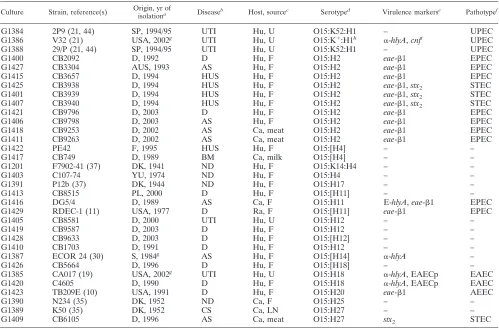
[image:2.585.43.542.80.409.2]Robert Koch Institute, Berlin, Germany, except fiveE. coliO15 isolates which were from James R. Johnson (Medical Service, Veterans Affairs Medical Center, Minneapolis, Minn.). A group of 33E. coliO15 strains that were isolated between 1941 and 2003 and originated from nine different countries were inves-tigated for serotype, virulence markers, and O15-antigen-specific genes. The strains originated from humans (n⫽25), cattle (n⫽3), meat (n⫽3), milk (n ⫽1), and a rabbit (n⫽1) (Table 1). TheE. coliO15 O serogroup reference strain F 7902-41 (G1201) for nucleotide sequence analysis of the O-antigen gene cluster were obtained from the Institute of Medical and Veterinary Science, Adelaide, Australia. Strains P12b, F 7902-41, N234, K50, and C107-74 from the collection of the InternationalEscherichiaandKlebsiellaReference Center, Stat-ens Serum Institute, Copenhagen, Denmark, were also used as reference strains for the O15 antigen (36). Strain TB209E was from Phillip Tarr, University of Washington, Seattle; RDEC-1 was from Eric Oswald, INRA, Toulouse, France;
TABLE 1. Relevant properties of
E. coli
O15 strains
Culture Strain, reference(s) Origin, yr of
isolationa Diseaseb Host, sourcec Serotyped Virulence markerse Pathotypef
G1384
2P9 (21, 44)
SP, 1994/95
UTI
Hu, U
O15:K52:H1
–
UPEC
G1386
V32 (21)
USA, 2002
gUTI
Hu, U
O15:K
⫹:H1
h␣
-hlyA,
cnf
iUPEC
G1388
29/P (21, 44)
SP, 1994/95
UTI
Hu, U
O15:K52:H1
–
UPEC
G1400
CB2092
D, 1992
D
Hu, F
O15:H2
eae-

1
EPEC
G1427
CB3304
AUS, 1993
AS
Hu, F
O15:H2
eae-

1
EPEC
G1415
CB3657
D, 1994
HUS
Hu, F
O15:H2
eae-

1
EPEC
G1425
CB3938
D, 1994
HUS
Hu, F
O15:H2
eae-

1,
stx
2STEC
G1401
CB3939
D, 1994
HUS
Hu, F
O15:H2
eae-

1,
stx
2STEC
G1407
CB3940
D, 1994
HUS
Hu, F
O15:H2
eae-

1,
stx
2STEC
G1421
CB9796
D, 2003
D
Hu, F
O15:H2
eae-

1
EPEC
G1406
CB9798
D, 2003
AS
Hu, F
O15:H2
eae-

1
EPEC
G1418
CB9253
D, 2002
AS
Ca, meat
O15:H2
eae-

1
EPEC
G1411
CB9263
D, 2002
AS
Ca, meat
O15:H2
eae-

1
EPEC
G1422
PE42
F, 1995
HUS
Hu, F
O15:[H4]
–
–
G1417
CB749
D, 1989
BM
Ca, milk
O15:[H4]
–
–
G1201
F7902-41 (37)
DK, 1941
ND
Hu, F
O15:K14:H4
–
–
G1403
C107-74
YU, 1974
ND
Hu, F
O15:H4
–
–
G1391
P12b (37)
DK, 1944
ND
Hu, F
O15:H17
–
–
G1413
CB8515
PL, 2000
D
Hu, F
O15:[H11]
–
–
G1416
DG5/4
D, 1989
AS
Ca, F
O15:H11
E-hlyA,
eae-

1
EPEC
G1429
RDEC-1 (11)
USA, 1977
D
Ra, F
O15:[H11]
eae-

1
EPEC
G1405
CB8581
D, 2000
UTI
Hu, U
O15:H12
–
–
G1419
CB9587
D, 2003
D
Hu, F
O15:H12
–
–
G1428
CB9633
D, 2003
D
Hu, F
O15:[H12]
–
–
G1410
CB1703
D, 1991
D
Hu, F
O15:H12
–
–
G1387
ECOR 24 (30)
S, 1984
gAS
Hu, F
O15:[H14]
␣
-hlyA
–
G1426
CB5664
D, 1996
D
Hu, F
O15:[H18]
–
–
G1385
CA017 (19)
USA, 2002
gUTI
Hu, U
O15:H18
␣
-hlyA, EAECp
EAEC
G1420
C4605
D, 1990
D
Hu, F
O15:H18
␣
-hlyA, EAECp
EAEC
G1423
TB209E (10)
USA, 1991
D
Hu, F
O15:H20
eae-

1
AEEC
G1390
N234 (35)
DK, 1952
ND
Ca, F
O15:H25
–
–
G1389
K50 (35)
DK, 1952
CS
Ca, LN
O15:H27
–
–
G1409
CB6105
D, 1996
AS
Ca, meat
O15:H27
stx
2STEC
a
SP, Spain; USA, United States; D, Germany; AUS, Australia; F, France; DK, Denmark; YU, Yugoslavia; PL, Poland; S, Sweden.
b
D, diarrhea; HUS, hemolytic-uremic syndrome; AS, asymptomatic; BM, bovine mastitis; ND, no data; CS, calf septicemia.
c
Hu, human; Ca, cattle; Ra, rabbit. Source: U, urine; F, feces; LN, lymph nodes.
d
An H type in brackets indicates that the strain was NM and thefliCgenotype was determined by PCR as described. K antigens were not explored in this study, and K designations are indicated as reported elsewhere (21, 30, 37).
e
The strains were investigated for the following virulence markers by PCR: alpha- hemolysin (␣-hlyA), EHEC-hemolysin (E-hlyA), CNF (cnf) cytolethal distending toxins (cdt), intimin (eae), bundle-forming pili (bfpA), Shiga toxins (stx), EAEC virulence plasmid sequences (EAEC-p), heat-labile enterotoxin (LT-I), and heat-stable enterotoxin (STI). Subtyping ofstxandeaegenes was performed as described in Materials and Methods. –, Negative for the virulence markers investigated in this study.
f
Pathotype according to virulence markers and disease.
g
Year of publication.
h
Strain V32 was originally described as O15/40:K⫹:H1 (21).
i
Strain V32 was reported to carry the gene encoding CNF1 (21).
on May 16, 2020 by guest
http://jcm.asm.org/
and strain PE42 was from Francine Grimont, Institut Pasteur, Paris, France. All plasmids used in the present study were maintained inE. coliK-12 strain DH5␣, which was purchased from Beijing Dingguo Biotechnology Development Center (Beijing, People’s Republic of China). OtherE. coliandShigellaO serogroup reference strains used are listed in Table 2.
TheE. colistrains that were used as positive and negative controls for detec-tion of EAEC, bundle-forming pili (bfp), intimins (eaefamily), Shiga toxins (stx
family), and hemolysins (␣-hlyAand EHEC-hlyA) are listed elsewhere (6), as well as the reference strains for cytolethal distending toxins and CNF (55). ETEC strains that were used as controls for PCR detection of genes encoding heat-labile and heat-stable enterotoxins were described previously (5, 43).
Serotyping of O and H antigens and molecular typing of flagellar (fliC) genes.
Production of antisera and typing of O (lipopolysaccharide) and H (flagellar) antigens was performed as described previously (36). O-antigen typing was per-formed by titration of boiled cultures of bacteria with serial twofold dilutions of rabbit antiserum, followed by incubation overnight at 50°C as described previ-ously (36). Strain F7902-41 (O15:K14:H4) was used for production of O15-antigen-specific antiserum. H serotyping was performed by titration of formalin-inactivated motile cultures of bacteria and the reference strains for the 53 different H antigens (H1 to H56) (36). NME. colistrains were investigated for their H-type-specific (fliC) genes by PCR, followed by HhaI digestion offliC
PCR products and evaluation of RFLP patterns as described previously (6, 26).
Detection of virulence properties and associated genes.All strains were
in-vestigated for production of cytotoxins by the Vero cell toxicity test as described previously (6). Verotoxic strains were investigated for production of Shiga toxins by the VTEC-RPLA assay (i.e., reverse passive latex agglutination test for de-tection of Stx1 [VT1] and Stx2 [VT2]; Denka-Seiken, Tokyo, Japan) and for the presence ofstxgenes andstxgene variants by PCR and restriction endonuclease digestion of PCR products as described previously (6). Hemolytic activity was detected by growing bacteria on washed sheep blood agar plates (enterohemo-lysin agar; Oxoid, Wesel, Germany) an indicator medium used for the phenotypic characterization of enterohemolytic and alpha-hemolytic strains ofE. coli(7). Strains showing hemolytic activity were analyzed for␣- and EHEC-hemolysin-specific genes by PCR (6). Detection and subtyping of intimin (eae) genes was performed as recently described (61). Bundle-forming pili genes (bfpA) which are associated with classical EPEC strains were investigated by PCR (6). The presence of DNA sequences associated with virulence plasmids present in EAEC was investigated by PCR specific for plasmid pCVD432 as described previously (6, 48). Multiplex PCRs detecting all known genetic variants of cytolethal dis-tending toxins (cdt) and CNF (cnf) were used for detection ofcdt- andcnf -specific sequences (55). Genes encoding heat-labile enterotoxin (LT-I) encom-passing antigenic groups LTh-I and LTp-I (29) were detected by PCR as described previously (16). Specific PCRs for detection of the heat-stable
ente-rotoxins STI (STa) of human (STIh) and porcine (STIp) types (29) were devel-oped on the basis of published nucleotide sequences. Primers STIh-Start (5⬘ -TCC CTC AGG ATG CTA AAC-3⬘) and STIh-Stop (5⬘-GCA ACA GGT ACA TAC GTT-3⬘) were developed from GenBank sequence M34916 and used for PCR amplification of a 244-bp product specific for the STIh variant (30 cycles of 94°C for 40 s, 47°C for 60 s, and 72°C for 40 s). Primers STIp-Start (5⬘-TTC TGT ATT ATC TTT CCC C-3⬘) and STIp-Stop (5⬘-TTA TGA TTT TCT CAG CAC C-3⬘) were developed from GenBank sequence M25607 and amplified a 258-bp stretch of DNA specific for the STIp variant (30 cycles of 94°C for 40 s, 51.3°C for 60 s, and 72°C for 40 s).
Construction of DNase I shotgun bank, sequencing, and analysis of O-antigen
gene cluster.Chromosomal DNA was prepared as previously described (3). The
O-antigen gene cluster DNA ofE. coliO15 reference strain G1201 (O15:K14: H4) was amplified by using the primer pairs WL-912 (5⬘-ATT GTG GCT GCA GGG ATC AAA GAA AT-3⬘) and WL-913 (5⬘-TAG TCG CGT GNG CCT GGA TTA AGT TCG C-3⬘), which were designed based on housekeeping genes
galFandgnd, respectively (12) (30 cycles of 94°C for 10 s, 60°C for 30 s, and 68°C for 15 min). The PCR products were digested by DNase I, and the resulting DNA fragments were cloned into pGEM-T Easy (Promega) to produce a shotgun bank as described previously (57).
Sequencing was carried out by using an ABI 3730 automated DNA sequencer. Sequence data were assembled by using the Staden Package (49). The program Artemis was used to find open reading frames (ORFs) (47). BLAST and PSI-BLAST were used for searching the GenBank database (2). The program Block-Maker was used for searching conserved regions in protein sequences (18). The protein domain databases COG and Pfam were searched by program HMMER to find potential protein domains (4, 52). The program TMHMM 2.0 was used for identification of potential transmembrane segments in protein sequences (24). The program CLUSTAL W was used for performing sequence alignment (54).
Specificity and sensitivity test of O15 serogroup-specific PCR assay.DNA
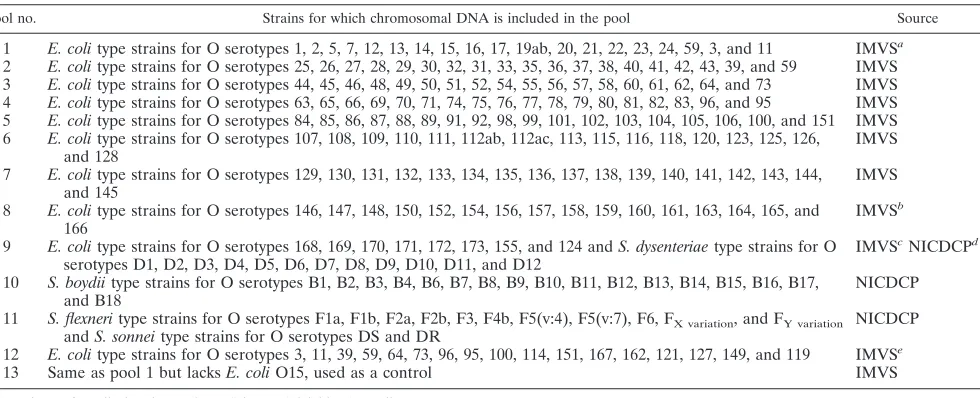
from each reference strain was prepared as described previously (3). The quality of chromosomal DNA prepared from 186 reference strains to represent the broadest range of O antigens ofE. coli(includingShigella) was examined by PCR amplification of themdhgene with the primer pairs WL-101 (5⬘-TTC ATC CTA AAC TCC TTA TT) and WL-102 (5⬘-TAA TCG CAG GGG AAA GCA GG) (45). A total of 13 pools of DNA were made, each containing DNA from 12 to 19 strains (Table 2). Pools were screened with four primer pairs based onwzxand
[image:3.585.51.541.79.278.2]wzygenes ofE. coliO15 (30 cycles of 95°C for 30 s, annealing for 30 s, and 72°C for 1 min; the annealing temperatures of respective primer pairs are listed in Table 3). Pools of 63 clinicalE. coliisolates representing different O antigens, including all 33E. coliO15 strains, were also screened in a double-blind test. Each strain was cultured in Luria-Bertani medium at 200 rpm in 37°C for 12 h,
TABLE 2.
E. coli
and
Shigella
reference strains and PCR pools used for testing of
E. coli
O15-specific primers
Pool no. Strains for which chromosomal DNA is included in the pool Source
1
E. coli
type strains for O serotypes 1, 2, 5, 7, 12, 13, 14, 15, 16, 17, 19ab, 20, 21, 22, 23, 24, 59, 3, and 11
IMVS
a2
E. coli
type strains for O serotypes 25, 26, 27, 28, 29, 30, 32, 31, 33, 35, 36, 37, 38, 40, 41, 42, 43, 39, and 59
IMVS
3
E. coli
type strains for O serotypes 44, 45, 46, 48, 49, 50, 51, 52, 54, 55, 56, 57, 58, 60, 61, 62, 64, and 73
IMVS
4
E. coli
type strains for O serotypes 63, 65, 66, 69, 70, 71, 74, 75, 76, 77, 78, 79, 80, 81, 82, 83, 96, and 95
IMVS
5
E. coli
type strains for O serotypes 84, 85, 86, 87, 88, 89, 91, 92, 98, 99, 101, 102, 103, 104, 105, 106, 100, and 151
IMVS
6
E. coli
type strains for O serotypes 107, 108, 109, 110, 111, 112ab, 112ac, 113, 115, 116, 118, 120, 123, 125, 126,
and 128
IMVS
7
E. coli
type strains for O serotypes 129, 130, 131, 132, 133, 134, 135, 136, 137, 138, 139, 140, 141, 142, 143, 144,
and 145
IMVS
8
E. coli
type strains for O serotypes 146, 147, 148, 150, 152, 154, 156, 157, 158, 159, 160, 161, 163, 164, 165, and
166
IMVS
b9
E. coli
type strains for O serotypes 168, 169, 170, 171, 172, 173, 155, and 124 and
S. dysenteriae
type strains for O
serotypes D1, D2, D3, D4, D5, D6, D7, D8, D9, D10, D11, and D12
IMVS
cNICDCP
d10
S. boydii
type strains for O serotypes B1, B2, B3, B4, B6, B7, B8, B9, B10, B11, B12, B13, B14, B15, B16, B17,
and B18
NICDCP
11
S. flexneri
type strains for O serotypes F1a, F1b, F2a, F2b, F3, F4b, F5(v:4), F5(v:7), F6, F
X variation, and F
Y variationand
S. sonnei
type strains for O serotypes DS and DR
NICDCP
12
E. coli
type strains for O serotypes 3, 11, 39, 59, 64, 73, 96, 95, 100, 114, 151, 167, 162, 121, 127, 149, and 119
IMVS
e13
Same as pool 1 but lacks
E. coli
O15, used as a control
IMVS
a
Institute of Medical and Veterinary Science, Adelaide, Australia.
b
E. coliO165 and O166 were from the Statens Serum Institute, Copenhagen, Denmark; all other strains were from the IMVS.
c
E. coliO155 and O124 were from the IMVS; all other strains from the Statens Serum Institute.
d
National Institute for Communicable Disease Control and Prevention, Chinese Center for Disease Control and Prevention, Beijing, People’s Republic of China.
e
E. coliO167 was from the Statens Serum Institute; all other strains were from the IMVS.
on May 16, 2020 by guest
http://jcm.asm.org/
and 3 ml of culture were centrifuged at 5,000⫻gfor 5 min. The pellet was mixed with 100l of Milli-Q water, boiled at 100°C for 15 min, and centrifuged at 12,000⫻gfor 10 min. The supernatant was used as a template in the PCR assays with four primer pairs based onwzxandwzygenes ofE. coliO15 (30 cycles of 95°C for 30 s, annealing for 45 s, and 72°C for 1 min, annealing temperatures of respective primer pairs are listed in Table 3). PCRs were carried out in a total volume of 25l, including 1l of template DNA.
Serial dilution of chromosomal DNA fromE. coliO15 strain G1384 (Table 1) was detected by using four primer pairs specific toE. coliO15. A 10-fold serial dilution ofE. coliO15 strain G1384 in pork and water samples were also detected by using the primer pairs WL-950–WL-951 and WL-952–WL-953. The methods for testing the sensitivity of O-serogroup-specific PCR assay in pork and water were described previously (17). For each primer, the experiment was performed in triplicate.
Nucleotide sequence accession number.The DNA sequence of theE. coliO15
O antigen gene cluster has been deposited in GenBank under the accession number AY647261.
RESULTS AND DISCUSSION
Serotypes.
Agglutination of boiled cultures of the strains
listed in Table 1 with O15 antiserum resulted in homologous O
titers between 1:3,200 to 1:6,400 and were thus not significantly
different from the O15 reference strains which showed
agglu-tination titers up to 1:6,400. The O15 antigen was described to
show cross-reactivities with O12, O40, O45, O51, O60, and
O143 antiserum (14, 37). In our study, the most important
serological cross-reactivity was found with O40 antiserum,
which showed agglutinating titers between 1:800 and 1:1,600
with
E. coli
O15 strains. Of the 33 O15 strains, 27 were motile
and could be analyzed for their H serotypes. H serotyping was
completed by analysis of the flagellar (
fliC
) genotype of motile
and NM O15 strains by HhaI digestion of
fliC
PCR products as
described in Materials and Methods. The strains were grouped
into 11 different H serotypes/
fliC
types (H1, H2, H4, H11, H12,
H14, H17, H18, H20, H25, and H27) as shown in Table 1.
Flagellar types H4 and H17 were previously reported to be
closely related for the nucleotide sequences of their flagellin
(
fliC
) genes and were also shown to be serologically related
(14, 36, 58).
Association of virulence markers with pathogroups and with
flagellar types in
E. coli
O15 strains.
All strains were
investi-gated for production of cytotoxins and hemolysins as described
in Materials and Methods. The presence of virulence genes
was investigated by PCR as listed in Table 1. Of the 33 O15
strains, 19 were assigned to four different pathotypes on the
basis of published data, clinical picture, and virulence markers
found in the strains. The uropathogenic
E. coli
clones were
represented by three O15:H1 strains, and two of these were
shown to carry the capsular antigen K52. A group of seven
O15:H2 strains that were isolated from humans and cattle that
carried the
eae-

1 gene were grouped as EPEC strains. A
second group of EPEC strains included O15:[H11] (
eae-

1)
strains. Among these strains was the NM rabbit EPEC strain
RDEC-1, which was shown to harbor the
fliC
gene encoding
flagellar type H11. Two other O15:[H11] strains were found,
one was from a human diarrheal case and the other from cattle
feces. A third group of O15 EPEC is represented by strain
TB209E (O15:H20) (
eae-

1), which was isolated from a child
with diarrhea in Seattle, Wash. (10). Two groups of STEC were
found; one is represented by O15:H2 (
eae-

1,
stx
2) strains that
were isolated from an outbreak with HUS hemolytic-uremic
syndrome in Germany, and the second is represented by an
TABLE
3.
PCR
testing
of
E.
coli
O15-specific
genes
Gene
Positions
Name
(position),
oligonucleotide
sequence
of:
Annealing temp
(°C)
Forward
primers
Reverse
primers
wzx
2430–3674
WL-947
(3092–3112),
5
⬘
-TAGTGCATACACAATGTTGAC-3
⬘
;
WL-950
(2475–2492),
5
⬘
-GGTGCCAATTACCTACTG-3
⬘
WL-948
(3429–3450),
5
⬘
-CAACTGTATTAAAACCTATGAA-3
⬘
;
WL-951
(2966–2984),
5
⬘
-AACGCCACAGAATGAATAC-3
⬘
58
62
wzy
4707–5885
WL-952
(5464–5483),
5
⬘
-ATGATGAGTTCGTTTCTGGA-3
⬘
;
WL-954
(4996–5016),
5
⬘
-TTTTATTTTCATTTGTTCCTG-3
⬘
WL-953
(5840–5860),
5
⬘
-TTAGTAATTGAACTCTGTCCA-3
⬘
;
WL-955
(5444–5461),
5
⬘
-AATCGAGGGAAGAACACC-3
⬘
56
58
on May 16, 2020 by guest
http://jcm.asm.org/
O15:H27 strain (
stx
2) that originated from bovine meat. Three
O15:[H18] strains were found; two of these were positive for
EAEC-plasmid specific sequences and for alpha-hemolysin,
and these were classified as EAEC. EAEC of serotype O15:
H18 were previously reported as human pathogens (28).
Eleven strains belonging to flagellar types H4/H17, H12,
H25, and H27 were negative for all virulence markers
investi-gated in the present study, and it is not clear whether these are
pathogens. However, four of these were isolated from cases of
disease, namely, CB749 (bovine mastitis), PE42
(hemolytic-uremic syndrome), CB8581 (urinary tract infection [UTI]), and
K50 (calf septicemia). None of the
E. coli
O15 strains
investi-gated in our study carried genes for enterotoxins, cytolethal
distending toxin, or bundle-forming pili; the latter are
associ-ated with class-I (typical) EPEC strains (56).
Sequencing of
E. coli
O15 O-antigen gene cluster.
The O
antigen gene cluster DNA of
E. coli
O15 was PCR amplified
with primer pairs based on sequences of housekeeping genes
galF
and
gnd
, which flank the O-antigen gene cluster in
E. coli
.
Five individual PCR products were combined to construct the
shotgun bank for sequencing analysis to avoid PCR errors. A
sequence of 11,893 bases from
galF
(positions 1 to 765) to
gnd
(positions 10,909 to 11,893) was obtained, and nine ORFs were
found. All ORFs have the same transcriptional direction from
galF
to
gnd
(Fig. 1) and start with an ATG codon except for
orf3
that probably starts from TTG, with a potential
Shine-Dalgarno ribosomal binding site GGGG. Five ORFs ended
with a TGA codon, two ORFs ended with a TAA codon, and
two ORFs ended with a TAG codon. Noncoding sequences of
78, 49, 41, and 1 bp were found preceding the start codons of
orf2
,
-4
,
-5
, and -
6
, respectively. All other ORF junctions have
overlapping termination and initiation codons. In
E. coli
O15,
ORFs share low G
⫹
C% content of 29 to 43% (Fig. 1),
signif-icantly lower than that of
E. coli
genome (50%), as the
situa-tion in all reported
E. coli
O-antigen gene clusters.
Sequence analysis of
E. coli
O15 O-antigen gene cluster.
Putative gene designations were made for all of the genes in
the O-antigen gene cluster based on knowledge of previously
characterized O-antigen genes and homology comparisons
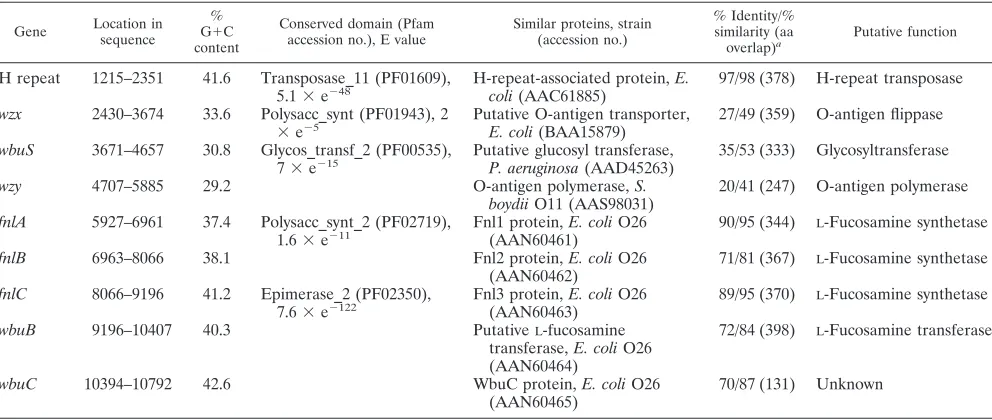
made by using available databases (Table 4).
(i) Genes for biosynthesis of 2-acetylamino-2,6-dideoxy-
L-galactose (FucNAc).
Genes for the synthesis of the nucleotide
form of common sugars are located outside O-antigen gene
cluster and only genes for unique NDP-sugars were expected
within the O-antigen gene cluster.
ORFs 5, 6, and 7 showed 90, 71, and 89% identity to FnlA
(Fnl1), FnlB (Fnl2), and FnlC (Fnl3), respectively, of the
E.
coli
O26 O antigen gene cluster (GenBank entries AAN60461,
AAN60462 and AAN60463) and showed 83, 56, and 70%
iden-tity to FnlA (WbjB), FnlB (WbjC), and FnlC (WbjD),
respec-tively, of the
Pseudomonas aeruginosa
O11 O-antigen gene
[image:5.585.56.530.71.149.2]cluster
(GenBank
entries
AAF72954,
AAF72955,
and
FIG. 1. O-antigen gene cluster of
E. coli
O15. All of the genes are transcribed in a direction from
galF
to
gnd.
TABLE 4. ORFs in the O-antigen gene cluster of
E. coli
O15
Gene Location in sequence
% G⫹C content
Conserved domain (Pfam accession no.), E value
Similar proteins, strain (accession no.)
% Identity/% similarity (aa
overlap)a Putative function
H repeat
1215–2351
41.6
Transposase_11 (PF01609),
5.1
⫻
e
⫺48H-repeat-associated protein,
E.
coli
(AAC61885)
97/98 (378)
H-repeat transposase
wzx
2430–3674
33.6
Polysacc_synt (PF01943), 2
⫻
e
⫺5Putative O-antigen transporter,
E. coli
(BAA15879)
27/49 (359)
O-antigen flippase
wbuS
3671–4657
30.8
Glycos_transf_2 (PF00535),
7
⫻
e
⫺15Putative glucosyl transferase,
P. aeruginosa
(AAD45263)
35/53 (333)
Glycosyltransferase
wzy
4707–5885
29.2
O-antigen polymerase,
S.
boydii
O11 (AAS98031)
20/41 (247)
O-antigen polymerase
fnlA
5927–6961
37.4
Polysacc_synt_2 (PF02719),
1.6
⫻
e
⫺11Fnl1 protein,
E. coli
O26
(AAN60461)
90/95 (344)
L-Fucosamine synthetase
fnlB
6963–8066
38.1
Fnl2 protein,
E. coli
O26
(AAN60462)
71/81 (367)
L-Fucosamine synthetase
fnlC
8066–9196
41.2
Epimerase_2 (PF02350),
7.6
⫻
e
⫺122Fnl3 protein,
E. coli
O26
(AAN60463)
89/95 (370)
L-Fucosamine synthetase
wbuB
9196–10407
40.3
Putative
L-fucosamine
transferase,
E. coli
O26
(AAN60464)
72/84 (398)
L-Fucosamine transferase
wbuC
10394–10792
42.6
WbuC protein,
E. coli
O26
(AAN60465)
70/87 (131)
Unknown
aaa, amino acid.
on May 16, 2020 by guest
http://jcm.asm.org/
[image:5.585.44.540.506.716.2]AAF72956), and showed 68, 42, and 50% identity to FnlA
(Cap5E), FnlB (Cap5F), and FnlC (Cap5G), respectively, of
the
Staphylococcus aureus
type 5 capsule gene cluster
(Gen-Bank entries AAC46088, AAC46089, and AAC46090). FnlA,
FnlB, and FnlC are enzymes of the UDP-l-FucNAc
biosynthe-sis pathway. Therefore, we propose l-FucNAc is a component
of the
E. coli
O15 O antigen and
orf5
,
orf6
, and
orf7
were
named
fnlA
,
fnlB
, and
fnlC
, respectively.
(ii) Genes for O-unit processing.
orf2
and
orf4
were the only
two genes predicted to encode proteins with several
transmem-brane regions. Orf2 has 12 predicted transmemtransmem-brane
seg-ments. It showed 30% identity or 52% similarity to the Wzx
protein of
E. coli
K-12 (O16) (50) and showed 26% identity or
49% similarity to the Wzx protein of
Shigella dysenteriae
type 1
(22). Orf2 was related to the protein family Pfam01943 and
COG2244 (
E
values of 2
⫻
e
⫺18and 2
⫻
e
⫺12, respectively),
which both include Wzx proteins of the O-antigen biosynthesis.
These facts indicated that
orf2
was the O-unit flippase gene
(
wzx
).
Orf4 had 10 predicted transmembrane segments with a large
periplasmic loop of 53 amino acid residues, which is the typical
topology of Wzy proteins. It showed 22% identity or 43%
similarity to the putative Wzy protein of
S. boydii
type 13 (15)
and showed 20% identity or 41% similarity to the Wzy protein
of
S. boydii
type 11 (51).
These facts indicated that
orf4
was the O-antigen
polymer-ase gene (
wzy
).
(iii) Putative glycosyltransferase genes.
The
wecA
gene
lo-cated in the enterobacterial common antigen gene cluster is
responsible for adding the first sugar GlcNAc onto the lipid
acceptor UndP in the assembly of GlcNAc-containing O units
of
E. coli
(1), whereas genes in the O-antigen gene cluster
encode the remaining glycosyltransferases for synthesis of O
unit.
Orf8 showed 72% identity to WbuB, a putative
L-FucNAc
transferase of the
E. coli
O26 O-antigen gene cluster (12), and
was in the glycosyltransferase family 1 (pfam00534,
E
value
⫽
2
⫻
e
⫺5).
orf8
, therefore also a putative l-FucNAc transferase
gene, is downstream of the
fnl
gene set, as is
wbuB
in
E. coli
O26. We propose
orf8
is an
L-FucNAc transferase gene and
named it
wbuB
.
Orf3 shared 43 to 53% similarity with many putative
glyco-syltransferases involved in polysaccharide or oligosaccharide
antigen synthesis. Orf3 was also in the glycosyltransferase
fam-ily 2 (pfam00535,
E
value
⫽
8
⫻
e
⫺11). Therefore,
orf3
is
proposed to encode a glycosyltransferase and is named
wbuS
.
(iv) H repeat.
Orf1 was related to the H-repeat-associated
protein of
E. coli
K-12. The sequence between positions 1,071
to 2,361 shared 96% identity to the H-repeat element of
E. coli
K-12. Therefore, this region was identified as an H-repeat
element. Orf1, the putative H-repeat-associated protein, has
no indel or stop codon, indicating that the H-repeat element
was inserted recently.
(v) Putatively nonfunctional ORF.
orf9
shared 72% identity
to
wbuC
of
E. coli
O26, which was proposed to be a gene
remnant (12). Its length of 132 amino acids is also significantly
less than those of normal O-antigen genes. Therefore, it is
likely that
orf9
is no longer functional and is named
wbuC
.
(vi) Intervening sequences next to
galF
and
gnd
.
The
se-quence of length 305 bp between the
galF
gene and the
H-repeat element (positions 766 to 1,070) shares high-level
iden-tity (between 94 and 98%) to the sequences next to the
galF
gene in
S. boydii
type 4, type 5, and type 9 and
E. coli
K-12
(O16), O6, O26, and O128. The putative promoter sequence
was found between positions 931 and 964 and shares 89%
sequence identity and identical
⫺
35 and
⫺
10 signals and
tran-scription initiation site to the promoter sequence of the
O-antigen gene cluster in
E. coli
O7 (27). The 39-bp JUMP-Start
sequence was found between positions 1,024 and 1,062 and
shares 95 to 97.5% identity to those of reported
E. coli
and
Shigella
O-antigen gene clusters.
There is a 116-bp region between
wbuC
and
gnd
. No
stem-loop structure or putative promoter sequence was found in this
region, as is the case described in the O-antigen gene cluster of
E. coli
O113 (41).
Identification of
E. coli
O15 serogroup-specific genes.
Prim-ers based on the proposed O-unit processing genes
wzx
and
wzy
, which are normally specific to different O antigen, were
designed (Table 3). Two primer pairs for each gene were used
to screen DNA pools of
E. coli
and
Shigella
reference strains
from 186 different O serogroups (Table 2), of which reference
strains for O serogroups O12, O40, O45, O51, O60, and O143
were reported to show serological cross-reactivity with the O15
antigen (14, 37). All of the four primer pairs based on
wzx
and
wzy
produced bands of correct sizes only with the pool
con-taining
E. coli
O15 chromosomal DNA, and no band was
detected with any other pools. The four primer pairs based on
wzx
and
wzy
, respectively (Table 3), were further used to detect
the 33
E. coli
O15 strains listed in Table 1 and 30
E. coli
clinical
isolates that belonged to other
E. coli
O serogroups (data not
shown). A double-blind test was performed, and all 33
E. coli
O15 strains from Table 1 gave the expected PCR products
corresponding to each primer pair. In contrast, no PCR
prod-uct was obtained from non-O15 strains, including those that
showed serological cross-reactivity with the O15 serum.
Com-bining the test in type strains and clinical isolates, all of the
four primer pairs designed show high-level specificity to
E. coli
O15 strains.
By amplifying a dilution series of chromosomal DNA from
E. coli
O15 strain G1384, a sensitivity of 1 pg
l
⫺1was
ob-tained for all of the four primer pairs. The sensitivities of
primer pairs WL-950–WL-951 and WL-952–WL-953 were
tested with pork meat samples or water contaminated with
E.
coli
O15 strain G1384, and the detection limit was determined
as 0.2 CFU g
⫺1for both primer pairs. The lysate of boiled cells
was directly used as a template of PCR assay, and the total
process can be finished within 16 h (17).
It was shown that the
wzx
and
wzy
genes are highly specific
to
E. coli
O15 and can be used as target DNAs in the
identi-fication and detection of
E. coli
O15 strains belonging to
dif-ferent clonal groups, serotypes, and pathotypes. The
O-anti-gen-specific PCR assay is faster and more accurate than
conventional serotyping because cross-reactions with other O
sera (here O40) that might lead to misinterpretation of the O
type, as in the case of strain V32 (21), were clearly excluded by
the PCR assay. Another advantage of the PCR typing method
over serotyping is the fact that some types of capsular (K)
antigens are known to block the lipopolysaccharide (O
anti-gen) detection and the selection of K derivatives is sometimes
required for serological detection of the O antigen in such
on May 16, 2020 by guest
http://jcm.asm.org/
strains (36). The O15-specific PCR assay could be extremely
useful in future investigations of hospital and community
out-breaks which have occurred with uropathogenic O15 strains
(20, 33). The PCR assay bears the advantage that multiple
samples of different origin can be rapidly investigated for the
presence of the organism. In contrast, sample screening by O
serotyping would require availability of an O15 specific
anti-serum and culturing of suspected
E. coli
isolates that is more
laborious and time-consuming than the PCR assay.
Our data indicated that the genes encoding the O15 antigen
could have been spread by horizontal gene transfer to
unre-lated strains of
E. coli
which were found to be heterogeneous
in their flagellar and capsular antigens and which express
dif-ferent virulence markers. This possibility could be explored by
investigating the genetic relationship between the O15 strains
by comparing them for the nucleotide sequences of their
housekeeping genes. As in previous studies, the H type was
shown to be a good indicator for strains belonging to particular
(patho)groups and virulence profiles, and the molecular
anal-ysis of
fliC
genes permits the grouping of NM strains that are
frequently found among pathogenic
E. coli
isolates (6).
ACKNOWLEDGMENTS
We thank James R. Johnson, Medical Service, Veterans Affairs
Medical Center, Minneapolis, Minn.; Francine Grimont, Institut
Pas-teur, Paris, France; Eric Oswald, INRA, Toulouse, France; and Phillip
Tarr, University of Washington, Seattle, for supplying
E. coli
O15
strains. We thank the Institute of Medical and Veterinary Science,
Adelaide, Australia; the National Institute for Communicable Disease
Control and Prevention, Chinese Center for Disease Control and
Pre-vention, Beijing, People’s Republic of China; and the Statens Serum
Institute, Copenhagen, Denmark, for kindly supplying
E. coli
and
Shigella
type strains. We thank David Bastin for critical reading of the
manuscript. We are grateful to Peter R. Reeves, School of Molecular
and Microbial Biosciences, University of Sydney, Sydney, Australia, for
helpful suggestions.
This study was supported by the Chinese National Science Fund for
Distinguished Young Scholars (30125001), the NSFC General
Pro-gram (30270029, 30370339, and 30370023), the NSFC International
Cooperation Program (30125001), the 863 Program (2002AA2Z2051),
the Cooperation Research Fund for Nankai and Tianjin Universities
from Chinese Ministry of Education, and funding from the Science and
Technology Committee of Tianjin City (013181711) to L.F. and
L.W. L.B., G.K., and S.Z. were supported by funds from the European
Commission project “Attaching and Effacing
Escherichia coli
Infec-tions” (QLK2-CT-2000-00600).
REFERENCES
1.Alexander, D. C., and M. A. Valvano.1994. Role of therfegene in the
biosynthesis of theEscherichia coliO7-specific lipopolysaccharide and other O-specific polysaccharides containingN-acetylglucosamine. J. Bacteriol.176:
7079–7084.
2.Altschul, S. F., T. L. Madden, A. A. Schaffer, J. Zhang, Z. Zhang, W. Miller,
and D. J. Lipman.1997. Gapped BLAST and PSI-BLAST: a new generation
of protein database search programs. Nucleic Acids Res.25:3389–3402.
3.Bastin, D. A., and P. R. Reeves.1995. Sequence and analysis of the O antigen
gene (rfb) cluster ofEscherichia coliO111. Gene164:17–23.
4.Bateman, A., L. Coin, R. Durbin, R. D. Finn, V. Hollich, S. Griffiths-Jones,
A. Khanna, M. Marshall, S. Moxon, E. L. Sonnhammer, D. J. Studholme, C.
Yeats, and S. R. Eddy.2004. The Pfam protein families database. Nucleic
Acids Res.32(Database Issue):D138–D141.
5.Beutin, L., L. Bode, T. Richter, G. Peltre, and R. Stephan.1984. Rapid visual
detection ofEscherichia coliandVibrio choleraeHeat-labile enterotoxins by nitrocellulose enzyme-linked immunosorbent assay. J. Clin. Microbiol.19:
371–375.
6.Beutin, L., G. Krause, S. Zimmermann, S. Kaulfuss, and K. Gleier.2004.
Characterization of Shiga toxin-producingEscherichia colistrains isolated from human patients in Germany over a 3-year period. J. Clin. Microbiol.
42:1099–1108.
7.Beutin, L., S. Zimmermann, and K. Gleier. 1996. Rapid detection and
isolation of Shiga-like toxin (verocytotoxin)-producingEscherichia coliby direct testing of individual enterohemolytic colonies from washed sheep blood agar plates in the VTEC-RPLA assay. J. Clin. Microbiol.34:2812– 2814.
8.Blanco, M., J. E. Blanco, A. Mora, and J. Blanco.1998. Distribution and
characterization of faecal necrotoxigenic Escherichia coli CNF1⫹ and CNF2⫹isolated from healthy cows and calves. Vet. Microbiol.59:183–192.
9.Blanco, M., J. E. Blanco, A. Mora, G. Dahbi, M. P. Alonso, E. A. Gonzalez,
M. I. Bernardez, and J. Blanco.2004. Serotypes, virulence genes, and intimin
types of Shiga toxin (verotoxin)-producing Escherichia coli isolates from cattle in Spain and identification of a new intimin variant gene (eae-xi). J. Clin. Microbiol.42:645–651.
10.Bokete, T. N., T. S. Whittam, R. A. Wilson, C. R. Clausen, C.M. O’Callahan,
S. L. Moseley, T. R. Fritsche, and P. I. Tarr.1997. Genetic and phenotypic
analysis ofEscherichia coliwith enteropathogenic characteristics isolated from Seattle children. J. Infect. Dis.175:1382–1389.
11.Cantey, J. R., and R. K. Blake.1977. Diarrhea due toEscherichia coliin the
rabbit: a novel mechanism. J. Infect. Dis.135:454–462.
12.D’Souza, J. M., L. Wang, and P. Reeves.2002. Sequence of theEscherichia
coliO26 O antigen gene cluster and identification of O26 specific genes. Gene297:123–127.
13.Eklund, M., F. Scheutz, and A. Siitonen.2001. Clinical isolates of non-O157
Shiga toxin-producingEscherichia coli: serotypes, virulence characteristics, and molecular profiles of strains of the same serotype. J. Clin. Microbiol.
39:2829–2834.
14.Ewing, W.H.1986. The genusEscherichia, p. 93–134.InW. H. Ewing (ed.),
Edwards and Ewing’s identification ofEnterobacteriaceae. Elsevier Science Publishing Co., New York, N.Y.
15.Feng, L., S. N. Senchenkova, J. Yang, A. S. Shashkov, J. Tao, H. Guo, G.
Zhao, Y. A. Knirel, P. Reeves, and L. Wang.2004. Structural and genetic
characterization of theShigella boydiitype 13 O antigen. J. Bacteriol.186:
383–392.
16.Furrer, B., U. Candrian, and J. Luthy.1990. Detection and identification of
Escherichia coliproducing heat-labile enterotoxin type I by enzymatic am-plification of a specific DNA fragment. Lett. Appl. Microbiol.10:31–34.
17.Guo, H., L. Feng, J. Tao, C. Zhang, and L. Wang.2004. Identification of
Escherichia coliO172 O-antigen gene cluster and development of a sero-group-specific PCR assay. J. Appl. Microbiol.97:181–190.
18.Henikoff, S., J. G. Henikoff, W. J. Alford, and S. Pietrokovski.1995.
Auto-mated construction and graphical presentation of protein blocks from un-aligned sequences. Gene163:GC17–GC26.
19.Johnson, J. R., M. A. Kuskowski, K. Owens, A. Gajewski, and P. L. Winokur.
2003. Phylogenetic origin and virulence genotype in relation to resistance to fluoroquinolones and/or extended-spectrum cephalosporins and cephamy-cins amongEscherichia coliisolates from animals and humans. J. Infect. Dis.
188:759–768.
20.Johnson, J. R., A. R. Manges, T. T. O’Bryan, and L. W. Riley.2002. A
disseminated multidrug-resistant clonal group of uropathogenicEscherichia coliin pyelonephritis. Lancet359:2249–2251.
21.Johnson, J. R., A. L. Stell, T. T. O’Bryan, M. Kuskowski, B. Nowicki, C.
Johnson, J. N. Maslow, A. Kaul, J. Kavle, and G. Prats. 2002. Global
molecular epidemiology of the O15:K52:H1 extraintestinal pathogenic Esch-erichia coliclonal group: evidence of distribution beyond Europe. J. Clin. Microbiol.40:1913–1923.
22.Klena, J. D., and C. A. Schnaitman.1993. Function of therfbgene cluster
and therfegene in the synthesis of O antigen byShigella dysenteriae1. Mol. Microbiol.9:393–402.
23.Kobayashi, H., A. Miura, H. Hayashi, T. Ogawa, T. Endo, E. Hata, M.
Eguchi, and K. Yamamoto. 2003. Prevalence and characteristics ofeae
-positiveEscherichia colifrom healthy cattle in Japan. Appl. Environ. Micro-biol.69:5690–5692.
24.Krogh, A., B. Larsson, G. von Heijne, and E. L. Sonnhammer.2001.
Pre-dicting transmembrane protein topology with a hidden Markov model: ap-plication to complete genomes. J. Mol. Biol.305:567–580.
25.Leung, P. H., W. C. Yam, W. W. Ng, and J. S. Peiris.2001. The prevalence
and characterization of verotoxin-producingEscherichia coliisolated from cattle and pigs in an abattoir in Hong Kong. Epidemiol. Infect.126:173–179.
26.Machado, J., F. Grimont, and P. A. Grimont.2000. Identification of
Esch-erichia coliflagellar types by restriction of the amplifiedfliCgene. Res. Microbiol.151:535–546.
27.Marolda, C. L., and M. A. Valvano.1998. Promoter region of theEscherichia
coliO7-specific lipopolysaccharide gene cluster: structural and functional characterization of an upstream untranslated mRNA sequence. J. Bacteriol.
180:3070–3079.
28.Nataro, J.P.1995. Enteroaggregative and diffusely adherentEscherichia coli,
p. 727–737.InM. J. Blaser, P. D. Smith, J. I. Ravdin, H. B. Greenberg, and R. L. Guerrant (ed.), Infections of the gastrointestinal tract. Raven Press, New York, N.Y.
29.O’Brien, A. D., and R. K. Holmes.1996. Protein toxins ofEscherichia coliand
Salmonella, p. 2788–2802.InF. C. Neidhardt, R. Curtiss III, J. L. Ingraham, E. C. C. Lin, K. B. Low, B. Magasanik, W. S. Reznikoff, M. Riley, M. Schaechter, and H. E. Umbarger (ed.), Escherichia coliandSalmonella:
on May 16, 2020 by guest
http://jcm.asm.org/
cellular and molecular biology, 2nd ed. American Society for Microbiology, Washington, D.C.
30.Ochman, H., and R. K. Selander.1984. Standard reference strains of
Esch-erichia colifrom natural populations. J. Bacteriol.157:690–693.
31.Okerman, L., and L. A. Devriese.1985. Biotypes of enteropathogenic
Esch-erichia colistrains from rabbits. J. Clin. Microbiol.22:955–958.
32.Olesen, B., H. J. Kolmos, F. Orskov, and I. Orskov.1995. A comparative
study of nosocomial and community-acquired strains ofEscherichia coli
causing bacteraemia in a Danish University Hospital. J. Hosp. Infect.31:
295–304.
33.O’Neill, P. M., C. A. Talboys, A. P. Roberts, and B. S. Azadian.1990. The rise
and fall ofEscherichia coli O15 in a London teaching hospital. J. Med. Microbiol.33:23–27.
34.Orden, J. A., S. Q. J. Ruiz, D. Cid, S. Garcia, and R. de la Fuente.1999.
Prevalence and characteristics of necrotoxigenicEscherichia coli(NTEC) strains isolated from diarrhoeic dairy calves. Vet. Microbiol.66:265–273.
35.Orskov, F.1952. Antigenic relationships between H antigens 1–22 of
Esch-erichia coli and Wramby’s H antigens 23w-36w. Acta Pathol. Microbiol. Scand.32:241–244.
36.Orskov, F., and I. Orskov.1984. Serotyping ofEscherichia coli.Methods
Microbiol.14:43–112.
37.Orskov, F., I. Orskov, B. Jann, and K. Jann.1977. Serology, chemistry, and
genetics of O and K antigens ofEscherichia coli.Bacteriol. Rev.41:667–710.
38.Orskov, I., and F. Orskov.1978. Significance of surface antigens in relation
to enterotoxigenicity ofEscherichia coli, p. 134–141.InO¨ . Ouchterlony and J. Holmgren (ed.), Cholera and related diarrheas: molecular aspects of a global health problem. S. Karger, Basel, Switzerland.
39.Oswald, E., H. Schmidt, S. Morabito, H. Karch, O. Marches, and A.
Cap-rioli.2000. Typing of intimin genes in human and animal enterohemorrhagic
and enteropathogenic Escherichia coli: characterization of a new intimin variant. Infect. Immun.68:64–71.
40.Padola, N. L., M. E. Sanz, J. E. Blanco, M. Blanco, J. Blanco, A. I.
Etchev-erria, G. H. Arroyo, M. A. Usera, and A. E. Parma.2004. Serotypes and
virulence genes of bovine Shiga toxigenicEscherichia coli(STEC) isolated from a feedlot in Argentina. Vet. Microbiol.100:3–9.
41.Paton, A. W., and J. C. Paton.1999. Molecular characterization of the locus
encoding biosynthesis of the lipopolysaccharide O antigen ofEscherichia coli
serotype O113. Infect. Immun.67:5930–5937.
42.Peeters, J. E., R. Geeroms, and F. Orskov.1988. Biotype, serotype, and
pathogenicity of attaching and effacing enteropathogenicEscherichia coli
strains isolated from diarrheic commercial rabbits. Infect. Immun.56:1442– 1448.
43.Prada, J., G. Baljer, J. De Rycke, H. Steinruck, S. Zimmermann, R. Stephan,
and L. Beutin.1991. Characteristics of alpha-hemolytic strains ofEscherichia
coliisolated from dogs with gastroenteritis. Vet. Microbiol.29:59–73.
44.Prats, G., F. Navarro, B. Mirelis, D. Dalmau, N. Margall, P. Coll, A. Stell,
and J. R. Johnson.2000.Escherichia coliserotype O15:K52:H1 as a
uro-pathogenic clone. J. Clin. Microbiol.38:201–209.
45.Pupo, G. M., D. K. Karaolis, R. Lan, and P. R. Reeves.1997. Evolutionary
relationships among pathogenic and nonpathogenicEscherichia colistrains inferred from multilocus enzyme electrophoresis andmdhsequence studies. Infect. Immun.65:2685–2692.
46.Robins-Browne, R. M., A. M. Tokhi, L. M. Adams, and V. Bennett-Wood.
1994. Host specificity of enteropathogenicEscherichia colifrom rabbits: lack
of correlation between adherence in vitro and pathogenicity for laboratory animals. Infect. Immun.62:3329–3336.
47.Rutherford, K., J. Parkhill, J. Crook, T. Horsnell, P. Rice, M. A.
Rajan-dream, and B. Barrell.2000. Artemis: sequence visualization and
annota-tion. Bioinformatics16:944–945.
48.Schmidt, H., C. Knop, S. Franke, S. Aleksic, J. Heesemann, and H. Karch.
1995. Development of PCR for screening of enteroaggregativeEscherichia coli.J. Clin. Microbiol.33:701–705.
49.Staden, R.1996. The Staden sequence analysis package. Mol. Biotechnol.
5:233–241.
50.Stevenson, G., B. Neal, D. Liu, M. Hobbs, N. H. Packer, M. Batley, J. W.
Redmond, L. Lindquist, and P. Reeves.1994. Structure of the O antigen of
Escherichia coliK-12 and the sequence of itsrfbgene cluster. J. Bacteriol.
176:4144–4156.
51.Tao, J., L. Feng, H. Guo, Y. Li, and L. Wang.2004. The O-antigen gene
cluster ofShigella boydiiO11 and functional identification of itswzygene. FEMS Microbiol. Lett.234:125–132.
52.Tatusov, R. L., D. A. Natale, I. V. Garkavtsev, T. A. Tatusova, U. T.
Shanka-varam, B. S. Rao, B. Kiryutin, M. Y. Galperin, N. D. Fedorova, and E. V.
Koonin.2001. The COG database: new developments in phylogenetic
clas-sification of proteins from complete genomes. Nucleic Acids Res.29:22–28.
53.Tauschek, M., R. A. Strugnell, and R. M. Robins-Browne.2002.
Character-ization and evidence of mobilCharacter-ization of the LEE pathogenicity island of rabbit-specific strains of enteropathogenicEscherichia coli.Mol. Microbiol.
44:1533–1550.
54.Thompson, J. D., D. G. Higgins, and T. J. Gibson.1994. CLUSTAL W:
improving the sensitivity of progressive multiple sequence alignment through sequence weighting, position-specific gap penalties and weight matrix choice. Nucleic Acids Res.22:4673–4680.
55.Toth, I., F. Herault, L. Beutin, and E. Oswald.2003. Production of cytolethal
distending toxins by pathogenicEscherichia colistrains isolated from human and animal sources: establishment of the existence of a newcdtvariant (type IV). J. Clin. Microbiol.41:4285–4291.
56.Trabulsi, L. R., R. Keller, and G. T. Tardelli.2002. Typical and atypical
enteropathogenicEscherichia coli.Emerg. Infect. Dis.8:508–513.
57.Wang, L., and P. R. Reeves.1998. Organization ofEscherichia coliO157 O
antigen gene cluster and identification of its specific genes. Infect. Immun.
66:3545–3551.
58.Wang, L., D. Rothemund, H. Curd, and P. R. Reeves.2003. Species-wide
variation in theEscherichia coliflagellin (H-antigen) gene. J. Bacteriol.
185:2936–2943.
59.Wolf, M. K.1997. Occurrence, distribution, and associations of O and H
serogroups, colonization factor antigens, and toxins of enterotoxigenic Esch-erichia coli.Clin. Microbiol. Rev.10:569–584.
60.Yamazaki, M., M. Saito, K. Inuzuka, S. Shima, H. Taniwaki, and K. Ito.
1997.eaeAgenes inEscherichia coliderived from Japanese patients with sporadic diarrhea. Kansenshogaku. Zasshi.71:1059–1065.
61.Zhang, W. L., B. Kohler, E. Oswald, L. Beutin, H. Karch, S. Morabito, A.
Caprioli, S. Suerbaum, and H. Schmidt.2002. Genetic diversity of intimin
genes of attaching and effacingEscherichia colistrains. J. Clin. Microbiol.
40:4486–4492.
62.Zhu, C., T. S. Agin, S. J. Elliott, L. A. Johnson, T. E. Thate, J. B. Kaper, and
E. C. Boedeker.2001. Complete nucleotide sequence and analysis of the
locus of enterocyte Effacement from rabbit diarrheagenicEscherichia coli
RDEC-1. Infect. Immun.69:2107–2115.