http://dx.doi.org/10.4236/ijg.2015.61005
How to cite this paper: Mingalev, O.V., Melnik, M.N. and Mingalev, V.S. (2015) Numerical Modeling of the Time Evolution of Super-Small-Scale Irregularities in the Near-Earth Rarefied Plasma. International Journal of Geosciences, 6, 67-78. http://dx.doi.org/10.4236/ijg.2015.61005
Numerical Modeling of the Time Evolution
of Super-Small-Scale Irregularities in the
Near-Earth Rarefied Plasma
Oleg V. Mingalev, Mikhail N. Melnik, Victor S. Mingalev
*Polar Geophysical Institute, Russian Academy of Sciences, Murmansk, Russia Email: *[email protected]
Received 3 January 2015; accepted 25 January 2015; published 28 January 2015 Copyright © 2015 by authors and Scientific Research Publishing Inc.
This work is licensed under the Creative Commons Attribution International License (CC BY).
http://creativecommons.org/licenses/by/4.0/
Abstract
The time evolution of the magnetic field aligned super-small-scale irregularities in the concentra-tion of charged particles, existing in the near-Earth rarefied plasma, is studied with the help of the model simulation. A new version of the two-dimensional mathematical model, developed earlier in the Polar Geophysical Institute, is utilized to investigate the temporal history of the irregularity with circular cross section, created initially in the near-Earth plasma. The utilized model is based on a numerical solution of the Vlasov-Poisson system of equations, with the Vlasov equations de-scribing the distribution functions of charged particles and the Poisson equation governing the self-consistent electric field. The results of simulation indicate that the mobility of the positive ions ought to influence essentially on the time evolution of the super-small-scale irregularities in the concentration of charged particles, existing in the near-Earth rarefied plasma.
Keywords
Near-Earth Plasma, Super-Small-Scale Irregularities, Numerical Simulation
1. Introduction
Irregularities in the concentration of charged particles are often observed inthe near-Earth plasma. These irre-gularities are a natural phenomenon in the Earth’s ionosphere and magnetosphere. The irreirre-gularities have a wide range of spatial scales, ranging from thousands of kilometers to a few Debye lengths. The charged particles den-sity increases and depletions inside irregularities can lie in the range from some tens of percentages to a few
portions. In the ionosphere, the well-known equatorial anomaly at F-layer altitudes is the example of large-scale irregularities [1]. The main ionospheric trough, observed at subauroral latitudes, is another example of large- scale irregularities in the ionospheric F-layer [2]. Some types of large-scale irregularities are also observed in the high-latitude ionosphere, for example, the tongue of increased values of the electron density stretched over the polar cap from the dayside to night side, polar and auroral peaks of ionization, “patches” and “blobs” of ioniza-tion and so on [3]-[6]. The F-layer ionosphere can contain middle-scale irregularities with dimensions of tens of kilometers, too [7] [8]. Short-scale irregularities, having cross-section diameters of about hundreds of meters, are also observed in the Earth’s ionosphere [9]-[12]. Also, the well-known example of short-scale irregularities is a radio aurora or small-scale turbulence of the ionospheric E-layer [13]. An example of irregularities in the ionosphere is meteor plasma trails, also [14].
Not large-scale irregularities are predominately magnetic field aligned. Usually, there are three generic types of their structures: rods, wings, and sheets. Rods are isotropic in the plane perpendicular to the geomagnetic field. Wings and sheets are elongated not only along geomagnetic field but also in the perpendicular plane along a certain direction [15].
It is known that the irregularities either are naturally present or may be artificially produced as a result of ac-tive experiments in the near-Earth plasma. For example, both a large-scale irregularity and super-small-scale ir-regularities in the concentration of charged particles may be formed by high-power high-frequency radio waves, pumped into the ionosphere by ground based ionospheric heaters. To investigate the behavior of the artificially created irregularities in the near-Earth plasma notonly the experimental and theoretical but also computational studies may be applied. The large-scale F-layer modification by powerful high frequency waves was investi-gated with the help of mathematical models in some studies (for example, see [16]-[29]). Also, the time evolu-tion of the magnetic field aligned super-small-scale irregularities in the concentraevolu-tion of charged particles, ex-isting in the near-Earth rarefied plasma, was studied with the help of the model simulation [30]-[33].
The purpose of the present paper is to investigate numerically the time evolution of the magnetic field aligned super-small-scale irregularities in the concentration of charged particles, existing in the near-Earth rarefied plasma, whose cross section is much less than the mean free path of particles between successive collisions and commensurable with a Debye length.
2. Mathematical Model
The near-Earth plasma at altitudes of the ionospheric F layer and magnetosphere is a rarefied compound con-sisting of electrons and positive ions in the presence of a strong, external, magnetic field. The parameters of the magnetic field aligned irregularities, studied in the present paper, have been described in details by Wong et al.
[34]. According to their paper, diametrical sizes of these irregularities are several Debye lengths (no more that about 100), while the disturbances of the density of charged particles in them can reach some tens of percentages. These irregularities may be formed in the near-Earth plasma not only by natural processes but also as a result of active experiments [34].
The studied irregularities are geomagnetic field-aligned. In the vicinity of the irregularity, gradients of the plasma parameters in the longitudinal direction are supposed to be much less than those in a plane perpendicular to a magnetic field. Therefore, plasma parameters inside and beyond the irregularity may be considered as inde-pendent on the longitudinal coordinate. Hence, it is sufficient to consider a two dimensional flow of plasma in a plane perpendicular to a magnetic field line.
[
0]
, , 0 , ,
a a a a
a
f f q f
a i e
t m
∂ ∂ ∂
+ + + × = =
∂ v ∂x E v B ∂v (1)
( )
( )
0
1
,t ,t
ϕ ρ
ε
= −
Δ x x (2)
( )
,t = −∇ϕ( ) ( )
,t ,ρ ,t =e0(
ni−ne)
,na( )
,t =∫
fa(
t, ,)
d ,E x x x x x v v
where fa
(
t x v, ,)
, na( )
x,t ,ma, and qa are, respectively, the distribution function, concentration, mass, and charge of particles of type a, x is the space coordinate vector, v is the velocity, B0 is the external mag-netic field, E is the self-consistent electric field, ϕ( )
x,t is the electric field potential, ρ( )
x,t is the electric charge density, ε0 is the dielectric constant of free space, and e0 is the proton charge. The Vlasov Equation (1), describes the behavior of the distribution function of electrons (a = e) and ions (a =i), whereas Poisson Equ-ation (2), describes the self consistent electric field in the plasma. More complete details of the utilized mathe-matical model, developed earlier in the Polar Geophysical Institute, may be found in the studies of Mingalev et al. [31]-[33].In the latter studies, the mathematical model has been utilized for numerical simulation of the behavior of su-per-small-scale rodlike and sheetlike irregularities existing in the near-Earth rarefied plasma. The time evolu-tions of plasma irregularities, having initial cross-section dimension commensurable with a Debye length, have been simulated during the period sufficient for the irregularities to decay completely. In these studies, a non-sta- tionary process started from a situation when, at the initial moment, the spatial distribution of the electron con-centration contained an irregularity at the center of the simulation region, with the spatial distribution of the pos-itive ion concentration having been homogeneous in all simulation region. Thus, an electrical neutrality of the plasma was disturbed at the initial moment.
Unlike, in the present study, a non-stationary process starts from a situation when, at the initial moment, the spatial distribution of the electron concentration coincides with the spatial distribution of the positive ion con-centration in all simulation region. Thus, the process starts from the completely electrically neutral state in all simulation region. However, the spatial distributions of the electron and positive ion concentrations may be in-homogeneous and can contain an irregularity at the center of the simulation region at the initial moment.
Moreover, in the present study, a new version of the mathematical model is applied in which positive ions can move. In the mathematical model, utilized in the studies of Mingalev et al. [31]-[33], positive ions were sup-posed to be immovable. This supposition was based on the fact that the mass of the positive ion is much more than the mass of the electron. Therefore, a mobility of the positive ions must be much less than a mobility of the electrons. Nevertheless, in the new version of the mathematical model, a motion of the positive ions is taken into account.
Also, in the new version of the mathematical model, some parameters of the numerical method were im-proved. In particular, the quantity of the grid cells was enlarged from 768 × 768 to 1024 × 1024, the average number of macro-particles in the Debye cell for the model plasma was enlarged from 213 to 215. A two-dimen- sional simulation region, lain in the plane perpendicular to the magnetic field line, is a square and its side length became equal to 128 Debye lengths of the plasma (instead of 96 Debye lengths of the plasma in the previous version of the mathematical model).
3. Presentation and Discussion of Results
The utilized mathematical model can describe the time evolution of the magnetic field aligned super-small-scale irregularities in the concentration of charged particles, having various parameters at the initial moment. The re-sults of calculations to be presented in this paper were obtained for the following initial state of the irregularity. The spatial distribution of the electron concentration (equal to the positive ion concentration at the initial mo-ment), contains a circular irregularity at the center of the simulation region. Beyond this irregularity, the electron concentration is homogeneous and coincides with the non-disturbed electron concentration, n0, which must be given in the simulation region at the initial moment. The initially created irregularity has the cross-section di-ameter of 12λDe0 , where
0
De
into the external ring, surrounding the internal circle. The relative decrease of the concentration of charged par-ticles,
(
n0−ne)
n0, is equal to 0.1 in the internal circle at the initial moment. In other words, 10 percent of charged particles were displaced from the center of the irregularity to its periphery, with the plasma having been electrically neutral at the initial moment.The applied mathematical model can describe the behavior of the near-Earth plasma under various conditions. The results of calculations to be presented in this paper were obtained using the input parameters of the model typical for the nocturnal ionospheric plasma at the altitude of 300 km. At this altitude, the plasma contains only positive ions, with the oxygen ion, O+, being the bulk of ion content (99%). At the altitude of 300 km, the value of the non-disturbed electron concentration (equal to the positive ion concentration), n0, is equal to 1011 m−3. The electron and ion temperatures are supposed to be equal to 1213 K and 930 K, respectively. The bulk flow veloci-ties of electrons and positive ions are assumed to be zero. The value of the magnetic field, B0, is 4.4 × 10⁻⁵ T.
The above pointed out values yield the following quantities of some physically significant parameters. The electron thermal velocity, VTe, is equal to 135.6 km/s, the ion thermal velocity, VTi, is equal to 0.693 km/s, the equilibrium plasma frequency, 0
pe
ω , is 1.78 × 10⁷ s−1. The Debye length of the plasma, λDe0 , defined as
0 0
De VTe pe
λ = ω , is equal to 7.6 × 10⁻³ m, the electron gyro radius, Rce, is 17.5 × 10⁻³ m. The equilibrium period of Langmuir oscillations of electrons, Tpe, is 3.52 × 10⁻⁷ s. The period of cyclotron oscillations of electrons,
, ce
T is equal to 8.12 × 10⁻⁷ s, that is, approximately a factor of 2.3 larger than the equilibrium period of Lang-muir oscillations of electrons (Tce≈2.3×Tpe). The collision mean free path of charged particles is about 50 m. The mean free time of electron between successive collisions with other particles, Tfree path, is larger than the equilibrium period of Langmuir oscillations of electrons by a factor of about 1047 (Tfree path ≈1047Tpe).
We have calculated the time evolution of the distribution functions of charged particles as well as self-con- sisting electric field, taking the input parameters of the mathematical model typical for the nocturnal ionosphere at the level of 300 km, for two distinct cases. The previous version of the mathematical model was utilized for the first case, whereas, the new version of the mathematical model was used for the second case.
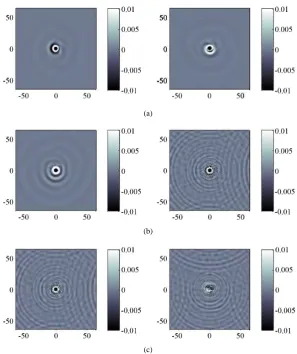
Simulation results, obtained for the first case when positive ions were supposed to be immovable, indicate that, after initial moment, the spatial distribution of the electron concentration changes essentially while the pos-itive ion concentration is retained practically invariable. As a consequence, after initial moment, the electrical neutrality of the plasma was broken and an electric charge arises at the center of the simulation region. The con-figuration of the disturbed area in the spatial distribution of the electric charge density was similar to the confi-guration of the disturbed area in the spatial distribution of the concentration of charged particles at the initial moment, which contained a circular irregularity at the center of the simulation region. Further calculations indi-cated that the changes in the spatial distribution of the electric charge density were continued. After a short pe-riod, the disturbed area in the spatial distribution of the electric charge density vanished almost completely, with the plasma having become almost electrically neutral in all simulation region. It turned out that, after a short pe-riod, the disturbed area in the spatial distribution of the electric charge density was recovered. Later, the cycle of vanishing and recovering of the disturbed area in the spatial distribution of the electric charge density was re-peated again and again. In the course of time, the disturbed area in the spatial distribution of the electric charge density was enlarged, and additional rings were arisen around the position of the circular initial irregularity si-tuated in the center of the simulation region. The spatial distribution of the normalized electric charge density,
(
e n0 0)
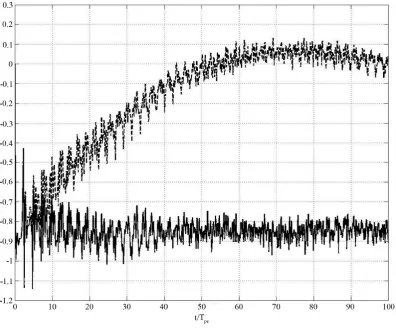
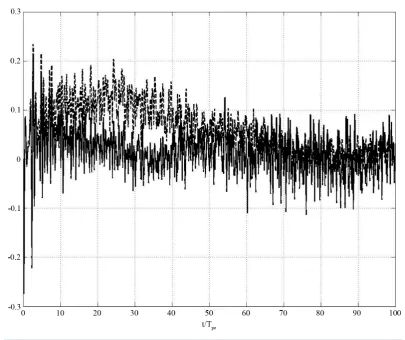
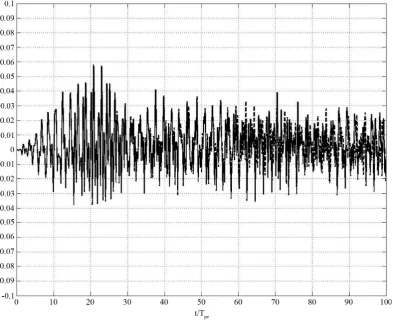
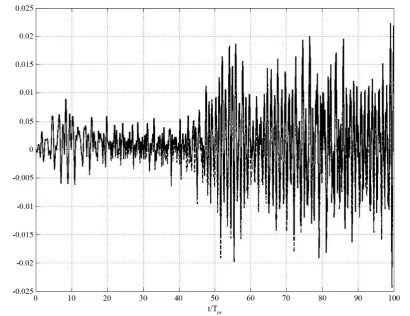
ρ , calculated for some moments, are presented in left column of Figure 1. Time variations of the elec-tric field components at two points of the simulation region and the time variation of the normalized potential energy of the plasma, filling up all simulation region, are presented in Figures 2-6 by solid lines for the first case when positive ions were supposed to be immovable. It can be seen that, for the first case, the initially created irregularity vanishes and recovers periodically, with its parameters fluctuating. The period of the fluctua-tions with the maximal amplitudes is close to the period of cyclotron oscillafluctua-tions of electrons which is approx-imately a factor of 2.3 larger than the equilibrium period of Langmuir oscillations of electrons.
Let us compare the results, obtained in the present paper for the first case, when the process starts from the completely electrically neutral state in all simulation region, with the results, obtained in the studies of Mingalev
(a)
(b)
(c)
Figure 1. The calculated spatial distributions of the normalized electric charge density, ρ
(
e n0 0) (
= ni−ne)
n0 , in the plane perpendicular to the magnetic field.The normalized distances, 0
De
λ
X and 0
De
λ
Y , that is, the distances in units of
the Debye length, 0
De
λ , from the central point of the simulation region are shown on the horizontal (X) and vertical (Y) axes. For the first case, when positive ions were supposed to be immovable, the results are presented in the left column, whe-reas, for the second case, when positive ions can move, the results are presented in the right column. The results are given for the following moments: (a) t=4.68Tpe;
(b) t=40Tpe ; (c) t=100Tpe.
of the fluctuations are very similar. During the processes of evolutions, around the initial irregularities, addition-al addition-almost symmetricaddition-al addition-alternate rings with an excess of charge of different sign began to appear. In the course of time, these additional rings filled up all simulation region.
[image:5.595.164.462.86.441.2]Figure 2.The time variations of one component of the electric field, namely Ex, lying in the plane perpendi-cular to the magnetic field, calculated at the point, displaced from the center of the simulation region in the X
direction for a distance of three Debye lengths
( )
03λDe . For the first case, when positive ions were supposed to
be immovable, the results are shown by solid line, whereas, for the second case, when positive ions can move, the results are shown by dashed line. The electric field component is given in V/m. The normalized time,
pe
t T , that is,the time in units of the equilibrium period of Langmuir oscillations of electrons, Tpe, is shown
on the abscissa.
exists during all period of calculations. As a consequence, an electrical neutrality of the plasma can not be reached because of a mobility of the electrons whose concentration deviate from the concentration of positive ions after the initial moment.
Figure 3.The time variations of one component of the electric field, namely Ey, lying in the plane perpendi-cular to the magnetic field, calculated at the point, displaced from the center of the simulation region in the X
direction for a distance of three Debye lengths
( )
03λDe . For the first case, when positive ions were supposed to
be immovable, the results are shown by solid line, whereas, for the second case, when positive ions can move, the results are shown by dashed line. The electric field component is given in V/m. The normalized time,
pe
t T , that is,the time in units of the equilibrium period of Langmuir oscillations of electrons, Tpe, is shown
on the abscissa.
The simulation results, obtained in the present study for two different cases, have essential distinctions. In the vicinity of the center of the simulation region, for the first case, when positive ions were supposed to be im-movable, the normalized electric charge density stays negative during all period of calculations, whereas, for the second case, when positive ions can move, the sign of the normalized electric charge density can change in the course of time (Figure 1). It is seen from Figure 2 that the time interval of about 50 equilibrium periods of Langmuir oscillations of electrons (≈50Tpe) is sufficient for the electric charge to change its sign in the vicinity of the center of the simulation region. Just the same time interval is required for the normalized potential energy of the plasma filling up all simulation region,
( )
0pot kin
W t W , to decrease and to achieve a stable regime for the second case, when positive ions can move (Figure 6). Thus, a capacity of positive ions to move ought to influ- ence essentially on the behavior of the magnetic field aligned super-small-scale irregularities in the concentra-tion of charged particles, existing in the near-Earth rarefied plasma.
4. Conclusions
Figure 4.The time variations of one component of the electric field, namely Ex , lying in the plane perpendi-cular to the magnetic field, calculated at the point, displaced from the center of the simulation region in the X
direction for a distance of sixteen Debye lengths
(
0)
16λDe . For the first case, when positive ions were
sup-posed to be immovable, the results are shown by solid line, whereas, for the second case, when positive ions can move, the results are shown by dashed line. The electric field component is given in V/m. The normalized time, t Tpe, that is,the time in units of the equilibrium period of Langmuir oscillations of electrons, Tpe, is
shown on the abscissa.
taking into account a motion of the positive ions and a new version of the model has been utilized to study a be-havior of initially created irregularities. The utilized model is based on a numerical solution of the Vlasov- Poisson system of equations, with the Vlasov equations describing the distribution functions of charged particles and the Poisson equation governing the self-consistent electric field. The Vlasov equations are numerically solved applying a macroparticle method. The Poisson equation is solved using a finite-difference method. In the new version of the mathematical model, some parameters of the numerical method have been improved.
The dynamics of the magnetic field aligned irregularity, having circular cross sections, was studied, with the initial cross-section diameter having been equal to twelve Debye lengths of the plasma. Inside the irregularity, the electron concentration is equal to the positive ion concentration at the initial moment, with the concentra-tions of charged particles being disturbed. Nevertheless, the process started from the completely electrically neutral state in all simulation regions. Calculations were made using the input parameters of the model typical for the nocturnal ionospheric plasma at the altitude of 300 km.
Figure 5.The time variations of one component of the electric field, namely Ey , lying in the plane perpendi-cular to the magnetic field, calculated at the point, displaced from the center of the simulation region in the X
direction for a distance of sixteen Debye lengths
(
0)
16λDe . For the first case, when positive ions were
sup-posed to be immovable, the results are shown by solid line, whereas, for the second case, when positive ions can move, the results are shown by dashed line. The electric field component is given in V/m. The normalized time, t Tpe, that is,the time in units of the equilibrium period of Langmuir oscillations of electrons, Tpe, is
shown on the abscissa.
simulation results, obtained in earlier studies devoted to investigation of the dynamics of the irregularity which had not electrical neutrality at the initial moment. For such irregularity, the time interval of about 35 periods of Langmuir oscillations of electrons was sufficient for the irregularity to decay completely. The distinction of the periods of existing may be explained by difference of the distributions of the positive ion concentration inside the irregularities at the initial moment.
Secondly, calculations were performed for the case when the process started from the completely electrically neutral state in all simulation regions and when a motion of the positive ions was taken into account. Obtained simulation results are appeared to be similar to the results obtained for the case when positive ions were sup-posed to be immovable. Nevertheless, essential distinctions between these simulation results exist. In particular, the behavior of some fluctuating parameters of the plasma, such as X-component of the electric field in the vi-cinity of the center of the simulation region and the normalized potential energy of the plasma filling up all si-mulation region, may be different during the initial time interval of about 50 equilibrium periods of Langmuir oscillations of electrons. Thus, the mobility of the positive ions ought to influence essentially on the time evolu-tion of the magnetic field aligned super-small-scale irregularities in the concentraevolu-tion of charged particles, ex-isting in the near-Earth rarefied plasma.
Acknowledgements
Figure 6.The time variation of the normalized potential energy of the plasma filling up all simulation region,
( )
0pot kin
W t W . For the first case, when positive ions were supposed to be immovable, the results are shown by
solid line, whereas, for the second case, when positive ions can move, the results are shown by dashed line. The normalized time, t Tpe, that is,the time in units of the equilibrium period of Langmuir oscillations of
electrons, Tpe, is shown on the abscissa.
by the Division of the Physical Sciences of the RAS through the program “Plasma processes in space and labor-atory”.
References
[1] Ivanov-Kholodny, G.S., Goncharova, E.E., Shashun’kina, V.M. and Yudovich, L.A. (1987) Daily Variations in the Zonal Structure of the Ionospheric F Region at Low Latitudes in February 1980. Geomagnetism and Aeronomia, 27, 722-727.
[2] Moffet, R.J. and Quegan, S. (1983) The Mid-Latitude through in the Electron Concentration of the Ionospheric F-Layer: A Review of Observations and Modelling. Journal of Atmospheric and Terrestrial Physics, 45, 315-343. http://dx.doi.org/10.1016/S0021-9169(83)80038-5
[3] Buchau, J., Reinisch, B.W., Weber, E.T. and Moore, J.G. (1983) Structure and Dynamics of the Winter Polar Cap F Region. Radio Science, 18, 995-1010. http://dx.doi.org/10.1029/RS018i006p00995
[4] Robinson, R.W., Tsunoda, R.T., Vickrey, J.F. and Guerin, L. (1985) Sources of F Region Ionization Enhancement in the Nighttime Auroral Zone. Journal of Geophysical Research, 90, 7533-7546.
http://dx.doi.org/10.1029/JA090iA08p07533
[5] Tsunoda, R.T. (1988) High-Latitude F Region Irregularities: A Review and Synthesis. Review of Geophysics, 26, 719- 760. http://dx.doi.org/10.1029/RG026i004p00719
Auroral Zone during the Magnetospheric Substorm on December 22, 1982. Geomagnetism and Aeronomia, 28, 66-70. [7] Muldrew, D.B. and Vickrey, J.F. (1982) High-Latitude F Region Irregularities Observed Simultaneously with ISIS1
and Chatanika Radar. Journal of Geophysical Research, 87, 8263-8272. http://dx.doi.org/10.1029/JA087iA10p08263 [8] Basu, S., Mac Kenzie, E., Basu, S., Fougere, P.F., Maynard, N.C., Coley, W.R., Hanson, W.B., Winningham, J.D.,
Su-giura, M. and Hoegy, W.R. (1988) Simultaneous Density and Electric Field Fluctuation Spectra Associated with Ve-locity Shears in the Auroral Oval. Journal of Geophysical Research, 93, 115-136.
http://dx.doi.org/10.1029/JA093iA01p00115
[9] Martin, E. and Aarons, J. (1977) F layer Scintillations and the Aurora. Journal of Geophysical Research, 82, 2717- 2722. http://dx.doi.org/10.1029/JA082i019p02717
[10] Fremouw, E.J., Rino, C.L., Livingston, R.C. and Cousins, M.C. (1977) A Persistent Subauroral Scintillations En-hancement Observed in Alaska. Geophysical Research Letters, 4, 539-542.
http://dx.doi.org/10.1029/GL004i011p00539
[11] Kersley, L., Russell, C.D. and Pryse, S.E. (1989) Scintillation and EISCAT Investigations of Gradient-Drift Irregulari-ties in the High Latitude Ionosphere. Journal of Atmospheric and Terrestrial Physics, 51, 241-247.
http://dx.doi.org/10.1016/0021-9169(89)90075-5
[12] Pryse, S.E., Kersley, L. and Russell, C.D. (1991) Scintillation near the F Layer Trough over Northern Europe. Radio Science, 26, 1105-1114. http://dx.doi.org/10.1029/91RS00490
[13] Greenwald, R.A. (1974) Diffuse Radar Aurora and the Gradient Drift Instability. Journal of Geophysical Research, 79, 4807-4810. http://dx.doi.org/10.1029/JA079i031p04807
[14] Dimant, Ya.S., Oppenheim, M.M. and Milikh, G.M. (2009) Meteor Plasma Trails: Effects of External Electric Field.
Annales Geophysicae, 27, 279-296. http://dx.doi.org/10.5194/angeo-27-279-2009
[15] Livingston, R.C., Rino, C.L., Owen, J. and Tsunoda, R.T. (1982) The Anisotropy of High Latitude Nighttime F Region Irregularities. Journal of Geophysical Research, 87, 10519-10526. http://dx.doi.org/10.1029/JA087iA12p10519 [16] Meltz, G. andLeLevier, R.E. (1970) Heating the F-Region by Deviative Absorption of Radio Waves. Journal of
Geo-physical Research, 75, 6406-6416. http://dx.doi.org/10.1029/JA075i031p06406
[17] Perkins, F.W. and Roble, R.G. (1978) Ionospheric Heating by Radio Waves: Predictions for Arecibo and the Satellite Power Station. Journal of Geophysical Research, 83, 1611-1624. http://dx.doi.org/10.1029/JA083iA04p01611
[18] Mantas, G.P., Carlson, H.C. and La Hoz, C.H. (1981) Thermal Response of F-Region Ionosphere in Artificial Modifi-cation Experiments by HF Radio Waves. Journal of Geophysical Research, 86, 561-574.
http://dx.doi.org/10.1029/JA086iA02p00561
[19] Bernhardt, P.A. and Duncan, L.M. (1982) The Feedback-Diffraction Theory of Ionospheric Heating. Journal of At-mospheric and Terrestrial Physics, 44, 1061-1074. http://dx.doi.org/10.1016/0021-9169(82)90018-6
[20] Hansen, J.D., Morales, G.J. and Maggs, J.E. (1989) Daytime Saturation of Thermal Cavitons. Journal of Geophysical Research, 94, 6833-6840. http://dx.doi.org/10.1029/JA094iA06p06833
[21] Vas’kov, V.V., Dimant, Ya.S. and Ryabova, N.A. (1993) Magnetospheric Plasma Thermal Perturbations Induced by Resonant Heating of the Ionospheric F-Region by High-Power Radio Wave. Advances in Space Research, 13, 25-33. http://dx.doi.org/10.1016/0273-1177(93)90047-F
[22] Mingaleva, G.I. and Mingalev, V.S. (1997) Response of the Convecting High-Latitude F Layer to a Powerful HF Wave.
Annales Geophysicae, 15, 1291-1300. http://dx.doi.org/10.1007/s00585-997-1291-8
[23] Mingaleva, G.I. and Mingalev, V.S. (2002) Modeling the Modification of the Nighttime High-Latitude F-Region by Powerful HF Radio Waves. Cosmic Research, 40, 55-61. http://dx.doi.org/10.1023/A:1014299902287
[24] Mingaleva, G.I. and Mingalev, V.S. (2003) Simulation of the Modification of the Nocturnal High-Latitude F Layer by Powerful HF Radio Waves. Geomagnetism and Aeronomy, 43, 816-825.
[25] Mingaleva, G.I., Mingalev, V.S. and Mingalev, I.V. (2003) Simulation Study of the High-Latitude F-Layer Modifica-tion by Powerful HF Waves with Different Frequencies for Autumn CondiModifica-tions. Annales Geophysicae, 21, 1827-1838. http://dx.doi.org/10.5194/angeo-21-1827-2003
[26] Mingaleva, G.I., Mingalev, V.S. and Mingalev, I.V. (2009) Model Simulation of the Large-Scale High-Latitude F- Layer Modification by Powerful HF Waves with Different Modulation. Journal of Atmospheric and Solar-Terrestrial Physics, 71, 559-568. http://dx.doi.org/10.1016/j.jastp.2008.11.007
[27] Mingaleva, G.I., Mingalev, V.S. and Mingalev, O.V. (2012) Simulation Study of the Large-Scale Modification of the Mid-Latitude F-Layer by HF Radio Waves with Different Powers. Annales Geophysicae, 30, 1213-1222.
http://dx.doi.org/10.5194/angeo-30-1213-2012
[29] Mingaleva, G.I. and Mingalev, V.S. (2014) Model Simulation of Artificial Heating of the Daytime High-Latitude F- Region Ionosphere by Powerful High-Frequency Radio Waves. International Journal of Geosciences, 5, 363-374. [30] Eliasson, B. and Stenflo, L. (2008) Full-Scale Simulation Study of the Initial Stage of Ionospheric Turbulence. Journal
of Geophysical Research, 113, Article ID: A02305. http://dx.doi.org/10.1029/2007JA012837
[31] Mingalev, O.V., Mingalev, I.V. and Mingalev, V.S. (2006) Two-Dimensional Numerical Simulation of Dynamics of Small-Scale Irregularities in the Near-Earth Plasma. Cosmic Research, 44, 398-408.
http://dx.doi.org/10.1134/S0010952506050030
[32] Mingalev, O.V., Mingaleva, G.I., Melnik, M.N. and Mingalev, V.S. (2010) Numerical Modeling of the Behavior of Super-Small-Scale Irregularities in the Ionospheric F2 Layer. Geomagnetism and Aeronomy, 50, 643-654.
http://dx.doi.org/10.1134/S0016793210050117
[33] Mingalev, O.V., Mingaleva, G.I., Melnik, M.N. and Mingalev, V.S. (2011) Numerical Simulation of the Time Evolu-tion of Small-Scale Irregularities in the F-Layer Ionospheric Plasma. International Journal of Geophysics, 2011, Ar-ticle ID: 353640. http://dx.doi.org/10.1155/2011/353640
[34] Wong, A.Y., Santoru, J., Darrow, C., Wang, L. and Roederer, J.G. (1983) Ionospheric Cavitons and Related Nonlinear Phenomena. Radio Science, 18, 815-830. http://dx.doi.org/10.1029/RS018i006p00815
[35] Hockney, R.W. and Eastwood, J.W. (1981) Computer Simulation Using Particles. McGraw-Hill, New York.