S T U D Y P R O T O C O L
Open Access
The effectiveness and cost-effectiveness of
a mindfulness training programme in
schools compared with normal school
provision (MYRIAD): study protocol for a
randomised controlled trial
Willem Kuyken
1*, Elizabeth Nuthall
1, Sarah Byford
2, Catherine Crane
1, Tim Dalgleish
3, Tamsin Ford
4,
Mark T. Greenberg
5, Obioha C. Ukoumunne
6, Russell M. Viner
7, J. Mark G. Williams
1and the MYRIAD team
Abstract
Background:Mindfulness-based approaches for adults are effective at enhancing mental health, but few controlled trials have evaluated their effectiveness or cost-effectiveness for young people. The primary aim of this trial is to evaluate the effectiveness and cost-effectiveness of a mindfulness training (MT) programme to enhance mental health, wellbeing and social-emotional behavioural functioning in adolescence.
Methods/design:To address this aim, the design will be a superiority, cluster randomised controlled, parallel-group trial in which schools offering social and emotional provision in line with good practice (Formby et al., Personal, Social, Health and Economic (PSHE) Education: A mapping study of the prevalent models of delivery and their effectiveness, 2010; OFSTED, Not Yet Good Enough: Personal, Social, Health and Economic Education in schools, 2013) will be randomised to either continue this provision (control) or include MT in this provision (intervention). The study will recruit and randomise 76 schools (clusters) and 5700 school students aged 12 to 14 years, followed up for 2 years.
Discussion:The study will contribute to establishing if MT is an effective and cost-effective approach to promoting mental health in adolescence.
Trials registration:International Standard Randomised Controlled Trials, identifier: ISRCTN86619085. Registered on 3 June 2016.
Keywords:Adolescence, Schools, Resilience, Mindfulness, Depression, Prevention
* Correspondence:[email protected]
1Department of Psychiatry, University of Oxford, Oxford, UK Full list of author information is available at the end of the article
Background
In the UK, the annual economic cost of mental health problems has been estimated at £105 billion [1, 2]. Men-tal health problems commonly have their first onset in adolescence, which is a period of heightened vulnerabil-ity associated with reduced attentional, emotional and behavioural regulation in the face of growing demands [3, 4]. In fact, 50% of adults with psychiatric disorders experience clinically impairing psychopathology before age 15 years, and 75% by age 24 years [5].
Of all mental health disorders that emerge during ado-lescence, depression is the one with the largest impact on health throughout the lifespan in terms of Years Lost to Disability [6]. Among adults with recurrent depres-sion, the earlier their depression first develops, the more severe its subsequent clinical course [7]. Onset in child-hood or adolescence is associated with greater impair-ments in social and occupational functioning and reduced quality of life, with adolescent depression asciated with poor academic performance, family and so-cial difficulties, physical ill-health, suicide attempts and completed suicide [8–11]. Such increased severity of early onset depression is also reflected in the fact that within child and adolescent samples, depression is often comorbid with other disorders; more than a third of these young people have a disruptive behavioural dis-order, anxiety disorder or both [12, 13]. It is, therefore, vital that effective interventions are developed to tackle these vulnerability processes and to target those inter-ventions during this critical window of adolescence.
There have been many calls to develop programmes for adolescents to reduce risk of mental ill-health, promote wellbeing and develop life skills across the spectrum of wellbeing and functioning [14, 15]. Be-cause of their broad reach and central role in the lives of children and families, schools are seen as the primary setting where such efforts should be focussed [16]. However, there are many challenges to imple-menting such school-based programmes. In particular, targeted interventions, selectively offered only to ado-lescents deemed at risk of later mental health prob-lems, face substantial costs associated with screening and can be stigmatising. Critically, they also miss those currently deemed at lower risk, but whose risk profile changes later.
As an alternative, recent systematic reviews and gov-ernmental reports suggest that school-based universal approaches, offered to the whole population, have the most potential to promote the mental health of young people [17, 18, 19]. However, the current research high-lights that for such universal interventions to succeed, several key pragmatic and theoretical issues need to be considered [20]. At the pragmatic level, many pro-grammes do not consider fully how best to support
teachers to deliver the intervention competently [18] or try to implement programmes without due attention to known implementation facilitators and barriers [21].
Even if these pragmatic concerns are resolved, more fundamental theoretical issues still remain. Many exist-ing universal interventions, aimed at reducexist-ing the risk of depression in young people, are based on theoretical models originally developed to address established psy-chopathology (e.g. cognitive theory and therapy) – that is, they are designed to be used when people are unwell. They therefore lack relevance, both for low-risk adoles-cents and for those who are at high risk, but not cur-rently showing symptoms. To illustrate, a recent UK, fully powered, large-scale, cluster randomised controlled trial (RCT) based on cognitive behavioural therapy (CBT) principles had good reach, but low acceptability [22]. The study found that the intervention had no effect compared to usual school provision or attention control conditions [22], consistent with other recent well-designed RCTs [14, 23, 24].
This suggests that the theoretical basis for an effective universal intervention needs to focus on those critical psychological mechanisms that are universally relevant for the whole spectrum of mental health, from risk at one end, through resilience, to flourishing at the other end. The proposed trial is grounded in such a framework and evaluates a method of mental training (mindfulness) to modify these core mechanisms which can be used by all young people.
Our key theoretical premise is that mental health and wellbeing are compromised when there is diminished ability to effectively harness top-down executive control to pursue goals and plans when faced with salient, com-peting distraction from bottom-up processes [25–29]. The significance of this premise is that this proposed central cognitive mechanism applies not only to those at risk, but also across the wellbeing spectrum.
For individuals at risk of internalising problems, such as depression and anxiety, deficits in executive control manifest as difficulty in regulating cognition, affect and behaviour in the face of distracting, intrusive, negative thoughts and feelings [30–36]. For those at risk of exter-nalisingproblems (conduct and antisocial/disruptive be-haviour), deficits in executive control manifest as impaired impulse regulation, a problem that is associ-ated with long-term impairments across multiple do-mains of functioning [37, 38].
executive control in the face of these diverse challenges will both reduce risk for vulnerable adolescents as well as promote flourishing among those who are already resilient.
Our theoretical framework points us towards a train-ing method that focusses on modifytrain-ing key executive processes, instead of focussing on reducing pathology-specific negative patterns of thinking and behaviour. Our programme aims to examine one such method, mindful-ness training (MT) which is specifically designed to ad-dress such processes [29] and can be used when people are well [41, 42].
MT involves systematic practice in focussing attention in a sustained and intentional way. It augments the abil-ity to exercise top-down executive control in the face of motivationally compelling distractions [43–46]. It also reduces intrusive thoughts and ensuing ruminative re-sponses [47–50] and behavioural impulses [51]. MT has been developed as a preventive intervention for those who already have enduring mental health problems. For example, mindfulness-based cognitive therapy (MBCT) was developed for people with a depression history but who are currently well, to prevent future depressive re-lapse [52]. The evidence base for its effectiveness and cost-effectiveness is growing [53–55], and it is now rec-ommended by National Institute for Health and Care Excellence (NICE) (2009) as a first-line psychosocial treatment for secondary prevention of recurrent depres-sion. Early studies suggest that MBCT’s preventive effect was greatest in those who had experienced three or more prior episodes. However, we now know that the number of episodes predicts good response because it is a marker for those with greater vulnerability due to pre-adult onset of depression and early adversity [56]. The effects of MT are not, however, confined to vulnerable groups. It has been found to have beneficial effects, via executive function changes, in nonclinical populations [47, 57]. This suggests that MT is not only acceptable to nonclinical populations, but also has huge promise for
primary prevention of depression because it enables intervention in early adolescence, the point at which such vulnerability first emerges.
The research question is:
‘Does MT have the potential in adolescents to shift the population away from psychopathology and towards improved mental health and wellbeing by addressing key processes of mental regulation and executive control that operate across the spectrum of risk/resilience?’
The acceptability and feasibility of MT in young people appears promising [58–62]. However, there are many unanswered questions about its ability to
prevent future depression and other mental health problems in adolescence, its mechanisms of action and what moderates its effectiveness. Also, there are no robust RCTs – grounded in theory and using an adequate follow-up period – that have evaluated the benefits of MT across the whole spectrum of risk/re-silience in adolescence [60].
A prototype of a school-based MT programme has been developed by classroom teachers to teach mindful-ness skills in a UK context as an integral part of the school curriculum [63]. This MT programme was piloted against matched comparison schools, including some schools with higher than average deprivation scores and more children with special needs. Not only was MT acceptable to secondary school children and teachers, but compared with normal school provision of social-emotional teaching, MT also reduced children’s depressive symptoms and increased their wellbeing. This was maintained at 3-month follow-up (adjusted mean differences: depression, (Center for Epidemiologic Stud-ies for Depression Scale; CES-D [64]),−1.4, 95% CI−2.3 to −0.05, p= 0.005; wellbeing, (Warwick-Edinburgh Mental Wellbeing Scale; WEMWBS [65]), 3.0, 95% CI 0.0 to 6.0,p= 0.05). Effects on wellbeing and depressive symptoms were most marked at times of highest stress, and greater use of mindfulness skills was associated with stronger effects [66].
Provisional evidence from this nonrandomised feasibil-ity trial is encouraging. Moreover, interventions that are designed with implementation in mind are likely to prove more acceptable [21, 67]. When adapted appropri-ately, MT is acceptable in more deprived and culturally diverse settings [68] and among young people with at-tention and conduct disorders [69]. Importantly, prelim-inary evidence suggests that MT in schools benefits not only young people, but also shows promise in enhancing teachers’self-efficacy and wellbeing [58, 70, 71]. There is a need for an adequately powered RCT–that uses vali-dated outcomes assessed over meaningful time frames– of a theory-based and thoughtfully implemented MT programme. Moreover, as the MT is delivered as a uni-versal school intervention, a cluster RCT is required where schools are the units of allocation.
with the Ottawa Statement on the ethical conduct and de-sign of cluster RCTs [79] and the findings will be reported in accordance with the 2010 Consolidated Standards of Reporting Trials (CONSORT) Statement [80] (including its extension to cluster RCTs [81]).
The primary aim is to determine the effectiveness and cost-effectiveness of the MT programme on three co-primary self-report outcomes at 2-year follow-up, mea-sured at the level of the individual young person:
1. Risk for depression,
2. Socioemotional and behavioural functioning, and 3. Wellbeing.
Broader secondary individual-level outcomes for stu-dents will include executive functioning, drug use, peer relationships, anxiety, attainment and mindfulness skills. Teachers will also rate the pupils on socioemotional and behavioural functioning.
For teachers, secondary outcomes will include stress, anxiety, depression, burnout and classroom mindfulness. Secondary school-level outcomes will include school ecology and climate.
Methods/design
Study design
The design will be a superiority, cluster randomised con-trolled, parallel-group trial in which inclusion of the MT
programme within school social-emotional teaching provision will be compared with provision of school social-emotional teaching as usual (teaching as usual, TAU), in 76 schools (clusters); 6840 school students (ages 12–14 years) will be approached to recruit 5700 (Fig. 1, CONSORT diagram). To ensure that baseline measures are collected for all clusters (i.e. schools) prior to randomisation pupils (approximately 25,000) will be enrolled into the study to provide baseline assessments (primary measures only), usually across both years 7 and 8. Only a subset of these pupils, who are members of classes subsequently selected to participate in the full trial, will move on to become full trial participants the following year. The reason for conducting baseline as-sessments with all pupils in the relevant year groups is that assignment of pupils to class groups varies in some schools from year to year. It is not, therefore, possible to randomly select and baseline pupils from a subset of classes at the outset to the trial and be confident that these pupils will still be taught together in the following, intervention, year. Conducting baseline assessments with all pupils ensures that these data are available for all pu-pils who might conceivably be grouped together in the year that the intervention will be delivered.
The definition of trial participants will be those who provide data at the baseline assessment and are mem-bers of one of the classes subsequently selected for con-tinued trial participation. Those pupils who do not
[image:4.595.56.537.436.701.2]provide baseline assessment data (for example, due to absence) but are subsequently present in selected trial classes will not be included as trial participants.
A two-arm trial as opposed to a three-arm trial is employed for several reasons. First, the research ques-tion addresses the key remaining uncertainty: does MT add value over current UK good practice in relation to social-emotional teaching? Second, MT’s mechanisms of action, relative to an active control condition, are exam-ined through a separate programme of work. Third, our experience is that cluster RCTs on this scale are most likely to be a rigorous test of effectiveness/cost-effective-ness when they are as simple as possible and when school heads, teachers and pupils perceive there to be equipoise between the two arms.
Setting
Secondary schools chosen to be recruited are broadly representative of those UK secondary schools which offer social-emotional teaching in line with good practice guidance and are open to having the content and quality of their provision monitored.
Participants and eligibility
A sample of mainstream UK secondary schools will be recruited that is representative of such schools, both with respect to the population served (on key variables such as deprivation, operationalised as eligibility for free school meals) and the type of school (e.g. selective/non-selective, urban/rural, large/small, mixed/single-gender, state maintained/independent). We will not include spe-cial schools or alternative settings where education is provided. Only schools that offer social-emotional teach-ing in line with good practice will be eligible for partici-pation, determined using a measure designed for this study to benchmark against key dimensions. Schools must also be willing to commit to the My Resilience in Adolescence (MYRIAD) study, including the teacher training required in schools randomised to MT and teacher and pupil assessments and follow-ups. To miti-gate risk to implementation, schools that are rated by national inspectors on measures of quality as ‘ inad-equate’, or where there is no substantive head, will be excluded.
Within schools, participating teachers will be quali-fied/experienced teachers who have given their consent to participate in the research and to complete the train-ing in the delivery of the MT programme and subse-quently to deliver the MT programme, should their school be randomised to the MT arm of the trial. Should the school be randomised to the TAU arm these teachers will be assessed as ‘controls’. They will normally be on substantive teaching contracts to increase the likelihood
that they will remain teaching within the school during the research period.
Recruitment
Recruitment of schools, teachers and pupils will occur in two recruitment cohorts with each new cohort starting at the beginning of a school year. For the first cohort the aim will be to enrol a relatively small number of schools (approximately 13), with the remainder recruited in the following cohort. The first cohort will serve to ensure that all the protocols (e.g. recruitment) are fit for pur-pose before proceeding to the second cohort. A variety of recruitment strategies will be employed; for example: newspaper articles, email or telephone calls with local authorities and attendance at events for school representatives.
Where schools decide to participate in the trial they will agree to offer the MT programme as part of the standard school curriculum. That is to say parental opt-out and child assent relates to the research (baseline and full RCT assessments) and not the MT or TAU. Consent to participation in MT or TAU curricula is at school level. Schools in the MT arm will be free to teach the MT programme to nontrial classes as they wish, but we will not collect data from these pupils.
Randomisation procedure
Schools (clusters) will be randomised using computer-generated random numbers by an independent statisti-cian. The schools will be assigned unique study numbers so their identities are unknown to the statistician, thus ensuring allocation concealment. The schools in each cohort will ideally be randomised as a single batch. The following are a selection of the variables that will be considered for stratifying the randomisation, with final decisions taken once schools have been recruited in each cohort: school size (large/small), type and quality of school (selective/nonselective, independent/nonindepen-dent, mixed/single-gender, school-quality measure, e.g. OFSTED), geographic location (urban/rural and region) and level of deprivation (e.g. below or above median of children eligible for free school meals).
Participating children will normally be recruited from the schools in the autumn term of the school recruit-ment years (September through December) [82].
Interventions
different ways. Thus, the trial cannot be categorised as either purely additive (MT in addition to existing social-emotional teaching provision) or substitutive (MT re-placing existing social-emotional teaching provision) in its design. Rather, different schools will be at different points on this hypothetical continuum and we will re-port details of provision of social-emotional teaching in schools across both arms of the trial, collected through a bespoke measure administered by the research team to one or more relevant staff members within each school and supplemented by review of school policy documents and other relevant materials.
MT programme [63]
The MT goals are to enable adolescents to learn mind-fulness skills that enhance mental regulation and execu-tive control across the spectrum of risk/resilience. The MT programme is drawn primarily from MBCT [52]. A unique feature of the MT programme is its focus on the full spectrum of functioning from mental health prob-lems to flourishing, enabling all young people to use mindfulness skills to manage emotions, academic study, sport, sleep and relationships. It was developed over more than 5 years by three classroom teachers (Richard Burnett, Chris Cullen and Chris O’Neill) who are also experienced mindfulness practitioners. This has included ensuring that the programme can be taught in main-stream schools, how best to engage hard-to-reach chil-dren and how to manage challenging classroom behaviour. It has been developed and adapted to ensure that it is acceptable to diverse school contexts and stu-dent populations. Latterly, the programme has been en-hanced to support children to practice mindfulness during and beyond the course.
The MT programme comprises several elements, de-livered through the school curriculum, over several years, supported by teacher training. The bulk of the MT programme is taught to students in a set of 10 structured lessons (within the trial, taught in years 8 and/or 9). The MT programme will normally be deliv-ered in the spring terms (January through April), with support to continue use of mindfulness skills into the summer term. In the following school years, there are follow-on lessons intended to continue and support fur-ther learning and ongoing mindfulness practice (e.g. lunchtime clubs or drop-in sessions). This follow-on training in subsequent school years aims to sustain, deepen and begin to apply students’ learning; for ex-ample, to managing tests and examinations and to embed mindfulness in the school ecology/climate.
The MT programme includes a combination of psycho-education and practical skills involved in training the mind, learned in an experiential way, through short mindfulness practices which focus on the breath, body
and immediate experience. There is also classroom dis-cussion of the application of new skills in everyday life. Its design aligns with principles identified as important for effectiveness in several reviews of schools-based pro-grammes that promote mental health and wellbeing and teach social and emotional competence. These principles include: explicitly teaching skills and attitudes; tailoring components and approaches to the needs of young people; using a range of age-appropriate, interactive, experiential and lively teaching methods; providing age-appropriate resources; for example, in this context re-sources that bring mindfulness to life (including a course booklet, a set of mindfulness exercises provided online and mindfulness practices that are introduced through animations and available as digital downloads); intensive, focussed teacher education to build teachers’self-efficacy and wellbeing; and programme implementation which pays close attention to clarity and fidelity, in this case supported by a manual and indicative script [19, 21, 58]. Building on data that greater practice is associated with better outcomes [84, 85], the MT programme includes strategies to support teachers in keeping mindfulness in-tegral to the culture of their year group/the school as a whole. Examples of good practice in this area could in-clude teacher catch-up days/support events, suggested schedules for progressive, regular mindfulness input throughout year groups, suggested smartphone apps and using parts of the MT programme in core curriculum subjects.
Whilst all participating schools randomised to MT will have agreed to deliver the MT programme to a mini-mum of three classes within years 8 and/or 9, they will be encouraged to consider how they might introduce mindfulness into the curriculum more broadly, for the potential benefit of other school pupils and the wider school climate.
Because implementation affects both reach and out-comes [86], all schools will be supported with imple-mentation guidance to increase the likelihood that MT is introduced into the schools in ways that maintain its integrity and are sustainable. For example, implementa-tion of MT will require engagement with school leader-ship teams, teachers and pupils, as identified; for example, in research in disadvantaged urban schools in the US [77, 87].
Training teachers to deliver the MT programme
8-week course). They will then attend a 4-day training workshop to learn how to deliver the MT in schools, with support where needed when they move onto teach themselves. Within participating schools, as large a pool of teachers as possible will be trained to build in redun-dancy should teachers either not achieve required levels of competency or leave the school. Training a larger group of teachers will also support greater implementa-tion of the MT programme within the school, outside trial classes, as well as offering peer support throughout the project.
Fidelity of the MT programme
To test the effectiveness of the MT programme we need to ensure that it is delivered with fidelity. The teacher training and MT programmes are highly structured and standardised to maximise fidelity. Through teacher se-lection and teacher training we will endeavour, as far as possible, to ensure that teachers reach an adequate standard before they teach trial classes. During the trial classes, competency/adherence will be monitored. Inde-pendent raters will rate a randomly selected subset of videotapes of MT programme classes for fidelity (adher-ence and compet(adher-ence) using a standardised measure de-veloped by the study team with adaptations made for MT in schools [88, 89].
Teaching as usual in line with good practice
The trial aim is to establish if MT, when integrated into social-emotional teaching in secondary schools, adds value over and above current good practice. Recent UK Department of Education reports suggest that 60% of secondary schools offer Personal, Social, Health and Economic Education (PSHE) lessons that are ‘good or better’and that this provision occurs across ages 11–16 years (Key Stages 3 and 4) through a variety of methods including regular scheduled lessons, drop-down days, within other subjects, and in tutor/form time [17, 90]. Determining whether schools have good PSHE provision is challenging. In cohort 1, schools will be eligible for in-clusion if their provision of PSHE (or equivalent) meets four criteria: (1) the presence of discrete, regular, named teaching time for PSHE, (2) a named PSHE lead, (3) a written PSHE policy and (4) a named member of the se-nior leadership team responsible for PSHE. TAU schools will agree not to provide the MT programme (or other curricula that include MT) until study completion. We will conduct a more detailed enquiry into the provision of PSHE in general and social and emotional learning (SEL) elements, in particular at each of the cohort-1 schools (see below), and will use the findings of this to describe provision and modify inclusion criteria for co-hort 2 if required. This approach ensures that MT’s ef-fectiveness is tested against current good practice.
PSHE/social-emotional teaching as usual in both trial arms
Following randomisation, the current provision of social-emotional teaching will be explored using a be-spoke tool developed for the MYRIAD trial drawing in part on existing measures [17]. This will enable us to re-port upon how schools describe their current practice with respect to PSHE in general, and social-emotional teaching in particular, in all randomised schools at the school level and for study pupils within each school and across both trial arms. It will further provide information on how the MT curriculum is integrated into wider teaching provision in intervention schools. This measure will be used initially in cohort 1 and both it, and the ini-tial PSHE eligibility criteria, will be modified if necessary for subsequent cohorts.
Baseline assessment and follow-ups
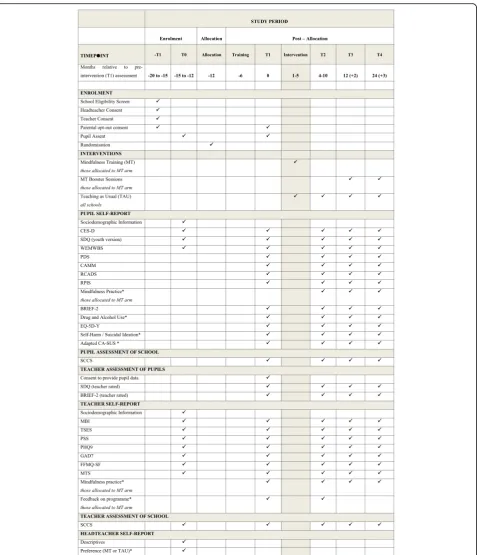
Study outcomes will be measured at school consent/ baseline (prior to randomisation1), preintervention (school term before intervention begins or equivalent), post intervention (within 3 months of the end of the MT programme or equivalent time in the TAU arm), 1-year follow-up (1 1-year after preintervention measures) and again at 2-year follow-up (2 years after preinterven-tion measures, see Fig. 2). The data gathered from study participants and other sources at each time point are shown in Fig. 2.
Sample size
co-primary outcomes. The sample size has been inflated to allow for multiple testing, setting the two-tailed signifi-cance level (alpha) for comparing each individual out-come between the trial arms to 0.0167 to preserve the overall family wide Type I error rate at 0.05. The study
has 90% power to detect the specified effect size for each co-primary outcome as statistically significant. The sam-ple size also allows for: (1) clustering of outcomes within schools, assuming an intracluster (intraschool) correl-ation coefficient (ICC) of 0.04, and (2) 20% dropout,
[image:8.595.61.539.85.641.2]with 60 of the 75 children consenting to participate in the trial providing full follow-up data within each school. Relevant literature suggests that our assumed value of the ICC is conservative. The largest ICC in one of our feasibility studies [66] was 0.037. The ICC for the same measure of depression as used here (CES-D) has been estimated to be 0.033 from a previous study in Quebec based on around 5000 children from across 71 schools drawn from relatively disadvantaged communities [91] and to be 0.009, 0.015 and 0.017 for different year levels (year 8, year 9 and year 10, respectively) based on around 2500 children from across 25 state-funded schools in South Australia spanning the full socioeco-nomic spectrum [92].
Outcome measures
Multimethod and multi-informant measures will be used that have reliability, validity and established sensitivity to change, balanced with consideration to minimising bur-den on both participants and researchers and maximis-ing data quality. All measures will be completed either on paper or via an online system. The pupils will complete the measures in a classroom setting where possible. Details of the measures and the time points at which they are collected are shown in Fig. 2. Where pu-pils are absent from school on the day at which data are obtained we will liaise with relevant school personnel to determine the most appropriate way of gathering these data, and will endeavour to gather data from as many absent pupils as possible to maximise data completeness.
Primary outcomes (pupil completed)
Our aim is to determine the effectiveness of the MT programme based on threeco-primaryoutcomes at 2-year follow-up: risk for depression (Center for Epidemiologic Studies for Depression Scale; CES-D; [64]); social/emo-tional/behavioural functioning (Strengths and Difficulties Questionnaire, youth version; SDQ [93]); and wellbeing
(Warwick-Edinburgh Mental Wellbeing Scale; WEMWBS [65]). There was consideration of selecting just one primary outcome but the research team, experts in the field who were consulted and peer review con-cluded that all three co-primary outcomes are critic-ally important. The research team also considered combining the three co-primaries into a composite outcome. However, as the research question includes the specific effect of the intervention on each of the three aspects, not just the overall effect, it was de-cided to retain the primary outcomes in their natural form. Composite measures can obscure variation that would convey interesting and important information in our proposed work [94].
There are a number of reasons for the choice of pri-mary outcomes. First, adult depression (like mental
health generally) is predicted by a range of difficulties in adolescence, including not only low-grade depressive symptomatology, but also social/emotional/behavioural functioning [13, 95–97]. Second, MT is a complex inter-vention that is specifically designed for young people along the full spectrum of risk/resilience and mental health. The outcome measures, therefore, needed to as-sess both problems (e.g. depressive symptoms) and also positive mental health. In such instances, and in line with the Medical Research Council (MRC) Complex In-terventions Framework [98] and evolving guidance in the literature [99, 100], a number of critical outcomes were chosen as co-primary outcomes that: (1) are tar-geted by MT, (2) cover the full spectrum of mental health risk/resilience and (3) predict later psychopath-ology/mental health.
Secondary outcomes (pupil-, teacher- and school-based)
A range of individual-level secondary outcome measures
have been chosen based on their value to education policy-makers, school heads and pupils themselves. Sec-ondary outcomes are:
Students’executive functioning (Behaviour Rating Inventory of Executive Function, self- and teacher-rated versions; BRIEF-2 [101])
Peer relationships (Resistance to Peer Influence Scale [102])
Drug and alcohol use, assessed using a brief measure designed for the study
Anxiety (anxiety subscales from the Revised Child Anxiety and Depression Scale; RCADS [103])
Social, emotional and behavioural functioning (Strengths and Difficulties Questionnaire, teacher version [93])
Student-level attainment (National Pupil Database [104,105])
Self-harm and suicidal ideation (measured devised for study)
Mindfulness skills (Child-Adolescent Mindfulness Measure; CAMM [106])
To support resource allocation decision-making and guideline development by bodies, such as NICE [107], the EuroQol five dimensions measure of health-related quality of life, youth version (EQ-5D-Y) [108], suitable for the calculation of Quality-adjusted Life Years (QALYs) and application to economic evaluation, will also be included, alongside the Child and Adolescent Service Use Schedule (CA-SUS).
Teachers’wellbeing (Maslach Burnout Inventory, Educator Survey; MBI [109])
Self-efficacy (Teacher’s Self-efficacy Scale; TSES [110])
Personal mindfulness (Five Facet Mindfulness Questionnaire, short form; FFMQ-SF, [111])
Teacher mindfulness (Mindfulness in Teaching Scale; MTS, [112])
Stress (Perceived Stress Scale; PSS [113]),
Depression (Patient Health Questionnaire; PHQ9 [114])
Anxiety (Generalised Anxiety Disorder; GAD7 [115])
Teacher-level variables will be measured for those teachers within schools identified to teach the interven-tion prerandomisainterven-tion, irrespective of which arm of the trial their school is subsequently randomised to. School (cluster)-level outcomes will include school ecology/cli-mate (subscales most relevant to the intervention from the School Climate and Connectedness Survey (SCCS) [116]) and school-level attainment; for example, GSCE results (National Pupil Database).
Study outcomes will be measured at five time points: baseline (school and teacher as well as pri-mary measures for all pupils from years 7 and 8); preintervention (school term before intervention or equivalent); 3 months post intervention (or equiva-lent); 1 year (1 year after preintervention) follow-up; and again at 2-year follow-up (2 years after preinter-vention). It is important that outcomes are measured over a short enough period to enhance data com-pleteness as well as over a long enough period to examine emergent risk/resilience over time.
Economic data
The economic evaluation will take a health and social care perspective, as preferred by NICE [107], but will additionally include education-based services, since evi-dence suggests that health and education make up the majority of the costs of caring for young people with depression [117].
Service use will be recorded using a brief version of the Child and Adolescent Service Use Schedule (CA-SUS), successfully applied in previous adolescent depres-sion populations [117]. A brief verdepres-sion focussing on key services (high cost and high volume of use), suitable for self-completion by parents of primary school children, is currently being applied in a similar school-based cluster RCT [73]. This measure will be adapted for application to an older population and for self-completion by the young people. Economic data will be collected at pre and post intervention as well as at 1- and 2-year follow-up. The preintervention measure will collect information
covering the previous 3 months; at follow-up the service use will be recorded for the period since the most recent prior assessment of this data .
Resource inputs into MT training and delivery will be recorded as part of the trial and will be costed using a micro-costing approach. This will involve calculation of the cost of all individual elements (teaching and training staff time, any supply teaching expenses, training and intervention materials, etc.), as well as relevant over-heads (administration, managerial, capital, etc.) and ad-justment for indirect time (non-face-to-face working time which cannot easily be allocated to specific individ-uals). All other services used will be costed by applying nationally applicable unit costs, including National Health Service reference costs for secondary care ser-vices, as well as published costs for primary care, social care and education services [118].
Outcomes for the economic evaluation will be mea-sured using the youth version of the EQ-5D measure of health-related quality of life (EQ-5D-Y) [108], shown to be valid and responsive to change in ado-lescent populations [119].
Analysis plan
Analyses will be conducted/supervised by the co-investigator trial statistician (Obioha Ukoumunne) and trial health economist (Sarah Byford) and reported fol-lowing CONSORT standards, overseen by the Data Monitoring Committee (DMC) and documented in a full prespecified statistical analysis plan. Analyses will be conducted on an intention-to-treat basis, with partici-pants analysed according to the trial arm that they were randomised to, using multiple imputation to ‘fill in’ missing data. Comparisons will also be made between the trial arms, based on those with complete data in a sensitivity analysis. All between-arm comparisons will be run first as crude (unadjusted) analyses and then ad-justed for baseline prognostic factors, chosen a priori, but certainly including the factors used to stratify the randomisation and, where measured, the baseline score of the outcome variable. The adjusted analysis will be considered to be the main analysis.
superior effectiveness and cost-effectiveness of MT com-pared with TAU. As set out above, all the co-primary outcomes are deemed important in their own right, such that each will be reported independently.
The main reported clinical analysis will use the intention-to-treat principle. The definition of a trial par-ticipant will be those who provide data at the baseline assessment and are subsequently in the classes randomly selected for participation in the full trial. In ancillary ex-ploratory analyses we will also examine whether the ef-fectiveness of the intervention is greater for schools, teachers and pupils that adhere to the curriculum (i.e. engage with intervention and, in the case of pupils in the MT arm, use the mindfulness practices). Because ad-herence is likely to be associated with factors that impact on the outcomes, we will account for this confounding using instrumental variable methods [120].
All analyses will account for clustering within schools as this is a cluster-randomised design. Continuous out-comes will be compared using random effects (‘ multi-level‘) linear regression and binary outcomes will be compared using marginal logistic regression models using Generalised Estimating Equations (GEEs) with in-formation sandwich (‘robust’) estimates of standard error, specifying an exchangeable correlation structure within clusters. Continuous outcomes will be sum-marised for each trial arm using means and standard de-viations and binary outcomes will be summarised for each trial arm using numbers and percentages.
We will use tests of interaction to explore potential moderators of outcome, including, but not exclusive to: school level deprivation (proportion of pupils eligible for free school meals); the children’s age/year group; base-line risk for depression; wellbeing; and strengths and dif-ficulties (SDQ). The latter is particularly important, as it is key to engagement with MT. These analyses are ex-ploratory and hypothesis-generating in nature [121]. We acknowledge the issue of multiple testing and the need to cautiously interpret significant findings that will re-quire replication in subsequent studies to have credence. We also acknowledge the low statistical power of tests of interaction in comparison to the power for detecting main effects [122].
Whilst mechanisms of action and potential mediators are examined in detail in a separate programme of work, we will explore potential mechanism variables pre and post MT in both trial arms and key outcomes at 1- and 2-year follow-up. We will ask if the change in mecha-nisms is specific to MT, changes as a function of use of mindfulness skills, precedes changes in the outcomes, and explains changes in key outcomes at follow-up. We will examine whether such changes occur over and above changes in those outcomes from baseline to post treatment [123] and through moderated mediation
explore what works for whom. Methods for the analysis of mediation using clustered data are in the infancy of their development [124]. We will keep abreast of on-going methodological research in this area and these analyses will be both exploratory and hypothesis-generating in nature.
Cost-effectiveness will be assessed in terms of QALYs using the EQ-5D-Y. Secondary analyses will explore cost-effectiveness in terms of the three co-primary out-comes to assess the sensitivity of analyses to the alterna-tive outcomes of interest. We will employ standard methods of analysis, including multiple imputation for missing data, adjustment for baseline prognostic factors in line with the clinical analyses, and standard paramet-ric tests for differences in costs, with the robustness of the parametric tests confirmed using bias-corrected, nonparametric bootstrapping [125]. Cost-effectiveness will be assessed using the net benefit approach, with un-certainty explored through the presentation of cost-effectiveness acceptability curves [126]. A within-trial analysis will be undertaken at 2-year follow-up.
The lifestyle choices and behaviour of young people on the threshold of adulthood can lead to short- and long-term adverse outcomes that are expensive for soci-ety and damaging to themselves [127, 128]. To this end, longer-term outcomes and costs will be explored using decision analytic modelling [129]. The model will be populated using data from our ongoing programme of work, including trial data and research on teacher train-ing models, as well as evidence from the literature and relevant longitudinal cohort databases. The most suit-able modelling framework in which to carry out the ana-lysis will be dependent upon the results of the RCT, and thus will be finalised at a later point. Markov modelling is likely to be the most appropriate for extrapolation over the longer term since it is able to deal with rela-tively complex care pathways. The cost-effectiveness model will be analysed using incremental analysis and probabilistic sensitivity analysis. The time period over which the model will be run will be determined after re-view of the literature, since data availability is the key limiting factor. These analyses are exploratory and hypothesis-generating in nature [121].
Minimising bias
schools in terms of their match to these variables, ac-tively seeking schools with characteristics that will im-prove the representativeness of the sample. In the event that we have more interested schools than we are able to recruit, we will make decisions on suitability based partly on the intention of achieving a representative sample of schools.
To minimisecontamination across clusterswe will ran-domise at the level of school, and secure schools’ agree-ment to adhere to the regime of the trial arm to which they are allocated. Attrition bias will be minimised by building on robust trial procedures developed in our feasi-bility trials [66, 130]. Retention of pupils is predicted to be 80% at follow-up. We have demonstrated that we can achieve close to 97% data from pupils and 100% retention of schools/teachers completion in our feasibility studies, albeit it with shorter follow-ups [66, 130]. As randomisa-tion is at the level of school, if teachers leave, provision can be made within schools for cover by allocating an-other teacher able to offer the interventions. We will ex-clude schools from the study with an inadequate school quality rating or without a substantive head because of the risk to implementation. Trial newsletters and social net-working will be used as a way of keeping in touch with schools and participants between follow-up points.
Robust randomisation procedures conducted by an in-dependent statistician and prepublication of the trial protocol, and subsequently the data analysis plan, will minimise subversion bias. To limit potential for bias when unblinded researchers are involved in collection of self-report data from pupils, all researchers will be trained to introduce the study and measures in a stand-ard way and provide standstand-ard responses to queries about the interpretation of questionnaire items.
Blinding of data files
The trial data file will be cleaned, locked and signed-off by the Trial Steering and Data Monitoring Committees before the trial statistician is unblinded. The remainder of the trial team will only have access to the unblinded data file following completion of main trial data analyses and presentation of main trial outcomes. Co-investigators other than Professor Willem Kuyken will remain blind to which trial arm each individual school is randomised as far as possible. Other members of the re-search team will be aware of school trial arm to facilitate implementation of the protocol within trial schools.
To maximise data completeness, data will be collected either through an online portal using tablets/laptops or through paper and pencil measures, whichever is pre-ferred by the school/teacher/pupil. Pupils who are absent from school will normally be contacted through their school. In cases where pupils or teachers leave the schools, attempts will be made to follow them up to
complete remaining measures. Teachers will be remu-nerated for completion of student-focussed measures. Time windows for the follow-up assessments will be large enough to maximise data completeness.
Data management and integrity will be maximised by using protocols established in our previous trials includ-ing usinclud-ing online data entry and, where appropriate, through double entry. All data will be stored securely in line with our data management protocol in order to pro-tect the confidentiality of participants. Finally,analytical biases will be minimised by prepublishing the study protocol prior to randomisation and the statistical ana-lysis plan prior to anaana-lysis.
Measurement of preference
In line with guidance for the design of RCTs [131], we will write our study materials to ensure that they provide clear information about the two trial arms. We will as-sess headteachers’preferences at baseline.
Trial governance
The management structure will ensure that the scientific aims are delivered and provide robust governance and oversight. Oxford University will sponsor and host the study and we sought ethics approval from the University of Oxford Central Research Ethics Committee.
A Trial Management Group (TMG) comprising the co-investigators and trial manager will provide day-to-day management of the project. TMG meetings will review progress against study milestones, plan work, discuss methods, keep a risk register and anticipate/resolve any problems. The first meeting will be face-to-face and then via video/teleconferencing throughout the project, with face-to-face meetings at least once a year. They will seek input from collaborators and others, as needed.
A Trial Steering Committee (TSC) and Data Monitor-ing Committee (DMC) will be established to provide trial oversight. They will be independent of the study team and trial sponsor and free of competing interests. The committees will be chaired and constituted by people with the requisite specialist expertise and experi-ence. Copies of the TSC and DMC charters can be ob-tained from the authors on request. The Peninsula Clinical Trials Unit will support the trial in terms of database development, randomisation, and data management.
Ethics
Consent from headteachers will be obtained electronic-ally following detailed discussions between the headtea-cher or their representative and the research team. Consent from teachers will also be obtained electronic-ally following a similar process. Parental opt-out consent will be managed by schools using ethically approved par-ent/carer and Pupil Information Sheets and an Opt-out Form and adopting the methods usually employed by the school for obtaining parental consent (e.g. electronic, hard copy or both). Pupils will provide assent at the start of the baseline assessment, through the computer termi-nals on which they will subsequently complete study measures, or occasionally, on paper. Cluster RCTs present particular ethical issues and we will, therefore, follow the Ottawa Group 15 consensus recommenda-tions for cluster RCTs, with school headteachers identi-fied as the ‘gatekeepers’ [79]. Child welfare and safeguarding procedures have been developed with input through our stakeholders (headteachers, teachers and young people). The investigators will ensure that this study is conducted in accordance with relevant regula-tions and with Good Clinical Practice. Researchers who will be obtaining informed consent will complete rele-vant components of Good Clinical Practice training. All members of the research team will undergo clearance through the UK disclosure and barring service. The study has received approval from the University of Ox-ford Central University Research Ethics Committee (CUREC). Any substantial change to the protocol design that alters the ethical frame of the project will be sent to the Ethical Committee for further review and any changes made as a result of this would be reported to the ISRCTN Registry. A random sample of approved CUREC projects may be monitored each year by the relevant CUREC subcommittee to review whether the research is being (or was) conducted within the scope of the ethical approval granted.
The recruitment and research governance procedures developed in the STARS (Supporting Teachers And chil-dRen in Schools) trial [73] and our feasibility study will be used [66]. Our feasibility study did not identify any risks to young people arising from the research proce-dures or MT itself. However, a risk management proto-col has been developed to provide a consistent approach to the identification and reporting of risk. This protocol will be discussed and agreed with the headteachers/safe-guarding leads at each participating school and builds on the protocol developed in our earlier trials. The protocol will ensure that, where young people are identified as at risk of abuse, appropriate safeguards are put in place in a timely way. Young people who disclose concerns dir-ectly to the research team in person, or via another means of direct communication rather than through Case Report Forms, will be followed up to ensure that
they receive appropriate support. All young people will be provided with bespoke information on local and na-tional sources of support, the content of which will be agreed with participating schools. Likewise, participating teachers who are identified as at risk of harm will be followed up in accordance with the protocol for risk management. Data on serious adverse events (death, overnight hospitalisation, prolongation of existing hospi-talisation, persistent or significant disability/incapacity, life-threatening situations and attendance at accident and emergency departments) will be collected as the re-search team becomes aware of them both as they arise and as part of routine data collection at each assessment point and will be reported to the DMEC within 7 days of the research team becoming aware of them. Adverse events will be logged and reported via the DMEC and TSC, and the DMEC will review aggregate data on child mental health and self-harm outcomes to ensure that there is no excess of such outcomes in the active arm. As we are collecting data in two cohorts, the end of the first cohort provides an opportunity for the DMEC and TSC to review these data and the robustness of these procedures once the first wave of intervention has been completed.
Dissemination of outcomes
We are committed to maximising dissemination of knowledge arising from the MYRIAD trial and making the outputs of this work available to the widest possible audience. We will achieve this through the open access publication of research findings in high-quality peer re-view journals and through the appropriate presentation of the research at conferences and meetings. We will also endeavour to make our research directly available to relevant communities and groups, such as schools, teachers and young people, in an accessible format through a programme of public engagement activities planned in collaboration with our public engagement group. Details of plans for dissemination and authorship eligibility guidelines are outlined in the MYRIAD dis-semination protocol v6, 14.11.15.
Discussion
This cluster RCT aims to provide a rigorous evaluation of the effectiveness and cost-effectiveness of a MT programme, compared with good practice teaching of social-emotional curricula, for young people aged 12–14 years within secondary schools. It will answer a question with significant public health implications; namely‘can a universal school-based intervention, in this case MT, shift the population away from mental ill-health and to-wards improved mental health and wellbeing?’
intervention to improve young people’s short- and longer-term social, emotional and mental health out-comes. This would have implications in terms of pre-venting mental health problems before they can take root and become a lifelong recurring problem. More-over, there are prospective studies suggesting that the executive control skills MT seeks to develop are associ-ated with a range of long-term health, social and eco-nomic outcomes [37]. This study will examine whether integrating MT into social-emotional teaching as usual, when compared with continuing social-emotional teach-ing alone, positively affects these pupil outcomes at 2-year follow-up. To assess longer-term outcomes we plan to establish a cohort, to follow participants up into adulthood, linked to the National Pupil Database. There are also significant potential benefits for schools in terms of teacher mental health, wellbeing and functioning and school ecology/culture. Finally, alongside our other pro-grammatic work, the trial will contribute to our under-standing of for whom, and when, MT is best delivered, its mechanism of action, and the most scalable approach to training teachers to deliver the MT programme.
Trial status
Recruitment of schools began in late June 2016, with re-cruitment of pupils beginning in September 2016. Ran-domisation for schools in cohort 1 will occur in December/January 2016–2017. Recruitment for cohort 2 will begin in January 2017 and continue throughout the year with randomisation for cohort 2 planned for December/January 2017–2018.
Endnotes 1
For pragmatic reasons at this time point only the pri-mary outcome measures for the pupils will be measured.
Additional file
Additional file 1:Completed SPIRIT 2013 Checklist for the MYRIAD Trial. (DOC 121 kb)
Abbreviations
BRIEF-2:Brief Inventory of Executive Function, Second Addition; CAMM: Child and Adolescent Mindfulness Measure; CA-SUS: Child and Adolescent Service Use Schedule; CBT: Cognitive behavioural therapy; CES-D: Center for Epidemiological Studies Depression Scale; CONSORT: Consolidated Standards for Reporting Trials; CUREC: University of Oxford Central University Research Ethics Committee; DMC: Data Monitoring Committee; EQ-5D-Y: EuroQol five dimensions measure of health-related quality of life, youth version; FFMQ-SF: Five Facet Mindfulness Questionnaire, short form; GAD7: Generalised Anxiety Disorder, 7-item measure; GCSE: General Certificate of Secondary Education; GEE: Generalised Estimating Equations; ICC: Intracluster correlation coefficient; ISRCTN: International Standard Registered Clinical/soCial sTudy Number; MBCT: Mindfulness-based cognitive therapy; MBI: Maslach Burnout Inventory, Educator Survey; MRC: Medical Research Council; MT: Mindfulness training; MTS: Mindfulness in Teaching Scale; MYRIAD: My Resilience in Adolescence; NICE: National Institute for Health Care and Excellence; OFSTED: Office for Standards in Education, Children’s Services and Skills;
PDS: Pubertal Development Scale; PHQ9: Patient Health Questionnaire, 9-item version; PSHE: Personal, Social, Health and Economic Education; PSS: Perceived Stress Scale; QALYs: Quality-adjusted Life Years;
RCT: Randomised controlled trial; RPIS: Resistance to Peer Influence Scale; SCCS: School Climate and Connectedness Survey, teacher and pupil versions; SDQ: Strengths and Difficulties Questionnaire; SEL: Social and Emotional Learning; SPIRIT: Standard Protocol Items: Recommendations for Interventional Trials; STARS: Supporting Teachers and Children in Schools; TAU: Teaching as usual; TIDieR: Template for Intervention Description and Replication; TMG: Trial Management Group; TSC: Trial Steering Committee; TSES: Teachers’Sense of Efficacy Scale; UK: United Kingdom;
WEMWBS: Warwick Edinburgh Mental Wellbeing Scale; Year 10: pupils aged 14–15 years; Year 7: pupils aged 11–12 years; Year 8: pupils aged 12–13 years; Year 9: pupils aged 13–14 years
Acknowledgements
We would like to acknowledge the contribution of the wider MYRIAD team to this work. The MYRIAD team comprises Daniel Brett, Liz Lord, Lucy Palmer, Anna Sonley, Laura Taylor, Anam Raja and Triona Casey. OU is supported by the National Institute for Health Research (NIHR) Collaboration for Leadership in Applied Health Research and Care (CLAHRC) for the South West Peninsula at the Royal Devon and Exeter NHS Foundation Trust. The views expressed in this publication are those of the authors and not necessarily those of the NHS, the NIHR or the Department of Health in England.
Funding
This trial is supported by the Wellcome Trust [107496/Z/15/Z]. This research does not fall under the Research Governance Framework in the UK and as such does not formally require a sponsor. The University of Oxford takes responsibility for the research but a sponsorship review by the Clinical Trials and Research Governance team has not been carried out. The sponsor and funders had no role in study design; collection, management, analysis and interpretation of data; writing of the report; or the decision to submit the report for publication. They do not have ultimate authority over any of these activities.
Availability of data and materials
Core study data will be made available in an anonymised form through an established data repository or bespoke data resource following study closure. Prior to study closure requests for access to data will be handled by the research team in line with the data management policy of the MYRIAD trial. The statistical code used to analyse trial data will be made available on request from the trial statistician following publication of the principal findings.
Information Sheets and other documents provided to the schools, parents and pupils during recruitment and study conduct can be found at the following website http://www.myriadproject.org/.
Authors’contributions
WK, JMGW, TD, OU, TF, SB and MTG designed the trial. WK drafted the protocol manuscript and EN, SB, CC, TD, TF, MTG, OU, RMV and JMGW revised the protocol for important intellectual content. All authors read and approved the final manuscript.
Competing interests
MJGW founded the University of Oxford Mindfulness Centre and was its director until 2013, whilst WK is the current director. WK receives payments for training workshops and presentations related to MBCT and donates all royalties received to the Oxford Mindfulness Foundation, a charitable trust that supports the work of the Oxford Mindfulness Centre. CC is research lead at the Oxford Mindfulness Centre and Programme Manager on the Wellcome Trust Strategic Award of which the MYRIAD trial is a part. JMGW receives payments for training workshops and presentations related to MBCT, as well as royalties for books published on the subject. Finally both WK and JMGW gave evidence to the UK all-party parliamentary mindfulness group. EN, TF, SB, MTG, RMV and TD have no competing interests to declare.
Consent for publication
Ethics approval and consent to participate
This study has been reviewed and approved by the University of Oxford Central Research Ethics Committee, REF: R45358/RE001. All participants will give consent to participate, either through opt-in consent (schools, teachers) or opt-out consent (pupils).
Publisher’s Note
Springer Nature remains neutral with regard to jurisdictional claims in published maps and institutional affiliations.
Author details
1Department of Psychiatry, University of Oxford, Oxford, UK.2Kings Health Economics, Kings College London, London, UK.3MRC Cognition and Brain Sciences Unit, Cambridge, UK.4University of Exeter Medical School, Exeter, UK.5Penn State University, Old Main, State College, PA, USA.6NIHR CLAHRC South West Peninsula (PenCLAHRC), University of Exeter Medical School, Exeter, UK.7UCL Great Ormond St. Institute of Child Health, London, UK.
Received: 25 November 2016 Accepted: 23 March 2017
References
1. Collins PY, Patel V, Joestl SS, March D, Insel TR, Daar AS, Sci Advisory B, Executive Comm Grand Challenges G. Grand challenges in global mental health. Nature. 2011;475:27–30.
2. Centre for Mental Health. The economic and social costs of mental health problems. London: Centre for Mental Health; 2010.
3. Paus T, Keshavan M, Giedd JN. Why do many psychiatric disorders emerge during adolescence? Nat Rev Neurosci. 2008;9:947–57.
4. Blakemore SJ. The social brain in adolescence. Nat Rev Neurosci. 2008;9: 267–77.
5. Kessler RC, Berglund P, Demler O, Jin R, Walters EE. Lifetime prevalence and age-of-onset distributions’of DSM-IV disorders in the national comorbidity survey replication. Arch Gen Psychiatry. 2005;62:593–602.
6. World Health Organization. Health statistics and information systems: disease burden. Geneva: World Health Organization; 2011.
7. Williams JMG, Barnhofer T, Crane C, Duggan DS, Shah D, Brennan K, Krusche A, Crane R, Eames C, Jones M, et al. Pre-adult onset and patterns of suicidality in patients with a history of recurrent depression. J Affect Disord. 2012;138:173–9.
8. Goodyer IM, Herbert J, Secher SM, Pearson J. Short-term outcome of major depression. 1. Comorbidity and severity at presentation as predictors of persistent disorder. J Am Acad Child Adolesc Psychiatry. 1997;36:179–87. 9. Goodyer IM, Herbert J, Tamplin A, Secher SM, Pearson J. Short-term
outcome of major depression. 2. Life events, family dysfunction, and friendship difficulties as predictors of persistent disorder. J Am Acad Child Adolesc Psychiatry. 1997;36:474–80.
10. Richardson LP, McCauley E, McCarty CA, Grossman DC, Myaing M, Zhou C, Richards J, Rockhill C, Katon W. Predictors of persistence after a positive depression screen among adolescents. Pediatrics. 2012;130:E1541–8. 11. Kessler RC, Avenevoli S, Merikangas KR. Mood disorders in children
and adolescents: an epidemiologic perspective. Biol Psychiatry. 2001;49: 1002–14.
12. Ford T, Goodman R, Meltzer H. The British Child and Adolescent Mental Health survey 1999: the prevalence of DSM-IV disorders. J Am Acad Child Adolesc Psychiatry. 2003;42:1203–11.
13. Goodman A, Goodman R. Population mean scores predict child mental disorder rates: validating SDQ prevalence estimators in Britain. J Child Psychol Psychiatry. 2011;52:100–8.
14. Sawyer SM, Afifi RA, Bearinger LH, Blakemore SJ, Dick B, Ezeh AC, Patton GC. Adolescent Health 1 Adolescence: a foundation for future health. Lancet. 2012;379:1630–40.
15. Huppert FA, So TC. Flourishing across Europe: application of a new conceptual framework for defining well-being. Soc Indic Res. 2011;110:837–61. 16. Greenberg MT. School-based prevention: current status and future
challenges. Eff Educ. 2010;2:25.
17. Formby E, Coldwell M, Stiell B, Demack S, Stevens A, Shipton L, Wolstenholme C, Willis B. Personal, Social, Health and Economic (PSHE) Education: A mapping study of the prevalent models of delivery and their effectiveness. London: Department for Education; 2010.
18. Vostanis P, Humphrey N, Fitzgerald N, Deighton J, Wolpert M. How do schools promote emotional well-being among their pupils? Findings from a national scoping survey of mental health provision in English schools. Child Adolesc Mental Health. 2013;18:151–7.
19. Weare K, Nind M. Mental health promotion and problem prevention in schools: what does the evidence say? Health Promot Int. 2011;26:I29–69. 20. Merry SM. Preventing depression in adolescents. Br Med J. 2012;345:e6720. 21. Durlak JA, DuPre EP. Implementation matters: a review of research on the
influence of implementation on program outcomes and the factors affecting implementation. Am J Community Psychol. 2008;41:327–50. 22. Stallard P, Phillips R, Montgomery AA, Spears M, Anderson R, Taylor J, Araya
R, Lewis G, Ukoumunne OC, Millings A, et al. A cluster randomised controlled trial to determine the clinical effectiveness and cost-effectiveness of classroom-based cognitive-behavioural therapy (CBT) in reducing symptoms of depression in high-risk adolescents. Health Technol Assess. 2013;17:vii–xvii. 1–109.
23. Spence SH, Shortt AL. Research review: can we justify the widespread dissemination of universal, school-based interventions for the prevention of depression among children and adolescents? J Child Psychol Psychiatry. 2007;48:526–42.
24. Challen AR, Machin SJ, Gillham JE. The UK Resilience Programme: a school-based universal nonrandomized pragmatic controlled trial. J Consult Clin Psychol. 2014;82:75–89.
25. Dalgleish T, Williams JM, Golden AM, Perkins N, Barrett LF, Barnard PJ, Yeung CA, Murphy V, Elward R, Tchanturia K, Watkins E. Reduced specificity of autobiographical memory and depression: the role of executive control. J Exp Psychol Gen. 2007;136:23–42.
26. Schweizer S, Grahn J, Hampshire A, Mobbs D, Dalgleish T. Training the emotional brain: improving affective control through emotional working memory training. J Neurosci. 2013;33:5301–+.
27. Schweizer S, Hampshire A, Dalgleish T. Extending brain-training to the affective domain: increasing cognitive and affective executive control through emotional working memory training. PLoS One. 2011;6:e24372. 28. Teper R, Segal ZV, Inzlicht M. Inside the mindful mind: how mindfulness
enhances emotion regulation through improvements in executive control. Curr Dir Psychol Sci. 2013;22:449–54.
29. Zelazo PD, Lyons KE. The potential benefits of mindfulness training in early childhood: a developmental social cognitive neuroscience perspective. Child Dev Perspect. 2012;6:154–60.
30. Dalgleish T. Cognitive approaches to posttraumatic stress disorder: the evolution of multirepresentational theorizing. Psychol Bull. 2004;130: 228–60.
31. Dalgleish T, Hauer B, Kuyken W. The mental regulation of autobiographical recollection in the aftermath of trauma. Curr Dir Psychol Sci. 2008;17:259–63. 32. Kuyken W, Brewin CR. The relation of early abuse to cognition and coping
in depression. Cogn Ther Res. 1999;23:665–77.
33. Meiser-Stedman R, Dalgleish T, Yule W, Smith P. Intrusive memories and depression following recent non-traumatic negative life events in adolescents. J Affect Disord. 2012;137:70–8.
34. Newby JM, Moulds ML. Characteristics of intrusive memories in a community sample of depressed, recovered depressed and never-depressed individuals. Behav Res Ther. 2011;49:234–43.
35. Williams JMG, Barnhofer T, Crane C, Hermans D, Raes F, Watkins E, Dalgleish T. Autobiographical memory specificity and emotional disorder. Psychol Bull. 2007;133:122–48.
36. Kuyken W, Watkins E, Holden E, Cook W. Rumination in adolescents at risk for depression. J Affect Disord. 2006;96:39–47.
37. Moffitt TE, Arseneault L, Belsky D, Dickson N, Hancox RJ, Harrington H, Houts R, Poulton R, Roberts BW, Ross S, et al. A gradient of childhood self-control predicts health, wealth, and public safety. Proc Natl Acad Sci U S A. 2011;108:2693–8.
38. Carver CS, Johnson SL, Joormann J. Serotonergic function, two-mode models of self-regulation, and vulnerability to depression: what depression has in common with impulsive aggression. Psychol Bull. 2008;134:912–43. 39. Killingsworth MA, Gilbert DT. A wandering mind is an unhappy mind.
Science. 2010;330:932.
40. Smallwood J, Schooler JW. The restless mind. Psychol Bull. 2006;132:946–58. 41. Rose G. Strategy of preventive medicine. Oxford: Oxford University Press;
2008.