S T U D Y P R O T O C O L
Open Access
RandomizEd controlled trial for pre-operAtive
dose-escaLation BOOST in locally advanced rectal
cancer (RECTAL BOOST study): study protocol for
a randomized controlled trial
JP Maarten Burbach
1*, Helena M Verkooijen
2, Martijn Intven
1, Jean-Paul JE Kleijnen
1, Mirjam E Bosman
1,
Bas W Raaymakers
1, Wilhelmina MU van Grevenstein
3, Miriam Koopman
4, Enrica Seravalli
1, Bram van Asselen
1and Onne Reerink
1Abstract
Background:Treatment for locally advanced rectal cancer (LARC) consists of chemoradiation therapy (CRT) and surgery. Approximately 15% of patients show a pathological complete response (pCR). Increased pCR-rates can be achieved through dose escalation, thereby increasing the number patients eligible for organ-preservation to improve quality of life (QoL). A randomized comparison of 65 versus 50Gy with external-beam radiation alone has not yet been performed. This trial investigates pCR rate, clinical response, toxicity, QoL and (disease-free) survival in LARC patients treated with 65Gy (boost + chemoradiation) compared with 50Gy standard chemoradiation (sCRT).
Methods/design:This study follows the‘cohort multiple randomized controlled trial’(cmRCT) design: rectal cancer patients are included in a prospective cohort that registers clinical baseline, follow-up, survival and QoL data. At enrollment, patients are asked consent to offer them experimental interventions in the future. Eligible patients— histologically confirmed LARC (T3NxM0 <1 mm from mesorectal fascia, T4NxM0 or TxN2M0) located≤10 cm from the anorectal transition who provided consent for experimental intervention offers—form a subcohort (n= 120). From this subcohort, a random sample is offered the boost prior to sCRT (n= 60), which they may accept or refuse. Informed consent is signed only after acceptance of the boost. Non-selected patients in the subcohort (n= 60) undergo sCRT alone and are not notified that they participate in the control arm until the trial is completed. sCRT consists of 50Gy (25 × 2Gy) with concomitant capecitabine. The boost (without chemotherapy) is given prior to sCRT and consists of 15 Gy (5 × 3Gy) delivered to the gross tumor volume (GTV). The primary endpoint is pCR (TRG 1). Secondary endpoints include acute grade 3–4 toxicity, good pathologic response (TRG 1-2), clinical response, surgical complications, QoL and (disease-free) survival. Data is analyzed by intention to treat.
Discussion:The boost is delivered prior to sCRT so that GTV adjustment for tumor shrinkage during sCRT is not necessary. Small margins also aim to limit irradiation of healthy tissue. The cmRCT design provides opportunity to overcome common shortcomings of classic RCTs, such as slow recruitment, disappointment-bias in control arm patients and poor generalizability.
Trial registration:The Netherlands Trials Register NL46051.041.13. Registered 22 August 2013. ClinicalTrials.gov NCT01951521. Registered 18 September 2013.
* Correspondence:[email protected]
1
Department of Radiation Oncology, University Medical Center Utrecht, Heidelberglaan 100, 3584, CX Utrecht, The Netherlands
Full list of author information is available at the end of the article
Background
Colorectal cancer is the second most common cancer in women and third in men worldwide [1]. Almost one-third of Dutch colorectal cancers are located in the rec-tum [2]. Rectal cancers are treated by surgery, preceded by chemoradiation in case of locally advanced rectal can-cer (LARC). Chemoradiation consists of a total dose of about 50 Gy combined with capecitabine. With this treatment regimen, approximately 15% of patients show a pathological complete response (pCR) [3,4], classified by Mandardet al. as tumor regression grade 1 (TRG 1) [5]. In a recent meta-analysis, we showed that doses of
≥60 Gy were associated with an increased pCR rate to 20.4%, without compromising toxicity [6].
Patients with‘good’clinical response, either pCR (TRG 1) or near-pCR (TRG 2), might be eligible for organ-preserving approaches. The aim of these strategies is to deliver an optimal quality of life (QoL) without com-promising the oncologic outcome in this favorable sub-group. Recently, several protocols have been developed, that use either local excision [7-9] or a“watch-and-wait” policy [10-12], in order to omit surgery (total mesorectal excision) as the primary treatment. In addition, patients who reach a pCR often show reduced local recurrence and improved (disease-free) survival probabilities com-pared with patients with a poor response (TRG 3–5) [3,13-15], possibly driven by a favorable tumor biology.
Thus, by escalating the preoperative radiation dose, the amount of patients with a‘good’clinical response or pCR who are eligible for organ-preserving treatment can potentially be increased. However, response rates after high-dose external radiation with 65 Gy have not yet been investigated in a randomized setting. Therefore, we set up an exploratory trial, the RandomizEd Controlled Trial for Pre-operAtive Dose-escaLation BOOST in Locally Advanced Rectal Cancer (RECTAL BOOST study: ClinicalTrials.gov NCT01951521) to compare tumor pCR rates (TRG 1), pathologic ‘good’ responses, toxicity levels, clinical tumor response and QoL between patients treated with 65 Gy chemoradiation (15 Gy boost plus 50 Gy chemoradiation) and those treated with 50 Gy standard chemoradiation therapy (sCRT).
Methods/design
Study design
This study is being conducted within the ProspectIve data CollectioN Initiative on Colorectal cancer (PICNIC) project [16]. The prospective observational PICNIC cohort includes patients with colorectal cancer of all stages. Infor-mation collected includes baseline demographic and clin-ical data, as well as prospective clinclin-ical follow-up and patient-reported outcome measures (PROMs). The study follows the cohort multiple randomized controlled trial
(cmRCT) design [17] and provides a pragmatic infrastruc-ture for multiple randomized controlled trials (RCTs).
Patient recruitment
At enrollment in the PICNIC cohort, patients are asked to provide informed consent for prospective collection of clinical, survival and PROMs data. In addition, ac-cording to the cmRCT design, we ask patients’consent to be randomly selected to receive offers on experimen-tal interventions in the future and to use their data com-paratively within the context of the PICNIC project.
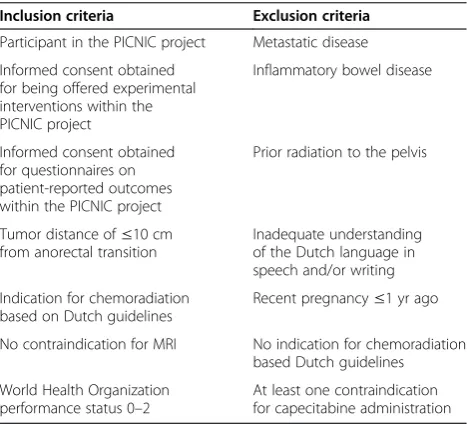
[image:2.595.305.539.496.708.2]From among the PICNIC cohort, we will identify all patients eligible for the boost intervention based on the following inclusion criteria: (1) histologically confirmed LARC, defined as T3 with threatened mesorectal fascia (<1 mm), T4 or N2M0 [18] (based on Dutch guidelines for chemoradiation in rectal cancer [19], in which N2 is de-fined as≥4 positive nodes visible with diameter >9 mm or 5 to 9 mm combined with 2 of the following 3 characteris-tics: irregular border, heterogeneous or round-shaped); (2) tumor located ≤10 cm from the anorectal transition; and (3) previously obtained informed consent to be randomly offered experimental interventions within the context of the PICNIC project (Table 1). Patients are ineligible in case of inflammatory bowel disease, pregnancy, previous radi-ation to the pelvis, contraindicradi-ation for capecitabine and inadequate comprehension of the Dutch language in speech and/or writing. Female patients in whom the tumor is located on the anterior wall close to the vagina are also ineligible because the maximum tolerated dose to the
Table 1 Inclusion and exclusion criteria for the RECTAL BOOST studya
Inclusion criteria Exclusion criteria
Participant in the PICNIC project Metastatic disease
Informed consent obtained for being offered experimental interventions within the PICNIC project
Inflammatory bowel disease
Informed consent obtained for questionnaires on patient-reported outcomes within the PICNIC project
Prior radiation to the pelvis
Tumor distance of≤10 cm from anorectal transition
Inadequate understanding of the Dutch language in speech and/or writing
Indication for chemoradiation based on Dutch guidelines
Recent pregnancy≤1 yr ago
No contraindication for MRI No indication for chemoradiation based Dutch guidelines
World Health Organization performance status 0–2
At least one contraindication for capecitabine administration
a
vagina does not allow for dose escalation when the tumor is in proximity to it.
Random selection
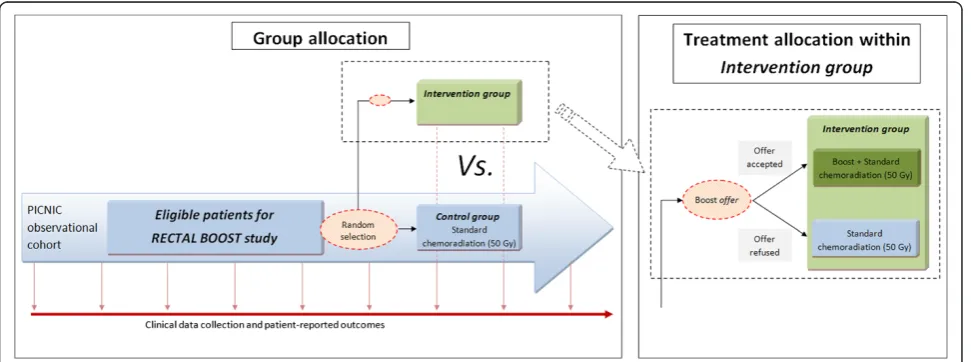
[image:3.595.57.543.525.706.2]Patients within the PICNIC cohort who meet the above inclusion criteria form a subcohort of eligible patients (Figure 1). From among this subcohort, a random sample is selected on a 1:1 basis with varying block sizes (n= 6 to 8) using a centrally available computer program. Ran-domly selected patients are offered the experimental inter-vention (boost prior to sCRT) by their treating physician. If they accept the offer, they will sign an additional in-formed consent to receive the boost. Patients who refuse the boost will receive care as usual (that is, sCRT). Patients in the subcohort who will not be randomly selected will not be informed about the boost intervention, nor will they be informed about their participation in the control arm of this study. When the trial is completed, aggregate disclosure about the trial results will be provided to the entire PICNIC cohort at the same time.
Standard treatment
sCRT consists of 50 Gy (25 × 2 Gy on weekdays) com-bined with capecitabine. The radiation dose is delivered by intensity-modulated radiation therapy (IMRT), which is standard care in our hospital, to the planned target volume (PTV), which comprises the gross tumor volume (GTV) and clinical target volume (CTV). Target volumes are de-lineated on computed tomography (CT) scans, matched to- and combined with T2- and diffusion-weighted mag-netic resonance imaging (DWI) according to published guidelines [20]. The CTV follows the mesorectal fascia up to the rectosigmoid curvature and stretches maximally to 4 cm caudal from the tumor, sparing the sphincter in case of a low anterior resection (LAR), or includes the
sphincter complex +1-cm margin in case of an abdomino-perineal resection (APR). The lymph node regions (in-ternal iliac and obturator) stretch from the caudal end of the v. iliaca communis downward to the crossing of the internal iliac vessels under the m. piriformis, laterally lim-ited by the pelvic muscles. The obturator region stretches from the m. obturatorius to the m. levator, ventrally lim-ited by the ureter or dorsal side of the neurovascular bun-dle without inclusion of the vesiculae, uterus and vagina. Lateral and dorsal border are marked by the pelvic mus-cles and ventral iliac region. In addition, the presacral re-gion stretches from the upper level of the iliac vessels to mesorectum, ventrally limited 2 cm from the sacrum, in-cluding the a. rectalis superior and exin-cluding the neurofor-amina. The PTVCTV50 is a non-uniform margin around the CTV according to local protocol consisting of an ex-pansion of 13 mm ventrally, 9 mm dorsally, 10 mm lat-erally and 10 mm craniocaudally (Figure 2). The prescribed dose to the PTVCTV50 is that 95% of the prescribed dose should cover≥99% of the PTV. Radiation is delivered with an external beam linear accelerator. For position verifica-tion, the sCRT protocol consists of cone-beam CT prior to the first three fractions and weekly thereafter.
Capecitabine is administered orally twice daily on treatment days at a dose of 825 mg/m2, taken 2 hours before each radiation fraction and 12 hours later. Hematologic toxicity is tested every 2 weeks. Surgery is performed 10 to 12 weeks postradiation according to the Dutch guidelines [19]. The decision whether to perform total mesorectal excision surgery in form of LAR or APR, is made on the basis of the location and extensive-ness of the tumor [21].
Two routine MRI scans are acquired using an MRI protocol developed in house, consisting of T2-weighted and DWI image sequences [22]. The first scan (taken
maximally 2 weeks prior to radiation) is used for radi-ation planning, and the second (obtained 9 weeks post-radiation) is used for preoperative response evaluation and surgical planning. Immediately prior to surgery, the surgeon will also perform a digital rectal examination (DRE) for clinical response evaluation.
Boost intervention
The experimental boost intervention consists of 15 Gy (5 × 3 Gy on weekdays) to the GTV without concomitant chemotherapy. The boost is delivered in the week prior to the start of sCRT. A cumulative GTV dose of 65 Gy is de-livered over the full treatment course of 30 fractions (6 weeks). This results in an equivalent dose in 2-Gy frac-tions of 66.3 Gy (α/β= 10 Gy) [23]. GTV delineation is based on T2-weighted and DWI scans; no CTVGTV65 margin is applied; and the PTVGTV65is defined by a non-uniform margin of +11 mm in the anteroposterior direc-tion, +7 mm in the lateral direction and +13 mm in the craniocaudal direction around the GTV, which represents tumor movement that was observed on in-house daily MRI scans and setup errors [24]. A volumetric modulated arc therapy stereotactic treatment plan is generated for boost patients, whereas IMRT is standard care used in the control arm, that accumulates the boost and standard che-moradiation doses (Figure 2). The maximally allowed cu-mulative dose within the GTV is 80 Gy (123% of 65 Gy), and the volume receiving 95% of the prescribed dose should be larger than 99% of the PTVGTV65. The max-imum dose around, and dose prescription to, the PTVCTV50 is similar to the elective sCRT field (that is, 53.5 Gy). Daily online cone-beam CT scans are used for positioning before each boost fraction, and the sCRT pos-ition verification protocol follows thereafter.
Organs at risk (OARs) consist of the bowel bag (ex-cluding sigmoid), bladder, vagina and anal sphincter.
The dose constraints for the OARs remain unchanged for boost patients (namely, the dose to 1 cc of the OARs should be ≤53.5 Gy), and the volume receiving 45 Gy is aimed to be less than 195 cc for the bowel bag (exclud-ing the sigmoid). OAR constraints are lead(exclud-ing over PTVGTV65coverage and may thus limit GTV dose if ne-cessary. If dose prescriptions cannot be reached, a panel of radiation oncologists will discuss the feasibility and anticipated safety of the treatment plan and decide ei-ther to continue or to adapt the plan toward acceptable OAR constraints, taking into account anatomical limita-tions and planned surgery. One additional MRI scan is obtained in patients who receive the boost for response prediction purposes at the end of the second week (after ten fractions including the five boost fractions) and a rectoscopy for clinical response evaluation is performed in a subgroup of boost-arm patients that showed a‘good’ response based on MRI.
Primary endpoint
The primary endpoint of this study is pCR, which is classified according to the Mandard classification system as tumor regression grade 1 (TRG 1) [5] (that is, a sterile specimen with absence of residual cancer cells). Experi-enced gastrointestinal pathologists use a standardized protocol to evaluate the specimens [25], and central re-view of pathology is performed.
Secondary endpoints
[image:4.595.60.539.91.249.2]Secondary endpoints include non-complete pathologic responses (TRG 2–5), acute grade 3–4 toxicity, clinical response, surgical complications, QoL and disease-free and overall survival. The non-complete pathologic re-sponses are categorized as good (TRG 1–2) or‘not good’ (TRG 3–5) by the pathologist. A radiation oncologist will assess toxicity at weekly visits during the radiation Figure 2Cumulative dose plan of boost plus standard chemoradiation fractions (left) with associated dose volume histogram (right).
Delineations of gross tumor volume (GTV) plus planned target volume (PTVGTV) (red), clinical target volume (CTV) plus PTV (PTVCTV) (green), bladder (brown)
treatment, as well as 4 weeks and 4 months after com-pletion of sCRT. Toxicity is recorded according to the National Cancer Institute’s Common Terminology Cri-teria for Adverse Events, version 4.03 [26]. Long-term toxicity, (serious) adverse events (SAEs), hospitalization and other health-related problems are registered within the context of the PICNIC cohort during clinical follow-up and annual patient-administered questionnaires on health and oncological status. Clinical response evalu-ation is based on MRI (9 weeks after completion of che-moradiation; that is, the week before surgery) and DRE and rectoscopy, which are both performed right before surgery while the patient is under anesthesia. MRI and DRE are standardly performed in all patients, whereas rectoscopy is only performed in intervention arm pa-tients who showed a good response based on MRI. For the MRI, a combination of T2-weighted and DWI se-quences is used to measure residual tumor tissue in the initially delineated tumor region and its surrounding elective radiation field. Surgical complications are regis-tered up to 30 days after the primary surgery in all pa-tients and after closure of the diverting stoma in papa-tients who previously underwent a LAR. For safety reasons, oc-currence of anastomotic leakage is monitored closely in the LAR subgroup by daily review of postoperative pa-tient charts for 30 days. QoL data are recorded by means of either online forms (Patient-Reported Outcomes Fol-lowing Initial treatment and Long-term Evaluation of Survivorship (PROFILES): http://www.profilesregistry.nl/ ) or pencil-and-paper questionnaires. For this purpose, cancer-specific QoL questionnaires from the European Organization for Research and Treatment of Cancer (EORTC) are used, including the core (QLQ-C30 [27]) and colorectal cancer-specific (QLQ-CR29 [28,29]) ques-tionnaires. The EORTC QLQ-C30 covers five functional scales, three symptom scales, a global QoL scale and six single items. The EORTC QLQ-CR29 assesses urinary, bowel and/or stoma, psychological and sexually related QoL issues, as well as side effects due to chemotherapy. These questionnaires are provided at the time of diagno-sis (baseline) and 3, 6, 12, 18 and 24 months thereafter. Survival and disease-free survival are monitored within the PICNIC project through clinical follow-up records and via a link with the Dutch Cancer Registry. Disease-free survival is defined as the time in absence of a rectal cancer local recurrence or metastasis.
Safety
According to Dutch law, the investigator reports SAEs within 15 days following notification through a government-based internet portal (Centrale Commissie Mensgebonden Onderzoek (Central Committee on Research Involving Human Subjects): https://www.toetsingonline.nl/) to the accredited institutional review board (IRB) that approved
the protocol. SAEs that result in death or are life-threatening will be reported within 7 days.
Because this is an exploratory dose escalation study, an independent data and safety monitoring board (DSMB) will make recommendations on continuation of the study based on safety results, focusing on toxicity and anastomotic leakage. The DSMB consists of an ex-pert surgeon, a radiation oncologist and a statistician and is provided, annually or after every SAE, with the raw data on the primary and secondary outcomes (in-cluding toxicity, surgical complications and survival). After the first 10 patients with LAR have undergone boost treatment, inclusion of patients scheduled for LAR will be stopped for 8 months to let the DSMB compare anastomotic leakages between boost and control arms. The 8-month period will consist of the time between sCRT to primary surgery (10–12 weeks) followed by the time between primary surgery and bowel reconstruction, including a postoperative monitoring period (16–20 weeks). Only inclusion of patients undergoing LAR will be halted during this stop, because patients undergoing APR have no risk of anastomotic leakage, owing to their permanent stoma. The DSMB analyzes the data inde-pendently of the investigators and reports their advice on continuation of the study to the sponsor, which will decide on continuation or stopping of the study.
Sample size considerations
On the basis of our center’s experience, we assume that 13% of patients will reach pCR if undergoing sCRT. On the basis of a prediction model published by Appelt
demonstrate a statistically significant difference. We ex-pect to complete recruitment within 3 years.
Data analysis
Data will be analyzed according to the intention-to-treat principle. Data of eligible patients who were randomly offered the boost (intervention arm) will be compared with eligible patients who were not randomly selected (control arm). In case of dropout (that is, no surgery fol-lowing chemoradiation), a worst-case analysis will be performed in which all non-resected intervention-arm patients are classified as non-complete responders and all non-resected control patients are classified as complete responders. However, because omission of sur-gery is not common practice in our institution, we ex-pect these numbers to be small. In case of substantial boost treatment refusal in the intervention arm, com-plier average causal effect analysis will be performed to deal with differences in compliance with treatment be-tween both arms [31]. Outcomes include tumor pCR rate (TRG 1), good pathological response (TRG 1–2), clinical response, grade 3–4 toxicity, QoL, recurrence rates and disease-free and overall survival.
The primary outcome (proportion of patients with pCR) will be presented in proportions and compared by means of the χ2 test. Toxicity will be presented as the overall and/or time point-specific incidence of grade 3–4 toxicity, and differences will be tested with the χ2 test. QoL will be compared at multiple points in time. A rele-vant change in the patient’s perspective is indicated by a 10% difference or more than 0.5 of the standard devi-ation [32]. QoL data will be analyzed by mixed-effects models. Differences in disease-free and overall survival rates will be analyzed by Kaplan-Meier analysis and log-rank test. Differences with a P-value <0.05 are consid-ered statistically significant, except for the primary endpoint, whereP< 0.15 has been prespecified.
Ethical approval
IRB approval was obtained separately for both the PIC-NIC project (including the cmRCT infrastructure) and the RECTAL BOOST study from the ethical body of the UMC Utrecht (under reference numbers 12/510 and 13/ 522, respectively). The PICNIC project is published under NCT02070146 [16] and the RECTAL BOOST study under NCT01951521 [33] on ClinicalTrials.gov.
Discussion
The RECTAL BOOST study aims to quantify the effect of an external beam radiation (EBR) boost of 15 Gy prior to standard chemoradiation (50 Gy) on pCR rates in patients with locally advanced rectal cancer. Toxicity, clinical (complete) response, (surgical) complications, (disease-free) survival, QoL and feasibility of boost delivery are
secondary endpoints. In this study, we will assess in a ran-domized fashion whether a preoperative 65 Gy EBR-only regimen (15 Gy boost followed by 50 Gy chemoradiation) can safely increase the proportion of patients with pCR (TRG 1) in comparison with the proportion observed after 50 Gy chemoradiation alone. Although contact X-ray [34], brachytherapy, EBR and EBR-brachytherapy combined studies [6] have shown response, sphincter-saving and organ preservation benefits at doses up to 60 Gy, such benefits have not been shown for the 65 Gy dose level when reached by an EBR-only approach.
High rates of good responders are important, as this will increase the number of patients eligible for organ-preserving treatment strategies. These strategies aim to improve the QoL of patients with a good response while their good oncologic outcome, and possible survival benefits, are maintained. Nevertheless, the value of tumor regression has not yet been confirmed as a surro-gate endpoint for oncologic outcome in this setting. In the present study, however, all patients, including those with a good clinical response to preoperative treatment, will still undergo surgery because pathological response is the primary endpoint, and because resection remains the standard care according to Dutch guidelines [19]. Therefore, future randomized studies in patients with good clinical responses after (boost) chemoradiation are needed to further assess the effect of radical surgery ver-sus organ preservation on QoL, toxicity and (disease-free) survival. In this study, we aim to quantify response rate by its current gold standard (that is, pathology), which in turn can be correlated to the clinical response data that are also obtained. In so doing, this study will provide important insight into the results of dose escal-ation that would otherwise be lacking in a trial that would combine dose escalation and omission of surgery within the same trial.
be used for boost dose planning in the week prior to sCRT. Furthermore, we choose to use IMRT because this is the standard of care in our hospital, and this study is set up as a single-facility trial. Direct applicabil-ity of these results should thus be considered when ex-trapolated to other centers in which different radiation techniques are used.
We have chosen to apply the cmRCT design, which aims to overcome common shortcomings of classic RCTs, such as slow recruitment, disappointment bias in patients randomized to the control arm, and poor generalizability. Not uncommonly, oncological patients possess strong preferences for experimental treatments that are (often) falsely regarded to be superior. This prevents such patients from taking part in randomized studies, thereby diminishing recruitment rates for RCTs. Furthermore, patients who remain willing to participate in RCTs often represent a younger, health-ier, higher-educated subgroup, and once participating, these patients are unfortunately often allowed to par-ticipate in only one trial at a time. All this makes re-cruitment for RCTs difficult and prone to selection bias. Because the cmRCT design uses a cohort as a re-cruitment pool, it represents the routine population more adequately because cohort inclusion is generally less selective. Because this baseline may also evolve over time, the cmRCT furthermore provides the advan-tage that the effectiveness of experimental interven-tions is compared with the most up-to-date available standard care with which it should compete, instead of competing with outdated treatments which is often the case when classic RCTs are published. A new aspect brought by the cmRCT design is that it provides the opportunity to evaluate acceptance rates of offered treatments. This offers new insights into patient pref-erences and reasons for refusal of experimental inter-ventions that become increasingly important. It forces clinicians and researchers to rethink their treatment approach at a much earlier stage when, for instance, a large proportion of patients declines the offered treat-ment. Overall, efficient, less selective recruitment, col-lection of long-term outcomes and early preference monitoring could reduce research costs significantly when conducting RCTs within the cmRCT design.
The RECTAL BOOST study is a pragmatic RCT per-formed within the infrastructure of the cmRCT design, that aims to quantify the effect on pCR rate of preopera-tive dose escalation to 65 Gy in comparison with stand-ard 50 Gy chemoradiation in patients with locally advanced rectal cancer. If the proportion of good re-sponders can be increased by dose escalation, this strat-egy could provide an option to increase the number of patients that may benefit from organ-preserving strat-egies in the future.
Trial status
Ethical approval for this trial was obtained in June 2014. Recruitment started in September 2014 and is currently ongoing.
Abbreviations
APR:Abdominoperineal resection; cmRCT: Cohort multiple randomized controlled trial; CRT: Chemoradiation treatment; CT: Computed tomography; CTV: Clinical target volume; DSMB: Data and safety monitoring board; DWI: Diffusion-weighted imaging; EBR: External beam radiation; EORTC: European Organization for Research and Treatment of Cancer; GTV: Gross tumor volume; IMRT: Intensity-modulated radiotherapy; LAR: Low anterior resection; LARC: Locally advanced rectal cancer; MRI: Magnetic resonance imaging; OAR: Organ at risk; pCR: Pathologic complete response, defined as Mandard grade 1 (TRG 1); PICNIC: ProspectIve data CollectioN Initiative on Colorectal cancer; PROMs: Patient-reported outcome measures; PTV: Planned target volume; RCT: Randomized controlled trial; SAE: Serious adverse event; sCRT: Standard chemoradiation treatment; TRG: Tumor regression grade, as defined by Mandard classification.
Competing interests
The authors declare that they have no competing interests.
Authors’contributions
JPMB, HMV, MI and OR designed and coordinated the study procedures. WMUVG and MK helped design the study. JJEK, ME, BWR, ES and BVA designed, performed and calculated treatment plan parameters. All authors read and approved the final manuscript.
Author details
1Department of Radiation Oncology, University Medical Center Utrecht, Heidelberglaan 100, 3584, CX Utrecht, The Netherlands.2Trial Bureau Imaging Division, University Medical Center Utrecht, Heidelberglaan 100, 3584, CX Utrecht, The Netherlands.3Department of Surgery, University Medical Center Utrecht, Heidelberglaan 100, 3584, CX Utrecht, The Netherlands.4Department of Medical Oncology, University Medical Center Utrecht, Heidelberglaan 100, 3584, CX Utrecht, The Netherlands.
Received: 29 September 2014 Accepted: 30 January 2015
References
1. International Agency for Research on Cancer, World Health Organization. GLOBOCAN 2012: Estimated cancer incidence, mortality and prevalence worldwide in 2012. http://globocan.iarc.fr/Pages/fact_sheets_population. aspx. Accessed 14 Feb 2015.
2. Netherlands Cancer Registry. Cancer statistics in the Netherlands. 2013. http://www.cijfersoverkanker.nl/. Accessed 14 Feb 2015.
3. Maas M, Nelemans PJ, Valentini V, Das P, Rödel C, Kuo LJ, et al. Long-term outcome in patients with a pathological complete response after chemoradiation for rectal cancer: a pooled analysis of individual patient data. Lancet Oncol. 2010;11:835–44.
4. Sanghera P, Wong DW, McConkey CC, Geh JI, Hartley A.
Chemoradiotherapy for rectal cancer: an updated analysis of factors affecting pathological response. Clin Oncol (R Coll Radiol). 2008;20:176–83. 5. Mandard AM, Dalibard F, Mandard JC, Marnay J, Henry-Amar M, Petiot JF, et al. Pathologic assessment of tumor regression after preoperative chemoradiotherapy of esophageal carcinoma: clinicopathologic correlations. Cancer. 1994;73:2680–6. 6. Burbach JP, den Harder AM, Intven M, van Vulpen M, Verkooijen HM,
Reerink O. Impact of radiotherapy boost on pathological complete response in patients with locally advanced rectal cancer: a systematic review and meta-analysis. Radiother Oncol. 2014;113:1–9.
7. Bökkerink GMJ, de Graaf EJ, Punt CJ, Nagtegaal ID, Rütten H, Nuyttens JJ, et al. The CARTS study: chemoradiation therapy for rectal cancer in the distal rectum followed by organ-sparing transanal endoscopic microsurgery. BMC Surg. 2011;11:34.
9. ISRCTN Registry ISRCTN14422743. Transanal endoscopic microsurgery (TEM) and Radiotherapy in Early rectal Cancer: a randomised phase II feasibility study. http://www.controlled-trials.com/ISRCTN14422743/.
Accessed 14 Feb 2015.
10. Maas M, Beets-Tan RG, Lambregts DM, Lammering G, Nelemans PJ, Engelen SM, et al. Wait-and-see policy for clinical complete responders after chemoradiation for rectal cancer. J Clin Oncol. 2011;29:4633–40. 11. Smith JD, Ruby JA, Goodman KA, Saltz LB, Guillem JG, Weiser MR, et al.
Nonoperative management of rectal cancer with complete clinical response after neoadjuvant therapy. Ann Surg. 2012;256:965–72.
12. Habr-Gama A, Gama-Rodrigues J, São Julião GP, Proscurshim I, Sabbagh C, Lynn PB, et al. Local recurrence after complete clinical response and watch and wait in rectal cancer after neoadjuvant chemoradiation: impact of salvage therapy on local disease control. Int J Radiat Oncol Biol Phys. 2014;88:822–8.
13. Agarwal A, Chang GJ, Hu CY, Taggart M, Rashid A, Park IJ, et al. Quantified pathologic response assessed as residual tumor burden is a predictor of recurrence-free survival in patients with rectal cancer who undergo resection after neoadjuvant chemoradiotherapy. Cancer. 2013;119:4231–41. 14. Martin ST, Heneghan HM, Winter DC. Systematic review and meta-analysis
of outcomes following pathological complete response to neoadjuvant chemoradiotherapy for rectal cancer. Br J Surg. 2012;99:918–28. 15. Zorcolo L, Rosman AS, Restivo A, Pisano M, Nigri GR, Fancellu A, et al.
Complete pathologic response after combined modality treatment for rectal cancer and long-term survival: a meta-analysis. Ann Surg Oncol. 2012;19:2822–32.
16. ClinicalTrials.gov NCT02070146. The PICNIC Project: a ProspectIve Data CollectioN Initiative on Colorectal Cancer. http://clinicaltrials.gov/show/ NCT02070146. Accessed 14 Feb 2015.
17. Relton C, Torgerson D, O’Cathain A, Nicholl J. Rethinking pragmatic randomised controlled trials: introducing the“cohort multiple randomised controlled trial”design. BMJ. 2010;340:c1066.
18. Sobin LH, Fleming ID. TNM Classification of malignant tumors. Fifth edition (1997). Union internationale contre le cancer and the American joint committee on cancer. Cancer. 1997;80:1803–4.
19. Dutch National Guidelines for Oncological Care: colorectal carcinoma. Version 3.0. Dutch. http://www.oncoline.nl/colorectaalcarcinoom. Accessed 14 Feb 2015.
20. Roels S, Duthoy W, Haustermans K, Penninckx F, Vandecaveye V, Boterberg T, et al. Definition and delineation of the clinical target volume for rectal cancer. Int J Radiat Oncol Biol Phys. 2006;65:1129–42.
21. Kapiteijn E, Marijnen CA, Nagtegaal ID, Putter H, Steup WH, Wiggers T, et al. Preoperative radiotherapy combined with total mesorectal excision for resectable rectal cancer. N Engl J Med. 2001;345:638–46.
22. Intven M, Reerink O, Philippens ME. Diffusion-weighted MRI in locally advanced rectal cancer: pathological response prediction after neo-adjuvant radiochemotherapy. Strahlenther Onkol. 2013;189:117–22.
23. Joiner M, Van der Kogel A. Basic clinical radiobiology. 4th ed. Boca Raton, FL: CRC Press; 2009.
24. Kleijnen JJE, Van Asselen B, Burbach JPM, Intven M, Reerink O, Lagendijk JJW, et al. MRI-based inter-fraction motion analysis for rectal cancer boost radiotherapy [abstract OC-0574]. In Proceedings of the European Society for Radiotherapy & Oncology: ESTRO 33; 4–8 Apr 2014; Vienna, Austria. 25. Quirke P, Morris E. Reporting colorectal cancer. Histopathology.
2007;50:103–12.
26. National Cancer Institute, National Institutes of Health. Common Terminology Criteria for Adverse Events (CTCAE) v.4 data files. http://evs.nci. nih.gov/ftp1/CTCAE/About.html] Accessed 14 Feb 2015.
27. Aaronson NK, Ahmedzai S, Bergman B, Bullinger M, Cull A, Duez NJ, et al. The European Organization for Research and Treatment of Cancer QLQ-C30: a quality-of-life instrument for use in international clinical trials in oncology. J Natl Cancer Inst. 1993;85:365–76.
28. Gujral S, Conroy T, Fleissner C, Sezer O, King PM, Avery KN, et al. Assessing quality of life in patients with colorectal cancer: an update of the EORTC quality of life questionnaire. Eur J Cancer. 2007;43:1564–73.
29. Whistance RN, Conroy T, Chie W, Costantini A, Sezer O, Koller M, et al. Clinical and psychometric validation of the EORTC QLQ-CR29 questionnaire module to assess health-related quality of life in patients with colorectal cancer. Eur J Cancer. 2009;45:3017–26.
30. Appelt AL, Ploen J, Vogelius IR, Bentzen SM, Jakobsen A. Radiation dose– response model for locally advanced rectal cancer after preoperative chemoradiation therapy. Int J Radiat Oncol Biol Phys. 2013;85:74–80. 31. Connell AM. Employing complier average causal effect analytic methods to
examine effects of randomized encouragement trials. Am J Drug Alcohol Abuse. 2009;35:253–9.
32. Osoba D, Bezjak A, Brundage M, Zee B, Tu D, Pater J, et al. Analysis and interpretation of health-related quality-of-life data from clinical trials: basic approach of the National Cancer Institute of Canada Clinical Trials Group. Eur J Cancer. 2005;41:280–7.
33. ClinicalTrials.gov NCT01951521. RandomizEd Controlled Trial for Pre-operAtive Dose-escaLation BOOST in Locally Advanced Rectal Cancer (RECTAL BOOST study). http://clinicaltrials.gov/show/NCT01951521. Accessed 13 Feb 2015. 34. Gerard JP, Chapet O, Nemoz C, Hartweig J, Romestaing P, Coquard R, et al.
Improved sphincter preservation in low rectal cancer with high-dose preoperative radiotherapy: the Lyon R96-02 randomized trial. J Clin Oncol. 2004;22:2404–9.
Submit your next manuscript to BioMed Central and take full advantage of:
• Convenient online submission
• Thorough peer review
• No space constraints or color figure charges
• Immediate publication on acceptance
• Inclusion in PubMed, CAS, Scopus and Google Scholar
• Research which is freely available for redistribution