C25-830-101 Display Terminals
Teletype 4400 Series Data Terminals
The 4420 Buffered Display Terminal offers full editing and formatting capabilities and modularity. The microprocessor, drive logic, and power supply are all housed in the unit's I5-inch circular display base.
MANAGEMENT SUMMARY
In October 1980, the Teletype Corporation introduced the
Model 4420 Data Terminal. Since that time, two additions '
have been added to the Teletype 4400 Series display
termi-nal family, Models 4424 and 4430. All three units feature
ergonomic design and ASCII compatibility.
Model 4420 is a standalone terminal for point-to-point and
general purpose applications. This unit offers user-friendly
operating features and ergonomic design. Model 4424
of-fers the same basic features as Model 4420, plus interactive
buffering capabilities.
Model 4430 is a standalone terminal for multipoint
opera-tion. The unit features user-friendly features, ergonomic
design, and modularity.
COMPETITIVE POSITION
Teletype is one of the leaders in the alphanumeric display
terminal market, both in the asynchronous segment and in
the IBM 3270-compatible segment. Teletype, formed in
1907, has been part of the AT&T family as a wholly-owned
subsidiary of Western Electric. Deregulation
willaffect
Teletype in that it no longer will need to obtain tariffed
pricing on its products, as
it
has in the past. However, as
part of Computer Inquiry II, Teletype will not be permitted
to sell new customer-premise equipment to commercial
end-users starting in 1983. Teletype products
willnow be
sold to end-users through AT&T Information Systems and
through other third-party resellers and lessors. Besides the
asynchronous 4400 Series, Teletype's display terminal
product line also includes the 4540 Series display
termi-nals, which compete against second generation IBM 3270
components, and the recently announced 5000 Series,
which includes both asynchronous and synchronous
dis-play terminal models.
I>
Teletype Corporation's 4400 Series display terminals feature ergonomic design and ASCII compatibility.
MODELS: 4420. 4424, and 4430.
DISPLAY: A 13-inch display screen mount-ed on a tiltable display stand is standard. KEYBOARD: A detached keyboard with a typewriter-style keyboard is standard. COMPETITION: Anderson Jacobson. ADDS, Hewlett-Packard, Lear Siegler.
PRICE: $3,997 to $4.207 in single quantity units.
CHARACTERISTICS
VENDOR: Teletype Corporation, 5555 Touhy Avenue, Skokie, Illinois 60076. Telephone (312) 982-2000. DATE OF ANNOUNCEMENT: Model 4420-October 1980; Model 4424-0ctober 1981; Model 4430-June 1981.
DATE OF FIRST DELIVERY: Model 4420-November 1980; Model 4424-January 1982; Model 4430-Decem-ber 1981.
NUMBER DELIVERED TO DATE: Information not available.
SERVICED BY: Teletype Corporation. CONFIGURATION
The 4400 Series display terminals are standalone units featuring a display mounted on a tiltable IS-inch circular base and a detached keyboard. The display base houses the terminal control unit. A typewriter-style keyboard is stan-dard, with a numeric keypad optionally available. Printers available for use with aU models include the Model 40 feed line printer, and the Model 43 pin- or tractor-feed serial matrix printer.
The three models can be distinguished as follows:
• Model 4420-Features a 13-inch display screen, 10 pro-grammable function keys, and three pagu of display memory as standard. Point-to-point transmission is supported.
• Model 44U-Features a 13-inch display screen, 16 pro-grammable function keys, and two pages of display memo-ry as standard. Point-to-point transmission is supported.
• Model 4430-Features a 13-inch display screen, one pro-grammable function key, and three pages of display mem-ory as standard. Multi-point transmission is supported. TRANSMISSION SPECIFICATIONS
4420-Asynchronous in half- or full-duplex mode at speeds up to 9600 bits/second. The 8-level ASCll transmission code is used; odd, even, mark, or space generation and ~ detection parity is included. An RS-232-C interface is
standard; a 20/6OmA current loop is optional. The commu- ~ JANUARY 1984 © 1984 DATAPRO RESEARCH CORPORATiON. DELRAN. NJ 08075 USA
C25·830·'02 Display Terminals
Teletype 4400 Series Data Terminals
J>
ADVANTAGES AND RESTRICTIONSTeletype's products have a well-deserved reputation for
quality and reliability. It is still somewhat unclear,
how-ever, how the deregulation of AT&T will affect Teletype
in
the long run. The company's recent display terminal
prod-uct introdprod-uctions' would seem to indicate that it will not
have a negative affect, and may very well
be
advantageous
to the company. Pricing is the one restriction evident
in
the
Teletype units, because other terminals in the marketplace
offer
similar
features at a lower end-user cost.O
~ nications interface is compatible witb BeD 103, 108, 113, 201,208, 209, and 212 type modems.
44ll-Asynchronous in haIf-duplex mode at speeds up to 9600 bits/second. The S-Ievel ASCII transmission code is used; odd, eveD, mark. or space generation and detection parity is included. An RS-232-C interface is standard; a 20/ 60mA current loop is optional. The communications inter-face is compatible witb BeD 103, 108, 113,201, 208, 209, and 212 type modems.
4430-Asynchronous/isocMonous in half- or fuD-duplex mude at speeds up to 4800 bits/second. The 8-level ASCll transmission code is used; odd, eveD, mark. or space genera-tion and detecgenera-tion parity is included. An RS-232-C or 20/ 60mA current loop interface is provided. The communica-tions interface is compatible with BeD lOB, 201, 202, and 202 type modems.
DEVICE CONTROL
All models transmit data character-by-character as it is keyed, by line, or in block/page mode.
Manual cursor controls position tbe cursor up, down, left, and right. Additional controls include: cursor return, which moves tbe cursor to tbe initial position of tbe next line; cursor home, which moves tbe cursor to tbe initial position of the first line; cursor index, which moves tbe cursor to tbe same position on the next line; and cursor XY addressing, which allows tbe cursor to be positioned to any row and column witb a single command.
All models include an extensive editing capability as a standard feature. Edit functions include botb character and line insertion and deletion. Character insertion and deletioD, botb repeatable functions, affect all data to the right of the cursor up to the end of tbe line or tbe beginning of a protected field. The displayed text expands (to the right) for each character entered and contracts for each character deleted. Character insertion is inhibited if no blank spaces are present to tbe right of tbe cursor. Line insertion and deletion affect all lines of text from tbe cursor to the end of display memory or a line occupied by a protected field. On all models, an attempted line insertion is inhibited when display memory has been filled with partial or complete lines of data, or when tbe insertion is attempted into a segment preceding a protected field where all lines are occupied; i.e., tbe line containing tbe protected field wiD not move downward. Character, line, and screen erase functions are standard on all units.
Scrolling Memory adds one or two additional 192O-charac-ter (24-line) segments to tbe basic 1920-charac192O-charac-ter display memory to provide storage for a total of 48 or 72 lines of data. Data storage is divided into two or tbree consecutive but continuous 24-line segments. By means of tbe Scroll Up and Scroll Down key functions, any consecutive 24 lines of memory can be displayed at one time; data is moved
continu-ously on one line from each key depression. The Display Advance key function displays each consecutive 24-line segment of tbe display memory through successive key depressions. Split screen confignrations of one scrolling area and up to two static display regions are user selectable. The protected format feature permits tbe use of fixed for-IJUlts for data entry applications that require tbe operator to key pertinent data into blank spaces witbin a displayed format. The feature restricts key entry to unprotected or variable fields witbin tbe fixed format. Format descripton are protected from inadvertent data entry and remain dis-played until erased by computer message or by the operator. Only unprotected fields are transmitted or erased, while the format remaIns displayed. Fields can be highlighted, blanked, restricted to numeric entry only, and displayed at half the normal intensity. The operator moves from one unprotected field to another via the tab function. Tabulation can be computer-controDed or controlled from the keyboard. Tab stops, each displayed as a dot, are line-independent; i.e., individual tab stops can be located at different positions on each line. When setting tab stops, all stops are simultaneonsly set in a column, at and immediately below tbe cnrsor, in a manner analogous to setting tabs on a typewriter. When clearing, all tab stops immediately below and to the right of tbe cursor are cleared. The operator can tab
to
tbe fint tab stop to the right, to tbe beginning of tbe next line, or to the beginning of the next unprotected field, whichever comes first.COMPONENTS
CRT DISPLAY UNIT: A 13-inch (diagonal measurement) CRT witb a viewing area 11.25 inches wide by 5.25 inches high is standard. The screen is arranged in 24 lines of 80 characten each, totalling 1920 character positions. Charac-ten are displayed in white phosphor on a dark background. On Models 4420 and 4430, characters are formed via a 7-by-9 dot matrix in a 7-by-by-14 field; an S-by-14 dot matrix in a 7-by- 9-by-14 field is utilized in Model 4424 units. All models provide the 128-character ASCll set, including upper- and lower-case alphabetics, numerics, and special symbols. KEYBOARD: All models feature a detached keyboard with a typewriter-style layout. The Model 4420 keyboard ofFen 10 programmable function keys; Model 4424 includes 16 programmable keys; and Model 4430 offen one program-mable function key as standard. An IS-key numerics keypad is a standard feature of Model 4424 units. It is optionally available for 4420 and 4430 models.
PRICING
Teletype 4400 Series display terminals can be obtained from Teletype on a purchase basis only. Maintenance is available through the Teletype Corporation's nationwide service orga· nization, witb over 80 local maintenance centers. A mainte-nance training program is avallable for cnstomen who wish to perform tbeir own maintenance.
Model 4420 Buffered Multi-purpose Display Terminal
Model 4424 Interactive Buffered Display Terminal
Model 4430 Buffered Multi·point Display Terminal
Purchase Price
$4.105
4.207
3.997
© 1984 DA T APRO RESEARCH CORPORATION. DELRAN. NJ 08075 USA REPRODUCTION PROHIBITED
C27-830-101 Teleprinters
Teletype Model 42
&
43 Teleprinters
The Basic Model 42 Automatic Send/Receive terminal is shown here with paper tape punch/reader module.
MANAGEMENT SUMMARY
Teletype Corporation, established in 1907 as the Mokrum
Company and renamed Teletype in 1928, became part of
AT &T's regulated domain in 1930. Until recently, Teletype
has marketed its tarriffed products to the Bell System,
which used the products internally or sold them to their
customers. Due to the divestiture of AT&T, this
arrange-ment has changed drastically in recent months, and we
discuss the present situation in the Competitive Position
section of this report.
Teletype Corporation has sold over 250,000 Model 42 and
43 teleprinters since delivery of the products began in the
late 1970s. The initial member of the Model 43 family, a
keyboard send/receive (KSR) terminal, was introduced in
1976 as a new transportable teleprinter that was compatible
with the existing Model 33 and 35 teletypewriters for use on
the public telephone switched network. In 1978, Teletype
made a number of announcements that broadened the
Model 43 product line. The company also introduced the
Model 42, a family of 5-level Baudot terminals featuring
compatibility with the CClTT #2 character code and the
international and domestic Telex environments.
The Model 43 line was further expanded to include a
buffered model (May 1979) and a buffered variable tractor
feed version (May 1980). In May 1982, two additions to the
Model 42 line were announced: the Basic ASR and the
Basic BSR with 4K memory.
The Model 42 and 43 are identical in appearance. They are
tabletop units occupying approximately the same amount
of space as an office typewriter.
The Model 43 family currently consists of three series:
Basic, Buffered, and Buffered Multipoint. The Basic Series
t>
Two models of tabletop teleprinters in buff-ered and unbuffbuff-ered versions.
Designed with Telex compatibility. the Mod-el 42 Series units are five-levMod-el Baudot print-ers. The Model 43 Series uses the
ei~ht-Ievel ASCII code. Selectable transmis-sion speeds are from 45 to 255 cps on the Model 42; Model 43 transmits from 110 to 2400 bps. Printer speed for both models is 30 cps.
Features on the various models include 80-. 100-. and 132-column printing and 81h-inch friction feed. 3- to 12-inch tractor feed. or 12-inch pin feed paper support mecha-nisms. A 4K or 16K buffer is available on both models.
Prices for unbuffered models range from $1.272 for the Basic Model 43 to $3.673 for the Model 42 ASR with V.21 interface; buff-ered terminals range in price from $1.842 to $3.618. Teletype teleprinters are available for lease or purchase through distributors. dealers. leasing companies. or OEMs.
CHARACTERISTICS
VENDOR: Teletype Corporation, 5555 Touhy Avenue, Skokie, Illinois 60077. Telephone (312) 982-2000. CANADIAN SALES: AT&T International, Building B, Mt. Kemble Avenue, Route 202, Basking Ridge, New Jersey 07920. Telephone (201) 953-7000.
DATE OF ANNOUNCEMENT: Model 43 (basic)-No-vember 1976; Model 43 (buffered)-May 1978; Model 42-May 1978.
DATE OF FIRST DELIVERY: Model 43 (basic)-Janu-ary 1977; Model 42 & Model 43 BSR (buffered)-2nd quarter 1978.
NUMBER DELIVERED TO DATE: 250,000 (all models). SERVICED BY: Teletype Corporation, telephone company, or leasing company, depending upon source of the terminal. MODELS
The Model 42 is available in three versions:
• Unbuffered Basic Automatic Send/Receive (ASR), with paper tape punch/reader.
• Basic Buffered Send/Receive (BSR), with 4K or 16K ~
memory.
C27-830-102 T eiepril1ters
Teletype Model 42
&.
43 Teleprinters
t>
is available in three versions: RO (Receive Only); KSR
(Keyboard Send/Receive); and
ASR
(Automatic
Send/Re-ceive) with paper tape punch/reader. The Buffered Send/
Receive version includes 4K or 16K storage and is designed
for point-to-point communications over switched or
pri-vate lines. The Multipoint BSR,
de~gnedto work over
dedicated facilities in a poll/select environment, includes
16K of storage and an auxiliary port for optional
connec-tion of a Teletype Model 40 line printer or a Model 43
teleprinter_
The Model 43 printers are available as pin feed, friction
feed, or tractor feed. units. Pin feed versions print 132
characters per line; friction feed, 80 characters per line; and
tractor feed, either 100 or 132 characters per line.
The Model 42 product line currently includes three models:
an unbuffered Basic ASR
(A~tomaticSend/Receive) with
paper tape punch/reader; buffered Basic BSR (Buffered
Send/Receive) with either 4K (or optionally 16K) memory;
and a Multipoint BSR with 16K memory and an auxiliary
port (for the connection of a Teletype Model 40 line printer
or another Model 42/43 teleprinter).
The Model42s are normally friction feed units which print
80 characters per line on 81f2-inch wide roll paper. The
Model 42 buffered multipoint version is also available with
a tractor feed mechanism, which prints either 100 or 132
characters per line.
All units are equipped with a high-resolution, impact
ma-trix printer that prints true upper and lower case
alphabet-ics. The 9-wire printhead can produce an original and three
copies, depending on paper/carbon weight and finish.
Buffering enhances operating efficiency, capability, and
flexibility. Besides supporting send/receive transmission
rates up to 2400 bps, the editing feature allows a string of
text to be located, retrieved, and edited via character
insertion, deletion, or replacement. Transmitted text is
temporarily stored in case it is not properly received, and
can
beresent. Internal diagnostics are provided to help
isolate problems to a major component.
COMPETITIVE POSITION
Teletype Corporation has always been a teleprinter
indus-try leader. To date, the company has sold over three
quarters of a million teleprinters. Teletype's major
compe-tition in the teleprint«r market comes from Digital
Equip-ment Corporation (DEC), General Electric, and Texas
Instruments; together the four companies have sold over
two million teleprinter terminals.
As a subsidiary of AT&T's manufacturing affiliate,
West-ern Electric, Teletype has over the years garnered
substan-tial revenues from a large built-in market; the Bell System
has both used Teletype products in its own operations and
resold them to end users on a 'tariffed basis. In addition,
Teletype has always offered its products on a non-tariffed
basis through a large network of dealers, distributors, leas-
t>.
.~ • Multipoint Buffered Send/ReCdve' (MBSR), with 16K memory and auxiliary 'seud/receive port.
The Model 43 is available in three series:
• Basic Series, including Receive Only (RO), Keyboard Send/Receive (KSR), and Automatic Send/Receive versions.
• Buffered Series, with 4K or 16K memory.
• Buffered Multipoint Series, with 16K of storage and auxil-iary send/receive port.
TRANSMISSION SPECIFICATIONS
Transmission in the Model 42 is asynchronous in the half-or fnll-duplex mode at selectable rates of 45.5, SO, 75, 100 half-or 225 bits per second. The transmission code is 5-level, 7.5 unit Baudot, (CCITT #2). The terminals are equipped with a simplified RS-232-C interface, with optional units available to provide TTL, Hi-Level Polar, FI-Fl, and V.21 interfaCes. Telex dialing can be performed from the numeric keypad or top row of the keybo!U'd.
Transmission in the Model
43.
i$asynchronous; in half-or full-duplex mode. The unbuffered models operate at selecta-ble rates of 110 to 300 bits per second. The buffered models operate at selectable rates of 110,200,300,600, 1200, 1800, or 2400 bits per second. The transmission code is 8-level, 10-or 11-unit ASCII,including character parity. Parity detec-tion can be selected or deselected. A parity error symbol is printed when an error is detected. Automatic answer is a standard feature. The basic models are available with an RS-232-C interface, a current loop (20 or 60 mA) interface, an integrall03-type modem, or a TTL digital interface. The buffered models are equipped with an RS-232-C interface. The Model 43 units are designed for either point-to-point operation over a dial-up or leased line facility, or multipoint operation over dedicated lines.DEVICE CONTROL
Transmission is performed on a character-by-character ba-sis as characters are keyed on the bufferless terminals. Buffered terminals can also transmit entire prepared mes-sages. ASR models can transmit directly from paper tape. The basic models are equipped with a 64-character line buffer for received data. The line buffer precludes the neces-sity of transmitting fill characters at the end of a line to allow for carriage return and line feed functions. The printer operates at a rate of 47 cps when data is waiting in the buffer, to give true 30 cps throughput.
The buffered models are equipped with a 4K- or 16K-byte internal memory divided into edit, send, was sent, and receive segments. Each editing function has its own control key-e.g., String Enter, Search, Retrieve, Insert, Delete, and M~ssage Clear. Entered text can be located via string search, retrieved, edited, and then transmitted. The buffer also makes possible the simultaneous local message prepa-ration and on-line opeprepa-ration.
The buffered models have a number of keyboard selectable options which permit the terminal to be tailored to a
particu-lar application. .
Standard features on all models include: local and line modes, automatic carriage return and line feed on received data, automatic answer, interrupt, an audible margin alert (eight characters before end of line), keyboard inhibit (pre-~
© 1983 DATAPRO RESEARCH CORPORATION, DELRAN, NJ 08075 USA REPRODUCTION PROHIBITED
C27-830-103 Teleprinters
Teletype Model 42
&
43 Teleprinters
1>'ing companies, and OEMs, as well as selling directly to
larger users on a purchase-only basis.
It
is impossible to predict just how the divestiture of AT&T
and recent FCC rulings will affect Teletype's competitive
position. The FCC has ruled that, beginning January 1,
1983, Bell Operating Companies may no longer provide
new customer-premise equipment, including Teletype
products, to commercial end users; however, they can offer
Teletype maintenance and service on already-installed
products.
AnFCC order, effective January 29, 1983, also
prohibits Teletype from selling its products directly to end
users. Thus, the company can now market its equipment
only through its network of distributors, dealers, leasing
companies, and OEMs.
Teletype has a good product reputation and a large installed
base; these facts will contribute to the company's future
success. Teletype can now respond more directly to the
demands of the marketplace because it has been freed to
offer new products. In fact, Teletype expects to spend 25%
more on research and development in the coming year.
ADVANTAGES AND RESTRICTIONS
The Model 42 and 43 teleprinters are fairly rugged
ma-chines that require minimal maintenance. Teletype
equip-ment is a little more expensive than its competitors'
comparable models, but users we contacted felt that the
quality of the teleprinters was worth the additional price.
The Model 42s and 43s print only up to 30 cps; some users
might want a faster-speed printer. In addition, prospective
buyers should note that they now must purchase or lease
their Teletype printers from distributors or dealers who
might charge more or less for the products, depending upon
geographic location and prevailing market conditions.
In general, the product, service, and documentation
pro-vided by Teletype Corporation are excellent, and
prospec-tive buyers should not anticipate any problems with these
teleprinters, which have withstood the test of time in the
marketplace.
USER REACTION
In May, 1983, Datapro contacted five Teletype terminal
users; four users reported their experiences with 157 Model
43s, and one user reported on 20 Model 42s. Teletype
Corporation supplied the names of the Model 43 users, and
Datapro contacted a Model 42 user who had answered a
previous terminal user's questionnaire. The users included
one electric company, one food company, a retail store, and
two non-Bell-affiliated telephone companies.
The Model42s had been installed for two years; the average
installed time for the Model43s was 21f2 years. Four of the
users had acquired their terminals directly from Teletype
Corporation, and one user had purchased from a
distribu-tor. The teleprinters performed a variety of tasks, e.g.,
interactive timesharing, billing, and transmitting Telex
messages.
1>
Teletype's Model 43 BSR, shown here with the variable tractor feed option, features a full ASCII keyboard and a 4K or 16K
buffer.
~ vents overtyping when right margin is reached), 8-character keyboard burst buffer, N-Key rollover, last character visibil-ity, ribbon cartridge for easy replacement, modular compo-nents for easy replacements, and diagnostic testing. Answer-back is standard on buffered models and optional on basic models.
The Model 42 has the following additional standard fea-tures: capability to distinguish between received and trans-mitted data by printing received data in smaller characters, 4-row typewriter-like keyboard with automatic figures/let-ters shift, 9 keys for automatic dialing of frequently called numbers or recall of frequently used phrases, horizontal tabs, directory key for printing summary of messages in all buffer segments.
The Model 43 has the following additional standard fea-tures: caps lock (provides upper case alphabetics and nu-merics without shifting), and locally or remotely set mar-gins. The buffered Model 43 has the following additional standard features: form feed (top of form), horizontal and vertical tabs, right margin release, single or double line feed. ASR models are equipped with automatic punch and reader controls that respond to received control codes. Via the control codes, the punch and reader can be switched on and off from a remote source.
COMPONENTS
PRINTER: An impact matrix printer which prints at 30 cps and is available with a friction, pin feed, or variable tractor feed platen. The friction feed printer on the basic Model 42 prints up to 72 or 80 characters per line at 10 characters per inch and 6 lines per inch on standard 81fz-inch wide roll paper.
The pin feed printer on the basic Model 43 prints up to 72, 80, or 132 characters per line at 13 characters per inch and 6 lilies per inch on paper 12 inches wide and up to 8.5 inches long with a .S-inch left and right tear-off strip. Margins are adjustable. An original and up to three copies can be produced.
The tractor feed version of the Model 43 prints 100 charac-ters per line at 10 characcharac-ters per inch (which can be modified to 132 characters per line at 13 characters per inch) at six lines per inch. Forms can be from 3 to 12 inches wide, 22 inches long, and up to 4-ply.
Characters are formed by a 9-wire matrix printhead; each character is formed within a 7-by-9 dot matrix. Model 43 is equipped with a character set of 94 ASCII upper and lower ~ JULY 1983 © 1983 DATAPRO RESEARCH CORPORATION, DELRAN, NJ 08075 USA
C27-830-104 Teleprinters
Teletype Model 42 & 43 Teleprinters
t>
The users rated the teleprinters in seven categories. Their
responses follow:
Excellent Good Fair Poor WA*
Overall performance 5 0 0 0 4.0
Ease of use 3 2 0 0 3.6
Keyboard feel & 3 2 0 0 3.6
usability
Print quality 3 2 0 0 3.6
Noise level 2 3 0 0 3.4
Hardware reliability 2 3 0 0 3.4
Maintenance service 4 1 0 0 3.8
*Weighted Average based on a scale of 4.0 for Excellent.
All of the users cited the reliability of the teleprinters. Two
users noted the excellent assistance provided by Teletype's
product service representatives. One user, who performed
most maintenance in-house, said that the teleprinters'
cards and components were easy to replace. In addition,
three users praised Teletype's documentation. Another
commented, "The printers do their job and do it well. They
are clean and quiet. They function."
Only one criticism of the products arose during our
discus-sions with these users. A user who had been involved in
training operators noted a problem with the Model 43
buffered terminal: data goes into one of three memory
segments, and it is difficult to determine which segment
holds the data, thus making retrieval for editing
cumber-some and difficult to explain to trainees, who generally
mastered the problem only after about three months.
All of the users recommended the Teletype printers to
prospective buyers. Everyone believed the Models 42 and
43 were good, solid machines.D
~ case symbols plus a parity error symbol. Model 42 is equipped with a character set of SO CCITT #2 symbols. The printer features last character visibility, a continuous inking replaceable ribbon cartridge, a print position indicator, a paper-out alarm, left and right margin set and clear, and single or double line feed.
Model 42
MODEL 43 KEYBOARD: A typewriter-style format with numeric pad/editing controls on the buffered versions. Key functions include Caps Lock Repeat, Backspace, Space, Carriage Return, Line Feed, Delete, Interrupt (Breaks), Local, Line Parity On/Oft', Printer Test, Half- /Full Du-plex, Shift, Control Shift, and
10/30
cps operation. The keyboard generates all 128 ASCII character codes. MODEL 42 KEYBOARD: A typewriter-style format with four rows of keys with numeric pad/editing controls and automatic figures/letters shift. Key functions include In Service, Local Preparation, Memory, Start, Stop, Send, Local Paper Feed, Repeat, Here Is, WRU, Figures, Letters, Space, Line Feed, Carriage Return, Tab and Control keys. The keyboard generates all SO CCITT #2 characters codes. MODEL 43 PAPER TAPE READER/PUNCH: Accom-modates 8-level, I-inch fully perforated oiled paper tape and operates at 10 to 30 cps. The unit is equipped with a 1000-foot paper tape supply and tape-out alarm.MODEL 42 PAPER TAPE READER/PUNCH: Accom-modates 5-level, 1l/16-inch fully perforated oiled paper tape and operates at 30 cps maximum. The unit is equipped with a 1000-foot paper tape supply and tape-out alarm. PRICING
Teletype now sells Model 42 and 43 teleprinters only to distributors, dealers, leasing companies, and OEMs, who may sell or lease the products to end users. AT&T Interna-tional was not able to provide Canadian pricing, but a representative ofthe company noted that teleprinters sold in Canada would be subject to exchange rates, duty, federal taxes, and transportation and brokerage fees. He noted also that there is no duty on Model 43 printers.
Given below are the suggested list prices supplied by Tele-type Corporation. Pricing may vary depending on geographic location and prevailing market conditions.
A separate maintenance contract is available for the pur-chased units. Prime-shift maintenance (8 hours/day, 5 days/week) within a Prime Service Area is priced at $1' per month (per terminal) for the unbuffered Model 43 terminals and $24 per month (per terminal) for the buffered Model 42 and 43 terminals. Teletype defines a Prime Service Area as that within one and one-half hours round trip from a Tele-type service center. TeleTele-type currently has 88 service cen-ters. Installation and deinstallation is priced at $45 for the unbuffered units and $70 for the buffered units. Installation/ deinstallation prices are lower for multiple-terminal installations.
List Price
Unbuffered Basic ASR Tabletop Unit with 80-column Friction Feed. punch reader.
and-RS-232-C Interface $3.373
3.815 3.627 3.673 Hi-Level Polar Interface
F 1-F2 Interface V.21 Interface
Buffered' Basic BSR Tabletop Unit with 80-column Friction Feed. 4K Character Buffer. and-RS-232-C Interface
TTL Interface Hi-Level Polar Interface F l-F2 Interface V.21 Interface
© 1983 DATAPRO RESEARCH CORPORATION. DELRAN. NJ 08075 USA REPRODUCTION PROHIBITED
1.987 1.842 2,428 2.230
Model 43
JULY 1983
Teletype Model 42 & 43 Teleprinters
Buffered BSR Tabletop Unit with 80-column Friction Feed. 16K Character Buffer. and-RS-232-C Interface
Hi-Level Polar or Neutral Interface
Buffered BSR for Multipoint Private Line with-80-column Friction Feed
100-column Tractor Feed
Unbuffered RO with 132column Pin Feed and -TTL Interface
103-Type Integral Modem
RS-232-C or Current Loop (20/60mA) Interface
Unbuffered KSR with Interface 132-column Pin Feed and-TTL Interface
103-Type Integral Modem
RS-232-C or Current Loop (20/60 rnA) Interface Dual RS-232-C and Current Loop (20/60 rnA) Interface Unbuffered ASR with RS-232-C or Current Loop/Interface
and-132-column Pin-Feed 80-column Friction Feed SO-column Friction Feed
100-column Variable Tractor Feed Answerback Feature
KSR/RO Pedestal ASR Pedestal Copyholder APL Conversion Kit
Buffered Model 43 Tabletop Unit BSR with 16K Character Buffer. RS-232-C Interface. and-132-column Pin Feed
80-column Friction Feed 100-column Friction Feed
© 1983 DATAPRO RESEARCH CORPORATION. DELRAN. NJ 08075 USA REPRODUCTION PROHIBITED
C27-830-105 Teleprinters
List Price
$3.177 3.618
3.177 3.278
1.272 1.782 1.388
1.442 1.952 1.558 1.612
3.168 3.177 3.278 201 175 295
57.10 128
C25-830-101 Display Terminals
Teletype Model 40, 4420
&'
4430 Data Terminals
The 4420 Bulfered Display Terminal is the planned replacement for the older Models 40/ I and 40/2. The 4420 offers full editing and formatting capabilities. and operating characteristics can be changed through the use of the options group key. The 4420 offers improvements. not on~l' in operatingfeatures. but in modularity over it:y predecessors. The microprocessor. drive logic. and power SUpp~1'
are all housed in the J5-inch circular display base.
MANAGEMENT SUMMARY
The Teletype Model 40 communications terminal was
introduced by AT&T at the International
Communica-tions Association conference in May 1973 and exhibited
on a grander scale by both AT&T and Teletype at the 1973
National Computer Conference in June. The terminal is
available on a purchase-only basis from Teletype, a
subsidiary of AT&T's Western Electric Company, and as
the Dataspeed 40 Service, a tariffed service offered by
AT&T and its Bell System operating companies.
The Teletype Model 40 family of Data Terminals consists
of four models that include:
• Three asynchronous, single-station, stand-alone
terminals for general purpose, interactive applications
and
• One synchronous model designed for IBM 3270
compatibility via BSC protocol, available in
stand-alone configurations.
Models 4Ojl, 40/2, and 40/3 are asynchronous ASCII
terminals that, except for differences among transmission
parameters and usage, provide essentially the same
features. The 40/ I, the original Model 40, is intended for
dial-up operation. Model 40/3 was introduced about a
year after Model 40/ I as the mUlti-point version of the
40/ I and is intended for leased-line operation. Model
A family of keyboard/display/printer ter-minals and their eventual successors.
Covered in this report are three asynchronous stand-alone models. the 40/1. 40/2. and 40/3. and the newer models intended to replace them. the 4420 and 4430. Improve-ments on the newer models inlcude a detached keyboard. function keys. higher line speeds. expanded transmission modes. and a controller integrated into the display base. Also covered is the 40/4. a synchronous stand-alone model offering IBM 3270 compatibility via BSC protocol.
Purchase prices for the 4420 range from $3.928 to $4.038. The 4430 sells for $4.969. Model 40 prices depend on the configuration chosen.
CHARACTERISTICS
VENDOR: Teletype Corporation, 5555 Touhy A venue, Skokie, Illinois 60076. Telephone (312) 982-2000.
DATE OF ANNOUNCEMENT: Model 40/1, 40/2, 40/3-May 1973; Model4Q/4 (stand-alone)-October 1977; Model 4420-November 1980; Model 4430-May 1981.
DATE OF FIRST DELIVERY: Model 40/1, 40/2, 40/3-October 1973; Model 40/4 (stand-alone)-November 1977; Model 4420-November 1980; Model 4430-0ctober 1981. NUMBER DELIVERED TO DATE: Information not available.
SERVlCED BY: Teletype Corporation, telephone company, or leasing company, depending on source.
MODELS:
The Teletype Model 40 product line is a family of four models:
• Model 40/1-A stand-alone terminal for point-to-point operation and general purpose applications. . • Model 40/2-A stand-alone terminal for point-to-point
operation especially suited for teleprinter-replacement for time-sharing applications.
• Model 40/3-A stand-alone terminal for multi-point operation.
• Model 40/4-A stand-alone IBM 3270-compatible terminal for point-to-point or multi-point operation. .Also available are Teletype's two newest models:
• 4420-Intended to replace Models 40/1 and 40/2, offering improvements in operating features, ergonomic features, and modularity.
• 4430-Intended to replace Model 40/3, offering the same improvements as the 4420.
40/2, introduced about
8months after the 40/3, is an
CONFIGURATIONimproved version of the basic Model 40 that can be used
The equipment confugurations for the four models of theon dial-up or leased lines.
t:>
Teletype 40 are described on the following page. ~C25-830-1 02 Display Terminals
Teletype Model 40. 4420 &
4430 Data Terminals
FEATURE COMPARISON
TRANSMISSION FEATURES
Microprocessor-driven Character, line, or block
mode Line speeds
Buffering: 2K to display, 2K to printer, 1 K from line
Built-in diagnostics Keyboard bit paring Auto high/low speed
control with 212 data set
Model 43 printer com-patibility
DISPLAY FEATURES
7 x 9 character matrix Protected format Highlighting Blinking, underscore,
reverse video Destructive scrolling Cursor addressing/
read-out
KEYBOARD FEATURES
Detached keyboard Numeric pad keyboard Programmable function
keys
Keyboard programmable options
Horizontal tab Cursor back tab Large N L or return key
option
Integrated tab set/clear key
Repeat key View controls key Automatic answer Integrater answerback
(40 chars.)
Operator alternate option group select
ERGONOMIC FEATURES
Three segment display Tilt tube Non-glare smudge resistant tube Monitor brightness control Power consumption
4420 40/1
Yes No All Line/
block To 9600 bps To 2400 bps
Yes No
Yes Yes Yes No Possible No
Yes No
Yes Yes Std. Opt. Std. Opt. Yes No Yes No Yes No
Yes No Opt. No Yes No Yes No Std. Opt. Yes No Yes No Yes No Yes No Yes No Yes No Yes No Yes No
Std. Opt. Yes Yes Yes Yes Yes Yes 113 watts 260 watts
4012
No Char. To 4800 bps
No Yes No No No Yes Opt. Opt. No Yes No No No No No Opt. No No No No No Yes No No Opt. Yes Yes Yes 260 watts
l:>Model 40/4, which was designed for IBM
3270-compatibility, is available in a stand-alone (single station)
arrangement. The Model 40/4 provides software
compatibility with the IBM 3270 with respect to
communications protocol (restricted to BSC), commands
and command code structure, and addressing sequence.
The clustered versions of the 40 / 4 have been replaced by
the newer 4540 Series (report C25-830-201). A stand-alone
SDLC model is also available in the 4540 Series.
~Models 40/1, 40/2, and 40/3-There are three basic equipment configurations: KDP-includes keyboard, display, and printer; KD-includes keyboard and display; and RO-includes printer only. The KD and KDP configurations are each available in different physical arrangements that include table-top and pedestal mounts. In the table-top KDP arrangement, the keyboard can be attached to the front of either the electronics package or the printer, with the display on top; the other module (printer or electronics package) can be located up to 1000 feet away. In
the pedestal arrangement, keyboard and printer are combined and the logic module is located in the base orthe pedestal. A multi-point Station Controller is required for Model 40/3 Configurations, and is also located in the pedestal. The Model 40 can accommodate the Teletype Model 4210 Magnetic Tape Data Terminal, which can be used in both on- and off-line modes.
4420 and 4430-Both models are stand-alone units featuring the display mounted on a IS-inch circular base, and a detached keyboard. The base houses the display controller. A typewriter-style keyboard is standard, and a numeric pad is optional. Printers available for use with the 4420 and 4430 include the Model 40 tractor feed line printer, and the Model 43, pin feed or friction feed, receive-only printer.
Model 40/4 (stand-alone version)-The single-display configuration consists of a Single Display Controller (SDC), one keyboard/display (KD) and an optional printer. The SDC is contained within a pedestal. The KD is available with an attached or detached keyboard. The detached keyboard version has a pedestal-mounted monitor.
TRANSMISSION CHARACTERISTICS
Models 40/1, 40/2, 40/3, 4420, and 4430 are asynchronous terminals; Model 40/4 isa synchronous terminal. The communications parameters for each of the models are presented below.
Models 40/1 and 40/3-Asynchronous in the half-duplex mode at 1050,1200, or 2400 (40/1 only) bits/second (lOS, 120, or 240 char./second). The 8-level (with parity) ASCII transmission code is used; the unit code structure is 10 bits/character, including unity start and stop bits. The modem interface is compatible with EIA Standard RS-232-C and connects to the communications facility via a Bell System 202 or equivalent modem, Model 40/1 is designed for point-to-point operation over the dial network. Model 40/3 is designed for mult!-point operation on leased or private lines. Model40/2-Asynchronous in the half-duplex mode at 110, 150, 300, 600, 1200, 2400, or 4800 bits/second (15 to 480 char./second). Any two specified speeds can be switch-· selected. The 8-level (with odd or even parity) ASCII transmission code is used. The unit code structure is 11 bits/character at 110 bits/second and 10 or 11 bits/character (as specified) at all higher transmission speeds, and includes 7 data bits, a parity bit, a start bit, and one or two stop bits. A 20 or 60mA DC interface or RS-232-C interface can be specified. Depending on operating speed, a Bell System 103, 113, or 202 type modem or an equivalent modem must be specified. 4420-Asynchronous in half- or full-duplex mode at speeds up to %00 bits/second. The 8-level ASCII transmission code is used; odd, even, mark, or space generation and detection parity is included. An RS-232-C interface is standard; a 20/60mA current loop is optional. The communications interface is compatible with Bell 103, 108, 113,201,208, 209, and 212 type modems.
4430-Asynchronous in half- or full-duplex mode at speeds up to 4800 bits/second. The 8-level ASCII transmission code
In November 1980, Teletype introduced the Model 4420
is used; odd, even, mark, or space generation and detectionBuffered Display Terminal. The 4420 is intended to t:>
.
parity is included. An RS-232-C or 20/60mA current loop.C25-830-103 Display Terminals
Teletype Model 40, 4420 &
4430 Data Terminals
t:>
eventually replace the 40
fI
and 40/2 units. The newer
model provides enhanced features, including an integral
controller housed in the display's 15-inch circular base.
The accompanying chart compares the features offered on
the 4420 with those offered by the older 40/1 and 40/2
models (Teletype continues to manufacture these units).
Likewise, in May 1981, Teletype unveiled another new
model, the 4430 Buffeted Display Terminal. The 4430
supports the same asynchronous mUlti-point operations
supported by the 40/3 (which it will eventually replace),
and the Model 33, 35, and 43 teleprinter families. Like the
4420, the 4430 is microprocessor-driven and contains a
controller housed in the circular base. The unit's keyboard
is detached. Other standard features include: line speeds up
to 4800 bps; full formatting and editing capabilities;
automatic generation and appendage of message control
characters; built-in diagnostics; and more than 90 cursor
. selectable options.
Also like the 4420, the 4430 contains ergonomic features
such as the 20° tube tilt feature, and the non-glare screen.
As many as five on-line buffers are available, with
approximately 14K of storage. The 4430 is equipped with
two ports-a printer port, and an auxiliary send/receive
port that can accommodate another display, a teleprinter,
or a compatible storage device.
Teletype is by no means a neophyte in the CRT terminal
industry. Though long dedicated to the production of
teleprinters and punched tape equipment, Teletype gained
experience with CRT terminals in the late 1960's, when
development began on communication display terminals
which were produced and used within the AT&T
organization for in-house applications such as order entry.
USER REACTION
In Datapro's 1981 survey of alphanumeric display
terminal users, six responses were received from users of
Teletype Model 40 Data Terminals. These users reported
on their experiences with 64 terminals (including one user
with 50 units installed). Their ratings are summarized in
the following table:
Excellent Good Fair Poor WI\*
-~---~
Overall performance 3 3 0 0 3.5
Ease of operation I 5 0 0 3.2
Display clarity 3 3 0 0 3.5
Keyboard feel & 3 3 0 0 3.5
usability
Hardware reliability 3 2 I 0 3.3
Maintenance service 3 2 0 I 3.2
Technical support 3 3 0 0 3.5
*Weighted Average based on a scale of 4.0 for Excellent.
All of the users reported that they were using the Teletype
40 terminals in conjunction with the Bell System
Dataspeed 40 service. When asked what the most frequent
applications for the terminals were, all six users indicated
data entry/interactive inquiry. Other applications
1:>
~ interCace is provided. The communications interface is compatible with Bell 108, 201, 202, and 202 type modems. ModeI40/4-Synchronous in the half-duplex mode at 1200 to 4800 bits/second (150 to 600 char./second) for the Single Display Controller (SOC). The 8-level (with odd parity) ASCII or EBCDIC transmission code is used. The Binary Synchronous Communication (BSC) line protocol is used. The BSC protocol conforms to ANSI X3.28-1971/2.4B2 for private line multi-point operation and to ANSI X3.28-1971/2.2B2 for point-to-point dial-up operation. An EIA Standard RS-232-C interface accommodates a Bell System 212 (1200 bps), 201 (2400 bps), 208 (4800 bps), or 209 (9600 bps) or equivalent modem.
DEVICE CONTROL
The Teletype Model 40 is an interactive terminal that, except for Model 40/2, transmits and receives data in message blocks. (Model 40/2 transmits data by character only.) Transmission performed on a message block basis transmits the entire contents or a selected part oC the display memory upon operator command (and after receipt oC a polling message in the case oC Model 40/4). Messages are composed and edited prior to transmission.
The 4420 transmits data character-by-character as it is keyed, or in a block/page Crom display memory. Data is received in blocks at the display or printer. Display memory consists of 2K characters; the printer has 2K characters of buffering, and lK characters are available from the line. Local modes consist of keyboard to display and display to printer. The 4430 transmits data in a block or page from the display send buffer or the optional auxiliary send buffer. Messages are received in a block or page at the buffers. Approximately 14K storage is available. Local modes consist of display to printer, display to auxiliary device, auxiliary device to display, and auxiliary device to printer.
Manual cursor controls position the cursor up, down, left, right, to the initial position of the next line (return), to the initial position of the rust line (home), or spaced forward or backward. Repetitive operation is provided for these cursor functions. The cursor can also be moved to any character position by received series of two-character cursor command sequences,that correspond to the cursor functions provided by the manual controls. The newer 4420 and 4430 models provide cursor X Y addressing and readout. The cursor can be controlled remotely and positioned to any row or column via a single command.
On Models 40/1, 40/2, and 40/3, cursor movement in any one direction is inhibited when the cursor reaches the edge of the screen. Model 40/4, however, provides cursor wraparound. If the cursor is moved off the screen to the right or left, it reappears on the left or right, one line lower or' higher, respectively. On the 4420 and 4430, the cursor automatically skips to the next unprotected field, once an unprotected field is completed.
Models 40/1, 40/2, and 40/3 differ functionally from Model 40/4. The 40/4 is designed for on-line data entry applications as a directly compatible replacement for the IBM 3270 Information Display System (BSC version only) and provides protected format, tabbing, highlighting (programmable brightness levels), and numeric field delineation as standard features. The other models are intended for inquiry-response interactive applications, but can be equipped for data entry applications. These models offer the above features as options.
All models include an extensive editing capability as a standard feature. Edit functions include both character and line insertion and deletion. Character insertion and deletion, both repeatable functions, affect aU data to the right of the ~
C25-830-104
Display Terminals
Teletype Model 40, 4420 &
4430 Data Terminals
I:>mentioned were: intracompany message traffic (four
users); text editing/word processing (two); and program
development (two). Two users reported that they received
maintenance service from in-house personnel, while the
remaining two users obtained maintenance from Bell.O
~ cursor up to the end of the line or the beginning of a protected field. The displayed text expands (to the right) for each character entered and contracts for each character deleted. Character insertion is inhibited if no blank spaces are present to the right of the cursor. Line insertion and deletion affect all lines of text from the cursor to the end of display memory or a line occupied by a protected field. On all models except 40/4, an attempted line insertion is inhibited when display memory has been filled with partial or complete lines of data, or when the insertion is attempted into a segment preceding a protected field where all lines are occupied; i.e., the line containing the protected field will not move downward. On Model 40/4, line insertion or deletion is inhibited if any formatted fields exist on the screen.
Erasure is restricted to screen erasure only. The entire contents of display memory (excluding protected fields when the protected format feature is activated) are erased, beginning at the first character position to the right of the cursor. On Model 40/4, the operator can erase the unprotected fields only or the entire screen. If the entire screen is erased, the cursor is automatically positioned at Home and the format is transmitted when the terminal is polled. Model 40/4 operates under the control of the program stored at the host computer and provides complete compatibility with the addressing sequence, command code structure, and line discipline employed by the IBM 3270 Information Display Screen. The 40/4 responds to and executes the full repertoire of IBM 3270 commands, including Read Buffer, Read Modified, Write, Erase-Write, Copy, Erase All Unprotected, Start Field, Set Buffer Address, Insert Cursor, Program Tab, Repeat to Address, and Erase Unprotected to Address. Attribute characters can define fields as protected, highlighted, numeric, and non-displayed.
The Model 40/4 stand-alone version is equipped with dual 1920-character buffers. One buffer is assigned to the
Teletype's 4430 Bu/Tered Display Terminal is a poll/select terminal for use with asynchronous mUlti-point private line systems. The unit
will eventua/~r replace the older Model 40/3.
keyboard/ display, the other to the printer; each has its own device address. This technique permits data to be prepared on the display, that data to be sent to the host computer for processing, and the results to be returned to the printer without interrupting operator preparation of a subsequent page of data. Also, the printer is available for local printing of displayed data or remote printing of host computer data without interrupting display operation. The printer can copy protected and/ or unprotected displayed data.
Scrolling Memory, an optional feature for Models 40/1, 40/2, and 40/3, adds one or two additional 1920-character (24-line) segments to the basic 1920-character display memory to provide storage for a total of 48 or 72 lines of data. Data storage is divided into two or three consecutive but continuous 24-line segments. By means of the Scroll Up and Scroll Down key functions, any consecutive 24 lines of memory can be displayed at one time; data is moved continuously on one line from each key depression. The Display Advance key function displays each consecutive 24-line segment of the display memory through successive key depressions.
The protected format feature permits the use of fixed formats for data entry applications that require the operator to key pertinent data into blank spaces within a displayed format. The feature restricts key entry to unprotected or variable fields within the fixed format. Format descriptors are protected from inadvertent data entry and remain displayed until erased by computer message or by the operator. Only unprotected fields are transmitted or erased, while the format remains displayed. Fields can be highlighted, blanked (40/4), or restricted to numeric entry only (40/4). Models 40/1, 40/2, 40/3, 4420, and 4430, display protected fields at half the normal intensity. The operator moves from one unprotected field to another (forward or backward) via the tab function, which permits the operator to move to the next unprotected field (tab) or on the 40/4, to the previous unprotected field (backtab). Formats are received only via computer message on the 40/4, but they can also be received from magnetic tape (via the Teletype 4210) or keyed by the operator on the other models.
Highlighting is used to direct the operator's attention to significant information. On the 40/4, fields can be made to blink, displayed at higher than normal brightness, or a combination of both functions. Specified fields can also be blanked (non-displayed) for security reasons. On all other models, highlighting is restricted to blinking a character or field between full and half intensity once every second. Tabulation is a computer-controlled function on the 40/4, but it can also be controlled from the keyboard on all other models. Tab controls on the 40/4 permit the operator to tab (move the cursor) to the beginning of the next unprotected field, to the beginning of the next unprotected field with erasure of all unprotected data between the existing and new cursor positions, and to the beginning of the present or previous unprotected field. On the other models, tab stops can be set and cleared from the keyboard. Tab stops, each displayed as a dot, are line-independent; i.e., individual tab stops can be located at different positions on each line. When setting tab stops, all stops are simultaneously set in a column, at and immediately below the cursor, in a manner analogous to setting tabs on a typewriter. When clearing, all tab stops immediately below and to the right of the cursor are cleared. The operator can tab to the first tab stop to the right, to the beginning of the next line, or to the beginning of the next unprotected field, whichever comes first.
SOFTWARE SUPPORT: Model 40/4 is supported under existing IBM software support for the IBM 3270, which includes the following IBM access methods: BT AM under DOS, DOS/VS, OS, or OS/VS2; TCAM under OS; and VTAM under DOS/VS, OS/VSI, or OS/VS2. Model 40/4 :
© 1981 DATAPRO RESEARCH CORPORATION, DELRAN, NJ 08075 USA REPRODUCTION PROHIBITED
C2S-830-10S Display Terminals
Teletype Model 40, 4420 &
4430 Data Terminals
~ is also supported for use with the following IBM Program Products: VIDEO/370, DATA/370, IMS, IQF, CICS, and TSO.
COMPONENTS
CRT DISPLAY: A 13-inch (diagonal measurement) CRT with a viewing area 11.25 inches wide by 5.25 inches high. The screen is arranged in 24 lines of 80 characters each, totaling 1920 character positions. Models 40/1, 40/2, 40/3, 4420, and 4430 provide a character set of 128 ASCII characters, including upper and lower case alphabetics, numerics, and special symbols. Model 40/4 has a character set of 64 or 96 (optional) characters, including upper case alphabetics, numerics, and symbols; lower case letters are included in the optional 96-character set. All models display data in white against a dark background. Characters are formed by a 7-by-9 dot matrix. The viewing screen can be vertically tilted through 20 degrees of rotation (±10 degrees from the horizontal) to compensate for glare and ease operator viewing:
MODEL 40 KEYBOARDS: The typewriter-style keyboard for Models 40/1, 40/2, and 40/3 can generate any of 128 ASCII character codes, including upper and lower case alphabetics, numerics, specials, and control codes. A choice of three typewriter-style keyboards is offered for the 40/4: one with no numeric cluster, one with an internal numeric cluster, and one with an external numeric cluster located to the right of the main key group. Each of the 40/4 keyboards can generate 96 upper and lower case ASCII or EBCDIC chl\l"acters. Control codes are printed on their respective key tops on all models. A character repeat function can be user-implemented to permit repetitive entry of data or control functions.
4420 & 4430 KEYBOARDS: Both models feature a detached keyboard with a typewriter-style layout. An 18-key numeric pad can be added as an option. The 4420 includes 10 programmable function keys. The 4430 includes one user-programmable function key that can be optioned for character strings up to 15 characters. All 128 ASCII code characters are generated.
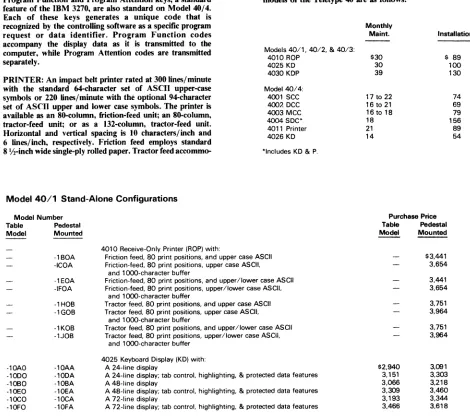
MODEL 40 PRINTERS: A full-character impact belt printer rated at 300 lines/minute with the standard 64-character set of ASCII upper-case symbols or 220 lines/minute with the
optional 94-character set of ASCII upper and lower case symbols. The printer is available as an 80-column, friction-feed unit; an 80-column, tractor-friction-feed unit; as a 132-column, tractor-feed unit; or an 80-column forms access unit. The forms access unit contains a tractor feed located below the print line, so that a form that has just been printed can be removed without destroying the next (unprinted) form. Horizontal and vertical spacing is 10 characters/inch and 6 lines/inch, respectively. Friction feed employs standard 81;1-inch wide single-ply rolled paper. Tractor feed accommodates pin-fed, 6-part, continuous forms from 41/ 8-to 91;1-inches wide for the 80-column unit or from 4Ys- to 15-inches wide for the 132-column unit. Form lengths is controlled by a "forms out belt;" the standard belt prints forms of 23;.1,3-2/3,5112, or II inches in length; optional belts can accommodate forms from 2.5 to 22 inches in length.
4420 & 4430 PRINTERS: Two models are optionally available: the Model 40 line printer, and the Model 43 receive-only character printer. The Model 40 features 80 or 132 column printing at 300 lines per minute speeds. Forms are fed via a tractor feed mechanism. Horizontal and vertical tabulation is standard. The printer can be located up to 2000 feet from the display. The Model 43 is available with either pin feed or friction feed mechanism. The unit can print 80 columns using the friction feed, or 132 columns using the pin feed. Print rate is 30 characters per second. The Model 43 can be located up to 50 feet from the display. Printer and paper alarms are standard, and pedestal stands are optional. PRICING
The Model 40 can be obtained from Teletype on a purchase only basis. Functional discounts are available to qualified customers.
Monthly maintenance and installation prices are as follows:
Models 40/1, 4012, & 40/3: 4025 KD
4030 KDP Model 40/4 4420 Keyboard Display 4430 Keyboard Display
Monthly Maint.
$30 39 20 to 35 19 to 31 19 to 31
Installation
$ 45 145 70 82 82
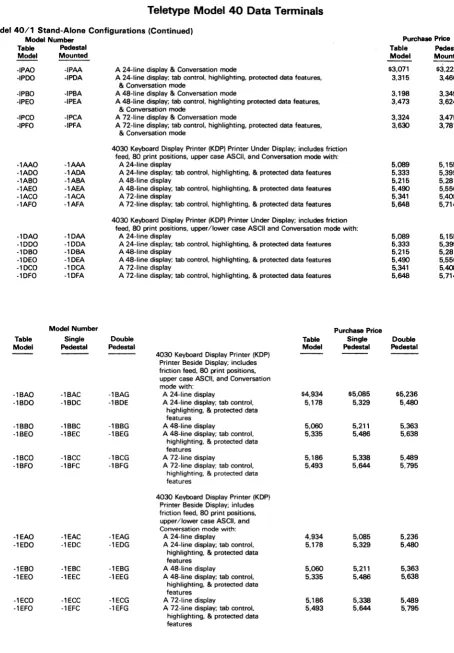
Model 40 Receive-Only Printer/Controllers (for Model 40/1 and 40/2 Configurations)
4010 Receive·Only Printer/Controller (ROP)
(includes 80 print positions, upper or upper/lower case ASCII, 6 or 8 lines per inch; four models available)
Model 40/1 Stand-Alone Configurations
4025 Tabletop Keyboard Display (KD)
(includes 24-, 48-, or 72-line display; tab contro/' highlighting. protected data. conversation mode, and printer port available; 12 models available)
Model 40/2 Stand-Alone Configurations
4025 Tabletop Keyboard Display (KD)
(includes 24-, 48-, or 72-line display; tab control, highlighting, protected data, and printer port available; 12 models available)
Model 40/3 Stand-Alone Configurations
4000 Station Controller
Purchase Price
$6,942
$5,118 to 6,607 .
$5,883 to 6,778
(double pedestal; 105 or 120 cps) $1.665 to 1.671 . .
C25-830-106 Display Terminals
Teletype Model 40, 4420 &
4430 Data Terminals
. . Model 40/3 Stand-Alone Configurations (Continued)
4030 Keyboard Display Printer (KDP) Printer Beside Display
(includes friction feed, 80 print positions, upper or upper/lower case ASCII, 24-,48-, or 72-line display, tab control, highlighting, and protected data; single or double pedestal)
4030 Keyboard Display Printer (KDP) Printer Beside Display
(includes tractor feed, 80 print positions, upper or upper/lower case ASCII, 24-, 48-, or 72-line display, tab control, highlighting, and protected data; single pedestal)
Model 40/4 Stand-Alone Configurations
4004 Single Display Controller (SOC); for mUlti-point private line facilities; provides support for: One Keyboard Display and one printer with 29-inch top
One Keyboard Display and one printer with 27-inch slotted top
4005 Single Display Controller (SOC); for switched network facilities; provides support for: One Keyboard Display and one printer with 29-inch top
One Keyboard Display and one printer with 27-inch top 4010 Receive-O nly Printer/Controller
(includes 80- or 132-column tractor feed, 48-char. ASCII/EBCDIC set, 64-char. ASCII or EBCDIC set, 96-char. ASCII or EBCDIC set)
4025 Single Display Controller & Keyboard Display (SOC & KD) with attached keyboard (for mUlti-point or switched network facilities; includes typewriter keyboard; internal or internal numeric cluster available; six models available)
4026 Keyboard Display (KD)
(includes detached typewriter keyboard; integral or external numeric cluster available)
Model 40 Printers
4011 Printer (P)
(includes friction, tractor, or forms access feed; 80 or 132 print positions; ASCII or EBCDIC code; 6 or 8 lines per inch available; ribbon mechanism available)
Model 4420 Stand-Alone Configuration
4420 Keyboard Display (KD)
(includes detached keyboard; numeric pad available)
Model 4430 Stand-Alone Configuration
4430 Keyboard Display (MPPL)
Model 4400 Printers
Model 43 RO
(pin feed, 132 print positions) Model 40 Line Printer
(tractor feed, 132 print positions)
© 1981 DATAPRO RESEARCH CORPORATION, DELRAN, NJ 08075 USA REPRODUCTION PROHIBITED
Purchase Price
$10,155 to 10,960
$10,815 to 11,345
$3,420 3,423
3,420 3,423
$6,170 to 7,295
$4,785 to 5,012
$1,565 to 1,712
$3,820 to 5,170
$3,928 to 4,038
$4,969
$1,388
$5,133.