S T U D Y P R O T O C O L
Open Access
Comparison of clinical outcomes following
percutaneous coronary intervention versus
optimal medical therapy based on
gray-zone fractional flow reserve in stable
angina patients with intermediate coronary
artery stenosis (COMFORTABLE prospective
study): Study protocol for a multicenter
randomized controlled trial
Hironori Kitabata
1*, Takashi Kubo
1, Yasutsugu Shiono
1, Kunihiro Shimamura
1, Yasushi Ino
1, Takashi Tanimoto
2,
Yasushi Hayashi
3, Kenichi Komukai
4, Hiromichi Sougawa
5, Keizo Kimura
6, Masahiro Gohda
7, Toshikazu Hashizume
8,
Masahiro Obana
9, Kazuisa Maeda
10, Junichi Yamaguchi
11and Takashi Akasaka
1Abstract
Background:Even in the current drug-eluting stent era, revascularization for coronary stenosis with fractional flow reserve (FFR) between 0.75 and 0.80, the so-called“gray zone,”is a matter of debate. Previous studies have reported conflicting results regarding outcomes of revascularization versus deferral for coronary stenosis when FFR values are in the gray zone, but these studies have had differing designs and populations. We therefore will investigate whether medical therapy plus percutaneous coronary intervention (PCI) is superior to medical therapy alone in reducing major cardiovascular events in patients presenting with coronary stenosis with gray zone FFR values.
Methods/design:This is a prospective, multicenter, open-label, parallel group, randomized, controlled, superiority study. A total of 410 eligible participants will be recruited and randomized to either the medical therapy plus PCI group or the medical therapy alone group. The primary endpoint is 1-year major adverse cardiac events (MACEs), defined as a combined endpoint of all-cause death, nonfatal myocardial infarction (MI), or unplanned target vessel revascularization (TVR). Secondary endpoints include MACE at 2 and 5 years. Moreover, each individual component of the primary endpoint, cardiovascular death, target vessel-related and non-target vessel-related MI, all MI, clinically driven TVR or non-TVR, all revascularization, stent thrombosis, and angina symptom status will be evaluated at 1, 2, and 5 years.
(Continued on next page)
* Correspondence:[email protected]
1Department of Cardiovascular Medicine, Wakayama Medical University, 811-1, Kimiidera, Wakayama, Wakayama 641-8509, Japan
Full list of author information is available at the end of the article
(Continued from previous page)
Discussion:This is the first prospective, multicenter, randomized, controlled study to investigate the superiority of medical therapy plus PCI over medical therapy by itself in reducing major cardiovascular events in patients presenting with coronary stenosis with“gray zone”FFR values. The results will help interventional cardiologists in making revascularization decisions regarding coronary stenosis with gray zone FFR values.
Trial registration:University Hospital Medical Information Network Clinical Trials Registry,UMIN000031526. Registered on 1 March 2018.
Keywords:Coronary physiology, Fractional flow reserve, Medical therapy, Percutaneous coronary intervention
Background
Coronary physiological assessment can more effectively guide management decisions on intermediate coronary stenotic lesions than coronary anatomical assessment. This allows determination of whether the patient would benefit from revascularization or medical therapy.
Fractional flow reserve (FFR) is an established invasive index for determination of the functional severity of a coronary stenosis. FFR values < 0.75 were shown to be associated with inducible myocardial ischemia with > 99% positive predictive value [1]. The DEFER study (De-ferral versus performance of percutaneous coronary intervention (PCI) of functionally non-significant coron-ary stenosis) has since demonstrated that PCI can be safely deferred in coronary stenosis with FFR≥0.75 [2]. In addition, at 15-year follow-up, it was reported that the rate of myocardial infarction (MI) was significantly lower in the deferred group than in the revascularization group (2.2% versus 10%) [3]. On the contrary, PCI for coronary stenosis with FFR≤0.80, compared with med-ical therapy by itself, is associated with improved clinmed-ical outcomes [4–8]. Nonetheless, revascularization for cor-onary stenosis with FFR between 0.75 and 0.80, the so-called gray zone, is still an unresolved issue. Owing to differing study designs and populations, previous studies have reported conflicting results regarding outcomes of revascularization versus deferral for coronary stenosis with gray zone FFR values [9–17].
We therefore will conduct a prospective, multicenter, randomized, controlled trial to investigate whether med-ical therapy plus PCI is superior to medmed-ical therapy alone in reducing major cardiovascular events in patients pre-senting with coronary stenosis with gray zone FFR values.
Methods/design
Study design
The Comparison of clinical outcomes following percu-taneous coronary intervention versus optimal medical therapy based on gray zone fractional flow reserve in stable angina patients with intermediate coronary artery stenosis (COMFORTABLE) study is designed as a pro-spective, multicenter, open-label, parallel group, ran-domized, controlled, superiority study. This study is
being conducted across 11 hospitals in Wakayama Prefecture and Tokyo, Japan. A total of 410 eligible participants will be recruited and randomized into ei-ther the performed PCI group or the deferred PCI group, with an allocation ratio of 1:1. Recruitment will begin soon.
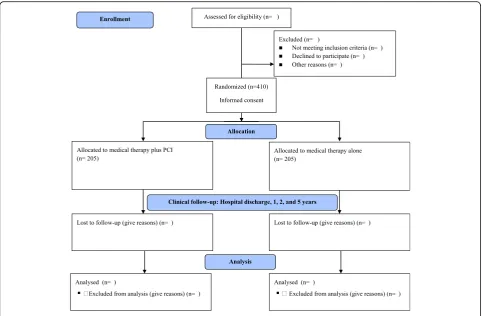
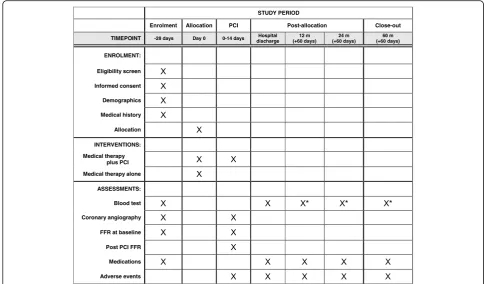
The protocol structure was written in compliance with the Consolidated Standards of Reporting Trials (CON-SORT) 2010 statement guidelines, and it follows the Standard Protocol Items: Recommendations for Inter-ventional Trials (SPIRIT) 2013 statement. Figure 1
shows the CONSORT diagram of this study, and Fig.2
shows the SPIRIT schedule. The complete SPIRIT check-list for the study is provided in Additional file1.
Objective
The aim of this study is to determine whether medical therapy plus PCI is superior to medical therapy by itself in reducing major cardiovascular events in patients pre-senting coronary stenosis with“gray zone”FFR values.
Participants
Participants will be eligible for registration in this study if they meet all of the inclusion criteria and none of the exclusion criteria listed in the subsections below.
Inclusion criteria
1. Intermediate coronary stenosis presenting with an FFR between 0.75 and 0.80
2. Aged≥20 years
3. Able to provide written informed consent prior to any study-specific procedures
Exclusion criteria
1. Culprit vessel in acute coronary syndrome 2. Untreated significant lesions (percentage of
diameter stenosis > 70% and/or FFR < 0.75) in coronary arteries other than the target vessel 3. Unstable hemodynamics
4. Hemodialysis
6. Allergy to antiplatelet therapy, anticoagulants, or contrast medium
7. Intracranial and/or gastrointestinal bleeding 8. Planned surgical procedure within 12 months 9. Life expectancy < 1 year
10. Pregnancy
11. Severe valvular heart disease
12. Participation in clinical trials of other devices or drugs
13. Left main coronary artery (LMCA) disease
(percentage of diameter stenosis > 50%) or planned PCI for LMCA disease
14. Chronic total occlusions
15. Heavily calcified or tortuous vessels, meaning inability to cross the lesion with a pressure wire is expected
16. Diffuse diseases, heavily calcified lesions, small vessels, and/or aneurysmal lesions, meaning PCI is thought to be unsuitable by operators
Randomization
Eligible participants will be allocated to one of the two groups (medical therapy plus PCI group or medical ther-apy alone group) by the online randomization system. Balanced randomization based on critical variables
(diabetes, age, sex, and institution) will be performed automatically by the randomization algorithm. Know-ledge of the treatment allocation is open to the investi-gators and participants.
Sample size calculation
On the basis of event rates of previous studies that eval-uated deferred versus performed revascularization in pa-tients presenting coronary stenosis with gray zone FFR values, we predicted that the event rates at 1 year would be 6.4% in the revascularization group and 16% in the deferred group [15]. Under the above event rates and the hypothesis that the crossover rate from the medical therapy alone arm to the PCI arm is 5%, we calculated that a sample size of 368 patients (184 per arm) would provide the trial with 80% power to detect the superior-ity of medical therapy plus PCI over medical therapy by itself, at a two-sided alpha level of 5%. Assuming a drop-out rate of 10% (patients lost to follow-up or patients unsuitable for analysis), the target sample size was set at 410 patients (205 per arm).
Endpoints
[image:3.595.57.540.87.403.2]all-cause death, nonfatal MI, or unplanned target vessel revascularization (TVR). Secondary endpoints will in-clude MACE at 2 and 5 years. Each individual compo-nent of the primary endpoint, cardiovascular death, target vessel-related and non-target vessel-related MI, all MI, clinically driven TVR or non-TVR, all revasculariza-tion, stent thrombosis, and angina symptom status will also be evaluated at 1-, 2-, and 5-year follow-up. All-cause death is defined as death of any cause, cardio-vascular as well as noncardiocardio-vascular. MI is defined as a clinical episode of typical chest pain with development of new Q waves in at least two contiguous leads on an electrocardiogram or elevation of the creatine kinase myocardial band fraction (spontaneous, above the upper reference limit; periprocedural, more than three times the upper reference limit). Unplanned revascularization is defined as any unexpected coronary revascularization (PCI or CABG) during the follow-up period after the index procedure. TVR is defined as any repeat revascu-larization of any segment of the target vessel by either PCI (additional stent or angioplasty) or CABG. TVR will be considered to be ischemia-driven if revascularization is performed on a patient who has ischemic signs con-firmed by noninvasive tests or FFR reassessment (with an inducible ischemia cutoff set at < 0.75), despite the presence or absence of ischemic symptoms. TVR will be considered to be clinically driven if revascularization is
performed on a patient who has ischemic signs con-firmed by noninvasive tests or FFR reassessment and clinical symptoms, such as chest pain that increases in frequency, intensity, or duration. Stent thrombosis is de-fined according to Academic Research Consortium def-inition [18]. Anginal status is assessed by Canadian Cardiovascular Society functional classification of an-gina. Clinical events are adjudicated by an independent and blinded clinical event committee.
Coronary angiography
Coronary angiography will be performed in the stand-ard manner via a transradial or transfemoral approach in each center. Intracoronary (IC) isosorbide dinitrate or nitroglycerin is administered in all cases preceding coronary angiography. A coronary angiogram is ob-tained from a standard series of six to eight projections for the left coronary artery and two or three projections for the right coronary artery. All images are stored on a CD-ROM for offline analysis. Diameter stenosis, mini-mum lumen diameter, lesion length, and reference lumen diameter will be measured by using dedicated software for quantitative coronary angiography (CASS-5; Pie Medical, Maastricht, The Netherlands). Quantitative coronary angiographic analysis is con-ducted at the Core Laboratory of Wakayama Medical University, Wakayama, Japan.
[image:4.595.54.541.88.372.2]FFR measurement
IC pressure will be measured using a pressure wire sys-tem (PressureWire, Abbot Vascular, Santa Clara, CA, USA; Smartwire, Philips Volcano, San Diego, CA, USA; Comet, Boston Scientific, Marlborough, MA, USA; or OptoWire, Zeon Medical, Tokyo, Japan). FFR measure-ment will be done as reported previously [17]. In brief, following pressure zero-calibration and equalization, the pressure wire will be placed in the distal part of the tar-get coronary artery. IC nitroglycerin is administered prior to FFR measurement. FFR is calculated as the mean distal coronary pressure, measured by the pressure wire, divided by the mean aortic pressure, simultan-eously measured by the guiding catheter during maximal hyperemia. Maximal hyperemia will be induced by intra-venous continuous infusion of adenosine 5′-triphosphate (ATP), given at 180μg/kg/min via the forearm or fem-oral vein. If maximal hyperemia is suspicious, additional IC papaverine (12 mg for left coronary artery or 8 mg for right coronary artery), IC nicorandil (2 mg for both cor-onary arteries), or IC ATP (50μg for left coronary artery or 25μg for right coronary artery) administration will be recommended. In case of contraindication to ATP, IC papaverine or IC nicorandil should be administered al-ternatively. After distal pressure measurement is done, the pressure sensor is pulled back to the ostium of the guiding catheter during maximal hyperemia, and both pressures are checked to exclude any transducer drift. Where drift is evident (Pd/Pa < 0.98 or > 1.02 measured at the level of the catheter tip), measurements should be repeated. Because caffeine attenuates ATP-induced hyperemia by blocking activation of adenosine A2a ceptor in vascular smooth muscles, patients should re-frain from consuming products containing caffeine 24 h (at least 12 h) before FFR measurement [19,20].
PCI
In the medical therapy plus PCI group, PCI will be per-formed in the standard manner according to clinical guidelines at the time of the procedure by using cur-rently available second-generation or third-generation drug-eluting stents (DES). The choice of approach site (transradial or transfemoral) is at the operator’s discre-tion. Also, the type of DES and the use of intravascular imaging are at the discretion of the operator. Patients who underwent PCI will be treated with aspirin (100 mg/day) and thienopyridines (clopidogrel 75 mg/day or prasugrel 3.75 mg/day) for at least 6 months, followed by aspirin indefinitely.
Medical therapy
Guideline-directed optimal medical therapy will be ap-plied to all participants, regardless of the treatment arm.
Data collection and follow-up
The data will be collected using a web-based dedicated case report form. All data management and analysis will be performed centrally at the Department of Cardiovas-cular Medicine at the coordinating center (Wakayama Medical University, Wakayama, Japan). Members of the coordinating Center monitor and verify the data in the participating hospitals. Clinical follow-up will be per-formed during hospitalization; at discharge; and at 1 year, 2 years, and 5 years after allocation. The patient’s clinical status, medications, and adverse events will be evaluated and recorded during office visits or by quali-fied personnel via telephone contacts if office visits are impractical or impossible.
Safety monitoring
Safety is observed throughout the study. During the study period, all participants will be monitored and eval-uated for clinical events and any other adverse events by the data and safety monitoring committee.
Statistical analysis
Continuous variables will be summarized as mean ± SD or median (IQR) for skewed data, and comparisons will be made using an unpaired Student’s t test or Mann-Whitney’ U test as appropriate. Categorical vari-ables will be summarized as number (%), and compari-sons will be made using the chi-square test or Fisher’s exact test as appropriate. Kaplan-Meier survival analysis curves will be used to assess clinical event timelines and will be compared with the log-rank test. Also, in time-to-event analyses, the treatment groups will be compared using a Cox proportional hazards model, and the results will be expressed as an HR with 95% CI. Values ofp< 0.05 will be considered statistically signifi-cant. All statistical analyses will be conducted using JMP Pro version 14 software (SAS Institute, Cary, NC, USA).
Discussion
clinical decision for PCI or medical therapy has been left entirely to the operator’s discretion.
The COMFORTABLE prospective study will be the first prospective, multicenter, randomized, controlled study to prove the superiority of medical therapy plus PCI over medical therapy alone in reducing major car-diovascular events in patients presenting with coronary stenosis with gray zone FFR values. The results of the COMFORTABLE prospective study will help interven-tional cardiologists guide revascularization decisions for coronary stenosis with gray zone FFR values.
This study has several limitations, the most important being its open-label nature. We cannot entirely exclude the possibility that the treatment strategy will be modi-fied, because the arm of treatment to which the patient has been allocated will be known. Second, an FFR value is limited by its reliance on the achievement of maximal hyperemia. Failure to achieve peak hyperemia, by not achieving maximal reduction in microvascular resistance, may result in overestimation of FFR and lead to wrong decision-making, especially in coronary stenosis with an FFR value in and around the“gray zone” [11]. For these reasons, in this study, we will use intravenous ATP admin-istration to induce steady-state maximal hyperemia, and additional IC papaverine, nicorandil, or ATP should be ad-ministered if maximal hyperemia is suspicious.
Trial status
The Wakayama Medical University Institutional Review Board approved the final version of the protocol prior to the start of the study (approval number 2234). The study is registered with the University Hospital Medical Informa-tion Network Clinical Trials Registry (UMIN000031526). The trial will open for recruitment soon.
Additional file
Additional file 1:SPIRIT 2013 Checklist: Recommended items to address in a clinical trial protocol and related documents. (DOC 122 kb)
Abbreviations
ATP:Adenosine 5′-triphosphate; CABG: Coronary artery bypass grafting; CONSORT: Consolidated Standards of Reporting Trials; DES: Drug-eluting stent; FFR: Fractional flow reserve; IC: Intracoronary; LMCA: Left main coronary artery; MACE: Major adverse cardiac event; MI: Myocardial infarction; PCI: Percutaneous coronary intervention; SPIRIT: Standard Protocol Items: Recommendations for Interventional Trials; TVR: Target vessel revascularization
Acknowledgements
We acknowledge proofreading by Benjamin Phillis at the Clinical Study Support Center, Wakayama Medical University.
Funding
This study is supported by the Japan Research Foundation for Healthy Aging. This funding body is only providing financial support and has no role in the design of the study protocol, the writing of the manuscript, the analysis and interpretation of the data, or the decision to submit the report for publication.
Availability of data and materials
Not applicable.
Authors’contributions
HK, TK, and YS designed the study protocol and drafted the manuscript. TA further aided in assessment and revision of the protocol and revised the manuscript. The COMFORTABLE study group members, including KS, YI, TT, YH, KK, HS, KK, MG, TH, MO, KM, and JY, contributed to the initial conception of the study design. YS provided the statistical analysis. All authors carefully read and approved the final version of the manuscript.
Ethics approval and consent to participate
The study is conducted in accordance with the Declaration of Helsinki. Wakayama Medical University Institutional Review Board approved the final version of the protocol (version 1.1) prior to the start of the study (approval number: 2234). This study was registered on the University Hospital Medical Information Network Clinical Trials Registry (UMIN000031526). Written informed consent will be obtained from all participants in the study.
Consent for publication
Not applicable.
Competing interests
The authors declare that they have no competing interests.
Publisher’s Note
Springer Nature remains neutral with regard to jurisdictional claims in published maps and institutional affiliations.
Author details
1Department of Cardiovascular Medicine, Wakayama Medical University, 811-1, Kimiidera, Wakayama, Wakayama 641-8509, Japan.2Department of Cardiovascular Medicine, Shingu Municipal Medical Center, 18-7 Hachibuse, Shingu, Wakayama 647-0072, Japan.3Department of Cardiovascular Medicine, Wakayama Rosai Hospital, 93-1 Kinomoto, Wakayama, Wakayama 640-8505, Japan.4Department of Cardiovascular Medicine, Hidaka General Hospital, 116-2 Sono, Gobo, Wakayama 644-0002, Japan.5Department of Cardiovascular Medicine, Hashimoto Municipal Hospital, 2-8-1Ominedai, Hashimoto, Wakayama 648-0005, Japan.6Department of Cardiovascular Medicine, Kinan Hospital, 46-7 Shinjocho, Tanabe, Wakayama 646-8588, Japan.7Department of Cardiovascular Medicine, Seiyu Memorial Hospital, 391 Nishitai, Wakayama 649-6335, Japan.8Department of Cardiovascular Medicine, Minami Wakayama Medical Center, 27-1 Takinaicho, Tanabe, Wakayama 646-8558, Japan.9Department of Cardiovascular Medicine, Saiseikai Wakayama Hospital, 45 Junibancho, Wakayama 640-8158, Japan. 10Department of Cardiovascular Medicine, Naga Municipal Hospital, 1282 Uchita, Kinokawa 649-6414, Japan.11Department of Cardiology, The Heart Institute of Japan, Tokyo Women’s Medical University, 8-1 Kawada-cho, Shinjuku-ku, Tokyo 162-8666, Japan.
Received: 5 December 2018 Accepted: 7 January 2019
References
1. Pijls NH, De Bruyne B, Peels K, Van Der Voort PH, Bonnier HJ, Bartunek J, Koolen JJ, et al. Measurement of fractional flow reserve to assess the functional severity of coronary-artery stenoses. N Engl J Med. 1996;334:1703–8. 2. Pijls NH, Van Schaardenburgh P, Manoharan G, Boersma E, Bech JW, Van’t
Veer M, et al. Percutaneous coronary intervention of functionally nonsignificant stenosis: 5-year follow-up of the DEFER Study. J Am Coll Cardiol. 2007;49:2105–11.
3. Zimmermann FM, Ferrara A, Johnson NP, Van Nunen LX, Escaned J, Albertsson P, et al. Deferral vs. performance of percutaneous coronary intervention of functionally non-significant coronary stenosis: 15-year follow-up of the DEFER trial. Eur Heart J. 2015;36:3182–8.
4. Tonino PA, De Bruyne B, Pijls NH, Siebert U, Ikeno F, Van’t Veer M, et al. Fractional flow reserve versus angiography for guiding percutaneous coronary intervention. N Engl J Med. 2009;360:213–24.
2-year follow-up of the FAME (Fractional Flow Reserve Versus Angiography for Multivessel Evaluation) study. J Am Coll Cardiol. 2010;56:177–84.
6. De Bruyne B, Pijls NH, Kalesan B, Barbato E, Tonino PA, Piroth Z, et al. Fractional flow reserve-guided PCI versus medical therapy in stable coronary disease. N Engl J Med. 2012;367:991–1001.
7. De Bruyne B, Fearon WF, Pijls NH, Barbato E, Tonino P, Piroth Z, et al. Fractional flow reserve-guided PCI for stable coronary artery disease. N Engl J Med. 2014;371:1208–17.
8. Van Nunen LX, Zimmermann FM, Tonino PA, Barbato E, Baumbach A, Engstrøm T, et al. Fractional flow reserve versus angiography for guidance of PCI in patients with multivessel coronary artery disease (FAME): 5-year follow-up of a randomised controlled trial. Lancet. 2015;386:1853–60. 9. Courtis J, Rodés-Cabau J, Larose E, Déry J-P, Nguyen CM, Proulx G, et al.
Comparison of medical treatment and coronary revascularization in patients with moderate coronary lesions and borderline fractional flow reserve measurements. Catheter Cardiovasc Interv. 2008;71:541–8.
10. Lindstaedt M, Halilcavusogullari Y, Yazar A, Holland-Letz T, Bojara W, Mügge A, et al. Clinical outcome following conservative vs revascularization therapy in patients with stable coronary artery disease and borderline fractional flow reserve measurements. Clin Cardiol. 2010;33:77–83.
11. Petraco R, Sen S, Nijjer S, Echavarria-Pinto M, Escaned J, Francis DP, et al. Fractional flow reserve-guided revascularization: practical implications of a diagnostic gray zone and measurement variability on clinical decisions. JACC Cardiovasc Interv. 2013;6:222–5.
12. Shiono Y, Kubo T, Tanaka A, Ino Y, Yamaguchi T, Tanimoto T, et al. Long-term outcome after deferral of revascularization in patients with intermediate coronary stenosis and gray-zone fractional flow reserve. Circ J. 2014;79:91–5.
13. Yamashita J, Tanaka N, Shindo N, Ogawa M, Kimura Y, Sakoda K, et al. Seven-year clinical outcomes of patients with moderate coronary artery stenosis after deferral of revascularization based on gray-zone fractional flow reserve. Cardiovasc Interv Ther. 2015;30:209–15.
14. Adjedj J, De Bruyne B, Flore V, Di Gioia G, Ferrara A, Pellicano M, et al. Significance of intermediate values of fractional flow reserve in patients with coronary artery disease. Circulation. 2016;133:502–8.
15. Agarwal SK, Kasula S, Edupuganti MM, Raina S, Shailesh F, Almomani A, et al. Clinical decision-making for the hemodynamic“gray zone”(FFR 0.75-0. 80) and long-term outcomes. J Invasive Cardiol. 2017;29:371–6. 16. Kang DY, Ahn JM, Lee CH, Lee PH, Park DW, Kang SJ, et al. Deferred vs.
performed revascularization for coronary stenosis with grey-zone fractional flow reserve values: data from the IRIS-FFR registry. Eur Heart J. 2018;39:1610–9. 17. Kubo T, Takahata M, Terada K, Mori K, Arita Y, Ino Y, et al. Retrospective
comparison of long-term clinical outcomes between percutaneous coronary intervention and medical therapy in stable coronary artery disease with gray zone fractional flow reserve - COMFORTABLE retrospective study. Circ J. 2018;82:3044–51.
18. Cutlip DE, Windecker S, Mehran R, Boam A, Cohen DJ, Van Es GA, et al. Clinical end points in coronary stent trials: a case of standardized definitions. Circulation. 2007;115:2344–51.
19. Matsumoto H, Nakatsuma K, Shimada T, Ushimaru S, Mikuri M, Yamazaki T, et al. Effect of caffeine on intravenous adenosine-induced hyperemia in fractional flow reserve measurement. J Invasive Cardiol. 2014;26:580–5. 20. Matsumoto H, Ushimaru S, Matsuda T, Shimada T, Mikuri M, Takahashi H, et