Digital
Technical
Journal
I
SPIRALOG LOG-STRUCTURED FILE SYSTEM
OPENVMS FOR 64-BIT ADDRESSABLE VIRTUAL MEMORY
HIGH-PERFORMANCE MESSAGE PASSING FOR CLUSTERS
SPEECH RECOGNITION SOFTWARE
Editorial
Jane C. Blake, Managing Editor Kathleen M. Stetson, Editor Helen L. Patterson, Editor
Circulation
Catherine M. Phillips, Administrator Dorothea B. Cassady, Secretary
Production
Terri Autieri, Production Editor Anne S. Katzdf, Typographer Peter R.. Woodbury, Illustrator Advisory Board
Samuel H. fuller, Chairman Richard W. Beane
Donald Z. Harbert
William R. Hawe
Richard J. Hollingsworth William A. Laing Richard F. Lary Alan G. Nemeth Pauline A. Nist Robert M. Supnik
Cover Design
Digital's new Spiralog rile system, a featured topic in the issue, supports rid! 64-bit system capability and fast backup and is integrated with the Open VMS 64-bit version 7.0 oper ating system. The cover graphic captures the inspired character of the Spiralog design effort and illustrates a concept taken from University of California research in which the whole disk is treated as a single, sequen tial log and all file system modifications arc appended to the tail of the log.
The cover was designed by Lucinda O'Neill of Digital's Design Group using images fi·om Photo Disc, Inc., copyright 1996.
The Digital Teclmica/juumal is a refereed journal published quarterly by Digital Equipment Corporation, 30 Porter Road L)02/DIO, Littleton, MA 0!460. Subscriptions can be ordered by sending a check in U.S. ti.mds (made payable to Digital Equipment Corporation) to the published-by address. General subscrip tion rates arc $40.00 (non-U.S. $60) for rour issues and $75.00 (non-U.S. $!15) for eight issues. University and college pro fessors and Ph.D. students in the electrical engineering and computer science fields receive complimentary subscriptions upon request. Digital's customers may qualify for gift subscriptions and arc encouraged to contact their account representatives. Single copies and back issues are available ri:>r $16.00 (non-U.S. $18) each and can
be ordered by sending the requested issue's volume and number and a check to the published-by address. Sec the Further Readings section in the back of this issue ror a complete listing. Recent issues arc
also available on the Internet at
http:/ /www.digital.com/info/dtj. Digital employees may order subscrip tions through Readers Choice at UR.L http:/ jwebrc.das.dec.com or by
enter-ing VTX PROfiLE at the system prompt. Inquiries, address changes, and compli mentary subscription orders can be sent
to the Digital Teclmical.fourna/ at the published-by address or the electronic mail address, [email protected]. Inquiries can also be made by calling thejoumal office at 508-486-2538.
Comments on the content of any paper arc welcomed and may be sent to the managing editor at the published-by or electronic mail address.
Copyright© 1996 Digital Equipment Corporation. Copying without fee is per mitted provided that such copies are made for usc in educational institutions by faculty members and are not distributed for com mercial advantage. Abstracting with credit of Digital Equipment Corporation's auth orship is permitted.
The information in the journal is subject to change without notice and should not be construed as a commitment by Digital Equipment Corporation or by the compa nies herein represented. Digital Equipment Corporation assumes no responsibility ror any errors that may appear in the Journal.
!SSN 0898-90 I X
Documentation Number EC-N6992-18 Book production was done by Quantic Communications, Inc.
The following arc trademarks of Digital Equipment Corporation: AlphaScrver, DEC, DECtalk, Digital, the DIGITAL
logo, HSC, Open VMS, PATH WORKS, POLYCENTER, RZ, TruCiuster, VAX, and VAXcluster.
BBN Hark is a trademark of Bolt Beranek and Newman Inc.
Encore is a registered trademark and
MEMORY CHANNEL is a trademark of Encore Computer Corporation.
FAScrver is a trademark of Network Appliance Corporation.
Listen for Windows is a trademark of Verbcx Voice Systems, Inc.
Microsoft and Win32 arc registered trade marks and Windows and Windows NT arc trademarks of Microsoft Corporation. MIPSpro is trademark of MIPS Technol ogies, 1 nc., a wholly owned subsidiary of Silicon Graphics, Inc.
Netscape Navigator is a trademark of Netscape Communications Corporation.
PAL is a rcgistcn:d trademark of Advanced Micro Devices, Inc.
UNIX is a registered trademark in the United States and in other countries, licensed exclusively through X/Open Company Ltd.
VoiceAssist is a trademark of Creative Labs, Inc.
Contents
Foreword
SPIRALOG LOG-STRUCTURED FILE SYSTEM
Overview of the Spira log File System
Design of the Server for the Spira log File System
Designing a Fast, On-line Backup System for a Log-structured File System
Integrating the Spira log File System into the OpenVMS Operating System
Rich Marcello
J ames E. Johnson and William A. Laing
Christopher Whitaker, ). Stu<lrt Bayl ey, �HJd Rod D. W. Widdo\\'son
Russell J. Green, Alasdair· C. B aird, and J. Christopher Davies
M ark A. Howell and Ju lian M. Palmer
Open VMS FOR 64-BIT ADDRESSABLE VIRTUAL MEMORY
Extending Open VMS for 64-bit Addressable Virtual Memory
The OpenVMS Mixed Pointer Size Environment
Michael S. H arvey and Leonard S. Szubo\\'icz
Thomas R . Benson, Kare n L. 'ocl, and Rich ard E. Peterson
Adding 64-bit Pointer Support to a 32-bit Run-time Library Duane A. Smith
HIGH-PERFORMANCE MESSAGE PASSING FOR CLUSTERS
3
5
15
32
46
5 7
7 2
S3
Building a High-performance Message-passing System for MEMORY CHANNEL Clusters
James V. Lawton, John). Brosnan, Morgan l'. Doyle, 96
SPEECH RECOGNITION SOFTWARE
The Design of User Interfaces for Digital Speech Recognition Software
Seosamh D . 6 Riordain, and Timothy G . Reddin
Bernard A. Rozmovits 117
2
Editor's
Introduction
This past spring when we sun·c\Td .founw/subscribcrs, readers rook the
rime ro commem on the parricula1· ,·aluc ofrhc issues fCawring Digital's 64-bir Alpha technology. The engi neering described in those two issues continues, with ever higher levels of pcrr(>rmance in Alpha microproces sors, servers, clusters, and systems software. This issue presents reccm developments: a log-structured file system, called Spiralog; the Open VMS opcr�1ting system extended ro take full a<hant�Jgc of64-bit addressing; high pcrf(mnancc computing software f{>r Alpha clusters; and speech recognition sofn,arc for Alpha workstations.
Spir�1log is a whollv new clusterwidc
file svsrcm integrated with the new 64-bir Open VMS version 7 .0 opcrat· ing system and is designed for high d�1ra avaibbiliry and high pert(xmancc. The tirst of four papers about Spira log is writtcn by Jim Johnson and Bill L1ing, wlw imroduce log-srrucrured file ( LfS) concepts, the university research behind the design, and design innO\'�ltions.
The <1dvantages of LFS technologv over com·emional "update-in-phcc" rcchnolog\' JI'C explained lw Chris Whir�1kcr, Stuart Baylcv, and Rod vViddowson. In their paper about the rile server design, they comp;m: rhc Spir;1log implementation of the LFS technology with others and describe the novel combination of the tcchnoi O!:,''Y with a R-trce mapping mechanism to provide the S\'Stcm with needed d�1t;1 recovery guarantees.
A third paper about Spiralog, \\Tittcn by Russ Green, Alasdair K1ird, �md Chris Davies, addresses a criric1l customer rcquirement hst, application-consistent, on-line
Digir:>l Technical journal
b�Kkup. Exploiting the features of log-structured storage, designers \\'ere �1blc ro combine rhe rlexibilin· of tile-based backup and the high pcdrml1�11KC ot' pll\'sical h· oriented lxKkup. Consistent copies of the file svstcm arc created \\'bile applications modi�' data.
The Spiralog integration into the Opcn VMS file system required th�1t existing <lpplications be able to run unchanged. M<!rk Howell and Julian P:�lmcr describe tbe integration of the \\'rirc-b�1ck c:�ching used in Spira log into the \\Tire-through em·ironmcnt used in the existing Fi\cs-11 tile S�'Stcm.
The imporL1nce of comp:�tibilin' h>r existing 32-bit applications in �1 64-bir environment is stressed :�g�1in in rhc set of three papers about the i<ltesr step in rhe evolution of'rhe Open VMS oper;1ting system. Digital first ported the 32-bir Open VMS opera ring system to the Alpha <1rchi tecture in 1992. The extension of rhe svsrcm ro exploit 64-bit \'irru:·tl addressing is presented bv Mike f-L!n·el' . �md Lennv Szubowicz. . Their discussion includes the team's
solution to signi6cant scaling issues rhat in\'(>h'cd �1 ne\\' approach to p;Jgc-rablc residenc\'.
The Open VMS ream anticipated rh�1r applications would mix 32- �1nd 64-lJit �1ddrcsscs, or pointers, in rhc new environment. Tom Benson, Karen Noel, and Rich Peterson explain why this mixing ofj ointer sizes is expected and the DEC C compiler solution thev developed ro support the practice. In a related dis cussion, Du�me Smith's paper revic\\·s ne\\' techniques the team used to �malyzc and modifv the C run-time librarv intcrtaces that accommochtc
Vol. 8 No.2 19':!6
:�pplicatiom using 32-bit, 64-bit, or both �1dd rcss sizes.
Designed f(>r scicntitic users, the p.!r;!llcl-programming tool ncx t described does not run on the Open VMS Alpha wstcm but instead on UNIX clusters connected with l'vlEMORY CHANNEL technologv. jim Lawton, John Brosnan, Morgan Doyle, Scosarnh () Riordain, and Tim Reddin rc\'iew the challenges in designing the TruCiustcr ,vn-:,vlOJ�Y CH ANNE1. SofTware product, which is a ll!Cssagc-passing s�·stcm intended t(>r builders of parallel software libr�1rics and implcmenrers of fl�H�!Ilcl compilers. The product reduces communicuions latenc\' to Jess than
10 f.lS in shared mcmor\' S\'stcms. Fin�1lly, Bernie RozmO\·its prcscnrs the design of user interfaces f(Jr the Digital Speech Recognition Software ( J)SRS) product. Although DSRS is r�ugctcd t(Jr Digital's Alpha work stations running UNIX, the impk· mcnt<1tion issues examined and the tum\ eft{>rrs ro ensure the prod uct's C�lsc-of-usc c1n be gcner<lllv �1pplicd to speech recognition prod uct dC\'Ciopmcnr.
Coming up arc p��pers on a ,·arictl' of topics, including the internet protocol, collaborati\·e SOIT\\':'ll'l: t(Jr the internet, and high-perk>nn�mcc servers. These topics rctlcct areas of imcrcst.frJ/11'/W/ readers rated ncar the rop in last spring's survcv. Our sincere th�1nks go ro C\'t:r\'onc \\'ho
responded ro that sun·ev.
Foreword
Rich Marcello
Vice President. Open VMS ,\)stems Sqfiu,are Group
The papers you will read in this issue ofthe.fournal describe how we in the Open VMS engineering community set out to bring the Open VMS oper ating system and our loyal customer base into the rwcnty-first century. The papers present both the develop ment issues and the technical chal lenges faced by the engineers who delivered the Open VMS operating system version 7.0 and the Spiralog file system, a new log-structured file system tor Open VMS.
We are extremely proud of the results of these efforts. In December
1995 at U.S. Fall DECUS (Digital Equipment Computer Users Society), Digital announced Open VMS version 7.0 and the Spiralog tile system as part of a first wave of product deliveries for the Open VMS Windows NT Nllnity Program. Open VMS version 7.0 pro vides the "unlimited high end" on which our customers can build their distributed computing environments and move toward the next millennium.
The release of Open VMS version 7.0 in January oftJ1is year represents the most significant engi11eering enhancement to the Open VMS oper ating system since Digital released
the VAXcluster system in 1983. Open VMS version 7.0 extends the 32-bit architecture of Open VMS
to a 64-bit <�rchitecture, allowing Open VMS Alpha users to fully exploit the 64-bit virtual address capacity of the Alpha architecture. As you will read in some of the papers in this issue, however, our design goal for Open VMS version 7.0 went beyond just delivering 64-bit virtual address capability to Open VMS users. It was
essential to us that Open VMS users be able to upgrade to version 7.0 with full compatibility tor their exist ing 32-bit applications.
In addition to achieving the sig nificant goals of 64-bit addressing and compatibility for 32-bit applica tions, version 7.0 includes very large memory (VLM ), very large database (VLDR ), fast 1/0, fast path, and symmetric multiprocessing (SMP) enhancements. These new features recently combined with the power of the Alpha architecture to earn Open VMS a world record tor perform ance. ln May of this year, Open VMS version 7.0 on an AlphaServer 8400 system configured with eight pro cessors and 8 gigabytes of memory, running Oracle's Rdb7 database <llld using the ACMS transaction processing monitor, set a new world record tor TPC-C pertormance on a single SMP system. Audited per tormance was 14,227 tpmC at $269 per tpmC. Just this past August, the combination of Open VMS version 7.0, Oracle's Rdb7 database, the ACMS monitor, and the AlphaServer 4100 system achieved world -record departmental server performance. The new world record was set on an AlphaServer 4100 5/400 system configured with four processors and 4 gigabytes of memory. ln audited benchmarks, the pertonnance results were 7,985 tpmC at $173 per tpmC. Such outstanding results are achiev able in a ti.ill 64-bit environment hardware architecture, operating systems, and applications such as Oracle's Rdb database. No other vendor today can deliver this power.
4
In E1ct, Digit�l has two 64-bit oper �uing s1·srems 1\'ith this po11·er: the OpenV/vlS �1nci the Digital U:-.JIX oper;ni ng SI'Stems.
As noted �1bm·e, Digit:ll inrrocluccd the OpenV1v!S operating system with SUflport f(lr full 64-bit l'irtual address ing at the s:1mc time it introduced the Spir;1log tile system, in Dt:cembcr 1995. The Spira log design is lmt:d on rhe Sprite log-structllred tile svs rem trom the University ofCalit(>rni;1, Berkeley. Wirh irs usc of this log
structured ;1pproaeh, Spira log offers Jll;1jor nell performance reatures, including t�1st, applicnion-consistcnr, on-line b;lckup. further, ir is fulk comparibk 11·irh customers' oisting
hies-II rile SI'Stems, and applications rh;H t·un 011 hles-11 will run on
Spir;Jiog 11·ith no modification. To
ddiver �111 of the re;nures we kit ll't:rc esscmd to mt:t:t the needs of our loval utstomer base, the Spiralog tc1m 0;1mined ;1t1d resoked a number of rechniul issues. The papers in this issue desuibe some ofrhe clullcnges rhe1· hcnl, including the decision to design ;1 hlcs-11 tile SI'Stcm emubrion.
The dcli1·crv ofrhe OpenVMS 1 crsion 7.0 operating SI'Stem and rhe Spir:1lug tile system are part of DigiL1I's continued commitment ro rhe Open VMS customer b:�se. These products reptTsent the work of dedi cated, t:demed engineering teams that h;we deployed state-ot�the-arr reehnology in products rhat ll'ill help our customers remain competiti1·e r(Jt-\'cars to come.
In the Open VMS group as else ll'hcre in Digital, 11·e are committt:d to excellence in the de,·clopmcnt and
Di1;ital Technical )ourn�l
delivnv o�· business computing solu tions. 'vVt: ll'ill continue to maint;lin
;Jnd cnluncc a product porr�(,lio th;1t meers our customers' need for true 24-hour bl' 365-dal' acct:ss ro theit-. . d�1t;1, ti.tll imegration wirh Microsof-t 'vVindows :-.rr enl'ironmenrs, and the full complement of network solutions ;1nd application software tor today and well into tht: next millennium.
Overview of the Spira log
File System
The OpenVMS Alpha environment requ i res a file system that supports its full 64-bit capabili ties. The Spiralog file system was developed to increase the capabilities of Digital's Files-11 file system for Open VMS. It incorporates ideas from a log-structured file system and an ordered write back model. The Spiralog file system provides improvements in data availability, scaling of the amount of storage easily managed, support for very large volume sizes, su pport for applications that are either write-operation or file-system operation intensive, and support for heteroge neous file system client types. The Spi ra log technology, which matches or exceeds the relia bility and device independence of the Files-11 system, was then integ rated into the Open VMS operating system.
I
James E. Johnson William A. Laing
Digital's Spiralog product is a log-structured , duster wide file system with i ntegrated , on-line backup and restore capability and support tor multiple tile sys tem personalities. It incorporates a number of recent ideas ti·om the research commu nity, i ncluding the log-structured tile system ( LFS) from the Sprite tile system and the ordered write back ti-om the Echo tile system.U
The Spiralog file system is fully integrated into the Open VMS operating system , providing compatibility with the current Open VMS file system, Files-ll. It supports a coherent, clusterwide write-behind cache and provides higb-pertonnance, on-line backup and per-file and per-volume restore functions.
In this paper, we first discuss the evolution of tile systems and the requirements tor many of the basic designs in the Spiralog tile system . Next we descri be the overall architecture of the Spiralog file system, identit),ing its major components and outlining their designs. Then we discuss the project's results: what worked well and what did not work so well. Finally, \Ve present some conclusions and ideas tor future work. Some of the major components, i . e . , the backup and restore facility, the LFS server, and OpcnVMS integration, are described in greater detail in compan ion papers in this issue .3-5
The Evolution of File Systems
File systems have existed throughout much of the his tory of computing. The need tor libraries or services that help to manage the collection of data on long term storage devices was recognized many years ago. The early support libraries have evolved into the tile systems of today. During their evolution, they have responded to the industry's improved hardware capa bilities and to users' increased expectations. Hardware has contin ued to decrease i n price and improve in its price/performance ratio. Consequently, ever larger amounts of data are stored and manipulated by users i n ever more sophisticated ways. As more and more data are stored on-line, the need to access that data 24 hours a day, 365 days a year has also escalated.
6
Signiticant improvements to file systems have been made in the t(>llowing areas:
• Direcrorv structures to ease locating data
• Device i ndependence of data access through the rile svstcm
• Accessi bil ity of the data to users on other svstems
• Avail;1bility of the thta, despite either planned or
unplanned service outages
• Reliability of the stored data and the pertc>rm:mn.: of the datJ JCCCSS
Requirements of the Open VMS File System
Since l977, the OpenVMS operating system has ofti..:rcd a stable, robust tile svstem known as Files-!!.
This tile system is considered to be very successfu l in the areas of reliab i l ity and device independence. Recent customer teed lxtck, however, indicated th;H the areas of data avaibbility, scaling of the ::tmounr of sror:�gc c:tsilv managed, support tor \'Cry large vol ume sizes, and support tc>r heterogeneous file system client types were in need of improvement.
The Spiralog project was initiated in response to customers' needs. We designed the Spiralog rile system
ro match or somewhat exceed the Files-1 1 system i n
its rel i ability and device independence. T h e focus of the Spir::tlog project was on those areas that were d u e tor improvement, notably:
• DatJ availability, especially d uring pJanned opera tions, such ::ts backup.
If the stor:tgc device needs to be taken offline to pcrtcm11 J backup, even at a very high backup rate of 20 megabytes per second ( Ml3/s), ;llmost 14 hours are needed to back up l terabyte. This length of service outage is clearly unacceptable. More typical backup rates of 1 to 2 M B/s can rake several davs, which, of course, is not acceptable.
• Grc:nlv increased scal ing in total amount of on-line storage, without greatly increasing the cost to man age rhar storage.
For example, 1 terabyte of d isk storage cutTcmly costs approxi mately $250,000, which i s well within the budget of many large computing centers. However, the cost in staff and rime to manage such amounts of storage can be many times th::tt of the storage.'' The cost of storage continues ro t�11I, whil e the cost of managing it continues to rise.
• Efkcrivc scaling as more processing and storage
resources become available.
For example, Open VMS Cluster systems aJlow pro cess i ng power and storage capacity to be added incrementally. Ir i s crucial that the software support
-Dig.it.tl Tcdtnic;tl jounul Vol. 8 No. 2 1996
ing the rile system scale as the processing power, bandwidth to storage, and storage capacity increase.
• Im proved performance tor applic:nions that arc either \\'rite-operation or tile-system-operation i mcnsivc.
As tile svsrem caches m main mcmor\' ha\'C i ncreased in capacitv, data reads and file svsrcm read opcr.nions have become satisf-ied more and more tl-om the cache. At the same time, nL1nv applica tions write large amounts of data or create and manipulate large numbers of tiles. The usc of redundant arrays of inexpensive disks (RAID) stor age has increased the available bandwidth r(>r d:na writes and rile system writes. Most tile system oper ations, on the other hand, are small writes and �1rc spread across the disk at random, often negating the bcndirs of RAID storage.
• lmpnl\'cd ;lbility to transparently access the stored data across several dissimilar client types.
Computing environments h ave become tncrcas ingly heterogeneous. Different client S\'Stcms, such as the W i ndo\\'S or the UNIX opccning S\'Stcm, store their nics on and share the ir ti les with scn·cr S\'Stcms such as the OpenVJ\1\S sen·cr. It Ius become ncccssJry to support the svn tax ;md scmJn rics ot-several ditkrcnr tile system personal ities on :1 common rile server.
These needs were central ro many design decisions we m::tdc t(lr the Spiralog tile system.
The mem bers of the Spiralog project eval uJtcd much of the ongoing work in file systems, dat:tbascs, :tnd storage architectures. RA.ID storage makes h igh bandwidth av:tiLlble to disk storage, but it requires large writes to be etiective. Dar:tbascs ha\'C exploited logs ;md the grouping of writes toget her to minimize the number ot' disk f/Os and disk seeks required. Databases and transaction systems have a lso exploited the tt:cbniquc of copving the tail of the log to dkct backups or data replication. The Sprite project at Berkeley had brought together a log-structured ri le system and RA.I D storage to good eftccr.1
By drawing rl·om the above ideas, parricul::trlv the insight of how a log structure could support on-line, h igh-pcrr(mnance backup, we began our dcvclopmcnr cft(>rt. We designed and built a distributed tile system rhar made extensive use of t he processor and me mory ncar the appl ication and used log-structured storage in the server.
Spiralog File System Design
F64 FSLIB
VPI SERVICES
Figure 1
FILE SYSTEM CLIENT
Spira log Structure Overview
BACKUP USER I NTERFACE
system client layer. It consists of a nu m ber of file system personal ities and the underlying personality independent services, which we call the V P I .
Two tile system personalities dominate t h e Spiralog design. The F64 personality is an emulation of the Files-l l fi le system . The fi le system library ( FSLIB ) personality i s an implementation of Microsoft's New Technology Advanced Server ( NTAS ) file services for
use by the PATHWORKS for Open VMS file server. The next l ayer, present on all systems, is the clerk layer. It supports a distributed cache and ordered write back to the LFS server, giving single-system semantics in a cluster configuration .
The LFS server, the third layer, is present on a l l des ignated server systems. This component is responsible for maintaining the on-disk log structure; it includes the cleaner, and it is accessed by multiple clerks. D isks can be connected to more than one LFS server, but they are served only by one LFS server at a time. Trans parent fail over, fi·om the point of view of the tlle sys tem client layer, is achieved by cooperation between the clerks and the surviving LFS servers.
The backup engine is present on a system with an active LFS server. It uses the LFS server to access the on-d isk data, and it interfaces to the clerk to ensure that the backup or restore operations are consistent with the clerk's cache.
Figure 2 shows a typical Spiralog cluster configura tion. I n this cl uster, the clerks on nodes A and B are accessing the Spira log volu mes. Normally, they use the LFS server on node C to access their data. I f node C should fail, the LFS server on node D would immedi ately provide access to the vol u mes. The clerks on nodes A and B would usc the LFS server on node D, retrying a ll their outstanding operations. Neither user application would detect any f�1ilure. Once node C had recovered , it would become the standby LFS server.
NODE A NODE B
USER APPLICATION USER APPLICATION
SPI RALOG CLERK SPI RALOG CLERK
ETHERNET
NODE C NODE D
SPI RALOG VOLUMES
Figure 2
Spiralog Cluster Configuration
File System Client Design
The file system client is responsible for the traditional fi le system fimctions. This l ayer provides fi les, directo ries, access arbitration, and file naming rules. It also provides the services that the user cal ls to access the file system .
VPI Services Layer The VPI layer provides an u nderly ing primitive file system i nterface, based on the U NIX V FS switch . The VPI layer has two overall goals:
1 . To support multiple file system personalities 2. To effectively scale to very large volumes of data
and very large n u m bers oftilcs
To meet the first goal, the VPI layer provides
• File names of 2 56 U nicode characters, with no reserved characters
• No restriction on directory depth
• Up to 2 5 5 sparse data streams per tile, each with 64-bit addressing
• Attributes with 2 5 5 Unicode character names, con taining values of up to l ,024 bytes
• Files and directories that are freely shared among fi le system personality mod ules
To meet the second goal, the V Pl layer provides
• File identifiers stored as 64-bit integers
• Directories through a B - tree, rather than a simple linear structure, for log(n) fi le name lookup time
The VPI layer is only a base for file system personali ties. Therefore it requires that such personalities are trusted components of the operating system. Moreover, it requ ires them to implement tile access security (although there is a convention tor storing access control l ist information ) and to perform all nec essary cleanup when a process or image terminates.
8
F64 File System Personality As �m.:viously stated, the Spira log product includes t\VO rile system personalities, F64 :111d fS U B . The f64 pcrson�1liry provides a sen·ice that emul ates the Files-! ! ri le S\'Stc m . ' I ts fu nctions, services, available ril e attrib utes, and execu tion bch�wiors :lrc simi lar to those in the Fi lcs-l l ril e S\'S tcm . i'vli nor d i fkrcnccs �li'C isobtcd i nt o areas that receive l ittle usc ti·om most applicuions .
F m instance, the Spiralog ti le svstcm su pports rhe \':lrious Files-! ! q ueued l/0 ( $Q I O ) par
J
mcters for reru ming ri le attri bute inf(mn�uion, because they are used i mplicit�\' or explicitly by most usn :1pplic:1tions . On the other hand, the h lcs-1 1 method of reading the ril e hea<.kr i n r(mmtion d i rectly through �1 tile cal led J N DEXf.SYS is nor com monlv used by applications �md is nor suppom . .:d .
The F64 rile svstcm pcrson�1liry demonstrates that rhc V PI layer con tains sufficient tlC\ibility ro su pport a complex ti le system inrnbcc. I n a n u m ber of cases, however, several V P I calls arc needed ro implement a single, complex Fi les-[ ] operation. For instance, ro
do a hie open operation, the F64 personality pcrr(xms the tasks listed below. The items th:tt end with ( V PI )
arc tasks that usc V P I service u lls to complete .
• Access rhc tile's p�1rcnt d irectory (V PI )
•
Re
ad the directory's rile �mributcs ( V P I )• Veri!-\• authorization r o rc1d t h e directory
• Loop , searching r(>r the tile name, by -Read i ng some dirccrorv entries ( V PI )
-Search ing the di rccrorv buftl.:r r()r the h ie name - Exiting the loop, i f rhc 1mtch is tcllll1d
• Access the target tile ( V P l )
•
R
ead rhc rile's attributes ( V I' ! )• Audit the h i e open �Htempt
FSLIB File System Personal ity The �S U B tile sysrem personal itv is J spcci�11izcd ri le system to support t he
PATHWO RKS rc>r Open VMS rile server. I rs nvo major
goals arc to support the tile 11amcs, attri butes, and bcha,·iors ti.n111d in
M
icrosoft's NTAS ri le access proto coJs, and ro provide low run-time cost rc>r processingNTAS tile svstcm req uests.
The PATHWO RKS server implements �1 ri le service t(Jr personal computer ( !'C) clients bycrcd on rop of the Filcs-1 1 tile system services. When NTAS service behaviors or ::�trri hu tcs do not match those of Files-l l , the PATHWO RKS server h:ts to e m u l ate the m . This can lead to checking security access permiss
i
ons nvice, mapping ri le names, and e m ulating rile Jttriburcs.Many of these pro blems can be avoided if the V PI interbcc is used directly. for instance, because the �SLI B pcrson:1l i
r
y docs nor laver on top of a Fi les-1 1 personalin·, sccurin· access checks do nor need to bepcrtcmm:d t\\'icc. fu rthermore, in a srraightrc>rward
design, there is 110 need to map across d i ftl.:renr tile
Dig:ire1l Tcchnic.d )oum,d Vol . � No. 2 l <J96
naming or attri bute rules. For rc1sons II'C describe later, in the V I' !
Res
ults section, we c hose nor ro p u r sue this design to its conclusion.Clerk Design
The c lerks arc respons i b l e tc>r m�maging the caches, determ ining the order o f writes out of rhc cache to the
LFS scn·cr, and mainL1i ning c:tche cohet-cnc\· ,,·ithin
a cluster. The caches arc write behind i n �1 111�1n ncr rhat preserves the order of dependent operations.
The cl erk-scn·cr protocol controls the rr:-�nskr of d:tta to and from stable storage . Data G il l he scm �1s a mu lti block :nomic \\Titc, �md oper�uions th�u ch�1ngc mu ltiple data items such as a rile re name em be made atomica l ly. I f a server tai ls du ring ;� request, the clerk treats the req u est as i f it were lost and retries rite request.
The clerk-server protocol is idempotent. I d e m potent operations cJn b e :tpplicd rcpcarcdlv with n o effects other t h a n t h e d esired o n e . Thus, a fter a n y n u m ber of server fai l u res or scn·cr tailovcrs, ir is alwavs sate to reissu e an operation. Clerk-to-server write operations always !ewe the ri le system stare consistent. The c lerk-clerk protocol protects the user data :1nd ti.Jc svstcm mctadatJ cached . lw the . cluks. C:�chc coherency i n r(Jrmarion, rather th�111 <.bra, is passed d i rect!\' between clerks.
The tile svsrcm caches a1-c kept in the clerks . iVI u l
tiple clerks can have copies ot'sta bi l i t.cd data , i.e. , <.bra rhat has been ll'ritten to the scn'Cr 11·ith the IITitc acknowledged . Onlv one c l er k can h�li'C unsL1bilizcd, volatile data.
D
ata is cschangcd between clerks b1·stabilizing it. vVhcn a clerk needs to \\Titc a block oF
data to the server ti·om i ts cache, it uses a rok.cn i mcr f:1ce t
h
at is layered o n the clerk-clerk proto co l .The ll'rites ti·om t h e c
:�
c hc to t h e SCI"\'CI" arc deterred as long as possi blc ,,.i thin the constra i n ts of the c�1c heprotocol and the dcpcndcncv gu:1r�m tccs.
Dirn· data remains in the cache �1s long as 30 sec onds. During th:n rime, m·cr11Titcs �1rc combined within rhe constraints of' the dcpcndcncv guara mecs. Furthermore, operations that arc known to other one another, such :�s ti-ccing a tile idcntiricr and �1 llocating a tile identitier, <l iT fu l l v combined within the c1chc. Eventually, some trigger causes the d i r tv d�na ro be written to the server. At this point, scvcLll writes arc
grouped together. Write opcLltions ro :1d
j
acc nt, oroverlapping, fil e locations arc combined to r(mn a smaller nu m ber of larger writes. The resu lting write operations are then grouped inr o messages ro the
LFS server.
The clerks pertorm write beh i nd r(>r rcn1r reasons:
• To spread the I /0 load over time
• To remove occluded data, which c.m result ti·om repeated O\'crwritcs of :1 d
:�
t�l b l ock, �i-om bei ng• To avoid writing data thJt is q uickly deleted such as temporary tiles
• To com bine multiple smaU writes into larger transfers
The c lerks order dependent writes from tile cache to the server; conseq uently, other clerks never see "impossible" states, and rel ated writes never overtake each other. For i nstance, the deletion of a tile cannot happen beti:>rc a ren:�me that was previously issued to the same ti le. Related d:�ta writes arc caused by a partial overwrite, or an expl icit linking of operations passed into the clerk by the V PI layer, or an i m plicit linking due to the clerk-clerk coherency protocol.
The ordering between writes is kept as a directed graph. As the clerks trave rse these graphs, they issue the writes in order or collapse the graph when writes
can be sately combined or elim inated .
LFS Server Design
The Spiralog ti le system uses a log-structured, on-disk format tor storing data within a volume, yet presents a trad ition a l , update-in-place ti le system to its users.
l
USER 1/0s FILE VI RTUAL BLOCKS [image:11.595.57.510.349.687.2]I I I I I I I I I I
Figure 3
Spira log Add ress Mapping
Recen tly, log-structured tile systems, such as Sprite, have been an area of active 1-escJrch . '
Within the LFS server, su pport i s provided ti:x the .log-structured, on-disk format and Jor mapping that tormat to an update-in-place model . Specitical ly, this component is responsible tor
• Mapping the incoming read and write operations from their simple Jdd ress space to positions in an open-e nded Jog
• Mapping the open-ended log onto a tin ite amount of disk spJce
• Reclaiming disk space by cleaning (gJrbage collect ing) the obsolete (overwritte n ) sections of the log
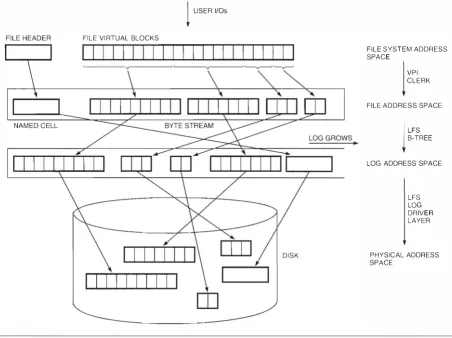
Figure 3 shows tllC various mapping layers in the Spiralog til e system, including those hJndled by the LFS server.
fncoming read and write operations arc based on a single, large address space. Initial ly, the LFS server trans torms the address ranges in the incoming operations into equivalent address ranges in an open-ended log. This log supports a very large, write-once address space.
DISK
Digit.ll "kdmical Journal
FILE SYSTEM ADDRESS SPACE
j
VPI CLERKFILE ADDRESS SPACE
j
LFSB-TREE
LOG ADDRESS SPACE
LFS LOG DRIVER LAYER
PHYSICAL ADDRESS SPACE
1 0
A read operation looks u p its location i n the open ended log and proceeds. On the other hand, a write operation m akes obsolete its c urrent address range and appends its new val ue to the tai l ofthe log.
In turn, locations in the open-ended log arc then mapped i nto locations on the (finite -sized ) disk. This additional mapping allo\\'S disk blocks to be reused once their original contents h ave become obsolete .
Physically, t h e log is divided into Jog segments, each of w hich is 256 ki lobytes ( KB) in lengrl1. The log seg ment is used as the transfer u nit for the backu p engine. I t is also used by the cleaner for reclaiming obsolett log space.
More int<xmation about the LFS server can be t(Ju nd in this issue:'
On-line Backup Design
The design goals tor the backup engine arost ti·om higher storage management costs and greater data avail ability netds. I nves6garions with a number of customers revealed their requirements for a backup engint:
• Consistent save optrations without stopping a11V applications or locking out data mod ifications
• Verv bst save operations
• Both ful l and incremental save operations
• Restorts of a ful l volu me and of individual tiles
Our response to these needs i n fl uenced many dtci sions concerning the Spiralog tile system design . The need for a high-performance, on-line backup led to a search ten an on-dis k structure that could su pport it. Again, we c hose the l og-structured design as the most suitable one.
A log-structured organization allows the backup bcil i ty to easily demarcate snapshots of tht tile system at any poi nt in time, simply by marking a point in the log. Such a mark represents a version of the file system and prevellts d isk blocks that compose that version ti·om being cltancd . I n turn, this allows the backup to run against a low ln·el of the ti le system, that of tht logical log, and thcrdorc to operate close to the spiral tr�mskr rate of the u nderlying d isk.
The d i fference between a parti a l , or i ncremtntal, and a ti.d l save operation is only the starting point in the log. An incre mental save need not copy data back to the beginning of the log. Therefore, both incre mental and hil l save operations transfer data at very high speed .
By i m plcmciHing these features i n t h e Spira log tile syste m , we fu lfilled our customers' req u i rements f(>r h igh-pcdcm11ancc, on-line backup save opcLltions. We ::dso met their needs tor per-tile and per-volume restores and an ongoing need tor simpl icity and red uc tion in operating costs.
Digital Technical Joumal Vol . 8 No. 2 1 9')6
To provide per-tile restore capabilities, tht backup utilitY and the LrS server ensure that the :1ppropriarc tile header information is stortd d uring the sa\ c opcr :ltion . The Sa\·cd ri le svstem clara, i ncluding ri l e head ers, log mapping i n formation, and user data, arc stored in a tile k.no\\'n as a SCI/Y!SC'I. Each sa\·escr, regardless of the n u m ber of tapes it requires, repre sents a singl e sa,·e operation.
'T'o reduce the complcxitv o f fi l e restore opcr:nions, the Spiralog fi l e system provides an on� linc SJ\'CSCt merge featu re . This allows tht systtm manager to merge severa l savesets, either tl.d l or i ncremental, to t(mn a new, single savcset. VVith this katurc, system managers can h ave a workable backup save plan that never cal ls fc>r :�n on-line full backup, rhus h1 rthcr red ucing the l oad on their prod uction systems. Also, this featurt can be used to ensure that tilt restore oper ations can be accomplished with a small , bounded set of S:l\'CSCtS.
The Spiralog backup t:K i litv is dtscribcd in dcuil in this issue . ;
Project Results
'l'he Spir:tlog tile svstem contains a n u mber of in nm·::t tions in the areas of o n - line backup, log-structu red storage, clusttrwick ordered \\'rite-beh ind caching, and m ultiple-tile-system client support.
The usc of log structuring as an on-disk t(Jrmat is very cftCctivc in supporting h igh-pcrf(mnancc, on-line backup. The Spiralog tile system retains the previously documented benefits of LfS, such as bst write pcrfc>r mancc that scales with the d is k size and through put that increases as large read caches arc used to oftscr disk rc:1d s . '
I t s h o u l d also b e noted that t h e Fi lcs-1 1 ti l e svstcm stts a high standard t(x data rel iabilitY and robusmcss. The Spira log technologv met this chal le nge \'en· wel l : a s a res u l t o f the idempotent protocol, the cluster Eli lover design, and the recover capabilitv of the log, \\'C cncountertd fC\\' d ata rcliabilitv p roblems d u ring development.
In any large, complex project, manv tech n ical deci sions arc necessary to convert research technology into :1 prod uct. I n this section, we d iscuss why certain decisions were made d uring the devtlopmtnt of the Spira log subsystems.
VPI Results
By using these primitives, the Spir:�log project members were able to successfu l ly design t\vo dis ti nctly difterenr personality modules. Neither was a fu nction a l superset of the other, and neither was lay ered on top of the other. However, there was an imporrallt second -order problem .
The fS LI B t-ile system personality did not have a full mapping to the Files-1 1 file system . As a consequence, tile management was rather difficult, because all the data management tools on the OpenVMS operating system assumed compliance with a Files-1 1 , rather than a VPI, t-ile system.
This problem led to the decision not to proceed with the original design for the FSLI B personality in version 1 .0 of Spiralog. I nstead, we developed an FSLI B !lie svstem personality that was ndly compatible with the F64 personality, even when that compatibility t(>rced us to accept an additional execution cost.
We also r()Lilld an execution cost to the primitive VPI operations. Genera lly, there was little overhead t(x <.bta read and write operations. However, tor operations such as opening a tile, searching t(x a tile name, and deleting a tile, we found too high an over head fi·om the number of calls into the V PJ services
and the resulting calls into the cache manager. We called this the "bn-out" problem: one high-level operation would turn into several V PJ operations, each of which would turn into several cache manager calls. Table l gives the details of the E1n-out problem .
We bel ieve that it would be worthwhile to provide slightly more complex V
PI
services in order to com bine calls that always appear in the same sequence.Table 1
Call Fan-out by Level
Revised F64 VPI Clerk Clerk
Operation Calls Calls Calls Calls
Create file 4 1 8 29 24
Open file 1 6 1 8 1 4
Read block 1 1 3 3
Write block 2 4 7 6
Close f i l e 1 4 1 3 1 0
Clerk Results
The clerk met a number of our design goals. First, the
usc of idempotent operations allowed tailover to standby L�S servers to occur with no Joss of service to the t-ile system clients, and with little add i tional com plexiry within the clerk .
Second, the ordered write behind proved to be efrective at ordering dependent, metadata file system
operations, rhus supporting the ability to construct complex file system operations out of simpler elements.
Third, the clerk was able to manage large physical caches. It is \'ery dlt:ctive at making use of unused pages when the memory demand fro m the Open VMS operating system is low, and at quickly shri n king the cache when memory demands increase . Although certain parameters can be used ro limit the size of a clerk's cache, the caches are normally self tuning.
Fourth, the clerks red uce the number of operations and messages sent to the LFS server, with a subsequent reduction to the number of messages and operations waiting to be processed. For the COPY command, the number of operations sent to the server \vas typicall y reduced by a tacror of 3 . By using transient files with lifetimes of tewer than 30 seconds, we saw a reduction of operations by a r:1cror of 100 or more, as long as the temporary tile fir into the clerk's cache.
In general, the code complexity and CPU path length within the clerk were greater than we had origi nally planned , and they will need further work. Two aspects of the services offered by the clerk com pounded the cost in CPU path length. First, the clerk has a simple interface th::n su pports reads and writes into a single, large add ress space only. This i nterface requires a num ber of clerk operations tor a number of the V P I calls, further expanding the call Em-out issues. Second , a concurrency control model allows the clerk to unilaterally drop locks. This requires the V PI !ayer to revalidate its i nternal state with each cal l .
Either a change t o t h e derk a n d V PI service inter faces to support notification of lock invalidation , or a change to the concurrency contro l model ro disallow locks that could be unilaterally invalidated, would reduce the number of calls made. We believe such changes would produce the results given in the last column of Table l .
LFS Server Results
The LFS server provides a highly available, robust file system server. Under heavy write .loads, it provides the ability to group together multiple requests and reduce the number of d isk IjOs. In a d uster configuration,
it supports tai lover to a standby server.
In normal operJtion, the cleaner was successfu l in
minimizing overhead, typically adding only a tew per
cent to the elapsed rime. The cleaner operated in a lazy manner, cleaning only when there was an immediate shortage ofspace . The cleaner operations were n1rther lessened by the tendency t(>r norma.! fi.le overwrites to free up recently ti lled Jog segments for reuse.
Although this produced a cleaner that operated with little overhead , it also brought about t\vo u nusual i nteractions with the backup facility. ln the t!rst place, the log often contains a number of obsolete areas that
1 2
arc eligible tor cleaning bur have nor yet been processed. These obsolete areas an: a lso saved by the backup engine. Although they have no c fkct on the logic:d state of the log, they do requi re the b�1ckup engine to move more data to b�Kkup storage tiL1n might otherwise be necess:try.
Second, the design initially prohibited the cleaner tl:om running ag:�inst a l og with snapshots. Conse qucnrlv, the cleaner was disabled duri n g �1 save opera tion, which had the following d kcts: ( 1 ) The :�mount of available ti·ee space i n tht: l og was artiticiallv depressed du ri ng a backup. ( 2 ) Once the backup \\'JS finished, the activated cle:111cr would discover that a great n u m ber of log segments were now eligible for cleaning. As a result, the cleaner underwent a sudden surge in cleaning acrivirv soon after the backup h:td completed .
vVc addressed this problem bv n.:ducing the area of
th e log that was off� l i m irs to the cleaner ro onlv the part that the backup engine \\'ould read . This limited snapshot window allowed more segments to remain
eligible fix cl eaning, rhus great!\' alln·i:tting the short age of cleanable space during the backup and eliminat
ing the postb::tcku p cleaning surge. for �1n 8-gigabvte
rime-sharing ,-ol ume, this change tvpicalh· reduced the
period of high cleaner acti,·irv ti·om 40 seconds to less than one-half of a second.
vVe have nor vet experimented with difkrellt clcm er algorithms. More work needs to be done in this a rc:J. to sec if the cleaning efticiencv, cost, and interactions with backup can be improved.
The c urrent mapping transt(mnarion fi·om the incom ing operation add ress space to locations in rhc open-ended log is more expensive in CPU rime rh;l11 we would like. More work is needed ro optim ize rhe code path .
Finally, rhe LfS server is gcncrallv successfu l a t pro vid ing the appearance of a tradi tion:� ! , upcbrc-in-place tile system . H owcvcr, as the unusecl space in a vol u mc nears zero, the abili ty to behave with sema ntics that meet users' expectations in a log-structured file system proved more difricult than we had a11ti cip�ned and required signiticanr cff(Jrt to correct.
The LfS server is described in m uc h m ore deta i l in this issue•
Table 2
Performance Comparison of the Backup Save Ope ration
Backup Performance Results
vVc rook a new approach ro the b:tckup design in the Spiralog system , resulti ng in a very t;1St and very low impact backup that un be used ro cre�ne consistent copies of the tile system while applications :1re ::tctively mod i�'ing dat<1. We achieved this degree of s uccess without compromisi ng such fu nctional i ry as i ncrt: menral backup or fjst, selective restore.
The pcrt(mnance imprO\·cmcnts of the Spiralog save operation �1rc par ticularlv noticeable ,,·ith the l::irgc numbers of rransie!H or acri,·c ti les that �11·e rvpi callv t(nmd on user volu mes or on mail server ,-o l u mes. In rhe t(J! lowi n g tables, we compare the Spi ralog and rhc fi le- b�1sed hlcs-1 1 backup operations on a DEC 3000 Model 500 workst:Jtion with J 260- MB ,·olume, conr�1ining 2 1 ,682 ti les in 40 1 directories and a TZ877 rape .
Tab le 2 gi,·es the resu lts of two sa,·e opcr�uions, which �11-c the �werage o f fi,-c operations. Although i ts s�wcser size is somewhat larger, the Spir:tlog sa,·e opcr;nion completes ncark t\vicc as fJst :1s the hks-1 1 sa,·c oper:�rion .
T1blc 3 gives the results ti·om restoring <1 single tile ro rhe target ,·ol u m e . I n rhis case, rhe Spi ralog fi le restore opera rion c.;ecu res more rha n three rimes as bst as the h lcs-1 1 svstem .
The perf(mnance �1d,·am�1gc ot' rhe Spiralog bac kup and restore tacilit\' increases fu rther kH-large, m u lti tape S�1\'Csc rs. I n these cases, the Spira log S\'Stcm is able to omit tapes that �11-c nor needed f(Jr the fi le resro1·e; the Filcs-1 1 S\'stcm docs nor h<l\'C this capabilit\'.
Observations and Conclusions
(),·cra l l , we bcl ie\'C that rhc signiticanr i tJnov�uion and real success of the Spiralog project was the inrcgLltion of high-pcrf(m11�l llcc, o n - l i ne backup with rhe l og structured tile S\'Stem mod e l . The Spiralog ti le svsrem del ivers an on-line bKkup engine that Glll run ncar device speeds, wirh l i ttle i mpact on concu rrcnrlv run ning Jpplicnions. Manv fi l e opcr:�rions �1rc signifi
c1ntly Elster i n elapsed rime as a resu l t ofrhc red uction in 1 /0s d ue ro the c1chc �md the grouping of write operations. Although the code p�1ths for <1 number of operations �11-c longer than we had pl�1nncd, their
File System
Elapsed Time
(Mi nutes:Seconds) Saveset Size (MB) Throughput (MB/s)
Spira l og F i l es-1 1
Dig:it,ll Technic.1l )ounnl
05:20 1 0 : 1 4
Vol . ::; No. 2 ! l)\!6 339 297
Table 3
Performance Comparison of the Individual F i l e Restore Operation
Elapsed Time File System ( M i n utes:Seconds)
Spira log
Files-1 1 0 1 :06 03:35
length is mitigated by continuing improvements UJ processor performance .
We learned a great deal during the Spiralog project and made the following observations:
• Volume fu ll semantics and tine-tuning the c leaner were more complex than we anticipated and will require future reti nemenr.
• A heavily layered architecture extends the CPU path l ength and the tan-out of procedure calls. We focused too much attention on red ucing JjOs and not enough attention on reducing the resource usage of some critical code paths.
• Although elegant, the memory abstraction for tbe interface to the cache was n ot as good a fit to file system operations as we had expected . Further more, a block abstraction for the data space would have been more suitable.
I n summary, the project team delivered a new file system for the OpenVMS operatjng system. The Spiralog file system offers single-system semantics in a cluster, is compatible with the cu rrent OpcnVMS file system , and supports on-l ine backup.
Future Work
During the Spira log version 1 .0 project, we pursued a number of new technologies and fou nd four areas that warrant future work:
• Support is needed from storage and ti le management tools tor multiple, dissimilar tile system personalities.
• The cleaner represents another area of ongoing innovation and complex dynamics. We believe a better understanding of these dynamics is n eeded , and design alternatives should be studied .
• The on-line backup engine, coupl ed with the log structured fi le system technology, oHers many areas for potential development . For i nstance, one area tor investigation is continuous backup operation, either to a local backup device or to a remote replica.
• Final ly, we do not believe the higher-than-expected code path length is intrinsic to the basic file system
design. vVc expect to be working on this resource usage in the near future.
Acknowledgments
We would like to take this opportunity to thank the many individuals who contributed to the Spiraiog project. Don Harbert and Rich Marcello, OpenVMS vice presidents, supported this work over the lifetime of the project. Dan Doherty and J ack Fallon, the Open VMS managers in Livingston, Scotland , had day to-day management responsibility. CatJ1y Foley kept the project moving toward the goal of shipping. Jan is Horn and Clare Wells, the produ ct managers who helped us understand our customers' needs, were elo quent in explaining our project and goa l to others. Ncar the end of the project, Yehia Bcyh and Pau l Mosteika gave us valuable testing support, without which the product would certainly be Jess stable than it is today. Finally, and not least, we wou ld like to acknowledge the mem bers of the development team:
Alasdair Baird , Stuart Bayley, Rob Burke, Ian Compton, Chris Davies, Stuart Deans, Alan Dewar, Campbell Fraser, Russ Green, Peter Hancock, Steve Hirst, Jim Hogg, Mark Howell, Mike J ohnson, Robert Landau, Douglas McLaggan, Rudi Martin , Conor J\llorrison, J u lian Pal mer, Judy Parsons, Ian Pattison, Alan Paxton, Nancy Pban, Kevin Porter, Alan Potter, Russell Robles, Chris Whitaker, and Rod Widdowson.
References
1 . M. Rosenblum and J . Ousterhout, "The Design and I mpl ememation of a Log Structured File System," ACM Transactions on Computer S)'slems. vol. I 0, no. I ( February 1 992): 26-5 2 .
2 . T . Mann, A . Birre l l , A. H isgen , C. Jerian, a nd C . Swart,
"A Coherent Distri bu ted File Cache with Di recrory Wri te-behind," Digital Systems Research Center, Research Report 1 0 3 (June 1 99 3 ) .
3 . R . C reen, A. B aird, a n d J . Davies, " Desi gn ing a Fast, On-line Backup System for :1 Log-structured File Sys tem," D(v,ital Techrzica!Journal, vol . 8, no. 2 ( 1 996, this issue ): 32-45.
4. C. Whitaker, }. Bayley, and R . Widdowson, "Design of the Server lor the Spiralog Fi le System," Digital Tee/mica!
Journal, vol. 8, no. 2 ( 1 996, this issue ): 1 5-3 1 .
5 . M . Howell and ) . Pal me r, " I ntegrating the Spiralog File Svstem i nto the OpenVMS Operating System," Digital Technical .fou rnal, vol . 8, no. 2 ( 1 996, this issue ) : 46-56.
6 . R . Wren n , "Why the Real Cost of Storage is More Than $ 1 /MR," presented at U .S. DECUS Symposi u m , S t . Louis, Mo . , June 3 - 6 , 1 996.
1 4
Biog raphies
James E. Johnson
j i m Johnson, a consul ring software engineer, has been working for Digital since 1 984. He was a n1e mber of the Open VMS Engineering Group, where he contribu ted
in several at-cas, including RMS, transaction processing services, the port of Open VMS to the Alpha architecrl!l·e, ti le systems, and system management. Jim recently joi ned rhc I nternet Software Business Unir and is working on rhe application of X . SOO d irectory services. jim holds rwo patents on transaction commit protocol optimizations and maintains a keen interest in rhis area.
William A . Laing
Bill Laing, a corporate consulting engineer, is rhe tech nical d irector of the I nternet Software. Busi ness U n ir. Bill joi ned
Digital i n 1 91\ l ; he worked in the U nited Stares tcJr five vears before transterring to Europe . During his oreer :tt Digi tal , Bill has worked on VMS systems ped(mllarlce :�nalysis, VAXclusrer design and development, oper;l ting systems dc,·clopmcnt, and transaction processing. He was the tech nical dir·ector of Open VMS engi neeri ng, the
tt:chnical di rector for engineering i n Europe, and most
n:cenrk was focusing on software i n the ·rech nologv and
Architecture Group of the Computer Svsrc ms Division.
Prior to joining Digital, Bill held rese.1rch and reaching
posts in operating svstems at rhe Un iversity of Ed inbu rgh, where he worked on the EMAS operating syste m . H e \\·,1s also parr of the starr-up of European Silicon Structu res ( LS2), an ambi tious pan-Enropean company. He holds undergraduate and postgraduate degrees i n computer science from the University of Edinburgh .
Design of the Server for
the Spira log File System
The Spira log file system uses a log-structured, on-disk format inspired by the Sprite log structured file system (L FS) from the University of California, Berkeley. Log-structured file sys tems promise a number of performance and functional benefits over conventional, update in-place file systems, such as the Files-11 file system developed for the Open VMS operating system or the FFS file system on the UNIX oper ating system . The Spira log server combines log structured technology with more traditional B-tree technology to provide a general server abstraction. The B-tree mapping mechanism uses write-ahead logging to give stability and recoverability g uarantees. By combining write ahead logging with a log-structured , on-disk format, the Spira log server merges file system data and recovery log records into a sing l e , sequential write stream.
I
Christopher Whitaker J . Stuart Bayley Rod D. W. Widdowson
The goal of the Spira log file system project team was w produce a high-pedonnance, h ighly available, and robust tile system with a high-performance, on-line backup capability for the OpenVMS Alpha operating system . The server component of the Spiralog file sys tem is responsi ble tor reading data trom and writing data w persistent storage . It m ust provide fast write performance, scalabil i ty, and rapid recovery from sys tem fail ures. In addition, the server must al low an on-line backup utility to copy a consistent snapshot of the tile system to another location, while al lowing nor mal file system operations to continue in parallel.
In this paper, \Ve describe the log-structured file sys tem ( LFS) technology and its particular implementation in the Spiralog file system . We also describe the novel way in which the Spiralog server maps the log to pro vide a rich address space in which files and directo1ies are constructed. Finally, we review some of the opportuni ties and challenges presented by the design we chose.
Background
A l l tile systems m ust trade off performance against availability in d ifferent ways to provide the throughput required duri ng normal operations and to protect data from corruption d uring system failures. Traditionally, fi le systems fal l i n to two categories, carefu l write and check on recovery.
• Careful writing policies are designed to provide a fail-safe n1cchanism tor the file system structures in the event of a system failure; however, they sufter fl·om the need to serialize several ljOs during file system operations.
• Some file systems forego the need to serialize file system updates. After a system failure, however, they require a complete disk scan to reconstruct a consistent file system. This requirement becomes a problem as disk sizes i ncrease.
Modern fil e systems such as Cedar, Episode, Microsoft's New Technology File System ( NTFS ), and Digital 's POLYCENTER Advanced File System use Jogging to overcome the problems inherent in these two approaches.'·2 Logging file system metadata removes the need to serialize IjOs and allows a simple
1 6
Jnd bounded mechanism f(>r reconstructing the tile system ah:cr a fai l ur e . Rcsc.1rchcrs at the University of Cali ti:m1ia, Berkeley, took this process one stage fi.Jr ther and treated the ll'hole disk as a single, sequential log where all rile system modifications arc appended to tbe tai l of the log.'
Log-structured tile system tcchnolot,'Y is p;1rticu larh' appropriate to the Spiralog ti l e s\·stcm, because it is tksigncd as a c lustcrwidc til e S\·stcm . The seJTcr must support a large n u mber of tile S\'Stcm clerks, each of which may be rcJdi ng ;1 nd ll'riting lhta to the disk. The clerks usc 1:-�rge ll'ri te- back caches to red uce the need to read daL1 ti·om the server. The caches also allow the clerks to bufkr write requests destined t(>r the server. A log-structured design allows multiple concurrent writes to be grouped togcthn imo large, seq uential ljOs to the disk. This 1 /0 pJttcrn red u ces disk head movement during writing and allows the size of the writes to be marched to characteristics of the underlying disk. This is Inrticul•1rly bcncticial t(>r storage devices with redundant arr.n·s of inexpensive d isks ( RAID ) 4
The usc of a log-structured , on-d isk f(>rmat greatly simpli fies the implementation of ;111 on-line backup capability. Here, the challenge is ro provide a consis tent snapshot of thc ti l e system that can be copied to the bac kup med ia while nor ma l opeLltions continue to mod i t\• the ti l e svsrcm . BcG\usc ;1n LrS appends J i l data to rhc tai l o f a log, a l l d:1 t�1 writes within the log arc tcmporallv ordered . A com plete sn:-�pshot of the ti le systcn1 corresponds to the contcllts of the sequen tial log up ro th<.: point in rime that the snapshot was created . Bv extension, an i ncreme nta l backup col-re sponds to the section of the scqucnr i a l log crc1tcd since the l ast backup \\'aS u kcn. The Spir:d og backup uti lit\' uses these k:1tmcs to prm·idc a bst, on-line, fu l l and i ncrcmen t : d backup scheme.;
vVc hJ\'C t:1kcn a number of Features ti·om the exist ing log-structu red tile system i m plcmcmations, in par ticular, the ide:\ or· d i\·iding the log i n to tixcd-sizcd segments as the basis ti:>r space ;1l locarion :1nd clean ing.'' Fu mbmcnL1l ly, hm\'e\·cr, existing log-strucw rcd tile syste ms h ave been built by using the main bodv of an existing ti le svstcm and bycring on top oLm under lying, log-structmcd conL1incr.'c This design has been taken to the logic1l extreme with the imp lc menration of a log-structu red d isk.'' for the Spiralog tile system , we have chosen to usc r h c seq uential l o g capability provided by the log-structu red, on-disk format through out the ril e system. The Spiralog server combines log structured technology with more traditional B -trec technol ogy to provide a general server abstraction . The B-tree mapping mechanism uses write-ahead log ging to give stability and recoverabi liry guarantees." B y combining write-a heJd logging with a loa-str uctured on-disk format, the SpiraJog server merges ti le system data and recovery l og records into a single, sequential write stream .
Digital Tcchnic;ll )ournc1l Vol . il :-\o. 2 1996
The Spiralog til e syste m d i fkrs ti·om nisring log
structu red impl ementations in :1 n u m be r ot· other i m portanr \\'ays, in parricuL1r, the mechanisms th;lt we haYc chosen to usc t( >r the c lc mcr. I n su bsequent sec tions of this paper, we compare these differences \\·ith e xisti ng implemcnrarions ll'hcrc appropri•1tc.
Spiralog File System Server Architectu re
The Spiralog ti le S\·stcm cmplo\'s ;1 c l ic m-scn·cr JJ·c hi recture . E:-�ch node i n rhc duster thar 1nou ms ;l Spiralog \·olu m e r u ns a tile svstcm clerk.. The term
clerk is used in this p;1pcr ro distinguish the client com ponent of the rile system fi·om diems oft he ti le S\'Stem as a whole. Clerks implement all the tile h111crions asso ciated \\'ith mainta i n i n g the tile svsrem sr�1rc wirh the exception of persistent storage of ti le S\'stem :md user d ata. This l atter responsibil i ty Lli ls on the Spir;1log server. There is exactly one scn·cr h>1· eac h volume, which must run on a node t h a t l 1 ;1s ;1 direct connection to the disk containing the volume. This d istri bution of function, where the majority of tilc system processing
takes place on the clerk, is simiLlr to that of the Echo ti le system .'" The reasons t(n choosing rh is ;1 rc h itccrurc arc described in more dct:-�il in the p;1pcr "O vcn'icw of the Spira log hie System," elsewhere in this issue . "
Spiralog clerks b u i l d ti.lcs a n d directories in a struc t ured add ress space cal led the ti le ;1d d rcss s1x1cc . This add ress space is imcmal ro the tile S\'Stcm and is onh· loosely related w tiLlt pcrcci\·cd lw cl icms of rhc tile svsrcm . The server pro\·ides ;111 i mcr bcc that :dlm\·s tbe clerks to pcrsistcnth· map to ti lc sp;Kc add rc�scs. I nternalh·, the scnn uses a logic:�lh· i nfin i te log struc ture, built on top of a plwsic:�l d i sk, to store the ti le S\'Stem datJ a nd the srructu res nccess:11·\· to locate
the datJ. Figure l shO\\·s the rcl ;Hionshifl hcn\·cc n the c lerks and the sc nu· and the rebtionships among the major componcms \\·ithin the scrnT.
Figure 1
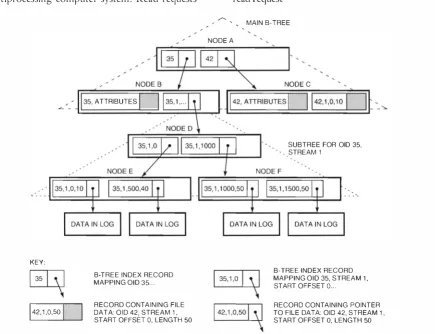
The mapping layer is responsible for mai ntaining the mapping between the file address space used by the clerks to the address space of the log. The server directly supports the file address space so that it can make use of information about the relative perfor mance sensitivity of parts of the add ress space that is implicit within its structure . Although this results i n the mapping layer being relatively complex, it reduces the complexity of the clerks and aids performance. The mapping layer is the primary point of contact with the server. Here, read and write requests from clerks are received and translated into operations on the log address space .
The log driver ( LD) creates the illusion of an i nfinite log on top of the physical disk. The LD transforms read and write requests from the mapping layer that are cast in terms of a location in the log address space into read and write requests to physical addresses on the underly ing disk. Hiding the implementation of the log from the mapping layer allows the organ ization of the log to be altered transparently to the mapping layer. For example, parts of the log can be migrated to other physical devices without i nvolving the mapping layer.
1
USER 1/0s FILE HEADER FILE VIRTUAL BLOCKS [image:19.593.55.513.364.702.2]I I I I I I I I I I
Figure 2
Add ress Translation
Although the log exported by the LD layer is con ceptually infinite, disks have a finite size. The cleaner is responsi ble for garbage collecting or coalescing free space within the log.
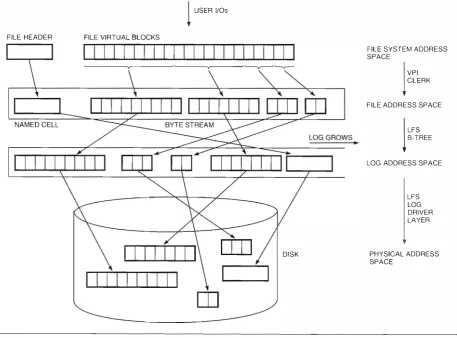
Figure 2 shows the relationship between the various address spaces making up the Spiralog file system . I n the next three sections, we examine each o f the com ponents of the server.
Mapping Layer
The mapping layer implements the mapping bet\veen the file address space used by the file system clerks and the log add ress space maintained by the LD. I t exports an i nterface to the clerks that t hey use to read data from locations in the file add ress space, to write new data to the file address space , and to spec if)' which previously written data is no longer requi red. The interface also allows clerks to group sets of depen dent writes i nto units that succeed or fai l as if they were a single write. In this section, we i ntroduce the file address space and describe the data structure used to map it. Then we explain the method used to handle clerk requests to modi f)' the add ress space.
DISK
Digital Technical Journal
FILE SYSTEM ADDRESS SPACE
I
VPICLERK
FILE ADDRESS SPACE
I
LFS B-TREELOG ADDRESS SPACE
LFS LOG DRIVER LAYER
PHYSICAL ADDRESS SPACE