• No results found

Increasing participation of cancer patients in randomised controlled trials: a systematic review

N/A
N/A
Protected

Academic year: 2020

Share "Increasing participation of cancer patients in randomised controlled trials: a systematic review"

Copied!
10
0
0

Loading.... (view fulltext now)

Full text

(1)

Open Access

Research

Increasing participation of cancer patients in randomised controlled

trials: a systematic review

Catriona Mc Daid*

1

, Zoé Hodges

2

, Debra Fayter

1

, Lisa Stirk

1

and

Alison Eastwood

1

Address: 1Centre for Reviews and Dissemination, University of York, York, YO10, 5DD, UK and 2London School of Hygiene and Tropical Medicine, 9 Bedford Square, London, WC1B 3RE, UK

Email: Catriona Mc Daid* - [email protected]; Zoé Hodges - [email protected]; Debra Fayter - [email protected]; Lisa Stirk - [email protected]; Alison Eastwood - [email protected]

* Corresponding author

Abstract

Background: There are many barriers to patient participation in randomised controlled trials of cancer treatments. To increase participation in trials, strategies need to be identified to overcome these barriers. Our aim was to assess the effectiveness of interventions to overcome barriers to patient participation in randomised controlled trials (RCTs) of cancer treatments.

Methods: A systematic review was conducted. Published and unpublished studies in any language were searched for in fifteen electronic databases, including MEDLINE, EMBASE, CINAHL and PsycINFO, from inception to the end of 2004.

Studies of any interventions to improve cancer patient participation in RCTs, which reported the change in recruitment rates, were eligible for inclusion. RCTs and non-randomised controlled trials as well as before and after studies reporting baseline rates specific to the population being investigated were included. Data were extracted by one reviewer into structured summary tables and checked for accuracy by a second reviewer. Each included study was assessed against a checklist for methodological quality by one reviewer and checked by a second reviewer. A narrative synthesis was conducted.

Results: Eight studies were identified that met the inclusion criteria: three RCTs, two non-randomised controlled trials and three observational studies. Six of the studies had an intervention that had some relevance to the UK. There was no robust evidence that any of the interventions investigated led to an increase in cancer patient participation in RCTs, though one good quality RCT found that urologists and nurses were equally effective at recruiting participants to a treatment trial for prostate cancer. Although there was no evidence of an effect in any of the studies, the evidence was not of sufficient quality to be able to conclude that these interventions therefore do not work.

Conclusion: There is not a strong evidence-base for interventions that increase cancer patient participation in randomised trials. Further research is required to evaluate the effectiveness of strategies to increase participation in cancer treatment trials.

Published: 17 May 2006

Trials 2006, 7:16 doi:10.1186/1745-6215-7-16

Received: 30 January 2006 Accepted: 17 May 2006

This article is available from: http://www.trialsjournal.com/content/7/1/16

© 2006 Mc Daid et al; licensee BioMed Central Ltd.

(2)

Background

Recruitment of the required number of patients is central to successful completion of a trial. In 2000, the NHS Plan set the target of doubling the total proportion of cancer patients entering clinical trials within three years.[1,2] This target was met by 2004, when almost 11% of people with newly diagnosed cancer participated in trials. [3] However, this remains a small proportion of all cancer patients. Recruitment levels vary between trials. Of 333 public and charity funded cancer randomised controlled trials (RCTs), conducted in the UK between 1971 and 2000, one fifth recruited at least 75% of the planned sam-ple, just over one half did not reach the planned sample size, while one fifth recruited less than 25% of the planned number of patients. [4]

While the research literature fails to identify in a clear, reli-able and consistent way the barriers involved in cancer trial participation, themes can be identified.[5] Patient related barriers include preference for a specific treatment, level of knowledge, concerns about randomisation and practical issues such as distance from the clinic and trans-portation costs. Physician and organisation related barri-ers include lack of time, poor organisational infrastructure, trials competing for the same patients, identifying eligible patients, lack of awareness of ongoing trials and preference for a particular treatment arm. How-ever, the listing of barriers to participation in cancer trials belies a complex situation. The barriers vary in impor-tance in individual trials and are likely to interact in unique ways for individual trials. These issues have been explored from many different disciplinary perspectives including psychology, sociology, ethics, professional edu-cation and health policy.

This systematic review is the second part of a project, funded by the National Cancer Research Network, which considers how participation rates in cancer trials might be improved. The first part of the project was a systematic review of the literature relating to the barriers to participa-tion in cancer trials as perceived by patients and clinicians. [5] In the second part we aimed to investigate the evi-dence-base for interventions to overcome barriers to trial participation.

We were concerned specifically with strategies to increase the participation of patients in RCTs of cancer treatments. There is likely to be some overlap between strategies that increase participation in cancer treatment and cancer screening and prevention trials. However, many of the issues that an apparently healthy individual needs to weigh up before deciding to participate in a prevention or screening trial would seem to be inherently different from those that need to be considered by an individual with cancer with the option of entering a treatment trial.

Simi-larly, while there is likely to be some overlap in strategies that effectively increase participation in randomised and nonrandomised studies, there are many differences. In particular, there is evidence that being faced with the pos-sibility of being randomised to a treatment arm as opposed to choosing treatment on the basis of patient or clinician preferences raises particular concerns for patients, and indeed sometimes clinicians. [5]

An earlier systematic review of interventions to improve recruitment to research studies considered both mock and real scenarios, as well as patient and non-patient groups. [6] Only studies published before 2002 were included, the authors highlighted the possibility of missed studies and the quality assessment was fairly limited. While studies using a hypothetical scenario may be useful in generating ideas as to what might be effective in a real scenario, any interventions found to be effective in increasing willing-ness to participate in a hypothetical trial would require subsequent testing in a real scenario. Therefore, the deci-sion was made in the current review to focus exclusively on interventions directed at real trials. We were specifi-cally interested in actual trial participation. Patient knowl-edge and understanding[7] or the quality of clinician communication with patients about RCTs[8] are impor-tant outcomes in their own right. However, improvement in these outcomes does not necessarily translate into increased patient participation in cancer trials.[9]

We carried out a systematic review of the available evi-dence on the effectiveness of any interventions to increase cancer patient participation in randomised controlled tri-als.

Methods

Search strategy

(3)

Selection of eligible studies

Two reviewers independently assessed titles and abstracts and full papers, where these were obtained. We included studies of any interventions to improve cancer patient par-ticipation in RCTs, which reported change in parpar-ticipation rates. The primary outcome of interest was patient partic-ipation. Therefore, for example, interventions aimed at increasing physician participation in trials, or interven-tions targeted at organisational change were eligible for inclusion provided the impact on patient participation rates was also assessed. The definition of participation var-ied between studies and the definition used by individual studies was accepted. We included controlled trials and also before and after studies, provided baseline participa-tion rates were reported specific to the populaparticipa-tion being investigated. We contacted authors for clarification when it was unclear whether the intervention was directed at randomised or nonrandomised clinical trials.

One reviewer extracted data from included studies into structured summary tables and assessed the methodolog-ical quality of the studies. A second reviewer checked the data and quality assessment with disagreements resolved by discussion and consensus. We developed separate quality checklists to assess RCTs, for each relevant study design, based on CRD Report No.4.[10] We assessed whether measures had been taken by the study authors to avoid or minimise selection bias, attrition bias, perform-ance bias and whether the study design protected against contamination between the intervention and the compar-ison. Studies were also assessed as to whether the nature

of the intervention was clear and whether the target of the intervention was clearly defined. It was not appropriate to undertake a statistical synthesis as the included studies were very diverse; therefore we conducted a narrative syn-thesis.

Results

Overview

We screened 3385 references and assessed 136 full papers. Eight studies met our inclusion criteria: three RCTs; two nonrandomised controlled prospective studies; two observational prospective studies with a comparison group and one before and after study (see Figure 1). The majority of studies were excluded because there was no intervention targeted at improving patient participation in cancer trials. Three studies were excluded because data on participation in randomised and non randomised tri-als were reported together and, following contact with the authors, no separate data were available for patient partic-ipation in RCTs. [11-13] It was not possible to assess six papers: one had not been received and for five papers it was unclear whether the intervention was directed at an RCT. [14-18]

[image:3.612.59.294.90.322.2]

Study characteristics

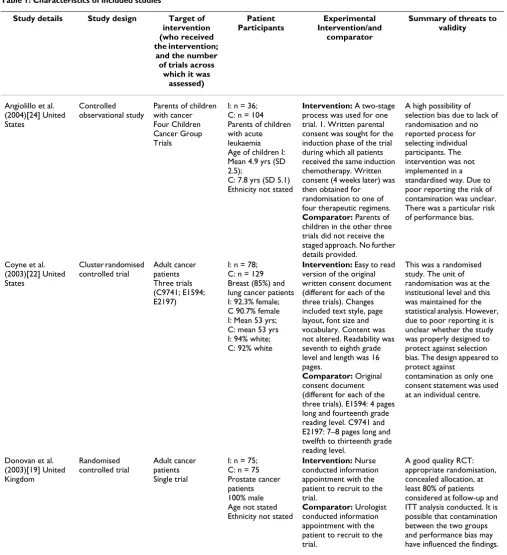
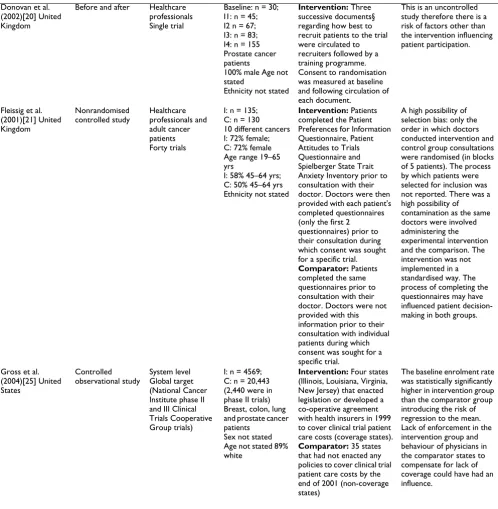
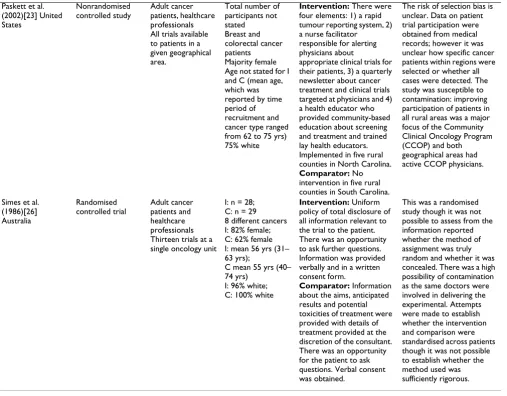
Table 1 summarises the main characteristics of the eight included studies. We found three studies that had been conducted in the UK or Europe, [19-21] one of which was an RCT.[19] Two of the UK studies were concerned with participation in the same cancer treatment trial.[19,20] The remaining five studies were conducted in the US [22-25] and Australia.[26] The majority of studies were con-cerned with some aspect of the consent process. In four of the seven studies of adults, the majority of participants were women. Four studies included predominantly white participants[22,23,25,26] and this information was not reported in the remaining studies. The majority of studies included individuals with different cancers. Only two studies provided details of disease stage or severity and only for subgroups of patients.[22,23] The included stud-ies varied in quality. A summary of individual study qual-ity is provided in Table 1 and the full qualqual-ity appraisal for individual studies is available in the full report.[27] Care needs to be taken when comparing rates of trial participa-tion between studies due to between study variaparticipa-tion in how participation was defined. In four studies, trial partic-ipation was defined as the number of patients accrued or enrolled but it was not clear whether this referred to the proportion who agreed to randomisation or the propor-tion who actually accepted their allocapropor-tion. [22-25] One study that used both measures illustrated that there can be a considerable difference between these figures, with actual accrual being lower than consent to randomisa-tion.[20] A further study based participation rates on questionnaires completed by patients, following their Study selection process

Figure 1

Study selection process.

Studies meeting inclusion criteria

Randomised controlled trial: n=3 Nonrandomised controlled study: n=2

Controlled observational study: n=2 Before and after: n=1

Total: n=8 (9 papers)

Excluded papers

No intervention: n=101 No participation rates: n=13

Not evaluative: n=5 Hypothetical: n=2

Total: n=121

Full papers ordered

n=136

Papers awaiting assessment

Not received: n=1 Awaiting information from

authors: n=5

Total: n=6

References identified (following de-duplication) and screened

(4)
[image:4.612.54.561.90.645.2]

Table 1: Characteristics of included studies

Study details Study design Target of intervention (who received the intervention;

and the number of trials across

which it was assessed)

Patient Participants

Experimental Intervention/and

comparator

Summary of threats to validity

Angiolillo et al. (2004)[24] United States

Controlled observational study

Parents of children with cancer Four Children Cancer Group Trials

I: n = 36; C: n = 104 Parents of children with acute leukaemia Age of children I: Mean 4.9 yrs (SD 2.5);

C: 7.8 yrs (SD 5.1) Ethnicity not stated

Intervention: A two-stage process was used for one trial. 1. Written parental consent was sought for the induction phase of the trial during which all patients received the same induction chemotherapy. Written consent (4 weeks later) was then obtained for

randomisation to one of four therapeutic regimens. Comparator: Parents of children in the other three trials did not receive the staged approach. No further details provided.

A high possibility of selection bias due to lack of randomisation and no reported process for selecting individual participants. The intervention was not implemented in a standardised way. Due to poor reporting the risk of contamination was unclear. There was a particular risk of performance bias.

Coyne et al. (2003)[22] United States

Cluster randomised controlled trial

Adult cancer patients Three trials (C9741; E1594; E2197)

I: n = 78; C: n = 129 Breast (85%) and lung cancer patients I: 92.3% female; C 90.7% female I: Mean 53 yrs; C: mean 53 yrs I: 94% white; C: 92% white

Intervention: Easy to read version of the original written consent document (different for each of the three trials). Changes included text style, page layout, font size and vocabulary. Content was not altered. Readability was seventh to eighth grade level and length was 16 pages.

Comparator: Original consent document (different for each of the three trials). E1594: 4 pages long and fourteenth grade reading level. C9741 and E2197: 7–8 pages long and twelfth to thirteenth grade reading level.

This was a randomised study. The unit of randomisation was at the institutional level and this was maintained for the statistical analysis. However, due to poor reporting it is unclear whether the study was properly designed to protect against selection bias. The design appeared to protect against

contamination as only one consent statement was used at an individual centre.

Donovan et al. (2003)[19] United Kingdom

Randomised controlled trial

Adult cancer patients Single trial

I: n = 75; C: n = 75 Prostate cancer patients 100% male Age not stated Ethnicity not stated

Intervention: Nurse conducted information appointment with the patient to recruit to the trial.

Comparator: Urologist conducted information appointment with the patient to recruit to the trial.

(5)

Donovan et al. (2002)[20] United Kingdom

Before and after Healthcare professionals Single trial

Baseline: n = 30; I1: n = 45; I2 n = 67; I3: n = 83; I4: n = 155 Prostate cancer patients

100% male Age not stated

Ethnicity not stated

Intervention: Three successive documents§ regarding how best to recruit patients to the trial were circulated to recruiters followed by a training programme. Consent to randomisation was measured at baseline and following circulation of each document.

This is an uncontrolled study therefore there is a risk of factors other than the intervention influencing patient participation.

Fleissig et al. (2001)[21] United Kingdom

Nonrandomised controlled study

Healthcare professionals and adult cancer patients Forty trials

I: n = 135; C: n = 130 10 different cancers I: 72% female; C: 72% female Age range 19–65 yrs

I: 58% 45–64 yrs; C: 50% 45–64 yrs Ethnicity not stated

Intervention: Patients completed the Patient Preferences for Information Questionnaire, Patient Attitudes to Trials Questionnaire and Spielberger State Trait Anxiety Inventory prior to consultation with their doctor. Doctors were then provided with each patient's completed questionnaires (only the first 2

questionnaires) prior to their consultation during which consent was sought for a specific trial. Comparator: Patients completed the same questionnaires prior to consultation with their doctor. Doctors were not provided with this information prior to their consultation with individual patients during which consent was sought for a specific trial.

A high possibility of selection bias: only the order in which doctors conducted intervention and control group consultations were randomised (in blocks of 5 patients). The process by which patients were selected for inclusion was not reported. There was a high possibility of contamination as the same doctors were involved administering the experimental intervention and the comparison. The intervention was not implemented in a standardised way. The process of completing the questionnaires may have influenced patient decision-making in both groups.

Gross et al. (2004)[25] United States

Controlled observational study

System level Global target (National Cancer Institute phase II and III Clinical Trials Cooperative Group trials)

I: n = 4569; C: n = 20,443 (2,440 were in phase II trials) Breast, colon, lung and prostate cancer patients

Sex not stated Age not stated 89% white

Intervention: Four states (Illinois, Louisiana, Virginia, New Jersey) that enacted legislation or developed a co-operative agreement with health insurers in 1999 to cover clinical trial patient care costs (coverage states). Comparator: 35 states that had not enacted any policies to cover clinical trial patient care costs by the end of 2001 (non-coverage states)

[image:5.612.58.556.90.598.2]

The baseline enrolment rate was statistically significantly higher in intervention group than the comparator group introducing the risk of regression to the mean. Lack of enforcement in the intervention group and behaviour of physicians in the comparator states to compensate for lack of coverage could have had an influence.

(6)

Paskett et al. (2002)[23] United States

Nonrandomised controlled study

Adult cancer patients, healthcare professionals All trials available to patients in a given geographical area.

Total number of participants not stated

Breast and colorectal cancer patients

Majority female Age not stated for I and C (mean age, which was reported by time period of recruitment and cancer type ranged from 62 to 75 yrs) 75% white

Intervention: There were four elements: 1) a rapid tumour reporting system, 2) a nurse facilitator

responsible for alerting physicians about

appropriate clinical trials for their patients, 3) a quarterly newsletter about cancer treatment and clinical trials targeted at physicians and 4) a health educator who provided community-based education about screening and treatment and trained lay health educators. Implemented in five rural counties in North Carolina. Comparator: No intervention in five rural counties in South Carolina.

The risk of selection bias is unclear. Data on patient trial participation were obtained from medical records; however it was unclear how specific cancer patients within regions were selected or whether all cases were detected. The study was susceptible to contamination: improving participation of patients in all rural areas was a major focus of the Community Clinical Oncology Program (CCOP) and both geographical areas had active CCOP physicians.

Simes et al. (1986)[26] Australia

Randomised controlled trial

Adult cancer patients and healthcare professionals Thirteen trials at a single oncology unit

I: n = 28; C: n = 29 8 different cancers I: 82% female; C: 62% female I: mean 56 yrs (31– 63 yrs);

C mean 55 yrs (40– 74 yrs)

I: 96% white; C: 100% white

Intervention: Uniform policy of total disclosure of all information relevant to the trial to the patient. There was an opportunity to ask further questions. Information was provided verbally and in a written consent form.

Comparator: Information about the aims, anticipated results and potential toxicities of treatment were provided with details of treatment provided at the discretion of the consultant. There was an opportunity for the patient to ask questions. Verbal consent was obtained.

This was a randomised study though it was not possible to assess from the information reported whether the method of assignment was truly random and whether it was concealed. There was a high possibility of contamination as the same doctors were involved in delivering the experimental. Attempts were made to establish whether the intervention and comparison were standardised across patients though it was not possible to establish whether the method used was sufficiently rigorous.

I: experimental intervention, C: comparator

[image:6.612.57.564.91.487.2]

§Document 1 asked recruiters to present the three treatment options in a particular order and provide equivalent detail on advantages and disadvantages. They were asked to avoid the terms trials and 'watchful waiting' to describe monitoring and place emphasis on patients being eligible for all treatments; document 2 re-emphasised monitoring as an active process, eliciting and challenging patients' views if at odds with the evidence and re-emphasised there was no compulsion to accept treatment allocation; document 3 provided good and not so good examples of how to present information about treatments in an equal way.

(7)

meeting with the doctor, stating whether they wanted to participate. This may have overestimated the number who actually started the trial.[21]

We synthesised two studies separately from the others as the interventions could not be implemented in the UK; these are only briefly summarised here. One was an RCT conducted almost 20 years ago in Australia which investi-gated a uniform policy of full disclosure of all relevant information when seeking patient consent to trial partici-pation compared with disclosure of information at the discretion of the consultant[26] A written consent docu-ment was completed for the former condition whereas only verbal consent was obtained for the latter. In the UK setting, clinical trials regulations require full disclosure of information with written consent.[28] The second study investigated the effect of legislation requiring health insurers to cover clinical trial patient care costs on trial participation rates in the US.[25] Although the funding of trials is an important issue this study is only relevant in settings where health insurance is widespread.

Efficacy of interventions

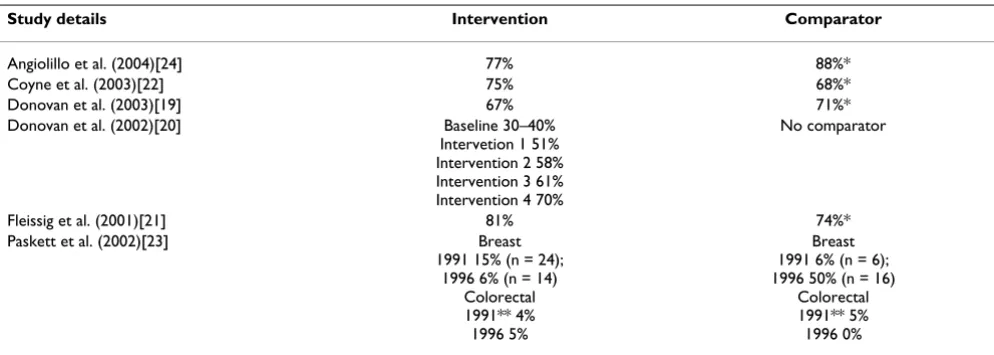
Across the remaining six studies there was no evidence that any of the experimental interventions evaluated led to an increase in cancer patient participation in RCTs com-pared with the comparison intervention (see Table 2). A good quality RCT, conducted in a UK setting, did find that nurses and urologists were equally effective in recruiting men with prostate cancer to a treatment trial with a two and three-arm comparison though recruitment levels var-ied between the three centres (94%, 61% and 45%).[19] Based on a cost minimisation analysis, recruitment by nurses was more cost-effective. This finding was unchanged in six out of seven sensitivity analyses explor-ing different resource scenarios, though the size of the cost difference did change. An uncontrolled qualitative study involving patients and recruitment staff was also under-taken in relation to the same trial. This study found increased participation rates following amendments to the nature and emphasis of information provided to potential trial participants.[20] However, given that this was not a controlled study, the influence of other factors on the recruitment rates cannot be excluded.

The following interventions were not associated with an increase in trial participation: a two-stage process for seek-ing parental consent for their child's participation in a leu-kaemia trial compared to the standard approach;[24] a written consent document designed to be easy to read compared with the standard consent form; [22] providing doctors with information on patients' individual informa-tion needs and attitudes to trials prior to seeking consent compared with the doctor not having this informa-tion;[21] and a multi-component, system level

interven-tion compared with no interveninterven-tion.[23] However, the evidence is not sufficient to conclude that the interven-tions investigated are ineffective.

In most of the studies participation levels were high in both the intervention and the control group. Apart from one study with low participation levels, [23] participation rates in the control groups ranged from 68% to 88%. This raises the question of whether there was a Hawthorne effect i.e. that the experience of participation in a study per se led to an increase in participation in the cancer trial. This could have been sufficient to mask an effect of the experimental intervention, especially given the fairly small sample sizes in these studies. Alternatively, the par-ticular cancer trials to which patients were being recruited in these studies may have been trials which were easy to recruit to and that would have had high recruitment levels anyway. This may have lead to a ceiling effect in individ-ual trials. None of the interventions appeared to be in response to recruitment problems being encountered either with the specific trials where individual trials were being targeted or with the health professionals conducting the recruitment where a large number of different trials were involved. For two studies related to a trial for treat-ment of prostate cancer the trial was described as contro-versial and difficulties in recruitment were anticipated. [19,20]

There is the possibility that the specific interventions investigated do not work in the particular contexts in which they were used. They may prove effective with a dif-ferent patient group or in relation to a difdif-ferent trial. For example, if the effect on participation levels of an 'easy to read' informed consent form, as used in the study con-ducted by Coyne et al., [22] had been investigated with patients with a lower level of literacy than the women in the study, it may have been found to be effective.

(8)

through study design, [22] there was a risk of contamina-tion across all studies.

Discussion

Overall there is not a strong evidence-base for interven-tions that increase patient participation in cancer treat-ment trials. Despite the large volume of research that exists on barriers to participation in cancer trials[5], we found only a small body of research on interventions to overcome these barriers. And despite the plethora of potential barriers to participation that have been identi-fied, only a small number of barriers were addressed. Most of the interventions were concerned with the consent process, though the specific aspects addressed varied, ranging from a fairly simple intervention to make a con-sent form more readable to more complex approaches tai-loring the information provided to potential participants. In addition, they were mainly pragmatic interventions; this mirrors the research on barriers to participation in cancer trials which is generally not theoretically driven. [5]

There was no evidence that any of the interventions inves-tigated led to an increase in cancer patient participation in clinical trials. However, the evidence was not of sufficient quality to be able to conclude that these interventions therefore are not effective. Overall the studies had a range of methodological weaknesses and in most of the studies there was a risk of the effect of the intervention being underestimated. The barriers to recruitment may be numerous, complex and probably interact in a unique way in relation to individual trials. In contrast, most stud-ies investigated interventions targeted at one aspect of recruitment in isolation. This is not surprising as it is probably the most straightforward way to evaluate an

intervention. However, if the intervention did not target the key barrier to participation in a particular trial, it may not show any evidence of effectiveness in that particular situation. Indeed, some cancer trials experience rapid and successful recruitment, which may relate, for example, to the particular treatment being investigated.[29]

The findings of this systematic review are similar to previ-ous systematic reviews with an overlapping scope. In one review of interventions to increase participation in mock and real trials, in healthy individuals and all patient groups, over 75% of the included studies found no evi-dence of an effect on participation.[6] In a review of inter-ventions to improve research participants' understanding during the informed consent process a similar proportion of studies found no evidence of an effect on accrual to real or mock trials.[7] The quality assessment in both reviews was fairly limited and possible reasons for the lack of effect in so many of the studies were not explored.

Strengths and weaknesses of the review

[image:8.612.55.552.99.276.2]

We searched for evidence from a wide range of sources on any interventions targeted at improving patient participa-tion in randomised cancer treatment trials or interven-tions aimed at making the process easier or more efficient. A range of study designs were included. However, given the nature of the topic, no relevant indexing terms were available for any of the databases searched, and the search strategy was heavily reliant on textword searching. This meant that the searches were limited to the terms used by authors in the title and abstract fields of each reference. Because of this, there is always the possibility that studies may have been missed.

Table 2: Participation rates

Study details Intervention Comparator

Angiolillo et al. (2004)[24] 77% 88%*

Coyne et al. (2003)[22] 75% 68%*

Donovan et al. (2003)[19] 67% 71%*

Donovan et al. (2002)[20] Baseline 30–40% Intervetion 1 51% Intervention 2 58% Intervention 3 61% Intervention 4 70%

No comparator

Fleissig et al. (2001)[21] 81% 74%*

Paskett et al. (2002)[23] Breast 1991 15% (n = 24);

1996 6% (n = 14) Colorectal 1991** 4% 1996 5%

Breast 1991 6% (n = 6); 1996 50% (n = 16)

Colorectal 1991** 5% 1996 0%

(9)

We focused on interventions to improve participation in trials involving cancer patients. Studies of interventions with other patient groups may provide useful information that might be transferable to cancer treatment trials. Therefore the review may have excluded studies of patients with other conditions that might have high-lighted interventions worthy of further investigation with cancer patients.

Conclusion

A more robust evidence-base for strategies to maximise patient participation in cancer trials is required. Preferably RCTs should be used to evaluate the effectiveness of inter-ventions. However, we recognise that there are many prac-tical barriers to carrying out RCTs of interventions to increase trial participation within the setting of a cancer treatment RCT.

There are a number of issues that need to be considered in future studies. The interventions in this field are effec-tively complex interventions and would benefit from being treated as such.[30,31] This could include use of qualitative as well as quantitative methods and piloting to define the intervention. Similar methods could be used to assess whether the intervention is being used in the appro-priate context in terms of the barriers to patient participa-tion in the trial/s being considered. One of the included studies effectively used such an approach to investigate the barriers to patient participation specific to the cancer trial.[20] Examples of such approaches are available in other areas of research.[32,33]

The risk of contamination between the experimental and comparison intervention needs to be assessed and taken into consideration. Using cluster randomised trials or increasing sample size are possible approaches[34,35] The possibility of clustering where more than one health professional delivers the intervention also needs to be taken into consideration when estimating the required sample size.[36] The problem raised by a lack of blinding of healthcare professionals cannot be avoided as blinding is not possible in these studies. However measures could perhaps be taken to systematically document the imple-mentation of the intervention and comparison.

Future studies also need to consider the potential influ-ence of social and ethnic background and disease related factors such as severity or stage of disease, social and eth-nic background on the effectiveness of interventions to increase patient participation in cancer trials. Such infor-mation was frequently not provided in the studies included in this review.

Given the paucity of studies investigating interventions targeted specifically at cancer patients, it would be helpful

to consider inclusion of interventions with different patient groups in future updates. It may also be beneficial to examine whether interventions to improve recruitment to nonrandomised trials exist which may be applicable to randomised trials.

The majority of included studies examined interventions targeted at the informed consent process. Where this proc-ess is the target of an intervention, trial participation can-not be considered in isolation from the quality of the informed consent process. The dangers of coercion when tailoring the information to maximise patient trial partic-ipation rates requires careful consideration.[20,37,38] Work has been carried out to develop a questionnaire to assess the quality of the informed consent process.[39] Some of the included studies assessed understanding or knowledge as well as trial participation as an outcome. However the extent to which understanding or knowledge are an indicator for the quality of the consent process is unclear. Future primary studies directed at the informed consent process should consider assessing the quality of the process as well as the impact on participation.

Competing interests

The author(s) declare that they have no competing inter-ests.

Authors' contributions

CMcD was responsible for writing the protocol, study selection, data extraction, validity assessment and writing the final report. ZH was involved in all of these processes. AE and DAF provided input at all stages and commented on various drafts of the report. LS devised the search strat-egy and carried out the literature searches. CMcD is guar-antor for the paper.

Additional material

Acknowledgements

This study was funded by the National Cancer Research Network (NCRN), UK.

We would like to thank those who have been involved in peer reviewing this work for their helpful and constructive comments.

References

1. The NHS cancer plan: a plan for investment, a plan for reform. London, HMSO; 2000.

Additional File 1

Search strategy Click here for file

(10)

2. The NHS plan: a plan for investment, a plan for reform. Lon-don, HMSO; 2000.

3. NCRN Annual Report 2003-4. Leeds, National Cancer Research Network; 2004.

4. Vale C, Stewart L, Tierney J: Trends in UK cancer trials: results from the UK Coordinating Committee for Cancer Research National Register of Cancer Trials. Br J Cancer 2005, 92:811-814.

5. Centre for Reviews and Dissemination: Systematic review of bar-riers, modifiers and benefits involved in participation in can-cer clinical trials. CRD Report 31 York, Centre for Reviews and Dissemination; 2005.

6. Mapstone J, Elbourne D, Roberts I: Strategies to improve recruit-ment to research studies. In The Cochrane Database of Methodol-ogy Reviews Chichester, John Wiley; 2002.

7. Flory J, Emanuel E: Interventions to improve research partici-pants' understanding in informed consent for research: a sys-tematic review. JAMA 2004, 292:1593-1601.

8. Jenkins V, Fallowfield L, Solis-Trapala I, Langridge C, Farewell V: Dis-cussing randomised clinical trials of cancer therapy: evalua-tion of a Cancer Research UK training programme. BMJ 2005, 330:400-406.

9. Edwards SJL, Lilford RJ, Thornton J, Hewison J: Informed consent for clinical trials: in search of the 'best' method. Soc Sci Med 1998, 47:1825-1840.

10. NHS Centre for Reviews and Dissemination: Undertaking system-atic reviews of research on effectiveness: CRD's guidance for those carrying out or commissioning reviews. 2nd edition. York, University of York, NHS Centre for Reviews and Dissemina-tion; 2001.

11. Aaronson NK, Visser-Pol E, Leenhouts GH, Muller MJ, van der Schot AC, van Dam FS, Keus RB, Koning CC, ten Bokkel Huinink WW, van Dongen JA, Dubbelman R: Telephone-based nursing interven-tion improves the effectiveness of the informed consent process in cancer clinical trials. J Clin Oncol 1996, 14:984-996. 12. Davis SW, Nealon EO, Stone JC: Evaluation of the National

Can-cer Institute's clinical trials booklet. Monogr Natl Cancer Inst 1993, 14:139-145.

13. Fisher WB, Cohen SJ, Hammond MK, Turner S, Loehrer PJ: Clinical trials in cancer therapy: efforts to improve patient enroll-ment by community oncologists. Med Pediatr Oncol 1991, 19:165-168.

14. Berner ES, Partridge EE, Baum SK: The effects of the PDQ patient information file (PIF) on patients' knowledge, enrollment in clinical trials, and satisfaction. JOURNAL OF CANCER EDUCATION 1997, 12:121-125.

15. Kimmick G, et al.: A randomized controlled trial of an educa-tional program to improve accrual of older persons to can-cer treatment protocols: CALGB 360001. Journal of Clinical Oncology 2004, 22:8040.

16. Kimmick GG, Peterson BL, Kornblith AB, Mandelblatt J, Johnson JL, Wheeler J, Heinze R, Cohen HJ, Muss HB: Improving accrual of older persons to cancer treatment trials: a randomized trial comparing an educational intervention with standard inter-vention: CALGB 360001. JOURNAL OF CLINICAL ONCOLOGY 2005, 23:2201-2207.

17. Lyckholm LJ, Hackney MH, Smith TJ: Ethics of rural health care. Critical Reviews in Oncology Hematology 2001, 40:131-138.

18. Martel CL, Li Y, Beckett L, Chew H, Christensen S, Davies A, Lam KS, Lau DH, Meyers FJ, O'Donnell R T, Richman C, Scudder S, Tanaka M, Tuscano J, Welborn J, Wun T, Gandara DR, Lara PNJ: An evalua-tion of barriers to accrual in the era of legislaevalua-tion requiring insurance coverage of cancer clinical trial costs in California. Cancer Journal 2004, 10:294-300.

19. Donovan JL, Peters TJ, Noble S, Powell P, Gillatt D, Oliver SE, Lane JA, Neal DE, Hamdy FC, Protec TSG: Who can best recruit to randomized trials? Randomized trial comparing surgeons and nurses recruiting patients to a trial of treatments for localized prostate cancer (the ProtecT study). J Clin Epidemiol 2003, 56:605-609.

20. Donovan J, Mills N, Smith M, Brindle L, Jacoby A: Improving design and conduct of randomised trials by embedding the in quali-tative research: ProtecT (prostate testing for cancer and treatment) study. BMJ 2002, 325:766-769.

21. Fleissig A, Jenkins V, Fallowfield L: Results of an intervention study to improve communication about randomised clinical trials of cancer therapy. Eur J Cancer 2001, 37:322-331. 22. Coyne CA, Xu R, Raich P, Plomer K, Dignan M, Wenzel LB,

Fair-clough D, Habermann T, Schnell L, Quella S, Cella D, Eastern Coop-erative Oncology G: Randomized, controlled trial of an easy-to-read informed consent statement for clinical trial partici-pation: a study of the Eastern Cooperative Oncology Group. J Clin Oncol 2003, 21:836-842.

23. Paskett ED, Cooper MR, Stark N, Ricketts TC, Tropman S, Hatzell T, Aldrich T, Atkins J: Clinical trial enrollment of rural patients with cancer. Cancer Pract 2002, 10:28-35.

24. Angiolillo AL, Simon C, Kodish E, Lange B, Noll RB, Ruccione K, Mat-loub Y: Staged informed consent for a randomized clinical trial in childhood leukemia: impact on the consent process. Pediatr Blood Cancer 2004, 42:433-437.

25. Gross CP, Murthy V, Li Y, Kaluzny AD, Krumholz HM: Cancer trial enrollment after state-mandated reimbursement. J Natl Can-cer Inst 2004, 96:1063-1069.

26. Simes RJ, Tattersall MHN, Coates AS, Raghavan D, Solomon HJ, Smartt H: Randomised comparison of procedures for obtain-ing informed consent in clinical trials of treatment for can-cer. BMJ 1986, 293:1065-1068.

27. Centre for Reviews and Dissemination: Increasing participation of cancer patients in randomised controlled trials: a system-atic review. CRD Report 32 York, Centre for Reviews and Dissem-ination; 2005.

28. Medicines for Human Use (Clinical Trials Regulations) 2004: Informed consent in clinical trials. London, Central Office for Research Ethics Committees (COREC); 2005.

29. Baum M: The ATAC (Arimidex(TM), Tamoxifen, Alone or in Combination) adjuvant breast cancer trial in postmenopau-sal patients: factors influencing the success of patient recruitment. European Journal of Cancer 2002, 38:1984-1986. 30. Campbell M, Fitzpatrick R, Haines A, Kinmonth AL, Sandercock P,

Spiegelhalter D, Tyrer P: Framework for design and evaluation of complex interventions to improve health. BMJ 2000, 321:694-696.

31. A framework for development and evaluation of RCTs for complex interventions to improve health. London, MRC; 2000:18.

32. Bradley F, Wiles R, Kinmonth AL, Mant D, Gantley M: Develop-ment and evaluation of complex interventions in health serv-ices research: case study of the Southampton heart integrated care project (SHIP). BMJ 1999, 318:711-715. 33. Oakley A, Strange V, Stephenson J, Forrest S, Monteiro H:

Evaluat-ing processes: a case study of a randomized controlled trial of sex education. Evaluation 2004, 10:440-462.

34. Torgerson DJ: Contamination in trials: is cluster randomisa-tion the answer? BMJ 2001, 322:355-357.

35. Cluster randomised trials: methodological and ethical con-siderations. In MRC Clinical Trials Series London, MRC; 2002. 36. Lee KJ, Thompson SG: Clustering by health professional in

indi-vidually randomised trials. BMJ 2005, 330:142-144.

37. Brown RF, Butow PN, Butt DG, Moore AR, Tattersall MH: Develop-ing ethical strategies to assist oncologists in seekDevelop-ing informed consent to cancer clinical trials. Soc Sci Med 2004, 58:379-390.

38. Little P: Commentary: presenting information to patients can be difficult. BMJ 2002, 325:770.

Figure

Table 1 summarises the main characteristics of the eightincluded studies. We found three studies that had beenconducted in the UK or Europe, [19-21] one of which wasan RCT.[19] Two of the UK studies were concerned withparticipation in the same cancer treat
Table 1: Characteristics of included studies
Table 1: Characteristics of included studies (Continued)
+2

References

Related documents

Sorption of lead on variable charged soils as affected by temperature and time in three.. Provinces

Thus, this research is conducted in order to identify the SMEs readiness to increase their participation in workforce skills development; What are the SME readiness factors

Агрохимийн бордоот суурин туршлагын талбайн хүрэн хөрсний органик бодисын ширхэгийн бүрэлдэхүүнийг лазерийн аргаар тодорхойлсон үр дүнгээс харахад бордоо

Content Based Image Retrieval (CBIR) is a process that finds a particular image from the image database according to the content of the query image which explores

Cutting edge: MyD88 is required for resistance to Toxoplasma gondii infection and regulates parasite-induced IL-12 production by dendritic cells. Lipoxin A4: a new class of ligand

lence and the etiology of acute otitis media (AOM) in children with bronchiolitis to determine whether AOM in such children is due entirely or mainly to respiratory syncytial

Zeppenfeld, Kristen (2005) "Medical Ethics and the Nazi War Data," CedarEthics: A Journal of Critical Thinking in Bioethics : Vol... Browse the contents of this issue