E-ASSESSMENTS SYSTEMS FROM ACADEMICS
PERSONAL TRENDS
1 SALWA ALSAMARAI, 2MOHAMMAD ALI ELJININI, 3AMAAL AMAWI, 4 SUHA HAMEED
1Isra University, Department of Management Information Systems, Amman, Jordan 2Isra University, Department of Computer Information Systems, Amman, Jordan 3Isra University, Department of Management Information Systems, Amman, Jordan 4
Isra University, Department of Management Information Systems, Amman, Jordan
E-mail: [email protected], [email protected], [email protected],
ABSTRACT
The research aims to identify the personal trends of the research sample which consists of professors who use computer systems for students’ assessments at the University. The Personal tends are about the relationship between the availability of supplies needed to carry out e-exams and to what extent it has been implemented successfully. The Research used descriptive analytical methods on a sample that consisted of (44) professors from (5) colleges. The research tool is composed of many variables for measuring the relationship influenced among them. The research concluded that there is a relationship effect between the availability of supplies and the success of the implementation process of the electronic examinations system. Also, there is a differences in the perspectives of members of the research sample on any of the variables. More effect has been observed that the variation in personal trends differed for the research variables where results indicated that there is variation in personal trends about one variable, when there is no variation on other variables. In previous study done on students, there was a variation in the attitudes about all the variables. Results indicated that there is a difference in professors attitudes about the problems facing the implementation process, and that there are variations on indicators of the success of the implementation process.
Keywords: E-Assessments, Assessments Trends, E-Learning, Open Source learning management systems,
Moodle System.
1. INTRODUCTION
From the initial research undertaken by DARPA during the 1960s, the Internet has evolved to allow researchers from around the globe to exchange information on a none centralized network. The most significant change was the creation of the World Wide Web (WWW). The underlying Hypertext Transfer Protocol (HTTP) has allowed for the exchange of all types of data, such as images, sounds, text, and videos[1,2,3]. The WWW has become an important medium for the dissemination of information related to a wide range of topics. The combination of this phenomenal quantity of information, applications and services that are readily accessible has attracted millions of people to access the Internet. Since the late 1990s a great interest has arisen in the field of e-commerce. Other e-words have followed, such as E-Learning and E-Assessments[4,5,6].
Since then, many academic institutions across the globe have began to develop tools and utilize information technologies for Education. This became an important backbone from which the concept of e-learning was born. In the western world a significant strides in this area is taking place[7,8,9]. Today there are many sophisticated and well-established e-learning systems in use[7,8,9,10]. One of the primary use for the these systems is to assess students. E-Assessments is becoming one of the corner stone’s that prompting many universities in the Arab countries, including Jordan to engage in this area. Several public and private universities in the Kingdom are adapting e-learning and e-assessments to be able to compete among universities in the Arab world in particular and the rest of the world in general[11,12,13,14].
to the increase in the number of students admitted. This has resulted in the presence of large numbers of students in classrooms, in which it became difficult to control during the process of assessments. Using papers for assessments also may not guarantee fairness and objectivity in the evaluation of the students, in addition to the extra costs undertaken by the universities to provide the extra requirements such as the papers and devices for printing, the time to prepare such exams, etc.
As for the university, the use of e-assessments would enhance the reputation and prestige among other universities. Hence the importance of this research is to identify the impact of the availability of the requirements of the e-assessments systems on the success of the implementation process at the university of Isra, which began to enter the era of information technology a few years ago, starting from electronic registration and e-learning, etc..
2. THE RESEARH PROBLEM
The utilization of the electronic examinations system is considered a good indicator of the development of methods used to evaluate the performance of students in the universities. The utilization of electronic examinations at Isra University are performed using Moodle (Modular Object Oriented Dynamic Learning Environment), an open source course management system that supports a modern social constructionist pedagogy [15,16]. It was noted from the survey conducted by the researchers for the students in previous study [17], and professors in this study about their views on the advantages and disadvantages of the electronic examinations system, that there are preliminary indications suggested the existence of some problems and obstacles facing the implementation process. Such problems needs to be studied and analyzed in order to be diagnosed properly which will help in the preparation of proposals and recommendations that will help the university to spread the use of the system to other colleges. Also to encourage other professors to adopt it as a way to evaluate the performance of students in most their courses.
2.1 Research Hypothesis
1. There is no effective relationship that is statistically significant at the level of (0.05 ≥ a) between the availability of supplies used for conducting electronic examinations in terms of infrastructure (computers, software, and networks), professional staff responsible for the preparation and implementation of the examinations system, IT skills and capabilities to deal with computers, the
setup and configuration of the electronic examinations system, and the success of the implementation process at the University from the point of view of the research sample which are the professors.
2. There is no statistically significant differences at the level of (0.05 ≥ a) trends in the sample search of professors at the University for these variables: (a) Providing supplies needed to implement the electronic examinations process whose infrastructure (computers, software, and networks) , (b) Providing professional staff responsible for the preparation and implementation of the electronic examinations system, (c) Providing staff training for skills and abilities necessary to deal with the system, (d) Providing the right setup and configuration of the electronic examinations system, and indicators of the success of the implementation and the problems they facing when implementing electronic examinations system.
2.2 Research Objectives
1. To provide a conceptual framework about the concepts and importance of electronic examinations system with a focus on early and applied mechanism at Isra university and other universities in the region.
2. To measure the impact of providing all the following:
a) Infrastructure (computers, software, and network requirements) on the success of the implementation of the electronic exam system from the point of view of members of the research sample, the professors.
b) Professional staff responsible for the preparation and implementation of the electronic examinations system success from the point of view of members of the research sample, the professors.
c) Providing the skills and abilities of the students in the use of computers and the setup and configuration of the electronic examinations system on the success of its implementation from the point of view of members of the research sample, the professors.
3. To measure the variation in the sample trends of research from the point view of professors about each of the following:
abilities needed to deal with computer setup and configuration.
b) The Indicators on the successful
implementation of the electronic examinations system.
c) Problems they face when dealing with the electronic examinations system.
2.3 Research Methodology
The research uses the descriptive analytical method based on field method of data collection by questionnaire that is analyzed statistically to test the validity of the research hypotheses. Add to interviews done by the researchers with those responsible for the preparation and implementation of the electronic examinations system for the purpose of preparing the questionnaire, as well as relying on literature reviews to build the theoretical framework and also to learn more about other similar studies that was one of the resources for collecting information to be used for this research.
2.4 The Research Sample
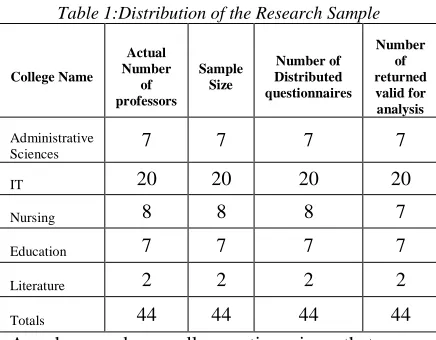
The research was conducted on a random sample of university professors that utilize the electronic examinations system to assess their students. The professors came from different faculties, and these are (College of Administrative Sciences and Finance, College of Information Technology, College of Nursing, College of Arts, and College of Education), as shown in Table (1).
Table 1:Distribution of the Research Sample
College Name
Actual Number
of professors
Sample Size
Number of Distributed questionnaires
Number of returned valid for analysis
Administrative
Sciences 7 7 7 7
IT 20 20 20 20
Nursing 8 8 8 7
Education 7 7 7 7
Literature 2 2 2 2
Totals 44 44 44 44
As shown above all questionnaires that were distributed on the professors were returned and were valid for analysis.
2.5 Research Tool and Variables
The variables that has been adapted by the researchers for the professors questionnaires are as follows:
1. Dependent Variables: Variable for the requirements, these are: Infrastructure,
Administration Personnel, Computer Skills needed for the preparation of electronic assessments. 2. Independent Variables: Indicators for applying the system successfully, variable for problems facing professors when taking electronic assessments.
2.6 The Reliability of the Research Tool
[image:3.612.85.303.441.611.2]We should note that the questionnaires used in this research were reviewed by experts in the field and their notes were taken into consideration and were implemented. Some paragraphs in the questionnaires were edited and other paragraphs were rephrased to insure the balancing of the content of all paragraphs. The coefficients of reliability (Cranach’s Alpha) have been used in the professors questionnaires to measure the internal consistency for all variables in the research sample as shown in table (2).
Table 2: The Coefficients of Reliability for the Research Variables in the professors Questionnaire
Paragraph Number in
the Questionnaire
Name of Variables Coefficient of Reliability
(7-11) Infrastructure Variable 1: %88
(12-17) Variable 2: Systems
Administration %80,5
(18-26) Variable 3: Computer
Skills %88,9
(27-33) Variable 4: Indicator of Success %81,2
(34-44) Variable 5: Problems
facing professors %84,2
We should note the coefficients of reliability for the research variables in the professors questionnaire are all high enough to carry out this research.
3. STATISTICAL ANALYSIS
dependent variables in addition to the use of (X2) to measure the variation in trends of the research variables.
3.1 Discussion of Research Results
I. Number and type of courses that were involved in the survey:
It is noticeable from table (3) that the college of Information Technology is ranked first in the number of computerized courses with (18) courses, while the college of Nursing came in second as the number of courses were (13) courses, and these numbers are increasing in these two faculties, where they both utilize the e-learning system almost fully. The application of this system in other colleges where the number of computerized courses where less noticeable, that the college of Administrative Sciences and Finance came third
[image:4.612.87.525.313.437.2]place with (9) computerized courses, and this college began an action plan which was adopted by the dean of the college which aims to increase the number of computerized courses. The utilization of the e-learning system were not applied in the college of Arts and the college of Education, nor in other faculties that were excluded from the sample, such as the college of Laws and the college of Engineering. While it is possible to do so, especially in the college of Laws in which to use the e-learning system in their courses, the researchers believe that the lack of IT skills is the main reason to prevent these faculties from utilizing the e-learning system. The researchers have concluded from these results that there are (46) computerized courses in (5) faculties in research sample.
Table 3: Courses Distribution based on their types
College Name
Numbe r of courses
University Compulsor
y
Universit
y Elective College Compulsor
y
Departmen t Supportive
Departmen t Compulsor
y
Departmen t Elective
Administrativ
e Sciences 18 1 2 3 - 8 3
IT 13 - - 2 1 10
Nursing 9 - - 3 - 5 1
Education 5 4 - - - - 1
Literature 1 1 - - - - -
Totals 46 6 2 8 1 23 4
II. Analysis of the professors answers to the system infrastructure (variable 1):
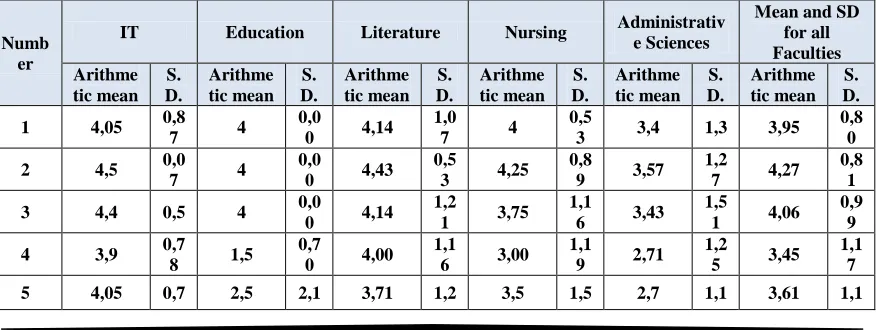
Results shown in table (4) indicate that there is general agreement on all paragraphs of this variable by the research sample, that is all professors in all colleges combined. They all agreed that the infrastructure of networks, computer hardware and software necessary to implement the e-assessments system is available. The overall arithmetic mean of
their answers is (3.87), which is higher than the arithmetic mean of measurement tool of (3) with standard deviation of (0.82). These answers came to confirm their consent on their colleges that they all provide the necessary computer hardware, sophisticated database which provides secured questions assessments, the presence of sophisticated software to implement the system, and provide laboratories equipped with the latest devices.
Table 4: The Arithmetic mean and Standard Deviation for professors answer on the Infrastructure variable
Numb er
IT Education Literature Nursing Administrativ
e Sciences
Mean and SD for all Faculties Arithme
tic mean S. D.
Arithme tic mean
S. D.
Arithme tic mean
S. D.
Arithme tic mean
S. D.
Arithme tic mean
S. D.
Arithme tic mean
S. D.
1 4,05 0,8
7 4
0,0
0 4,14
1,0
7 4
0,5
3 3,4 1,3 3,95
0,8 0
2 4,5 0,0
7 4
0,0
0 4,43
0,5
3 4,25
0,8
9 3,57
1,2
7 4,27
0,8 1
3 4,4 0,5 4 0,0
0 4,14
1,2
1 3,75
1,1
6 3,43
1,5
1 4,06
0,9 9
4 3,9 0,7
8 1,5
0,7
0 4,00
1,1
6 3,00
1,1
9 2,71
1,2
5 3,45
1,1 7
[image:4.612.90.528.579.744.2]5 2 5 1 1 8
6 4,18 0,4
9 3,2
0,2
8 4,08
0,9
4 3,7 0,9 3,17
1,0
7 3,87
0,8 2
III. Analysis of the professors answers to the availability of specialized personnel to administer the system (variable 2):
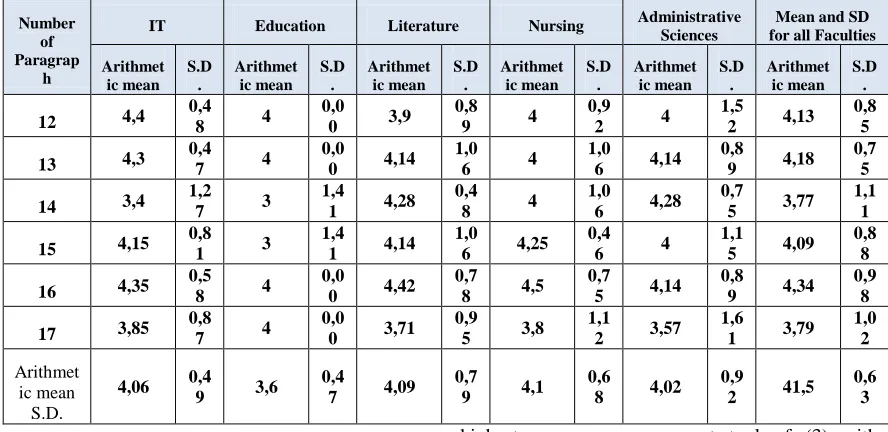
Results shown in table (5) indicates that there is general agreement on all paragraphs of this variable by all members of the research sample on the
[image:5.612.83.527.248.464.2]availability of expert staff who are responsible for the preparation of the e-assessments system. The overall arithmetic mean of their answers was (4.5), which is higher than the average measurement tool standard deviation of (0.63). This means that all professors who took the questionnaire agreed that those responsible for administrating the e-assessments system are highly skilled.
Table 5: The Arithmetic mean and Standard Deviation for professors answer on the system administration variable
Number of Paragrap
h
IT Education Literature Nursing Administrative
Sciences
Mean and SD for all Faculties
Arithmet ic mean S.D . Arithmet ic mean S.D . Arithmet ic mean S.D . Arithmet ic mean S.D . Arithmet ic mean S.D . Arithmet ic mean S.D .
12 4,4 0,48 4 0,00 3,9 0,89 4 0,92 4 1,52 4,13 0,85
13 4,3
0,4 7 4 0,0 0 4,14 1,0 6 4 1,0 6 4,14 0,8 9 4,18 0,7 5
14 3,4 1,27 3 1,41 4,28 0,48 4 1,06 4,28 0,75 3,77 1,11
15 4,15 0,81 3 1,41 4,14 1,06 4,25 0,46 4 1,15 4,09 0,88
16 4,35 0,58 4 0,00 4,42 0,78 4,5 0,75 4,14 0,89 4,34 0,98
17 3,85
0,8 7 4 0,0 0 3,71 0,9 5 3,8 1,1 2 3,57 1,6 1 3,79 1,0 2 Arithmet ic mean S.D. 4,06 0,4 9 3,6 0,4 7 4,09 0,7 9 4,1 0,6 8 4,02 0,9 2 41,5 0,6 3
IV. Analysis of the professors answers for the variable of computer skills (variable 3):
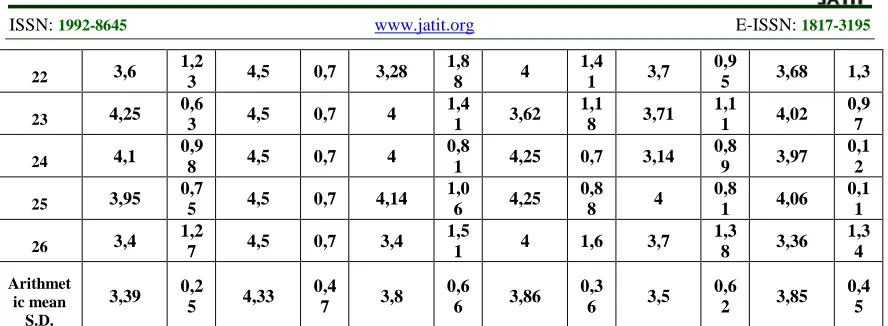
Results shown in table (6) shows that there is a general agreement on all paragraphs of this variable by professors of all colleges combined, to provide the skills and capabilities of professors to deal with computers and prepare e-assessments, where the arithmetic mean for their answers is (3.85), the
[image:5.612.90.528.597.741.2]highest average measurement tool of (3) with standard deviation of (0.45). These results were confirmed the agreement of all professors that they have the ability to deal with the computers and some of have certificates for Computer Driving (ICDL), this confirmed that the preparation of e-exams does not need a training and have enough skills and time to prepare the database of questions, and the nature of their material does fit well for e-exams.
Table 6: The Arithmetic mean and Standard Deviation for professors answer on the computer skills variable
Number of Paragra
ph
IT Education Literature Nursing Administrative
Sciences
Mean and SD for all Faculties
Arithmet ic mean S.D . Arithmet ic mean S.D . Arithmet ic mean S.D . Arithmet ic mean S.D . Arithmet ic mean S.D . Arithmet ic mean S.D .
18 4,9 0,22 4,5 0,70 4,14 1,06 4,5 0,53 4,14 0,69 4,5 0,65
19 3
1,8 5 4,5 0,7 0 4,14 1,4 6 2,87 1,6 4 3,85 1,4 6 3,36 1,5 7
20 4,65
0,6 7 4,5 0,7 0 3,57 1,2 7 4,25 1,3 8 2,57 1,6
1 4,06 1,3
21 3,45
22 3,6
1,2
3 4,5 0,7 3,28
1,8
8 4
1,4
1 3,7
0,9
5 3,68 1,3
23 4,25
0,6
3 4,5 0,7 4
1,4
1 3,62
1,1
8 3,71
1,1
1 4,02
0,9 7
24 4,1
0,9
8 4,5 0,7 4
0,8
1 4,25 0,7 3,14
0,8
9 3,97
0,1 2
25 3,95 0,75 4,5 0,7 4,14 1,06 4,25 0,88 4 0,81 4,06 0,11
26 3,4 1,27 4,5 0,7 3,4 1,51 4 1,6 3,7 1,38 3,36 1,34
Arithmet ic mean S.D.
3,39 0,2
5 4,33
0,4
7 3,8
0,6
6 3,86
0,3
6 3,5
0,6
2 3,85
0,4 5
V. Analysis of the professors answers for the variable of the success on the implementation of the system (variable 4)
The results described in table (7) indicate that there is a general agreement by the professors in the colleges, collectively, that the system had succeeded in accordance with the indications expressed by the paragraphs of this variable as overall average of the answers to this variable is (4.02), which is higher than the average tool measurement standard deviation of (0.72). This means that there is agreement on the fact that e-examinations saved a lot of effort and time for the
[image:6.612.86.530.69.232.2]teacher to prepare the exams as well as achieved justice and prevent cases of fraud, as well as provided the time and effort in the distribution of questions and reviewing the exams, and the grades of students approached the normal distribution. It has been also noticeable that the results of phrase (32) for the professors of the College of Nursing did not see it as indicator of successful implementation and when the person responsible for e-exams in college asked for the reason, he pointed out that the college does not possess its own laboratories and need to make an appointment for students.
Table 7: The Arithmetic mean and Standard Deviation for professors answer on the success of system implementation variable
Number of Paragra
ph
IT Education Literature Nursing Administrative Sciences for all Faculties Mean and SD
Arithmet ic mean S.D.
Arithmet ic mean
S.D .
Arithmet ic mean
S.D .
Arithmet ic mean
S.D .
Arithmet ic mean
S.D .
Arithmet ic mean
S.D .
27 4,00 0,47 4,5
0,7
0 4,14
1,0
6 3,5 1,3 4,00
1,1
5 4,27
0,9 7
28 3,00 1,18 4,00 0,00 4,28
1,1
1 3,25
1,7
5 3,71
1,3
8 3,68
1,2 8
29 4,00 0,59 4,00 0,00 4,71 0,48 3,87 1,45 4,42 0,78 4,43 0,84
30 4
1,16
9 4,5
0,7
0 4,57
0,5
3 4,37
0,7
4 4,42
0,7
8 4,25
0,9 4
31 3,85 1,13 4,5 0,70 4,14 1,06 4,25 1,38 4 1,00 4,02 1,11
32 3,95 0,94 4,5 0,70 3,71 1,38 2,87 1,12 4,14 1,21 3,77 1,13
33 3,35 0,93 4
0,0
0 4,57
0,5
3 3,75
1,3
8 4
0,8
1 3,75
1,0 1
Arithmet ic mean S.D.
4 0,61 4,28 0,4 4,3 0,6
9 3,69
0,9
1 4,1
0,8
8 4,02
0,7 2
VI. Analysis of the professors answers for the variable of system problems (variable 5)
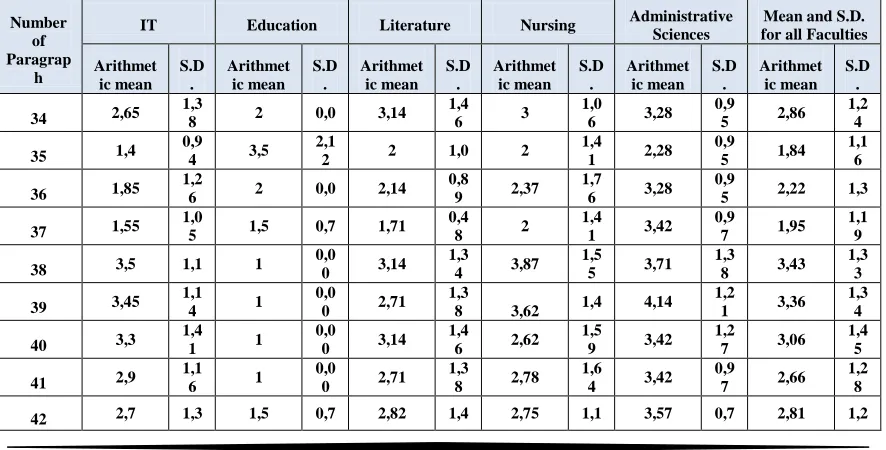
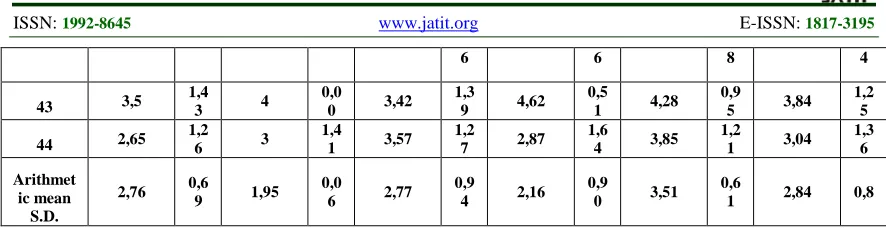
Results shown in table (8) indicate that there is a general agreement about the lack of obvious problems afflicting professors when implementing exams where arithmetic average of their answers to this variable was (2.84) which is less than the average measurement tool of (3) with standard deviation of (0.80). For phrase (34), which states
considered normal for professors in this specialty, as the arithmetic average of their answers were higher than the average measurement tool. As for phrase (36), it has been found that only professors in the College of Administrative Sciences considered it a problem that is faced when utilizing the system where the arithmetic average of their answers were higher than the average measurement tool. This phrase stated that e-exams are held at times other than lectures, causing confusion for students. Phrase (37), has found only professors in the college of Administrative Sciences deemed to be the problems they face and confirms the results from phrase (36). In other words, professors are sometimes absent from lectures due to conflicting exam date with times of lectures, where the arithmetic average of their answers were higher than the average measurement tool of (3). Phrase (38) has found that professors from the college of IT, Arts, Nursing, and Business Administration are forced to re-exam the student when technical problems in the network occurred, where arithmetic average of their answers were higher than the average measurement tool. Through Phrase (39), it has been found that there are agreement by professors in the college IT, college of Nursing, and college of Administrative Sciences that it is delayed student sometimes in completing exams because of slow network, where arithmetic average of their answers were higher than the average measurement tool. Phrase (40) has found that professors from the college of IT, the college of Arts and the college of Administrative Sciences considered any examinations system is designed in a manner that does not alert the student that there are questions
[image:7.612.87.530.520.745.2]unresolved to return to, as the arithmetic average of their answers were higher than the average measurement tool, but their answers on paragraph (41) has considered for professors in the college of Administrative Sciences and Finance, which stated that the majority of courses on the e-learning system are courses that are taught by one professor only (i.e. not multi-sections courses). For phrase (42,) only professors in the college of Administrative Sciences and Finance deemed to be a problem, averaging arithmetic answers were higher than the average measurement tool, which means that e-exams are in their entirety suffer from the absence of a sound scientific mechanism for preparing questions, while we find professors from the colleges of Information Technology, Education, Arts, and Nursing did not consider it of a problem as arithmetic average for their answers were less than the average measurement tool of (3). As for the phrase (43), it has been found a general agreement for all colleges as arithmetic average of their answers and as shown in table (9) higher than the average measurement tool, which states that the lack of essay type questions and the use of multiple-choice questions only do not allow professors to test the full scientific capability of students. Finally, in phrase (44), it has been found that there is an agreement by professors in the colleges of Education, Arts, and Business Administration, where arithmetic average of their answers were higher than the average measurement tool, which means that e-examinations do not allow professors the chance to review answers and solve questions because of its multiple form nature.
Table 8: The Arithmetic mean and Standard Deviation for professors answer on the system problems of system variable
Number of Paragrap
h
IT Education Literature Nursing Administrative Sciences for all Faculties Mean and S.D.
Arithmet ic mean
S.D .
Arithmet ic mean
S.D .
Arithmet ic mean
S.D .
Arithmet ic mean
S.D .
Arithmet ic mean
S.D .
Arithmet ic mean
S.D .
34 2,65
1,3
8 2 0,0 3,14
1,4
6 3
1,0
6 3,28
0,9
5 2,86
1,2 4
35 1,4 0,94 3,5 2,12 2 1,0 2 1,41 2,28 0,95 1,84 1,16
36 1,85 1,26 2 0,0 2,14 0,89 2,37 1,76 3,28 0,95 2,22 1,3
37 1,55
1,0
5 1,5 0,7 1,71
0,4
8 2
1,4
1 3,42
0,9
7 1,95
1,1 9
38 3,5 1,1 1 0,00 3,14 1,34 3,87 1,55 3,71 1,38 3,43 1,33
39 3,45 1,14 1 0,00 2,71 1,38 3,62 1,4 4,14 1,21 3,36 1,34
40 3,3
1,4
1 1
0,0
0 3,14
1,4
6 2,62
1,5
9 3,42
1,2
7 3,06
1,4 5
41 2,9 1,16 1 0,00 2,71 1,38 2,78 1,64 3,42 0,97 2,66 1,28
6 6 8 4
43 3,5 1,43 4
0,0
0 3,42
1,3
9 4,62
0,5
1 4,28
0,9
5 3,84
1,2 5
44 2,65 1,26 3 1,41 3,57 1,27 2,87 1,64 3,85 1,21 3,04 1,36
Arithmet ic mean S.D.
2,76 0,69 1,95 0,06 2,77 0,94 2,16 0,90 3,51 0,61 2,84 0,8
3.2 Testing the first hypotheses
There is no effective relationship that is statistically significant at the level of (0.05 ≥ a) between the availability of supplies for applying the e-examinations system and the successful implementation from the point of view of the research sample which consisted of professors from several colleges at the university. Results indicated multiple regression analysis and described in table (9) that the value of the level of moral F was equal to (0.005) which is less than (0.05) and this means that the independent variable was able to explain (0.27) of the variation in the variable which stated that professors approved the level of success in applying the e-examinations system.
[image:8.612.84.527.70.184.2]
Table 9: Multiple regression analysis for effective relationship between the availability of requirements and
the successful implementation of the system
Source of Variatio
n
0T
Squar es
0T
of
0T
Deviat ion
Degre es of Freed om
Avera ge Deviat
ion F
Mo ral Sig
R R2
Slope 6.078 3 2.026 4.
95 0.0 05
0. 52
0. 27 Remain
ders 16.34 40 0.4
Total 22.41
9 43
The results indicate the exclusion of the variables (2, and 3) and were limited to variable (1). Table (10) shows the test results as the value the correlation coefficient of the two variables (R = 0.411) and the value of the regression coefficient (R2 = 0.169) and the value of the level of moral F (0.006), which is less than (0.05). This indicates the rejection of the hypothesis subsidiary that there is no effective relationship between the availability of the infrastructure (computers, software, and networks) and the success of the implementation process, and accept the alternative hypothesis that there is effective relationship between of them. Also the acceptance of hypotheses bodies which states that "there is no effective relationship between the availability of professional staff responsible for the preparation and implementation of the e-examinations system, and providing skills
and capacity to deal with computers and the setup and configuration of the e-exams" and the success of the implementation process. The value of the level of moral T each amounted respectively (0.90, 0.72) is larger than (0.05).
Table 10: Sequential results of the regression analysis of the influential relationship between the availability of requirements and the successfulimplementation of
e-assessments system for professors answers
Independent Variable
0T
R R2 T Level of
Moral Sig
Infrastructure 0.411 0.169 8.53 0.006
Availability of Computer
Skills
0.90
Variable adopted: successful implementation of the system of indicators.
Independent variable: provide professional staff and provide skills and abilities.
3.3 Testing the second hypotheses
There is no statistically significant differences at (0.05 ≥) trends in the research sample of professors at the University for the following variables: The availability of resources needed to implement the e-examinations system which are: the infrastructure (computers, software, and networks), professional staff responsible for the preparation and implementation of the e-exams system, and the necessary skills and capacity to deal with computers, and the setup and configuration of e-exams, and indicators of the success of the implementation of the e-exams system, and the problems they face when implementing the system.
3.4 Research Testing Results
[image:8.612.312.528.295.365.2]indicators of success), the results suggest that there is no variation in attitudes about these variables where the level of significance for each respectively (0.313, 0.059, 0.969, 0.545) and all are greater than the level of significance (0.05) which confirms the validity of the assumptions for each of these sub-variables. As The results suggest that there is not a difference in the trends of research sample for the variable (supplies all its elements) where the level
of significance is (0.662), the largest of (0.05), and compared these results with the results of descriptive statistics of the averages we find the arithmetic average of the combined variable reached paragraphs ( 3.917) with a standard deviation of (0.45). Which confirms the validity of the hypothesis.
Table 11: Analysis of Chi square results for the professors answers
Model Infrastructure Specialized
Personnel
Computer Skills
All Requirements
System Success
System Problems
X2 24.364 16 31.682 18.727 14.227 12.818
Degrees of
Freedom 15 14 14 22 16 24
Level of
Moral 0.059 0.313 0.04 0.662 0.545 0.969
4. CONCLUSION
In light of the results of the analysis on the collected data on the variables of the research and testing hypotheses we can draw several significant results. First of all, the results of the arithmetic means for answers of the majority of the members of the research sample agreed on the availability of all the requirements for applying the computerized examinations system. These are the provision of the infrastructure (networks, software, computers), the provision of the professional staff responsible for preparation and implementation of the system, in addition to providing the skills and capacities of professors to use the system. Second, The results showed on the testing of the first hypothesis that there is a relationship impact morale between the availability of all the requirements of the e-examinations system and success of the implementation process from the perspective of the professors and rejected the hypothesis nihilism that there is no effective relationship between of them. This is as indicated in the results of regression analysis chain which is to accept the hypothesis nihilism of variables (provide professional staff, availability of skills and abilities), and there is no relationship between of them both individually and the variable of the success of the implementation process, which has also been rejected. Third, the results of testing the second hypothesis that there is variation in the attitudes of professors about the variable to provide skills and abilities which indicates the rejection of the hypothesis subsidiary, that there was no variation in attitudes about the variables (infrastructure, provide professional staff,
and indicators on the success of the implementation process and the problems facing it).
REFRENCES:
[1] Baran, P. (1964). "On Distributed Communications Networks", IEEE Trans. Comm. Systems, March 1964.
[2] Fritz E. Froehlich; Allen Kent (1990). "ARPANET, the Defense Data Network, and Internet". The Froehlich/Kent Encyclopedia of Telecommunications. 1. CRC Press. pp. 341– 375
[3] Kirstein, Peter T. (2009). "The Early Days of the Arpanet". IEEE Annals of the History of Computing 31 (3): 67.
[4] McAndrew, P. (2010). Defining openness: updating the concept of "open" for a connected world. Journal of interactive Media in Education. http://jime.open.ac.uk/article/2010-10.
[5] Shin, N. and J.K.Y. Chan (2004) “Direct and Indirect Effects of Online Learning on Distance Education,” British Journal of Educational Technology, Vol 35 (3), 275-288.
[6] Bates, M.; Loddington, S; Manuel, S. and Oppenheim, C. (2007) Attitudes to the rights and rewards for author contributions to repositories for teaching and learning. Association for Learning Technology Journal, 15 (1). pp. 67-82.
[8] Servonsky, E., Daniels, W., & Davis, B. (2005). Evaluation of Blackboard as a platform for distance education delivery. The ABNF Journal, 16(6), 132-135.
[9] Dougiamas, M., & Taylor, P. C. (2003). Moodle: Using learning communities to create an open source course management system. In D. Lassner & C. McNaught (Eds.), ED-MEDIA2003: Proceedings of the 15th world conference on educational multimedia and hypermedia & world conference on educational telecommunications (pp. 171–178).
[10] Machado M., Tao E. (2009). Blackboard vs. Moodle: Comparing user experience of Learning Management Systems, Proceedings of the 37th ASEE/IEEE Frontiers in Education Conference (pp. S4J-7 – S4J-12).
[11] Vendlinski, T., & Stevens, R. (2002). Assessing student problem-solving skills with complex computer based tasks. Journal of Technology, Learning, and Assessment, 1(3).
[12] Birenbaum M. et al. (2006). A learning Integrated Assessment System, Educational Research Review (1), 61–67.
[13] Scalise K., Gifford B.(2006). Computer-Based Assessment in E-Learning: A Framework for Constructing "Intermediate Constraint" Questions and Tasks for Technology Platforms, The Journal of Technology, Learning, and Assessment, 4(6).
[14] Jurczyk, J., Benson, S.N.K. and Savery, J.R. “Measuring Student Perceptions in Web-Based Courses: A Standards-Based Approach”, Online Journal of Distance Learning Administration (7:4), Winter 2004.
[15] Alnsour A., et.al. (2011)," Implementing Moodel as a Tool to Develop the Isra university E-learing system",Jcsns International Journal security,vol.1 No.6.
[16] Alnsour A., et.al. (2011), " Managing the E-Learing of Isra university "European of scientific Research, Issn,XVol.55.No.3.