Munich Personal RePEc Archive
A Multivariate Causality Analysis of
Export and Growth for Turkey
Halicioglu, Ferda
Department of Economics, Yeditepe University
2007
Online at
https://mpra.ub.uni-muenchen.de/3565/
A Multivariate Causality Analysis of Export and Growth for Turkey
Abstract
This study seeks to validity of the export-led growth hypothesis using quarterly data from 1980 to 2005. The bounds testing approach to cointegration is employed to test the causal relationship between industrial production, exports and terms of trade. An augmented form of Granger causality analysis is implemented to identify the direction of relationship among the variables both in the short-run and the long-run. The empirical findings suggest uni-directional causation from exports to industrial production.
Key words: Export-led growth, causality, cointegration, Turkey
JEL Classification: C12, C22, F14, F43
Correspondence to:
Ferda HALICIOGLU
Department of Economics Yeditepe University 34755, Istanbul, Turkey
e-mail1: [email protected]
e-mail 2: [email protected]
1. Introduction
The pace of economic development of a nation poses one of the most fundamental issues in economics debate. It is argued that a nation could accelerate the rate of economic growth by promoting exports since it will stimulate the production of goods and services. This argument has led to export-led growth (ELG) hypothesis in the literature. The linkages between export performance and economic growth are established through different channels, which include allowing the diffusion of technical knowledge, easing the foreign exchange constraint, providing positive economies of scale, increasing degree of competition, and leading to progressive trade liberalization measurements.
A large number of studies tested the ELG hypothesis using different econometric procedures ranging from simple OLS to multivariate cointegration but previous empirical studies have produced mixed and conflicting results on the nature and direction of the causal relationship between export growth and output growth.
Giles and Williams (2000a, 2000b) provide an excellent literature review of the ELG hypothesis until the late 1990s. In addition to this extensive survey, one notes that the literature on the ELG hypothesis has been constantly expanding with more recent studies such as Darrat et al. (2000) for Taiwan; Hatemi-J and Irandoust (2000a) for Nordic countries; Fountas (2000) for Ireland; Panas and Vamvoukas (2002) for Greece; Balaguer et al. (2001) for Spain; Chandra (2003) for India; Abual-Foul (2004) for Jordan; Al Mamun and Nath (2005) for Bangladesh; Awokuse (2005a) for Korea; Awokuse (2005b) for Japan; Love and Chandra (2005a) for South Asia; Mah (2005) for China; and Siliverstovs and Herzer (2006) for Chile.
Turkey made a major policy change regarding her economic development strategy in 1980. On witnessing the weaknesses of import-substitution strategy in the 1970s, Turkey attempted to overcome these weaknesses by gearing towards a more outward-oriented economic development strategy. The 1980s reforms and liberalization attempts in the foreign trade regime has resulted in a successful export-led growth era. The ratio of total exports to gross domestic product (GDP) increased from 4.1 to 20.3 percent during the period 1980-2005 and the real GDP grew by 4.1 percent in the same period. Expansion of exports has been facilitated by the following export incentives and subsidies: i) the Central Bank pursued a depreciating exchange rate policy until 1988; ii) the exports benefited from generous direct payments till 1990; iii) preferential and subsidized export credits were provided; iv) tax exemptions were offered on imported inputs; and v) corporate tax allowances were made available; see for details of these policies in CBRT (2002). The other important aspects of export-led growth strategy of Turkey are discussed in Ertugrul and Selcuk (2001) and Togan (2004).
equilibrium among the variables. Mah (2005) adopts the same procedure in bivariate case but the causality inference in Mah is only based on the error-correction term. This study firstly extends the Pesaran et al. procedure into multivariate analysis. Secondly, the direction of causal relationships among variables is examined through short-run and long-run augmented Granger causality tests.
The rest of article is organized as follows. Section II outlines the econometric methodology adopted. Section III presents the empirical results. Section IV summarizes and concludes.
2. The Econometric Methodology
This study adopts a three-stage procedure to test the direction of causality between the variables. In the first stage, the order of integration of the variables is established by implementing the augmented Dickey-Fuller (ADF, 1979) and Phillips-Perron (PP, 1988) unit root tests.
The second stage involves testing for the existence of a long-run relationship between real industrial production index (Y), real exports (E) and terms of trade (T) within a multivariate framework. On following Love and Chandra (2005b), the variable of terms of trade is utilized in this study in order to eliminate possible mis-specification bias of previous bivariate analyses in addition to a fact that terms of trade has had an influence on export earnings.
In the last two decades, several econometric procedures were employed to investigate the cointegration relationships between macroeconomic variables. With regards to univariate cointegration approaches, there are several examples including Engle-Granger (1987) and the fully modified OLS procedures of Phillips and Hansen (1990). There are also many examples of multivariate cointegration procedures of Johansen (1988), Johansen and Juselius (1990), and Johansen’s (1996) full information maximum likelihood technique. A recent single cointegration approach, known as autoregressive-distributed lag (ARDL) of Pesaran et al. (2001), has become popular amongst the researchers. Pesaran et al. cointegration approach, also known as bounds testing, has certain econometric advantages in comparison to other single cointegration procedures. They are as follows: i) endogeneity problems and inability to test hypotheses on the estimated coefficients in the long-run associated with the Engle-Granger method are avoided; ii) the long and short-run parameters of the model in question are estimated simultaneously; iii) the ARDL approach to testing for the existence of a long-run relationship between the variables in levels is applicable irrespective of whether the underlying regressors are purely I(0), purely I(1), or fractionally integrated; iv) the small sample properties of the bounds testing approach are far superior to that of multivariate cointegration.
t t Y t Y t Y m i m i m i i t iY i t iY i t iY Y t v T f E e Y d T a E b Y a a Y 1 1 3 1 2 1 1
1 1 1
0 ln ln ln ln ln ln ln + + + + Δ + Δ + Δ + = Δ − − − = − = − = −
∑
∑
∑
(1)t t E t E t E m i m i m i i t iE i t iE i t iE E t v T f Y e E d T a Y b E a a E 2 1 3 1 2 1 1
1 1 1
0 ln ln ln ln ln ln ln + + + + Δ + Δ + Δ + = Δ − − − = − = − = −
∑
∑
∑
(2)t t T t T t T m i m i m i i t iT i t iT i t iT T t v E f Y e T d E a Y b T a a T 3 1 3 1 2 1 1
1 1 1
0 ln ln ln ln ln ln ln + + + + Δ + Δ + Δ + = Δ − − − = − = − = −
∑
∑
∑
(3)where lnY is the logarithm of real industrial production index, lnE is the logarithm of real exports, lnT is the logarithm of terms of trade, and Δ is the first difference operator.
The F-tests are used for testing the existence of long-run relationships. The F test used for this procedure, however, has a non-standard distribution. Thus, the Pesaran et al. approach compute two sets of critical values for a given significance level. One set assumes that all variables are I(0) and the other set assumes they are all I(1). If the computed F-statistic exceeds the upper critical bounds value, then the H0 (null
hypothesis) is rejected. If the F-statistic falls into the bounds, then the test becomes inconclusive. Lastly, if the F-statistic is below the lower critical bounds value, it implies no cointegration. When long-run relationship exists, the F-test indicates which variable should be normalized. The null hypothesis of equation (1) is (H0:
). This is denoted as 0
3 2
1Y =e Y = f Y =
d FY(Y E,T). In equation (2), the null
hypothesis is (H0: 0d1E =e2E = f3E = ). This is represented by FE(EY,T). Finally, the null hypothesis of equation (3) is given by (H0: 0d1T =e2T = f3T = ) with the following function, FT(TY,E).
The third stage includes forming standard Granger-type causality tests augmented with a lagged error-correction term. The Granger representation theorem suggests that there will be Granger causality in at least one direction if there exists a cointegration relationship among the variables in equations (1)-(3), providing that they are integrated order of one. Engle-Granger (1987) caution that the Granger causality test, which is conducted in first difference via a vector autoregression (VAR) will be misleading in the presence of cointegration. Therefore, an inclusion of an additional variable to the VAR system, such as the error-correction term, would help us to capture the long-run relationship. To this end, an augmented form of Granger causality test involving the error-correction term is formulated in a multivariate pth order vector error-correction model (VECM), as follows:
[
]
⎢⎡ ⎥⎤ ⎥ ⎤ ⎢ ⎡ ⎥ ⎤ ⎢ ⎡Δ ⎥ ⎤ ⎢ ⎡ ⎥ ⎤ ⎢ ⎡ ⎥ ⎤ ⎢ECt-1 is the error correction term, which is derived from the long-run relationship, and
it is not included in equation (4) if one finds no cointegration amongst the variables in question. The Granger causality test may be applied to equation (4) as follows: i) by checking statistical significance of the lagged differences of the variables for each vector; this is a measure of short-run causality; and ii) by examining statistical significance of the error-correction term for the vector that there exists a long-run relationship.
3. The Empirical Results
Quarterly data over 1980I-2005IV period were used to estimate equations (1)-(3). Data definition and sources of data are cited in the Appendix. The results of the ADF and PP unit root tests are not reported here due for brevity; however, the variables in question are integrated of order one.
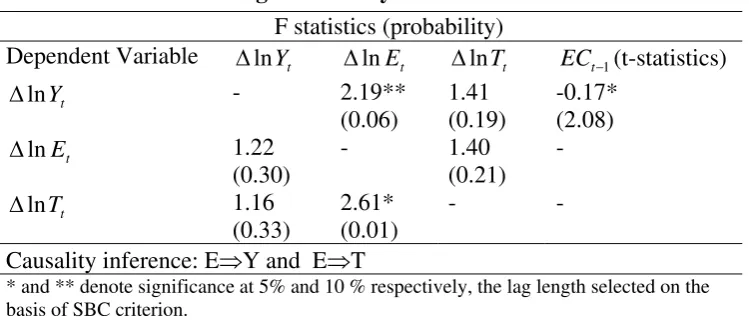
Equations (1)-(3) were estimated in two stages. In the first stage of the ARDL procedure, the order of lags on the first–differenced variables for equations was obtained from unrestricted VAR by means of Akaike Information Criterion (AIC) and Schwarz Bayesian Criterion (SBC), which both indicated the optimal lag level as five quarters. Then an F deletion test was applied to equations (1)-(3) in order to test the existence of a long-run relationship, by using lags from five to eight, following Bahmani-Oskooee and Goswami (2003), as they have shown that the results of this stage are sensitive to the order of VAR. The summary results of bounds tests are presented in Table 1. As can be seen from Table 1, it is clear that there is a long-run relationship amongst the variables when Y is the dependent variable because its F-statistic exceeds the upper bound critical value at the 5% and 10% levels. The null hypothesis of equations (2) and (3), however, cannot be rejected.
Table 1. The Results of F-test for Cointegration
Calculated F-statistic for different lag lengths 5 lags 6 lags 7 lags 8 lags
) , (Y E T
FY 3.97 3.88 5.09 5.23
) , (EY T
FE 3.03 2.06 1.05 1.78
) , (TY E
FT 1.56 1.93 1.76 1.80
The critical value ranges of F-statistics with two explanatory variables are 3.79 - 4.85 and 3.18 – 4.12 at 5% and 10% level of significances, respectively. See Pesaran et al. 2001, pp.300-301, Table CI, Case III.
Table 2. Results of Granger Causality
F statistics (probability)
Dependent Variable ΔlnYt ΔlnEt ΔlnTt ECt−1(t-statistics)
t Y ln
Δ - 2.19**
(0.06)
1.41 (0.19)
-0.17* (2.08)
t E ln
Δ 1.22
(0.30)
- 1.40 (0.21)
-
t T ln
Δ 1.16
(0.33)
2.61* (0.01)
- -
Causality inference: E⇒Y and E⇒T
* and ** denote significance at 5% and 10 % respectively, the lag length selected on the basis of SBC criterion.
On analyzing the long-run results, one can ascertain that the coefficient on the lagged error-correction term is significant with the expected sign in the real industrial production index equation at 5%, which also confirms the result of the bounds test for cointegration. This implies that real exports and terms of trade Granger cause the real industrial production index in the long-run and the direction of causality runs interactively through the error-correction term from real exports and real terms of trade. The value of error-correction term is rather small; therefore restoration of the equilibrium level of the real industrial production index in the case of a deviation will take considerably longer. As for the short-run, the F-statistics on the explanatory variables demonstrate that there is uni-directional Granger causality between real exports and real industrial production index, in which the direction of causality runs from real exports to real industrial production index confirming the ELG hypothesis. Nevertheless, the strength of this causation is rather weak as far as the F-statistic is concerned. Similarly, there is uni-directional Granger causality between real exports and terms of trade.
4. Conclusion
Appendix
Data definition and sources
The data set used in this study cover the period 1980I to 2005IV. All data are collected from International Financial Statistics (IMF) and Turkish Treasury Annual Foreign Trade Statistics (TT).
Y is Turkish industrial production index, which is deflated by the consumer price index of Turkey. Industrial production index is used as a proxy variable for real income since there is no quarterly data available for the concerning variable before 1987. Source: IMF.
E is exports in millions of US dollars, which is deflated by the US consumer price index. Source: IMF
T is terms of trade defined as the unit value index of exports as a percentage of the unit value index of imports. Source: TT.
References
Abual-Foul, B. (2004) Testing the export-led growth hypothesis: evidence from Jordan, Applied Economics Letters, 11, 393-396.
Al Mamun, K. A. and Nath, H. K. (2005) Export-led growth In Bangladesh: a time series analysis, Applied Economics Letters, 12, 361-364.
Awokuse, T. O. (2005a) Exports, economic growth and causality in Korea, Applied Economics Letters, 12, 693-696.
Awokuse, T. O. (2005b) Export-led growth and the Japanese economy: evidence from VAR and directed acyclic graphs, Applied Economics Letters, 12, 849-858.
Bahmani-Oskooee, M. and Goswami, G. G. (2003) A disaggregated approach to test the J-curve phenomenon: Japan versus her major trading partners, International Journal of Economics and Finance, 27, 102-113.
Bahmani-Oskooee, M. and Domac, I. (1995) Export growth and economic growth in Turkey: evidence from cointegration analysis, METU Studies in Development, 22, 67-77.
Balaguer, J. and Cantavella-Jorda, M. (2001) Examining the export-led growth hypothesis for Spain in the last century, Applied Economics Letters, 8, 681-685.
CBRT (Central Bank of the Republic of Turkey), (2002) The Impact of Globalization on the Turkish Economy, Banknote Printing Plant Department, Ankara.
Darrat, A. F., Hsu, M. K. and Zhong, M. (2000) Testing export exogeneity in Taiwan: further evidence, Applied Economics Letters, 7, 563-567.
Dickey, D.A., and Fuller, W.A., (1979) Distributions of the estimators for autoregressive time series with a unit root, Journal of the American Statistical Association, 74, 427-431.
Engle, R. and Granger, C. (1987) Cointegration and error correction representation: estimation and testing, Econometrica, 55, 251-276.
Ertugrul, A. and Selcuk, F. (2001) A brief account of the Turkish economy, 1980-2000, Emerging Markets Finance and Trade, 37, 6-30.
Fountas, S. (2000) Some evidence on the export-led growth hypothesis for Ireland, Applied Economics Letters, 7, 211-214.
Giles, J. A. and Williams, C. L. (2000a) Export-led growth: a survey of the empirical literature and some non-causality results. Part 1, Journal of International Trade & Economic Development, 9, 261-337.
Giles, J. A. and Williams, C. L. (2000b) Export-led growth: a survey of the empirical literature and some non-causality results. Part 2, Journal of International Trade & Economic Development, 9, 445-470.
Hatemi-J, A. and Irandoust, M. (2000a) Export performance and economic growth causality: an empirical analysis, Atlantic Economic Journal, 28, 412-426
Hatemi-J, A. and Irandoust, M. (2000b) Time series evidence for Balassa’s export-led growth hypothesis, Journal of International Trade & Economic Development, 9, 355-365.
Johansen, S. (1988) Statistical analysis of cointegrating vectors, Journal of Economic Dynamics and Control, 12, 231-254.
Love, J. and Chandra, R. (2005a) Testing export-led growth in South Asia, Journal of Economic Studies, 32, 132-145.
Love, J. and Chandra, R. (2005b) Testing export-led growth in Bangladesh in a multivariate VAR framework, Journal of Asian Economics, 15, 1155-1168
Mah, J. S. (2005) Export, expansion, economic growth and causality in China, Applied Economics Letters, 12, 105-107.
Ozmen, E. and Furten, G. (1998) Export led-growth hypothesis and the Turkish data: an empirical investigation, METU Studies in Development, 28, 491-503.
Pesaran, M.H., Shin, Y., and Smith, R.J. (2001) Bounds testing approaches to the analysis of level relationships, Journal of Applied Econometrics, 16, 289-326.
Phillips, P. and Hansen, B. (1990) Statistical inference in instrumental variables regression with I(1) process, Review of Economic Studies, 57, 99-125.
Phillips, P.C. and Perron, P. (1988) Testing for a unit root in a time series regression, Biometrica, 75, 335-346.
Siliverstovs, B. and Herzer, D. (2006) Export-led growth hypothesis: evidence for Chile, Applied Economics Letters, 13, 319-324.