INTRODUCTION
Alison Mackey
Georgetown UniversitySusan Gass
Michigan State University
Interaction research has come a long way since its beginnings nearly 25 years
ago+The aim of this special issue is to demonstrate how the methodological
boundaries of interaction research continue to be expanded with the use of
new and interesting methodological angles and techniques+Our goal is to
fur-ther our insights into the question that seems to be paramount in the
inter-action field at the moment—namely,how does interaction work to bring about
positive effects on second language~L2!learning? The articles collected here
suggest that new methodologies promise to open up avenues of research that
will allow us to gain insights into the interaction-learning relationship+
Initially,the exploration of interactions between native speakers~NSs!and
nonproficient nonnative speakers ~NNSs! of a language was descriptive in
nature,and the research largely focused on the ways in which conversations
between L2 learners and NSs were structured+In this early descriptive
ground-work~e+g+,Gass & Varonis,1985;Long,1980;Pica, 1987,1988;Pica,Young,&
Doughty, 1987; Varonis & Gass, 1985!, the goal was to describe the ways in
which conversations with language learners at lower levels of proficiency
dif-fered from conversations with fluent speakers+ Naturally, such research
included a good deal of analysis and investigation into the frequency,
func-tions, and patterns of negotiation routines, including clarification requests,
comprehension checks,and confirmation checks,as well as into the possible
functions of comprehension as a stepping stone to learning+In one example
of such early research,Wagner-Gough and Hatch~1975! reported on the
lin-guistic behavior of a young Chinese speaker learning English who often
incor-porated information from a preceding utterance to construct his own discourse+
They presented this tendency as support for their now famous argument that conversation was used not only to practice the L2 but also as an actual venue
Our intent in this special issue is to show some of the current methodological techniques being used to provide insights about how interaction works to promote L2 learning+We would like to
thank the contributing authors who have made interesting and worthwhile contributions to help us attain this goal as well as theSSLAeditorial team for all their help in bringing this issue to completion+
Address correspondence to:Alison Mackey,Department of Linguistics ICC 460,Georgetown
Uni-versity,Washington,DC 20057;e-mail:mackeya@georgetown+edu+
to support learning+From this descriptive research evolved investigations into
the value and function of particular discourse patterns+ For example, Long
~1983a,1983b!attempted to provide an explanatory framework for the
descrip-tive data that were accruing+ He proposed that the discourse structure and
the interactional modifications that were part of this discourse helped the
learner to comprehend what was being said—an essential part of acquisition+
In other words,specific aspects of interaction provided learners with
oppor-tunities to gain new linguistic information+Many studies throughout the 1980s
and early 1990s examined the links between conversation and comprehension+
In the mid-1990s,researchers began to move beyond suggesting why
inter-action might be useful in L2 learning and toward demonstrating empirically
that it was, in fact,useful+For example,with an indirect argument based on
interlocutors’ success in following spoken directions,Gass and Varonis~1994!
suggested that interaction could potentially have positive effects on L2
learn-ers’ later production+Mackey’s~1999!study of English as a second language
~ESL! question formation showed that active participation in interaction was
associated with learning, and Ellis, Tanaka, and Yamazaki ~1994! likewise
showed positive effects for interaction+Although there are a few studies~e+g+,
Loschky,1994!that did not find such effects on language acquisition,
research-ers had enough of an empirical basis to begin asking questions about the
mech-anisms of interaction-driven L2 learning+
These developments were codified by Long in his important 1996 update of
the interaction hypothesis+In its simplest form, the interaction hypothesis
states that “negotiation for meaning,and especially negotiation work that
trig-gersinteractionaladjustments by the NS or more competent interlocutor,
facil-itates acquisition because it connects input, internal learner capacities,
particularly selective attention,and output in productive ways”~Long,1996,
pp+ 451–452!+ Thus, interaction-based research attempts to account for
vari-ous aspects of L2 learning through learners’ exposure to language,their
pro-duction of language,and the feedback they receive on their production+Gass
~2003!also pointed out that interaction research “takes as its starting point the
assumption that language learning is stimulated by communicative pressure and examines the relationship between communication and acquisition and the
mechanisms~e+g+,noticing,attention!that mediate between them”~p+224!+
In a recent update of this line of research,Gass and Mackey~in press!argued
that it might be time to acknowledge that the terminteraction hypothesisneeds
to be reevaluated,due,in particular,to advances in empirical research+They
pointed out that the facilitative role of interaction in learning is now well
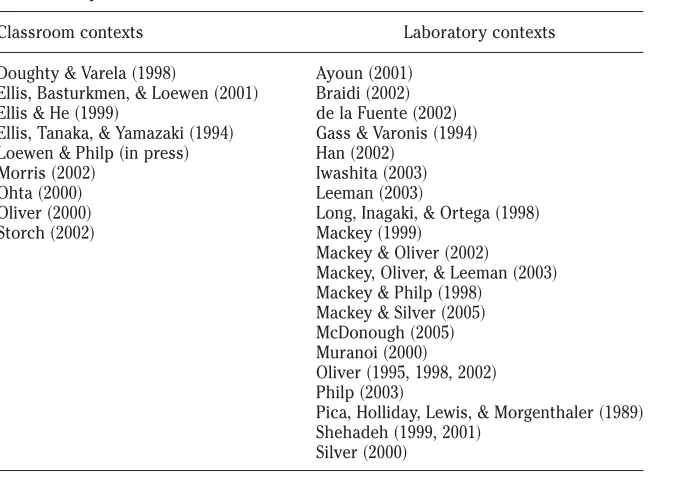
estab-lished~see Table 1 for examples of studies that suggest or demonstrate a link
between interaction and language development in a variety of contexts!and
that given the limitations implied by the wordhypothesis,it might be
neces-sary to reevaluate the appropriateness of the term with respect to current
ideas and the body of research findings on interaction+ As Long ~1996! also
pointed out, the interaction hypothesis includes some aspects of the input
~Swain,1985,1995,2005!;Gass and Mackey further pointed out that in
addi-tion to its designaaddi-tion as a hypothesis, this line of research has also been
referred to as the input,interaction,and output model~Block,2003;also used
by Thomas,2005,although it is not clear whether she used this term only to
refer to Block’s discussion of it!and as the interaction hypothesis in a
discus-sion of input and theory~Carroll,1999!+Based on VanPatten and Williams’~in
press!arguments about theory construction and evolution,Gass and Mackey
illustrated that the interaction approach includes elements of anhypothesis
~an idea that needs to be tested about a single phenomenon!, elements of a
model~a description of a process or a set of processes that comprise a
phe-nomenon!, and elements of atheory~a set of statements about natural
phe-nomena that explains why events occur the way they do!+Thus,they suggested
that this line of research might be better characterized as an approach or
model+Jordan~2005!made a similar point regarding the evolution of the
inter-action hypothesis in his book on theories in SLA+
Having firmly established the interaction-learning link, researchers have
begun to extend this knowledge base to new contexts, linguistic forms and
languages, and interpretations of feedback+ This approach currently allows
research to move beyond the question of whether interaction plays a role in
development to asking how it facilitates development+ It has also entailed a
[image:3.432.55.395.84.323.2]broadening of the research methods employed+ Research methods in early
Table 1. Sample studies suggesting a role for interaction in L2 production and development
Classroom contexts Laboratory contexts
Doughty & Varela~1998! Ayoun~2001! Ellis,Basturkmen,& Loewen~2001! Braidi~2002!
Ellis & He~1999! de la Fuente~2002! Ellis,Tanaka,& Yamazaki~1994! Gass & Varonis~1994!
Loewen & Philp~in press! Han~2002! Morris~2002! Iwashita~2003! Ohta~2000! Leeman~2003!
Oliver~2000! Long,Inagaki,& Ortega~1998!
Storch~2002! Mackey~1999! Mackey & Oliver~2002!
Mackey,Oliver,& Leeman~2003!
Mackey & Philp~1998! Mackey & Silver~2005! McDonough~2005! Muranoi~2000!
Oliver~1995,1998,2002!
Philp~2003!
Pica,Holliday,Lewis,& Morgenthaler~1989!
Shehadeh~1999,2001!
interaction-learning research were relatively similar,with most research
involv-ing a pretest-posttest~delayed posttest!design and with the treatment
involv-ing some sort of interactive task~see Pica,Kanagy,& Falodun,1993,for a task
framework!+ In general, most treatment data have been oral and gathered
through the use of one or more of the following:picture description tasks,
spot the difference tasks,jigsaw tasks,consensus tasks, ordering tasks, and
consciousness-raising tasks+ There have also been a few studies of
inter-action in writing, carried out using tasks ~often one of the preceding! and
employing a computer as the medium+However,the increasing emphasis on
how interaction mediates development, which is a new research focus with
different research questions,has necessitated a retuning of the
methodologi-cal approaches used to investigate L2 interaction+In other words,
research-ers have begun to develop and adapt methodologies,look for different tools
of analysis,and create new modes of testing L2 knowledge in order to obtain
a more detailed and nuanced picture of the mechanisms of the
interaction-learning relationship+
One focus of current research,for example,relates to learner-internal
cog-nitive processes during interaction+Within this newer paradigm,novel types
of data collection measures are being used~e+g+,introspective measures such
as immediate and stimulated recalls are employed to better understand
learn-ers’ mental processes and processing;see Gass & Mackey,2000,for
explana-tion!+ The concept of tasks is also being extended within interaction-based
studies—for instance,through the design of tasks that tap into a variety of
learning processes+ Emphases that were previously restricted to a different
line of research in task-based learning,such as pretask planning,are also
begin-ning to surface in interaction research+
Another major area of development is in coding systems+For example, as
part of their analyses,researchers have recently begun to code what are known
as language-related episodes~LREs!, which refers to parts of interactions in
which learners monitor or talk about their language use,or both+ Beginning
with the work of Kowal and Swain~1994!,LREs have been discussed and
doc-umented in a range of discourse contexts and settings+They have moved the
research agenda into a new and more socially informed area+Coding systems
from other areas of L2 research, which focus on the constructs of fluency,
accuracy, and complexity, are also being employed by some interaction
researchers+
Finally, interaction researchers increasingly concern themselves with the
results of interaction on different types of knowledge~e+g+,implicit vs+explicit
knowledge and controlled vs+automatic knowledge!as well as the theoretical
relationship between online processing,reports that suggest noticing has taken
place,and the nature of interaction-driven learning+The Epilogue returns to
these topics+
Each of the papers in this special issue pushes methodological boundaries
to address current questions within the interactionist paradigm,driving
classroom and experimental settings, studies with L2 and foreign-language
learners~and teachers!,and studies incorporating a range of ages and
first-language backgrounds+The authors discuss the role of tasks in their studies
as well as their experimental procedures,coding methods,pretest and
post-test types,and participants+In considering interaction-driven L2 learning,their
research focuses on different aspects of interaction, including—but not
lim-ited to—recasts,negotiation,LREs,and modified output+
We begin the issue with a study by McDonough on syntactic priming~a
speaker’s tendency to produce a previously spoken or heard structure!,which
she explored as one possible factor in the beneficial relationship between
inter-action and L2 development+ The application of priming research is a
rela-tively new move in interaction research and might help to explain the
consistent repetition of forms found in earlier interaction studies~e+g+,Mackey,
1999!+ McDonough carried out two experiments that examined the
occur-rence of syntactic priming;both studies employed a technique known as
con-federate scripting to elicit dative constructions from advanced English L2
speakers+In this technique,one of the participants in a task,unbeknownst to
the other participant, is a confederate~a knowledgeable assistant! to the
researcher and is often basing his or her production on a script+ In
McDon-ough’s first experiment,the participants~n⫽50!received both prepositional
and double-object dative primes+Her analysis indicated that syntactic
prim-ing occurred with prepositional datives+In experiment 2,the participants~n⫽
54! received double-object dative primes only, and results showed no
evi-dence of syntactic priming+McDonough speculated about a potential role for
syntactic priming in explaining how L2 development occurs through
inter-action+ Furthermore, whereas learners’ interactions with their interlocutors
have often been studied in contexts in which the utterances of all parties are
authentic ~although—as in much discourse involving learners—teachers or
NSs sometimes feign a lack of comprehension!,her experimental study showed
that interactions might be contrived in other ways in order to create contexts
more conducive to the examination of specific processes of interaction+
The next study in this special issue considered the context of interaction
moves in relation to language learning+Carpenter,Jeon,MacGregor,and Mackey
focused on a problem pointed out by a number of interaction researchers—
namely, the fact that recasts might be ambiguous+ Rather than perceiving
recasts as containing corrective feedback,learners might see them simply as
literal or semantic repetitions without any corrective element+Carpenter et al+
investigated this issue empirically,with a focus on learners’ interpretations of
recasts in interaction+In another technique not previously used in interaction
research,they edited video clips to manipulate the context in which recasts
were seen+They showed the clips of recasts and repetitions to advanced ESL
students~N⫽34!+One group saw clips edited to remove the learners’ initial
nontargetlike utterances,whereas another group saw the same video clips with
the initial nontargetlike utterances included+ Learners in both groups were
or something else+A subset of learners provided simultaneous verbal reports
while they evaluated the clips+Carpenter et al+report that learners who did
not hear~or see!the initial problematic utterances were significantly less
suc-cessful at distinguishing recasts from repetitions,which suggests that the
con-trast between a problematic utterance and a recast contributes to learners’
interpretation of recasts as corrective+Consistent with previous research,their
study showed that morphosyntactic recasts were less accurately recognized
than phonological or lexical recasts+The verbal protocol data suggested that
learners were not looking for nonverbal cues from the speakers+In sum,the
manipulation of the discourse context for recasts in this study allowed
Car-penter et al+ to test claims regarding which factors contributed to learners’
interpretations of recasts+
In another experiment reported in this issue,Polio, Gass, and Chapin
re-port on NSs’ perceptions in interactions with language learners—an innova-tive approach because NSs have not generally been a focus in previous
inter-action research+Pointing out that corrective feedback is related to a variety
of task and interlocutor variables,Polio et al+examined how the background
of a NS,in terms of amount of interaction experience with NNSs,impacts the
quantity of recasts provided+Their study used stimulated recall protocols to
probe the interaction patterns of two groups of NSs interacting with L2
learn-ers+Eleven NSs of English who had minimal experience with NNSs each
com-pleted an information exchange task with a L2 learner, as did eight NSs of
English who were experienced ESL teachers+Immediately after the task,each
NS participated in a stimulated recall, in which they viewed a videotape of
the interaction and commented on it+ Although quantitative results did not
show a significant difference in the number of recasts provided by the two
groups,there was a difference in the amount of NNS output:The less
experi-enced NSs talked much more and provided fewer opportunities for the
learn-ers to talk+ This finding was corroborated by the stimulated recalls, which
showed that the more experienced NSs, who seemed to view themselves as
language teachers even outside of the classroom,had strategies for and
con-cerns about getting the learners to produce output+Additionally,they
demon-strated greater recognition of student comprehension,student learning,and
student problems+The NSs with little experience were more focused on
them-selves,on student feelings,and on procedural and task-related issues+
Obvi-ously, these factors must influence learners’ interactions both inside and
outside of the classroom+This laboratory-based study showed that NSs and
their level of experience with language learners can impact interactional
processes+
Moving from the laboratory to the classroom, Lyster and Mori’s study
extends the framework of interaction research through a comparative
analy-sis of teacher-student interaction,in which the authors applied the same
cod-ing scheme to two different instructional settcod-ings at the elementary-school
level~18+3 hours in French immersion and 14+8 hours in Japanese immersion!+
inves-tigated a number of different interactive constructs,including the immediate
effects of explicit corrections, recasts, and prompts on learner uptake and
repair+The results were similar to Lyster’s previous findings in that teachers
in both settings provided more recasts than either prompts or explicit
correc-tion moves~e+g+,Lyster & Ranta,1997!+However, Lyster and Mori found
dis-tinctively varied student uptake and repair patterns in relation to feedback
type depending on setting,with the largest proportion of repairs resulting from
prompts in the French immersion classroom and from recasts in the Japanese
immersion classroom+ Based on their findings,Lyster and Mori introduced a
new hypothesis about classroom interactional feedback—thecounterbalance
hypothesis—in which they claimed that instructional activities and interactional feedback that act as a counterbalance to a classroom’s predominant commu-nicative orientation are likely to prove more effective than instructional
activ-ities and interactional feedback that are congruent with it+
Continuing with the theme of instructional activities and feedback, Pica,
Kang,and Sauro’s article describes how information gap tasks can be designed
as instruments for data collection and analysis and for treatments in
inter-action research+Communicative tasks have been a cornerstone of interaction
research,and their use in experimental and classroom contexts is ubiquitous+
Interestingly,research on the development of tasks themselves—as opposed
to the linguistic products of tasks—has been somewhat scarce in interaction
work+Pica et al+showed how to develop such tasks,and they presented data
on the role of tasks in drawing learners’ attention to L2 forms that are
diffi-cult to notice through classroom interaction alone+ They described
closed-ended, precision-oriented tasks that require the exchange of uniquely held
information, with a focus on the role of these tasks in promoting modified
interaction among participants and orienting their attention to form,
func-tion, and meaning+ Pica et al+ claimed that tasks reduce researcher
depen-dence on externally applied treatments and analytical instruments that are
not integral to the interaction+ To illustrate their methodology in use, they
also reported on a study in which six pairs of intermediate-level English L2
learners carried out three types of information gap task in classrooms+ The
learners first read passages on familiar topics with sentences that contained
L2 forms that were low in salience and difficult to master, but
developmen-tally appropriate+ They were then required to identify, recall, and compare
the forms,their functions,and their meanings+The results showed close
rela-tionships between~a! attentional processes,~b! recall of form,function,and
meaning,and~c! the interactional processes that supported learners’ efforts
to identify,recall,and compare the targeted low-salience L2 forms+
We conclude the empirical research in this special issue with an article by
Ellis,Loewen,and Erlam that takes a new perspective on the impact of
inter-action+Whereas previous studies have considered and compared the effects
of implicit and explicit corrective feedback on learning in general,Ellis et al+
examined the effects of these two feedback types on implicit and explicit L2
experimen-tal design that involved two treatment groups and a control group, lower-intermediate learners of English completed two communicative tasks during
which they received either recasts~implicit feedback!or metalinguistic
expla-nation~explicit feedback! in response to utterances that contained errors in
the target structure~past tense -ed!+ Learning outcomes were measured by
means of an implicit knowledge test~oral imitation!and two explicit
knowl-edge tests ~untimed grammaticality judgments and a test of metalinguistic
knowledge!+The tests were administered prior to the instructional treatment,
1 day afterward,and again 2 weeks later+Statistical comparisons of the
learn-ers’ performance on the posttests showed a clear advantage for explicit feed-back over implicit feedfeed-back on both the oral imitation and grammaticality
judgment posttests+ Thus, the results indicated that explicit feedback
ben-efited implicit as well as explicit knowledge+In what could be an interesting
and useful development in interaction research,Ellis et al+suggested that their
results point to the importance of including measures of both implicit and
explicit knowledge in experimental research of this nature+
REFERENCES
Ayoun,D+~2001!+The role of negative and positive feedback in the second language acquisition of
the passé composé and imparfait+Modern Language Journal,85,226–243+
Block,D+~2003!+The social turn in second language acquisition+Washington,DC:Georgetown
Univer-sity Press+
Braidi,S+M+~2002!+Reexamining the role of recasts in native-speaker0nonnative-speaker
inter-actions+Language Learning,52,1–42+
Carroll,S+~1999!+Putting ‘input’ in its proper place+Second Language Research,15,337–388+
de la Fuente,M+J+~2002!+Negotiation and oral acquisition of L2 vocabulary+Studies in Second Lan-guage Acquisition,24,81–112+
Doughty,C+J+,& Varela,E+~1998!+Communicative focus on form+In C+J+Doughty & J+Williams~Eds+!, Focus on form in classroom second language acquisition~pp+114–138!+New York:Cambridge
University Press+
Ellis,R+,Basturkmen,H+,& Loewen,S+~2001!+Learner uptake in communicative ESL lessons+ Lan-guage Learning,51,281–318+
Ellis,R+,& He,X+~1999!+The roles of modified input and output in the incidental acquisition of word
meanings+Studies in Second Language Acquisition,21,285–301+
Ellis,R+,Tanaka,Y+,& Yamazaki,A+~1994!+Classroom interaction,comprehension and the
acquisi-tion of L2 word meanings+Language Learning,44,449–491+
Gass,S+M+~2003!+Input and interaction+In C+J+Doughty & M+H+Long~Eds+!,The handbook of second language acquisition~pp+224–255!+Oxford:Blackwell+
Gass,S+M+,& Mackey,A+~2000!+Stimulated recall methodology in second language research+Mahwah,
NJ:Erlbaum+
Gass,S+M+,& Mackey,A+~in press!+Input,interaction and output in SLA+In B+VanPatten & J+
Wil-liams~Eds+!,Theories in SLA+Mahwah,NJ:Erlbaum+
Gass,S+M+,& Varonis,E+~1985!+Variation in native speaker speech modification to nonnative
speak-ers+Studies in Second Language Acquisition,7,37–58+
Gass,S+M+,& Varonis,E+~1994!+Input,interaction and second language production+Studies in Sec-ond Language Acquisition,16,283–302+
Han,Z+~2002!+A study of the impact of recasts on tense consistency in L2 output+TESOL Quarterly, 36,543–572+
Iwashita,N+~2003!+Negative feedback and positive evidence in task-based interaction:Differential
effects on L2 development+Studies in Second Language Acquisition,25,1–36+
Kowal,M+,& Swain,M+~1994!+Using collaborative language production tasks to promote students’
language awareness+Language Awareness,3,73–93+
Krashen,S+~1982!+Principles and practices in second language acquisition+London:Pergamon+
Krashen,S+~1985!+The input hypothesis: Issues and complications+London:Longman+
Leeman,J+~2003!+Recasts and second language development:Beyond negative evidence+Studies in Second Language Acquisition,25,37–63+
Loewen,S+,& Philp,J+~in press!+Recasts in the adult L2 classroom:Characteristics,explicitness,
and effectiveness+Modern Language Journal+
Long,M+H+~1980!+Input, interaction and second language acquisition+Unpublished doctoral
disser-tation,University of California,Los Angeles+
Long,M+H+~1983a!+Linguistic and conversational adjustments to non-native speakers+Studies in Second Language Acquisition,5,177–193+
Long,M+H+~1983b!+Native speaker0non-native speaker conversation and the negotiation of
compre-hensible input+Applied Linguistics,4,126–141+
Long,M+H+~1996!+The role of the linguistic environment in second language acquisition+In W+C+
Ritchie & T+K+Bhatia~Eds+!,Handbook of research on language acquisition: Vol. 2. Second lan-guage acquisition~pp+413–468!+San Diego,CA:Academic Press+
Long,M+H+,Inagaki,S+,& Ortega,L+~1998!+The role of implicit negative feedback in SLA:Models
and recasts in Japanese and Spanish+Modern Language Journal,82,357–371+
Loschky,L+~1994!+Comprehensible input and second language acquisition:What is the
relation-ship?Studies in Second Language Acquisition,16,303–323+
Lyster,R+,& Ranta,L+~1997!+Corrective feedback and learner uptake:Negotiation of form in
com-municative classrooms+Studies in Second Language Acquisition,19,37–66+
Mackey,A+~1999!+Input,interaction,and second language development:An empirical study of
ques-tion formaques-tion in ESL+Studies in Second Language Acquisition,21,557–587+
Mackey,A+,& Oliver,R+~2002!+Interactional feedback and children’s L2 development+System,30,
459–477+
Mackey,A+,Oliver,R+,& Leeman,J+~2003!+Interactional input and the incorporation of feedback:An
exploration of NS-NNS and NNS-NNS adult and child dyads+Language Learning,53,35–66+
Mackey,A+,& Philp,J+~1998!+Conversational interaction and second language development:Recasts,
responses,and red herrings?Modern Language Journal,82,338–356+
Mackey,A+,& Silver,R+E+~2005!+Interactional tasks and English L2 learning by immigrant children
in Singapore+System,33,239–260+
McDonough,K+~2005!+Identifying the contributions of negative feedback and learners’ responses to
L2 development+Studies in Second Language Acquisition,27,79–103+
Morris,F+~2002!+Negotiation moves and recasts in relation to error types and learner repair in the
foreign language classroom+Foreign Language Annals,35,395–404+
Muranoi,H+~2000!+Focus on form through interaction enhancement:Integrating formal instruction
into a communicative task in EFL classrooms+Language Learning,50,617–673+
Ohta,A+S+~2000!+Rethinking interaction in SLA:Developmentally appropriate assistance in the zone
of proximal development and the acquisition of L2 grammar+In J+Lantolf~Ed+!,Sociocultural theory and second language learning~pp+51–78!+Oxford:Oxford University Press+
Oliver,R+~1995!+Negative feedback in child NS-NNS conversation+Studies in Second Language Acqui-sition,17,459–481+
Oliver,R+~1998!+Negotiation of meaning in child interactions+Modern Language Journal,82,372–386+
Oliver,R+~2000!+Age differences in negotiation and feedback in classroom and pairwork+Language Learning,50,119–151+
Oliver,R+~2002!+The patterns of negotiation for meaning in child interactions+Modern Language Journal,86,97–111+
Philp,J+~2003!+Constraints on ‘noticing the gap’:Nonnative speakers’ noticing of recasts in NS-NNS
interaction+Studies in Second Language Acquisition,25,99–126+
Pica,T+~1987!+Second language acquisition,social interaction,and the classroom+Applied Linguis-tics,8,3–21+
Pica,T+~1988!+Interlanguage adjustments as an outcome of NS-NNS negotiated interaction+ Lan-guage Learning,38,45–73+
Pica,T+,Holliday,L+,Lewis,N+,& Morgenthaler,L+~1989!+Comprehensible output as an outcome of
linguistic demands on the learner+Studies in Second Language Acquisition,11,63–90+
Pica,T+,Kanagy,R+,& Falodun,J+~1993!+Choosing and using communication tasks for second
Pica,T+,Young,R+,& Doughty,C+J+~1987!+The impact of interaction on comprehension+TESOL Quar-terly,21,737–758+
Sheen,Y+~2004!+Corrective feedback and learner uptake in communicative classrooms across
instruc-tional settings+Language Teaching Research,8,263–300+
Shehadeh,A+~1999!+Non-native speakers’ production of modified comprehensible output and
sec-ond language learning+Language Learning,49,627–675+
Shehadeh,A+~2001!+Self and other-initiated modified output during task-based interaction+TESOL Quarterly,35,433–457+
Silver,R+E+~2000!+Input,output,and negotiation:Conditions for second language development+In
B+Swierzbin,F+Morris,M+E+Anderson,C+A+Klee,& E+Tarone~Eds+!,Social and cognitive fac-tors in second language acquisition: Selected proceedings of the 1999 Second Language Research Forum~pp+345–371!+Somerville,MA:Cascadilla Press+
Storch,N+~2002!+Patterns of interaction in ESL pair work+Language Learning,52,119–158+
Swain,M+~1985!+Communicative competence:Some roles of comprehensible input and
comprehen-sible output in its development+In S+M+Gass & C+Madden~Eds+!,Input in second language acquisition~pp+235–253!+Rowley,MA:Newbury House+
Swain,M+~1995!+Three functions of output in second language learning+In G+Cook & B+Seidlhofer ~Eds+!,Principle and practice in applied linguistics: Studies in honour of H. G. Widdowson~pp+125–
144!+Oxford:Oxford University Press+
Swain,M+~2005!+The output hypothesis:Theory and research+In E+Hinkel~Ed+!,Handbook of research in second language teaching and learning~pp+471–483!+Mahwah,NJ:Erlbaum+
Thomas,M+~2005!+Theories of second language acquisition:Three sides,three angles,three points+ Second Language Research,21,393–414+
VanPatten,B+& Williams,J+~in press!+Introduction+In B+VanPatten & J+Williams~Eds+!,Theories in SLA+Mahwah,NJ:Erlbaum+
Varonis,E+,& Gass,S+M+~1985!+Non-native0non-native conversations:A model for negotiation of
meaning+Applied Linguistics,6,71–90+
Wagner-Gough,J+,& Hatch,E+~1975!+The importance of input data in second language acquisition